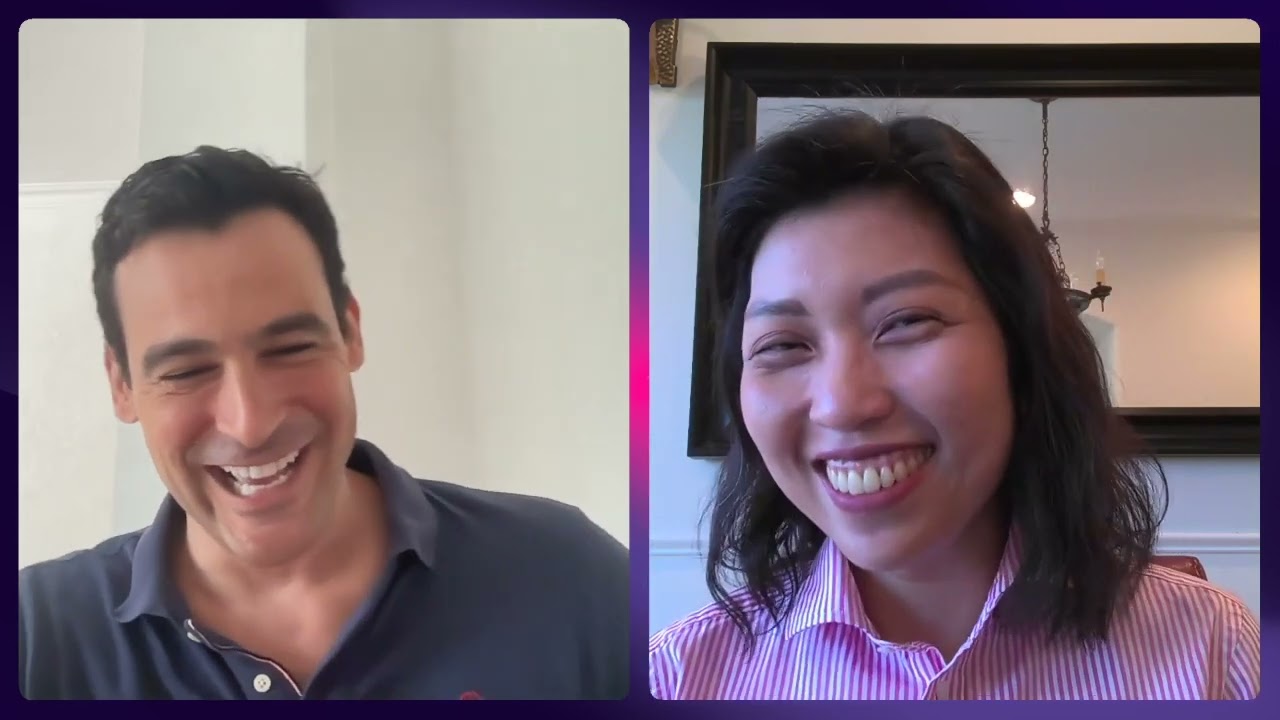
In this conversational interview, host SPEAKER A chats with JIB, a Bangkok‑born professional who has worked at the World Bank, held a leadership role at Intel, served as a venture partner at the Mr. Pink fund, and teaches an impact‑investing course at UC Berkeley’s Haas School of Business. JIB recounts his career path—from growing up in Thailand, studying in Michigan, joining the World Bank, moving to Silicon Valley, and launching an Android tablet business at Intel—to his involvement with UC Berkeley’s SkyDeck incubator and the founding of Mr. Pink. The discussion moves to the fund’s strategic focus on five Latin American countries (Chile, Peru, Uruguay, Argentina, Colombia, dubbed CAPUC), the rationale for a specialized, founder‑friendly approach, and the bilingual, cross‑regional nature of the team. JIB explains the fund’s lean investment committee process, emphasizing open debate, rapid decisions, and a commitment to both financial and social (impact) returns. He defines impact investing as using capitalism to incentivize social change, insisting that financial returns are necessary but not sufficient, and illustrates the concept with portfolio companies such as Talently, which delivers reskilling and upskilling services. The conversation concludes with a deep dive into JIB’s popular Haas MBA course on impact investing, which blends theory with hands‑on deal sourcing, due diligence, and actual student‑led investments, supported by mentors like Mr. Pink’s founder Hernán. Throughout, the interview highlights the fund’s mission to democratize capital for emerging markets, its dual‑language operation, and its belief that impact and profit can be mutually reinforcing.
Chapters
Hey, Yip, how you doing?
I'm doing really well. Excited to see you.
Same, same-wise, likewise. I'm happy to talk to you finally. So here we are. This is— I don't have a name, but let's call it Mr. Pink Podcast for now. Mr. Pink PC Podcast. You like it like that, or?
I love it. Mr. Pink is a unique name, so why not, right?
It is. One day we'll, we'll explain why we are called Mr. Pink, but not today. It's a secret. Secret story. So yeah, the idea of these talks we're doing is talking with somehow people connected to Mr. Pink for now, and then probably we'll extend that to other people. But, you know, people connected to Mr. Pink and the investment, the VC sector, entrepreneurs, professors, mentors, and you fit all the categories. So this is gonna be a A fun chat, and of course you work with us, which is extremely important, and we'll get to that. But I'm just gonna very quickly read through a couple of things you've done in your career. I'm not gonna go through all of it because we will run out of time, but just to give a glimpse to the people listening: you are a startup founder. You work in the World Bank managing big data. You took a leadership role at Intel. You are a startup advisor and mentor till today. You are a professor at Haas School of Business at Berkeley with a very interesting— some courses, but one very interesting course about VC that we'll talk about it in a minute. Many other things, and most important, you work with us, Mr. Pink, doing different things as a venture partner, but with a very broad role that we'll discuss. So thanks for talking to me. It's gonna be super interesting, and if you want, we can start. I think you have a great story. You are from Thailand and you have a great story from Thailand, from Bangkok, I would say, right? Because you're from Bangkok, right? Absolutely.
I'm from Bangkok.
So if you want, we're going to start from there.
Absolutely. Well, as you know, we talk about this many times, right? Like Bangkok, Thailand, people love to go there. That's where I grew up. That's where I was born. I went to college there, came here for graduate school. About twenty years ago, and my first stop was in Michigan and Arbor. So it was a rapid change, you know, from a very warm climate to a very cold climate, so to speak. And it it was one of the best experiences I had because right after that, I joined the World Bank in Washington, D.C., where I support ministries of finance in emerging markets in so many regions around the world. Lat M. is one of the key regions, Eastern Europe, Africa, and Asia, the region where I came from. And through that experience, very early on, I saw the rise in technology industry, and I just couldn't stop thinking about it. I saw it firsthand, even in Africa, 17, 15 years ago, that people used feature phone to transfer money from one province to another, to their cousins and relatives. I thought, I had hypothesis back then that technology was going to be big, right? And that was before the first iPhone was launched. And through that sort of firsthand experience and thinking coming from emerging markets, I really wanted to get into technology and probe what it can do for human lives. So I came here, moved from the East Coast, Washington, D.C. to Silicon Valley. And of course, my first stop in Silicon Valley was at Haas School of Business where I met Hernan as my classmate at UC Berkeley.
The founder?
Yes, the founder, GP of Mr. Pink. And after that, we kind of like went separate ways. So he went back to Argentina, founded his own company, I've been here. I don't move away. I enjoy being in the Bay Area, working at big enterprise companies like Intel, where I was trained and worked with the C-level executives and leaders who were trained by Andy Grove. It was the best learning experience, right, to kind of jump into tech, really understand the history of hardware, software. And now we are talking a lot about software and SaaS applications.
Service software.
So that was the first stop that I thought it was very critical to actually launch my career. I spent 7 years at Intel. I launched one of the first Android-based tablet businesses for the world, targeting education for kids and, you know, for personal use and entertainment. It was one of those things that made me even more curious about what else we can do to create a global impact. After I left Intel, I joined a pre-IPO company, and along the way, I also had a chance to work with the top-level academia from UC Berkeley who founded Skydeck, which today is one of the top 3 incubation programs in the area, if not the world.
Can you talk a little bit about the Skydeck? Because Yeah. Some people are not familiar with that program, but I think it's very, very interesting.
Yeah, absolutely. So Skydeck is an incubation program that is very unique. So it's unique because, one, 50% of the founders in the cohort, 50% of companies that they recruited, is actually targeted international founders, right? It's not just the US founders or, you know, people in the area. And number 2, it's directly linked with UC Berkeley. It's a part of UC Berkeley. So people who came in, the founding team, the leadership team, they get immediate access to computer science and engineering college, business school, huge alumni network. They are considered as a part of Berkeley. And I think the resource itself is really huge in terms of recruiting the talent, forming the team, tapping into university network, work and research that is really well known inside UC Berkeley. But most importantly, also because of the location. We are in the Bay Area. So every single cohort that comes in, they get a lot of attention from top VCs, right? VCs are here, they want to come and see, you know, what are the latest and greatest ideas that they can fund. So Skydeck is one of the kind of For me, it's a pivot point because I was engaged early on when the VC was founded. And that's turned me— to answer your question, kind of like a long story— that's kind of turned me into VC. And I still see a lot of opportunities and perhaps gaps, right? As much as Skydeck has done a great job, there should be a lot of early-stage venture capital funds that bring the capital directly to talented entrepreneurs all around the world, especially emerging markets. I mean, 50% of the companies in a cohort is not enough, right? We have to be able to democratize our access to founders in LATAM, in Asia, and some other regions. And that's why I'm a part of Mr. Pink. I know that we start in LATAM, but we are not restricted in the future that this is only the region we're gonna do. And I think that our vision, as you shared with us as well, that it's much bigger than what we do right now.
Absolutely. Great segue deal, Mr. Pink. It really, really gives us the whole journey, at least a little bit better picture of the whole journey. And I couldn't have put it better than you. Like, that's the gap that you are defining is what we're trying to, to fill with Mr. Pink. That's why we chose this, at least for now, at least for this first fund, at least for what we're doing right now. We, we are filling the gap in, um, the region that we call CAPUC, which is Chile, Peru, Uruguay, Argentina, and Colombia. Why precisely? Because we think That there is a lot of talent, a lot of opportunities, a lot of great companies. But still, till today, although it's changing, we are part of the movement, it's just, it's a lack of access to capital, access to, uh, sometimes mentors, sometimes key resources. And, uh, because yeah, of course, LATAM is very big. And if you, if you think, uh, many people think about LATAM and they think Brazil, huge, huge monster in terms of the kind of companies that they come from there and unicorns they have. If you think Mexico, because of the proximity to the US, because of the size, because of the culture, also extremely well-funded in terms of funds and in terms of companies that come out of there. But then Latin America is very big and And of course, we are a small fund and we cannot cover everything. And there is a key aspect which is specialization. If you try to cover everything, you don't cover anything. If you specialize on some sectors and some countries, you are better known. You know how to deal with entrepreneurs, how to access entrepreneurs, how to Create deal flow, how to create partnerships with other funds that are in the region. And we decided to go to these five countries because they are the most promising, promising ones in the region. So at least we feel like it. Of course, some people in I don't know Panama and Ecuador and Bolivia and many other places will say, "Hey, what about us?" Sure. I mean, there will be somebody helping you, and we will probably at some point too. But we you you have to focus at some point, and we. We think we have— it's a good focus that we have, and we are helping cover this gap that you were talking about. And doing a little segue on working as a VC in Latin America and LATAM, working with us, we have a fund that is somehow diverse. We want it to be more diverse, but most of us, all of us, We speak our main language is Spanish, but you.
Hola.
How is your experience working with us? You can you can be honest. I will edit out any part of course. But what's your experience working with with a Latin VC fund and working with people that speak Spanish mainly and working with entrepreneurs with with the main language being Spanish?
Yeah, you know, honestly, I don't feel strange at all. I don't. And I think that—
Good to hear.
It's been my training since 20 years ago, since I started my journey at the World Bank as an economist, right? It was— I consider myself global and not particularly that, you know, I have to be in the Bay Area only or in Asia only. It just— that part to me personally doesn't make any sense. When we talk about emerging markets, absolutely, LATAM is one of the top, given the opportunities that you mentioned. That's why we choose to go into 5 major countries first. I mean, what's not to like about working with Mr. Ping?
That's good to hear.
Yeah, so the most impressive thing I have to say, 'cause I work with a lot of VC funds and I operated here in the Bay Area before, founding Mr. Ping and work alongside you. I think that what differentiated us is we are entrepreneurs and we are operators before becoming a VC. So we know deeply how hard it is, you know, for founders to actually found a company and try to scale. And we bring that understanding into investment. We are ready to help them. And even if we— I mean, even if your first language is Spanish, my first language is Thai, but so what, right? We actually end up speaking the same language somehow because we know what are the core issues and the challenges that the entrepreneurs are facing that we have to come in and help. And in fact, I would look at this as our competitive advantage. Because I've been here for 20-some years and we know what it takes. We see a lot of companies here and we know what it takes to win. And this is the path that we want to bring top companies that we invest in when they want to raise the next round, when they want network, when they want exposure in the Bay Area, in Silicon Valley. That's what we can help. You travel a lot, including in Europe, and that's what you bring in, right? So even though we focus on LatAm investment right now, our exposure is actually global if you really think about it. And I like also the fact that we are very honest with each other, meaning, you know, not to overexpose, but when we discuss about deals, which company are we going to invest in, which company are we going to pass, and here's our thesis, what thesis makes sense and why this doesn't make sense at this point in time. An ability to be able to talk with open mind regardless of who you are, where you are from. I think that where the best idea wins, and I think that's really telling a lot about how we work within the team. And it's a lot of fun. There are stressful times like any other venture fund, but it's also like a really good time. So to me, it's our core strengths more than anything else, that we are different and diverse.
Very well put. Absolutely. I'm happy to hear that. But also, like, yeah, we are a strange fund in a good way because although we invest in mainly Spanish, only I would say Spanish-speaking founders, although sometimes there are founders from other places in the world that has come to Latin America to create their companies, so it's slightly different. But it's funny because most, a lot of, most, I would say most of the communications we have internally in the fund are in English. And a lot of our investors, I wanted to say most of our investors speak English as a main language.
Absolutely.
Or that's the way we communicate. Our report is in English, everything's in English. And then we go and talk with Spanish, native Spanish speakers as founders. But it's, I think that's, as you would put it perfectly, it's a great advantage. It's like mixing both worlds, the connection with Silicon Valley and best practices, good connections, communicating. When we have our meetings, as you know, we debate everything I mean, of course, an English conversation because it's how it's supposed to be. Your Spanish is not there yet, right, Jib?
Oh, I say hola. All right. I'm trying to get up to speed on that.
All right. It's great. As you put it, I think it's a big strength to have one foot in Europe, one foot in the US. And then constantly being with a focus on LATAM, but not forgetting that, yeah, we are a global fund and our investors, our LPs are global. Our VPs, venture partners and partners are global. So I think that gives a lot of hedge to the fund. And I'm happy to have debates in English where, as you said, like, because that's another thing that I want to point out, like we don't have big committees as some funds. When we are discussing investments, they, they don't go through big committees. We have a process that I think we talked a little bit about it when we had the last conversation with Hernán, which is— I'm not gonna go through it, but it has different phases from very early with very little information from the founders to a little more information on the hard numbers or hard facts of the company to, to a more in-depth analysis by the GPs or the partners or everybody involved. And then we tend to go, when it comes to the last stages, to have good debates between everybody in the company, and especially people like you and all the partners. And we bounce ideas and we openly debate. And, and as you know, um, we are very direct in a good way, like, do you like it or not? Why do you like it? I don't like it. I do like it because, and it's very, uh, it's very rich.
Liberating.
Yes, liberating and rich conversation. At the end of the day, you take a decision, you hear all the points. Some points would come from people like you, which are vast experience but also different angle, completely different angle than my angle and Hernán's angle and definitely Diego's angle, which is another of our partners, or JP angle or Gonzalo, which is more in finance. Like, and we Put all together, and and we think we we reach good with good outcomes, with conclusions. I'm happy about it at least.
Yeah, absolutely. We take every deal seriously, so that's why there are a lot of internal debates, great debates. Yeah, yeah.
Like extreme bureaucracy, long investment committees. Like our committees is a conversation that we're having where we put ideas, then we elaborate some kind of memo where we say. Yes, because of this, no, because of that. And we come to a conclusion and we're happy about it.
Most importantly, a lot of people didn't realize that we are VCs, but we are entrepreneurs ourselves. I mean, even the way we operate the fund, right? As you said, this is our fund 1. We focus on 5 countries. We actually have to also build a fund, right? And that is also entrepreneurship. That's how we really understand how challenging it is to make sure that entrepreneurs would benefit from our knowledge and network, and that's how we can help.
Absolutely. And I've said it before, I'll say it again in English, we always are on the side of the entrepreneurs. So the process sometimes with VCs is Some people even fear it, or they feel like it's opaque or not really founder-friendly. A lot of funds say they're founder-friendly. Maybe they are. We are too, but we are in a very hands-on way in the sense like if we don't invest, we try to be as open and polite as we can, but also especially give candid feedback, good feedback that can help the company go forward. Even if it's in a very early stage, at least we say, okay, we cannot invest in you. It's very interesting, but You are out of the thesis of the fund, or this is because we're not investing in. And the reviews we get is bad that I say it, but they are very motivating reviews because most of the times when we say no, it's like entrepreneurs feel like we help them. We help them maybe talk to different VCs. We connect them with other VCs. We help them. Understand why we feel maybe something they're doing, it's maybe not. Of course, they know their business better than we do, but we give our point of view about the market, about the future of, I don't know, some strategy, and they really appreciate it. And we proud ourselves to be fast, as fast as we can, transparent as much as we can, and give feedback as positive and as helpful as we can.
Yep, yep, agreed.
Let's talk about the topic of this chat. But you know, the idea was to talk about with you about anything, but the topic was impact investment. So I, I think it's a great moment to, to talk a little bit about that. Like, and I'll start maybe for some people because it's a broad term and it's— most people maybe have an idea of what it is, but I love to hear from you what do you consider that it's impact investment?
Yeah, a lot of people thought impact investing means nonprofit. Okay, when they hear the word impact, is it social impact only? Is it nonprofit? It's actually not. You know, the way that I define impact investing is how we use the new, you know, say capitalism, right? Capitalist and investment to incentivize social change. Investment in VC is the key area to catalyze the change that we want to see. Mr. Pink, or investing in Latin America, actually really fits beautifully in this area. What I like to say as an economist, I said, when you invest, financial returns are necessary but not sufficient. The sufficient condition is you have to have impact returns. What it means is that we are in the new world right now that we know that there are a lot of challenges and problems when you only optimize the financial returns and you ignore the impact that you create in the society. And if you just go to, you know, the other extreme, which is nonprofit only, Then you can actually effectively generate lucrative return to the LPs, limited partners or investors of the fund. So that's not a VC business model. So to me, we live in the right time. When we look at Mr. Ping investing in, let's say, starting in Latin America, the way that we invest, of course, we optimize financial returns because we have commitment to our investors and our limited partners. But at the same time, the sectors that we choose to invest in, whether or not it's fintech, financial inclusions, healthtech, we really care about health deliveries that would scale and expand throughout the region, if not outside the region as well. Foodtech, agtech, agriculture, that hopefully in some cases it would also reduce carbon monoxide and whatnot. All of these areas create positive social returns, and we call them impact returns. Good example that you know really well as well, Talently, right? Women entrepreneurs, founders creating reskill, upskill, and classes for the general population so that they can increase their wage rate, increase employment, and also overall return for the society. These are the kind of impact returns that we like to see, as well as they're doing really well.
Yes.
I mean, they grow, they if not triple by the time that we put our first check in until today. And that's also financial return that we see for our fund as well as for the entrepreneurs themselves. So if I may summarize, impact investing, It's the new kind of investing that we use capitalism to incentivize social change. It's not a trade-off for us. For us, we demand financial returns for our LPs and investors, and we also demand social returns that benefit in a society through our core thesis of investment in different verticals that create direct impact in the economies.
Well, if any— if anybody didn't have it clear, I think it's clear right now. Perfectly explained. Yes, and it has different layers. As you said, investing in the region in a way, it's, it's a way of impact investment already, like investment in a region with not so much access to capital. But then you go deep, as you, as you were explaining And you can help a lot. You can help a lot in different ways, but not as an NGO, as you correctly said. Like, because people immediately think like it means like you are like an NGO. No, not at all. We have a, we have an obligation.
High expectations.
Yeah. We have an expected return and an obligation with our LPs, our investors. And, and this is just a way of investing and You mentioned Talently, amazing company, definitely doing impact in the society and also doing really well as a company with Domenica. Shout out to her as a head of the company. I was talking to her the other day, amazing company. But we have others. I mean, we could, I would say if not all, most of our investments today fall in that category. We have some, Some fintech investments that the other day I was discussing with Hernan that it's not fair to call it fintech because that sounds like a new bank or something like that. It's more like social impact investments in the sense that one of them is a way to improve the access to capital to people that really cannot reach it in the same way as others because they're not so privileged or because they're They're in different circumstances, or because they did a default on one of the payments and now they don't know what to do. Or in, in those companies, Half an Impact.
Yes, a great company. I love that company that we invested in.
So yes, and also again doing great because if you improve the way you facilitate that access to capital, to debt, many other people can, you know, have debt in a clean way, not in a in, you know, not so clean in the sense like not understanding well how the payments work, how they can be left out of the system. If you prove that, banks improve their bottom line too, and they're happy with you.
That's right.
But you're making an impact on society. So those are the investments we like, we love to do. Yeah.
And that's win-win-win, right? It's win for the entrepreneur, it's win for us as an investor, and it's also win for the society. So that's why the concept, which is relatively new, of impact investing is actually creating or incentivizing the strategy that wins for everyone.
Exactly. So win for everyone. And some people might say, well, I'm not interested in investing if it doesn't have an impact, which is a good trend in today's society, like not investing for the sake of investing. But also I require some kind of impact. So yeah, we we are we are in that boat. But considering that returns are key for us, it's not like we are this we are we want to as you pointed out like it has to be a win for everybody society us as a fund and for sure entrepreneurs. Yeah, super interesting talk. I would like to close. if you have some time talking a bit about your program, your course you have at Berkeley, Haas Business School. Super interesting course that you give there. I heard it's extremely popular. Everybody wants to get in. It's an easy course. And you actually feature Hernan in one of the talks, I think. Hernan, our founder. So yeah, tell us a little bit, like, how is that course going? What are the reviews? Are people enjoying that course? I'm sure they are.
Yeah, absolutely. So this is actually what I teach, impact investing.
Yes.
And it's a class for MBAs at the Haas School of Business, UC Berkeley. It's very popular because, you know, one, it's also the trend that Students right now, at least in this generation, they really want to become a VC. It's something that they see as a way for them to create larger impact in the society. And so to train them to be the next generation VC, the class is broken down into basically 2 themes. One, they have to learn the concept of investment. That's what we do every day, you and I. You know what it means, what's the thesis, you know, what are different sectors and whatnot, how they calculate financial returns as well as impact returns. And another side of it is they have to practice doing it. The way to learn in this kind of course, you can't just learn it through lecture. Lecture is the foundation, but then they have to go out and practice. So, students have the opportunity to go source deals, to interview entrepreneurs and startups, especially early-stage companies that are currently raising funds, small funds, and they would go and figure out whether or not this is the kind of company they want to invest in. So they are essentially a VC in training.
Uh-huh.
And towards the end of the semester, If this is the company that they choose and they passed through the criteria we are looking at, they came back to class and they pitched to us and we agreed that this is the company that we should invest in, they actually get to make an actual investment while at school. And that's why it's popular because it's kind of like a hands-on experience. They get theory and they work with mentor. from the industry like Hernan. Hernan is one of the mentors that work closely with the students to guide them through all the process from deal sourcing, interviewing, doing due diligence to investment. I, you know, and this is what we do at work at Mr. P. I just translate it sort of like a shorter or recap summary version for the students so that once they graduate, this is one of the toolbox or the career choice that they may want to pursue. So it's new. Not a lot of, you know, not all business schools are able to offer this. I think Haas School of Business is really unique in that way that we are able to offer this kind of class.
Absolutely. Sounds amazing because it's like a small-scale, real-life experiment as a VC, like from the very beginning of the due diligence and sourcing the deals, as you said, to finally investing, even if it's not a huge amount, but it's real. You are a VC in the making.
Yeah, yeah. And not all students choose to become a VC. So students who take this class, some of them, you know, want to found a company, they wanna be an entrepreneur, But it's also beneficial for them to really understand what VCs are looking for.
Absolutely.
Right? So you have to sit at the other side of the table so that you can pitch better, that you understand 2 sides of the coin, and all those things that come with the type of learning. And honestly, it's also fulfilling to me to return to Berkeley, 'cause I graduated more than 10 years ago from the business school. return to the school as professional faculty and bring the hands-on experience, as well as network, like Mr. Ping, to come in and say, hey, we are doing something that is really innovative. We are investing in emerging markets, and these are actually really, really amazing deals that we have, and while creating an impact. So, it became the real-life case study. for the students, whether or not they choose to go and take this career later on, that's their choice. But at least they have the mindset that from now on, what you need to do, you have to think about, okay, whether or not this is impactful, whether or not this is creating meaningful return, and look at multifaceted from different stakeholders in the industry and how to create win-win solutions.
Absolutely. Well, I think that's, that's a great way to, to finish this conversation. I mean, we have talked about many, many aspects of the industry, of you as a professor, investor, with us at Mr. Pink. All left to say is thank you for your time, Jeep. Really, it has been a pleasure talking to you.
I love working with you and talking to you.
Thank you very much. Yeah, next conversation we have, we'll have it in private with no cameras around, but we have the same fun. So adios, Jeep. Hablamos pronto. Ciao ciao.
Thank you. Bye.
More from Hernan
PinkTalk 021 | OrderEAT: digitalizar cafeterías escolares y educar a una generación

PinkTalk 020 | Sin Intermediarios: la plataforma para democratizar la buena nutrición