Ben Muwoki - The importance of purpose, confidence & market knowledge will help you level up
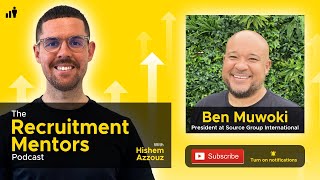
In this Recruitment Mentors Podcast episode, host Hishem Azzouz interviews Ben Muwoki, Managing Director of Source Group International’s U.S. business. Ben shares his 19‑year recruitment journey from starting at Esprit/S3 in the UK, launching offices in Amsterdam and New York, to leading SGI’s American division. He outlines the "3 Ps" (purpose, persistence, pride) as core traits of top recruiters, describes S3’s culture (deliver on KPIs, be a team player, work hard‑play‑hard), and explains how purpose‑driven self‑reflection fuels long‑term success. Ben discusses market nuances in the Netherlands (direct communication, partnership mindset) and the U.S. (high fees, partnership expectations, niche focus, inch‑wide‑mile‑deep strategy). Practical tactics are covered: building credibility through expertise, maintaining a focused candidate community (150‑200 top prospects), leveraging personal branding, adopting retainers over contingent work, and asking "how do you win?" to align daily actions with outcomes. He also shares leadership insights on scaling teams, the importance of flexibility, and the need for greater diversity in staffing. The conversation ends with his favorite book, "The One Thing," and his vision to build a lasting, impact‑driven recruitment business.
Chapters
Welcome to the Recruitment Mentors Podcast. My name is Hishem Azzouz. Today I'm very excited to be joined by Ben Muoki, who is currently the managing director of Source Group International's American business, um, who operate in several states such as LA, New York, and soon to be launching in Chicago. Ben entered the recruitment industry in 2001 where he joined Esprit, and he stayed there for 19 years where he climbed the ranks from recruiter all the way to Vice President of Sales. And this is where he was responsible for 5 distinct brands across 7 locations in North America before he left to join SGI to head up their American division in 2020. Ben, thank you for joining me.
Thanks for having me, Hishem. Excited to talk.
Yeah, really looking forward to this. So where we always like to start on this show is, in your opinion, what characteristics and traits do you think make up a highly successful recruitment consultant?
You know, I've been asked this question a lot over the years, and there's no better answer, I feel, than one I got from one of my MDs, a guy called David Thompson. And he instilled into me this belief about 3 Ps. Um, purpose, persistence, and pride. And so although those are obvious in their definitions, um, there are often many people that don't have a purpose-driven approach, right? They will just turn up and, you know, one day they might be on, another day they might not be. The people that I've seen the most successful, who sustain success, have got clarity in terms of where they're going and why and what they're doing. What are that, say, money-driven, career-driven, any other types of aspirations. They really want to know what they want to go for. And of course you want people who are resilient, of course people that can see through, but being able to understand that it's not you, right? You know, you're going to make mistakes, look forward to the failure and understand that there is success at the end of that. And so that level of persistence The job that we do has often been said, it's not rocket science, it's not. The difference is your application, your ability to want to work through, and then pride, really caring about what you do, right? So that job qualification, doing it to the best of your ability, asking the questions that make the difference, following up with the candidate, even if you don't have feedback for them, having pride in your service. And so Those are the 3 things that I really believe stand the test of time. And every top biller or producer that I've ever seen or met, they have those 3 things in some way.
Yeah, really. Yeah, I really like how you brought that. Yeah, sharing that with the 3 Ps, that's really interesting. So just to tee this up for everyone. So obviously you worked at S3 for a long period of time and across that time you worked in different locations. Started in the UK, moved to Amsterdam in that time, New York, and then later Chicago, which is where you're sort of based now. And then obviously 2020, moved to SGI where you're based in Chicago and helping them grow their American business, right? So we're gonna unpack this, but I'll be honest with you, Ben, I haven't had loads of recruitment professionals on here who have come from the infamous S3 brand. Right. So I only knew about S3 when I moved up to London and sort of got sucked into this whole world of recruitment. Right. So I'm always curious to hear from different people's stories and journeys as to like how they would describe it. So how firstly would you describe your first year in recruitment? And then latterly, like, how would you describe the S3 culture that sort of has really stuck with you when you look back into those years?
Yeah, sure. I look back at my time at S3 really fondly. It's the time that shaped me professionally and it's given me all the career opportunities that I've asked for and more. So there's lots of fond memories. When I first started, February 28th, 2001, I joined with a brand called Recruit First. That's later merged into others. I remember it was a baptism of fire. There was a great bunch of people thirsty for activity and it was, it was fierce, right? There was great training, there was great application, but there was an absolute understanding that you needed to get on with it, right? You needed to be able to ask the questions, understand what you need to do, but then just execute. And so, like many, I went through that roller coaster. I remember my first lunch clubs, which were amazing. I remember blanking, which was devastating. But all the while, I look back at that first year and it was a real lesson. And the biggest lesson for me was really about one of those 3 Ps I talked about earlier. About purpose. I turned up thinking, I've got this, I'm going to really crush it. And there were certainly moments or some months where I was fully at it and that translated into my performance. And then there was other months, excuse me, where I believe my own hype, right? And so because I did well, I took my foot off the gas a little bit and then that translated in poor performance. And so it really took me about 6 to 9 months to figure out that I needed to create this calm in my approach and that that's how I'm going to be able to deliver further on. And your next question about the culture, I think any great organization, they start with their people, right? And that's certainly true of my experience at S3. Lots of the people that I worked with then I count as good close friends today. Some I'm working with, we've gone round the circle and I'm working with them back at SGI. But yeah, it was people. I want to be inspired by colleagues, by staff that I work with. I love the idea of being reverse mentored. And so I've always had that access and also believe in the journey that the person I'm working for. So that's what allowed me or gave me the drive to want to stay at Esri for as long as I did, to go to the different locations, because there was always somebody I could go to battle with. There was always somebody I believed in that this journey was worth fighting for. And being surrounded by people that are willing to go on that journey and really sink themselves in is really fulfilling. You feel like the sense of togetherness is so strong and they back you. And if you've got the ability to take on something big and you've executed, they'll give you— they gave me an opportunity in multiple locations. And so that just gives you— that feeds the engine and gives you the desire to move forward.
Yeah, that's really interesting. So just out of curiosity, so how old was he when you joined them?
I was 20, 21. Okay.
21. Okay. Okay. Interesting. Right. So there's two things I just want to sort of just dig a bit deeper in there. So the first thing, because we're talking about it, like from Europe, in your opinion, then what were the sort of three non-negotiables of the S3 culture that you think they abided by that made up the S3 culture? If people didn't abide by these 3 top things, what were they?
So in no particular order, I would say the thing that really stands out is you needed to be like ronzil, right? You needed to do what it says on the tin. If you said you were going to be able to deliver on this particular KPI, this particular task, then go and deliver it, right? And that was certainly expected. Being in the environments I was in, being a team player, what was really important. So, you know, cross-selling, breaking into customers for other people, pulling jobs for other people. You would do this long before there were deal splits, long before you would get something for it. You just did it because it's the right thing to do. And you knew that, you know what, if I break in and play my colleague in, it's better for the brand, better for me, better for the business. And I think the other thing was really having fun, right? Because there's such a strong work mentality that the culture was really deeply manifested in having a good time, whether that was at your desk, whether it was after hours, whether it was at lunch clubs, incentives, or, you know, over the weekend. You really, you really gel together, right? So this idea that many people would have talked about, but work hard, play hard was a thing, right? And the people that tended to enjoy that, people that embraced that were people that would excel in that environment.
Yeah, really interesting. And the next thing that I just wanted to hear from you, so just to give me an idea of timeline. So when you joined, Obviously, I know you said that it was in, yeah, it was a Perm villa. What was the timeline before you then got the opportunity to go to Amsterdam? Just really quickly.
Yeah, so I joined February 28th, 2001, and I launched our business in Amsterdam on June 1st, 2008.
2008, okay, so 7 years, yeah, I guess, building your professional equity of that business and, getting opportunities in these things. And then before you launched that, was you in a management position or was you still in just a producer role or both?
No, I'd worked my way up to a manager position. Actually, before moving to Amsterdam, the brand I was with at the time was going to launch in New York and this was going to happen in 2007. And so I put my hand up and got accepted to launch alongside a handful of other individuals. And of course, the financial crisis happened. And so we were meant to go in 2007. The CEO at the time and my MD at the time broke the news and said, we can't go to New York. And so that was pretty devastating. But After 2 weeks, I came back and I just told my MD that, look, the destination of New York, it sounds fantastic, but it's the opportunity that I want. And so, you know, it doesn't need to be New York. And 2 weeks later, we started building our plan for Amsterdam and then went 6 months, 6 months after that. Okay.
And so just to be clear, because I know I work with some businesses that just recruit in the Amsterdam space, was there no espanyol footprint there? Before you went there?
Yeah, there were other brands. The brands that I worked with, for example, was a brand called Madison Black. At the time, there was Huxley, Progressive, and Computer Futures.
Yeah, I thought, yeah, because I thought there was some people there. Yeah. Okay. So what I wanted to know, that context really helps for people listening. So what I just wanted to know, Ben, in like your opinion, is what you're talking about there is that, yeah, you put your hand up and you got accepted, right? So what I'm really curious about is like, Why was it that Ben was able to get those opportunities and not others? Like, like we've been talking about, is it— is it competitive? It was high standards environment, um, there was fierce competition, but it was also a team player. So I just want to know sort of from your opinion, like, why was it that Ben got those opportunities and not the person sitting next to you that may have similar ambitions?
Well, I can't talk for other people. I can, I can only talk about my my ambition and what I wanted. And so I started off the conversation talking about being purpose-driven. That was something that was drilled into me. And because I led and still lead with my purpose, it was clear that I wanted to do more. And so at the time, there was a great talent of leaders at Madison Black. And I looked around and I felt like the best way for me to scale up is to go abroad. And so at the time, not many of my peers at Madison Black wanted or were prepared to do that, starting young families. And so that gave me the edge, right, my willingness to get out of my comfort zone and then communicating to my leaders about my desire to do that and my flexibility, right? So wanted to go to New York. I started off telling that story. My wife and I got married faster than we were going to, just so that my wife would be able to get a visa. And so we sold everything and we created a dollar fund. And, you know, 3 months later we were told we're not going to go to New York, we're not going to launch. Right. And so being able to pivot and just think, right, okay, you know, it is what it is. We still want to go on a journey and then taking that opportunity to Amsterdam. I think I displayed flexibility And that was something that the leadership ended up backing.
No, I think the key part that I keep finding when I sort of ask questions around this that I think people should really take away and put an underline around is when you said that you let your leaders know and you communicated that. Because I think sometimes, and I'm sure you've experienced this now, right? I think sometimes people can fall in the trap of expecting, expecting those opportunities to come. Actually, the best thing to do is actually overcommunicate. So if I'm someone working in your team now and this is sort of, I have an idea of where I wanna go or whatever, I should be communicating that to you and my manager going, hey, like this is how I'm thinking about the future. This is sort of where I wanna go. Because when you are then having business strategic meetings around how we're gonna grow the business, you know then Oliver and such and such has said to you, well, actually I know all this is sort of somewhere where Ollie wants to go or whatever. Do you get what I mean? So I think that's— I really like that you shared that.
Yeah, I certainly— communicating your ambition, communicating your desire is absolutely true from— as an individual contributor. And I think as the leaders need to also have the conversations with staff because some staff might not yet be comfortable in putting their hand up. They might think, oh, you know, am I not— Am I not credible enough? And so it's a two-way street. I was lucky enough that that conversation happened that way. But the other thing that's really important, I think, is understanding that opportunity doesn't always come at the right time and it doesn't come gift-wrapped, right? So often lots of people will think about, right, I want to go to this destination, and then they're fixated on that destination. And if that doesn't happen, then there's devastation. And so in my personal experience, for me and people that I know, there is no path that is linear, right? It's literally up and down. And so I gave you my first story. I wanted to go to New York. We sold everything that we had. The gifts for our wedding were dollars, right? Our honeymoon was in New York and we were told, you know, And then 2 weeks later, sorry, we're not going to New York. And so you have a choice at that moment, right? It's like you can either be devastated about this American dream that I had or look at it and say, well, actually, do you know what was more important was getting an opportunity. New York is just one jacket. So I took that jacket off and put on my Amsterdam jacket, if that makes sense, right? And then 4 and a half, 5 years later, I'm in New York. And so I got to where I wanted. I got there in a better position, actually, as well, after working in my time in Amsterdam, and I was also better suited to it because I've now worked in two different locations rather than just from the UK. So that's what I mean about opportunity doesn't come gift-wrapped. If you communicate but also have the flexibility that that's where I want to go, there might be different steps along the way, that to me is where, as a leader, And I talk to individuals about that. That's where I think somebody can stand out, can have that edge, because what you do today isn't what you're going to do tomorrow. But lots of people sometimes, I think, have too much of a blinkered approach. Yeah, I need to be in this position, this position, this. It's like it doesn't work like that. Well, certainly it didn't work like that for me.
Yeah, but at the same time, that's what actually gave you the competitive edge. Yeah. No, thank you for sharing that. That's really interesting. I want to dig into the sort of nuances of going into a different market. We can talk about New York, Amsterdam, and the nuances of those different markets and going into these places and adapting, etc., because I'm sure there would have had to be even more flexibility when you entered these new environments, right? But just because you've spoken about it quite a bit, I want to ask you this question now, and it's about purpose, right? It seems like you've really anchored onto that. That sort of really helped you along your career, right? And I think what I love about your story is that you've built a system, clearly you've built a sustainable career, right? You hear about a lot of people enter the recruitment industry and then leave it, but you've built, you've worked at one particular company for a very long time, right? So the purpose piece, you're hearing that a lot more now. I think the COVID period really tested people's purpose, right? I'm sure you've even experienced that yourself. So I guess the question is, if I'm listening to this right now, I might be someone early on in my recruitment career and that might be a bit, I don't know, that might be difficult for me to sort of uncover or think about or talk to. And I don't know, I might find it difficult to uncover or I might be someone listening on later on down my career where I've had more time to work that out. So I guess the question is like, how can the people listen to this? How can recruiters listen to this sort of tap into that? Purpose, which really is important for longevity and sustainability in recruitment. How did you tap into it and does it change? And yeah, just I guess talk a bit about the purpose bit and your journey with that.
Yeah, I think that's spot on, Hishem. Like I mentioned, in my experience, the people that are genuinely purpose-driven in whatever vocation, but we're talking about recruitment, but in whatever vocation, time and time again, you will— I will see them achieve above and beyond their expectations. So I guess I've always been purpose or target-driven. If I think about school, I think about sports, I think about the things that interested me when I was growing up, there was always something that I was running after. But it wasn't until an early MD of mine framed it in this way for me. And so what I needed to do at that time was self-reflect and just ask myself the questions, what does that mean? And you go through the kind of what, why, how, when question technique. So at the time, I was unashamedly materialistic. And what I meant by that was I wanted to create a platform for my wife and I. So whether that was investments, whether that was holidays, whether that restaurants, whatever it was, I knew that I needed to be able to bill a certain amount to get there. And I would ask myself, why do I care about that? What is it that makes me want to get out of bed? And I keep asking that question, why, until I found something. Right. And that was where I would go, yeah, that is what's going to make a difference because I'll have just as many bad days as everybody else. Just as many bad weeks. Having a purpose doesn't mean you beat that. Having a purpose just means you reduce the time that you feel sorry for yourself, right? Where you feel like, oh, the world's against me. It's like, well, it's not actually against you. What are you going to do to move the needle forward? What's the thing that's pushing you? And so I've talked to so many people in my career and supported them through that. Sometimes it's learning. Some people want to learn a particular skill, a particular tactic. That's what gives them their energy. Other people, it's self-development. Other people, it's a sense of victory. Other people, it's recognition. There are a number of different things that give you your spark, give you your joy. And so you have to have a moment of self-reflection. And then don't take it like uber seriously, but like set maybe a 6-month goal. Sometimes 12 months is a bit much for some people, right? Just set 6 months and just go, what would I— how do I want to feel in 6 months' time? What would that look like? So if I did this, would I like the look of it? How do I feel? What would it feel around me? And then you kind of visualize that sense. And then you work backwards. Okay, so what will I need to do to achieve that. And some people have Post-its on their PC, some people post this on their mirrors in their bedrooms or whatever. However you need it to visualize and remind yourself, use that, but tap into it, particularly through the tough times. But also don't ignore it when you do well, because it's always good to confirm what it is that you're working towards and then assess once you've achieved it. Like, great, do I want to double down and earn more money? Or do I want to do this? Whatever the purpose is certainly unique to you, but I find it very difficult for anybody if they don't have that, then I don't understand what you're working towards. A promotion. A lot of people say, I'm working towards a promotion. That's brilliant. Of course it is. But once you hit that promotion, what's next? Right. A promotion, I feel like, should be part of your journey, but not the destination, not the end of your journey. It's a byproduct of you. It's a recognition of you doing well when you get in there. So what is it that is going to take you through that promotion? And not just that first promotion, the next promotion. That, to me, is when you're clear on your purpose, you can explode. But if you're just sat there thinking, oh, I'm just going to get promoted to be a senior con or a principal con, I think you're missing your potential. You're missing the opportunity to discover what's great about you.
Yeah, no, I think you spoke about that really well and I'm glad you brought that up. So I think the key things that I took there to sort of put that together is, yeah, ask yourself why you want that or this or whatever it is more than once, right? To sort of peel back that onion and yeah, try and find that anchor point. And I think the other part there, you've— I agree, I think the best recruiters I've interviewed on this show, one of the common traits is definitely willing to self-reflect, or that's something that, something that they actively do, right? Being willing to go, right, what went well this week, what didn't, that call went badly, what could I have done to improve it, etc., etc., right? So, so I think, but, and then the other part that you mentioned there, which I think is really important, is that destination piece, right? Because I've spoken to a lot of high, highly successful recruitment professionals who have maybe been too reliant or put too much emphasis on the destination. If that's achieving a certain paycheck, if that's getting the promotion, as you said, when you then get there, and I don't know if you ever felt this, but then it's like, oh, wow, okay, this doesn't feel as great as I thought it would, or it doesn't last as long as you thought it would. And then it's like, what next? What now? And that's why you're talking about that potential miss of your own potential if you don't dig that bit deeper, because as you just said, if you dig that bit deeper, and you really have clarity on why and where you're going, then these promotions and these destinations along the way will be a byproduct. So if you listen to this, explore that. You should really explore that.
Yeah, 100%. Because promotions work for some people and for others it doesn't mean so much, right? It might be excellence in their field. It might be, it might be something else. And so Often you join an organization and you look forward and you think, right, okay, the way for me to progress is via career. And that's fantastic, of course. And I hope your organization has got a very clear path for you to do that. But don't just tap out of that area. Think to yourself, where else can I excel? What's going to make me happy? Where else can I take take myself? And so learning a new skill within the job that you're doing. I don't know, maybe you're a great recruitment consultant, but you haven't done any networking yet, right? You could do that a bit better. Maybe you haven't sold a particular element in the job. Maybe you haven't done retainers before, or you have, but only a few. How can you learn that expertise? Maybe you haven't done any cross-selling into different product lines. There are many different ways that you can get deep in the job that can feed your purpose. And so, yeah, I completely agree. You've got to have clarity so that you can just fly through. Right. And I think if you ever find yourself having a what next moment, then pause. Right. And then go again with that self-reflection.
Yeah. Okay. Really enjoyed that. So I'm really excited to dig into a bit more tactical, practical things here with you. So just for context for me and people listening, when you went to Amsterdam and also New York and beyond, did you typically go into those environments at senior level? Was you billing at that point? Just to give me a bit of context so then I can make sure I ask the right questions.
Yeah, of course. When I, when I launched Amsterdam with, with the team, I wasn't billing at that particular time.
Okay.
And as I grew, my role became larger with great complexity. And so my position skill set was much more strategic.
Okay. And was that echoed in New York or?
Yeah. So when we launched in Amsterdam, we started with 5. It was a fantastic experience and we built and I ended up being asked to manage different businesses. And so I built my scale, if you like, up to 45 people and then moved to New York and that team was 12. So I mentioned that because when Gary Eldon, who was the CEO at the time, talked to me about America, because he knew I wanted to go 5 years prior. I built myself to this position. I was on the board in the Dutch business. I was running 2 brands, 45 people, were looking to take that to 60, 70, 80. And he was like, well, there's an opportunity in New York, but it's 12 people. So that didn't matter to me. It didn't matter to me because I knew what I wanted was the opportunity and I knew I could take my time from 12 to make it 130, which is what I ended up finishing with. So the skill set that I employed in all of those jobs was talking about trying to make sure that we've got the right access to talent, trying to make sure that we've got the right— taken the right opportunity to market and then building the talent pipeline to execute on that and grow and Fortunately enough, I was able to surround myself with some great people and that's what we did.
Okay, that's really good context. So then just to be clear then, so when you went into New York again in that more strategic growth position and by the time you left to join SGI, it went from 12 to over 100 people that you was—
Yes, the responsibility that I had grew from December 2012 until the end of 2020, I managed 130 people across, across brands. So I went from one team, yeah, one team, perm, in New York to 5 brands, 7 locations, all of perm across America.
Okay, cool. So first thing I want to dig into, and then I'll be keen to then dig into more practical things around client development and these types of things that a lot of people always want to hear about, right? So the first thing I have to ask you, I do get these questions quite a lot, and it's around the nuances of the different markets, right? I think from the conversations that I've been having, I think if you're a recruitment business or a recruiter that did diversify your business, as in not just be reliant maybe in one particular location that you recruited or one particular market, you had a better chance of thriving rather than just surviving. During the COVID period, right? So I do feel like there'll be a lot of businesses that will be continuing to diversify, if that's opening up new markets in different countries, etc. So if we start with Amsterdam first, then what would you say were the main sort of different new nuances that you had to adapt to or learn the hard way? And then we'll go to America. Just quickly to hear your take on that. Were these people super direct and you had to always go through internal recruitment? I don't know. What were the key, maybe 1 to 3 things that you really had to adapt to that you think are specific to the Amsterdam market and region?
Right. So we started trading into Amsterdam from London before we landed. So we had a soft launch, if you like. And the Dutch are famously direct, which is fantastic, actually, because you actually know where you stand. The difficulty that we had were that we didn't speak Dutch. We hired one guy at the beginning of the launch and he spoke Dutch, and so he had to become our translator in lots of situations. And so communication was difficult in some circumstances. And so having to be direct was really important. I think the other thing that really stands out was that the Dutch were quite tolerant and they would give you a chance. They were willing to work with you and forgive if you demonstrated that you were working hard, if you could show that you were partnering with them. That was slightly different to my experience in the UK. When I was leading then because sure, we'd had some great relationships with and partnered with some great customers, but it was much more transactional. And so going to Europe, mainland Europe, that was the first time that I really felt like you could create partnerships and that's really been the case in the US. And so that was the first transition where I was like, whoa, okay, wow, you know, we can really do something together here and be viewed as a partner rather than just be viewed as a supplier and then all the kind of negative connotations that come with that. You know, you can't really get the best out of each other. And so, yeah, those are the two things that stood out to me from my time in Holland.
Nice. That's great. I think that's really interesting. And then let's just then go into America then. So some of the things that I've heard and we've heard on this podcast are, can definitely make more money. Fees tend to be typically larger. Corporate recruitment, internal recruitment are definitely people that you want to have on your side. And you may actually piss more people off and reduce your potential if you just do like the typical thing in the UK, right? Bypass those people and just speak to the hiring managers and maybe secondary be concerned about building relationships with internal. And then also then the common things that we've heard of them, actually, like the lack of competition that there are. Obviously there are competitors, right? But the sort of just mass scale of America, and actually the— there's so much potential and opportunity because there are far less recruiters compared to the UK in America, right? So I guess nuances in America that you obviously now are accustomed to and know that you think would be beneficial for people to understand and know from someone like yourself who's been operating in that market for a while now?
Right. So the things that you've mentioned are certainly my experiences as well. There is a wonderful opportunity to create a platform of excellence. The fees certainly do offer greater upside than perhaps some parts of the world. But it's not for nothing, right? You can't just land and just expect high fees. You've got to be able to still demonstrate your value. And I find the American experience quite similar to the Dutch inasmuch as they're very willing to partner. They're very willing to give you a chance because sales and recruitment is a it's a much more respected profession in America than it might be in other parts of the world. And so they get that you're trying to make a difference, but they'll certainly hold you to a high standard. You are able to, I think, demonstrate your value and look for better margins. But again, with those customers, you've got to be able to show how you can stand out. It's got to be greater than, "Oh, I can find you a candidate." So what? So can everybody else. What companies are really looking for is greater than contingent, is how can you take us on this journey? Now, I don't need you just to send me and place one candidate here or there. How can you really add value to the business? And so being able to demonstrate that is really important. Having a niche focus, it's often said, but it can't be overstated. This idea of being a jack of trades or jack of all and master of none, it just doesn't work. I've seen so many people want to conquer all of America. It's just too big. It's really, really too big. You need to be able to coin the phrase inch wide, mile deep. That's where you make your difference. And that's actually where your customers see your value because most of the competition, the American staffing businesses don't generally operate a 360 model. They have a 180, they have an account team and people on delivery. And those people on delivery are largely cross-vertical. And so, they will find candidates on the periphery. And so if you can demonstrate your expertise and find the top 10% they can't find, that's your edge. And so having that expertise is vital. It's very tempting, I don't know if you're in New York, to start trading into Boston or trading into Philadelphia, but there's plenty for you to go after if you're in one location. Have that commitment.
Yeah. Okay. Interesting. Right. So I'm keen to go into the more sort of tactical things day to day that obviously you've been in a sort of real, and I guess I'm assuming with SGI you're in a similar role now where you're you're responsible for the growth and strategy for the business, right? But in America. So I guess what people always want to know about Ben is the sort of new business element, right? I don't, it seems like it's just always the most popular area where people want to develop and improve and sort of master, right? So I guess let's start here. So maybe we can take, you can take this sort of last 6 to 12 months, 'cause they're, let's keep it sort of current to today, over the last 6 to 12 months, like in your opinion, from what you've seen from people in your team and people that you manage, like what have been the sort of 1 or 2 ways that have been the most effective for your guys and girls to win business and form client relationships and new client relationships, would you say?
It starts with you being an expert, right? Okay. It's such an obvious thing to say, but so many people don't operate this way. They understand it, but they don't believe it. And so the people in our current team that are standout great performers and people that I've managed before, they're in the center of their hurricane, if you like. They're at the center of the storm. And so what I mean by that is they will know the top 100, top maybe 150 candidates, say you're on perm, that are in their vertical. In my humble experience, I don't think you need more than about 150 to 200 candidates, top candidates in your particular market for you to execute and be a top, top, top biller, right? The difference is understanding who they are, and keeping in contact with them. Too many people give this business a really bad name because they ghost, right? They talk to you the first time, and if you're good or no good, then you're gone. You miss that deep expertise, you miss that deep knowledge. And so if you focus on your community and you build it out, they become your advocates. And so almost everybody that I've ever seen build a business other than their ability to work hard, you know, find a pool of candidates very quickly. What you'll notice is that they break into accounts based on their relationships. Somebody has recommended them, somebody has gone internally and advocated for them in a really strong way. Somebody has said, hey, you should work with XYZ. And that is how they are breaking into other division lines within those organizations or how they're breaking into those organizations because the candidate that they worked with over here I've got such a great relationship with, they moved on and they can play them in. No, I think gone are the days where you just want to blindly do a send out and just think, oh, that's going to open me business. You might open something sporadically, but it's the relationships that will open genuine doors for you. And you can't build those relationships if you don't have expertise. And your expertise doesn't need to be just within your market. Sure, you need to know the tactics you need to understand how your market operates, but your expertise is recruitment and that is what people look for. And that's, in my opinion, that's how you can stand out. And time and time again, I see and hear the teams talking about, oh, this person has introduced me over here. Hey, you should talk to this person because of X. And it's always boils down to, that relationship. It really does. So how do you build and nurture your community? You can do that by personal branding. Lots of people will be using LinkedIn and other platforms to communicate, which is fantastic. You can have your own community in terms of networking events when we're allowed to see each other, or virtual at the moment. You know, but the thirst to build and feed that community is what makes a difference. And then that community will feed you back.
Yeah, no, that's great. I mean, you may have answered it, but my next question was just going to be sort of, in your opinion, what's the sort of one most important thing recruitment consultants listening to this need to master and why? When it comes to maybe new business, but I don't know, maybe you just answered this, relationships. But what comes up for you for that? Like, if people listening could really become a master at— I know there's a multitude of things that you need to do, but what comes up for you?
You've got to have credibility. And so to create credibility, you've got to know what you're talking about. So you've got to know, you've got to know your, your, your your personal market, but you've got to understand recruitment. You've got to understand push and pull factors. You've got to be able to offer advice. You can't just rock up and just say, are you looking for a job? Like, that's such a basic interaction, right? You need to be able to understand the desires, the needs, the push and pull factors that operate in your market and talk to somebody about that. And so I often talk about the first time you talk to somebody, the goal is not, oh, I need to place you tomorrow, today or tomorrow. The goal is I want to get to know you. I'm going to place you at some point. Right. It might be today, it might be next year. And I think if you take that approach and you're committed to that approach, remember I talked about identifying your network and then just constantly running around it, right? Constantly talking to people, constantly building, sticking in your niche, you will build a reputation, right? You'll build a reputation as you're reliable, right? Because you keep in contact. You build a reputation as you're honest, right? Because you're doing the things that you said you're going to do. And that is what people buy. People buy that. They don't buy the, oh, I've got 5 years experience in this. So what? Right? So does everybody else that calls me up. What they want to be able to see is how you can make an impact to them. And so that is what I would say is credibility and the commitment to that idea. Call back people, have them in your list, get to know them, understand what they care about. If they've got a family, know them. Right? If they— what are their interests? How can you build that relationship if you're not committed to doing the hard yards? But your question was, what's the biggest difference? Or what can people do?
What do people need to really master?
Yeah. So I think we talked about that from a new business point of view. Of course, there are different approaches, there are different markets that need slightly different nuanced approaches. A question I often ask, and the individual needs to have this self-reflection, is how do you win? Right? So what is it in your market that makes the difference? So if you're on perm, generally your objective is obviously to get jobs, but it's really interviews is the currency, right? You need to be able to get a consistent number of interviews in your marketplace for you to be relatively successful. So how do you win? What is it that you need to do to create that for you? Is it you've got to headhunt 'cause your candidate pool isn't big enough, or if you've got a big enough candidate pool, I need to keep in touch with them. There are a myriad of different things, but if you zero in on that, the outcome will be the interviews. On contracts, the thing that will make the difference is the amount of committed jobs that you have, AB jobs is how I refer to them. So how are you gonna do that, right? Where are you gonna find these pockets of business lines in customers. And so those are the tactics that will vary based on your experience, based on your market, based on your region. But the question should always be, how do you win? What are the things that you need to execute on a daily basis? And if you commit to that, the rest follows. And so when I was growing up in the business, the thing that made the difference to me was being able to uncover or generate or regenerate 2 unique candidates a day, right? So I knew if I found 2 unique candidates a day that I could then sell out to my live jobs and then, you know, spec out to other companies that I felt that could make a difference. I knew if I could do that, so 10 a week, and I could send them each to at least 10 different places, that's going to create an opportunity for me to pull jobs and get interviews. And conversely, if I did not do that, I didn't get the interviews that I needed to have. So I didn't, I didn't obsess so much about jobs. I didn't obsess so much about interviews. I obsessed about finding those candidates. And my criteria was clear. They needed to be in my market. They needed to have a certain depth of experience. They needed to have a certain type of profile. And I obsessed in that world. And then that I knew if I found that person, I could get them 2, 3, 4 interviews. It just happened. I knew I could pull a job. I knew I could get that place. So that's how I won. And everybody I work with, we try to drill down and just get really to the nub of it. That's the difference maker.
Yeah, honestly, I love how— because I love that, asking that question, how do you win? And I think the way that you've articulated that, and I think what I love about that is that you've made it, when you really dig down and think about those things, it then becomes really simple or like really clear what you need to focus on. 'Cause as you know, recruitment consultant, especially if you're 360, right? There's so many different things that you could spend time on, but have you actually taken a step back and asked yourself, what do I need to make sure I do on a daily basis that will give me the outcome that I'm after? And like you said, you've worked out how you can win. So I think that's such a great insight to people because when you really dig deep, it then, like you just said, like you could have worried about all these other things, but you knew if you've got those two candidates that fit the criteria that you spent a lot of time working out, that the rest should take care of itself. And I guess not many recruiters or average recruiters work out what is that formula, what are the things that's going to help me win. So I love that. That's a great insight, Ben.
It's like, think of it as dominoes, right?
Yeah.
What's that first domino that you need to flick over? And if you see any of these, you know, fantastic feats, people build these stacks of dominoes, it starts with one, and it knocks over, and then you get your biggest one at the end. Right. And so, yeah, it's not to say that you, you should ignore all the other inputs. They're all important, right? But there's, there will always be something based on your experience or your market that will be like, if I do that right, if I get this spot on, then these other things will knock forward. And then as you get better at that, maybe there's something else that you move to. But too many people just float around, I think. They float around and they do a bit of this and a bit of that and they don't understand the ratios. They don't understand the real difference makers.
Yeah. So the next thing that happened— we okay for 10 more minutes?
Yeah.
Okay. Yeah. Okay, cool. So next thing, this is again really practical, but a really common question is a lot of people want to know, okay, Ben, so the recruiters that you've seen when they were performing, I don't know, $100K, $150K years to then becoming sort of double that, $300K, $400K+ billers. What, what changed in their day-to-day from when they were 100, 150K billers to that? People want to know that. Like, I don't know if anything comes up for you then. It's this sort of the, the daily routines of a recruiter that was sort of performing half of what they were doing to now double that. What, what changed?
It's what I've talked about already, right? It's, it's the belief in how you win. So I can think of top of my head about 15 people in the last 2 years that have trebled, quadrupled their performance. One individual in particular that I won't mention, but this person, the previous year, right, had a performance that was disappointing, right? Barely did the level of performance that they wanted. I think for the full year did, I think $300,000 US, right? And in the US, that's not a particularly high benchmark. So this person spent the Christmas break trying to understand and trying to uncover what it is that would make a difference in their market. And the key difference was working with better commitment, right? Because what they were doing, they were working on so many different jobs and requirements. Everyone was window shopping and just not going anywhere. And so came back and took this attitude of, right, I'm gonna start working retained. And before this point, the person didn't really have a belief in it because they weren't confident in themselves that they would fill it. Because they'll work at any type of job. So we narrowed it down. In January, true story, in January, this individual started pitching retainers, won 2 retainers, I believe, in January. And by February had pulled 19 retainers, signed retained businesses. And by March, this person's now doing $200K a month. Because they have set themselves up in this position where in the beginning they were pitching for retain, they weren't quite sure. By February, they're like, I can't work with you unless you're retained because I've got such a full desk. This demonstrated their credibility immediately to that client portfolio. And now everybody wanted to work with this person. That person went from $300,000 that year, the previous year, to $1.1 million US. In the next year on perm, right? Night shift, a complete difference. And that difference was because of understanding how were they winning that market. And the way that they would win was great commitments and which is working on retain. So went from no retainers doing $1.1 million and of that about $800K of that was retained.
Yeah.
So that's a very clear example is It's, there will be different nuances, but understand it and then commit to it.
Yeah, I have to ask because it is a really popular area and something that comes up in the community a lot. Just really quickly, I'm assuming you was involved at this stage, like going from that shift from contingent to pitch and retained, or they may have even been doing some exclusive sort of agreements, right? But now they're retained. What were the, what were just the main sort of before they gain confidence, Ryan? It's a lot easier to pitch these things when you've already done one or two and like you just said, they go, hey, look, I understand I can help you, but I can't unless we agree this because this is what's going on. So I guess just for people listening, because I feel like this is a really popular area for people that want to develop, one or two things that that person really had to overcome when they were sort of making that transition of getting more commitment of retained Typically, it's not believe, not really believing in the actual doing retain them while they deliver it. If it's actually asking, it always, it's always that. People don't ask, like, when you like, have you asked? So I don't know, anything that you can share that they really had to overcome that maybe helped them have that breakthrough moment?
I think you've hit the nail on the head there, Hishem. The first, The first thing is belief. And when you uncover it, largely it's because when people pitch retains, their first instinct is they pitch it for the most difficult job in their market, right? And they go, look, I'll only work it if it's retained. And it's outside their scope. They don't understand it. The customer has a terrible experience. You don't place it. They want their money back and it just feels It's just awful. And in my opinion, that's the wrong approach, right? Actually, retain should be in the sweet spot of your market, right? Because what the customer is buying is your time and your resource, right? Your service. And so what you're saying to them is, I'll give you a great proportion of my time and retain, but if you don't want that in retain, then I'll give you less. And so taking the customer on that journey, I often talk about like being able to demonstrate that, you know, retained is the greatest level of service we offer. Then, you know, there's other categories, but A, B, C, and at these levels, this is what you're gonna get from us. And you just be transparent and then just ask them, where do you wanna sit? And I haven't met anybody that sits there as a customer goes, oh, actually I wanna be a C client. 'Can you just send me candidates every, you know, once a week after everybody else doesn't want them?' Nobody talks like that. You know, everybody wants a better level of service. So you've got to just be able to articulate your value and stand behind it. The other problem I think people have in retained is that they offer it as a discount, right? And so they have their contingent fee and they go, 'Well, if you do retain, I'll give you a discount.' You need to flip that, it needs to be the other way around. You are giving more of your time. So if anything, retain should be more expensive, it's the top layer of service. And so having the belief in those two areas makes a difference. And then something I talked about earlier, having expertise. There's no point in you pitching retain in areas you don't know, right? 'Cause you're just gonna struggle to find them. So if you're a master of your particular network, you can get retained, you can fill it quickly, you can make the difference to the customer. And everybody wins. So yeah, those are the 3 things that I think make the difference other than practicing, right? Just have a go. You're spot on. Ask the question. Start unretained and if the customer won't go unretained, then ask for an exclusive. If they don't go exclusive, ask for— Yeah, exactly. Work your way down. And at some point then you decide whether the customer's worth partnering with or not. It's got to be your choice, right? And I think that's really powerful because individuals have a certain capacity. You know, people have the ability to work a certain amount in the time. So categorize and prioritize your time so you get your best bang for your buck.
Awesome. So before I ask you the sort of final 5 questions, always do sort of a bit of a quickfire round. To finish. There's loads more that we could talk about, but we'll sort of wrap up here. Maybe we can get you back on in the future, right? There's loads of sort of leadership stuff I'd love to dig in with you, but I'm glad with where it's gone. So I guess what I just wanted to hear from you is your sort of, your honest take on the US market to sort of pull this together. And obviously you can relate this to sort of, I guess, a real big opportunity for you, SGI, and what you're building there. So I guess If I'm honest with you, before COVID I'd say a lot of or most progressive recruitment companies had America on their business plan. It seemed like that I spoke to because of the things that we've spoken about. Right. So obviously this may have delayed some people's plans or it just meant like that. Yeah. People having to wait longer for visas, which means more time in the UK and building it, etc. But what's your sort of honest take on like how the US recruitment market is going to be sort of taking shape over the next sort of 2.5 to 5 years, if we can look that far in the future. I guess there will be more and more companies, probably UK companies, entering the US market, right, and wanting to get some of this market share. And I know there's plenty to go around, but what's your sort of take on how are you feeling about the US market and how— yeah, what do you think people should think about it and how they should view it for people listening to this that may be thinking about wanting to take their recruitment career internationally and particularly the States?
The States is an incredible opportunity, no question. I wanted to move there in 2007. I ended up getting there in 2012 and I'm still here, right? So my actions speak in terms of what I personally feel about this as a location. Well, there's a bit of a fallacy in terms of it's a mature market. There are some heavy, heavyweight US staffing businesses out there that post incredible numbers. And so the view tends to be that because there's not many British companies that have gone and set up there, which is true. The people in my network that I know are trading in the US, particularly last year and through to now, focused on STEM markets, they are producing incredible returns, incredible double-digit returns.
Just to make that really clear for people, because some people— STEM markets, what would you— just to make that really clear for people, when you say STEM markets, what we're talking, just to be clear for people?
Science, technology, engineering, and mathematics. And so, okay, cool. So those markets, the have, have produced incredible results year on year on year on year. And, and last year, the companies that are in the US focused on that, um, had some, some outrageous growth. So I, I am really, really bullish about the US opportunity. We are seeing it ourselves personally. My network are seeing, are seeing incredible, uh, gains to be made following this, these structures that we've talked about. Having expertise, deciding what you're going to be famous for, and then having commitment into that market. There's plenty to go around and it's a very exciting time. And what—
always interested on this, like what sort of free states are you excited by? Obviously you live in Chicago and I guess in your— I don't know what. What 3 states? Because there's a lot of different sort of states and places people can look at, right? But I guess what sort of states excite you? Maybe top 3 you're looking at.
So currently California, the East Coast, and the Midwest is my lens of focus, particularly around tech and life science. There's tremendous hotbeds of of talent in terms of universities, local talent, and also the types of organisations there. So the US is vast. It's inconceivable in some cases to really get your head round. So that's where my laser focus is right now. That's where I'm feeling greatest excitement.
Yeah. Okay. Really interesting. Okay, so I've got 5 questions for you. To finish this. Okay. So first question is, if you could change the industry, what would you improve?
Diversity. I— there is— there's such low barriers of entry into staffing, but it unfortunately, it doesn't transcend across many diverse areas, right? So I don't just mean gender, but I also mean ethnic diversity. You know, I just don't— I think there is a great talent pool out there that doesn't get tapped into because people farm in the same areas, right? They farm for talent from certain universities or certain locations. So I'd love to see a more diverse set of people in the industry.
Yeah. Amazing. So the next question is, what book have you read that has had the biggest impact on you? So if you don't read, that could be an audiobook or maybe even a podcast. But yeah, what, what's the resource that you've read that's really had an impact on you?
There's a number of books that I've liked that I've picked up. The one that I've picked up most recently that I read, I read 2 or 3 times, is The One Thing. And what I love about that book is the simplicity, right? This idea that you should try and zero in on the one thing that's going to— that one domino that's going to make that difference in whatever that you're focusing on. And so that's a well-turned book. Book that is, is by my bedside that I, I would, I would just dip into every now and again, um, just to remind myself about some of the things that I need to be working on. So yeah, I found that a particularly powerful book to help center me.
Yeah, amazing. So next question is, if you could write a LinkedIn post that could be seen by every single recruitment consultant across the world, what would you want it to say?
I'm hiring for 25 people. What I wanted to say, I don't know. I post now, so there are so many different topics. That's a hard thing to answer.
What would you want to communicate to a room full of like-minded recruitment consultants? Maybe a better way to look at it.
Yeah. Okay. Well, I guess if I'm talking to people or giving any advice, the things that I'd want to impart is to encourage people to understand their purpose and understand that the juice is worth the squeeze if you understand what you want to squeeze, right? And double down on that by having a simple approach you know, focus on that one domino that will lead on to the next, lead on to the next, lead on to the next. And so, yeah, perhaps, perhaps that.
Amazing. So next one is, what did you spend your first biggest commission paycheck on?
Oh, wow. So I remember getting my first 5-figure paycheck My wife, my girlfriend at the time, but we went down to London, we stayed at the Sanderson Hotel, got a suite, went and had dinner at Claridge's, did a lot of shopping, went to a show on the West End. Well, we stayed there in London for the weekend. And spent about 80% of it that weekend.
Brilliant. Love that.
We just wanted to, just wanted to have fun, right? And just be—
Not think about what we're spending. Just have fun with what we're doing.
Yeah. Just that freedom of like, yeah, do you want to do that? Yeah, let's just go and do it. And so I talked about purpose, you know, that feeling gave me so much joy that let me want to go and do it again.
So you didn't walk back, you didn't go back home with a Rolex or anything like that?
I didn't get that then, no. But we did get jewelry and things like that. Yeah, yeah. I didn't, no, I didn't get a Rolex at that time.
Nice.
Okay.
So final question. What's the ultimate goal for your recruitment career, Ben?
For me, I want to— I felt like I've had a great 19 years at S3. I've got a lot of energy to go again. And my goal, I want to build something that is long-lasting. I want to build something that creates an opportunity not just for me, but for the hundreds of people that I'm yet to know or yet to hire. And I want to make an impact, right? I want to discover more of my potential. I feel like I've had a fantastic inning so far, but it's untapped. It's not even halfway where I think I could go. And so I want to discover my potential and being able to build something again really gives me that excitement. And going along that journey with others and watching them take their opportunity, discovering their own potential, makes— gives me— fills me up with joy.
Ben, it's been an absolute pleasure. Thank you for coming on.
You too. Thank you very much. Really appreciate it.
More from Hishem




You don't need as many clients as you think to bill $1 Million A Year In Recruitment



From 30 Direct Reports to Back-to-Back $1M Years as a Solo Recruiter with Zach Creighton



