Bernadette Clarke - How to run a successful contract desk, women in recruitment & levelling up BD
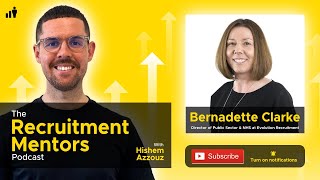
In this Recruitment Mentors Podcast episode, host Hishem Azzouz interviews Bernadette (Bernie) Clarke, Director of the public‑sector division at Evolution Recruitment. Bernadette shares the traits that make a recruiter successful – ambition, internal drive and a strong work ethic – and reflects on how her modest upbringing on the Isle of Sheppey shaped her ambition. She outlines her 17‑year journey across public‑sector social‑care, private‑sector tech, and contract recruitment, explaining the unique complexities of contract work: balancing business development, contractor management and delivery. Bernadette details the evolution of her daily workflow, from early‑stage ratio‑based calling (≈25 BD calls per placement) to disciplined time‑management tools such as nightly to‑do lists, a three‑folder inbox system, dashboards, and Trello boards. She emphasizes the power of personal branding – podcasts, round‑tables, webinars and article series – as the most reliable business‑development engine, describing how she leverages these platforms to build relationships, convert them into NHS contracts, and maintain a high hit‑rate (≈40% on cold outreach). The conversation then shifts to outreach tactics, stressing non‑recruiter language, tailored messaging and the importance of referrals. Finally, Bernadette discusses gender equity in recruitment, sharing her experience of navigating pregnancy, maternity leave, and returning to work, advocating for transparent policies, commission protection for contractors on leave, and a culture that supports women leaders. She concludes with a call for greater collaboration within the industry to improve its reputation.
Chapters
Welcome to the Recruitment Mentors Podcast. My name is Hishem Azzouz. Today I'm really excited to be joined by Bernadette Clark, who is the director of the public sector division at Evolution Recruitment. Bernadette has worked in industry for over a decade, and within this time she has consistently progressed to either director level or a leadership position across the number of brands that she's worked for throughout her career. Bernadette is extremely passionate about moving the needle on diversity within the sector that she recruits in, as well as the recruitment industry. She actively mentors within Women in Recruitment and also has recently joined us at the Recruitment Mentors Community as well. Now, as well as this, she has launched the Exchange NHS podcast where she actively interviews leaders within the public sector, and in 2017 launched Her+Data Manchester, which is a community working to connect, inspire, support, and empower the Northwest UK's women in data. Bernadette, or should I say Bernie? And I said Bernadette a number of times there. Everyone calls me Bernie. Yeah. Well, welcome to the podcast. How are you?
You make me sound amazing. When you hear it like that, it sounds great, doesn't it?
Yeah, plenty of great things to talk about. So where we always like to start on this podcast is, so in your opinion, the million-dollar question, million-pound question, like what, what characteristics and traits do you think make up a highly successful recruitment consultant in your eyes?
So probably been asked the question a few times over the years, and then, and, and obviously done my fair share of, of hiring, um, you know, people from that have maybe graduated or want to work in that sort of recruitment and sales environment. And I suppose there's always sort of common themes running through the ones that make it, the people that become successful. And then you sort of look around yourself sort of 10 years later, and they're managing teams of their own or businesses of their own, or people have gone on to either open their own businesses. And so I think the number one thing is is ambition, and it's sort of why— how you, you quantify that. It's sort of ambitious in terms of money. Money's one thing. Money's, you know, that's the financial side. I think you need more than that. You need an internal drive, um, and I don't— you can't say where that comes from in a person, whether it's your background, whether it's your aspirations, whether it's your culture, or it's your, you know, the people around you, but the people that have been successful want a little bit more out of life than, than your average, and so they're willing to put the effort in. And I think work ethic, for me, if someone's not to put the graft in in recruitment, it's probably— there's a million and one other jobs out there that you can do. And so having a strong work ethic is very, very important for me.
So let's talk about the other things like, yeah, sorry, I was gonna say, let's obviously, we can, like you said, I know the drive piece there, which I think is really interesting because I think, yeah, everyone has their own story and they've been on their own journey, but let's talk about yours then, like where do you think that comes from for you in your story? Like where is that? Do you think it's come from the environment you grew up in or where do you think it's come from?
Yeah, definitely. I think, you know, we're all, we're all a product of our, of our early years, aren't we? And I think, you know, sort of quite humble beginnings for me. One side of my family is quite well off and the other very much sort of working class. And so I probably had a little bit of a sort of a side of life that you could have a window into. But definitely my immediate family, very, very working class and grew up in a place called the Isle of Sheppey, which is not known to many people, but, you know, quite as a sort of humble, humble beginnings. We didn't have a lot of spare cash or anything like that. So you're there for seeing what other people have and the holiday and the house and the lifestyle. And, you know, I knew that I had to educate myself in the first instance. You know, I think I was always taught by those around me that education would be our path out of— and I say our because it was me and my sister— um, our path out of, of the, the situation that we were in, really. So going to university, getting a good degree, and then being able to make choices as to your career, that was the basis and the foundation of what everything else was put on.
Yeah, love that. So just for context and for people listening, um, Obviously, so right now, like, you— do you manage— are you just involved on the contract side?
Yeah, I've been a contract, uh, biller, a contract consultant for, uh, really for 17 years. And whilst I managed those billers, um, and, you know, and I direct that team, I still have my toe in the— dip my toe in the water, and I still— sure, it's lots of clients now, but contract's always been me through and through.
Yeah, that's all I wanted to make sure for people listening. And then, and then, have you always been in— so I can see in the first company you work for it says social care, but so have you always been around the public sector, or have you also, have you also been involved in the private sector as well? Has it always been on the, in the public sector, out of interest?
So, um, Morgan Hunt is a recruitment company. I worked there for 9 years, um, opened up sort of various different offices for them regionally, um, but the, the teams that I ran were always in the public sector, like housing, um, and, and social care, as you've just mentioned. Um, but I also ran— I opened the Manchester, Leeds, Birmingham, Newcastle offices. Um, and the, um— and then I moved to Roullion, um, which was entirely private sector. So right there for around 6 years. So I'd moved to technology at that point, um, to doing tech, digital, it, data, um, you know, dev and testing as well with the markets that I ran. Um, and, and that was purely private sector customers. When I moved to Evolution, I was, um, brought on as a director for the private sector tech contract team for the UK. Did that for 2 years, and then it's really only as a result of COVID that I directed our efforts to deliver digital into the NHS.
Okay, got it. Perfect overview. So that, that's really good context. So I guess, look, let's Let's just dive into like the really good stuff then that I think people are going to want to obviously hear from your point of view. Like, what do you believe sort of makes a great contract recruiter great? Like, what do you think great contract builders have in common, would you say? When I ask that to you, what immediately comes up for you?
I think, um, contract is probably gonna I don't want to upset anyone that's a pair of hella here, but contract is complex. You know, there's a little bit more to it than placing, you know, even in terms of the compliances attached to it and all of that kind of thing. So lots and lots of moving parts. So you have to be really good at keeping your eye on the ball at business development as well as doing your, you know, managing your contractors. You only grow, obviously, if you're, in your book, if you're good at managing your base and not letting that base, you know, those runners sort of fall away from you. So you have to have your eye on anything, new jobs, business development, contractor management, and bringing your pool of contractors through. So you have to be good at all of those things at one single time, which some people find that quite difficult to manage all of those things. I think contract tends to be a little bit more salesy. There are people that, you know, they're not waiting for the next contract deliverer to come through, are they? You know, you need to be able to have very, very good hunting skills. And, you know, that sort of not taking no for an answer, the resilience and determination that everyone in recruitment needs to display. But I think, you know, I'm looking around the room that we're, you know, the office that I'm in now, a couple of them worked at the weekends, more than happy to put in a little bit of graft in the evenings. And I don't know if people want to hear or not, but, you know, it's about going the extra mile and being probably prepared to make a few sacrifices in your personal life throughout the week in order to get those gains eventually so that you can, you know, you enjoy other aspects of your life.
Sure. So a couple of things I just want to sort of zoom in on that most people, most recruiters will message me that they want to find out, learn about, ask people on this podcast. So the two things are, one, the new business side of things. That's always a popular area that people always message around, want to hear how people have improved on that and these types of things. And then two, the time management, the systems, like what you've, what I guess what your day plan looks like now, or when at the peak of when you was a contract biller compared to what it looked like early on. People now obviously hear these types of things. So let's start with the time management and these types of things, if that's okay with you. So you said even more, and I feel like obviously I used to work in permanent recruitment and people listening who operate in that world as well will also say to you that they're juggling loads of spinning loads of plates and these types of things, right? But I think fair to say, as a— whenever I've interviewed contractors, they've got to be like really on the ball with like everything that's going on. Like that person that's coming to the end of their— I don't know, there's— yeah, there might be just even, even more going on. So I guess that's a really common thing that people want to know. So like, sort of Bernie, early on in her career, as you were working out what worked for you and these type of things, like what, what, what has massively changed in your sort of day plan when you were really producing the, the high numbers compared to when you were early on out of interest? Like, what does a typical day look like? What did it look like when you was in a full-out billing role?
And I'll, I will go back a few years rather than talk about the present time.
Yeah, yeah.
Okay. So, um, I think when you're first starting out, you're, um, you're not aware of like your ratios, you're not aware of how many calls it takes to, for example, to, to put a job. So I worked that out quite quickly, and for me, I needed to make about 25 BD calls to then pull a position, and then, yeah, you know, then you can work out how many placements that you're going to make a month, and you can become quite scientific about it. You're also grafting to where you get into a customer in the first place, and I think people sort of miss a trick a little bit. You know, they might be doing lots and lots of new business calls to new organizations, but have they fully maxed out the organizations that they've already placed with? So, you know, the common thing about sort of landing and expanding, that was probably where I did pretty well. I would always highlight where there were pockets of, of business that I could do and then get people to recommend me over to other managers. So you're actually from one customer, you might have, you know, multiple contractors running. If I think about one particular customer I worked with, had about 50 contractors in one organization. So you could whilst you've got risk there, because what if suddenly that tap turns less diversified?
Yeah, yeah.
Um, and you've got sort of lots of eggs in one basket. Um, obviously that really helped me significantly in terms of time. So I would, um, I think when I was probably doing the best in terms of my financials, I had about 4 or 5 customers where I had multiple contracts, and then I had ones and twos in say another 5 or 6 customers. And that spread the book, and I always tried to sort of enhance what I already had because getting into a new organization was a lot harder. In terms of day plan, in Morgan Hunt, it was really pre-designed for you, not an awful lot of autonomy. Like, okay, you could have walked into any Morgan Hunt office at 10 o'clock and everyone was switching to BD from candidate.
Right, okay.
Like little robots almost. And, um, and, and I suppose after a couple of years you get a bit fed up with that because you want your own— to add your own spin on things.
Yeah, yeah.
But there's definitely something to be said for structure and something to be said for, you know, that discipline and routine, um, because I still instill that now into people that join. Fair enough, once people have got sort of a little bit more experience, they can, they can, you know, sort of change times that they're doing things. But broadly speaking, you have to do some business every single day as a contract recruiter. If you don't, if you spend all your time on delivery, you're going to turn around and not know what jobs you're going to be placing next. So even when my consultants are at their busiest, I still ask them to carve out of business development day. And I think that's— it's a bit of golden— a golden rule. A, you know, I've seen so many people sort of spend a week or two weeks delivery solidly and then not have anything to sort of turn around and, and be able to still be playing things. So you limit yourself and restrict yourself significantly. Um, I think also we were talking about contractor management, and you've got to weave that into every single day as well. Don't, and you, you could go a week without speaking to your contractors, well, they'll soon be being poached by someone else if you don't keep that relationship. So, um, it's about being hot on, on all of those, all of those aspects.
And what, and what— so just quickly, just getting really practical here because this is what people love. So yeah, you've explained that really well. And then I guess just what, what— I guess what systems or what things really work for you to have the best possible chance of keeping on top of all those things? Was it you pretty much blocked out your diary for every activity? Did you have a to-do list that worked for you? Like, what sort of— and I know there'll be some days that are better than others, but like, besides when the whole team around you doing the same thing, that obviously helps, but like, for you, what really works for you in the end, or typically?
Yeah, I think being, um, organization has always come quite easily to me, um, It's not— I've got 100 to-do lists in my personal life as well as my, my work life. I always write a to-do list the night before.
Okay.
It's clear. And if anything hasn't been actioned, it rolls to the next day without being, you know, my inbox is always super, super clean. It's either filed, actioned, or it's yet to do. And I would be— if I had more than 10 emails in my inbox. Yeah, yeah, they, they, you know, I run things very, very leanly, and that helps me sort of see the wood for the trees when things are busy, because it's so easy to become overwhelmed. Um, different organizations that I've worked in have had different systems. So Morgan Hunt was Bond Adapt. I absolutely loved it. It had a, you know, it had a great way of sort of doing your callbacks, uh, monitoring what your outputs were each day, and then I could press the button and I could see what my team's outputs were. Um, I love dashboards and being able to see your stats and what is actually— what you've actually achieved, and then link that into the monthly, um, you know, but good old Outlook, you know, having reminders and, you know, making sure you start from maybe a paper day plan when you're first starting, don't you? But soon you, you become accustomed and do certain things on automatic. Um, uh, Rouleon was a bespoke database which, in my opinion, wasn't that great. It didn't help me an awful lot, and it's more of a candidate management tool than a business development And at Evolution, we use multiple things, but we're big fans of Trello. Yeah, Trello's great. Yeah, and, you know, I think working in tech, people are very, you know, there's much more advanced tools than Trello out there. But for me, it's a really useful tool, moving cards along, everyone having shared access to those boards so that you can see where updates are, getting the notices through so that you can understand. Where things have moved from. Um, and then just being able to go into it, log into a Trello board from wherever you are, and being able to manage your, your own team.
See what's going on. Yeah, yeah, nice. And you can use a lot of Trello for free, by the way, for anyone listening that's sort of always trying to look for a tool that can help them. And I guess just really quickly, so you organize your inbox by filed, actioned, and to-do, you said?
Yeah, absolutely.
Okay, nice.
Um, I hardly So right now, as I've been on things all day, my inbox will be filling. But I have a rule that— so I can't, I can't leave until it's either actioned or put it onto the to-do list for the next day. Or, you know, you have to be quite rigid and disciplined with yourself because you could easily let that, that slip. But if that slipped for me, then I would know that I'm not completely— I'm not, not in a great state.
Awesome. Thank you for sharing that. So I guess the next thing then, and let's sort of keep, I guess it'd be great if you could keep this maybe in the last sort of 12 to 18 months and maybe you could speak from yourself or even your team, just because I feel like the landscape has changed so much and that's what sort of people want to hear. So I guess the next thing then on like what has been sort of the most reliable way then for you and your team to win business? And get the most out of that business development time. There's one thing making the time for it, but then there's another thing doing it effectively. So like what, what comes up for you? And there might be a couple of ways, but what's ended up being like the most, the best sort of most reliable way of you and your team to be winning business on the contract side of things out of interest?
So Evolution didn't recruit the NHS 18 months ago. Wow. And now we are I would say, I suppose without blowing our own trumpets, recognized as a brand that delivers into the NHS, um, definitely multiple customers across multiple NHS organizations and winning business ahead of competition, um, quite, quite easily. Um, and I think the thing that— and, and, you know, Hishem, you've definitely had something to do with this as well in to understand how personal brand could really aid me. And I very much enjoyed doing the sessions that you ran at Evolution, um, sort of getting your name out there. But by giving something back to the market that you're in helps you then to take something from that market. And yes, um, and by taking, I mean being able to place business and make revenue. Um, but the, the The single biggest, uh, I suppose, tool in our toolbox is the, the podcast, the roundtables, and the article series that we do. Um, I was able to leverage the experience I had from Her+ Data, um, in hosting sort of quite large events and understanding the types of conversations that people wanted to talk about. Um, and then take that into— I've done a female leadership series, um, in tech in the NHS. I had the privilege of interviewing around 60 female leaders in tech who've then become my customers. And because you're building up sort of quite a bond with them, or as you're talking, then it sort of makes sense that then you'd end up working with them and delivering their talent as well. Yeah, I definitely didn't want to be pigeonholed into just talking to women. So for me, I was looking for angles to talk about things that appealed to men and women, and men definitely want to talk more about the tech and the projects that they've, you know, delivered, the things that they've actually executed and facilitated in the organization. They want to talk about achievement much more than challenges. Women are quite comfortable to talk about the diversity angle, so I've kind of just appealed to both, and then I've I regularly now, um, organize round tables. I held a webinar yesterday on robotic process automation, something that I wouldn't thought I'd be doing 18 months ago. But you find yourself in those sort of positions, and then you become very, very comfortable and familiar at doing the hosting side, as you're doing today.
Yeah, yeah, for sure.
That's been our best angle.
So, so just on this then, you don't have to give us all the secrets and like go into loads of details in your processes, right? But like Would you mind just like painting a picture for us? Like, obviously I understand this because it's also a great tool for me and how I've grown my— so like, just talk to us in like recruitment terms. Like, if I'm listening to this, I'm going, okay, Bernie, but like, how? Like, how does it— how do you go from speaking to people about webinars, podcasts, articles, to then these people giving you vacancies and opportunities to work with them? Like, What is the typical journey out of interest? And maybe just paint a picture on that out of interest. Do you— is it that you always follow up? And is it always that you do bring it up at some point? I don't know, like, what— how does it typically happen out of interest? I know it will differ because that's how it's happened for me.
But yeah, I think I understand your question. I think some people could do lots of these nice sort of questions, interviews, and talk to people on roundtables and things like that, but never monetize it, never, yeah, turn that into anything commercial, and, you know, sit there and have lots of lovely conversations but no outcome. So very quickly explain who I am and, and what I actually— what I'm about, I want to do, and why I'm doing it. So for us, we're a framework supplier on several of the NHS frameworks, so I make a point of stating it. And some people will be aware that you're, you're going to, um, talk to them about recruitment. You can tell maybe that's not the right time to, to broach it. Um, so it's all about reading people, isn't it, and understanding what the right time is. But at no point do we ever shy away from the fact that we're a recruiter, and I'm very proud to say that I deliver lots of wonderful tech talent into the NHS. But then we talk about the things that matter to people. I draw the connection that way, that what, what matters to people— their careers, their career choices, the environments they work in. We talk about mental health, diversity. I've got onto topics like Black Lives Matter because people are people. So I could be, I could be, um, we're talking about people with disability, LGBTQ, because the NHS hires all of those people. Of course it's relevant because we need to— we should all be taking our, you know, playing our part in making our working environments more inclusive because our people will then be more productive and they will— the organizations that we're working with will be more productive and more efficient. So you draw those connections. And I will sometimes, you know, it feels like a little bit of a loose connection because, um, what you're wanting to do is, is place their people. But as I mentioned, I would never, ever, ever shy away from being a recruiter. It's one of the things that I say as a recruiter, or I'll give them the context when we frame the conversation. I'll tell them, want to do an them, or I want to do a podcast, or I want to do, um, a roundtable, and the reason why. But then I say, let me give you the context and explain that as a recruiter, this is what we do. And they sit down.
Yeah, I think that's the key point. Like, it's— and that's the thing, like, as a recruiter, you need— it's just about getting more opportunities to share, like, who you are, why you do— well, more, more, less about you, but more about them, as to, like, how you can help them. So it's like, this is how we've been helping people like you, these are the challenges that we help them solve with the talent that we provide them, etc. So like just making sure, I guess, then at the relevant part of the process in talking about these things, you're going, hey, this is what we do, we're proud of it, we're bloody good at it, just so you know. And like what we're— yeah, okay.
But never— if you miss the opportunity to see it, then you're kind of always going to have a nice relationship but not much else.
Yeah, exactly. Yeah. Okay, cool. But that's a key part.
Yeah.
Yeah. So then just— and then again, just on this before we go into the the next thing I want to ask you about, which is, like, just again, getting a bit practical here, like, what does the outreach look like? Because I think that's what people are interested in as well, because it's like, the typical reasons why I may call a particular target client will be spec in a CV, I've got, I know I've helped such and such like you, or referral or whatever. So like, what does that outreach look like out of interest? And how have you found that being received? Has it been received better? Have you got more people coming back to you? Like, what does that outreach look like as well to target prospects, clients?
So the same with any sort of, um, getting together a project on LinkedIn of a target audience, or, um, getting, um, a— the same situation would apply to this. Um, and you've got to be mindful that you're not gonna get 100% hit rate. Um, I get 100% hit rate when it's a referral, when someone says, I've really enjoyed talking to you about female leadership, please talk to my colleague here, I'll copy you in and we will do the same thing and I'll chat to her tonight about how it was. That's 100%. But if I'm sort of sending out a mass message to people, yeah, and I would say I'd be happy if it was around 40% hit rate, and I would think that that would still be quite high. It's all about the way you— the what you put in the message, the, um, the, uh, using leverage from your output. So getting your first one is probably going to be the most difficult, um, and I'm— so I, I chose someone in the marketplace that was very prominent, um, that I thought other people would be very, very keen to hear about, and if I got her to do it Exactly, a snowball. And, and so it gained momentum, and it gained that momentum really, really quickly. I appreciate for every market there might not be that, um, that, that one person, but you know your markets. You know, a recruiter knows their market pretty well. You can, you can go to the, like, the number one client in your market and reach out to someone there, um, and then— but the messaging has to be you know, really well written. It has to be the language that you're using is non-recruitment. Um, your reasons have to be you're not mentioning recruitment in any of that message at all.
Yeah, yeah, I got him in.
And, and I'll be honest and say there's not a lot of ego-flattering and telling people that they, they look amazing and they're exactly the type of person that you want to have to speak to. Yeah. Yeah, yeah, and clearly that works.
Yeah, I love that. Okay, and then just so before we finish, what I just really want to talk to you about is sort of, um, just around really you always ended up in some sort of leadership position and a few other things, but just really quickly on this, like, what— how do you think— like, you, you've started to highlight this, but you've been doing recruitment for, as you said, like 17 years. Right. So I guess so. Yeah, I just want to like commend— I guess what I want to commend and highlight here, and maybe you can comment, like how a lot of people would have gone, nah, I know how to do it. Or like, we've always done it this way. Do you get what I mean? So I guess I don't know. I'm just like curious as to like, why was you able to be open-minded to doing it this way? Because I'm sure if I was to say to you 3 years ago that you'd be doing podcasts I know you had the event series, but doing podcasts, webinars, all this, and that would have been one of the most effective ways for you to grow your contract business, you would have gone, good one, or not sure about that, maybe. So I don't know, just curious about that. Like, how, what do you think, why have you been able to be so open-minded and fluid?
And yeah, and I'd say, so yes, I have been. Also, if I think about my boss Matthew, yeah, he probably won't mind me saying, but he's, he's over 55, and so he would, okay, You think, you know, he won't mind me saying this at all, but, you know, he would, you would think, oh, that he wouldn't be that, you know, that on it, that on things that were current and trendy. And so it is that open-mindedness, isn't it? I think it's just, you know, we're never, never as recruiters, we never know it all, do we? There's always someone that's built more than you, that knows more than you. And yeah, I probably have walked in a little bit and T-shirt and all of those things. But you have to move with the time. If you do not move with the times, then you're going to be dead in the water. And I think I'd listen to, you know, to enough people and, you know, a good— there's a lot of innovation at Evolution, a lot of people that are, you know, it is one of our core values. We are, you know, collaborative and ambitious and innovative. And you've got to then breathe it, haven't you? You can have something written on a wall. but you've actually got to be innovative. And I would say I came up with it. I didn't come up with it by any means. Um, in fact, I would say, go so far as to say, I would have shied away from it. I'm not an outgoing— I probably even said this to you when we did the personal brand session, Hishem. Yeah, I don't like— I was quite— I'm quite actually naturally shy. Um, don't really like to be put out there. Definitely when I'm doing hosting a webinar yesterday with 80 people on it, I am wracked with nerves a minute before. And yet, there's also something about, we're in a situation now where Teams and video conferencing is just so commonplace. You do something again and again and again. It just wouldn't matter now whether it's me and you talking or whether there's 1,000 people there sat behind the screen. I don't know. So I just, I'm confident now. To talk in sort of these environments really, really freely. Um, I wouldn't say I would probably have the same confidence base. Um, but I think a lot of it comes down to characteristics. Are you prepared to sort of take on other people's new ideas? Um, I'd credit— definitely credit a chap called Chris Bennett, who I know you know, with pushing and, you know, pushing and saying, you know, we— but I might have come up with some of the ideas around doing the, um, roundtable articles. But definitely there's a collaboration of people internally. We've got an innovative marketing team. I work with people that are constantly pushing me, and I quite like it. I like being—
yeah, that's amazing.
Yeah.
So before we finish then, um, I just definitely want to make sure that we talk about this. So women in recruitment, right? So I guess, look, I guess the way that I want to frame this up is Really, I just want to sort of hear your thoughts on how can we impact the amount of women in leadership in senior positions in the recruitment industry. So to give context, and I'll share this a couple of times, and you have a family, right? You have children, don't you? Yeah. Yeah. So, so one of the— so I want to find out from you really, like, how you've managed to do both, basically. And the reason why I say that is because one of the— Yeah. And I just want you to talk freely about that, really, because one of the things that I continue to hear, and I know it's a complex, multifaceted issue and challenge, right? But definitely one of the common things that I hear is that whole sort of crossroads that you must have appeared on or may have, it may have sort of come up for you where you're like, wow, I put all this work into my recruitment career. I'm doing well. I want a family, definitely. But how am I going to maintain my career and like my family life? Like, I don't know, like, how— that's one thing. One, how have you managed that? And any advice for people that are aspiring mothers and people that want a family to how they can maintain both? And two, like, how can we move the needle on more sort of senior females in the recruitment industry?
I think it would definitely have been a bumpier experience. So my kids are now 11 and 9, twins are 9 and Zach's 11, so I remember it was a guy, actually, one of a close friend. I think he was instrumental in actually writing the paternity policy. It was that, you know, archaic. There was, you know, in recruitment, those, you know, say 12 years ago, organizations didn't even have a—
they didn't even— policy.
Yeah, or childcare.
Yeah, yeah, yeah.
Or anything of like that, whereas now it's just sort of like a given that that would be in place. I actually remember being absolutely petrified to tell my boss that I was pregnant. Yeah. And, and, you know, trying to keep it for a long time and, you know, being probably a little bit secretive because you just didn't know what was— then was your desk going to be taken away from you? What was going to be the consequence of that? Going back, and, and that's what happened. My desk was taken away from me. Um, and I was also promised a couple of bonuses that then I didn't receive because I was going off on to Matley. I did a lot of— I actually opened our Newcastle office while pregnant and did a lot of work very heavily pregnant. And really, in hindsight, probably wouldn't have busted a gut quite as much if I knew that the goalposts would have been moved. And so you hear of lots of experiences like that and joined Evolution, people were saying to me, you know, having a female on the board was really welcome. Could we, could we think about the, you know, the return journey for women coming back after mat leave? And there was an example of someone had a rocky time. I absolutely vowed that she wouldn't have a rocky time the second time around, and we would put our arms around anyone that was coming back, because for women, your confidence is at the lowest ebb it ever is coming back after maternity leave.
You've got—
absolutely, absolutely. And, you know, that needs to be recognized by leaders, and you need to support these women into coming back into an environment that they can manage. They're daunted by having to leave their world in the first place, and then how on earth are they going to have the juggle? That— how do you master that? How do you master being the best at work? Yes, it is so, so, so difficult. And so our jobs as leaders is to make other people's jobs as easy as we possibly can, not harder. So, as you can tell, I've got very, very strong beliefs on this matter. Yeah, but it's about— absolutely, yeah. And, and I would say for anyone returning to work, whether that's because you've cared for a parent that's been poorly, or, or for whatever reason, you know, been sick yourself, or whatever, all of these things matter. So I think In terms of— it's about sort of, you know, supporting those around us. Often on contract, if someone's going on to mat leave, you don't then get your commission. I think that should be a whole-scale policy change that, you know, you've put those contractors in, you should earn that commission. If that person would be far more likely to return to a business if their commission has been kept going for them, Of course. And, you know, people, you know, recruitment companies will say, oh, they're not likely to come back. Well, of course they're not likely to come back if you haven't treated them well in the first place. Yeah, yeah, yeah. Um, policy. It all comes down to policy.
What about, what about, um, for anyone listening, that's like, what would your advice be having gone through it? Like, advice for anyone that is really worried about telling their employer? I don't know, I don't know, you may have had these conversations, but like What, any sort of practical advice there or anything that people can think about that might help in that situation? Because I can imagine that being so daunting and yeah.
I think there's two instances of women that have gone on mat leave that have either been close to me here at Evilution or on my team, and they were just really, really open and honest and, you know, and One of the girls, when she told me, I stood up and gave her a hug, and she just wasn't expecting that. She thought that it was almost going to be the opposite of that, in fact. And so I suppose there has to be that transparency. And both women actually continue to do a little bit of work on their mat leaves to keep their hand in. You obviously get your 10 days to keep in touch, and but we didn't enforce that if they didn't want to. But if they did want to, it was absolutely fine. Yeah, we classified even an hour coming in and seeing people as a keep in touch day. Um, you know, people will do— if you treat people well, men or women, they will do their best for you.
Yeah, but I think obviously, yeah, it's so hard obviously because there's just so much nuance and context, like, to that situation that, that matters. Like, I think, I guess, I guess the more people that talk about it, hopefully. So, for example, the experiences that you experience, the more people that hear that and go, oh, so that isn't what usually happens, or that isn't what I should expect, the better. So then hopefully that could mean that more women can be like, go into those conversations more confident and go, hey, look, the fact that you're giving me all this limited support, whatever, actually that's actually not— that isn't how it's typically done, or that isn't how I'm hearing other businesses are doing it. So like, am I in the right bit? Like, because yeah, because you could be in the wrong business, or the business doesn't support it.
Evolution, the entire, um, board, all our parents, um, I was the first female on that board, so they're all dads, and there is a slight discrepancy in terms of workload at home.
Yeah, of course.
But, um, But I remember our CEO sort of touched me on the arm. I was leaving for interview and said to me, um, you know, my kids still sleep in my bed sometimes. Don't worry about it at work. You know, when people are human about things, yeah, then it actually breaks down those barriers, doesn't it?
Yeah, I love that. And obviously anyone listening that may be in that situation, I know that— I don't want to put this on you, but they're happy to reach out to you or during that, because I feel like it's—
yeah, always. I think that's important for others, or, you know, no one should ever be— it's a horrible thing. You should be really excited to be announcing.
Yeah, exactly. Not—
yeah, rather than ashamed or worried or frightened. Um, and for me, those two things don't, don't, you know, marry up. You should be proud and excited to explain that you're going off to have a baby, if it's— because it's a wonderful thing in someone's life.
Yeah, absolutely right. So I've got, um, final question for you, which is, if, if you could change the industry, what, what would you improve?
Um, reputation, without a doubt. I think you tell people you're a recruiter and they go, really, are you? You say, yeah, but, and they, people have a perception, don't they, that the, that we're I don't know, just all out to make a quick buck, or, you know, that we're not— we do think and have quality at the heart of what we do, that we're just throwing CVs at and making a load of money. We all know that actually, you know, the skills that's required to actually make those placements and make revenue is, you know, recruiters have got such a lot of skills in their armoury. And I think sometimes we don't help ourselves. I think sometimes recruiters can sort of do themselves a So, um, definitely we're competitive with each other rather than collaborative in terms of, um, how I think it's changing, and it's changing slowly. But even things like this wouldn't have happened 10 years ago. We'd have kept all of that to ourselves. So I think that, um, you know, the more that we can be open and sort of share, the more that the industry will get a better reputation.
I love that. Bernadette, absolute pleasure. Bernie, should I say. I know, I feel like there's loads more we could talk about, so I feel like we're going to have to get a part 2 for this. But thank you for being super open, honest, and joining us.
Thank you. It's a pleasure.
More from Hishem




You don't need as many clients as you think to bill $1 Million A Year In Recruitment



From 30 Direct Reports to Back-to-Back $1M Years as a Solo Recruiter with Zach Creighton



