Cultivating resilience and going the distance amongst adversity LIVE podcast.
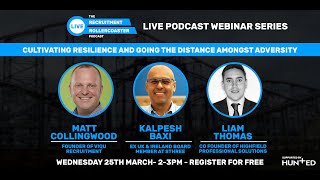
In this March 2020 live podcast hosted by Hishem Azzouz, three seasoned recruitment leaders – Liam Thomas (Highfield Professional Solutions), Matt Collingwood (VQ), and Kalpesh Baxi – discuss how recruitment firms can survive and thrive amid the COVID‑19 crisis and broader economic downturns. The conversation opens with personal histories of past recessions (2008‑09, post‑9/11) and the lessons learned: the need for rapid cash‑flow monitoring, scenario‑based forecasting (rolling six‑month plans), and diversifying revenue streams (contract vs. permanent). The panel stresses the importance of clear, frequent remote communication (daily huddles, Slack, video platforms) and maintaining team morale through virtual social activities. They share practical onboarding solutions (remote onboarding guides, Charlie HR) and business‑development tactics that focus on empathy, leveraging warm client lists, and targeting “hot” sectors (healthcare, logistics, AI‑related projects). Mental‑health support is highlighted, with internal mental‑health champions, regular check‑ins, and peer‑support groups (Canaries WhatsApp). The group also addresses debt‑collection strategies, emphasizing relationship‑based negotiations, payment‑plan offers, and understanding client supply‑chain pressures. Branding advice cautions against herd‑following on social media and urges authenticity. Finally, they forecast the pandemic’s economic trajectory (possible double‑dip, 4‑6 months of flat growth) and advise leaders to prioritize personal resilience, stay market‑aware, and be ready to pivot when opportunities arise. Throughout, the tone remains conversational, supportive, and pragmatic, offering concrete tools, metrics, and mindsets for recruitment owners navigating adversity.
Chapters
Good afternoon everyone and welcome to the second live podcast webinar where today I'm delighted to be joined by Liam Thomas, Matt Collingwood, and Kalpesh Bakshi. Um, before— very quickly before we go into, um, the chat just introducing themselves to you all, um, two things. So firstly, a huge part of today is gonna be all about Q&A. I want to make sure that you get your questions answered, and I know a lot of you have submitted questions, um, to register, so I've got loads of those up and ready to ask these guys. But as these guys are speaking, please feel free to submit questions. So it should be to the right of you, you should see a Q&A panel to the right, and you can very easily, where it says ask a question, just type in there and ask it and submit it, and I'll make sure that these guys can answer it. And if there's any questions that you really like, and then you can also click upvote on the questions that you want to make sure get answered. And then the final thing, all of you should know that this podcast is sponsored, supported by Hunted, and Hunted are really trying to do their utmost in challenging times, and they've recently put together a survey that's completely dedicated to business owners in recruitment to assess and gather information on how businesses are getting through this tough period. So they've split into different segments like impact on the market, evolving a people strategy, remote working infrastructure, and I'm gonna follow up with everyone and make sure everyone gets that, 'cause the more people that obviously submit that, the more information they can share that could hopefully benefit all of us. So before I start asking you guys some questions, why don't we start with introduction? Liam, if you go first, if you could just introduce yourself to everyone and then we can get started.
So, Liam Thomas, co-founder at Highfield Professional Solutions. Been in the recruitment industry since 2002, running Highfield for the last 13 years. We specialize in the built environment space, predominantly design projects around the world.
Thank you, Liam. And Matt?
Afternoon all, Matt Collingwood. I started my recruitment journey back in 1997, spent 17 years with one of the largest corporates globally before launching VQ in 2014. So we've got two offices, Southampton and Birmingham, focusing on IT. When I'm not doing the day job with running VQ, I I'm a member of Canaries, which is a group for professional IT recruiters in Birmingham. We can tell you a bit more about that in a bit.
Cool, nice. And Kalpesh?
Hi everyone, so my name is Kalpesh Baxi. Like Matt, I joined, I started off in recruitment in 1997 working for esprit. So I've done pretty much every market. I'm a permanent contract guy, so So hopefully we can add some variety on the panel to help you guys out. And look, what I'm grateful about the podcast today for is it's our chance to help you guys out and to help each other in this uncertain time.
Cool. Thank you, guys. Well, honestly, a pleasure having you. So I think it's safe to say all of you combined have worked in recruitment way longer than I've been alive. I think, look, I think no one has, I mean, a lot of the workforce would definitely not have experienced sort of the adversity and sort of challenges we're going through right now. But where I wanted to start with you guys is, so besides the current situation and climate today, like what's been sort of the most challenging time for you guys as recruitment business owners or working at S3 and how did you get through it? Feel free, one of you to go first.
Should I pick that one up?
Yeah, go on Liam.
Okay, so obviously, you know, probably what most people are thinking about Credit Crunch in 2008. We were quite fortunate because it was just me and my business partner Sam at that time. We'd literally just started to take people on.
You started your business in '08?
Well, a year before, but, you know, by the time we really got going, you know, we'd made some good headway. And then I think it was kind of June, July in the summer of 2008 when it really hit. When Lehman Brothers went down.
Okay.
For our sector, working in just UK kind of built environment, then it was like somebody turned off a tap. So it was quite scary for two young, relatively inexperienced contract recruitment consultants at that time. We thought we were very good at our jobs and we were good at filling jobs, but we weren't necessarily the best business owners in the world. So it was a good time for us to learn and kind of you know, cut teeth really in dealing with problems, you know, similar to what we're going through at the moment.
So how do you feel that you got through that then, that difficult period?
Well, the first thing that happens is you kind of go into shock. You're like, wow, this hasn't happened before.
What should I do?
And then you just need to sort of sit down and you can't keep thinking the way you've always thought. So it's about thinking about new strategies and new ways. How are you going to generate income?
Innovation.
Exactly. You just can't keep doing the same thing. And, you know, when the markets change, expect the same results. You've got to think outside the box. And for us, it was looking globally and we moved a lot of our business to Asia and the Middle East and ended up doubling our turnover throughout the last recession. So that worked well for us.
Thinking out of the box. Yeah, definitely.
You've just got to change, really. You can't keep thinking about the same thing. Sit down, go somewhere quiet, get, you know, some of your senior people around you and have a bit of a brainstorm.
Hopefully people have got quiet places in their homes right now. Matt, what about you? What's been the toughest time for you and how did you get through it, would you say?
I suppose, you know, the toughest times, one of the biggest challenges, and this is whether, you know, when we started out, when we were at our highest growth, and even today, it's just around cash flow.
Yeah.
So it's just being on top and knowing knowing your cash flow forecasts, being on top of chasing any aged debt. Looking back at kind of, and this is going back 2000 recession, the 2008-2010 double dip recession, where we had bad debt, so companies that went bust, ceased trading, you can't recover that debt. Usually when the creditors go in, there's very little, the administrators go in, there's very little for the creditors. And the fact is, businesses are going to go bust or they are going to have cash flow issues, and that's going to affect the whole supply chain. So one of the things that we've been doing very, very closely is working with our customers. We've been working with suppliers around payment terms, etc., just so we can, you know, we've got the cash flow in, the bills are paid, etc. But I think that those are problems that startups are going to experience in terms of that cash flow, even when businesses are going through super growth, because a lot of the time you might be growing, you might be doing really well, but when your money's tied up in someone else's bank account, it can restrict your growth.
Okay, and Kalpesh, what about for you?
What—
obviously working at S3 for a good number of years, what were some of the most challenging times for you before this period, and how did you get through it?
So I've got— I mean, like Matt and Liam, I've been through 2 downturns, 2 upturns. So I did the post-Y2K, 9/11 crash, which just completely came overnight. And then obviously post-Lehman Brothers. And the key thing for me, so I've worked with a private company and I've worked in a public company, you know, in terms of both of those areas. And I think the cash flow, absolutely. I think, you know, Liam's point about thinking outside the box, absolutely. The biggest thing for me was about making sure you do and adapt. So the market required— the rulebook that you would have had in a boom market will not be fit for today. So the key thing for today is you've got to adapt what you do as a business. You've got to make sure your people know where you're going with a plan. And I think the most important thing I'd say to everyone is, look, you know, there are still people buying out there. There are still people actually taking on our services, but you've just got to find a way to connect with them. And make sure they see the value you can offer.
Okay, interesting. So just, just before I start going through the— quite a lot of questions that people submitted then, just to sort of set the scene and to give everyone context of sort of where you guys are today. So Liam, let's just start with you again. So right now, today, obviously as a business over the last couple of weeks, what have they looked like and where's your sort of business at today? Just to set the scene for everyone, just to give them a bit of context of the types of businesses that you run. So yeah.
So we're based in, based in Hampshire, single-site agency, about 40 of us in there, and it's been quite good. So, you know, one of the benefits of being a single site is just the key for us has just been keeping that communication on point. Really, really important. You know, everyone's worried at the moment. So the last few weeks have just really, for me, been putting an arm around everyone. You know, everyone's panicking at the moment. They want some reassurance. So it's just been that communication has been key for the last couple of weeks, definitely.
And what's been the most difficult decision you've had to make so far then?
Probably, well, the nervousness of looking at the cash flow, like Matt says, you know, you think you're in a good position, but until you really see it on paper, you know, you've got to base all your decisions on that, really. We haven't had to make any too— luckily we haven't had to make too many tough decisions. Probably the hardest thing for me is telling my kids we're not going to Disneyland. So that was the toughest thing I had to do at the moment.
So I think— yeah, no, so I was just going to— sorry to jump in there, but we were speaking about this before we went live and Chris, you just put that— I know that we were talking about that you're sort of— you've got a cash flow plan of 6 months, haven't you? I just wanted to mention that. Yeah.
Yeah, we've sort of stripped the cash flow and the income right back to worst-case scenario, you know, forecasted for 6 months. And, you know, it doesn't look great, but yeah, it's comfortable. So that's good news.
You forecasted cash flow-wise 6 months, and then obviously you're going to constantly evaluate that, I'm sure. Okay.
Yeah.
Matt, what about you? What does today look like with your business?
You might remember when we We did our podcast together, one of the things that I spoke about was our industry, when recruiters tend to get together, certainly recruiting leaders and owners, the numbers, the metrics they talk about, the size of their businesses, or the number of staff, and the phrase I used at the time is staff numbers are often vanity. The sanity really is, it's the bottom line, and I think that this is a great example of what high numbers of staff can do to a business. We kept Viki pretty lean, so there's only 22 of us, and when COVID's finished, there'll be 22 of us. I kind of wanted to make a very clear message across the business that we put our arms around everyone, we're going to back them. We haven't got rid of anyone, we haven't furloughed anyone, there's been no reduction of salaries or anything like that. We have asked the guys to compromise a little bit, perhaps with their holiday, just because we don't necessarily think there's a full requirement there for the people working 5 days a week, but We're in a good shape, just like what Liam and Kalpesh have said. We've done a cash flow forecast for 6 months.
So yeah, you've given yourself 6 months as well.
It's a rolling 6 months. So in a month's time, there'll be 6 months, and a month after that, there'll be 6 months.
Yeah.
One of the things that we're looking at as well, just in terms of where we're at today, I think it's really important that we can be agile and we know exactly where our business is. So we're heavy on contract. 90% of our business is contract. So we're getting regular timesheet reports so we can look at our contractors and know that they're on site. It's one thing thinking you might have 100 contractors, but if only 20 of those guys are working, it's quickly going to catch up with you in terms of your cash flow.
Okay, so you've been keeping an eye on that on how many— okay, that's interesting. And then just to frame that, so Liam, as well, your business, what's the split in contract and perm? Just for everyone's context?
At the moment, it's probably closer to 50/50, but we're aiming for it to be 70/30 in favor of, in favor of contracts.
Okay, cool. And then Kalpesh, I know that you've been obviously left us free in December, but you've been really active in having conversations, offering help. So what have been the conversations that you've been having with different business owners and sort of what's been the common themes that you've heard from people as to what today looks like for them and what they're currently thinking about?
So my conversations have been completely varied and I tend to— I've spoken to organizations from 0 to 5 people right the way through to 100 people plus companies. And I think, and I want to pick up on some of the— Matt talked about vanity and sanity. Yeah. Right now, look, the number one thing is if you're a leader, it's time to lead. And that's probably the starting point I have a conversation with anyone. The world doesn't need more directors and managers sitting in a room somewhere or not talking to anyone. If you are a leader of a business and a recruitment business specifically, it is time to lead. And leadership to me means two things. One, you have to get in front of your customers and talk to your customers. Don't leave it to your salespeople. They need to know you're going in the battle with them as well. And the second thing is you have to make sure you're making the right decisions for the business. And part of being a leader is sometimes you've got to make the unpopular ones as well, right? So the two things I tell everyone is agility and responsiveness. You need to know how you can move and what you can respond to.
Yeah.
You need to make sure you've got a plan. And I'll caveat that with a clear plan. Make sure you communicate it and you get the right people involved. And the thing I've learned, and I'm not just talking about, you know, markets up and down, the thing I've learned in general crisis situations in my life, work and non-work, is some people thrive in a crisis and it might be the people you least expect to. So in your teams and in your squad, look at those people that you've got that you think, you know what, they might be the most junior person or by time served or billings or whatever it might be, but they might be able to add the most value to you right now because they've got the right mettle and the right outlook to help them.
Yeah.
And the final one is Cash burn. I know Matt's talked about it, Liam's talked about it. You've got to know your numbers.
Yeah.
You cannot outsource knowing the numbers today. And I was talking to an organisation last week. Every day they have a cash position report coming out. Right. And I talk, I call it the doomsday scenario. The doomsday scenario is no one buys any more from you. No one spends any more money with you.
What does that mean?
How long you've got to run out of money. Then you also need to know what levers you've got. To impact that.
Okay, cool. So, um, all right, so let's sort of segue into some of the questions that people, um, have. So I think what you just said about leading, um, uh, and all of that, Calpeche. So I think, um, and we were talking about this before we went live, the, the working from home, right? So I think a lot of people now, and obviously, Liam, you're at home, Matt, you're at home, you're now having to lead away from your typical home, right, which is your office. And your culture and your environment. So just to set— and I think this then goes into like Mike's question on how to onboard people. Like, so for you guys, how are you now communicating with your business? Like, what have you set up and what does a typical day look like for you guys in running your business to making sure that you're leading from your home?
Should I go first then?
Yeah, yeah, yeah.
I think it's fair to say, I think we come from a generation where, as recruiters, we were in at 7:30. I think if we left before 7:30 of an evening, you could be getting the death stare from the boss. But things have changed. One of the things that we've been slow to adapt to is homeworking, and this has really opened my eyes. I think one of the key things in order for it to work, what managers got to have is just have complete trust in their staff, firstly. Yeah, I have massive trust in those guys, and to be fair to them, we've only been home working for this week, but the results are there, and it will be something that we'll be considering as doing something longer term when COVID-19's long gone. One of the things we are doing, and this is just to kind of keep that rapport going and communication, is we're having a huddle at 8:30 every morning, we have one in the middle of the day, we have one at the end of the day. Okay, guys get on to Audrey, so those that aren't aware, it's a video platform. You get multiple people on there, you can share screens. I mean, it's absolutely brilliant for interviewing as well as bringing all your colleagues together. So it's having that regular comms, keeping those guys positive throughout that, keeping the message consistent across the offices, just in terms of what we're doing. They don't know this yet, but I want to sprinkle in a bit of fun with it. I've just arranged for a personal trainer Really? Expression with everyone. So those who are listening, you've got some good news coming your way. So that's probably not something we'd normally be able to do because, you know, to get home and get changed, all the rest of it. But yeah, we can do that on the— yeah.
So you've got 3 touch points: morning, in the middle of the day, later in the day. And then also now you're like, right, how can we have fun with this and try and, yeah, breed that sort of team morale with things like that? Um, Liam, what are you doing? How are you communicating to your staff? Because how— because as you said, you have circa 40 staff, but how are you ensuring that you're communicating to these people.
Yeah, I think that's a key word as well, communication. It's— that's the bit for me personally, because, you know, I don't sit in an office, I'm sitting with everyone else, and I do find it hard being isolated at home. So pretty much exactly what Matt said, you know, make sure you're on the video calls with everyone, keeping those going. But we found Slack absolutely brilliant for anyone who's not using it. Yeah, such a good tool. For me, it's making sure, you know, it's because it's not business as usual at the moment, you know, you need to try and inject a bit of fun in it when you're all working remotely. So any positive news you get, make sure you're shouting about it, even if it's just qualifying a really good vacancy, getting some good CVs over, interviews, whatever. Share that positivity, celebrate those wins. Yeah, definitely, because everyone will bounce off that and give you something to smile about. We will set that at home.
Yeah. So, so with this, then obviously a lot of people having to use video, Audero, Zoom, Microsoft Teams, whatever it may be like. So let, let, let— I'd love to get your thoughts on Mike Amos's question. I don't know if any of you guys have come up against this, right? So a lot of people now having to do interviews over video, doing it remotely. And that's— but the part that's going to be difficult for businesses is they've never had to— like, if you guys took on a new recruiter tomorrow, that you're going to have to do that from, yeah, from home and you're going to have to onboard them remotely. So how, how can you, how have you gone about or how have you heard your consultants deal with this sort of combat of how are we going to get these people onboarded to our business when we're on lockdown and they can't come into the office, meet the guys? Like, what have you heard from, if you've heard it directly from clients or from some of your consultants that have got on the phones, how are clients onboarding people and how people approach that?
We've, um, we've onboarded 2 guys this week, so, uh, okay, we've got a client in the finance sector, um, and we've arranged for laptops to, to be sent out to these guys. Um, we, we can get them on board and get them started. Um, so it is still possible. Um, I don't think every client's going to do that. I think the smart ones will want to get a competitive edge at the moment, so why would you not want to, uh, be interviewing these guys and, and locking them down now? When more clients are putting things on ice.
But have you done that before, Matt? So how have you approached it? Because I'm sure that isn't— you haven't had to onboard people remotely. So how have you— what have you actually done to ensure that that happens?
We've actually never needed to do it. We've never been in this situation before. So it is pretty new. I mean, there's a massive shortage of hardware at the moment. So really, you've got to— your clients have got to be able to find a hardware supplier. Or you've got to be able to do that, get those machines all imaged and get them sent out. But fortunately at the moment those businesses are still operating and the delivery guys are still dropping kits off. So I think at the moment it is still a possibility. Again, coming back to what Liam said, I think both of our businesses are contract-led, so these guys probably don't need as big an induction as what some of the perm staff might need.
Fair enough.
And Liam, have any of your consultants come up against that or Yeah, so we, you know, part of the objectives, you know, we're setting guys slightly different KPIs at the moment when they're speaking to people. You know, one of the things we're talking about is not, you know, what jobs can we fill, but how can we help you? And I think video interviewing is more, it's pretty common now, so a lot of people have been doing that anyway, so it's not that unfamiliar for people. You know, really good question from Mike, is the onboarding part that people are struggling with? So When we realised that, we actually put a bit of content out on a guide on how to remotely onboard people. Okay. So, yeah, we've been sharing that with our clients and that's been quite helpful because there's some really good tech out there at the moment. You know, there's stuff like Charlie HR, which is really good software for onboarding people. You can do it all remotely and it's taking advantage of the tools that we've got now in this digital age and making sure our clients are all aware of them, really.
Yeah, and I think, obviously, I think from a lot of conversations I've had, generally that onboarding piece is genuinely an opportunity as a recruitment business to add like significant value on that and be involved and heavily involved on onboarding these new people. So on that note then, I think you just mentioned there, Liam, I'd love to get your thoughts as well, Kalpesh. Like a lot of people when they were submitting questions said like, like, how do we approach BD right now? Like, what with, with the current, with what's going on right now, what, like, how should people be take, like, approaching business development? What are your thoughts on that? Feel free, someone, to jump in. Go, K, what do you think?
If I, if I give you the— I mean, look, again, this is the conversations I'm having with different, different people. I think, look, the first thing is you have to accept what what's going on in the world and people will be feeling at different points of emotions when you're trying to get through to them. But I think you can still put calls in and my typical starting point would be start with your warm list, start with the people that buy from you, start with the people you've engaged with, don't start with the cold calls, but also think about how you're gonna connect with them as well because not everyone wants to talk on the telephone right now. You know, we've just been talking about how to use technology. So is it Slack? Is it Google Hangouts? Is it, is it Interview you can get on in terms of a domain or Podro, etc.? But I think you can still put calls in and you can still have conversations. And I know, again, talking to a company this morning, there's a lot of people now getting Corona fatigue. You know, we're a week and a half, two weeks into this, right? People are bored. They're bored of out here talking about it. So they're looking for a bit of escapism as well. Put the calls in, but Just be mindful of the person you're talking to. Be clear about why you're calling them up. And look, and also just wear a real thick skin. If people don't want to talk to you right now, don't take it personally. Come back to it and then walk away and come make a call back in for the future. But there are different ways of connecting with people. It's not just telephone. Yeah, there's enough online events going on. There's things like this going on in a number of different forums right now.
Yeah.
But I think you can still do it. And look, from my own personal experience, you know, my best times have actually been in hard markets.
Okay.
The difference with this market as opposed to 2008, 2009, it's not man-made and everyone is going through it. So you have to be respectful and mindful of where people are and the emotional journey they're on at the moment.
So, so, Peter, but you, you like, you'd like to think people would welcome a conversation that isn't just focused on coronavirus, but you've got to be empathetic, be mindful, and sort of, yeah, see how you can help. What about you guys, Liam and Matt? Like, what are you saying to your guys? How important is business development right now? And like, what's— what— how are they approaching that?
I think, yeah, you wouldn't even necessarily term it business development at the moment. It's keeping in contact with your clients and just speaking to them. The objective at the moment isn't just sales. Don't get me wrong, filling jobs is brilliant at the moment, and there are jobs out there, But empathy is a great word, compassion is a great word. That's what we've been talking about in the office. And it's like Kalpesh says, everyone's going through the same problems at the moment. So it's understanding those and showing empathy. And if you can help them out with something like a remote onboarding plan and how to do it, then they're going to remember you when they do need those jobs filling in the future. They're going to be the ones that remember you for helping them when it was times are tough.
Okay, Matt, anything to add to that, or just—
yeah, yeah, I think from the BD side, it's just setting the right sort of expectations. I got Russell Monday. I don't know if you know him, he's a coach trainer. He's done a bit of work, um, with a few of my guys recently. And rather than setting the expectation of you've got to go and pick up jobs and all the rest of it, and that is their mindset— I've got to get a job, I'm going to get the pressure off— at the moment, we're setting the expectation more around building those save lists lead generation, finding out where these guys have gone, who they work for. So the real basics. So BD doesn't necessarily mean the KPI of pulling a requirement. It could be a lot more. And I think we need to remove any of the— we can't be setting these guys, we're setting an expectation they all should be going out pulling jobs because they won't deliver on that and it makes their job very negative. Yeah.
So what— so with that then, what should anyone that's obviously watching the is managing the team remotely right now, is being the leader, what, what, what are you guys emphasizing that your guys do? So you just mentioned a bit there, Matt, in terms of save lists and leads, etc. But like, what— for anyone, again, we haven't been through this, a lot of people haven't had to manage their team remotely— what should— what are you guys emphasizing, or what, what KPIs in this climate should your guys— are you making sure your guys focus on, if it's not the typical things, obviously?
So on the contract market, you know, we've got them around at the moment speaking to every single contractor we have, really, really focusing down and doubling down on that contractor care, really making sure they're all okay, you know, if they've got any queries, you know, if some of them are on temporary layoffs, just making sure they've got all the good advice, you know, just looking after them, advising them. Some of them aren't aware about mortgage payments and the holidays you can take and things like that. So it's not all about sell, sell, sell at the moment, it's about looking after after your contractors and your clients as well at this time. So obviously, you know, it's important that we get as much of the contractor book working as we possibly can at the moment. So, you know, making sure those figures are all kind of up to date as well. So, you know, what's going to be coming in every week on the contractor payroll side.
Okay. So you're just looking at just as many touchpoints as possible with their existing network and relationships?
Yeah, definitely.
Okay. What about you, Matt? What thing? And I know you're just talking a bit about how, yeah, the change the expectation, which I love. But anything that you're also emphasizing your guys to focus on to ensure they're doing the right activities?
Yeah, I'd say if we're having sales calls with clients, they just need to be educated, educated calls. Yeah, I don't see the point in talking to clients about when they're next going to be hiring, but we can have conversations with them about how they're getting their workforce mobile, what's their business continuity plan, what's the disaster recovery, what are they going to do in the event that 30% of their IT department are going to be off and and those are the opportunities where we can backfill those pretty quickly with contractors. We have seen firms taking a lot of contractors on recently simply to do those roles and get their people mobile and to protect their business. In answer to your question, the other thing really just to target is just to get more out of candidates, and as Liam says, contractors. What an amazing opportunity that we've got at the moment to get through to these people when they're all at home, the boss isn't around, they can take these calls. And probably a lot of the time they probably welcome a bit of interaction, you know, as all of us are working from home at the moment, might have our partners around or families, but it's going to be a little bit lonely and we're only at day 2 for some of us. So, oh my God, yeah, great, great opportunity for our recruiters to have those conversations. So I'd say it's educated calls to our clients, stuff that's relevant to them, okay, and just targeting our people to talk to and get as close as possible to candidates and contractors.
I love that, guys. And I think just— and then someone's— and I think on the flip side of this, which you have to do as a leader, as a manager, like someone submitted a question which I thought was really interesting. So like now with this remotely, like how would you recommend managers, leaders challenge output whilst working from home without being like a big bother or doing it in a negative way or whatever? Because I think that's also the challenge, isn't it? Like it's great if people do that, but what— I don't know, you've— what if people aren't doing that? Like, how can you challenge that? What do you think about that?
I think it should be challenged whether or not they're home sitting on a beach, apparently working in Barbados, or in the office. Yeah, um, you know, we set the expectations and those activity levels should be adhered to.
Would you say just—
yeah, might just need an arm around someone.
Yeah, so just as you would in the office or in normal, just, yeah, you have to do it remotely.
Yeah, so I think it's also, so I was just going to say, one of the things I guess just to be mindful on that is, you know, we talked earlier about kind of motivating people and, you know, the whole kind of positivity thing. We're at early stages at the moment. I think as this goes on, it obviously will do for weeks, yeah, could even be months, we are going to have some people who are going to be maybe isolated or working on their own, and there is a mental health issue here to consider. So although the activity levels for some people might drop, it's not because they've been lazy. It might just be they're not in the right mind at the moment or the right place. And I think with that, those are the sorts of people that, you know, we have a word when we need to, but it's understanding that people that might be not in the best place and giving the support they need. Yeah.
Liam, what was you going to say? Sorry.
I think it's like, you know, like Matt says, really, it's just not assuming anything. Make those expectations really crystal clear at the start. But then if people do have a problem with them, you know, make sure you ask the question why. You know, a lot of people, because they're in a different environment, people are going to struggle for different reasons, be that, you know, mental health or, you know, not liking the isolation or the fact they've got 3 or 4 kids running around all day and they can't actually do any work. So, yeah, you know, It's just understanding it's a different situation for everyone. Again, a bit of empathy, a bit of compassion, and just keep those communication lines open. But, you know, I completely agree with Matt. You've got to make those expectations clear. You know, it's easier to talk to people at the moment. So those activity levels should be on the rise, if anything.
So, yeah, and I think that's definitely— I've got quite a few questions on mental health and things like that and resilience and getting through this because it's like for me personally, Like, I'm finding it really difficult, like, definitely. So my— I've moved down to Eastbourne with my girlfriend's family. My girlfriend's mum yesterday started showing symptoms, so she's now got to self-isolate and I can't leave the house for 14 days. And honestly, my head fell off last night. I was just like, oh my God. So like, what are you— and no doubt a lot of people are going to find it challenging, like, definitely mentally. So like, what one of the questions was One, is it the manager's responsibility to monitor people's mental well-being? I'd like to think it is, but like, what are you guys doing to ensure that, I don't know, people feel safe to talk about the mentally, the challenging side of this? What are you guys doing to make sure that these people are able to talk about or trying to impact that or help with that? What comes up for you guys?
We're fortunate enough that we've got a really amazing, uh, like mental health trained professional in the, uh, on the the team. Really? So yeah, yeah, yeah. It was, of course, he was really passionate about it and he's literally exactly the sort of person you'd want to do that job. So we put him through the course and he's great to talk to about anything like that. So everyone knows if we're in the office or out of the office, they've always got access to him. And it's still early stages for us all working remotely at the moment. But next week we've got plans to really, really roll that out and get him assisting people and kind of being proactive with it rather than waiting for people to come to him.
Yeah. So you're going to make it— just communicate to everyone that if anyone does want to book in time or virtual coffee or whatever, they can do that with the person you have internally.
Yeah, definitely. Just being, you know, almost, you know, he might not— he's probably got enough on his plate at the moment, but almost I'm going to ask him to kind of check in with people individually and just make sure they're doing okay. Because, you know, some people do struggle to put their hand up sometimes and they just need that question asked every now and again.
Yeah, that's fair enough. What about you, either Kalpesh or Matt? Like, what's— what are some of the things that either Kalpesh you're hearing, or Matt, you're— I know you mentioned the pt session, which no doubt is part of this, but anything you're doing to ensure that the men— like, you're doing as much as you can for your guys on the mental side to support them through this?
Um, I, I, I think something like this really should be in a business right from the early days. It shouldn't take a situation like this for people to start thinking about it. I just come back to the word we mentioned a couple of times already, it's just communication. If someone isn't in the right place, they need to raise their hands and we can support them as best we can. I think there's a lot of really good consultants and third parties out there, so I love what Liam's done in terms of getting someone in his business. There's external people as well that can be used, and I just think the nature of where we find ourselves at the moment doing all this fire webcams, etc. A lot of these guys could be booked out for an hour to do a level of support or coaching, business coaches or mental health specialists, yeah, to help out. So I'd say to anyone, if they feel that they've got those challenges, to raise their hands. I think at the same time as well, you know, we've got to think of our own mental health. Yeah, there's a lot of us at our level that are carrying not only our own livelihoods, but the livelihoods of 20, 50, 100 staff and their families. So I think it's important that we can talk, and it's good to talk to a peer group. So, you know, most recruitment owners are going to be in the same boat. So the key bit is I'd start reaching out and talking to as many of those people as possible. So I mentioned earlier, and it's a bit of a plug anyway, but our Canaries group, we've got 50 members and we've got our WhatsApp group, and I guarantee we get in 50-odd messages a day from the different owners that want to share a bit of success they've got, challenge they've got, what they've heard, government releases about the grants and stuff like that. Now, we're quite fortunate that we've been— that little group's been going now for 2 and a half years, and it's a real success. But I think for those that aren't in a group, whether it's TRN or APSCO or whatever, is just find another local recruitment owner, reach out.
Yeah, reach out.
Yeah, I said before on my podcast, you get recruiters together and they generally say, yeah, everything's going well and we're doing amazingly well. Well, this is one of those chances just to be brutally honest about where you're at the moment if you really want to get that help.
Yes, if you're a business owner right now or a leader feeling alone, make sure you reach out to people. And Kalpesh, what are you hearing from the people you're speaking to on on helping, yeah, the conversation you have with people to help get through this mentally and the challenges there.
So look, I think that Matt's talked about it, Liam's talked about it, right? So number one, I'm going to start with the leader. And I think what Matt's just talked about, and then, you know, whether it's the canaries or whoever you've got in your world that you go to, as a leader, make sure you have got an outlet in this as well because your mental health is absolutely critical to be able to be there to support your business. And I think, you know, one of the things I'm learning, and I'm quite lucky at the moment, I'm talking to people in random places about random things, and it doesn't have to be someone from recruitment. It could be someone completely random, you know. So please make sure you make that time for yourselves. I think if you're a leader, it's critical. The second thing around it is there are so many different experts out there, and I'm not going to name-check anyone for fear of upsetting anyone, but there are people with recruitment experience that understand what we go through as pressures that can be there to support you. So if you don't have the luxury of Liam and what he's got with someone internally, go and find someone externally. It's probably one of the best money you will spend right now, um, to be able to speak to people. And then the final thing I'm going to put out there is, look, this is— I'll go back to the point about being good leaders, Ryan. If you see a change in someone's behaviour, and I appreciate it's a little bit harder when you're trying to do it down Slack or Interview or Zoom or one of those type of platforms. If someone's gone quiet on you, there's a problem, right?
Yeah.
If someone all of a sudden is quite an introvert, is talking really, really loud, there's a problem. You don't have to be the expert to be able to go and solve it. You just need to know there might be something there to just take someone in to go and help them. And I think the final thing I'd say is, look, we're all in this together, right? So this is the world of frenemies, if you want to think of anything. So if you're always about taking your competitor down against on the job, today's not about worrying about that. Matt's point and Liam's point as well is just go and put a call in. We're all human.
Yeah.
Going through the same challenges. And you never know, your call might actually be appreciated by someone else as well.
Yeah, no, I like that. Cool, right, let's make sure we get some of these questions answered then. Top question right now. Will's asked, if you're a consultant in this climate who has seen all their jobs put on hold and previously fruitful clients put on recruitment freezes, how would you go about building a new business right now? That's tough. What do you think about that?
I mean, my view on this, Will, I don't think there's a magic tree out there. There's not a silver bullet. You're not going to turn a corner and find a bunch of jobs, and everyone's in the same boat. Is that there is still some business out there. Like I say, I'd be going after things that are relevant. Retail seems to be doing well, as in the shops for food, and mobility, disaster recovery, certainly within, from within an IT perspective. Contracts as well. It's possible that, I don't know, if Will's a perm guy, that he goes back to those clients and asks about what contractors they've taken on or what particular time would they need to take additional resource on.
Okay, and anything else to add to that? Kalpesh, what do you think about that? What— how could someone go about— you said you've had a lot of success in hard markets. What— how could someone go about rebuilding some more opportunities to make money?
So look, my starting point would be to— Will, it's like, okay, and I don't know how long you've been doing recruitment or whether you're permanent contract, but look, the starting point is you always start off in the warmest place possible and then go out to being in the coldest place. So if you start with existing customers, whether it's candidates or clients, and start working out from that network, that's one way out of doing it. The second way around is exactly what Matt said. Find the hot industries. So if you think about right now, you know, people, medical device companies, engineering companies, right? Any company right now around data to be able to make good informed decisions. AI is becoming mainstream. And I think we might have found a use for AI finally, you know, in terms of trying to help us map out some of these COVID trends coming through facilities. You know, there are people that if you think about pop-up hospitals, there's some infrastructure logistics, there's a whole heap of industries out there that are mission critical right now. And I don't underplay that, that will still need people and need people. Yeah, they're going to try and do it themselves and that's fine. That happens in boom markets as well. But you know what, there's definitely opportunities. And the big thing I'll tell you, Will, is if you're working as part of a team or you know, you've got a leader above you, go and talk to your leader, go and ask questions and also reset what the expectations are on you for the next week, 2, 3, 4 weeks as you build up your business again.
Yeah, nice. Okay, next question, Chris Stringer. So what, so obviously maybe obviously Liam, Matt, like what What data are you— obviously he said is what data you're using to forecast for the next quarter? Fairly unique situation. So are there any barometers that you would use to forecast outside of current runners? Like, how do you think about that? What are the sort of data points you guys are looking at constantly?
So I think, you know, from our side of it, you've got to look at the markets you're in and the sectors you're in. Which one of those are going to be busy and how agile are you? How can you redeploy your staff internally to make sure you're focusing on those markets that are going to be busier? And then obviously base your forecast around that. Obviously perm is going to see a bigger hit in the short term than contract. We're quite fortunate in a lot of sectors we work at that most of the contractors we have are still working. So that's obviously good news for us, but it's how can we then exploit those opportunities? Make sure we're still filling jobs where the market's busy. So for us, it's going to be definitely perm taking a pretty heavy hit and contract will definitely be down, but not as much as perm. To give an exact figure, I don't think anyone knows where it's such a unique situation. But what we always do is plan for the worst and hope for the best, really.
What have you, like perm-wise, What have you put in your 6-month plan for that?
So, you do, you know, when you do a cash flow forecast, you put different amounts of perm in there. You know, the worst one's obviously zero. But, you know, I think it's good to know, you know, if you have a cash flow forecast where you've got zero perm coming in, at least you know what.
Yeah, yeah.
At least you know everything's a bonus on that. And then, you know, varying various amounts, 20% above that, 40%, then 60% and onwards from there. So, you've got to map out different scenarios and, you know, make sure— Matt spoke about, you know, cash being king earlier, and you're going to see how long you can hold out in this period if things go bad for a longer period than we all hope.
Matt, anything to add to that?
I know Chris, I know he's got an amazing business predominantly within the Perm space. Around the forecasting, it is going to be difficult with Perm, as Liam said. It's it's going to be closer to the zero mark. It's going to be low. Let's be blunt over the next couple of months in terms of what we sell. In terms of what we do around forecasts at the moment, because we are weighted more towards contract, it does make it easier. And we've got, as I mentioned at the beginning of the podcast, we've got a— we now have a report that comes out every single week. So I'm looking— I'm able to tell which of my contractors are working. We're keeping in regular contact with them. Just picking up on what Kalpesh said, and probably this would be for Chris, would be if you are a perm-heavy business, start talking— these are your warm clients— start talking to them about their contractor usage and under what circumstances they would. Because if you start seeing signs or that they're giving those opportunities, you can forecast better on contract, which gives you some growth.
Okay, interesting. And just on that, before Rob's question came through, which I'll ask you guys in a sec. Like, yeah, how— so I've had this myself over the last couple of weeks. Like, how do you go about— so Mike's question on how do you chase debt with clients who are probably inclining towards keeping cash in their bank accounts? I mean, sales calls feel a bit weird, but chasing for money must feel even weirder. So like, what should people be doing that? I don't know. What should people be chasing debt?
I've got an example of that.
Yeah.
Naming no names, when I worked at a corporate business, one of our customers went bust. I mean, they were a huge company and then the bad debt was massive. And I got to know the accounts payable person. I had a conversation with her afterwards and she said, Matt, we're in a difficult position towards the end and we paid the smaller businesses first because we knew the impact it would have.
Yeah.
The big corporate were at the bottom of the list now. Whether that's right or wrong, legal or not, I don't know. But I think that if there is going to be any bad debts or clients in that situation, I think we as the directors— and this is what Kalpesh said about the, um, the, the, the, the, the business owners talking to these people— we should be talking to the head of finance for these businesses and stressing we are, we are small companies, we're privately owned, um, and we need them to honor the payment terms. Can we force them to make payments to us. I don't think we can. I don't necessarily think this is the time to be issuing legal notices to them and charging with interest and with a late payment tax and all the rest of it. Yeah, I'll probably remember those agencies that can afford to give them payment terms and support them with that. Yeah, I'll just say one last point as well, just on Mike's point, is often when we look at the debt that's outstanding, we look at our clients I think it's really important to look at the supply chain. So if our client's paid by their customer, who is their end customer and how volatile is the industry that they work in?
Yeah, interesting. Kalpesh, anything to add?
I think there's two things. If I could just go back to the previous question really briefly for Chris as well, it's about perm, or I think it was Will. So there's one thing you can do on perm, and look, I wouldn't use this as your absolute tool right now, but keep it in your locker, right? So if you know where we're going over the next couple of weeks and things will start to become clearer, hopefully anyway, but there's no harm in you being able to go to your best customers and saying, look, right, pay me a retainer for future business once things start getting good. If you know when people are going to turn around again and start hiring, there's no harm in you actually doing a prepaid sale, right, for future business. Pay me now. And you might have to be flexible, right, to get someone to give you money upfront, but that might help you out with your cash flow in a period where it's low or in decline. And it might mean that when you come out at the other end, you've got to do business a little bit cheaper in terms of placements, but at least it's got you out of the—
Yeah.
It also gives you a reason to start pipelining and building candidate pools for opportunities that, you know, will be coming back as well, right? Rather than— that classic, oh, I might have a job coming up. So now you're actually building stuff for something that's particular. And the same goes for contract as well. The bit around cash flow, I think you look, this goes back to, you have to put the calls in. You know, people are expecting these phone calls. Think about what you do in your personal life. If you are struggling, you know, you pay the people to keep your lights, your electricity, etc. You'd pay the most important people first that you deem are the most important. Companies are going to make those decisions every day. Yeah, they've got to understand how much money they've got, and you've got to just have a sensible conversation. I think, look, there will be some companies out there that will go the final demand legal route because they have no other options and they've got so far down the line it's that or nothing, and they're out, they're in trouble. The other extreme is start having a conversation, start having those part payment conversations, right? Yeah, part payment is better than no payment.
Yeah. I've definitely had those conversations and people really appreciate it as well. If you're in the position to be able to do that, do you know what I mean? It's you being empathetic and saying, look, if it does help, we can split this over 2 months, 3 months or whatever. If you can do that, then 100% have that conversation.
And it goes back down to, right, we've talked about it a few times. If you're the leader, the owner, the director, etc., your job is to get in the trenches with your people and put those calls into customers. You can't rely on your consultant, no matter how experienced, to go, please give me the money because my boss is after me.
Yeah, yeah, yeah, yeah.
So being authentic is key as well, you know. Yeah, really important about this.
Um, so great, great question coming from, from, um, Rob Hanna. Um, interested to get your thoughts on this. So what, what do you think recruiters, business owners in the current climate should not be doing to preserve their authentic personal brand on and offline? What do we think about that?
Good question. Yeah, because I think, I don't know, I would say, I would say just not what everyone else is doing. I don't know, but I just think I've never seen LinkedIn busier at the moment with pictures of people's laptops. So I think my best advice would be if you're going to do something, make it interesting, you know, make it add value to someone. Not everybody wants to just have a look at a picture of your laptop on your desk at home. It's great and it's good fun, but you know, what's it really adding? So yeah, I think if the question is what should you not be doing, I would say just don't follow the herd.
Yes, don't follow the herd. Yeah, because I think from my perspective, for me, I've seen a lot of people obviously empathize because they're in a difficult situation, but people who have had to be let go for whatever reason, and a lot— it's quick, easy to point the finger at leaders and say they've banished me very quickly, or they made a cutthroat decision straight away. And I think obviously it works both ways, but I think I saw a lot of that over the last couple of weeks of, unfortunately, a lot of people have been made redundant, but also a lot of people saying that a lot of leaders in the industry just cut loads of people really quickly, didn't give them a chance. And that's obviously hard for you guys to make decisions like that. Like, I think it's important to be empathetic towards you guys. You have to make super difficult decisions.
One of the things I'd say on this, and Hishem, you're the branding guy, right? So you're, you know, and I know you've given me some advice as well, but the key thing I would explain to everyone as they're going through this journey, and I think that question's a really good one, Rob Hanna. But just remember, at the end of this, the way I always look at it is how do you want to be remembered?
Yeah, it's a great question to ask.
If you want to be remembered as the chump who keeps putting things out there that gets you in trouble, then fine. But also remember your personal integrity as well. So you know what, if you're looking for a job, by all means, it's okay to put that out there. But I would probably leave the personal digs and stuff like that offline, yeah, not in a public domain. Because you've got to remember, once it's out there, it's out there and you've got no control about where it goes.
Yeah.
And, and I think that— I think, um, I think we were talking a bit about this before, Liam, like, just quite loosely. But I mean, look, like, Scott's prime example question now, I think approaching it in the right way, where Scott Evans unfortunately has been, um, put on temporary lay but started the recruitment recently, and he's thinking, right, how can I still add value? To a company from home and continue to develop as a consultant. So if you found yourself in a difficult spot now where you have been obviously put on that temporary leave, what could people, what could recruiters be doing to upskill themselves instead of, well, I'm sure they can volunteer and get involved with the NHS and things like that, but like, I don't know, what could these consultants do to continue that they stay, they can do everything they can? As a recruit?
It's all about mindset, really.
Yeah.
The way you've got to look at it is it's an opportunity. So the world we live in now and the training resources that are available to people who are at home, you know, 10 years ago, the things that can happen now just wouldn't have been possible. So the way we've been talking about it is keep yourself match fit. You know, you can train, but you can't play. So, you know, you could get called back off the bench at any time. Get back into the game, but you need to keep yourself match fit and ready to go, really. Make sure you're looking after yourself. Make sure you're still, you know, keeping in a bit of a routine, doing your exercise, looking after your mental health, but also upskill yourself. There's so many training courses out there that you can access online. Keep doing all of those as well.
Yeah, that's awesome, man. I really like that. Keep yourself match fit. That's a great way to put it. Well, anything to add to that, Matt? Like, what would you be doing if you were a consultant find yourself in that position?
We haven't put anyone in that position, we've got no plans to, but I think one of the things to add is if people are off, they're not supposed to be working for their employer.
Yeah, yeah.
So, you know, they can't be resourcing, they can't be talking to people because the employer will get themselves in trouble, just to be clear on that. What they can do is personal development. So I totally agree with everything we said earlier, there's some great books out there, some great stuff online, you know, start reading that, sharing it, read some good books, get your mental health in a good place, I'd say. There's— you can read about new and emerging markets, but in terms of market mapping, talking to these people, then it's going to be difficult to do without HMRC breathing down your neck.
Yeah, yeah, for sure.
Which you don't want.
You definitely don't want that. So how do we see this evolving then, chaps? Obviously, if we were to have a to predict this. What do we think? What— how do— how long do we think this is going to go on? Obviously no one knows, but what, what are your sort of thoughts on how this is going to plan out?
We've got a UV and an es, haven't we, on this one, Jim, based on the earlier chat.
Glass crystal ball. What, what do we think can happen?
Yeah, should I go first? Yeah, yeah. My gut feel on this is I think this is going to be like the recession of 2008, 2010. So there was talk of a slowdown. Definition of recession is 2 economic— 2 quarters economic slowdown. I think what we've seen is companies cut deep. I think we've seen the economy fall off a cliff. I think people are going to be quarantined. I don't think this is going to be 3 weeks. I think it's going to be 6 weeks, maybe a little bit longer than that.
Oh my God, that scares me.
I think we're going to come out of it, and I think there's going to be spend and confidence, and I think we're going to peak and then come down a little bit. And come out of it again. That's my gut feel. So I just think it's going to be slow, steady investment. I think if you're a recruitment owner and the sun is shining in 3 months and it feels confident, don't go all out and just hire a ton of people because let's just steadily see what happens. That's my gut feel.
Steadily see what happens, yeah.
I would say, I think we're in this for 2 months of a lockdown. Tough times. And I think we're probably going to see 4, maybe 6 months of slower growth or flatline, maybe.
Liam, what do you think?
Yeah, I agree with Matt, definitely on the downside. I'd love to think it's going to be 3 weeks, but unfortunately it probably will be a bit longer than that for all of us. So, but perhaps slightly more optimistic on the upside. I think having gone through it in 2008 as well, there were a lot of underlying economic conditions that led to that collapse. The underlying economy will still be strong and the demand will still be there. So particularly in the infrastructure sectors that we work in, those projects are all— they still need to be built and the demand is still there. So I'm slightly more optimistic about a bit of a bigger bounce on the upswing when it does kick in.
Like that. Kalpesh?
So I think we're, um, okay, the optimist in me says, you know what, hopefully we'll start seeing some shoots, um, moving forwards by the end of May-ish, you know, hopefully. But I think the realistic thing is, and this is like, I don't want to be the guy that bursts everyone's bubble, but you have to be prepared to say this is the long haul. And I, you know, I think we were talking about, I looked at something on The Visual Capitalist It's a great website if anyone wants to do some research on graphs. But you've got a V-shaped bounce, you've got a U-shaped bounce, and an S-shaped bounce. I actually think, along with Matt, this could be a double dip in terms of where we're going with this. But be cautious, but also be optimistic. And being optimistic means look at where you can pivot your business to still keep growing. Right. It doesn't mean you have to hire 150 people. What it does mean is where are the opportunities with your customers? Where are the opportunities in your markets? Right. But also talk to your people because, you know, your people are out there talking to a number of people in their networks. Where are they finding opportunities?
Yeah. And that was going to be— I just wanted to sort of do before we finish, chaps, is like, and obviously you guys have been through this and built towards obviously bouncing back. So like, how, what are the thoughts on sort of people approaching building or coming to the bounce to get ready for hopefully what will be a, a great upside and sort of, yeah, get back to normal, whatever. But like, how should people be best preparing for the bounce back, do you think?
So I'm going to say the first— I'll take this one if that's okay. Just my first thing is, before you worry about the external world, I'm going to steal something from Matt, is all about make sure you're ready. Yeah, that's physical, whether it's mental, whether you're doing a Jovics PE workout or whatever it might be. But you've got to look after yourself because you don't know when that opportunity is going to come through. So look after your mental health. Yeah. Then the second part of it is just be understanding what's going on with your market. Read the press, read the paper, look at opportunities, look at what industries are starting to talk about good stuff. You know, there's so much information out there. Caution though, watch the fake news. But there are some good stuff coming. Look around the world. Where if there's any economies further down the line than we are, then look at what's going on in those countries. Where are the opportunities coming through?
Right.
Okay. But I think the two things— yeah, you look after yourself, number one, you've got to be match fit. And the second thing is just start looking at opportunities around the world and go, right, how does that relate to what we're doing here? And then the final one is if you stay close to your customers, your customers will tell you when they're ready. They'll give you enough warning as well.
Yeah, okay. Matt, anything to add?
Um, I love what Kalpesh said there, focus on us firstly. It sounds selfish, but we've got to understand as the business owners, the leaders, the managers, whatever, what we want. It might be growth, but we might not want a £500 million turnover business. What— why do we want it, and how are we going to go about doing that? And I think once that's in place, for me, the next most important thing is the existing people that we've got. So are they happy? They've probably just come out of it. They'll have come out of a war, you know, really tough times. So let's get— let's invest in those guys firstly.
Yeah.
Make sure they're happy. And then we look at how we further grow and what we do with the business. Yeah.
Nice. So really focus on— yeah, I like that. Liam, what about you? What are you thinking about?
You know, brilliant from— brilliant advice from these guys. Always a big believer in, you know, again, a bit selfish, Spanish, but put your own oxygen mask on first. Yeah, don't try to be helping everyone else. And, you know, I've been a victim of that before. And, you know, if you're not matched fit yourself, everyone else is going to see that and everyone else is going to get the knock-on effect from it. So, yeah, looking after yourself, definitely key. And going back to what Kalpesh said as well, I think different areas of the world are kind of going to come out of this at different times. So that will naturally create opportunity. You know, be fit and agile and make sure you're ready to take advantage of those opportunities. Opportunities no matter where they are in the globe. The world's a small place now, so, you know, don't limit your horizons at all.
Yeah, great point. Cool. Well, honestly, guys, thank you so much for your time. I think— I hope— I'd like to think a lot of people got value out of this. If anyone— again, just really open to people's feedback, how you're finding this. Hopefully you all found it really useful. And thank you for giving us your time on this sunny afternoon. We really appreciate it. But, um, if anyone does want to reach out or ask any question or anything, are you guys happy for people to reach out and just drop me a note? Best place on LinkedIn? Anyone? Okay, cool. All right, well, um, look, yeah, thanks you guys, uh, for your time, chaps, and, um, thanks everyone for tuning in.
More from Hishem




You don't need as many clients as you think to bill $1 Million A Year In Recruitment



From 30 Direct Reports to Back-to-Back $1M Years as a Solo Recruiter with Zach Creighton



