David Jenkins - Receiving investment in recruitment & why it pays to be nice in business.
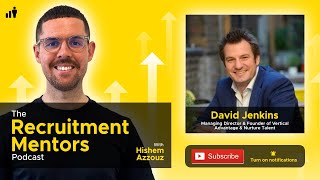
In this Recruitment Mentors podcast episode, host Hishem Azzouz interviews David Jenkins, Managing Director of Vertical Advantage and founder of Nurture Talent. The conversation covers the traits of high‑performing recruiters—urgency, a blend of sales, HR and marketing skills—and how to assess urgency during interviews, especially through graduate hiring exercises. David explains his graduate recruitment process, including rapid email response testing and practical tasks. They discuss challenges of scaling a recruitment firm past the ten‑person threshold, the importance of culture, humility, and being "nice" in business. The episode delves into David’s earlier VC‑backed recruitment venture with James Caan, detailing the motivations for seeking investment, the deal structure (majority VC share, ratchets tied to net fee income and EBIT), and lessons learned. Niche specialization is highlighted as a competitive advantage, with examples such as focusing on FMCG, e‑commerce (Amazon), and emerging trends like sustainability and sugar‑reduction legislation. The value of non‑executive advisors, solution‑selling models like talent‑partner services, and the trust barrier in subscription‑style recruitment are explored. Finally, David shares recent growth achievements, future plans for vertical segmentation, tech upgrades, and a continued focus on culture and people‑centric leadership.
Chapters
Welcome to the Recruitment Mentors Podcast. My name is Hishem Azzouz. Today I'm really excited to be joined by David Jenkins, who is the managing director of Vertical Advantage and also the founder and director of Nurture Talent. Vertical Advantage was launched in June 2012, and over the last 9 years they have solely focused on serving the FMCG and consumer space, recruiting from everything across sales, marketing to logistics and procurement. They're currently, there's currently 16 people within this brand and they have 3 more people joining the company in January. In September 2019, David launched Nurture Talent with Andy Davis. They offer an embedded talent solution and subscription pricing model where they partner with scale-ups who want to hire quickly and effectively. Now this isn't David's only recruitment business or his first. So before this, before launching both these businesses, David actually started another recruitment business where he received VC funding from James Caan in 2009, but after a couple of years, David exited this business and sold his shares in the company. Despite adversity, both businesses, both brands, he's been really pleased with the growth the year they've had. And I know David is going into 2022 excited, optimistic, as he plans to achieve more growth on both these brands. So, David, welcome to the podcast. Welcome to the podcast.
Thank you. Thanks for having me.
Looking forward to this. There's a lot to cover. There's a lot to cover. So where I always like to start is the million-pound question, which I'm sure you thought a lot about as a leader of a recruitment business. So love to hear your thoughts on this. So I'd love to just hear your take on what you believe are the traits, characteristics that really make up a successful, high-performing recruitment consultant in today's market. In today's market?
[Speaker:DAVID] Okay, the first thing that I would look for in any recruiter at any level is urgency. I think it's one of the most difficult things to actually test for in an interview scenario, to try and work out how urgent somebody is, how they deal with things, how quickly they work, and you can kind of, it's something that with every exceptional biller that I've ever kind of met, come across, at any different level, they're always, they just are always on it. They're always really, really sharp. They're always moving from one thing to another, but they know if they need to pivot and they need to kind of to change, they'll do that quickly. And we could talk a lot about a number of different traits, but I honestly put urgency at the very, very top. Um, the other bit I think that is more relevant today than it was 5, 8, 10 years ago is the recruiter today, I think, needs to be one-third salesperson and relationships, one-third HR and understanding human psyche, behaviors, culture, what makes a good cultural fit, and one-third marketeer, being able to, to not only to be a sector expert, to be, but to be able to position yourself as a sector expert. and to be able to talk really, really freely, both, you know, online, openly on LinkedIn, or, you know, via blogs or emails, or, and actually provide that real added value being that sector expertise.
Couldn't agree more. How have you got better at looking for urgency in an interview? Because I'm sure it's something you've continued to think about if it's that important to you.
Well, we've done a lot of grad hiring this year. Okay. We did a lot of analysis, um, when we were kind of coming out kind of Q4 last year, we did a lot of analysis over the previous 3 or 4 years of everyone that we hired, all the levels, the salaries we paid them, how they performed, what they built, what the ROI was, etc., etc. And we kind of just realized that ultimately we were, we were getting the best ROI and the best development from the people that we'd hired as, as either grads or second jobbers, but they hadn't done recruitment before and they wanted to come in. So we've done a lot of that this year. And we, within our, um, interview process there, we set 2 tasks.
Okay.
So if they get through, so I interview everyone first of all.
Yeah.
I receive all the CVs. I, I look through them all. I, anyone I like, I email immediately and I deliberately have an email conversation with the person and I see how quickly they come back to me.
Okay.
Come back to me on email. So the quicker they come back to me, the better a sign it is that I wanna book that person in for a call quickly.
Yep.
So I'm already starting to make a decision on what their email community— I'll ask them something spurious in the email just to see how they respond. And sometimes people make stupid spelling mistakes or they say something silly in the email, and that's a bit of a turnoff, but still go through with the call. We have a quick 20-minute to half an hour call. If they're punchy and reactive on that call, I'll book them in immediately for a Zoom call with my commercial director. But again, I'll introduce them on email. And I'll leave it to them to book the interview themselves. So I want to see, I want to see that they're driving the process then at that stage.
I like it.
We'll, we'll obviously send the Zoom invite. So all the way through the process, we're trying to see like how on it these people are. And then when we get them to the interview, we put them through a, you know, a fairly, fairly rigorous, probably 1 to 1.5 hour interview. And then we do, we have a couple of tasks and exercises. So we give them a job description, 6 CVs, tell them to, to give them 15 minutes, come up with the best 3 in order, reasons why they're the best 3. And then we ask them to write an email selling in those candidates to a client and we give them another 10 minutes to do that. And if they can achieve all of that as a grad with no experience in recruiting, they could get through it. Okay.
I feel like that's been refined over time.
Taking a while to get there.
It's still a work in progress. I like the subtle sort of urgency to— I like that. I think that's great because I think it should give you a real insight into what they might be like. I mean, if they're not urgent for themselves, how urgent are they going to be for another human being?
You know, 100%, you know, people, you know, I have had people come back to me, you know, after 3 or 4 days saying, oh, thanks for your email. Like, let's book in a call. And I, you know, and at times I'd be like, well, sorry, you missed the boat. That's not quick enough. I know that sounds harsh, but like, it's what we're looking for.
Yeah. Yeah. So interest, just, just, just, just curious, just as we're on this topic. So obviously done more grad hiring this year. What, what, so you've spoken a bit about the interview process, just keen to get your thoughts immediately really on speaking to a lot of recruitment companies over the last couple of months. And yeah, real, real challenges is hiring for their own companies. I mean, it's always been, a challenge, but for most companies I speak to, they've really got back this year to hiring that trainee. If I'm honest, I think most people I speak to, they actually prefer that, that's what they want, but typically a lot of companies I speak to are always open to experienced hires, but I think this year that's been really difficult just because, I mean, look, if you're half decent, you should be making some good money this year with the sort of how sort of crazy the job market is. So I guess what I wanted to ask and just get your immediate thoughts on was, speak to a lot of people who just find it really difficult and they're just like, what advice do you have, or people you speak to that have worked hard on getting better at getting in front of grads or selling to grads or attracting grads, could you share with me? So I don't know if there's anything that you've learned this year that maybe you've seen have a direct impact on the amount of sort of attraction you've got from grads or, that type of talent that have interest.
Yeah, it's an interesting one. I wonder when you're talking to people about that and you ask them about that process, the main change that we've made this year is that I've driven it.
Okay, so the business owner, the owner of the company driven that.
The owner. Most people are saying, "The biggest thing I want to do is hire more people. The biggest thing I want to do." Then you say, "Well, 'Who's doing the interviewing?' It's the senior consultant, or it's our talent manager, or— and I get it, businesses bigger, far bigger size than us, they need to have that structure and that thing. But for me, I will always, regardless of what size we get to, and let's hope we're sitting here in a year or two's time and we're at least double the size where we are now. But for me, it will always be the most important thing that we do, and it's hugely important for our culture. And I think it's helped us to, you know, to win when we've, when we've been competitive with grads who've had 3 or 4 offers that I've had the engagement with them from the very, very start. And I'm not saying they're joining because of me, but always I've been able to then have a relationship with them where I could pick the phone up and say, look, I think you can make a balanced decision. These are the things where I think we'd be a great fit for you, but I could totally see why these other options might be things you want to consider as well. Um, so, so personally driving it is one. And then actually on the, on the overall attraction bit, I think that people on grads, people are not paying attention to grads on LinkedIn enough. So grads, like obviously we're advertising, we'll advertise on all the main job boards and LinkedIn and stuff like that. Most, that's, that's not rocket science, but lots of grads in their last year are on LinkedIn. And they're, you know, like, if they're anything like me, they've no clue what they want to do. So again, some really, really— we've actually hired 3 grads from Loughborough and we've hired 3 grads from Bournemouth. And there's no doubt in my mind, like, I love my sport. And whenever we meet people who are into their sports, their rugby, their football, whatever it may be, they, you know, that's just something. And yeah, we've got a 5-a-side football team and we do kind of some hit stuff. Yeah. So it's just a trait of a lot of the people in the business. So we target people at those universities who are in their last year at uni, and we try and connect with them, find out what their plans are, etc., and if they know anyone else who's looking. And we also get our grads to go back and talk to people at the universities and see if we can get ahead of the game a little bit there as well.
Final thing on that, just really quickly, curious, what do you think grads of today actually want from your perspective? Like, what do you think they're motivated by just from your conversation? Because I think this is, again, this is probably where you've had to adapt, I feel like, or recruitment companies have had to think about what they articulate, communicate. What do you think?
We were talking, we were talking about this yesterday. Uh, yeah, yeah, yeah. We, we, we, I was chatting with some of them yesterday. We have one of our directors went off on, um, maternity leave yesterday. So we had a, a little mini baby shower online and, uh, but then we end up, I ended up having a chat cause I was talk, talking about a couple of these hires that we've been making. And I honestly think that the culture is now the most important.
Culture.
Yeah. Honestly do. I think it, I think for grads, it, you know, obviously everyone's different, but I see more these days coming in saying, I want to work for the right kind of business. Going to be the right fit for me, me as an individual. And whereas, you know, a few years ago, money would have still been top of the list. It would have been, you know, earnings, earning potential. I think, I think a very Very close second actually is career progression and development. And then, and you know, I get asked that question pretty much in every interview that I do with a grad on that first call is, you know, that's usually the second or third question that I get, but usually the first question is culture.
Nice. Thanks for sharing. So let's get straight into the juicy stuff, David, if that's okay. Let's just get straight into it.
Nervous.
No, no, because look, you've, Yeah, I mean, look, you've been in recruitment for nearly 20 years.
Yeah, there's a lot, right?
So let's just get straight into it. So where I want to start is this journey that you went on with the VC side of things. Let's start there and then we'll really unpack the last sort of decade, basically.
Okay.
So obviously, bar that, for anyone— obviously I've got David's LinkedIn up here, but obviously before that you worked at a recruitment company for 5 years, progressed to director before you did that, right? So I guess firstly, I guess firstly, like, what, what was you hoping raising investment would enable you to do when thinking about starting a recruitment company? So what was it that you was hoping it would enable you to do? Was it enable you to sort of grow at pace? Was it enable you to grow it, like, invest in the best techs immediately, invest in people? I don't know. What was you hoping it would enable you to do out of interest?
Yeah. But you know what, the, so the, The two main things from that actually stem from my prior year with the first business that I worked for. So I actually joined there in 2002, 7 years actually from grad to director level. I sat on that board of that business, which is a really, really nice business. We grew it to about 80 people at its max. I sat on the board with 3 other people, the MD and 2 others. And we'd have board meetings that would last the entire day. And a lot of the stuff that we would talk about, I just couldn't believe that we were talking about, like going into the minute detail of the change of price of stationery from month to month would be an example. There was a slide on that in the boardroom, you know, and, you know, and I was like this, but this is the only, like the guy who set up that firm was an ex-senior consultant from Michael Page. So he'd never, he'd never, he was a self-taught MD. All the other people who joined that company were grads that had worked their way up from grads to execs. So our learning journey as a board was basically we were a bunch of recruitment consultants that grew up to be directors.
Yeah, just learning on the job.
Yeah, exactly that. So actually, for me, the investment piece was great because it enabled us to grow at scale. It enabled us to hire. We set up in April 2009, which is probably I would akin to like setting up in January of this year, you know, just, just as markets coming out of a crash. Really, really brilliant time to start. Hired lots of great people, da da da da. So the cash was great from that perspective. But for me personally, it was the learning journey. I wanted to learn. I was a good recruitment director. I had a team of 20 people across 3 offices. I was a decent operator, a good biller, not the best biller, but a decent biller. And but I wanted to learn how to run a business. I wanted to learn what a P&L was, what every line of the balance sheet meant. I wanted to learn like what payout rate was, what ROI was. And I felt James Caan and the team that he had there, they've been it, they've done it. I would learn loads. So it was a twofold journey of a learning piece. And also, hopefully we're going to grow scale, something that, you know, going to sell in the future and, you know, buy a small island off the Caribbean. You know, that would be me done.
Okay.
Didn't quite work like that, as you can tell from my backdrop, but, you know, I did I did get the learning.
Yeah. No, I like that. Okay. Thank you. So what— always interested to hear. So for anyone listening that may be considering going down that route for maybe other reasons, but what was like, what did you learn or what ended up being the most crucial part that you had to communicate when convincing people like James Caan and his vehicle as to why they should back David? Like what was really crucial? Because if you said It was a learning. I'm assuming you've never put together an investment deck before or a business plan. So like what ended up— because I'm sure that was learning. So what ended up being really crucial looking back that you think— I don't know. Yeah. Anything important around that?
Yeah, I think with them, like we were coming as a team, so there was 6 of us starting. So, you know, it was nice to have— like to be able to— they had the trust in me that I was bringing 5 pretty experienced, pretty good people with me on the journey and that they believed that I, they could all report to me and I could be their MD. So that was, that helped.
Yeah.
And that was, that was obviously compelling, but that's not a necessity, certainly if you're looking at investment. I honestly think with, with the whole, with the, that whole convincing someone to invest in you, you have to be true to yourself. You have to be, you know, you can't kind of pick things kind of pie in the sky. You have to be honest with, you have to be honest with like where you are, where you are in your career, what you, what, what you need, and then what, what is achievable. So don't over-egg it, basically.
Yeah.
So, but, but also, I look, there are some standard things— being in, being in good markets, being in growth markets, being able to spot where niches are and where development opportunities are. And again, with that business, uh, when we were pitching to James, we could, we could call out this was 2009, right? We were able to call out in retail, e-commerce is going to absolutely fly, right? So we were able to call out, we can target the likes of Net-a-Porter, ASOS, et cetera, et cetera. They will be amazing clients and we can really, really over-index on that. And you could see that there were really, really good growth opportunities in various other pockets of the market. And that really, really helped.
I like that. So, I mean, share with us what you, what you can. But like, I guess people interested, and Kington, I'm sure you've been asked this question before. Yeah, of course. Like, how was the deal structured? Because I think this is where sometimes people can be a bit worried, because I think the perception— I know people I speak to, I think the perception can be quite a negative one of going down the investment route. They're going to take all my money, all this, still feel employed. Like, how was it structured out of interest? Like, did you— was you the majority shareholder? Would you not? How did it work?
No, James was the majority shareholder. James and the VC business were the majority shareholder. So they were about 66% and we were, you know, we were the remaining 34. I was the second highest shareholder, you know, invested our own cash.
So ratchets that if you do this.
Yes. Yeah. And ratchet ratchets to grow, to get to, to get to a higher, to get to a higher level. And we, to be fair, ratchets that were achieved. So, okay, it wasn't, uh, you know, it wasn't an underperformance thing as to why it kind of evolved the way it did. It was more, uh, you know, board to MD kind of thing, that it was more probably more appropriate that I moved on, took my money out of my shares, and let somebody else come in. Because ultimately, I think my learning journey had— there it had stopped.
Yeah.
And I really wanted to be the majority shareholder.
Yeah.
It was going to be impossible to make that happen in the timescale that I wanted it to happen. So that's kind of why I ended up going. But you know, I think the learning there is I wouldn't put anyone off getting investment. I actually think it was an incredible thing to do, but it's doing it for the right reasons. If your plan is to grow rapidly, scale, or your plan is to you know, to live a kind of a certain way or a certain lifestyle, and it doesn't mean— it doesn't dictate that you need to be 100% shareholder. I think the investment is a really, really good route to go down.
Yeah, I think— yeah, that I was going to ask you advice, but you've nailed that. It's just— yeah, anyone listening that's considering going down that path, like, really, really make time to think about why. Um, and yeah, it's something— it is true. I think that, that's really what it boils down to. And once you have clarity on that then hopefully you'll be able to make the right decision or better decisions. I guess just quickly, final point on this, just to wrap this up, just because I think it'd be useful. What were the, were the, were the ratchets like, were they all similar, just different targets? Or was it around like net fee income? What were the typical ratchets out of interest? That could be interesting for people.
Yeah, it, it was net fee income and EBIT.
Okay, nice. Super simple then.
Yeah. So we had, yeah, we had to, we had to maintain a minimum of a 20% margin and then we did a 3-year budget forecast. So basically the ratchets kind of went along kind of as they came. So yeah, and we, you know, we achieved those and that was great. But I think the input level where you've got kind of a VC business and then you've got to kind of, you're always pushing, right? You'll see it in any industry, right? It's growing, it's growing, it's growing. And then sometimes that's not the most sensible thing to do with the business. Sometimes there are times where actually you shouldn't be hiring. You should actually just be letting people bed in or doing different things. But, you know, in that kind of scenario, it's pressure, pressure, pressure to do it. And actually then you're making decisions which aren't necessarily the best decisions for the business because you're trying to hit a target. You're trying to hit a number, you're trying to hit a ratchet. And it's like, well, we, we've got to do it. But actually, you know, that's what I mean about like getting the right investors and the right support for when you're thinking about what you want to do with the business longer term, because actually you don't want that support to then impact how you're going to run your business.
Got it. So what— so vertical advantage. So like, talk to me about— I feel like I'd be interested to know when you thought about vertical advantage in the first instance, like what was top of mind for you? I think a lot of people would then go into launching their own recruitment business and be like, right, I'm going to do this differently. I'm going to take that which I liked. I'm not going to do that. What was like David's mindset towards sort of approaching Vertical Advantage differently out of interest?
Well, the first thing was there was 140 clients I couldn't touch for a year. And I had a year. So I did.
Yeah. So yeah.
Yeah. Yeah. Yeah. Yeah.
6 months. Isn't it typically people would experience?
But, you know, I was getting paid out on shares and stuff like that. So it was, it was, it was a prescriptive list, right? So it was every client that the business had had an interview with in the previous year.
Wow. Okay.
Was it, was, was so it was basically, I just, so, so I knew who I couldn't go after, which then made it quite easy actually to go, okay, that's fine. Yeah. So I sat myself in, like I had been off the tools for about 18 months in terms of recruiting day to day. So it was great to give myself 6 months to just go and do that, build some clients, build some relationships, make a few placements, et cetera, et cetera, before starting to kind of scale it. Um, so I guess the, I think I just took, I took the view that again, there were some niches within some of the spaces that we were operating in that we were, would've been great growth areas and we would've pushed kind of further desks on. I just kind of focused on those. So things like CRM, data analytics, insights, we, which is, you know, a hybrid part of a kind of a marketing department really, but we weren't really, really focusing on those. I really, really pushed that in the kind of the early stages and then the scaling kind of, of the FMCG consumer piece and what Vertical Advantage really stands for is that we wanted to be a sector specialist that had specialist individual recruiters across these different areas that we hire into. So supply chain, procurement, logistics, sales, marketing, digital, etc. So we could go to any client, Pernod Ricard, Revlon, Racket Benckies, or whoever it may be and say, look, you could put us onto your PSL and we will have a specialist in each of these individual areas that can cover. And we're, we're niche specialists for you, but also you can use this across the board. So you guys get economies of scale. And we can probably be your boutique recruiter alongside your Michael Page, your Hayes, or whoever you want as your, you know, your top tier major supplier. And that is still the premise of us today. That's still, that's, that, that still works. We've just got more people and we've become more specialized.
Yeah. Why, why, why do you think, like, I hear this, so I hear this so much, this is always interesting to hear people's take that just spoke to so many people now on the podcast where they've, they sort of, sometimes people will go, I wish we went niche more sooner, or we'll talk about that. You are talking about that it's actually your differentiator or it's really important. Like, I dunno what, from your perspective, a modern day recruitment bit, like why is that so essential? Why is that so critical to a, a modern day recruitment business to have those niche? But I dunno, why is that important from your perspective? Be good to hear your take on why that's important.
Yeah, it's, um, do you know what it is? It's that just the modern day of recruitment and the modern day of how businesses want to engage in attracting talent and their EVP. So there's so much more today that is out, you know, the internet, social media, etc., etc. There's Glassdoor, there's all these things, and businesses are so, so cognizant of their own brand. And it's really, you know, people can go on to Twitter or, you know, trash about whatever it is, right? They can do it. So it starts there really. And actually then when they start thinking about their suppliers and who they want to be their representatives in the marketplace, they don't want somebody who's going to be uber salesy trying to ram jobs down people's throats or anything like that. They want really, really credible, really, really bright individuals who understand, A, their business, B, understand the types of candidate they're trying to attract, and C, handle them in the right way, treat them like human beings. And I think that is how recruitment has evolved today, and it's a far, far, far more professional industry than it was when I joined in 2002. And that is why niche specialization is so, so important. For anyone. And, you know, like if I could have another 20 people in the business, we'd still continue to do the same things that we do. We just keep segmenting again.
Yeah. What, just on this really quickly, just again, interested to hear your thoughts.
Sure.
What sort of, what sort of key markers do you look at or indicators you look at that sort of gives you the feels of this could be a big area, this could be a big growth area? I'm trying to, yeah, just interested in your thoughts on that. Not trying to get you to give all the secret sauce away, but what are some of the typical key markers that you look at that go, you know what, that could be a really interesting area that could be its own market itself? Those things.
A couple of different things. So I'll give you, actually easier to probably give it as an example within our business. So within e-commerce and digital, we separated that out from our sales and marketing team a couple of years ago. Because we realized that brands wanted to, you know, wanted to sell their products directly to us. They didn't want to sell them in the supermarkets or whatever it is. And then, and then we realized that brands were actually selling a lot more of their products on Amazon.
Mm-hmm.
Standard, right? Like, but there's loads of, like, there's mom and pop brands in Amazon that are like, you know, selling golf branded golf balls or whatever it is, picture frames, and they're making a couple of million quid. So we kind of, saw this kind of trend happening and obviously ridiculous growth of Amazon. Everyone kind of knows about that. And we basically just saw this ecosystem of businesses happening around Amazon and marketplaces. I basically just said, we are going to just— we're going to get in there early. We're going to basically be Amazon specialists. We're going to focus on, on just talking, knowing, understanding Amazon, being able to like— are lots of literature about Amazon, candidate attraction, so that when businesses go to search for Amazon recruitment or recruitment experience, like, we're coming up. Yeah, we're— our people are there. Now, other businesses have caught on to that. Of course they have. It's, you know, it's no secret that there have been billions and billions of pounds raised by businesses just acquiring brands that sell on Amazon. So that always happens. But we got there early.
Yeah.
So we're ahead of the game. We've got the brand, we've got the space in there, so it's easier for us to execute. And there were probably 3 or 4 other areas. Now I can personally see in our space that are going to be super, super impactful. Like there's a lot of legislation about reducing sugar content in products. So, you know, think about the impact of that, the impact of climate on food. These are things in the next 10 years are going to shape what products we buy on our shelves, sustainability. So we're already positioning our new desk. With what's coming through.
So is this, is this very much just a, just, just being super curious, committing to your industry, being embedded in your industry, asking good questions, speak like networking, speaking to people, and then yeah, just like, just, yeah, I guess just being smart really with what you're reading, what you're taking in, the information that you're looking at.
Yeah, absolutely. Like my guess, my guess is you talk to loads of tech recruiters and probably got a really great network. So that, you know, in tech, there's new stuff going on there all the time, right? New, new stuff going on and new, new different things being tried, et cetera, et cetera. So again, depending on whatever industry you're in, I think as a, as a leader and as a recruitment owner, you owe it to yourself to be the most knowledgeable person in the room about what's going on in your industry.
Yeah.
Yeah. Yeah. Yeah. Because if you do, then you can see and spot the trends. You might, you might spot a competitor doing something that looks quite interesting, and then you might be able to jump on the back of that. It's not, you know, there's no shame in doing that. But if you're also the first person there and can recognize the need coming before anyone else does, that first mover advantage is huge.
Yeah. I love that. Thanks for sharing that. So obviously, as I said in the introduction, so soon to be, correct me if I'm wrong here, but you're going to be just around 20 people in January, right?
Yes. Okay, cool.
So common question that I get, and I know we're sort of just jumping around a bit here, but common question I get is typically, and I don't know if you can relate to this, but there seems to be like a real— it can be like a real challenge for recruitment businesses to get past that like 10 headcount mark and then sort of build that sort of critical mass that enables them to go from, yeah, 10, 15, 20, etc. So I guess I don't know if you could talk a bit about some of the challenges that you've had to work through. In getting— I know it's not just about the headcount, but in terms of like just building a good group collective of profitable— I don't know, like what's been some of the challenges in breaking through that 10 headcount mark? And did you experience any challenges?
Experiences? Far too many. We could have a whole podcast just on the challenges. Yeah, that's not just recruitment, that's just generally.
Yeah, for sure.
No, no, no, being serious. Um, yeah, you're, you're right, and it is, it is difficult. 10 is, 10 is a, is, is an important number. But also with, with, with when you're going past 10, yeah, you're also making a difference in terms of, you know, your cost base, your, the way your business is, you know, you're, you're making decisions, proper business decisions. But pre-10, you've always got the opportunity to be, push it back to a lifestyle business, retract to 6 or 7. Move everyone remote. You know, it, it, it, that can happen if you lost one or two people. Yeah. You could make that decision. Once you've committed and you've gone to 10, 12, there's a bit more reality about the direction of travel you're going. Now, luckily, I, I've never— I, I was always going this way, right? I was never— it was always trying to get here as quickly as we possibly could. And, you know, I'm actually pretty disappointed we're only at 20 people in January, given the age of the business. But I firm plan that we're going to accelerate and catch up on where I'd like us to be in a couple of years' time. But I think that main challenge or how do you get through it is when the times are good and the times are, you know, when you've got the opportunities, when you've got the good performers, don't sit and rest then. That's the time to really push. That's the time to really, when you're tracking your job volumes and your job volumes are strong, you're tracking your conversions and your conversions and your ratios are strong, that's the time to have your own, you know, your own KPI in place, your own saying, okay, I've hit that now. Some people will call it a hiring trigger. Some people will look at it from a financial perspective, whatever it is, but have that in place, stick to it, be dedicated, but push through. And I think you can't do it just bit by bit, one at a time. You've got to really, really try and make the jump because it won't all work. You will step back a little bit. So then you've gotta be pretty tough about your decision-making because, said, it's become a bigger business.
How important is it, like, if you think of like your job now, do you think you stayed too close to the tools for too long? Was that a part of it or was it just part, was it, you just had to do that anyway? I don't know.
I was too nice.
You was too nice.
Yeah, I just, Like, I like hiring people that I like.
So did you keep even a business that maybe you shouldn't have?
Yeah, and probably experienced recruiters that ended up going into in-house jobs and things like that, who would be far better in those roles, but we liked them, got on well with them, maybe worked with them in previous businesses, whatever it is, and they're far better doing what they're doing now. But because we got on well and they were good people, I held on too long. And actually I had to, you know, I'd have a word with myself in 2018 into 2019 about toughening up. Otherwise we just weren't going to kind of get there. And I had a non-exec at the time, which recently evolved, but he had the same chat with me. He was kind of like, look, you're going to have to decide here what you're going to do. You're either going to have to really, really push on, but you're going to have to toughen up on some of your decision-making, or you can just crack on as you are and everyone can be friends, but you're going to remain at 12. What is it that you—
I don't want to say struggled with, with. But what was it that sort of maybe— I don't know, what was it? Just that you're just an overall nice guy, or you didn't want to let people down? Did you feel responsible for these people? Like, you knew, like, what?
I mean, yeah, I mean, you probably— I'd like to say overall I'm a nice guy, and that's why. You know what, it's difficult when you've seen people do well and perform and you know they can perform to a level.
Yeah.
And you believe in them and you like them as people, you want them to succeed. You want to try and help them to succeed and you'll do everything in your power to help them to get to where they should be or where they've been before. But it changes. The market changes, people change, their needs, wants, motivations, desires, they all change. Actually, you can only control the controllables. I'm sure loads of people have said that on the podcast. It's so true. But actually, you do have to toughen up. If you're going to be a business owner, you're going to— you're going to be looking at what your cost base is every month and it's going up 60 grand, 70 grand, 80 grand. Like if you're not going to run a successful business, you have to make those decisions. And like I make those decisions and we make those decisions now, but I also have a leadership team that probably takes some of those decisions away from me sometimes.
Yeah.
And kind of say like, I'd be like, let's try this or let's try that. And they're like, no, we've got to do the right thing. We're moving, we're moving on and we're going to make this decision.
Non exact. You mentioned that. Oh, it's been a real, it's been a real popular message that I've had this year, which I find really interesting because I do feel like I've recorded it. Hasn't I? I've recorded like a bit of a sort of short video series and like key insights from this year's conversations. And one of them is absolutely like, I don't think this will come as a surprise to you. From sort of our interactions and stuff. But I do really believe that the modern day recruitment business owner or the most successful recruitment business owners that I've spoken to are, have way more humility than they do ego. So I think it makes sense the fact that most messages, like I've had so many messages going, hey, you're connected to a lot of people. Do you know any good non-execs decent? Because they're willing to ask for help. They don't feel like they know all the answers. So you mentioned non-exec there. So one, when did you get, when did you engage with a non-exec and then where was the sort of driver motivation behind that? I mean, it makes sense the fact that when you went down the VC route, you wanted that learning. So clearly you're someone that was willing to ask for help. And then two, how do you go about finding that, that person? That person?
Yeah. Okay. Yeah. Good, good, good questions. I 100% believe in the, in the non-exec and advisor route. I made a mistake when I set up Vertical Advantage, not getting a non-exec sooner.
Okay.
Because I thought like, yeah, because I, you know, okay, 2012, 2013, I'd had a lot of the learnings and I felt like, great, I'm equipped now. I've, you know, I've done my 10 years, done 2 recruitment businesses. I know what I need to know. I can, I can do this. So I did it for 3 years, got us to about 10 people across 2 different offices. There was a little bit of that back and forth, 12, 9 to 9, back to 11. And I was a bit like, okay, how do I get through it? And that was where I went and sought the help. And I, I asked every single supplier that I had who was involved in the recruitment industry, who they knew and who they recommend. I did LinkedIn searches and I went, I probably met about 15 different people over a 6-month period.
And what was it that you looked for that was important to you? I know this is nuanced, but what were the sort of important things for you out of interest?
Just someone that didn't just, I, I, they're the best one in the world. There are some people in the, well, maybe speak of the recruitment industry. There are some people in the recruitment industry who do a lot of talking, but don't say very much. right? So there was a lot of that kind of chat and it's a lot of like up in the air and strategic and this and that. I actually really, really wanted someone who was gonna be really, really honest, really, really direct, said something in one sentence that they would, you know, they wouldn't waste saying it in 3 sentences. They just tell me how it is. Yeah. And I don't have time to, you know, kind of red personality. I don't have time to kind of to have 4-hour meetings when we can do something in an hour. I'd rather, I'd rather we were kind of to the point. We moved on. Yeah. And we have those conversations. So there was a style match point. I was looking for, I was looking for the right kind of person, the right kind of style. And the guy I settled upon didn't know anything about our industry. He had a fairly corporate kind of background, but a global kind of background. And he'd been doing advisory for a couple of years, but he was really, really interested in what was going on. He was really interested in tech. He was really, really interested in markets. He was interested in international recruitment and he was Yeah, he, he had a good story himself, but he, he'd seen a lot of different things in a lot of different sectors. And that I thought was, that was great. And he was, he was exceptional, but we also worked together for 5 years and became too comfortable. And he, when we parted ways earlier this year, we both agreed it was the right thing to do.
I love that.
Because again, learning journey had finished because we worked together for 5 years. We were good mates, but Yeah, that's you being too nice again, mate.
There you go.
It keeps coming back to that. We need to rename, we need to rename this podcast.
So what, so then, so I know you said it's evolved. So then have you got a new exec now? A new non-exec?
Yes.
How, what, what was important this time? Think, cause I think like now you're at a different business. What was important now that you was looking for out of interest that was important to you?
Yes. So because we've got, it's actually important that we, because we've got the two businesses.
Yeah.
And we want really, really someone who could work with both businesses. And I like— and selling nurture as a proposition is a bit like selling a SaaS product. It's a solution-based sell. You're asking someone to commit far higher amounts of money, and it's not like contingency recruitment or even a retainer. It's a lot more kind of complex than that. So actually when we were thinking about evolving this, we wanted someone who could actually really, really help us advise us on a solution-based selling proposition. So maybe you'd come from an RPO background or a technology kind of background, but again, also on the recruitment side of things. So the guy that we found actually started just on the nurture business for 6 months, and then he started to pick up the VA stuff. How did you find him? Yeah.
How did you— how was it?
Um, again, recommendation. So we, um, We use a recruitment-specific accountancy firm and the CEO of that firm I've got to know well over the last few years. And yet again, similar, similar process to it, to how I went before. Asked all my suppliers, asked all the people in the industry. Probably these days is now a little bit easier to find those people because they're all on LinkedIn networks. You see a lot of people doing talks and stuff like that. We've got a good training provider, so I asked him who he, he rated. Um, Nice. And yeah, again, yeah, I find them that way.
So, okay, cool. So before, before we finish, and I wanted to ask you around natural talent, so this is one of the other insights that I've taken. It's interesting you mentioned. So one of the other things that I've definitely noticed this year is like definitely a rise in like solution selling, I would say. So I don't know if you've noticed this, but I would definitely say that like I think in the last 12, 18 months it's definitely enabled or encouraged recruitment companies to think about their offering and how they could evolve it. And something I've definitely noticed more and more of is this like talent partner model, which seems obviously a bit similar to nurture talent. So I guess, so I get interested to hear. So I get, I feel like the common hypothesis that I get from people and speak to people about who've done this or considering it is Like instead of working with David, who has a business that wants to go from 10 heads to 15, 25 heads, has just raised Series A funding, whatever. Instead of speaking to him about 1s and 2s, 3s and 4s every quarter or whatever, let's speak to David around how we can actually support his business for 6, 12 months. And we're going to agree what the deliverables are on the hiring side. Each month. We're also going to help him shape their hiring process because that needs some work, understand what's possible, what they need to look for, these sorts of things. And instead of paying per person, you're going to pay us X per month. And there might be some deliverables in there where if you deliver 4 or 5 people, then you get a, you get an extra increase in terms of monetary or whatever. But what that means for David is he's got a dedicated talent partner. The hiring problem should hopefully be solved. He's got a dedicated person going out there every single day talking about their brand. They're building out their hiring process that could be useful for people in the future. And he's saving money. He's saving money.
Yeah.
Like, that seems to be the typical hypothesis.
You should be our head of sales. You've nailed it.
But that seems to be like the hypothesis. So like, how— but I do feel like there's different challenges in this from when I spoke to people that are doing it. So like, how has it actually played out? Does that hypothesis make sense? Like, it makes sense, doesn't it? So David, you can save money. They're gonna work like, did they do all that? But like what, what, what has been really difficult about out of interest? Like what, when, when actually executing?
Because the trust, trust, trust is the, is the, is the big thing. So you're asking some, it's very, very easy to give a recruiter a job on a contingency basis.
Yeah.
Cause you pay on delivery. Yeah, exactly.
Right.
You know, even pay him a small retainer upfront or whatever it is. You spent a couple of grand, whatever it is. Still, right? It's, it's— but you're then trying to convince someone to maybe part with 60, 80, 100 grand over a 6-month period, and they've got nothing for it. Before they've committed to it, they haven't got anything for it. And it's that you're not selling them a piece of technology. You know, you can show them what it's, what it's like, and you can show them case studies of how you've done it really, really well before, but that person needs to trust you and needs to believe that you can deliver what you say you're going to deliver. And actually, more often than not, at some point, if they've got CEO or founder level, they've been burned by somebody in recruitment at some point in their career.
They've got a preconception that trust, trust already broken for a lot of people.
Exactly that. So you've got to try and get your head around that. Now, if it would, it really, really helps if you sell a concept that is like nurture. So if something is a service, This is talent as a service. You can call it that. So if your product or something that you sell is similar and your product is also part of a supply chain, you're basically saying, look, recruitment is part of your supply chain. It's part of your DNA. It's just one component part of you building and scaling this business. You might outsource, you know, you, you're not going to hire a chief legal officer, are you? You're going to outsource your legal to a law firm. Probably not going to hire a CFO day one. You're going to outsource to an expert. It's just the exact same thing. It's just an outsourced part of your supply chain and it's not a direct overhead. All right. So you're not paying national insurance. You don't have to employ someone. If you're not happy with it, you've got a 30-day notice period. So you're trying to give them comfort in terms of where they are. But you also need to be compelling that actually you've got good quality, you're delivering good quality. So the people that you line up to talk to them about who their talent partner is going to be need to be impressive. They still need to be able to sell themselves. They need to be good recruiters. So these are, you know, there are a lot of component parts, but it's also, it's incredibly rewarding. It's basically from a, if I can liken it to anything from the recruitment agency side, it's basically like working for your best client.
[Speaker:DAVID] What's been the biggest challenge that you least expected with it? Expensive?
I think the biggest challenge is, is the, is the door opening piece.
Okay.
Is that— it's the, it's the, like, how many proposals a month for, for new business can we actually get out? You know, we've got Bowhurst and you've got LinkedIn and you've got TechCrunch and you, you know, you can track and you can see where people are. But getting hold of people, you know, just because someone's raised £5 million and they need to hire 50 people, doesn't automatically give you the God-given right that they want to talk to you and hear about your service, right? You think this is amazing, they're going to be spot on for this. And you know, it's an e-commerce business, something we know inside out. We're like, this surely is a no-brainer. And they're like, no, you know, don't even want to have a conversation. So I think we underestimated that a little bit, but we're also getting a lot better at how we sell into those businesses. You know, I've got growth hackers in, in these businesses and you know, entrepreneurs in residence, and basically they're just people who are working out within, you know, growth tech firms, how we grow more, how we grow quicker, how we sell more. And actually, we need— we've needed to adopt that kind of mindset of how we develop business isn't the traditional recruitment methodology. We need to get away from that. We need to get to more of a solution selling model.
Yeah. So look, coming to the end here, I want to get to recent times and then sort of find out a bit about what's on the horizon for you guys. And I know there's obviously still so much you can talk about, right? But I guess obviously when we were preparing for this, I know that you mentioned that— I hope you don't mind me sharing this, but again, correct me if I'm wrong— but obviously this year you've experienced nearly 80% growth on your NFI. So I guess, well, just to keep it recent, obviously we've had all-time high job markets. But yeah, like, what would you say has really contributed to that? What was it like? I'm sure you're spending a bit of time looking at this year now, thinking about it as well as next year. But what do you think are some of the fundamental things you did right this year that really enabled you to achieve that figure, do you think?
I honestly think it's what we did right last year that's made us do well this year. I think that the recruitment market has been good. We all know it's been good. I actually don't know if nearly 80% growth is where that sits in the overall market for business of our size, if that's good. Like, as you said yourself, most businesses should be growing, should be growing at a good level. I think I'm really, really proud of what the guys have achieved this year. And we're, you know, we're really, really happy with that. We've got another plan to do something similar next year, but it definitely stemmed from how we, how we manage things from April to December of last year. That's what's enabled us to get to where we are.
What did you do right? Just do the right things, support when you could. Like, what was it?
We just over-indexed on helping.
Really?
No surprise there, David. Yeah, again, comes back to the nicest guy in recruitment. I keep on labeling myself that. But you know, we, you know, in all our sectors, we created spreadsheets of open, open spreadsheets of candidates who have been displaced in the industry. Amazing. And where we noticed that people were hiring directly and there were relevant people on those spreadsheets, we'd send those spreadsheets to clients and say, look at this list. These are all people who are active in the market. Contact them directly. It's not a fee, it's not anything. We know you're hiring. There's some really, really good people in here. So we basically did a lot of free work for, for probably a 3-month period. And we'd had a brilliant Q1, so that was great. And then, then we were able to really, really monetize that. I think a couple of our, my senior people stepped up ridiculously in terms of their networks, their market, how they were able to impact, took things on their own board. One guy started his own kind of podcast series with a guy in New York who was working in a similar market, and it was talking about the difference between the US market here. Didn't ask him to do it, he just did it. He did a brilliant job, got him brilliant traction in the marketplace. So I had— so thankful that I had a brilliant senior team, but also we just went out of our way to be nice, do the right thing as much as we possibly could. Yeah. Because it was pretty horrendous for everyone.
I do really feel like that really resonates with me. And I do really feel like this will play out on recruitment, I think, in the long term. But I do feel like being nice isn't a typical business owner, business person trait. But I think that should change. And I do think, I think that will change. And I do think empathy, compassion, doing the right thing, being a good human are absolutely brilliant business traits. And I do think that'll change. I don't know, that just really resonates with me just because I think the journey that I'm on, like, so far, and that it does play out. But I think it's when you're like, you did those things not because you're like, in 24 months' time, we're going to do 5 deals with that company, you're doing it because it feels fundamentally right in your bones to do it, to do the right thing. And yeah, the way the world, it then comes, it comes back around, right?
So yeah, absolutely. Absolutely. And yeah, you know, there is all those, you know, those different things around, you know, business owners needing to be, you know, tough and harsh. And you know, there are times where you've obviously got to make difficult decisions. And I'm not a, I'm not a believer in that, but what I am a massive, massive believer in is, is really, really understanding people. And I think to like, with the way of the world today, with mental health, with physical health, with the way that, you know, you cannot grow and scale a business in the recruitment industry without being really, really interested in your people and what's actually going on in their lives outside of the day-to-day. Because if someone's sleeping badly, they're not going to be— they're going to struggle to recruit properly. If someone's eating badly, they might have to be experiencing some health— like, it's all completely interconnected. And if you aren't interested in that kind of stuff today, the future, you're going to really, really struggle to grow. And I think that's fundamental in terms of building a business now in these— and maybe not just recruitment, other sectors as well.
So what's— let's wrap up then. What's on the horizon for VA then? What are you, uh, excited about? Talk to us. Talk to us next year. What's going on?
Super excited. We've done a big, big piece with the new NIESEC on further divisionalizing.
Okay.
So all these new hires— so probably most of our guys are probably working across 3 or 4 different skill sets at the moment. That's going to go down to 2.
Oh, wow.
So all these new— so it'll be slimmed down. So we probably segment out probably 7 or 8 different areas that will really, really focus on. Some are growth areas, some are more core areas. And so we've got to, we've got to take that to clients. We've got a new client management strategy in terms of client reporting and being more connected with our clients. We've got to build on that. We've got some new tech coming in, a new phone system's coming in early part of next year. It's going to be interesting, but that's going to help. We were hybrid working, so we're 3 days in the office, 2 days from home, and a couple of people have more flexible contracts. So we need to again gear up for the future by investing in some really, really good tech around that. So there's some of the things, but honestly, you know, over all of that, the thing that I most enjoy and most looking forward to getting my teeth into is more growth for both of the businesses because we've got amazing opportunities to continue growing. And I love, like, I love hiring. I love seeing the business grow in terms of headcount. So I can see it's going to be an exciting year.
Love it. Well, David, thank you so much. Continue being you, my friend. Continue being nice.
Thank you.
Thanks for, uh, thanks for being so honest and, uh, and then sharing everything. Yeah, really excited to share this with everyone. So yeah, huge thanks for coming on the pod.
No worries. Thanks a million, mate. Cheers.
More from Hishem




You don't need as many clients as you think to bill $1 Million A Year In Recruitment



From 30 Direct Reports to Back-to-Back $1M Years as a Solo Recruiter with Zach Creighton



