Donovan Pignatiello - Why hunger and ambition will make you successful as a recruitment consultant!
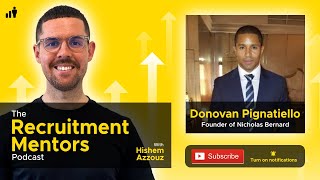
In this episode of the Recruitment Mentors Podcast, host Hishem Azzouz interviews Donovan Pignatiello, co‑founder of the specialist SAP recruitment firm Nicholas Bernard. Donovan shares his personal journey from university graduate to international recruiter, emphasizing that hunger and determination are innate traits that cannot be taught. He recounts his early solo years working from a bedroom, the partnership with Richard Onyedua in 2013, and the gradual shift from a lifestyle business to a growth‑focused operation that now employs 13 staff and generates just under £8 million in turnover. The conversation explores how Donovan’s background in Muay Thai shaped his business mindset—discipline, strategy, and a do‑or‑die attitude translate into recruitment practices. He details the hiring of inexperienced graduates, a hands‑on training programme based on live call coaching, and the importance of hiring for drive rather than pedigree. The duo’s growth strategy hinged on building a financial “platform” through market intelligence, focusing on key global clients, and expanding into the US and Asia with a US C‑Corp to meet local client expectations. Donovan discusses cultural nuances of US recruitment, the challenges of the COVID‑19 pandemic and economic downturn, and how strong processes and employee communication helped the firm stay profitable. He offers advice on international expansion, client relationship tactics, and the future of the industry, warning that automation could erode the human touch. The interview concludes with his vision of creating a multinational recruitment conglomerate and reflections on influential books and personal milestones.
Chapters
Welcome to the Recruitment Mentors Podcast. My name is Hishem Azzouz. Today I'm very excited to be joined by Donovan Pignatiello, uh, who is one of the founders of a global specialist SAP recruitment agency called Nicolas Bernard. Um, Donovan formed this agency 10 years ago by himself, but from 2013 he has been growing this business with with his business partner, Richard Onyedua, for the last 7 years. They currently have 13 employees in the business, and last year turned over just under £8 million. Donovan, thanks for joining me.
Thank you for having me on this podcast, Hishem. I've been listening to it for the last year and a half, really. And yeah, thank you very much. You've added a lot of value to this recruitment space.
I appreciate that, Donovan, and safe to say we just practiced 3 or 4 times the names before we did that. But where I want to start, Donovan, the first question is, in your opinion, what characteristics and traits do you think make up a highly successful recruitment consultant?
Well, characteristics. First and foremost, you need to be hungry. You know, everyone says that they want it, but when it comes down to the actions, you really see how hungry, how hungry they are. So it's got to be number one for me is hunger, determination, and there needs to be a reason why that person wants to achieve it. Hmm.
Do you think that hunger can be taught?
Definitely not.
Really?
Definitely not. No, it's Hunger is a character trait. It's either you're born with hunger or your circumstances in life is going to give you a reason to have hunger. But you can't teach someone to have hunger. You can teach someone skills, a process, an industry sector, but you can't teach hunger. It's either you've got hunger or it's either you're, it's either you're put into a situation where you develop hunger. But it definitely can't be taught.
Do you think— so just interested on this, so I think safe to say a lot of younger generation get a bad reputation for not being as hungry or not wanting to work as hard or whatever. Would you agree with that?
I've seen it, yeah. I would agree with it to a certain extent, yeah.
Really? Interesting. So look, Donovan, So what we're going to focus on today is definitely sort of Donovan's recruitment business owner journey. And obviously that spans over 10 years, but obviously before that, from what I can see, you worked as an employed recruiter for over 5 years, right? Before you got to that point of starting your own business.
Yeah.
So let me just start here. What gave you the confidence to go out on your own? And start a recruitment business. I think that's what a lot of people lack, that confidence or the willingness to take that jump. So what would you say, looking back, gave you the confidence to start your recruitment entrepreneur journey?
Well, to be quite honest, I always knew from when I was at university that one day I was going to have my business and my own business, and I didn't know what in, but I always knew that I would be running my own company one day. And I did international business with languages at university, and it so happened that I managed to get into international recruitment where I use languages almost every day.
What languages do you speak?
So I speak Italian, French, and Spanish.
Really?
Yeah.
Well, I didn't know that. Definitely. I mean, with a name like that, I guess people would expect it.
Well, that's awesome. No, no, when they see me, they definitely don't accept it.
Okay, so you got into that and then, okay, in international recruitment, you utilizing your bilingual skills.
Yeah, because I first started off doing telecoms recruitment for the South American market. I worked at a company called The Blue Group, which got bought out by Mawson's International. And then this was in 2004, and then I went in doing SAP recruitment for a company called Square One in 2006, and it was all international-based. I've only ever done international recruitment contracts.
That's interesting. So always— so you've always done contract recruitment, international markets, and have you always utilized your bilingual skills? Really?
Yeah, yeah. So when I was recruiting, um, for telecoms in South America, it was Spanish-speaking. Even I was doing the Brazilian market, and I would speak slowly to clients in Spanish, and they would answer me slowly, very slowly, in Portuguese, and we could understand each other. And yeah, I'll be closing deals like that.
Amazing.
Yeah, German managed to do a client visit in Brazil once.
Really? That's awesome. So where did this hunger for your own business come from then? Talk to me. What, what— did you have parents that were entrepreneurial? Did you, did you think that was the only way to build a life that you wanted to provide yourself and your family? Like, where did that hunger come from?
Um, to be quite honest, my, you know, I didn't come from any privileged backgrounds. My parents had to struggle in life, and, um, yeah, that was always just drummed into me that you've got to work harder than everyone in life. You've got to do things to become somebody and achieve. You know, a certain, certain status and achieve big things in life, basically. So my mom always drummed that into me from a young age. So I guess I always knew that if I wanted to do things, then I would have to work. And yeah, what better way than work for your own self?
Yeah, for sure. So, um, before you started Nicholas Bernard and went out on your own, Yeah. So you worked at a business for nearly 4 years before you took the leap. So I guess what sort of things happened for you to be like, right, I'm going to do this on my own? Did you have a really good year? Did you think, right, why can't I do this for myself? I'm making this company money. Was there anything in particular that gave you the confidence to start this venture?
To be quite honest, before I set up, I had some up and down years. So I had a good spell at the Blue Group where I was doing telecoms recruitment. I got a bit fed up of, you know, just doing the different hours because I was doing South American or US hours. And at the time, the US dollar was very low when you converted it back to pounds, which meant that commissions were quite low. So I wanted to do something more European-focused. Um, I went to Square One, and then I went to, to, um, a company called Spring Technology, which was then bought out by Adecco. And then the financial crisis hit, and I was specializing at the time placing SAP consultants into banks, you know. So I went from zero to zero literally overnight. And, um, yeah, I ended up— I left Spring and then went to some absolute shit shows. And I thought, yeah, I went to some, you know, I went to a company in particular which I thought I could just do a better job with my eyes closed. So yeah, I just thought I'm gonna do it.
So let's break down this journey then, because we're talking about this before. So at the beginning, I think you'd agree that you— it was a bit of a lifestyle business, right? Um, and that was the first couple of years, it was just you Working from home.
Working from home.
And then just for context. Yeah, from your bedroom. So just for context. So for first 2, 3 years, that was that. Then obviously 2013, and as I explained in the introduction, Richard then came on as your business partner. Again, as we discussed then, obviously the both of you then building up some traction for Nicolas Bernardin, making sure that this is a business that you can grow. And then for the last, sort of, um, 3 to 4 years, you then focused on, on growth and hiring people, etc. Yeah. So let's just, let's just focus on just quickly the early days.
Yeah, right.
Because obviously you working from home in your bedroom, and then you also had a, um, a Muay Thai. So was you doing Muay Thai professionally at that point, or—
Yeah, so I, I did Muay Thai back in early 2000s and, you know, I focused on university and starting out in recruitment and I bought my flat, my first flat in 2005. Yeah, 2005 it was. So, you know, I stopped all of that and then I went back to it when in 2010 when I had started or set up Nicholas Bernard from home where I had a bit more flexibility and it was essentially a bit more of a lifestyle business. And, um, yeah, I used to train twice a day. Really? Yes, 6 days per week. And, um, I ended up fighting in Thailand. I had, uh, 9 amateur fights and about 6 professional fights at the O2, Indigo, at Scala in, um, in King's Cross, and at Coco's in Camden Palace. Um, I fought under a gym called Team 2 at Gymbox. So it was, um, you know, it was, it was quite good because I would get the train into Bank in the morning, go to gym box, train, go to Shoreditch where our office was, and, uh, yeah, crack on in the evenings.
How long did you do that for, the whole fighting thing?
Probably about 4 years.
Okay.
Yeah, it was, um, yeah, so interesting, tough time.
Yeah, for sure. So like, so let's just talk a bit about— I'd love to just sort of for you to share the sort of comparisons that you see in sort of being in that environment, training, fighting, and how that's translated into Donovan business. Because for me, I'm a huge fan of MMA. Yeah, I've only done like 5 Brazilian jiu-jitsu classes and I hurt my knee and haven't been back. So that's— I used to do karate when I was a kid. But for me, what I absolutely love about watching MMA and I have the utmost respect for you is that when you're in that— and we spoke about this before— but like, when you're in that environment where you're in an amateur fight, professional fight, um, you're in complete survival mode. That, like, that you— the only thing you— the only thing that you can be is present and, and like completely focus on the task at hand, right? So I'm sure there's been— you've been in deep uncomfortable situations and, and all these sorts of things, but would love you to share. I haven't had many people in here from a background like that, um, on this show. So like, for you, looking at your sort of, um, business career and your entrepreneurial journey, how— what similarities do you see in Donovan, Muay Thai fighter, doing that, going into those, those fights and being a business owner? How's it helped you?
Well, it's do or die, isn't it? So when you set up your company you have to do deals or you die. When you're in combat, it's either you do them or you get done, you know. So look, there's a lot of, there's a lot of, there's a lot of similarities between the both because they're both about strategy and having discipline. If you don't have discipline in a business, you're probably not going to lay down the foundations that allow you to grow your business. You're not going to you know, do the, the rounds, the groundwork. You're not going to call your candidates, your KPIs, add your contacts. Just like when you're a professional fighter or a professional athlete, you've got to do your cardio, you've got to get your technique up, you've got to think with your brain and get your strategies. Because, you know, just like you can't just call any client and say, okay, well, have you got any jobs? You know, I'm Donovan from Nicholas Bernardak Supply Consultants, have you got any jobs? You've got to come with a strategy. So You've got to find a unique selling point. You've got to find market information, speak to candidates. If you're targeting, for example, you know, BP, speak to all the candidates at BP and understand what's going on at BP and then call the manager and say, look, I know that you're doing this, you're doing that. If you're fighting an opponent and you know that he's a boxer or a kicker, or he's going to have you in the clinch, you've got to play or you've got to be able to stifle their strategy. So You know, it's, um, they're both, they're both very similar in the way that every day is an attack, is a day that you have to fight for survival, especially in business, you know. So the bigger companies are more equipped to, you know, fight for that territory, for that market share, for that client, you know. So it's, it's a question of you know, fighting them off. And you've got to be— have that same mindset as you're going into battle, you know, every day. You've got to believe in your capabilities, believe in your system, and apply everything that you believe in for you to be able to realize that success and that tiny step towards being closer to your goals, you know.
I like it. Strategy, discipline, Mindset.
100%. I mean, discipline to anything is the key. If you're losing weight, if you're wanting to learn an instrument, if you know you want to take up a new sport, it's all about discipline, isn't it?
Donovan, why do you think people fail at discipline? Because I think everyone listening would know. I think everyone knows how to lose weight. Everyone knows how they could be better or improve. But obviously you hear consistency is king and discipline like Like, what— why do you think— and like, you've obviously being a fighter, that's something that you would, you would have to be non-negotiable with your discipline. Otherwise, when you turn up to fight day, there's a good chance that you're going to get knocked out or, yeah, you could be seriously hurt. Or when you turn up to go on the scales and you do your weigh-in, if you haven't been disciplined, then you might not be able to fight and you might not be able to earn the money that you've been working up, whatever, right? So why— I'll just be interested to get your thoughts on that. Like, why, why do you think people fail at discipline?
I think people have just been wrapped around in cotton wool a bit too much. Some people aren't really prepared to go through the depths and probably put themselves in, in comfort situations. You grow when you're out of your comfort zone. You know, if you're, if you're starting out and you're scared of rejection, you're never going to understand how to get around the rejections. You've got to be able to just, you know, not take it to heart, you know. In anything you do, you have to— if it's easy, you're never going to learn, you know. A client's never going to answer all your calls. It's probably going to take them— probably, it's probably going to take you 10 times to call them and then they answer. And then when you speak to them 5, 6 times, or 8 times, then they're going to start to remember you and probably start to buy from you. So I think that people are probably— they need to condition themselves more into this is hard, not anyone can do this, and you need to be resilient and carry on, and eventually it will all add up as a compound effect to, you know, creating that picture.
Yeah, I think they're just— the interesting point on that is like, I think a lot of people assume— I think this sort of gym and working out and stuff is, is just a good analogy. But like, if I was to look at you, Donovan, and be like, wow, he, he works out a lot, he looks in great shape, he must find it easier than I do. Or for example, running. For example, a lot of people may look at people that do amazing runs and all that and go, they must really enjoy running. But I'm sure, hopefully you agree, but I can relate to running where I used to be the person, I'd say I hated running. Yeah, but it's the people that, it's not, it's not, so it's the mindset of, okay, yeah, you might hate it, but it's those that push through that and still do it, isn't it?
Absolutely.
So it's like, don't assume that people, like, you might look at someone going, oh my God, they're so good at business development, I'm finding it really difficult, blah blah blah, they must find it easy. Well, actually, no, they've pushed through that discomfort to give themselves more of an opportunity to find it more comfortable or be more competent in the uncomfortability. Do you get what I mean?
Absolutely.
Yeah.
And look, there's some elements of recruitment that I don't like to do, you know, but I know that has to be done. You know, if you, you know, you have to, you have to do your groundwork. You have to speak to candidates to get leads. If you don't speak to candidates, you don't get leads. You have to map out clients. Okay, there's certain elements of it which are boring but fundamental, you know. So I never liked running, but it was a core part of what I did. And, you know, there's a lot of elements in recruitment that you're not going to like that you have to do.
Yeah. So quickly then, how would you describe early days of Nicholas Bernardin? Just you smashing out at home. How would you describe those early years?
Well, working from home, I didn't like it because, you know, it's, it's very easy to be comfortable and distracted, definitely for me. And, um, I think I wanted at the time, I remember that I wanted to have— I lost engagement with colleagues and, you know, just general camaraderie in the office. So when my business partner, um, Richard joined in 2013 and we got an office in Shoreditch, I thought, great, I can get up and go to work again. And yeah, it was great. It was great. But, you know, we still had ups and downs. It wasn't, okay, now we're in the office and we're smashing it, you know. So there was ups and downs in that.
Okay. So what advice would you give then to a younger Donovan starting this business?
Mm, just, well, I found that there was a bit of an illusion at first because, you know, I had the whole world that I could contact and there was no restrictions. But then it's like, okay, I can speak to everyone and anyone, but then where do I actually start? So You know, it's, you always need to just focus in one territory, focus in an area, you know, like you said, double down, like I hear you say on many of your podcasts, you need to have just like a, be a specialist in one area, then you, or one client, and then you could branch out, you know? So, um, I think at first I wasn't as focused. I was just running around the market, just trying to chase any, any, any within, yeah, within SAP. But even that is too vague.
Okay, so when, um, uh, Richard came in then, what would you say was the biggest impact? Like, what was the biggest impact Richard had, or him personally, or just having another human being involved? Because obviously it was just your own, and I think a lot of people are quite worried about starting a business on, on a recruitment business on their own. So like, what would you say were sort of the, the best things about having someone involved in your recruitment business?
Well, for one, you don't want to let your business partner down.
Accountability.
Accountability. Absolutely. So, you know, you don't want to be late because then you don't want to— you don't want that person to think, oh, he's taking the piss, or you don't want to have another day off or half a day. You want people to think, okay, yeah, the person I'm in this with is great. You know, if I'm going to war with someone, I would want to go to war with that person. So it makes you raise your standards because you're no longer you're no longer just keeping yourself, answering.
Yeah, you're not just holding yourself accountable.
Yeah, precisely, precisely. So, you know, it slowly added a bit more form and shape to it being a small business. And, you know, I'm a very process-orientated person, so, you know, it was just another piece of the puzzle of a system that was being created that, you know, let us scale eventually. You know, to be the company we are today.
How, how easy did you find it having to like answer to someone else, or you couldn't, do you know what I mean? Like, I don't know, like, did you find that difficult?
No, to be quite honest, we don't answer to each other, but it's, you know, it's obviously a respect thing where you want, you know, we always communicate and, um, you want everything to always be clear, crystal clear, and Yeah, it always has been, to be fair. You know, if you do, if you do something in the best possible way, then other people will see that. And, you know, it doesn't, it doesn't become a question of answering to someone else.
Okay. So Richard joined in 2013 and then you didn't make your first hire until when was that roughly?
So we hired 2000, July 2017.
Okay. So yeah, solid 4 years of obviously building. So like, what, what, like, did you guys have a plan when Richard joined? Like, what was the plan? Tell us a bit about what the intentions were for those 2 to 4 years with Richard being involved.
So the first plan was for us to build as much as possible and just pay off large chunks of our mortgages off. Okay.
And we will just absolutely smash it out.
Yeah, and then we would just, you know, both put in, you know, a percentage or a part of our billings into a pot, and then that pot finances hires. So, um, yeah, we had— we both got to a level that we had some solid billings, you know, and, uh, yeah, we went for it.
Give us some context, just you two. What— tell us how long it took traction. What was you guys billing? 'Cause it's all contract SAP.
Yeah, so I was billing about 240 a year and Richard was doing the same and then we started employing. But do you know what, even with that, a lot of people think, okay, well, you know, I'll just set up and just do it all myself. But it's a lot harder than that because you've got to, you can't just be a biller, you've got to be a businessman, you've gotta be able to set up a system. You know, or you can't just have one lucky year where, you know, you've come across a client and, you know, they're hiring loads and then it all goes bad, you know, because then if you start hiring people and you don't have that solid foundation of client giving you jobs or clients giving you jobs, then, you know, you could find yourself a bit in a sticky situation. So, you know, we was both billing like 240 grand you know, for the year and we had a solid base where we could just thought, okay, this is a platform that we can actually go and create something with.
Let's just talk a bit about that platform, Donovan, and then let's talk about the sort of last 3 years because I think that's interesting, right? So like what you did it in the— so basically what you've done there is you've de-risked the risk of hiring more people and growing the business, right? Yeah. Yeah, building a platform. I'm assuming there's maybe some systems that you thought about as well. We might have some sort of key accounts, but like, When you say platform, talk to us a bit about that because I think some people benefit from that who are thinking maybe they want to grow this business but not sure of when to hire or like where to get to. Do you get what I mean? So you mentioned a bit about billings and revenue that you're bringing into the company. But yeah, what was the sort of, I guess, what were you and Richard aiming for to get to, for you guys to have confidence and be like, right, let's start trying to grow this thing now? Yeah. So I'm assuming it could be, I don't know, in terms of money-wise, you wanted saving where you gave yourself a 6-month, 12-month runway, or it might have been certain systems. Like, what was you getting to for you two guys to be like, right, let's get more people involved and try and grow this business?
Well, to be quite honest, is when we had— when the market was really good, we got to a point where we had you know, a good amount of money in the business and that we had refined our systems. Our database was, you know, pretty much spot on and we just thought the time was right, to be quite honest.
Okay.
Um, plus also, it's also down— it was also down to our natural progression as individuals because realistically, if you're a one-man band recruiter, you're just a recruiter, aren't you? But for you to evolve and get to that next level, you need to have people underneath you to manage, lead, and coach, you know. So the time was right, and we felt that, you know, we had had a good spell, but we wanted that next level and that new challenge in terms of, you know, bringing people on and training them up. Okay. So forth. Yeah.
So how did you go about this then, Donovan? Because you're in London. Yeah, there's a lot of recruitment businesses in London. It's you and Richard smashing it out. Like, how, how did you go about getting people into this business and not for the challenge? I think that, that's one of the biggest challenges for a lot of recruitment businesses or smaller growing businesses. So like, how did you then— did you get people without experience at the start? Did you just— so you just hired one person, or did you hire quite a few initially? Talk to us a bit about how you try— how you aimed at growing it.
So basically, we hired grads, or well, we hired inexperienced recruiters, people that had some sales experience, and we just trained them all up. So we put together a training program, and yeah, we just had some good hands-on We were like their mentors, like you go to the gym and you have a personal trainer, but it's just like that. So we hired our first consultant in July 2017. We hired one, and then we hired our second employee in October 2017. And, you know, things are all going good. Then 2018, February, we hired two 2 more at a time. And, you know, we thought, okay, well, let's just limit the work. It's the same training, you know. We had the cash, we had the, we had the, the funds to be able to facilitate it. And then we just kept on hiring, probably like, uh, you know, 2 every 5 to 6 months.
Okay, so when you say training I know you just mentioned there where it's like hands-on stuff like that. Just give us a bit of a flavour of that because I think that's where I think it comes back to systems, doesn't it? And I'm assuming that you're thinking, well, if we have a training programme now where we are, then that hopefully will come in handy when we get to 20, 30, 40 people, right? So I guess what, like, some recruitment owners that are sort of where you're at, they may think, well, I'll give them a phone and then I'll sort of just answer their questions and stuff like that. Like, what, what were, what were the— what did that training program actually consist of, out of interest?
Well, to be quite honest, it's— there was no glossy, you know, handouts. It was just getting on the phones and doing the work, right? But we would be listening to, you know, all of the calls. They would literally be sat next to us, and after every call, we would be like, okay, the candidate said this, it means this, therefore you've got two options. You can either do that or this alternative, and this is what you get in both situations. So it was like a case study on every call, you know, and that, and, and, and we found that people would learn a lot better, a lot more, should we say, than, you know, some of the bigger companies are just like, all right, here's some numbers, here's the phone, just crack on, you know. So it was really just proper coaching, should we say.
Yeah. Okay. And, um, look, it's something that people are always interested in, Donovan, like, and I think back to the first question, there's so many different things that— well, there's so many different types of successful recruiters, different backgrounds or whatever, but like over the sort of last, yeah, 3, 4 years where you've consistently hired now, like what are your non-negotiables when hiring for your business? Like what do you look for? And yes, work ethic and these things, but like what do you actually look for? What are the non-negotiables for you?
Um, So, you know, we haven't always got it right, but we've got it right more often than not. It's just pure drive and hunger, you know. I, I don't really— I'm not bothered about if, you know, someone comes from money, good upbringing, because I'm not going to generalize. But if you've had hardship if you haven't really had much in life, there's a chance that you're going to be more hungry to go and get it, to make it happen. So that's what we personally look for, you know. We look for hungry, you know, just diamonds in the dirt. Seriously, that's what we look for, diamonds in the dirt. And, you know, we polish them up, we'll give them a chance, you know. A lot of the people, they probably wouldn't you know, they wouldn't have been seen by the bigger, the bigger, more corporate recruitment companies, you know, which is, you know, if you can sell, if you've got that drive, then yeah, well, we're interested.
What are we looking for here then, Donovan? Like a back— a rough, like a backstory, like I had it hard when I was younger, I'm here to like— you know what I mean? Are you, are you digging for that with people?
No, to be quite honest, it's like everyone's got to be themselves, you know, but We've hired some people that, you know, dress well and, you know, they're quite polished. And then when they come and, you know, they say they want to be successful, they say they do this, but then it's like, okay, I'll call this client later. Well, no, call him now. Oh, I just tried him once or twice. No, you've got to be on it. You've got to be on it because every time you're not on it and calling and making it happen. You know, when you're racing with your competitors on that job, believe me, they're going to harass that client, that candidate. It comes down to drive. So where people don't have it in them to, you know, just, just not just be persistent, you know, that's, that's, that's what, that's what we look for. People that are just, they need to earn money, you know. If we think that you don't need to earn money, if you've got it too easy, then look, it's better that, you know, they go to some of the bigger companies because you've got to understand, yeah, when we started we didn't have any external backing, you know, we just did it all organic. So we've gone for a slower approach where we're training up people ourselves. And yeah, we want to— obviously we're a business, we need to see a return, so we need to hire people that want to change their lives, that want to make an impact, you know, in, in the recruitment world.
And would you say, like, that training and your time has been more so than not worth the investment?
100%, yeah, 100%, because it's like, it's definitely worth the investment because you're you're, you're buying, you're employing people when they're cheaper and then you're training them up. You know, it's like you're getting— it's like, you know, being Arsenal that, you know, develops youth academy and then they grow into, to players. You know, obviously it's, it's, it's definitely worth an investment, but I went to the recruitment fair, I think it was last February, not this February gone, the one before that, and one of the speakers, I can't remember who, they said that, look, you can't build a recruitment company on inexperienced recruiters. Really? But yeah, yeah, you know, on grads, inexperienced. I mean, once that you're a certain size, you can bring an academy and just bring an L&D person and then just train them up and, you know, just 10 in 8 out at the end of the month, 2 sticks. But look, you know, we've, we've done a good job of it so far, but obviously there's going to come to a point where we're probably looking at more experienced recruiters. But yeah, it's worked for us so far.
Okay, so what, what were some of the sort of key ingredients to Nicolas Bernard going from— yeah, you, you and, um, your business partner doing $500K or so revenue between you, then hiring people to now, yeah, last year did $8 million in turnover. Like, what were some of the sort of key things that you think has enabled you to get to that point? Because that's an amazing achievement. But if you think of that, obviously you're a small business, right? So to be generating that, that's great. So like, what were some of the sort of, so you're mentioning around the people, training them up, the right types of people that you're getting into the business. But what else do you think that you and Richard have sort of had to change or have implemented that has enabled you to achieve turnover like that?
To be quite honest, it's having market information and going for quality clients.
Right.
When things started to go really good for us is because we had some We had a strategy and this strategy was complemented with having a couple of key clients that enabled us to deliver and have a good financial, you know, platform for us to grow, you know, so focusing on certain key clients in regions and yeah, just, just being able to deliver on them. but that comes with having the market knowledge, being a subject matter expert in, in your fields, you know.
What— so look, let's talk about that because I think a lot of, like, hopefully you agree, but a lot of recruiters get fixated. And this has come out from some of the conversations recently where I had a, um, chap called, um, Oliver on from Faden International, that are a global organization scaled to 800 staff, and they've done really well in America. And one of the things that he thinks is the, the key reason why is that they really impacted the culture of instead of sort of getting a new client, doing really well, then rinse and repeat with the next new client, new client, actually what they ended up doing is, yeah, focusing on key clients, expanding those accounts. They ended up building a whole team, client services team that then turned, I don't know, 6-figure accounts into 7-figure accounts, right? So from your perspective, What was you looking for that you think, or gave you more confidence that these could be a key client or a good client? Like what were you looking for? What was you trying to gather and understand?
Well, to be quite honest, we started to have a different approach. So a lot of our competitors were supplying SAP resources across Europe and we started to branch out further afield. So You know, since 2014, we started doing lots in the US. We had some key accounts that focused our delivery in the US and Asia. So we weren't just another recruitment company doing, you know, prospecting for the European markets, but we were able to follow implementation projects globally. And, you know, there were certain regions where we didn't really have much competition, you know, and that allowed us to really, you know, just form a partnership. And yeah, the billings rose with those partnerships. So, you know, in 2016, we set up a C-Corp in the US. The plan is to, because we did probably about 50% of our revenue out in the US. And, you know, the plan is to, to grow that part and just have, you know, troops, troops on the ground in the US in probably a couple of years.
Okay, yeah, that makes sense. So actually your competitive advantages and how— so it's actually been, yeah, global, a global focus. Yeah, actually.
Okay, so we've still had a focus in Europe, but You know, it's been like, you know, we can follow your implementations across Europe.
Yeah. So instead of— yeah. So, yeah. So like you might have got a client in Europe where you supplied X amount of people for an implementation and then you've gone— yeah, exactly. Whereas before, what you're saying is, well, actually we made sure or we aim to start working with clients that didn't just have an EU operation or whatever they had. Global footprint, which meant we deliver well here, then it's like, right, who's dealing with your Asia implementation, whatever, we can supply that, blah, blah, blah, right?
Exactly.
So let's talk about this then, Donovan, you're someone that's bilingual, right? You may have noticed this, but there's definitely more UK agencies going to America. There's more UK agencies just focusing in the EU markets. So talk about the nuances that you've had to adapt to, like What have you had to change in your approach or what have you had to learn about the American culture that you've had to adapt to? A lot of people are interested on if I'm, if I've typically been a UK recruiter, but I've heard the fees in America are much larger or actually there's a real option, like the UK is just completely saturated. I'm just going to do Amsterdam and this skill set or whatever. Like, let's talk about America first, because I think that's quite popular. What, like, what have you had to adapt to? What things have you picked up on that you've gone, oh, 'That's a bit interesting, I'll make sure I don't do that next time,' or what have been the main differences that you've picked up on?
Well, the more we started to do, um, the more we started to trade in the US, the more our clients or prospects, clients would ask if we had a local entity out there, and they didn't want to be invoiced by a European company or a foreign company. And there was a lot of, you know, bureaucracy and just a lot of paperwork, a lot of hoops to jump through just to avoid that. So to bypass that. So we ended up setting up a company there. And yeah, still it's been, it's been challenging because, you know, there's— unless you're actually there, it's a lot more difficult to gain the trust from US clients when you're in Europe, or even US candidates. Some, you know, some will be like, well, how do I know I'm going to get paid? I don't really want to work with a non-US entity, you know, even though that SAP is a German software, European software. And I just— yeah, but yeah, that's all fun and games. But also the hours. The hours is a killer. Really? The hours is a killer. Yeah, I was I was doing 14 hours a day, coming home most nights at half 11. Yeah. Still having my phone just beefing with emails and that.
So what about, so you mentioned a bit about, yeah, so yeah, dealing with, well, have you got an organization in America or whatever? What about, so one of the conversations I had recently with a chap called Luis who has actually moved out to Boston, Massachusetts. And one of the things that he shared, be interested to get your thoughts on this, is that he's had to really change his approach in making sure that he builds relationships with internal recruiters. And that's actually helped him open up some big accounts, whereas before he used to do the Danish market and he would be super direct, go straight to the CEO and wouldn't always go through the internal recruiter. But that's something that, actually ends up being more damaging than positive. So what's been your experience in winning accounts? Have you had to go for internal recruiters? Have you had to adapt that or what's been your experience with that?
No, not really. No, we haven't really had to do that in the US. To be quite honest, I think where the US market is different is that you've got a 180 model, which is basically just, you know, someone that's just doing delivery. And then you have someone that's just focusing on business development. You don't really have much of 360 recruiters. Now, from the client point of view, it was literally just it directors or ERP managers that we would, or well, that would always be speaking to. So I don't think it was, you know, that different to I mean, I think this is going to depend on the sector that you're in, but yeah, it's not going to be that different to, um, the setup in Europe, to be quite honest.
Okay, interesting. So, um, look, so what, um, what's helped you get through the last 6 or so months, Donovan? How have they been?
Um, yeah, it's, uh, it's It's brought us back down to reality. It's definitely been humbling. But we, we've had good— we've run the business in a very good way. So, you know, we've— we're still financially healthy. We're still making a profit. You know, we still haven't had to use any of our savings as a business, even though that we've— we're in the, you know, the worst crisis human race has ever seen. Um, look, if you do good things in the good times, then in the bad times you should be good, you know, as long as you've got discipline again, you know, and you're doing good processes, then, you know, it makes the hard times easier to survive. Now, um, we were, we were very good. We topped up everyone's furloughs. You know, that we paid everyone an extra 20%, we paid everyone full commission. And, you know, some of our, a lot of our competitors, and I heard a lot of other agencies were paying half commission, 33% or whatever it is, you know, we paid everyone 100% commission and we topped up people's furloughs. So, because we had a good, good solid foundation, but yeah, it has been hard. You know, we have come back.
Well, what's been your biggest challenge?
Biggest challenge is, well, look, we not all of our sales force, not all of our recruiters were experienced. So having people which are still training and got, you know, less than a year's experience working from home remotely when they still need guidance that's challenging, you know. So when lockdown happens—
smashing it out.
Yeah, well, this is it. And when lockdown happens and you've got runners that are finishing left, right, and center, and you don't have the workforce which is, you know, working to, to, to add to the runner base, that obviously becomes a big challenge.
So yeah, because I've, I've heard that a lot. Donovan, was— did you— do you have conversations conversations where, or did you literally go from X amount of contractors out to dramatically dropping by, I don't know, 50, 75%, which you then had to build up? Or I've heard— yeah, yeah, like how—
yeah, definitely.
What was the thought process then? Would you like, oh my God, are we literally gonna have go from X runners to zero?
Because when you're in the ring— sorry, go ahead.
I was just gonna say, I've heard a number of stories. So I spoke to a guy the other day who was in— he's always done contract, he was in construction, and literally he went from a £6,000, £7,000 grand book, it was just him, to a couple of hundred quid overnight.
Yeah. Well, you know what, it's just like when you're in the ring. So, you know, if you're in the ring and someone comes at you and they want to take your head off, you're not going to panic. You've got to have composure. You've got to believe in your skills, believe in your processes, believe in your strategy. And you just, just got to work the game. So, you know, look, this is a cycle. So we're in the down cycle now. We've, we've built the business in a certain way that we have to, you know, keep at it and carry on giving our best and training our employees and make sure that everyone understands that this is the hardest it's going to be for the next 12 years or so, because Recessions happen every 12 years, you know, the credit crunch last time and the dot-net bubble, um, which burst, you know, in 2001, whenever it was, in the year 2000. So every 12 years or so there's a cycle. Now this is the hardest it can be, so people have to believe in our leadership, they have to believe in the system, they have to understand what's going on in the world, and everything— the good days will be back. You know, you just have to carry on, work harder, because the market shrunk. You know, if you put the same activity in the good times as you do in the bad times, obviously it's not going to be enough, you know. So as, um, as long as people give their all and believe in, you know, our vision, then we're going to back all of our employees. And I believe we're going to come back out on, on the other side and, you know, just carry on with our growth plan.
So what I'd be interested in, so look, you've been in that environment where you've been in the ring and it's do or die, as you said, but like, how do you communicate that as a leader? Because you might know, yeah, look, this is really bad what he's talking about. Look, I'm— it might be more comfortable to you to be like, right, let's do this. Like, I'm ready to get at it and take action. But how did you then communicate that as a leader to your staff? Because I'm sure there might be business owners or even managers going, you know what, I've sort of weathered storms before, we can do this. But it's communicating that to the people that may not think that straight away or may have that place to go to, do you know what I mean?
Well, to be quite honest, we don't just wait for the bad times to try and communicate a message, you know. We've communicated messages in the good times, so to all of my, you know, to all of my employees, I used to tell them about, okay, well, look guys, you don't know how good the market is. You know, in the recession, in the credit crunch, there was times where we weren't probably picking up a job for, you know, a couple of weeks. You know, if you've got a job a month, it might, you know, sometimes, you know, I experienced that in that times and they couldn't believe it because they were used to picking up, you know, quite a few a week. And then when the pandemic happened, it was like, well, look guys, remember what I was saying, you know, about what it was like? Now you've earned your stripe. Now you're— this is where you're going to earn a badge because you're being a recruiter in the recession. This is when you're going to learn how to recruit when the market contracts. And when we get through this, you're going to be a better recruiter. You know, so we're constantly coaching and, and, and, and giving them the message, you know, not just now that Corona's here and ruining all of our lives, but, you know, we was, you know, just building them up and building the beliefs and making them understand how good the market was, you know, well before this pandemic.
So look, one or two things before, um, I ask you some quickfire questions, Donovan. Um, be really interesting to get your thoughts on this. So in, in your opinion, um, could refer to yourself or sort of people you've been around in your career or your employees, but, um, what would you say, or what do you think is the most important action or KPI that contributes to a recruiter's success?
Hmm. This is an interesting one. Look, I've worked with, I've worked with million-pound billers that just bash the phone out every day for 4 hours a day. I've worked with million-pound billers that were just street savvy. Just, you know, pure hunger. And I've worked with very successful, probably more average Joes and process-oriented person, but the number one trait that they all had, they all had was outworking the competition. No matter how much charisma you have, no matter how much flair, how much knowledge, that you have. Hard work beats talent all day long.
So the KPI is not a specific one, it's the volume that they do it?
Yeah, I mean, look, you've got to work smart, obviously, because, you know, the world's changing, times are changing. I mean, you know, now there's a lot more, you know, there's a lot of AI and email focus, email campaign and marketing. But look, however, however the times, you have to work I think your number one attribute, you have to be a hard worker.
Yeah.
You know, if you don't work hard, if you don't, if the phone's not going to call itself, you know, a client's not gonna, you know, just give it to you. So you've just got to go and make it happen, you know. But like I said, with the different types of very successful recruiters that I've worked with, they all bloody worked hard, you know.
Um, and, and final thing before I ask you these questions, because I think you're, you're very well positioned, if I may recruitment consultant or business owner, sort of this period has probably really showed me that I do need to not have all my client base in UK and actually internationalising and having more of an international footprint can actually diversify my business and give me more chance of dealing with difficult times. What would be your like 3 best bits of advice for me as a recruitment consultant or business owner to take my recruitment desk or market international, would you say?
So basically how to position yourself internationally, is that what you're asking?
Yeah, so like, so I think a lot of people during this period may have gone, you know what, I know America's not as bad, I'm going to go over there and try and win some business there or whatever. So I guess what I'd be keen just to get from you, because you have worked in always really international markets, if that's EU, Brazil, whatever. What would be your 3 best bits of advice for me if I've recognized that my sector, there's an opportunity to not just do it in the UK where it's more saturated, I could actually diversify and pick up business in the EU or America, whatever. What would be your 3 best bits of advice for me to do that?
Well, I mean, if in my field is multinational companies, so if you're dealing with a client in Europe, there's a big chance that they're gonna have an entity in the US and an entity in Asia. So if you're dealing with them in Europe, why not, you know, start trying to deal with them in the US and in Asia? So you've, you are literally, it's a warm call, it's a warm relationship, but you've gotta be able to back that delivery and have a candidate pool in the US or in Asia. So you need to build that that candidate network to be able to reflect that. You know, with that, you need to understand the networks because if you're trying to pitch people in the US and you don't understand the US rates and all the different, you know, business culture in a specific market, then you're going to fall flat on your face. And obviously every region has got different compliance You know, if, if you're, you know, there's withholding taxes, there's different, um, ways of doing business. So you've got to really understand, you know, what you can and can't do in different markets, because, you know, um, if a client doesn't pay you, then yeah, it's gonna hurt. Yeah. You know, if, if, if, if you haven't, you know, incorporated, if you haven't figured out that is withholding taxes and, you know, a country's got 20% withholding tax, then yeah, that's your margin gone to the tax, to the taxman.
Got that. I've got 5 questions for you, Donovan. Okay. Okay. And we'll finish. So first one, if you could change the industry, what would you improve?
If I could change the industry. Um, if I could change the industry, well, I think LinkedIn's changed it. Yeah, I think LinkedIn has really, uh, changed industry. I mean, it's put everyone on a semi-even, like, position where— yeah, where you don't have to be a specialist. You can just put an advert out. You don't have to be a specialist in SAP, you can just have big budgets, you know, put loads of adverts out on LinkedIn and you can reach the same people that, you know, we reach to, but not as fast as us because this is what we do all day, every day.
So what would you want to improve then? So what would you want to improve about the recruitment industry if you could change it?
To be quite honest, I think it's all going down it's all going down in automation and AI. I think the— I hope it doesn't, but I think that human touch element, I can see it going down an automation part, which I think could kill the industry in years to come. Okay. Yeah, that's what I would want to prevent, to be quite honest.
What book have you read that has had the biggest impact on you?
Hmm, it's quite a few, but Rich Dad Poor Dad 2, Cashflow Quadrant. If you want to set up a business, you need to understand what a business really is, because a lot of people work for themselves, they think they own a business, but they don't, they're just self-employed. So Rich Dad Poor Dad 1 is a good introduction, but Cashflow quadrant, that's the real one.
Like it. So if Donovan could write a LinkedIn post that could be seen by every single recruitment consultant across the world, what would you want it to say?
Oh, you really put me on the spot now, haven't you?
Um, what would you want it to say?
What would I want it to say? What would I want it to say? To be quite honest, I don't really know. I'm not gonna bullshit you. No, I don't really know.
Put you on the spot.
Okay, that's fine. You can tell I'm not a blagger. I'm real.
All right, what did you spend your first biggest commission paycheck on?
Well, that's not my first biggest commission. What, as in when I was First time?
Whenever, whenever, just whenever, like whenever.
To be quite honest, I bought, I bought my flat straight away. So I really— yeah, I bought a flat in literally within the first— I was, I was pretty much in my first year of recruitment and it was in 2005 and I just put all my money and just bought a flat. I'm a builder, I'm about, you know, just growing and making it happen. And once, yeah, then you could be a bit more flashy. Yeah, yeah, you know, it's, it's only in the last probably 5 years that I've started going on lots of holidays and just being a bit more, you know, just splashing out.
Yeah, enjoying your hard work.
This is it, and this is it. And there was times where, you know, I wasn't doing any that because I was just accumulating and grinding and yeah, then you just got cash in.
Last question. What is the ultimate goal for your recruitment career or your recruitment entrepreneurial journey? What's your ultimate goal?
Um, I would like to have, I would like to have a big, big, a big conglomerate of recruitment companies in different continents, different brands doing different technologies, and yeah, just be seen as a leader, as a pioneer.
Donovan, it's been a pleasure.
Thank you, Hishem. It's been a pleasure as well.
More from Hishem




You don't need as many clients as you think to bill $1 Million A Year In Recruitment



From 30 Direct Reports to Back-to-Back $1M Years as a Solo Recruiter with Zach Creighton



