Duane Cormell - Why adding value long-term will always win you business in recruitment
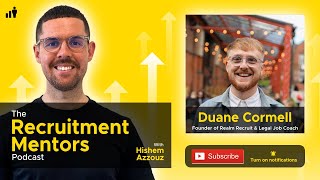
Duane Cormell built Realm Recruit from a failed first year into a legal recruitment firm approaching £1 million turnover by treating lawyers and law firms as partners, not transactions. He scaled too fast early on, over-hired, and lacked a clear value proposition. Now he focuses on ultra-niche work, consistent client delivery, and hiring deliberately.
Chapters
Welcome to the Recruitment Mentors Podcast. My name is Hishem Azzouz. Today I'm really excited to be joined by Duane Cormell, who is the founder of Realm Recruit and the legal job coach. Duane has worked in the recruitment industry for over a decade, but for the last 5 years he's been focused on building Realm Recruit, who are a specialist within legal markets. Despite challenges during the last 12 to 18 months, Duane has managed to come out the other side of COVID having grown his business in headcount and also as a business, they're well on track to set new records and hopefully achieve their first million pound year in revenue. Duane, welcome to the podcast.
Thank you so much for having me. I'm really excited.
So where we always like to start is In your opinion, what characteristics and traits do you think make up a highly successful recruitment consultant?
Okay, so, um, you had me on 15 Minutes with recently, and I touched on this point then, but we've got to start off with communication skills. Recruitment, in my humble opinion, is about people, and your success or otherwise hinges heavily I think on your ability to form relationships with them. And I think I shared this when we spoke before, but there's a book by a lady called Susan Scott called Fierce Conversations. And whilst I wouldn't necessarily recommend everybody go out and read it, there's a really powerful line that she uses in it, and the line is, the conversation is the relationship. And I found that really mega profound. Like, it was almost like this light bulb, cha-ching, moment. Yeah, like any relationship you have, yes, there's non-verbal cues and all the rest bit, but more than anything else, the quality or otherwise of them hinges on the relationship, the relationships you have. Sorry, the quality or otherwise of them hinges on the conversations you have, right? So you've got to have good communication skills, written, verbal. That's just a nailed on for me. And I'm sure it won't be long before I mention this anyway, but in Realm we use a tool called IMA, Identify, Modify, Adapt. And it's all about better understanding the way you communicate as an individual and the way others communicate and modifying and adapting your communication accordingly to better connect with people. And we've seen a lot of positives through putting that tool in place. So absolutely number one, good communication skills. The next thing I would say is empathy. Again, given that we're dealing with people and that humans by definition are imperfect and can sometimes disappoint. You've got to have a degree of empathy to really put yourself in the shoes of the other person, to see it from their perspective, because otherwise you're going to get worn down. In my humble opinion, recruitment is necessarily full of setbacks. I would also say that having good organisation is a pretty fundamental need. So whether or not the business you work in has got good systems and processes in place or not, I think you need to be able to organise yourself in such a way that it's clear day to day what you're going to be doing. It's clear how you're going to follow those organised— and follow those systems and processes, because ultimately there's that old adage about spinning plates, right? And recruitment is just like that. There's lots of things going on simultaneously. And if you take your eye off one for too long, it crashes, smashes, and, um, yeah, that necessarily comes through in your performance and your billings. And I'll go for one more if that's okay.
Yeah, that's fine.
Uh, resilience. Yeah, I'm trying to be positive and not be negative, um, and I've— but I've said it already, recruitment comes with setbacks, right? Everybody that works in recruitment knows that, and you've got to be resilient if you expect to have anything like a long-lasting, meaningful career in recruitment.
Yeah, for sure. No, thank you, great, great points there. So let's, let's just— obviously we're going to really focus on sort of Dwayne the business owner and, and the sort of Realm journey, but let's just touch on it really quickly because I think there's always sort of interesting stories or things to be learned from sort of early days in recruitment. So from what, from what I can see then Obviously went to university to do law, and then you graduated and then didn't become— didn't work in a profession, but decided to recruit lawyers instead. Yeah, basically.
It wasn't quite as strategically thought out as that, if I'm honest. Um, I mean, does anybody— does anybody deliberately set out to be a recruiter? No, I don't think they do. I think 9 times out of 10.
I think that's changing.
Yeah, no, I think I'd like to think it's changing because I think there's a lot going for this profession, otherwise I won't be here 10 years later. But yeah, and my point being, certainly when I went into recruitment, it wasn't a well-thought-out, you know, long-term aspiration. Frankly, it was something I fell into, and it was as simple as this: I wanted to be a barrister, it costs something like, certainly it did at the time, £15,000 to do a qualification after you've already paid for your degree.
Degree, yeah.
You've got to pay £15,000, you've got to find money to also live off in the meantime, and that doesn't even guarantee that you're going to get over the line. And I just thought, well, that's a bit of a gamble. And I backed myself at the time, don't get me wrong, but I thought what would be good is if I went and earned a bit of money first. To give me a bit of a safety net. And the company that I ultimately worked for, they basically hired me for two reasons. One, because I had a law degree and they recruited lawyers. And two, the patch that they wanted somebody to recruit into was in and around Birmingham. And 10, 11 years ago, my Brummie accent, being from Birmingham, was a lot thicker. So they were like, this guy can probably talk the talk with these Brummie lawyers.
Yeah, yeah, fair enough. So how, how would you describe your first year recruitment then? Because it's typically a difficult year for a lot of people.
Miserable.
Really?
Honestly miserable.
Why was it so miserable?
Again, I'm conscious I don't want to come on here and be all neggy because, as I've told you before, my non-negotiable with myself day to day is to be a positive person.
But I guess we can, we can put a positive spin on it and sort of talk about what you learn. But let's— I think people want to know that it's not all rosy and it's all positive, right? So share, why was it miserable?
It was miserable because I went into it for the wrong reasons to start off with. I thought, I thought, oh, it'll be a job that I'll earn a bit of money and it'll be easy and straightforward. And it's not that. Recruitment is not easy and it's not straightforward. As I've already said, you need resilience because there are a lot of setbacks. So coupled me going into it naively, coupled with the fact that I don't think I necessarily got the training, guidance, and support that somebody so naive and young and lacking in experience needed. Those things compounded to me not really performing very well. And when you're not performing very well in recruitment, um, in most companies at least, I don't think that's a very enjoyable experience.
That's grim.
And, um, I think on top of that, and this is nobody's fault, it's just the way it was, most people within that business were a good 10 years older than me. So just on a human level, there was nobody there I could really kind of connect with and bounce with day to day. So yeah, it was pretty miserable. And again, you know, if we're gonna— if we are gonna spin the positive of it, because there is a positive actually, it's that that made me lose confidence and made me think, I've really achieved nothing in this year. I've got no money saved to go and do this barrister thing, so I've got to keep going. And the more I stuck at it, the more I got into it, I suppose the more I did start to see the upsides of recruitment.
Yeah.
And I guess if I'd had a decent first year and managed to put some money away, I would have been like, great, I've achieved what I need to achieve, and I would have disappeared off and done the barrister gig, and I wouldn't be here today.
Yeah, that's a good point. So I guess for people listening then that might be going through that early period what would you say to them? Because obviously sometimes it can be really hard to see the light at the end of the tunnel, can't it, when you're working through that?
Um, I think that the hard bit is, I think what I would say to them would depend on why they're feeling like that. And when you're in that situation yourself at that time, you may not necessarily know. So for example, you may feel that way because you're not in the right company, because you're not aligned with what this company is about, because you're not getting the training support that you need. But that might not be that clear to you. But if, if that were the situation, I would say think twice about whether you're in the right place and maybe look around, because there are lots of really good recruitment businesses out there.
What are good— just on that, sorry to butt in— what are good questions these people can ask themselves? Because I'm sure these are types of questions you get your people to ask themselves that could maybe discover or unearth those things?
I suppose I'd start off with a fairly simple one. Do I feel like I know how to do this job?
Good question.
Because actually, if I'd said that to myself 6 months in— or let me rephrase it. Do I know how to do this job to the point where I feel capable of hitting that billing target that I've got? If I'd asked myself that 6 to 12 months in, the answer would have been no.
Yeah.
Um, and I think if the answer is no, then you're not necessarily in the wrong place. You know, the answer isn't always leave, the grass isn't always greener, but certainly you need to try and address that, that issue. And it might be going to your line manager, your director, asking for more support, training, or whatever. Or, you know, ultimately maybe it might be moving elsewhere where you're going to get that.
Yeah, nice. So I guess just on this then, just one or two more things on the sort of early days. What, um, what— so if you could go back and communicate to Duane then, as you were going into recruitment because you wanted to save some money to become a barrister, what would you— knowing what you know now, what would you say to him?
Well, because of that age gap, right, and because of it being my first real experience of being in an office setting, I suppose I felt that I had to behave in a certain way that wasn't natural to me, and I had to talk in a way that wasn't natural to me either. And I don't think that helped. So the first thing I'd say is be authentic. Own who you are. Certainly the more that I've done that in my career, the more I feel that I've benefited. That I've felt mentally in a better place. I feel that there's been success around me. So that would be one thing that I would say. I was really fixated on just being good at recruitment in the early days without really knowing what that meant. What I thought it meant was being good at putting in the hours, being good at getting the numbers. And maybe that's part of it. But actually, if what you're doing is making 50 BD calls a day and all those BD calls are, hi, have you got any jobs? Well, you needn't have bothered picking up the phone. You may as well have just sat there thinking about doing something else. But being truthful, that's the sort of thing that I used to do. I didn't know otherwise. Um, so with hindsight, I would advise myself now, um, the person I am now, I'd advise me back then, don't just make it about recruitment, make, make it about relationships, add value, talk to people in a normal meaningful way, and, um, don't, you know, don't try as hard, you know, focus on doing less and doing that less better.
Yeah, I love that. So, and then just the final point, just because I think by the time we release this, it will be— and we're doing a few things around just focused on sort of graduates obviously graduating this year, or just people going into the workplace for the first time. Obviously I've seen— obviously you hire quite— obviously you have a young, fairly young team. Um, yeah, I guess just, just a quick point, it might be related to what you just said, but like, what do you play— do you place grads into law? Firms, or is that not something?
No, from time to time, for time to time we do. Um, yeah, not all that often, but yeah, occasionally.
I guess the question just was, I was just interested, would be like, obviously having been a graduate yourself, or like entering the workplace for the first time, any advice for people that might be listening to this that could be find themselves entering the workplace for the first time, particularly recruitment? For me, I, I, from the, the messages that I get on a weekly basis, I really do feel like recruitment will become a career choice. Um, and, and I think hopefully part of this podcast, what it should be achieving, because it's one of our goals, is like actually painting a real picture of what to expect so there's less surprises, um, and there's a real picture going into it rather than just being sold the typical recruitment dream. So I guess anyone, just final point on this, is like anyone listening to this that might be graduating this year or is entering the workplace for the first time, which you can obviously relate to as well, like what would your advice be to them?
I don't know whether or not this is what you're looking for, but what comes to mind is that recruitment is a genuinely meritocratic profession, like much more than lots of other professions. And one thing that's kept me in recruitment, and we may come on later to why Realm became a thing versus why I, you know, didn't ditch and go and do the law thing. But I felt that actually there was the possibility in this space to really create something really exciting and grow it a lot quicker and be the leaders at it sooner than you could in other walks of life, certainly than you could in law. So that to me is a backdrop for me saying that it's a really exciting profession. You can achieve great things, not just financially, but in terms of where you can take yourself. There are graduates that have joined Realm who within 3, 4 years have been not just nominated but won awards external of the four walls of Realm, recognized as being the best at what they do. And objectively, probably are the best at what they do. They dominate the markets they sit in. So what you've got to be prepared for is hard work, a steep learning curve because there's a lot more to it, I think, than people let on. I would ignore what I believe, in my humble opinion, to be those ridiculous OTE 70 to 100K adverts that you see because it's a load of crap. That's not going to happen in year one unless you, you know, are, you know, the absolute luckiest person in the world and you kind of walk into a hot desk. So be prepared for a long game. But by long game, I mean, you know, 1 or 2 years of grafting and maybe not necessarily earning the big bucks, winning the awards, but then actually it can quickly take off thereafter.
Yeah, I love that. And I think, yeah, I think I would, I would just add, which is why I'm excited to get, do this sort of graduate series, is because I think working in recruitment just equips you with so many skills. Like so many skills that you probably didn't even expect. Might, you might end up going into recruitment thinking, oh yeah, I'm gonna, I'm a good salesperson, I'm gonna get better at sales, but there's just so much more to it. There's just so many more skills that you'll hoover up, and it will just, just for me, when you do it the right way and you have the right mindset and you're in the right environment, it can just make you a better all-rounded human with so many skills that just benefit all different parts of your life.
Absolutely. Do you know what, I'd like to build on that if I can. Yeah, we have a core training program at Realm and it's, you know, it really is just a kind of minimum that everybody needs to do in terms of training and development. And at the moment it stands at about 36 hours of training and only a kind of tiny part of that, 2-3 hours, is around selling and selling techniques. And of course we do follow-up, we do follow-up sessions on all of those core sessions. So you spend more than 2 or 3 hours learning how to sell is my point. But there's all that other stuff, all that other stuff. How to communicate better with people so that you don't unknowingly cause somebody else stress. How to remain resilient, practical steps to do that. How to organize yourself. You're absolutely right, there's loads to it that can benefit you above and beyond just a day job of recruitment, but you can take into your personal life.
Yeah, absolutely. And obviously future careers as well, outside of— yeah, 100%. Um, so let's, let's sort of take this into Duane being the, the business owner then. Always interested to hear— a lot of people talk about starting their own business but never end up taking that first step. So what, what gave you the confidence to take that first step and, and why?
Um, I have to be really truthful about this. I, I was 5 years deep into recruitment and The last 2 of those 5 years have been quite good in the grand scheme of things, though I still wasn't sure that recruitment was for me. And I felt like I'd finally made peace with myself in terms of I've gone into this and I've achieved something. Maybe now is a good time to get out. So I was actually thinking about finally going and doing that whole barrister thing, right? Yeah, but then along came one of my clients and said to me, we really like the work you've been doing of us— with us of late, and we were wondering whether you'd be interested in setting a recruitment business up with our backing.
Oh wow.
And I kind of thought, well, it's not really what I set out to do, but why, why would you dismiss that opportunity? They don't come along every day, especially attracted it.
Yeah.
Yeah, they don't come along every day. And I thought, you know what, this could be fun. This could be fun. And actually, it's that thing again about recruitment being meritocratic. I thought to myself, because I was still pretty young, I was like 26, I was probably— well, not probably, I was mad naive, probably more arrogant than I should have been. And I thought, do you know what, if I go and do this barrister law gig, right, I at best might kind of become a barrister and be a half good one in a few years' time. But, you know, I'm not going to reach the top of that profession for another 20, 30 years. I thought, you know what, this recruitment thing, if I get it right, you know, we could probably be best in class within 10 years. And that really excited me. So yeah, that, that was how it was born. Nice.
So you got back to do it?
Pardon?
Do you end up— did you end up sort of going down that route then? Did you end up getting invested to start?
Sorry, yeah, yeah. So yeah, I accepted their offer. I said, yeah, let's do it, let's do it.
I love that. I didn't know that, so I'm excited to get your experience on that, 'cause I think that is something that people sort of consider, think about, but again, I think it does, obviously the way that you described it, it seems pretty organic, it's from people in the industry, but I think, I don't know if you've spoken to other recruitment business owners about this, but sometimes it can get quite a bad rep on like, oh, aren't these people just there to sort of take my money, or aren't I gonna, it's just like, I don't know, it doesn't, there's been some not great stories around going down that path.
Yeah, I do hear a lot of that. I'm really fortunate that my experience doesn't correlate with that at all. I've had nothing but support and encouragement really along the way. Don't get me wrong, it's not been all roses. There were times in the first couple of years especially when it was, you know, it was tense, but that was because the business wasn't performing. And you know what, if a business isn't performing, the people that have backed it who are ultimately looking for a return, they're going to ask difficult questions. But to say, to go back to what you said, that some people see it that investors are just there to take away from you your money. I don't see that in my situation. I actually count myself really lucky, count my blessings and go, do you know what, Realm wouldn't be here today the business that it is, did I not have the backing that I've got? Not just the financial backing, but the people that did it. Because the truth is, our first couple of years were really tough and difficult. And, you know, other investors at that time might have gone, you know what, we're out, we've had enough of this. Whereas the people that backed Realm, I guess they believed in me and what I was saying and doing. They doubled down on their investment. And without that, we wouldn't be in this really exciting position we're in now where we've got the foundations in place and we're really fortunate to be able to look 5 years ahead and go, do you know what, that, that 10-year goal, we're on course to achieve it.
Yeah, I love that. So very quickly then, do you mind, are you okay to share like how it works? Don't have to go into like all the details, but like people, this is the stuff that people want to know. Is it, was it a straight equity split or I don't know Like, how does that look? Or does it change as you hit certain goals?
Yeah, I can talk a little bit about that. I might not give specific figures, but I'm happy to kind of share the overall.
Yeah, because I think that is something that people are curious about and how they do it. So I think if you didn't mind just, I guess, just giving us a bit of a picture of what that actually looked like. Was you just then put on— was you then just employed and on a salary? And I don't know, how did it actually work?
So I think I probably got the best of both worlds, to be honest. I didn't have to put any money in. Yeah, you know, the nature of the investment was that the two people that invested fronted the money to run the company. Um, they gave me a split of the equity. Yeah, so I own part of the business. Um, but they also gave me the comfort of a salary.
Yeah, nice.
And on top of that, um, a performance bonus to incentivize me above and beyond the equity that I had to grow it day to day, knowing that ultimately what, what our combined plan is— and what, um, sorry, was and is— is to keep growing it. And if you grow a business at great speed, anyone will know the amount of profitability in it is limited for that time that you're pushing the growth. So to compensate for the fact that me owning equity, yes, that would mean I'd get dividends, but there might not be huge dividends for a while because we're reinvesting the profit, there was that bonus there on the side that says, well, regardless if you do X, you'll get this.
Yeah, I love that. Thanks for sharing that. So I'm really keen to talk about the challenges that you had to work through because that's, that's what this podcast is all about. So, but I think what will help is like just paint the picture of where the business is today, and then we'll talk about those first couple of years and what you sort of, I guess, learned along that journey in hindsight now. And these things, and then we'll talk about sort of recent times. So like, where is the business today?
So we've had a rather crazy last 12 months, as I know lots of people and businesses have. When the pubs closed, that's like the key date I remember last year, when the pubs closed and we'd just gone from 7 to 8 members of staff. And then, you know, the week later we all went into lockdown. We've now got 16 members of staff and it'll be 17 as of July. So we've more than doubled headcount over the last 12 months. The turnover looks like it's on course for €1 million this year, which will be amazing for us because it smashes anything that we've, that we've done before and there'll be profitability there. And we're on course for that, that, that— I don't want to say end goal, but for that, in, in that sort of 10-year picture that I had in my mind when we started, that's, that's now 5 years from now. We're on, we're on course and trajectory for that. Um, that look— what that looks like is probably about 50 members of staff, a turnover of 3 to 4 million.
Okay, so talk to us about these first couple of years then. Well, obviously it seems like Obviously, the great thing about that, that ended up being the investment partnership, is obviously that does de-risk it quite a bit, right? Absolutely. In terms of taking that leap. So I don't want to say it was more comfortable, but there was— you were stepping outside your comfort zone, but there was a comfortability there, you know, you could support your family or do your own personal circumstances, etc. So obviously you said it was really challenging and they stuck with you. Like, what I guess, what was really difficult? Let's just talk about that and Maybe share some of the things that you least expected that were really challenging.
I think what was difficult was, was that I'm— truthfully, I wasn't yet at that stage in my life equipped to run a business. I, I didn't have a lot of the skills, understanding, and experience that I've now got. And that's maybe obvious because it's maybe a bit chicken and egg, but I think there will be other people out there in employed positions within recruitment businesses now that would have had a lot more management, team leadership, general leadership experience than I'd had at that point. So in that first couple of years, I was having to try to make fees myself as a recruiter to get things moving. But because of this, this goal, this aim of growing it quite quickly, we were very quick to hire people, graduates, into the business. So I was also having to learn on the job how to train them, how to coach them, how to manage them and get the best from them. And at the same time, I was also having to get to grips with the fact that I had this really exciting but naive vision of becoming best in class in 10 years and this belief that I wanted to do things maybe a bit different to the way most of our competitors went about recruiting. But I didn't really know what different looked like. I didn't really know what that was. So I had to really go through a trial and error process over that first couple of years to kind of work out what it was. And all of those things combined meant that the first 2 years, when I talk about them being difficult, I suppose what I mean was that it was challenging for me from a mental health standpoint. Like, I didn't necessarily realize it at the time. It's only when I came out the other side, but it took its toll on me. I was in a really bad place.
Um, in what sense?
The levels of anxiety that I had to endure day to day were awful. I was bringing that anxiety into my personal life, and it affected the way that I kind of perceived myself. It affected the way that I went into social activities with my friends. It was horrible. It was just a real constant niggle, and it created a lot of self-doubt, which is not something that I'd ever really had before. I mentioned earlier on that, you know, I was quite an arrogant mid-20-something. That went, that went, and it was all of a sudden self-doubt, imposter syndrome. But the other difficulty was that this business wasn't making business sense. It wasn't generating enough in the way of revenue for us to really call it a business.
And how much are you doing your first year and two, if you don't mind sharing?
Uh, I can't remember the exact specifics, but you know, frankly, next to nothing. Like year one, probably just over about €150,000, maybe near double that in year two.
And how many of you were there?
Um, between 3 and 4.
Yeah.
And I know now with hindsight that we got that whole thing wrong. We just did it the wrong way. We were too eager to scale up. And remember what I said, you know, I was trying to build whilst also trying to teach these graduates how to recruit whilst also, you know, doing the other stuff. I was just spread too thinly, um, and didn't work. What we really should have done was build up more headroom first and then grow, give ourselves that foundation. But instead, we tried to do too much too soon. As it's happened, as it happens, it's not worked out all that bad because, you know, we're 5 years in now and we've got, thanks to that hit that we took in those first couple of years, we've got a solid foundation in the business as I could hope for. Yeah, but, um, yeah, I don't know whether I've gone off maybe on a bit of a tangent there, but yeah.
No, no, no, it's— you're just talking about that, that generally. So there's just so many different— when you're— I'm sure when you're thinking about it, there's just so many things that come to you on like what the experience was like and stuff. So I guess what we've taken from there is like, one, obviously you had this investment, so obviously we're like, right, let's, let's grow this business. But from what you shared, it seems like you just ended up doing that too quickly because you didn't give yourself enough space to build relationships with maybe new clients, new business, get enough business in through the door to then build a bit of a platform that other people could leverage. You were then training other people, so you spread really thin. Like you said, you're doing a lot of firsts, you started to obviously doubt yourself and you're now this business owner, you've got other people to care about, you've got obviously investors that you've got to make sure that they're happy. So you're like, oh my God, like, am I actually as good as I thought I was? There's loads of things there, right?
Yeah, overwhelming.
Yeah, overwhelming, right? So I guess, I know you were just touching on it then, but I guess for people listening to this that are thinking about taking that leap, I guess this is what I'm taking away from what you said then is like, really dependent on the nuance and the circumstance of how you start your business. If it's down the investor route, you do have more capital, or maybe you saved up X amount of money to have like a 6-month runway or whatever. But what would you, going back, what would you really focus on in those first 6 to 12 months that you think would have gave you an even better platform to, I guess, to reach sort of where you're at more quickly now?
This is maybe a slightly long-winded way of answering that question, but when I reflect and look back, the way I see it is we had this naive vision of doing things different and we didn't know what different was. And so almost inadvertently, whilst we were scrambling around to be different, we ended up just being exactly the same as all of our competitors. And it's like, why would anybody go to those new guys down the road for the same service that I can get with this really established business that I know is going to deliver the goods? Does that make sense?
Yeah, you didn't really nail your USPs or really work out.
Yeah, exactly, exactly. And anything that we tried to peddle as a USP on our website was as hollow as you could get. Didn't mean anything. So if I were to go back and do this whole thing again, before I even launched, I would work out more clearly what it, what it is that this business is about. Why does this business exist? How is it going to do what it does day to day? And what does that mean for its clients, prospects, candidates? And I would absolutely nail that early doors so that everything then would flow from that. And the other thing I would do differently, um, you know, this isn't a regret because actually one of, one of the guys that joined us early doors is still with us, he's brilliant, he's award-winning, so it's worked out really well. But you know, if I'm being truthful, if I did the whole thing again, I wouldn't hire as quickly. I would, I would focus on just me using that, you know, that proposition, building things up, establishing a name for us in the market, getting some really solid clients that we're going to do repeat business with again and again and again, and build up a bit of headroom and then inject, inject staff.
Yeah, nice. Just on that, just really practical, and I know again there's nuances, but Thinking back, that headroom, would you want that to look like, I don't know, maybe like, obviously there's just some, I guess, like financials. Would you be looking at like, I don't know, like a 6-month runway of not worrying at all about this new person having to build or bring in revenue? Or are you talking more about a plan? I guess it's both, but I don't know, what would you be aiming for out of interest?
You know what, I wouldn't be able to put a figure on that because it will really depend on the specific situation that you're in. Suffice to say, the situation we were in meant that the business was losing, not just losing money, but losing money quite drastically, you know, quite a chunk month on month. Um, and that obviously wasn't good. So I think the answer to that is really based on what you can afford or what your investors can afford.
Yeah, fair enough. Any On the mental health piece, and thank you for sharing how you felt during that because I think, again, still plenty of work to get more people talking about it, but any sort of coping mechanisms that I guess you still utilize now that helps keep that in check or helps you have better, sort of more good days than bad days? Sort of looking back, was there anything that did help during that period that you think actually really helped you? Work through that?
Talking. Yeah. And sharing. Um, I've, I've had counseling, and I think it's brilliant. It's really, really brilliant.
How's that actually helped you? Like, how is that sort of—
it's, uh, it's quite hard to articulate because it's not as if you, you go in and have these sessions and go away at the end with these really practical bits of advice on what to do. It's almost that just through the process of going through counseling, you end up with a lot more just clarity and a clearer mind. So that really helped. Um, I think practically things that I do now that, that help me personally— well, There's an idea that you've got 5 fibers of resilience. This is something I'm borrowing from a talk that I went to the back end of last year. You've got mental, emotional, physical, social, and spiritual. Okay, so the idea is the stronger those 5 fibers of resilience, the more resilient you become, and the more resilient you are, I think, you know, that goes hand in hand with mental health So I try to develop knowledge. I— one thing that we encourage at Realm is self-development. We've got loads of things in place that do that, but I try to live and breathe that myself. So try to do a lot to kind of develop myself in that sense. Emotional resilience. I think that's around stretching yourself. So at Realm, we talk not so much about getting outside of your comfort zone, but growing your comfort zone. So doing something that develops you personally. Physical resilience, well, that's the easy one to understand, but maybe the more difficult one to stick to. But, you know, exercise. Social resilience, I think that's about sharing positivity and love with others, looking after others. I think that's very rewarding. And I think the strongest one of all is the spiritual one. And by spiritual, I don't necessarily mean religion or some sort of, you know, voodoo or witchcraft, but rather a sense of purpose, a goal, something that drives you. And again, I'm going to refer to the talk that I went to the back end of last year that really helped crystallize all of this for me. One practical tip that I got given then was to have goals that stretch you, goals that are not so obviously attainable that you know, you know you're gonna do that thing. But things that are maybe a little bit dicey, like it's push and go, if not slightly unrealistic, write them down and stick them in front of you, right? And the idea is that if they're in front of you all the time, your unconscious, without you knowing it, is taking that information in and it's processing it and it's getting creative and trying to do something with it. But also, if you're having a crap day, you can just look down at it and remind yourself, this is, this is why I'm doing this. And, um, that helps a lot.
Yeah, love that. Thanks for sharing that. So let's, let's start unpacking what you— I guess some of the things that have really helped you get to where you are now then, and the things that have really started, um, working then. So always interesting, it's a really popular question I get from other business owners. What along the way, or things that sort of you live by now, what tools have you invested in as a business that's really helped, do you think, as you started growing and building this platform as a business? Any tools that you live by?
So practical tools, you mean, like LinkedIn Recruiter, for example?
Yeah, just people always message me like, oh, I'd love to know what pieces of tech other businesses have invested in that they actually use and really rate or really value, because there's also loads of tools out there, but Yeah, um, honestly, we're maybe slightly tech-averse at Realm. Yeah, fair.
So I think we have the things that you have to have: a CRM system, an advert multi-poster, LinkedIn Recruiter licenses. But based on some bad experiences with various pieces of tech early on— so we were really early adopters of like a video interview piece of kit. Well, we had that one started and back in 2015 that was pretty novel. Didn't really work for us. We had a chatbot on our website at one point, didn't really work for us. We had this artificially intelligent text message system, didn't really work for us. So I'm afraid I've not got much to say that's in the way of kind of practical takeaways. Other than that, we are actually just in the process now of trialing intro and interview.
Oh, nice.
So I firmly believe that video has definitely got a place in recruitment now, and I think it's time that we at Realm had another look at that. Whether or not we adopt yet or not, I don't know, but we try, we try not to rely on tech. We try to rely more on us.
Yeah, fair enough. So let's just get, get into some practical things. So I'd say the other really popular area that recruiters always want to learn, listen about is over the last— we can keep it in the last 12 to 18 months. Like what, as a business, as you've grown in that period, like what has been sort of the most successful way for you and your team to win business? Out of interest.
Okay. Business, right? Well, we— our mission statement, right, at Realm is we believe in treating lawyers like people, not candidates, and we believe in treating law firms like valued partners, not just transactional customers. Okay, so in terms of winning business, that's the starting point for us. Treat both your existing clients and your prospective clients like valued partners and not just a transactional customer that you're hoping to get a fee off. And in practice, what does that look like? Well, we try to add value in whatever way we can. So whether that's sending them a piece of research that we've run as a business that we know is going to have data in that's going to benefit them, whether it's reaching out to them to just offer them insight on what's going on in the market. You know, I don't want to give too many of our secrets away, so maybe won't say any more, but just add value in whatever way you can. Go out of your way to help them is another way, I suppose, to put that. The second thing is I think we've got a pretty clear idea of what our proposition is. So this is the second time I'm referencing this, and it's the thing that I said I wish I'd nailed down and bolted on the walls of our office a lot sooner. But we understand what our why is, what's driving us, and it's that mission statement. We understand how it is that we do our job. So that's, you know, we've got— we pride ourselves at Realm on having a refreshing, refreshing values-driven approach. And we know what our values are, we know what they mean, and we emphasize those to clients. And Ultimately, we know how those things combined help and benefit our clients, and we emphasize that. We emphasize that we save you time, we save you money, we help you to make money. So all of that combined with the way we're set up as a business, and the way we're set up as a business is a huge part, I think, of our success. So I'll explain that. We are ultra niche at Realm. So many of the listeners to this might think legal is quite specialist in itself, but we take that to the nth degree. Each recruiter in our team only recruits one, or in some cases two types of lawyer, and that's it. And not only that, but they are confined to a relatively small geographical area. So by playing a long game on the candidate front there by not just jumping headfirst and trying to get candidates for jobs, but rather knowing that actually I've only got this finite pool of potential candidates. So rather than just trying to pick from them and place them in jobs quickly, instead I'm just going to focus on building relationships with these people and being the person that they automatically think of when they think of moving jobs. All of that combined, it, it kind of makes our life relatively easy when it comes to working, trying to work to win new business, because in the areas that the legal areas that we cover, we've just got such good mature talent pools. And on top of that, I think we know the value in adding value to clients and prospects to show them we're not just trying to look for a quick fee. And we also, on top of that, you know, we know the why, the how, and the what, so we can articulate what it is that we do for them and how that adds value. That's a slightly long-winded answer, and I don't know how much of that people can extract and practically do themselves. But yeah, I think that's been the key for us in winning new business and retaining the clients we've got, certainly the last 3 years.
It just seems like you've just matured as a business. Like, these are all— that's what it sounds like, really. It's like you've got systems and processes and we're all on the same thing. Whereas I think a business like— and this is going to be my next question because a really common question I get as well is like, Obviously, a large chunk of the recruitment industry is sort of as a business size where you was under that sort of 10 headcount. And I think sometimes the things that you're mentioning can also be perceived as things that you would do when you're bigger or larger or when we're over here, we'll do that. But it seems like you've really done the legwork and all of that. So then actually when you do grow, when you do add people and as we are doing it, then we're all clear. It's all really clear, basically. I think sometimes that's what can lack. And that was going to be my next question, really. Like, it was two things. I think obviously one was going to be, okay, so for people listening to this that do have a business where you were, so under 10 heads, what advice would you give them to sort of get to that next level? And I know you're still on that journey, but I guess things that have helped you might be the things you just mentioned. And then the other thing, which I think is sort of core to that, is that people always want to know is like, how have you developed leaders? How have you got— obviously, I know you shared with me, obviously, and I hope you don't mind me sharing, obviously, you're due to have your first child soon. So obviously you're going to be out of the business. So I'm sure this is something you've done. Like, how have you developed leaders and how have you got them on the bus? You know, because that's going to be important as you grow this. So I know a few things there, but—
Do you know what? That's a tough one because, as you said, I'm still kind of going through that journey. Like, you know, I can't sit here and say to you, we've done it, we're there, because we're absolutely not. We've got miles to go. Not to say that I'm not proud of where we are, I am, but we've still got miles to go. And I think because we're still going through that process, I haven't yet got that benefit of hindsight to be able to reflect back and go, those were the things that really made the difference. But I'll try and have a go at answering it anyway. Good systems and processes, I think, are really important. I know that they're not for everybody, um, and I know that, you know, when we've hired people that have worked in other recruitment businesses, they've maybe found some of the things that we insist upon a little bit arduous or tiresome. And I think we've got maybe as a business some way to go in getting better at explaining the benefits of why these things exist to newer team members, but they do help. They really do. They, they make sure that whatever it is that's got you to the point of being 10 members of staff— because by the way, I don't think you get to 10 members of staff without having a viable business there and loyal clients and all the rest of it. So whatever it is that's got you, got you to that point, they help ensure that you don't lose the essence of that. Almost you capture it and then it's easier to replicate. Um, the, the other thing I suppose is a clear structure for how you're going to grow. So where are you going to put people, how that's going to benefit those that are already there. Um, something that I'm proud of at Realm is that we really see the value in not just having a load of recruiters but also in having support staff So in a team of 16, take me out, leaves 15. We've got 1, 2, 3, 4, 5, 6, 6 members of support staff and 9 recruiters. I don't think that sort of ratio is very normal in recruitment.
And what do they do? Sorry, if you don't mind sharing.
So we've 2 people that sit within kind of the admin side of the business and HR, and then 4 that sit within marketing. And certainly in the early years of running Realm, I was going to talk after talk after talk, desperately trying to find the recipe to get things moving. And I quite often heard this thing about how recruitment to some extent isn't just sales, but it's just as much marketing. And so I tried to kind of take that on board and do something with it. And hence why we have a marketing team of 4 now. And because, yeah, so much of what we do and underpins the success that we're currently having stems from the work of that marketing team. So I guess practical bit of advice is think about the bigger picture in the team structure. Don't just throw a load of recruiters at it. Actually, having more support staff might actually enable the recruiters you've got to believe in more and give you even more solid a base off which to continue growing.
Love that.
As for the leader part, um, I'm grappling with this at the moment. I've got, I've got a group of people that I work with who I trust a lot and I've known for a long while, and I see them as leaders. And I think the challenge that I'm faced with is helping them to see themselves as leaders and understand how that changes sort of the dynamic as to the way they act and behave day to day. And again, I'm just being honest in saying that, you know, I've not mastered that yet. It's an ongoing thing. What have I done so far? Well, I think one thing we're relatively good at, or rather I'm relatively good at, is giving feedback and ensuring that it's not just a you know, let's have a chat now and I'll see you in 12 months' time for your next appraisal. But more structured one-to-one system monthly, an appraisal system that's more regular, and we've got a really transparent progression policy that says in order to move up the ranks, these are the things you need to do. And by the way, there's 9 criteria and only one of them relates to billings. There's all this other stuff, so I guess what I'm trying to say is there's a— in my mind at least— there's an ongoing dialogue with people around the areas of development and the things they need to do to move up. And I think that combined with, you know, me starting now to do practical things and have conversations with them about them awakening to the idea that they're leaders, that's the strategy thus far.
Yeah, no, thank you for Thanks for sharing that. And then I guess as we come to the end here, always obviously a challenge for growing businesses is hiring for their own business. Have you got any better at that?
Do you know what? That implies that I was once not great at it. And you know what? You'd be right to imply that. I've made some shocking decisions on that front.
Yeah, I guess it's just a two-part question. One, have you got any better at it? The other thing that I think whenever I have these conversations is like people have had to get better at, I guess, just noticing and understanding what their hiring triggers are for their business, you know, rather than, I don't know, just always, I guess, seeing people and go, yeah, they sound good, let's get them in. I don't know. So that was the other part I was going to say. But how has that journey been?
Yes, we've got better at it as a business and More through the, the efforts of my colleague Becky, who's our office manager and oversees the HR functions within the business. She's put something in place that is just a lot more structured and more closely aligned with what's important to us at Realm. So with a 3-stage process, you know, the first is just a 15-minute natter with me where I get to sense check whether this person seems to be, on the face of it, worth moving forward, and they get to sense check whether I seem to be somebody that they want to work with. Then we have a second stage, which is a longer, more traditional interview, I suppose, that looks at technical aptitude, and then a third stage that looks at cultural fit. Now, I think what we've got better at is kind of understanding that as much as we've got values at Realm and whoever we hire, they have to align with those, that actually it's not a one-size-fits-all approach. You know, I don't think having clones works. You need different people from different backgrounds with different viewpoints. I think that's another thing that's actually helped us along our kind of way the last 5 years. Um, so yeah, not, not, not being too rigid in saying that people have to look and sound a certain way. Yeah, but, but that said, they do have to align with these values, these sets of— this set of non-negotiables that's really important to us. So yeah, to answer the question shortly, we have got better at it. Uh, the second part, um, Again, to be honest, still not there with that one. It has been very, very much an ad hoc opportunistic approach to growing the business in recent years. That is now coming to a stop because we're at a point now where we can't push and grow any further without first taking a step back, putting some more structure in place, and looking at whether we've got the right ratios of support staff and kind of what our sub-team structure looks like and reporting lines, all that kind of stuff. Once we've done that, then we are going to move forward, have a more structured way of recruiting, and look to do kind of intakes where we have multiple people onboarded at once rather than just people all over the shop. I think that is a more productive way of doing it from our perspective, but it's also probably a better experience to somebody starting a new business because they've got peers that are joining at the same time. It kind of softens the landing into the team.
Yeah, nice. And then look, before we finish and ask you the sort of final couple of questions, how— obviously during this period it seems like there's been a lot more positives, but how, uh, how's your mental health been in this period?
Pretty good. I'm fortunate that I can say that because as I've got older, I think I've become more self-aware. And can— I'm better now at recognizing when maybe I'm not feeling great, and so I can do something about it. Whereas when I was 26, that's how old I was when I launched Realm, I was, yeah, nowhere near as self-aware and was a lot— it was very naive.
So, um, does that just come with age, you think, or is it because of the work you've done on self-development, or I don't know what?
I think a combination of those things. Yeah, a combination of those things, definitely. And, um, yeah, the counseling helped too. Um, so yeah, I, I can't— I count myself really lucky actually that this last 12 months, I know, has been incredibly, incredibly difficult for a lot of people. Um, I'm really fortunate that, you know, I've landed okay.
And how are you feeling about adding another human in your life? Being a family. I did a post about this the other day because, uh, I guess, um, the, the context is when, whenever I've interviewed women on this podcast and we sort of talk about why, what are some of the reasons behind a lack of women in sort of senior leadership positions, and you may see this in your sector, um, obviously one of the factors that us guys don't have, don't think about as much, doesn't mean that we don't sort of deem it as important, is this sort of crossroads of like, right, do I want to start a family or am I going to put everything into my career? Can I have both, etc.? So you've got this business now, you've got a lot of people to support. So how are you feeling about that?
Do you know what, actually, the one thing that maybe I have had a tinge of anxiety about over the last 8 or 9 months has not been becoming a father because I cannot wait. I'm so excited.
I love that.
To welcome our baby girl, but rather whether I'm going to have the right balance between life and work when she arrives, because this is something that I try to put a huge emphasis on within the business. I mean, our whole vision is about becoming the leaders in our space, but whilst recognizing that, you know, when it comes to life-work balance, it's life that's the more important of the two, right? And because of how fast we've grown as a business, the structures and the support isn't quite there yet, or hasn't been there yet, for me to feel confident that basically I'm going to be, you know, a good dad in that I'm going to be home and around enough. So that's a work in progress. But yeah, I'm just so excited. I can't wait.
Yeah, I love that. So before I ask you the final question then, what I guess for anyone listening to this that could be a maybe aspiring business owner, and what advice would you have for them then with the journey that you're on? If I'm someone listening to this and I'm thinking about starting my own recruitment business someday, what would you communicate to me?
I could spend a lot of time and think very carefully about all sorts of bits of practical advice that I would give, but actually the thing that I would say above all else is just give it a go. You only get one go at life, right? So there's a book that we've read at our book club at work. Sorry, a shameless plug there, but that's okay. By a lady called Elizabeth Day. And that's called—
what is it? Fail First or something?
Failosophy.
Failosophy.
It's all about why it's okay to fail. And there's a quote, it goes something like, the minute you let go of your fear of failure, you score more.
Yeah, I love that. I've got that actually posted on my computer in front of me. It says, you can do this, fear equals growth. Because I've definitely struggled with that when I've been in my own sort of business journey. It's definitely the fear piece.
It is always the fear. And exactly, so the point is, I could try to give you loads of practical advice and you could go around and ask a load of other business owners for practical practical advice, but ultimately, you know, you just got to crack on and do it. You've got to do it your way, and don't let the fear of failure stop you.
Give it a go, take that first step.
Yeah.
Well, um, so what— final question then— what's the ultimate goal for Realm? What's the ultimate goal for your recruitment career?
So I've just alluded to it there. It's our vision statement as a business. We want to become the leading legal recruitment consultancy in the UK. But doing that whilst putting, you know, life above work. So where I see us in 5 years' time is probably a headcount of about 50 staff members, and I want us to be in the Sunday Times top 10 list for best small companies to work for. That's how I'll know that I've achieved what I set out to achieve. Yeah, building something up that's financially viable and successful, but where people actually like to come and work.
Yeah, well, I'm excited to, uh, see that unravel from afar. Thanks so much for coming on the podcast.
Thank you for having me.
Good luck with fatherhood. Obviously we'll stay in touch, but, um, yeah, thanks a lot for coming on and being really open, honest, and, um, really excited to share this with everyone. So thank you.
Very welcome. Cheers.
More from Hishem




You don't need as many clients as you think to bill $1 Million A Year In Recruitment



From 30 Direct Reports to Back-to-Back $1M Years as a Solo Recruiter with Zach Creighton



