Early on in recruitment series | Ellie Maybank - Choosing a career in recruitment
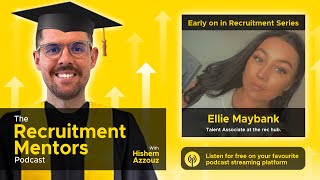
In this episode of the Recruitment Mentors Podcast, host Hishem Azzouz interviews Ellie Maybank, a Talent Associate at RecHub, about her first 6‑12 months in recruitment. Ellie explains how the reality of recruitment differed from her expectations, describing the role’s complexity, stakeholder management, and the need for confidence and self‑awareness. She outlines RecHub’s embedded talent‑partner subscription model, where recruiters act as an internal hiring team for a client for a fixed term, handling everything from sourcing to benefits design. Ellie discusses the transferable skills from her criminology degree, the pressure of graduate expectations, and how she reframed her career path. She shares how she built market knowledge and resilience through asking questions, shadowing colleagues, and using remote‑learning resources. The conversation covers her multi‑channel sourcing approach (LinkedIn, TikTok, personalized outreach), the importance of personal branding, and the benefits of autonomy and flexibility in a remote‑first culture. Finally, Ellie offers advice for early‑career recruiters: research company culture, prioritize personal brand, ask questions, and view each experience as a learning opportunity.
Chapters
Welcome back to another episode of the Recruitment Mentors Podcast. I'm your host, Hishem Azzouz, and this is another installment of the Early On in Recruitment series where we're sitting down with people who are in their first 6 to 12, 18 months of their recruitment journey to find out what have been some of their biggest challenges, what have they learned so far, and most of all, what advice do they have for people that listen to this that may be considering a career in recruitment, uh, and also, uh, for people that are in the, the trenches, in the thick of their first year in recruitment and, and that sort of difficult stage of being in recruitment. So really excited to be joined by Ellie today, who works for a business called RecHub. And, uh, yeah, we're going to have a bit of a chat about Ellie's career so far and, um, get into it.
Hi, thanks for having me.
No worries. Look, really excited to, to chat to you. Obviously, we're just talking a bit beforehand on how you got into recruitment, about the things that you're really passionate about. But I guess where I've been starting with people, which would be really good just to get your sort of your story on so far, would be how, how has recruitment, how is working in recruitment being compared to what you expected?
I was quite intentional with moving into recruitment, but in terms of how it compares to what I expected it to be, it's so different. I thought it was quite easy. You kind of posted a job ad, loads of people applied, you'd send them off for interview, they got placed, deal's done, dusted. And it's so different, you know, there's so many more intricacies to it. There's so much more framework that's required behind it. There's a lot of different factors, you know, people management, stakeholder management, organisation skills, And yeah, it's, it's very different. It's a lot scarier than what I thought it would be is probably the best word.
Really?
Yeah.
So obviously those things that you said, I feel like different, but like in mainly in a positive way or just there's been things that you've had to learn and grow with that maybe you least expected.
Yeah. Yeah. I think, I think what it is is when you kind of say that you want to do a career, you never know what it's going to be. Everything's so much different than a job description. I mean, obviously, especially being in recruitment, people can tell you that. But in terms of what I actually thought the job would be, I thought it would just be a job and it's not, it's so much more. It's like you as a kind of person, you can really kind of put your all into it and so that aspect I really, really love, but it was definitely a shock to the system, like how much kind of of myself I would put into the job.
Yeah, thank you for sharing that. So I guess just to frame out for people, so You graduated uni with what I can see, a degree in criminology, July 2021. Yeah, right. And then, like, like you shared with me before we started this, getting into recruitment was, was intentional for you. Um, so you joined the business, um, who you worked for, uh, for a period, and then over the last 8 months you've then been with RecHub as you was really keen to get into a tech environment and sort of continue progressing your recruitment career and sort of level up the environment that you was in. Yeah, yeah. And sort of right now, like you said, correct me if I'm wrong, but at the moment you are the most junior person in the business.
Yeah, yeah. So I've come in as a talent associate and there are no other talent associates here.
So yeah, awesome. So would you— what I think would be helpful for people just quickly would be, would you mind just high level explaining the sort of model that RecHub has? Because it isn't the typical working for an agency, you're doing 360 recruitment or you're in an environment that does that where you work with multiple different clients filling different jobs within your sort of niche and sort of focus sector. Could you just tell us a bit about, yeah, how the RecHub associate, how they work, and then you can tell us being a talent associate, what does that mean sort of day to day?
Yeah, 100%. So we are an embedded talent partner. So we work on subscription with different clients. But for maybe 3 months, 6 months, or 12 months on a project. So maybe 1 or up to 4 talent partners will go into a project, then we will essentially become their internal recruiters, or we will form a part of their internal team. So everything on our LinkedIn gets branded as such, and we work solely for that client for that entire period of time, meaning they could essentially get unlimited hires out of us, but also different aspects. So kind of the full recruitment aspect to it. So that could be benefits package or, you know, their branding or something like that. So they kind of get everything from us. So yeah, it's definitely different to agency. There isn't a 360 aspect to it. And I think it's really nice to kind of focus on one client at one time. And it's definitely, yeah, it's been a big shock to the system, but I've definitely liked doing it.
Yeah, and then just help us understand. And so like, I can see that, so you worked for a company for, it looks like, 6 months. So like you said, there's loads of different factors that RecHub can support them with, but in terms of like, what did you mainly focus on? Was you just basically mainly focusing on the live vacancies that you agreed that you're going to support them with? What you're working on, and then you is very much focused on the candidate side.
Yeah. So when you initially go in, you still do onboarding like you're a normal employee, or at least with my project we did. And then we look at their entire forecast of the hires that they want to make for that year and kind of the targets that they've set for themselves. And then we essentially take a portion of those roles and help hire for them. In terms of other kind of day-to-day bits. It's obviously still very heavily sourcing, so you still have that aspect of agency. It's not just kind of focusing on their inbound applicants. You're bringing the value of an agency in terms of passive candidates and sourcing and things like that. But I also helped with, like I mentioned, you know, their benefits package and how we can make that more attractive to candidates and things like that.
Okay, brilliant, lovely. Thank you, thank you for sharing that. So that's really helpful. So I think that would just set the scene for people and like the sort of environment that you've been in for the last 6 to 8 months. So what skills or experiences has recruitment given you then that maybe least expected, Ellie, so far, do you think?
I would say confidence, but more self-confidence. I'm always a very confident person and outgoing, but I tend to kind of over-analyse or overthink, you know, certain situations, and I think Being in recruitment has really allowed me to be confident with what I'm saying and how I'm acting and what I'm doing. It's just really, really leveled that up because you kind of see the impact that you're making throughout that. And a lot of self-awareness is probably the biggest one, a lot of self-awareness.
I love that. And then how that— I hope you don't mind me asking, but like, this has been such a common answer and I think this is why so many more people should consider a career in recruitment because of these types of things. Like, I just, I think more confident people in our world means potentially more happier people, or more self-awareness people in our world, more happier people potentially, or at least it's going to have an impact. So like, how is that, how is that more self-awareness, how is that more self-confidence manifested in your, in your personal life?
I think it's being able to understand different point of views and, and different people and different situations and and in terms of being self-aware, understanding when to listen, understanding when to talk, understanding when to give value. You know, things can be, especially when you're at uni, there's so many different opinions and you don't necessarily know how to navigate that, whereas when you kind of apply it to a professional aspect, you know how to navigate that situation and you know how to add value to it. So that's definitely helped in terms of social situations, and then in confidence, it's just kind of being able to go about day-to-day life and, you know, feel happy within myself and happy with what I'm doing and being able to show that off, but not in a, you know, too much, too much of an arrogant way.
No, that's brilliant. I absolutely love that. So, so let's just, let's just focus then for a second before we really get into the weeds of like the last couple of months, like How, how did Ellie navigate and deal with the pressure of graduating with a degree and then figuring out what the hell you want to do with your life and getting the perfect job with your now criminology degree? Like, how did you deal with that pressure? Because I didn't go to university, and I, I've obviously done these sort of podcasts before, and the sort of— just to hear my take on it, and then you can let me know how you felt and what manifested for you. But when I have spoken to graduates, there really does sort of feel that I do sense this sort of real undercurrent of like pressure from on themselves, pressure they get by their parents, by their friends. On Ellie has just obviously graduated this degree and now to make it all worthwhile, she has to get a job that reflects all that work, that money that has gone into that. And it sort of can almost paralyze people on putting themselves forward for things, getting a job or trying different things. Because they feel like it has to be the perfect role. Uh, how did you deal with that pressure, and did you have that pressure?
Oh, 100% had the pressure from both my dad and my mum, who were kind of like, why would you go into recruitment and not something to do with criminology like you said that you were going to? But I think it was justifying it by applying like soft skills that you learn at university. Um, I think the subject was you know, subject of criminology is great, but there was so much more from that degree that I got than just the subject of criminology, like researching skills, analytical skills, being able to present, and things that you can all apply to recruitment or any other career. So for me, it wasn't necessarily a pressure of, oh my God, I'm not doing anything with my criminology degree. It was more of a, I'm taking this aspect from a degree that I got at university and I'm going to apply it to a job, and a job that I really want to do, because I didn't know what to do with criminology. I chose it when I was 18, probably because I watched too many Criminal Minds episodes, and then, you know, got to my third year and I was like, I have no idea what to do with this, and I don't think I'm going to make a career of it. So I found a way.
Awesome. I think that's a really great way, great way, great way of reframing it, of what you just said, of like taking away the actual subject matter that you obviously graduated in, but looking at all the things on that journey that it helped you with. So to sort of wrap that up then, what would your advice be for someone that's listening to this right now that's feeling really heavy with the pressure of, I've got all this debt, I've got the pressure from my parents that want me to do well because they may have paid some of my uni, or I don't know, they might have helped in some way. I don't want to feel like a failure because I just did graduate this degree and then I'm not getting a job that's relevant to it. What would be your overarching advice for people that yeah, might be feeling really stressed right now?
I would say just run with it. Just talk to anyone else that has finished uni and ask them what they're doing because in my experience about 90% of them didn't go into something to do with their degree. But in terms of when you're actually there at university coming towards the end of that degree, it's just researching what else is in the market and, you know, there's not a finite amount of jobs out there. The biggest thing that I've learned in recruitment is how many different types of jobs there are and there will always be something for someone. Just take that small bit of something that interests you and you could probably go and find like 50 jobs that will kind of match that. So just normalizing it really. And I think that's what I've tried to do with my personal brand, my LinkedIn, my TikTok. It's just normalizing that way that people feel and then they're not really alone with it. So yeah.
And what do you feel about this? I have my own opinion on it, but like, what do you, what do you feel about people being less hung up on getting the perfect job, these types of things, and instead lean into experimenting, trying different industries, trying different jobs, and not getting really caught up on having a CV that looks like you've tried loads of different jobs? What do you think about that now you're in recruitment on the other side?
I'm not too sure, actually. That's quite an interesting question. I suppose Trying new things is a part of, especially in this generation, it's part of what we're about, you know, we kind of dabble in everything, but I think if you hop to something and then you find what you really love, I think that's great, but no, I've never been asked that question, it's actually a really interesting one, but I would just say if you love it, then do it.
Yeah, so like for me, the reason why I ask that is, again, speaks to a lot of young people, there's often this sort of sentence that you hear of like, I don't want to come across job hoppy, I don't want to look this certain way, And for me personally, like, I think, like, I'm 29 years old, so I feel like the better thing to lean into and focus on in your 20s is taking risks and trying and experimenting different things, trying different— like, how are you meant to know if you like different foods without trying them, right? And I feel like with your career and work, how are you meant to know what you want to do, what you love doing, as you said, without trying different things? And then when you've got to a point where, like, you know what, I actually really like this role, then it's like, wow, this is exciting, then I can apply myself in the role that I'm in, or you can then see a future for yourself. But I think also a lot of people can get hung up on Ellie looking job hoppy, having different jobs. But really, I don't know. I mean, you're, you're in the seat that you're in. I don't know if you see this.
Yeah.
Do you get what I mean? So it's just like, I don't think that's going to put off loads of employers that people think if they're honest about it and they share, this is what I've done.
No, 100%. And I think for me, I mean, on my LinkedIn, it doesn't have that. I had millions of, oh, I say millions. I didn't have loads, but, you know, I had maybe 5 jobs whilst I was at university and in bars. And different things like that. None of that's on my LinkedIn, but in terms of my previous company before I came to The Rec Club, it probably does look a little bit weird that I left after 10 months, but for me, it was a big decision, and it did take me a while to make the decision. I actually gave them 3 months' notice because I loved what I did so much, but for me, it was the right move in my career, and I think when you explain that to people and you explain actually the long-term, you know, ambitions that you have for yourself and why that company is going to fit into that and why you're looking at making the move, the fact that, you know, you're leaving the company after 10 months kind of becomes redundant because you're doing it for the right reasons and you're doing it because you believe that that company is kind of going to elevate you and it's going to give you the exposure that you want, which The Rec Hub has done for me. It's definitely paid off.
Exactly. So what, what has been— so people want to know this— what has been your biggest challenge? So far on this journey with Red Cub specifically? So think of the last 6-8 months, what has been your biggest challenge? We often hear, and I definitely got told it, your first year in recruitment can be the hardest. What's been the most difficult for you? What's been your biggest challenge?
I was actually thinking about this and probably have a really different answer, but I think where your first year is a learning year, it's kind of like a learning bubble. I don't think that there's ever a biggest challenge. I've One week I could have a really, really hard challenge, I could have a really, really hard day, and then I overcome it, I bounce back from it, and then the next week, or maybe a month later, I could have another one that squishes whatever that other bad day was. So I wouldn't say that I've got a biggest challenge, or even kind of like a best moment, you know, your first higher, you'll probably say is your best moment, but then when you make a really, really like high placement placement, you know, that then be your biggest one. So kind of in your first year, I would say like all those different hurdles that you face are probably going to be the hardest until the next one comes along.
So you mentioned bouncing back there. How's Ellie got better at bouncing back?
Um, it would probably be not taking it too much to heart. I think I mentioned that, you know, I put a lot of myself into this job, and it's being able to set boundaries within myself of not being— of still putting myself in the job, but kind of building a bit more resilience and not, you know, taking it too much to heart if something doesn't go my way. And especially working from home, it— for me, it's definitely just stand up, walk out the house, go take a 5-minute walk and come back fresh and start, you know, start again, but learn from it as well.
Yeah, that was gonna— I was gonna ask you. Yeah, so you're a walker.
Yeah. Yeah, 100%. Got my Apple Watch on and I go for a walk around the block.
I love that. So I guess, like, how have you, how have you adapt— like, a lot of people concerned right about this, like, how have you adapted to, like, learning a new market in this role, particularly tech? How have you gone about focusing on that and sort of not again being paralyzed by Ellie is a junior recruiter, doesn't have loads of experience, so why would this developer speak to me, or why would this senior person speak to me? Like, how have you gone about building that self-confidence around learning a new market?
So I obviously work with 50 brilliant recruiters who all come from amazing backgrounds, and I just wasn't afraid to ask them whether that, you know, ask them to kind of walk through new jargon to me or something like that, or, you know, ask to shadow a call with them. And then as I slowly started to do that, I felt a lot more confident in myself. Seeing them maybe have a hiccup on a screening call made me feel a lot more confident, even if they did have 7 years' experience. So it's just really kind of not being afraid to ask the question, even with candidates. If you're just a bit more forthcoming with it and say, "Oh, I actually don't know too much about this," in my experience, they're more than happy to kind of tell you what they love to do. So it's just kind of asking the question.
And then I guess it's sort of, you let me know if you feel like you've had one of these, but have you, have you had a penny drop moment? And if so, like what, like when did you feel like you, you got it?
Um, it would probably be when I graduated university, put it up on LinkedIn, and the next time I spoke to one of my clients, he said to me that he had no idea that I was at university and thought I had been in recruitment for about 5 years. And to me, that was like, oh my God, he didn't think I was junior. He didn't think like this. And I didn't come across that way. And that gave me a lot more confidence because he just didn't know I'd been at uni the entire time.
And why do you think he said that? Was that because of the way he was on the phone? What you were talking about? The questions he was asking?
Yeah, again, I think it was me being quite inquisitive, but also kind of went, I, in my opinion, I kind of tried to always bring something different to a call that I thought would add value to him, even though it wasn't necessarily asked, whether that was, you know, market research or research, you know, analytics of what the quarter looked like for them or something like that. And it was an experience that he hadn't had with the previous agency that he worked with. And I suppose maybe just kind of my confidence, even when I was on a call with, say, the managing director and I kind of led that call and he just kind of wouldn't see the difference.
That's a great, that's a great compliment. So what, obviously a big part of your role is focused on, like you said, taking that sort of agency approach, but internally in terms of getting into the passive candidate market, being proactive. What have you found has been the most effective for you in terms of building like sustainable candidate relationships? Like what has ended up really working for you? Has it been headhunting people on LinkedIn? Has it been calling people? Like, I don't know, what have you found has ended up really sort of working for you and has been the recipe?
I would say it's doing a lot of different things. I think when you're a junior person, you have so many people kind of telling you their best practices. I took— excuse me— I took a little bit of everyone's and then kind of made my own recipe. So, you know, when I'm doing LinkedIn messages, if I can see somebody spent hours, you know, building up their presence on LinkedIn and they have a really, really good profile, I will also take the time to make that message a little bit more personal to them. Also connecting with them on LinkedIn and starting a conversation with them on there and just really building up that network, because I think every conversation you had or you have can always maybe lead to something more further down the line. It doesn't have to be that day, it doesn't have to be that job, or that deal. It could be further down the line or something like that. But I have also placed 2 candidates in processes from TikTok as well, so maybe it might be another avenue for people to look at.
Yeah, so yeah, just trying different things. And I think I really like that mindset, like, where you are today and that conversation may not be something immediate today, but it could be in the long run. I think that's a— sometimes it's hard to see that when you're in the trenches of like your first couple of months, like building relationships, you know, you'll have likely senior people tell you that, but sometimes it can be hard to believe, you know. But then when you have people start coming back to you and these things. So, um, what I was going to say, so it says on your LinkedIn, Ellen, you've mentioned it a few times, that you are a remote work advocate.
Yes, I am indeed. So obviously, if I could turn around my camera, you'd see.
Yeah, so for those that I'm tuning in on video. Ellie's definitely working from home in a remote environment. So I wanna, I wanna just get your take on this. Like, there's so— there's such a debate on this, and for me, my stance on it is it is so contextual, uh, on about the individual. And also, I think if a company wants their people in the office and that's the culture they want to build, then that's their right and they can own that. And if people want to be part of that, great. If people don't, then that's fine. But like, I guess how you've mentioned a few things around learning, you're the least experienced person in the business at the moment, but you're in a really supportive environment. Like, how have you in a remote environment mainly, I'm assuming, I don't know how often you go into the office, if at all. Like, how have you learned? Like, how have you made space to learn? How have you made time to speak to people and learn from? Because a lot of people will say, The sentence is, what's really great about people in the office early on is they can hear Ellie, the senior recruiter, on the phone. They can pinch things from that. And like, you know, you said earlier around taking little parts, people really believe, a lot of people I speak to anyway, believe that you can do that way quicker in an office environment. So how have you, how have you like, how have you done that in a remote environment? What does that look like?
I think it started off really, really easy because I was in the pandemic. Well, everyone was in the pandemic, but I was at uni during the pandemic and we went completely remote in my second year and I had to learn still and I had to do my degree and I had to do my dissertation, so it wasn't too much of a transition for me. But also everyone learns in different ways and so I use so many different tools, like it might be a YouTube video. There's so many resources out there at the moment of people doing screening calls on YouTube and things like that that I just went off and, you know, took my laptop and learnt that way. And like I said, you know, still screen share and you can still kind of listen in on people's screening calls and shadow and things like that. So I think definitely being a kind of remote student helped me out a lot because it wasn't too much of a transition. But also, like, just being able to kind of take control of my learning in the sense of not just using the training materials that I was given but actually actively going out and having a look what else was out there on YouTube. And, you know, I actually found this podcast as well. So I listen to different podcasts and you just learn so many different things. And yeah, you can kind of use your 8 hours in the day kind of that way and not be necessarily shoved into face-to-face training where you might not always digest it. Everyone has different ways of learning.
And how have you tapped into the experience of your business? So like, do you know what I mean? Because that, that, that's what can take time, right? So if we're in an office right now and I've got 5 years experience and you're sitting next to me, like, it's very easy for you to go, Hishem, I've just had this candidate say this to me, what would you do if he said that to you? Like, that, that's quite, that's quite hard to sort of create that instantaneous, those types of things that could be really helpful for people remotely. So the, the, the amount of experience you have in your business is one of the great things that you can tap into. So have you Have you, like, do you have to really be proactive in reaching out to people? Like, do you do something on a weekly basis where you can, there's an open forum to tap into this knowledge? Like, how have you tapped into that remotely?
So with us, where The Rec Hub is a remote-first company, there are, you know, there's not that many people that go into the offices. So there's, we have different offices around the UK. I sometimes go into the London office maybe once or twice a month, but we have, we use Slack and we have so many different channels. Support channels and things like that where you can either ask the question or you could probably scroll up and find the answer to your question. And I think that's a nice good way as well, because if one person has a question, 9 times out of 10, you know, other people are going to have that question and you kind of got that as a keepsake. And then for my team, we still do, you know, morning meetings where we can kind of collaborate on different challenges and things like that. So you still kind of get to have that collaboration. And then kind of as a business as a whole, outside of like just my team, we still have like once a week pods where you get to meet different people in the company and get to experience— well, you get to ask people about different experiences and things like that. So it doesn't feel like as isolated as what I think most people think it is. It still feels very, you know, everyone's together and everyone's helping each other, and there's a lot of support out there, and everyone's more than willing to you know, help out if you need them to. They'll kind of give you 5 minutes in their day if you need to.
Yeah, awesome. Thanks for sharing that. Some good insights there. Okay, so final thing on this, because I know this is interesting for people. Just final thing would be like, again, these are the assumptions I'm sort of trying to communicate, the assumption, play devil advocate here, and like the assumptions out there, right? And I'm sure you've heard these and see these online. As a young person in work, I feel personally, but I feel like a big part of why people want to, um, go into the office work, or a big part of why people look forward to work, is the social element. Um, being able to meet new people, make new friends, maybe even create a romantic relationship. It happens a lot in work, right? And these types of things. So do you feel like Ellie's missed out on that because you're remote first? Do you feel like you've still got that? I think this is another assumption as well. As a young person, do you feel like you've missed that out or you're not getting that part that a lot of people really enjoyed as part of working in London in different places?
Oh, 100% not. No. So we've got like different clubs and societies which I'm a part of. So we've got the health hub, we've also got the book club. So I'm also in that. And, you know, like I said, I still go up to the office maybe once or twice a month. And that's really, really nice because it's like, it's like seeing people that you haven't seen in a while. So you have so much more to catch up on rather than just kind of day-to-day chitchat. And we all go out after work, and that's a lot nicer, but I don't feel like that I don't have the social aspect because there's so many more things that we kind of do to kind of help out with that. Like, we throw in different ideas. The quarterly meetups are absolutely brilliant. They're so much fun. We've got so much to kind of talk about in that sense, and we've got— there are people at the Rec Club who, you know, live in different countries and sometimes travel as well because we can work, you know, anywhere in Europe and things like that. So I think it's kind of subsidized with how great the kind of remote culture is, and everyone that we work with, I think, definitely kind of have the same, like, fun element to them, if that makes sense. There's no one that kind of doesn't get involved. Everyone kind of gets involved with everything, and they can start a new hub you know, club if they want to. I think somebody was talking about starting a wine club. I know that was quite popular. So yeah, I think the social element is definitely still there, and I think people as a society have gotten used to still having social aspects to their lives, like especially during the pandemic, and it's just a way to incorporate it into your work life.
Yeah, okay, brilliant. So a couple last things then before we finish, uh, So I really wanted to get your thoughts on this. What's been the best training advice that you've received that's really worked for you since starting?
There's been so many. I've had such great mentors. So if I pick one of them, I think it would be to just ask questions. And that generally applies to every aspect. And I think I say it quite a lot. I think One of them that I received quite recently was that time kills deals and that was kind of very relevant to my situation and kind of helped me out quite a bit. But yeah, I think everyone gives great advice, but I would definitely just say ask the question. I mean, you don't, you don't ask, you don't get.
Yeah. What do you wish you knew before joining the industry?
I would say how much of a big part your personal brand can have on your success in recruitment. It was definitely something that I think I wish I'd started a little bit earlier. I'm definitely still on the journey of my personal brand and stuff like that, but yeah.
Brilliant. So final question, so bit of a sort of scenario here, and then you can be honest with me and let you know what you think. This would be really helpful for, for people. So If you could pick one thing about the environment that you joined that has allowed you to succeed so far, what do you think it would be? So it could be, it could be, um, so, so for example, so what should— so that will help us understand what people should look for in a company when entering recruitment, right? So in terms of, yeah, some of the things, it might be culture, training, incentives, the right market, way of working, like If you could pick one thing out of the environment that you sort of experienced so far at RecHub that you feel has really enabled you to sort of excel, what would it be, do you think?
I think it would be autonomy and flexibility to, say, have my own work setup and work in the way that I want to work. And having, you know, the directors and the company really advocate for that and really push for you to kind of work in the way that best suits you has been really, really helpful for me. So that would be kind of my number one. One.
There we go. Remote work advocate. Absolutely love it. Living by it. Yeah, I think, I think, look, I know we focus on that quite a bit, but I think that's really helpful just to get a real honest perspective from someone like you on your journey because there's positive, there's pros and cons. It's going to be right for some people, not right for other people. But clearly here, this is really working for you and you're enjoying it. And if that's the one thing that you think has really enabled you to be happy in your role, enjoy your work, and you're in, yeah, enjoying the journey that you're on, then that's amazing. And I think that's awesome. So I guess before we finish, then parting, parting words of wisdom, Ellie, for people that are on a similar journey to you, they're in the trenches right now. What advice do we have for people that are early on in their recruitment career?
But before we finish, I would just say do your due diligence, go out and research what you're actually going to want, whether that's embedded, agency, you know, RPO, really kind of have a look at what's going to suit you and also the industry that you're going to work with. But I think company's the biggest one, like really go and speak to the people that work in the company before you join because they'll be honest.
Ellie, thank you so much.
More from Hishem




You don't need as many clients as you think to bill $1 Million A Year In Recruitment



From 30 Direct Reports to Back-to-Back $1M Years as a Solo Recruiter with Zach Creighton



