Early on in recruitment series | Grace Kisnorbo - Unlocking self-confidence
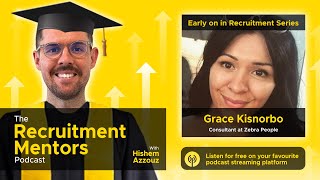
In this episode of the Recruitment Mentors Podcast, host Hishem Azzouz interviews Grace Kisnorbo, a recruiter with 30‑40 months of experience, to explore the realities of the first 12‑18 months in recruitment. Grace reflects on how the role differed from her expectations, highlighting the high volume of moving parts and the challenge of dealing with factors beyond her control. She discusses unexpected confidence gains from daily interactions with candidates and clients, and how this confidence translates into her personal life. The conversation delves into her biggest challenge—lack of control over client timelines and outcomes—and how she mitigates it by focusing on influence, thorough preparation, and a proactive mindset. Grace shares her personal development practices, including mindfulness, affirmations, and taking responsibility for her reactions, drawing on insights from neuroscience. She emphasizes the critical role of relationship building, meticulous note‑taking (using OneNote and CRM), and avoiding analysis paralysis by acting quickly. The episode concludes with Grace’s advice for newcomers: prioritize genuine relationships over immediate deals, be patient for long‑term value, and choose a recruitment firm whose culture aligns with personal values. She also advocates for recruitment as a career, citing its merit‑based rewards, collaborative environment, and the satisfaction of helping others.
Chapters
Welcome back to another episode of the Recruitment Mentors Podcast. I'm your host, Hishem Azzouz, and today I'm really excited to be joined by Grace as we are kickstarting a short and new podcast series where we're calling it Early on in Recruitment, and we're going to be sitting down with recruiters who are in their first 12 to 18 months of their career to discuss and talk about what have been some of the biggest challenges, what have they learned along the way so far, advice for other people kickstarting their career in recruitment, and why we believe more people should consider a career in recruitment. So we're going to talk about Grace's journey so far. And Grace, you've been on an interesting journey as you didn't follow the classic cookie-cutter journey of, I don't know, graduating uni or recruitment being your first quote-unquote proper job. Uh, from what I can see, you obviously worked in a few different places, but more before recruitment, you progressed your career at a company called American Express, which I'm sure most people will know. And I know that a career in recruitment is something you actively pursued and was something you was actively motivated to get in. But I guess where I wanted to, to start with you, having worked in recruitment yourself for coming up to 30, 40 months, is like How has a career in recruitment so far compared to what you expected? Let's start there.
Sure, thanks for having me, by the way. Yeah, compared to how I expected, I mean, I would say recruitment itself has been amazing. Like, I've absolutely loved it, which is what I was hoping. So yeah, all good in that sense. It's ticked every box that I hoped it would. I would say in terms of more the day to day, it's probably been quite different, more so in terms of just how many things are happening, how many things can go wrong and how many moving parts there really are. I think it's really easy to think that it's as simple as I never thought it would be simple, but the basics would be people looking for jobs, people wanting to hire, and you being that matchmaker and that middle person. And I think when you're really in, in it, there are just so many moving parts and so many parts that are out of your control. So in many ways amazing, and in many ways challenging and difficult.
Yeah, it's the many parts that can't be controlled. That's, uh, the difficult part, right, early on.
Exactly, exactly.
I guess what I always like to, to ask, and I'd love to hear your thoughts on this, is what— obviously you was really motivated to get into the industry, so I guess what, what skills or experience has recruitment given you so far that maybe you, you least expected?
I think like with this question Because I came from quite a corporate working environment beforehand, a lot of those basic skills that maybe if I had just come from graduation I might not have had, I'd already kind of luckily been able to pick up. So that was one thing for me that was a real kind of stepping stone that I had, like, that helped that transition. But I think all of those things I've massively been able to expand on in recruitment, which is all the things you would imagine, like time management and relationship skills and people skills. I was really having a think about this when you mentioned it before. I think one thing though that I didn't expect to get so much that I've got from recruitment would be confidence. It's funny for me to say that as well because I am actually quite a confident person, so it's not something that I didn't have before, but I think that that is one really great thing about recruitment is that You are constantly speaking to people from so many different places and of so many different levels of where they are in that company. And it's a very collaborative job. So I think that's a real big thing, whether you haven't got it to start with. And if you didn't, it would be a great thing for you to build in that career. But even when you have got it, it just elevates it so much more because you really feel kind of everything you're doing. And when things go well, it's a real sense of pride, I guess.
Love it. Honestly, the, the confidence thing has come up a lot when we've done these particular series, so I'm not surprised that you, you say that. I guess what I'd love to ask you to follow up on that is Of course, as you do more of the recruitment activities, more of the things that you're improving at, you're going to have more confidence calling a client, speaking to a candidate, managing expectations. But I'd love to just find out if, like, where has this confidence or more confidence shown up in, like, your personal life? Because this is also really important. And yeah, I think this is really cool.
Yeah, I think Just everything, really, in terms of anything you're doing. People are just people, right? No matter— it's so easy to look at someone and be like— I remember the first time I was calling a head of whose salary expectations were north of $100K, and it's like I'd never really spoke to someone like that. Well, probably within Amex, but not only in the terms of sending an email, maybe. And this time I'm calling them because I kind of want something from them in a sense. And, or, or trying to sell them something. I don't really like that term of selling within recruitment because it makes it feel like dirty, but it's like I, I'm basically, yeah, trying, trying to sell something to them in a sense, trying to get them excited about this job. And, um, yeah, I think I remember the first time doing that, and it's really overwhelming thinking. It's really easy to think, especially when you get that imposter syndrome, when it's like a new career or a new environment, it's really easy to think I'm down here and they're up here, and I, what What value am I going to bring to them? And I think just having to do that constantly and speak to people that beforehand you may have seen in that different light, it really changes that. So in your personal life as well, that would probably be the same in many ways of different people that you're speaking to specifically and never having that barrier of I'm here, this person's here. It's like we're all level and we're all people and we're all human.
Yeah, brilliant. So I'm sure you would have heard it, and it's a really common sentence that we all hear in recruitment, which is your first year can typically be the hardest. I'm sure you've had experienced people within Zebra, uh, tell you that maybe once or twice. So I guess let's go. And I think what's really useful about these series is people can listen to these who are on a similar journey to you, maybe 6 months in, 3 months in, 8 months in. And listen and learn and find out that the things that you had to work through and continue to work through, um, yeah, isn't just— is the same as what they are, right? Because a lot of people can think, oh, is it just me that is having to navigate all these challenges and deal with these things? So let's go straight into like, what has been your biggest challenge? You mentioned only things you can't control. There's a lot of different spinning plates, but what has been your biggest challenge on this journey so far in recruitment? And how do you think you've not necessarily completely overcome it— we're always working on things— but how have you sort of navigated getting better at it or working through it? So what's been your biggest challenge?
I think going back to what we were saying about the things you can and can't be in control of, that's the biggest challenge for me. It's like, it's the things you can't be in control of. I'm such a control freak in some ways, in like the best possible way. I'm also very chilled. I would like to put that out there. But I'm also in the important things. I like to do things well and I like to make things move and progress. And there's so many things, like we say, that you can't be in control of. So I think for me, that's really the biggest challenge. So there's been times, for example, where, you know, I've spent the time and I've found the candidate and I've built that relationship and they're maybe not looking for a role and I've brought them in and got them excited about that role. And then, they've, they've, I've spoke to the client about them and brought together. It's all in progress, it's all moving along. And then the client, maybe people go on holiday or they're not moving fast enough, even though they told us it was this really urgent hire that they really wanted to make, which I'm sure every recruiter will understand my frustration of. Um, but you're, there's, yeah, there's been times where you're doing everything and it's dragged out across such a long time period, which it really shouldn't be, and then for no fault of your own. I've had that with, like, a really big head of research role, and the woman's lovely, and we've got such a lovely relationship now. But it's really horrible when you've done everything right and then you have to be that bearer of bad news, and you have to be that middleman, and you have to have those difficult conversations. For me personally, that is I think it really depends what your personality type is as to what's the hardest. For me, that's me, because I have a lot of empathy and I hate doing that. It's difficult because I don't want to tell that person that thing after I've supported them all this way along. And it's also difficult because obviously you've put in loads of work and then you don't get to make the deal that you put the hard work in for. Right. So, yeah, I think the difficult thing is not being in control of things, but I think there's an element of things that you can be in control of and an element of things that you can't. For example, as soon as that person gets in that interview, you have no control of that. They're only going to do as well as they can. But at the same time, you have to remember that you can't be in control, but you can have influence. So I just always try and be as, you know, make sure I've prepared them as much as I can for the interview, checked up on them before, done— just sent them everything they need from the job spec to extra notes to videos on YouTube or articles that are about the company that they can maybe speak about and think of questions to ask them from. And yeah, just, I would say that's a good way of overcoming that, is just the parts that you can't be in control of, try and have as much influence to make it go the right way.
Nice. And I guess, how do you— what do you do, or maybe what helps you not let these things affect you for too long? So, so what I mean is, you do all the right things, the client is just being an absolute pain in the ass, even though you've advised, you've consulted, you can't influence it, but you've got this candidate that's going, Grace, like, I thought it was going to be this long, they're getting frustrated. How do you not let that then sort of, I don't know, maybe affect you for a longer period of time than it does? It doesn't— you're not then in a funk for the rest of the afternoon and you're not as productive. Like, how have you got better at— like, I understand what you're doing on the parts you can influence, but like, I think that's oftentimes the hardest, is like shaking these things off. So like, I don't know, how have you— how have you approached that? Have you navigated that when you've just had a really difficult situation that you can't wasn't able to influence, it was out of your control, and not let that affect you for the entire week?
I think going back to being in control, that's the key thing there. You are in control of yourself and you are in control of your thoughts and your actions, and you can choose how you react. So, I mean, I guess the first thing is just being human. And in that specific situation we were talking about, just being human and you can't dodge around it. Like, it's a difficult conversation that you have to have. And so just, you know, being empathetic and being clear and concise and laying it all on the table as it is, because that's what you have to do, and supporting your candidate as much as you can. And then, as I say, at the same time, supporting yourself and understanding, okay, this is what's happened, and I can choose now how I react to this. I can let it me in a funk and the rest of the day will be ruined, maybe the rest of the week, or I can choose to carry on and continue. Um, my manager Nick always likes to have, um, like a saying of like, get the Uzi out. He's like, you know, if you're on that front line and you're shooting and everything's all good, you kind of— you don't want to have that second where you stop and you rest and you slowly kind of reload. And it's like, you just have to get these out straight away. Something else is probably coming, something else is going to happen. You need to be like ready to go, prepared. And that's kind of how it is. But I think you need to look at that not in the way of like, never relax, go, go, go, stop, stop, stop. It's nothing like that. It's just, okay, things will happen. Things are always constantly moving. Things are going to go up and they're going to go down. But as long as you just keep progressing and choose to be clear and level-headed, then everything will be fine in the end. And if it's not, you can just go about it the best that you can by being human.
What a great mindset. I love that. Have you always been like that? Where's that? Where have you caught with that? Because that isn't typical.
Yeah, like, I think just over the years I've just always been quite like a— I'm quite a spiritual person, quite into mindfulness and into like affirmations. And I've read a lot of books and done lots of different things that kind of have taught me these really lovely mindsets in my life that I then carry into work, I guess. And that's one of them is like, you know, like, I don't want to go into that too much because that's not where it is, okay?
But, you know, it's useful for people.
Like, one of my biggest things in my life, and which carries into all parts of your life, is like affirmations. Like, the things you choose to think and speak constantly create your future. So take that situation, for example. If I'm just going to sit and go, I'm a rubbish recruiter, my day's ruined, this is this, that is that, that is inevitably what's going to happen for me in my day because people will pick up on that. Then they'll react to me differently. I'll maybe type emails differently even because I'm in a bad mood or different things will happen. Whereas if I just keep telling myself you know, I'm a great recruiter, and it's easy to think you're just convincing yourself of something that's not true. But that's not it. It's just the fact that literally everything you think or speak, everything else around you will react to it, right? So yeah, yeah, no, thanks. Yeah, that's just how I kind of—
no, I appreciate you sharing that, Grace, and that will be helpful for a lot of people. I've been on my own journey with that, and I was just listening to— I'm going to put it in the show notes of this just as a bit of a timestamp and we'll move this on. But yeah, I was listening to a podcast recently, a really popular guy that I like to listen to is a guy called Andrew Huberman. And like, there's literally studies now backing this up in terms of like, if people were told a certain thing, then they will believe that. Yeah. And this isn't just a mental This is also a physiological thing that can happen. Like, you're told that you will be able to breathe longer in this certain context, and then these people were actually able to breathe longer because they were told that they were able to. Like, it's crazy.
So, like, I've seen lots of things like that. It's completely true. But yeah, I mean, I just think, yeah, it—
the biggest thing I'll take from that, right, that everyone I think should really hone in on, and I'm a big believer in this, and me and my mate speak about this a lot, is like you've basically— you've taken full responsibility and accountability. But the main thing that you said is like, I can choose how I react, I can choose my actions. A lot of people cannot do that. A lot of people can think the candidate did this, a client did this, so I'm going to do this, so I can't do this, right? But what you're saying is the candidate could decide this and the client could do this, and I'm going to choose how I react to that rather than Yeah, you being the victim of how they are determined.
That's a bit like when I hear stories sometimes of people getting a job and then their recruiter is angry because they were in a process with them and then now they've taken another job. That's never my mindset. I'm so happy for someone if they've got a job, and that's only going to mean that next time they're looking for a job, they'll probably come straight to me because we've built a nice relationship. Right. Whereas if I choose to be mad about that, then why would they ever want to work with me again?
Yeah, absolutely. No, I love that. So what did you learn then in your first, let's just say, because you're sort of just past the year mark. So what did you learn in your first 6 months that you wish you knew from day one?
Hmm. What did I learn that I wish I knew from day one? I would say There's so many things.
It's okay.
Since day one, I think for me, just for me, just write everything down. I'm very much someone who kind of does that anyway, but for me it's like write everything down. And that for me is, I mean, when I'm speaking to candidates, because I feel that when you come back to that relationship building piece, like when I speak to candidates on the phone, I'll take so many notes, I'll write everything down. And it just means when I come to speak to them again, I've got so much clarity on everything that was said. It sounds quite obvious. It sounds like such an obvious one, but I think that relationship building is such an important part. So even the small things that I've spoken to them about, next time I speak to them, I can reference it and I can ask about it. But also in the sense of without just the candidates just at work, as we keep saying, there's so many things that can happen and there's so many people you're talking to and so many different things happening that it's so easy to forget tiny pieces of information. So if you've got it all there, um, for reference, it just makes your life so much easier.
So take that seriously. Yeah, that they're the things oftentimes that at the beginning you can just sort of let slip and not do those things, but you've already recognized that. Yeah, like you said, you can— if you really capture those moments and create that discipline, it's— that's going to be such valuable information in 6 months, 12 months, 2 years, 3 years.
Like if I speak to a contractor, for example, and, um, they, you know, a couple of days later they've got another contract. Happens all the time. But 6 months later, they might get in touch. I can just scroll back, see my notes from speaking to them. I already remember. I can say, oh, is this roughly your day rate still? Yep. Is this this? It just makes those conversations smoother. It makes the person feel that you've listened and you remember them. I just feel it adds so much value. To relationships. And on that note, my colleagues will laugh because I talk about it so much, but OneNote. Have you ever used OneNote?
No, I use, I use Notion.
See, I love Notion for like my personal life, but I just love Microsoft OneNote. It's so good and no one ever uses it. Um, so I am such an advocate for it, especially in that terms of like note-taking. It's a bit like having a big notepad with lots of little tabs, but virtually, um, which I guess is Notion as well.
But yeah, I just use— no, I use, um, I use note— like notes taken. I'll just use like Notes from the iPhone and Mac. I'll just use that, something similar to that.
Yeah, yeah. But it's great. Like, for example, when I do calls, I've got like a tab that says chats. I'll go into chats, and then I've got literally all the tabs of people's names I've spoken to, and I keep all my notes in those separately. Um, yeah, I don't know how to talk about it without, like, making it sound any different to any other note-taking app.
I'm sure— I'm assuming, uh, I'm assuming you, you better be putting these notes in the CRM, otherwise you'll be getting a big telling off.
Yeah, yeah, of course, of course. But that's my own, like, the stuff that doesn't need to go in there, we've got it all there. Like, you know, just like personal conversations you've had or something you don't want to block up the CRM with. It's like, yeah. And, and also just things that aren't conversations, just other things in work that I want to remember, like my own employee stuff or different things. It's just a really good tool.
It's somewhere that you can just put all your stuff down out of your mind. Yeah, so valuable.
Yeah, yeah, exactly.
Sort of underestimated.
And, you know, I showed it to many of my colleagues and my boyfriend and different things, and they all love it and all use it now. So I think that backs me up, hopefully.
So another question, like, back to the beginning, but super curious on this. Like, if you were to start this journey all over again, knowing what you know now, how would you approach the sort of your first 90 days differently?
Um, if I was to start again, I would definitely say, like, I— which is funny because I'm now saying this off the back of taking loads of notes, but, um, sometimes I definitely get— have you heard, like, analysis paralysis?
Just whatever.
That's like a thing. Yeah, but yeah, basically just, just overanalyzing something so much to the point that you're not actually taking action. So I feel that for me, especially coming from somewhere that I'd worked for a long time and it— I felt really like a subject matter expert in what I was doing, to coming somewhere that I didn't, it's like, um going from primary school to secondary school, right? Like, it's quite a difficult feeling of feeling like you know nothing and that you can't add value to things because you haven't got that basic knowledge. I feel sometimes when there's so many different— like, for example, where I work, there's so many different companies and then jobs that we're hiring for within those companies, and there's just so much information that you have to take in that goes back and forward. If I wanted to speak to a candidate, for example, I would very much feel that I need to go super prepared and kind of know everything and fill them in on everything, which to an extent you do. But at the same time, like we're saying, we're human and people, you could always say, I can come back to you with that. I can come back and find that out and get back to you. I feel like when I started, I sort of had a bit of analysis paralysis where Yeah, everything just felt a bit too much and then I just was not kind of taking action. It was like blocking me. So I would say if I could start again, it would be like just let things move and let things flow quickly and act quickly and make decisions quickly and go with the flow and keep things moving. And we can always come back and tick every box and cross every T and dot every I, if that makes sense.
Yeah. So don't focus on— yeah, it makes complete sense. So I'm assuming you're also saying they're like, yeah, to pick up the phone and just get speaking to people rather than like—
exactly, exactly. So if I was going to call someone about a job, for example, and I'll feel like, okay, right, let me just get the jobs back up one more time. Let me just remind myself that it's like, you know it. Like, I've chatted to people in the office about the roles. We've spoke about it on our catch-up. Like, I know it. And if they ask me anything I don't know, I can go back and I can find out the answer and come back to them. It's really not an issue, but I just, yeah, have that kind of analysis paralysis.
No, totally get that. So to sort of tie that all together then, what would be your, like, one piece of advice for someone who wants to get— have the best possible start to their career?
I think just, um, Just going back to what we've been saying about relationship building, like, everything doesn't have to bring you value, like, right now. Every time you speak to someone, it doesn't have to be a deal right now. Just when you're connecting with someone and someone feels they can trust you and have that conversation with you with confidence and feels that you understand their true need, then whether or not it happens right now, they'll still come back to you. And I think that's, like, one of the most satisfying things as well. Once, like, when you're quite new to recruitment, that point when people do come back to you, it's such a nice feeling because you feel like you've obviously done something right the first time around and they're coming back to you. And And a lot of, for me, a lot of the wins I've had recently have been through that. People just coming back that I've spoke to a long time ago. And that's definitely something I've learned along the way, is that everything, as I say, is constantly a moving part. It's constantly evolving, going to the next part. And something that you think has no value now will have lots of value in future. So, yeah, I would say spend those times, build those relationships. I mean, I'm quite lucky because the place that I work, we are very much like invested in that and we're not super KPI-driven and we are all about, you know, even if someone just comes to us for help with their portfolio or advice about salary ranges or something like this, then we are like encouraged to take that time and spend that time and help those people rather than somewhere else where it might be like, we don't have time for that. You need to call this many people this afternoon or you need to do XYZ. It's like, Yeah, I feel very lucky that the place that I work is more focused on that, but I've seen the value it adds, so I can only recommend that.
What I take from that, honestly, and I'm sure you may disagree, but I'm hoping that you'd agree, is like, what you've experienced recently can be hard to see in the moment. Like at the beginning, right?
Exactly.
So that, that's the thing, and that's why this is good to know. But what I take from that, Grace, is that the advice is lean in. Like, don't get so fixated on having that candidate tell you that they're going to give you their CV and be put forward for that job. Instead, really lean into, yeah, building these relationships, asking good questions, listening, understanding what's important to these people. And ultimately, what you're saying is deliver a great experience. Because exactly these— yeah, it all, it all comes full circle. And these will be people that you could help in the, in the medium term, long term, but also help more than once. So that, that's what I take from that, and that's, that's great advice. But as I said, it can be hard to see that in the moment, but that's why these conversations are important, right? Because you've already seen that and you're only 12, 14 months in.
But when you have—
yeah.
Sorry, I was just going to say, I think that's the exact perfect example of what we were saying before about I could speak to 4 or 5 people and then none of them are interested. And I've spent, you know, like when sometimes you're on the phone for a really long time and you just kind of think, oh, this isn't like bringing me anything now. And you spoke to 4 or 5 people. Okay, let me try some more. And then by the end of it, you spent a whole day, nothing's, nothing's brought anything. You could be like, I'm a rubbish recruiter. I've, you know what we were saying earlier, like, I am, my day's ruined, I've wasted my whole day, I've done this, I've done that. And then actually, in 3, 4 months' time, that could be like your biggest quarter, because all these people who you spent the time connecting with and understanding what they really want, suddenly you've got all these jobs where it's like, actually they might not be looking, but they might now because I've got something that ticks every box of what they told me they wanted 3 months ago.
Honestly, totally get it. What I was just going to say was, and then we'll— I'll ask you the final question, was just like, when, when, when Nick, your manager who's done recruitment for over 10 years, say, Grace, it'll pay off, trust me, focus on this, sometimes you can, you can find yourself— because I had this because I worked in a small business and there was many experienced people around me you can sort of go, yeah, it's easy for you to say, Nick, like you're getting all these recommendations, you're coming back to you. But this is why this is great, right? Because you're, you're just over a year in and you've already experienced this. You've already experienced the sort of the rewards of your hard work and your integrity and your approach in your first 3-6 months. So the actual like timeline of actually, uh, yeah, all this coming back in the ecosystem oftentimes cannot be as long as people think. Right.
Yeah.
And they have to trust the process.
Exactly. And exactly like you said, I think it is really like— I don't know, I wouldn't use the word daunting, but it can be quite a heavy weight on you. Like you say, when all the people around you, their networks are huge, like they've got people coming to them all the time. And then you also feel like, well, if all these people come to them, then there's going to be none left for me. But there are so many left for you. And yeah. Yeah, and like you say, they've been doing it for a decade or so, and I feel like people who find that really difficult first year, that's going to be a massive part that's hard of it, seeing everyone else around you do everything so easily. But these things will come in time and you just have to keep that positive mindset, keep going. And like we just said, in the future, that will be you.
So final question, why do you think more people should consider a career in recruitment as a choice. People should be wanting to come into our industry. Why, why is that?
Oh, I would just, I would just massively recommend recruitment to anyone now. I think because of the fact, like, I think it depends on the type of person you are, right? And if you're like me, I feel that if I'm doing a job, any job, and there will be me and somebody else that somebody else could maybe come in, do the day's work, do the bare minimum, go home. That's never me. I like to come in and I like to learn things as I go and do things the best I can and see what I can find from doing it and help other people and go the extra mile. And I feel that if you're someone like that, like me, who is maybe in a different job where you feel like you're not really rewarded for that, If that makes sense, you— like, in this type of industry, you have commission, right? And it's like, you— I don't really know. Do you see what I'm trying to say?
Like, yeah, this, this is for me. Like, when— before I got into sales, I, I couldn't believe that I would ever be in a job where me and Grace do the same job, I put in more work than her, or I feel like I've done better and we get paid the same. Yeah, getting rewarded. Yeah, I totally understand what you mean.
Exactly. I think that's a massive reason why people should, because I feel like if— obviously I'm not speaking about this coming from a graduate perspective, but someone who's more like a career changer. And there's probably so— well, I know there's so many people out there now doing jobs that they just really don't enjoy that much. They're putting their heart and soul into it, probably again, like me, doing shift work and not even having your weekends. Your work-life balance is terrible, and you just feel like you're not getting back what you give. And I feel that in recruitment, that's very different. You get back exactly what you put into it, and it's a really, really nice feeling. So if you're someone who likes the challenge and you're someone who really likes to go the extra mile and get the best out of things, then I would just massively recommend it. But I would also recommend that you very much look into the type of company you're joining, because I feel very blessed that I have joined somewhere where the culture really aligns with my values and it's a super supportive and collaborative environment. And I feel that sadly, as I hear, there are a lot of places that you maybe wouldn't find that at. So also be really kind of thoughtful and really look into where you decide to join.
Grace, thank you so much. Absolutely love your mindset. I'm not surprised at all why Nick speaks so highly of you. You're going to go on to continue to achieve the goals that you have. So thank you so much for being part of this. I really appreciate it. And I know that if anyone wants to connect and I don't know, get help or ask any more questions, that you'd be more than happy for them to connect with you on LinkedIn.
Yeah, yeah. So I work in the UX and product design space. So user research, UX, UI, product design, anyone in that space or other spaces, then get in touch.
Love it. Thank you.
More from Hishem




You don't need as many clients as you think to bill $1 Million A Year In Recruitment



From 30 Direct Reports to Back-to-Back $1M Years as a Solo Recruiter with Zach Creighton



