Early on in recruitment series | William Johnson - Becoming a million pound biller
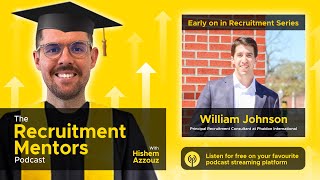
In this episode of the Recruitment Mentors Podcast, host Hishem Azzouz interviews William Johnson, a 17‑month‑old recruiter at Faden Dallas who has become the firm’s fastest million‑pound biller. William shares his unconventional path into recruitment after studying psychology and marriage‑family therapy, his rapid immersion into the financial‑technology, crypto and hedge‑fund market, and the concrete tactics that helped him overcome early insecurity. He describes how he built confidence through daily phone reps, deep market study, and a disciplined learning routine, and how he refined his candidate‑qualification and closing approach by listening for objections and influencing early. William outlines his 360‑recruiter day plan, time‑management hacks, and persistent follow‑up system (including “break‑up” emails) that generated his first client and subsequent deals. The conversation delves into his mindset of extreme ownership for handling setbacks, the importance of avoiding complacency by focusing on marginal daily improvements, and his transition into a player‑coach role mentoring two junior recruiters. Throughout, William reflects on memorable milestones, such as closing the largest deal in Dallas history, and offers practical advice for early‑career recruiters on mindset, process, and continuous growth.
Chapters
Welcome back to another episode of the Recruitment Mentors Podcast. I'm your host, Hishem Azzouz, and this is the final installment this year of our Early On in Recruitment series. So in this series, we've been interviewing and speaking to recruiters who are early on in their career, so in their first 6, 12, 18 months. And I'm really excited to be joined by Will today, who I'm going to get to introduce himself. In a second, um, just because he has achieved some pretty amazing, uh, achievements in his time in recruitment. And I know a lot of people will have loads of different questions and be really interested to hear sort of Will's journey so far. So before we go into all of that, Will, uh, for those that may not know who you are, uh, tell us a bit about yourself, how long you've been working in recruitment, these types of things, and then we'll get into the stuff that I know a lot of people are going to be really interested listening to?
Sure. Yeah. So I guess just a bit about myself, you know, born and raised in Texas, uh, US, and then, um, have stayed here my entire life. Went to college, went to university, college in Texas. And then, um, you and I were actually just chatting about where I've traveled, but so I am well traveled, been around the, been around the world. But, um, yeah, I've been in recruitment for about a year and a half now. And, uh, have loved it. So doing, doing some good stuff there.
Love it. So how I came aware of you is, uh, we're friends of Oliver Cook here. We've had him on the podcast, who I know is the managing director of the office and, and sort of business function, or the, the part of the business that I know you're a part of. And I saw his post where he was talking about William Johnson, which is you, and about some— and like just highlighting some of the amazing achievements that you've worked your absolute socks off to achieve.
Sure.
So I'm just going to share some of these and then like, just, just so people can get the context why I was like, right, let's, let's get Will on the pod, uh, and then we can just get you to share a bit about your market, whether you're recruiting, and then we'll get into all the good stuff. So this is the post that I saw from Oliver where he said, uh, what you've achieved in 17 short months. Largest ever single deal in Faden Dallas history. Largest single paycheck in Faden Dallas history. Fastest person to $1 million billed in Dallas history. You're now a player coach already managing 2 juniors. You've helped 16 candidates find amazing new roles. Qualified for the Faden International summer holiday in Cancun. Currently in pole position to be the top performer and top biller in Faden Dallas this year. And you've even got a deposit on your first house and put down that week. So I saw that post of a picture of you with some balloons and apparently you don't drink so you had like a steak I think on your desk. So like that, they're like some pretty like unreal achievements, right? In this sort of period that you've been on. And this isn't going to be a conversation where we just have Will tell us how great he is everyone, just so you're aware, right? We're always about uncovering the challenges and I know you've had challenges along the way. But just for— this will help people, like, tell us a bit about the world you recruit in, the niche that you operate in, maybe like what your average deal size is, and just tell us some of those, some of that context, because I think that would be really helpful for people.
Yeah, sure. So, um, I'm a, I'm a permanent recruiter, so in the financial technology space, working with hedge funds, proprietary trading firms, investment banks. And then also a variety of different fintech firms and been dabbling in crypto and blockchain as well and helping kind of get that off the ground here in Texas. Our New York team is phenomenal in that sense. But yeah, my average deal size, if we're going off the numbers, is around $58K. I would say it's probably more so around that $50K mark. With a couple of big splashes here and there. So yeah, it's been fun. I have nothing to complain about here.
[Speaker] Yeah, so okay, cool. So that's really helpful. So let's just start then with like, how has this, like you said, you've always been in Texas, Dallas went to university there. So like firstly, how has this career in recruitment being compared to like what you expected when you first went to the Dallas office? Like, I don't know, what were the expectations? How has it been to those initial expectations when you, when you joined the industry?
Yeah, I think I'd have to back up a little bit, right? So I got my degree in psychology and then I went and actually got a master's in marriage and family therapy and was going to be a therapist. Had this like idea that I was going to be a therapist and do that. And then I decided after I graduated, it was like peak COVID and I was like, I'm not ready to enter the workforce. So I'm going to go and do more education. And then like halfway through the first semester, I was like, why am I here? Dropped out of that, that university and, and that degree. And then happenstance just fell into recruitment. I think that's a common theme, common story. Amongst, uh, most of us. And so, uh, I, I, I had no expectation. Um, I walked in to the, the final interview and did a couple of mock calls and was like, okay, yeah, I could, this seems simple enough. I could do this. Um, and then, uh, you know, walked in on my first day and was like, okay, this is going to be harder than, than I thought it was going to be. Like, I'm, I'm going to have to put in a bit of work and grind for a bit. And I, my, my mindset was that exactly. Like I loved it. Um, I, the, the grind is something that, um, you kind of just fall in love with, but I was looking for that when I started. Uh, I don't think I could sit in a, in an office job where, uh, where I could get all my work done in, you know, 2 hours and there'd be nothing else for me to do that day. I would, I would get really bored. And so I think per my expectations, not really having any, but it exceeding those expectations regardless in terms of what I wanted to do and where I found myself and just how I can work hard and be rewarded for that work.
I'm just quickly curious, Will, when you tell your friends that you fell into recruitment or you got a job in recruitment, like What's the perception in the US or what did your friends say? How did they react? Like, yeah, what was the perception from your friends when you told them about this job that you've taken?
I think I started talking about the money first. That's when I really started talking about my job was when I started talking about how much money I was actually making and the potential for the amount of money that I could make. And then that got my friends interested. And funny enough, I actually referred probably 7 or 8 of my buddies to Faden and to where I'm at now. And a couple of them were working here and my best friend's in contracts recruitment, you know, and so they, they, they took well to it. Um, you know, you talk about money, people want to make money, talk about the potential.
So the, the reason why I ask is I think having interviewed American recruiters, sure, the perception, the perception in the UK, from what I understand, the perception in the UK is definitely— the perception of the industry and the career is, is definitely different compared to the US, just because in the UK we as an industry, and a big part of what we're trying to change with this podcast, is it doesn't have the best reputation. So in the UK, that experience might be like, oh, there's no way you're doing that, Will, is there? Or like, why would you do that? I hate recruiters, my experiences have always been bad. But I do think in the US, particularly from what I understand, sales, which recruitment falls into, is definitely perceived as like a legit, respectable career in the US more so than in the UK. This has been my, this, this has been my experience. From speaking to people. So that's why I was curious just to ask, having been someone that clearly told your friends about wanting to be a therapist, you really invested a lot in education, to then say, I've now got this job. I was just curious to see what your sort of friends or, yeah, what the sort of society would have said. Well, I don't know. Yeah, I was just curious. So that's, that's why I asked. So thanks for sharing.
Yeah, well, and I agree with you, um, like, people in America don't necessarily know that much about recruitment as a career. Yet, and so there isn't, I guess, a bias or a prerogative towards it yet. And then also, you know, there's been plenty of people who have been successful in sales, and so selling that or talking about it with a new grad to talk to their parents about or talk to their friends about, it's definitely more open-minded.
So, so let's get in, let's get into this. So, First thing I want to get your thoughts on, you told us about the market that you recruited in and you told me you did a master's, a degree in psychology, and you want to be a therapist. That is the polar opposite of crypto, financial tech, proprietary tech, investment funds, these things. People in those industries might have a therapist, but like that, that wasn't your world. Is that fair to say?
Absolutely.
So The first thing I want to find out from you is what was Will's strategy and the principles that you used to really make sure that you became as knowledgeable as you needed to be to build confidence to speak to these people? Because a lot of people, a lot of recruiters that I speak to in interview that are early on sometimes are paralyzed by the fact that they know a lot less than the people they're calling. And that can sometimes, yeah, that can sort of, yeah, paralyze them, as I say, and sort of reduce their confidence, which impacts performance. So first thing I want to know from you was like, what was your approach? What was your strategy? Because you clearly didn't know a lot about this world. What did you do on a daily, weekly basis early on that you feel like gave you, um, yeah, more confidence, or the confidence that you needed to remove that fear and just go straight, go straight into it?
Yeah, great question. I think Ollie Cook would attest to my inability to speak on the phone when I first started and the lack of market knowledge that I held was, it was tough to say the least. And I think my approach to it was just getting the reps in. I treated it like working out or like going to the gym and working out that muscle of the more I do it, the more comfortable I'm going to get with it. And then in terms of gathering the market knowledge, in order to be confident about talking about something, you need to know a lot about it. And that was explained to me really early on in my career of the more you know, the more confident you're going to sound on the phone and the more people are going to buy into you. And, and so I treated it like school. Um, if I'm being real honest, I, I took what study habits I had and, and also just the ability to learn that I have and applied it to learning my market in a, in a very deep manner to where I was teaching people on desk on my team about the market or about different technologies or about what I had learned just because I had kind of taken the extra 30 minutes, 60 minutes at the end of the day or at the beginning of the day to read an article or to dive a bit deeper into something that I had figured out. I think another strategy that I used was talking to candidates. If I saw something on a resume or a CV and, or a candidate mentioned something in a call, I would ask them. I think I got over that fear of not knowing what I was saying pretty quickly, because I just, I was, I'm a pretty pragmatic guy and recognize that I don't know what I'm talking about and would tell candidates that. But I also think that came from my master's degree as well, is in, in practice, you know, if we don't know something, we don't wanna fake it. We wanna ask more questions around it, really be curious about it. And so I think that curious mindset helped me as well.
[Speaker] Really interesting. So you mentioned that Ollie were the test for your inability to get on the phone or speak to people.
[Speaker] Yeah.
[Speaker] Like, let's just paint a picture, 'cause I think to hear at the beginning what you achieved and to hear that you went through that, would maybe be surprising to some people. So one, how long were you— how long, being honest with us, like how long would you say were like maybe you maybe let that fear overcome you a bit, or there might be other things at play? And then two, let's just hear about like what that actually looked like and what you feel like really helped you like push through it and you didn't let that be your story at Faden. So firstly, how long was that period would you say?
I mean, I was on the phones in my first week. Um, and so it was very much so like, we're calling people and we're going to get over that quickly. Um, and Ollie, uh, so to give context, when I started, we were an office of 25 here in Dallas. Uh, and so Ollie sat right next to me and was very involved in my training. And then as we've grown to, over 100 people in Dallas now, it's, it's, um, you know, it's been a lot, a little bit different. Um, but Oli will, you know, just kept encouraging me. Uh, and I honestly think that he did a really good job of mentoring me and making sure that I, even though I was saying the wrong things, he would ask me questions and challenge me and focus on that. So it was really in the first week I was still on the phones. It was just uncomfortable. And it was downright bad, but I kind of got embarrassed. If speaking can be—
I appreciate being honest, yeah.
I would get embarrassed. I've got this guy with 10 years of experience sitting next to me who's the managing director of the office, and he's looking at me like, What are you saying? Um, and like, um, and that's how he is. And he and I joke about that a lot now. And I would get embarrassed. Uh, and so that's, that's what drove me to, and you could take that one of two ways, right? You could take it of, oh, I'm embarrassed. Like I'm just not going to talk or I'm embarrassed. I'm going to figure out what I can talk about. Um, and I think that. That's a difference maker of why my story was not, you know, leaving after 6 months, um, and why my story was the success that story that it is now was because the mindset that I took was, okay, cool, I'm embarrassed right now, but I'm going to use that embarrassment to motivate me to, um, to get better and to find a way to not be embarrassed.
Yeah, I appreciate you sharing that. I think we've all been— I can definitely resonate with that. When I was in recruitment, it was an office of 8 Sat down next to the owner of the business and those first few calls, even voicemails, like—
It's brutal.
You just, you think everyone is listening to you and maybe laughing inside of how terrible you sound or how bad you are. So I totally get that and love that mindset again, which is a big part of what this is about, which is instead of letting that be your story or be the reason why you can't, you've met, you've sort of used that as fuel and motivation as to like why you're going to push through it and yeah. So I love that. So I guess another bit of context that would be helpful, Will. So got on the phones quite quickly. Like, are you over this period, have you been someone and have you been expected and at what stage were you expected, if at all, to bring on your own clients and do new business? So like in, I don't know if it's the same in, I don't think it's always the same in the US, but we use terminology here as like a 360 recruiter, which would mean you bring on your own clients, you source your own candidates, you do like the full deal. Has that been your journey?
Yeah. Yeah. So, um, to start, not necessarily. I am a 360 recruiter and I do bring on my own business. When I started, I had a pretty good job platform to start with and that definitely helped and accelerated my career and my earnings and my billings. Um, but I have brought on and am expected to bring on new business, um, as, as part of my day to day and just what I do. Um, it, it probably took me, uh, so I started April of 2021 and then I brought on my first client in, um, I want to say October, late October. And then I didn't do my first 360 deal until February.
February this year?
Yeah, February this year. And then that's honestly when I started seeing my earnings go up and like when I started, when I wasn't reliant on jobs that other people had pulled and you wasn't getting the split.
The split of the fee.
Exactly.
So let's talk a bit about this then. So let's just focus a bit on the candidate side first. Curious, with hindsight, knowing what you know now, if we were to take those first 90 days, or maybe even first 6 months, what do you think maybe you would do differently? Or what would be your strategies or approach, knowing what you know now, that you think would enable Will to get even more out of the candidate activity and the time he was investing in the candidate sourcing, the relationship building that led to success of the placements? Like, yeah, knowing what we know now, would you do anything differently? Would you approach that period, those first couple of months, yeah, differently on the candidate side out of interest? And feel free to go as practical as you want here. If it was, I would really focus more on the candidate qualification calls and uncovering the candidate drivers. I don't know, anything that comes up with hindsight that you think you would maybe do differently that would would have brought success even more quickly?
Sure, yeah. And before, before answering that question, I want to address, um, so the— there isn't like a split fee for like if, if someone else had pulled a job or if it was a job from a, a key account or a key client. It wasn't necessarily a split fee if I placed it. I would still get that full fee. Um, there's, you know, that here nor there. I just wanted to make sure that was okay.
No, yeah, fair. Sorry, that was, that was my assumption. Apologies.
No, no. All good. And then, yeah, in terms of like in the first 30, 60, 90 days, what I would— to clarify, what I wish I'd done differently or what I—
Yeah, maybe like just looking back, is there anything? Because this is what people want to know. Like, is there anything that maybe, yeah, looking back, you think you could have done better or improved on or doubled down on that you think would— because a lot of people, it's the same in the UK where a lot of people, like I did as well, a lot of people do start on candidate side hopefully have like a good job platform to get started right into and get the reps in. So we're just curious to sort of hear your thoughts on if there's anything that maybe do differently, double down on with hindsight.
Yeah, 100%. I would say closing on the first call or focusing on closing before the, you know, final call after the final interview and you pick up the phone and you're like, do you want the job? And they're like, no. Okay. Um, I, in my first year, I generated over a million dollars in terms of deals and only closed $350K of it.
Wow.
And so, yeah, it was, it was, it was tough. Um, and, and for, so very genuinely in my first 30, 60, 90 days, closing and focusing on that the close isn't the ultimate thing, it's the process and asking the right questions and not putting my head in the sand and really making sure that I know the reasons why my candidate isn't going to take the offer versus just asking the candidate why they would take the offer. And hearing all the happy positive things, um, but being more attuned and, and ready to hear the negative things of, and the objections that I could then overcome. So that, that's, that's what I would have wanted to, what I know now, what I would have wanted to put in practice earlier. Um, I think also, yeah, go ahead.
No, no, sorry.
No. Yeah. Um, Sorry if it's a little loud, we're doing a deal right now. But I would say that the other thing is learning that I can influence people way, way earlier in the process than, than I thought. And I think that ties in with closing and ties in with that aspect. But our CEO said, you know, once he learned that he could influence the process and people, that's when it changed for him. And I would agree, once I felt as though I could say no to a candidate or push back or be a bit more upfront and personal with someone, I think if, you know, I'd learned that early on and implemented that early on, it would have helped.
So was it— thank you for sharing that, I'm being honest— so what do you think it was more like You mentioned a few things there. So was it more that Will early on was really good at just listening to what he wanted to listen to, just hear the things that he wanted to hear, and was less reluctant to ask the questions that maybe you didn't want to hear the answers to, or maybe even didn't even think that you could, yeah, like influence, as you said? I don't know, was it, was it, was it those types of things, or was there anything else? So when you say closing, was it, yeah, was it Was it just something that you didn't, I don't know, take seriously, or you always just opted for like the positive and you didn't look at the reasons as to why they may not take that job opportunity that you were speaking to them about?
Yeah, I just always opted for the positive. I just didn't want to hear the negative.
So that's so common. Yeah, because I think, I'm sure there's many times that you got off the phone, spoke to Ollie, said you got this amazing candidate, It's a deal already, it's done.
Yep.
8 weeks, 12 weeks later, you're rubbing the deal that was on the board off the board.
Yep.
Okay, I appreciate you sharing that. So I guess the, the advice there then, Will, is like really lean into that and be willing to hear the things you don't want to hear, to hear. And yeah, don't fall into the trap of just wanting to hear the positives and being an order taker and not—
yeah, yeah, I would, I would say get uncomfortably personal with your candidates. Like, understand how many dogs they have. And, you know, that, that's, you know, I joke, but at the same time, like, understand that about your candidates or, you know, who else is making the decision with them? You know, do they have a partner? Are they, do they have kids? Like, it, it's those simple, minute things that we don't think about. That came and would bite me in the butt.
So yeah, so let's just talk about this for a second. I don't want you to think about it for too long because it, I don't know, it might be really painful, but let's just talk about it because a lot of people have to go through this and this is common.
Yep.
Like, that must have been like so painful, like realizing what you could have built and what you did. So let's just talk about this in terms of, again, why, like, why did Will not quit? Like, why, why, why did, when those down days happened, when did the, like, these things happen, why, why did you carry on? And what, what did you do to help you make sure, or help ensure, that that dropped deal, or that month where maybe 2 fell out or whatever, wasn't then the reason why Will didn't perform for the rest of the month? He was in a funk for the rest of the month. Like, just talk a bit about that, because that is something that I know is difficult and something, and a lot of the time a reason as to why people leave the industry. So like, let's just talk about some of these really challenging moments and days where, yeah, you had to push through them. And again, you didn't let it be the story of Will's career at Faden, where you could have been this person that built a million, but you build 350 in your first year and you quit.
Yeah. Um, I took, uh, again, it goes back to your mindset. I took them as learning opportunities. Um, it, it, like, I could have taken it as I could have blamed everyone else except myself. Um, and I have a buddy on desk, uh, in the office who talks about extreme ownership, you know, pulled from Jocko. And, um, that aspect of extreme ownership is so important because if I'm owning everything and I'm responsible for it, then it's really, I can only blame myself. And so taking those as learning opportunities versus taking, you know, more of a victim mentality where, you know, the world's against me, like, that's just more draining. Like, if I own it and am responsible for it and learn from it, then I can move on from it. But if I take a more victim mentality towards it, then I'm going to dwell on it. It's going to weigh me down and I'm going to, eventually it's going to push me out of the industry. And so, um, I don't know where it clicked or how it happened, but I would just take responsibility for it. I would talk with my manager about it. We would process through it, kind of do an autopsy almost of the dead process and make sure that did I do everything that I could have done in my power to make sure that the candidate took the offer. No? Okay, cool. Where can I learn and improve for the next time? And so that was my process and that was implemented with my manager and I can give credit to them for that.
So yeah, no, love that. I'm a big, big believer in that mindset as well, just because I think the way that I think about it is if you don't have that mindset and you do have more of that victim mindset, as you said, you're giving so much power to other people.
Yep.
And you're removing that power from yourself. So I love that, and I think I'm really glad that you shared that, because I think if more people do have that mentality in our industry, then there's just going to be way more opportunity for people to learn rather than be like you just said, like really heavy and like, this is so hard, so difficult, I don't want to do it anymore. Uh, it's a whole then different story on if you do keep having those auto top season, you keep making the same mistakes, that's when you need to be in an environment where you're getting help and support and these things. But I think to have a chance of dealing with those down days in recruitment, I think the best chance you've got is taking extreme ownership.
Yep.
So yeah, I think that's brilliant. So talk to me, talk to me a bit about then your new business journey, because that, that's difficult for a lot of people. Like, obviously it was a little while before you, uh, obviously, um, started working with your, your first client. Like, what, what were some What were your biggest challenges when it comes to Will becoming someone that was self-efficient of bringing on his own clients? What were some of your biggest obstacles at the beginning?
It's going to sound— but time management. I just couldn't find the time or couldn't be bothered to find the time to do it. And so, it was sitting down and creating a plan. Over, you know, a week or two weeks with, and just really understanding that, okay, from this hour to this hour, this is what I'm going to be doing, and being very strict with my time in that sense. And then also creating my own luck. So having enough output to where, you know, the luck would come back and someone would respond. And then beyond that, getting together, I started focusing a bit more in the crypto and blockchain space and, and wanting that to be the kind of clients that I bring on. Um, and having that specific focus helped me organize my time better and organize where I was gonna attack the market and what market I wanted to build out. Um, and recognizing that, okay, that's a growing market there'll be some good business development wins there that I can grow and, and build into accounts that, you know, service my team now.
So the time management piece is really common and really typical. There's, there's a— you go from just focusing on maybe like a, like a few sort of job, um, opportunities you're working on, speaking to similar candidates, similar experience, looking for similar experience, to then within the same day having to do that, but then also win your own business, then work on the clients that you're working with and sign terms with. So that, that sort of leads quite nicely into my next question. Like, will people love day plans on this podcast? People love a day plan breakdown. I think everyone wants to hear, or want, would like to think that there's a golden bullet, right? But I don't think there is. Like you said, you have to put the output in to create your own luck. But I'd love to just hear again, because this will be through trial and error, what have become your sort of non-negotiable activities that you feel like give you the best chance of creating your own luck? Talk to us a bit about what a typical day looks like in terms of how much weight and time you put towards certain activities from a 360 perspective. Tell us about your day, Will. People would love to, to learn and hear that.
Yeah, I think my day has definitely changed. As I, as I brought on two, two juniors.
Let's do it before the two juniors, because I think a lot of people, a lot of people early on won't have juniors. So let's just— what did Will's day look like? What were the activities he was doing before you didn't have— before mentoring responsibilities and you would just focus on being an individual contributor?
Yeah, easy enough. Um, so you get in at 8, um, and 8 to 8:30 is checking email, ad response, focusing on kind of organizing the day. And then at 8:30 is pretty much an office-wide core hour. So it's a non-negotiable of like candidate calling from 8:30 to 9:30. 9:30 to 10 is going to be some admin from getting resumes out. And then at 10, I'm doing business development, focusing on new client generation. And then that'll consist of either sending out spec CVs, market intelligence, or flipping, pancaking, you know, more senior candidates. And then 11 to 12 is ad response and sending out emails in that sense. 12 to 1, I'll grab lunch. 1 to, you know, 5:30, 6 is basically just my morning, but replicated into my afternoon, but focusing on different, focusing on different clients. So like if my 8:30 to 9:30 core hour was for one specific client I was calling for, calling candidates for, then, you know, from 1 to 2:30, I'm calling for a different client that I'm working with right now. And then beyond that, you know, my business development might look like cold calls versus spec CVs, or it'll turn into, let's do some warm business development and expand and mushroom accounts that we're already working with and see where we can, you know, get in with a different hiring manager in that sense. So it's not a foolproof plan and it typically gets blown up by some sort of process management or some sort of, you know, crisis that's going on. But at the end of the day, like that's a pretty rough plan of what I do. I would say the morning is the most important. I'm pretty sure.
Awesome. What, Will, what's been Again, I know there isn't like a golden bullet, but from your experience so far, your market, I know there's nuances. What has been like the most effective way for you to land that all-important or first client meeting with a new prospect? What's enabled you to— yeah, what would you say? What comes up for you when we think about the most sort of consistent and successful way you've been able to get that first client meeting and start opening those doors?
Persistence. It, you know, we're told to follow up and follow up and follow up and people don't follow up. I think if you follow up more than, you know, 5 times and someone doesn't respond, you can send an email saying like, hey, I'm not going to follow up anymore. I just want to let you know that like this is the last email you'll receive from me. I've been utilizing that technique a lot lately and that's been—
like a breakup email sort of thing.
Yeah.
Yeah.
It's, yeah, it's, I think it's also just being courteous to people, right? Like the other, the other end of the email is a person and I know I don't like getting spammed and I think, you know, following up 5, 6 times is plenty for them to, you know, recognize that they either want to do business with you or they don't want to do business with you right now. And so you can send them, yeah, a breakup email and then after that follow up in 3 months, right? Like give them a little bit of a break. And so that's, that's what I've been finding effective is just being persistent. Even once I have like a call booked in, I'll follow up and I'll make sure that we're still good to go. And then beyond that, making sure that I have, you know, weekly or biweekly follow-ups and calls with my clients. That I'm bringing on just to calibrate and make sure that we're sending the right candidates and things like that.
So, and then just quickly, Will, understand, definitely that's where a lot of people fall short. So just two things, if we might know, we're going quite granular here, but I know it's what people want to learn. So firstly, what's Will's follow-up organization like? What do you do to that? Do you have like Outlook reminders? Use your CRM? What helps Will know who he needs to call and when? Just curious when it comes to like following up and just giving yourself the best chance of actually following up and being reminded to?
Yeah, yeah. I have Outlook reminders. So, it's a 15-minute recurring calendar invite on my calendar that extends until the end of time that tells me how to follow up and then I know who— just because I do it on a 2-week period pretty much. I will hit 5 different clients, 3 or 5 different managers, 3 to 5 different times, ways, and then Monday, Wednesday, Friday on the first week, and then every day the next week, and then I'll switch it up and I'll do 5 more people or 5 different, you know, clients the next 2 weeks. And so I know who I'm going to be hitting up and I've got my CRM organized in terms of lists that I can call through or lists that I can email. And so yeah, it's a pretty efficient system that once you get set up, it's pretty simple to operate, but it's the getting it set up.
The doing.
Yeah.
The setting up and the doing. And then my follow-up question was just like, when you're following up, it's like, I'm sure it, I may be wrong here, but I'm sure it's not just like Will, you're just calling these people and at some point hoping they pick up? Like you said, you're trying different— is it, I don't know, maybe within this follow-up journey you're sending an email, you're speccing out a candidate, you might be trying to speak to them as a senior candidate that you might then find out about their hiring goals. Like when we say you're following up and multiple touch points, are you not going with the same intention each time on like, my name is Will, I work for Faden, this is why I think you should give me 90 seconds of your time as to like why, like, do you know what I mean? Like what? Yeah.
Yeah, it's definitely different. And sometimes it's not even with the motivation of pulling a job or getting, you know, an MSA in place. It's, it's, it sometimes it's just to network and talk with senior people in my space. Um, you know, the, sometimes, you know, I'm not getting terms in place until 6 months down the line, right? Or I'm following up with a candidate that I worked with who I had an offer for and now they're at a different company as a lead engineer and hiring for their team. And it's like, okay, cool. Like, let's talk. Like, how are you doing? How have you been? And, um, Ollie Cook says your network is your net worth. And I imagine he got that from somewhere as well, but it, it is true. Um, I think connecting with senior people in, in a non in a way that you aren't trying to get something from them, but maybe have something to add value for them. Maybe you have market intelligence, maybe you know something about their competitor that they might want to know. It's a give and a take, and a lot of the times we take and don't necessarily give or provide. I think that that set me apart is I like to give more than I take with my clients.
Now, I'm glad you said that about the long-term piece because when you were early on, you now have the benefit of having the evidence of it taking a while sometimes or maybe your best client did take 6 months. So, when you feel like you're not getting anywhere with a particular dream client, you know that you've got evidence now to point at. That goes, well, no, Will, it took you 6 months with this client. It's like, keep going. And sometimes when you're early on, it can really feel thankless and you don't have that evidence yet to be like, no, keep going because I'm going to create my own luck. So I'm glad that you shared that. So I guess as we come to the end here then, Will, I'm just curious. I don't know if this is something that's come up for you, but I'd be interested to hear your take on what, what are you being mindful of to make sure— like, some of these achievements have been big, no denying it. So you— there's a couple of things— there's this question, or a couple of thoughts that are coming up for me that just interested to hear your thoughts on. What are you doing to make sure Will does not become complacent and to be the guy in the office that thinks he's completed recruitment and he's only done it for 17 months because he's got these accolades, he's, he's had these achievements? Because you, you could fall into that, and we've interviewed enough people on here who have said that one, like when they became a top performer or these types of things and where some of their biggest challenges were when they became complacent. And you could fall into that. I don't know how you feel about that as I say that. I don't know if this is something you'd be mindful of. Like, I don't know what comes up for you when I share that and something that just, I don't know, I got thinking about when thinking about your journey so far because you could, you could become that.
Yeah, well, I appreciate the reminder. Um, my, uh, my, my manager and I have a, you know, weekly, biweekly meeting and pulled me into a room. It was like, hey, don't, like, you're, you're getting complacent. Basically called me out for getting complacent.
Really?
Um, in, in like a very teachable way.
Yeah, not in like, yeah, what it's like.
He's like, yeah, but he was more so talking to me about complacency and helping me recognize that that's the mindset that I'm slipping into. And, um, it was a really helpful conversation, and this is a really good reminder.
Um, what was you— sorry to butt in, but I think people like— what, what was you getting complacent? Like, again, you've had that reminder, been going into that meeting, and someone goes, well, I'm gonna hold up a mirror here, and I, and I do feel like you, you're getting complacent. This is what to be wary of. I understand why you might have got like this. But what was it when you then left that environment and actually thought about it? What was it that you was actually being complacent with?
All of it. A lot of my KPIs went down. A lot of my numbers decreased and it wasn't the same standard that I had been with— that I held myself to. And so, yeah, it, like a good amount of it just, just went straight down and, um, it's almost like relearning how to recruit in a sense and, and going back to the basics is, is how I'm, uh, getting out of that complacent nature is, you know, setting up a day plan that I would have set up for myself when I was 60 days in, and being very cognizant of my mindset throughout the day of, I don't know everything, and always being willing to learn, and, you know, when someone holds up that mirror to your face, being willing to accept it and look at it and explore it versus just, you know, slapping it down and telling them they're wrong and getting frustrated and walking out, because I think, again, that um, that could weigh down on someone versus, you know, building them up.
So, so just final thing on this, it's really interesting that you said that, and again, really appreciate you being honest. I interviewed someone before who had on their goals list for a long time to become the top biller, and they achieved it. And then the following year after that they weren't and they really struggled because they then achieved that sort of big goal that they had, and then they sort of realized, or like felt, then they labeled themselves as the top biller. And if they weren't that, like, what were they? So what I just— from what you just told me, it was a bit of what we just spoke about. But also, I feel like— again, correct me if I'm wrong here— but I feel like you've had to, even though you're early on in your career, right, because there's the achievements that you've achieved you've had to realign maybe the story that you tell yourself as to like why you're doing what you're doing, what your goals are, because you've checked off some of those things quite quickly, which then I'm not surprised that you then had a dip because you like, I'm sure at whatever period you were like, I'm going to be the top performer, I'm going to do this. You got there and it's like, fuck, I've got to go back in the office tomorrow now and just do it again and crack on, even though, you know, you, you've achieved that milestone. Yeah, I don't know, I don't know if that resonates, but I don't know if there's anything to share there that you feel like you've had to sort of recalibrate on, or maybe just look at things that— I don't know.
No, absolutely. Um, yeah, more honestly, that, that's, that's spot on, right? Like, uh, my— I hit my goals and was like, all right, what's next? Um, and like had to come up with new goals. And I was like, what goals do I want to come up with now? And the goal now is consistency. It's focusing on getting one, like the accumulation of marginal gains. So getting 1% better every single day. And then having the year-long, 5-year-long goals are great. But I think if you come in with a daily goal of getting 1% better every single day, then you're, you're going, that's the mindset that I've adopted now is, is I'm not going to label myself as a top biller, or I'm not going to label myself as someone who, you know, has had all of this success, but rather I'm, I'm labeling myself as someone who is going to get 1% better every single day, or like try and have that mindset. Because I think that's, that's how I can avoid. Another dip, or that's how I can avoid the disappointment of potentially not being the top biller next year, right? Like, it's, it's, it's not guaranteed, um, just because I did it this year and, and, or am potentially going to do it this year.
You are, you are, you are going to do it this year. No, I appreciate your honesty there, and I think that's a great lesson for people where, for me, you've, you've made the goal and what you're thinking about every day, less about the outcome and more about the process.
100%.
And that isn't to say like, don't have those milestone goals on your list. Just don't make it all about that. So I think that's a great, great share. So let's end on a high note there, because I really feel like I've held a mirror up against you and I really appreciate you sharing it because this would be really helpful for people. Like, tell us about your most memorable day so far. On this journey?
There's a couple. I'll narrow it down. I'll give you one. It's probably bringing the largest deal in Dallas history. That was a pretty— that was like a 6-month-long process with a candidate who was getting married and there was a lot of talk about package and everything that was going into that. I think ringing that deal was a really cool day because it was, yeah, it was really satisfying.
A lot of work.
Yeah.
Can you give us a bracket? What was the deal? What was the bracket? You don't have to give us the exact dollar. Is it over $100,000? $200,000?
It was over $150,000. Under 200. Yeah. So like, yeah.
Yeah. So it's a 6-month work, a lot of things that could have gone wrong, but it was done.
Yeah.
Most memorable day, one of the most memorable days.
Yeah. One of the most. This is later on in my career, but the second most memorable day is watching my juniors just buzz about interview requests and things coming in and all of that. Almost like a proud dad moment in that sense. So that was fun.
Well, I love that you said that, just because again, this is quite typical where top billers, top performers find themselves enjoying those, what, those experiences and those moments more than the ones that they experience themselves.
Yeah, exactly.
See, clearly on that, on that journey, which is awesome and exciting. Look, we'll just, just want to thank you so much. Thanks for being really honest. Thanks for joining us on this. I'm really excited to hear the lessons and what people take away from this conversation. But kudos to you, Will. I think in the 17, 18 months that you've been in the industry, you've had challenges, you've had highs, but clearly what you've had to do is really go on this journey of working on Will. And, you know, and that journey is never going to end, right? Which is exciting, but also I think really cool. And I really appreciate you sharing all those things with us. So thanks a lot for joining me.
Yeah, I absolutely appreciate you having me.
More from Hishem




You don't need as many clients as you think to bill $1 Million A Year In Recruitment



From 30 Direct Reports to Back-to-Back $1M Years as a Solo Recruiter with Zach Creighton



