Farooq Mohammed - Investing in your brand, and being laser-focused when you know you want to sell!
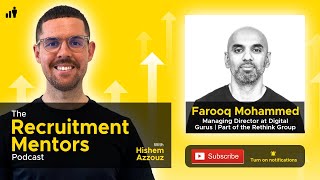
In this Recruitment Mentors Podcast episode, host Hishem Azzouz interviews Farooq Mohammed, co‑founder of Digital Gurus, about the full lifecycle of building a recruitment agency from a £10,000 start‑up in 2008 to a £54 million turnover business that was sold to the Rethink Group in 2016. Farooq shares the core traits he looks for in recruiters (hunger, humility, ambition), the unconventional way he raised the initial capital by selling a story to the News of the World, and how early‑stage learning from competitors and experts shaped the company’s financial, operational and branding strategies. He explains the systematic hiring triggers based on metrics, the aggressive branding and guerrilla‑marketing tactics that gave Digital Gurus a market edge, and the importance of investing at least 10 % of revenue in marketing. The conversation moves to common early‑stage mistakes – under‑investing in specialist finance, accounting and non‑executive directors – and the criteria for selecting a valuable NED. Farooq discusses the most critical hires (sales director, accountant, marketing director) and the cultural model (bottom‑up, flat, localized autonomy) that drove retention and performance. He offers concrete scaling advice for 10‑20 headcount firms, demystifies recruitment valuation terms (NFI, EBITDA, multiples), and outlines the timeline and mindset required to plan an exit, emphasizing profit as the primary driver for investors. The episode concludes with reflections on industry culture, the influence of Ray Dalio’s Principles, personal anecdotes (first big commission spent on his father’s car), and Farooq’s ultimate career goal of working with meaningful people on meaningful work.
Chapters
Welcome to the Recruitment Mentors Podcast. My name is Hishem Azzouz. Today I'm very excited to be joined by Farouk Mohamed, who is one of the co-founders of Digital Gurus. And in 2016, they sold this business to the Rethink Group, which he's now on the board of. Um, and this group consists of 4 recruitment brands, including Digital Gurus, generating over £150 million in turnover. They employ over 100 staff within the group. And Farouk started Digital Gurus during the financial crisis in 2008 with 2 business partners, and in the last 12 years has grown this business to 80+ staff, turning over £54 million, a net fee income of £12 million. And then this actual business, DG, now operates in London, Manchester, Sydney, and Dubai. Farouk, welcome.
Good to be here, thanks, Hishem.
So as I was saying, where I always like to start, in your opinion, what characteristics and traits do you think make up a highly successful recruitment consultant?
So I really thought about this, and I thought over my career of interviewing recruiters as well, and I've interviewed over, last count, it was over 1,500 people for recruitment consultant positions within DG, right? So there's been a lot, and it was always the core things that we looked for. There were some bonuses on top, but the core things that we always looked for was hunger and drive, which you can probably bunch up together, a willingness to learn and humility, and ambition. And the reason it was those things was because we couldn't teach them. We could teach market sector-specific knowledge, we could teach how to go and find a good CV, we could teach how to network, we could teach how to do a Boolean search, we could teach how to go and find a customer, but we couldn't teach those core values. So let me just relate to them. Hunger and drive. Obviously, we wanted people who wanted to really push themselves because when you're, When you're in recruitment, the business that we built was one that was less cracking the whip and more self-motivation. So we wanted more of the carrot than the stick. And what that meant is that you had to be self-motivated. You had to be able to go, right, what am I wanting to achieve for myself? What is it that I'm driving towards? The company will give you the infrastructure, but without that hunger and ambition, that willingness to win, there wasn't a lot that we could do for you. There would only be a certain amount, and I believe this, there's only a certain amount that the stick could even get you to. Now, right, how many calls have you made today? How many customers have you spoken to? After a while, that becomes repetitive and boring. If you've got that willingness to win, that ambition to learn, that ambition to push yourself, that will just keep going indefinitely. That was a core value that we looked at. The other thing that I mentioned was humility and willingness to learn, right? Unless you are willing to listen to people that have been in the trenches before, that tell you to do it in a certain way, that you're able to go, actually, let me try and do it that way. Let me try and experiment in a different way to what I think it should be. Then you're going to struggle. If you have that ability to go, I'm not an expert in this area, let me try it in this different way, or let me experiment. You're going to end up being far better than you would if you didn't. So those were some of the key criteria for us. It was always the same thing. Now, like, the, the whole— you could always go to, should you hire experienced or non-experienced, right? And my answer to that is that you, if you don't have those core qualities in the experienced people, it doesn't matter. You have to have those core qualities whether you're inexperienced or inexperienced. So if I was hiring a recruiter, 10 years worth of experience in recruitment, didn't have those core qualities, or I felt they didn't have those core qualities, we wouldn't hire them.
Yeah, so that's the recipe that you always look for. Yeah, the key parts of the recipe.
Yeah, I've never met— honestly, I've never met anyone who'd set their career goal as being a recruiter. So therefore, most people who come into this industry have come in it without meaning to come into it. And they need to have some core key characteristics. That means that everyone's learned the skill of being able to do recruitment, so they must have had some core key skills, and for me, those are the key ingredients.
Yeah, interesting. Well, hopefully recruitment is becoming a bit of a career choice for you. I'd like to think that it's changed, that's slightly changing, and I think there is definitely more people that want to get into the industry. But really interesting insight. So a lot to uncover here. You've been on a long journey, where I want to start when doing my preparation for this, we've got to start with this MyCashly story. We just have to start with it, right? So to give some context, and correct me if I'm wrong, from what I learned about you through, because you worked in recruitment for a year and a half, and you and your two business partners started to think about, we can do this better than the business that we're in, and started to formulate Digital Gurus in a shisha lounge. On a weekly basis talking about what we're going to do, what you can do better. So you had that, I guess, that naiveness to be like, no, we can definitely do this, right? And just that hunger to make things happen. And from what I heard you talk about this before is that you decided, all three of you, that to kickstart this journey, you need $10,000 each. That's what you need to buy in to start this. So why don't you share how you got that $10,000? Because I know you didn't have it, but you found a way to get it. So why don't we start that and how Digital Gurus started?
Absolutely. So I didn't have the money and I was like, right, where I'm gonna get this money from? And this was sort of like in the back of my mind. Anyways, I used to live with a bunch of mates and one of my mates worked for a large spread betting firm and he comes home one night and he just goes, oh, you'll never guess what, Mike Ashley lost £60 million last night. Making a bet. I can't remember exactly what a bet was, but he lost, and I was just like, all right, okay. Back in those days, there was News of the World, and you'd often see little adverts on the tube or wherever, will pay for stories. So I was like, okay, maybe I can make some money out of this, right? Obviously betraying one of my friends' trust, totally like stepping over the line, but needs must at this stage. And he still to this day doesn't know. He still to this day doesn't know. And, uh, so I call up News of the World. I call up a few of the newspapers and I go, look, I've got this story, how much would you pay me? News of the World go, 10 grand. They must have known rounded numbers work, right? So they say 10 grand. And, uh, I, uh, I, I arranged to meet this reporter and he arranges to meet me in this hotel on, like, on the Thames in Waterloo, near Waterloo, on the Thames. I remember this hotel was in and it was like dimly lit, and I walked in there and it was absolutely how you'd imagine a News of the World reporter to look, right? I'm just saying stereotypically, I'm not saying they all look the same, but this is how I imagine that person to look, and he looked exactly like it. Shiny suit, slicked back hair, the whole works. And he sits down and he goes, right, so tell me the story. Told him the story. Tell me how you know. Told him all of that. And he's like, well, we have to verify this story, we have to call up Mike Ashley. So he, um, he just calls him up, he like, you know, he calls up this, this secretary or something like that. Anyway, he gets through to Mike Ashley and goes, Mike, look, we're going to run this story that you lost X amount of, uh, £60 million on Monday night or whatever it— whatever night it was, and we're going to run it on Sunday. And Mike Ashley just turns around and goes, no, that's not true, I lost £120 million because I had the same bet on with someone else. A firm, same bet with a different firm. So anyways, this story ran. It was a double-page spread, which I've still got. I've still got it in my house. And they paid me 10 grand, and I used that money to start the business up with. So literally about 2 weeks later, we started the business because I went to the guys and I went, look, I've got 10 grand, so I've got my share. I have no idea where they got their share, but that's how I got my money. I sold it to my best friend.
Absolutely unbelievable, that story.
Yeah.
So, absolutely, I had to get you to share that. I just thought when I first heard you talk about that, I was like, that is just, that is mental. But I think that says a lot about the type of, like, you clearly someone that makes shit happen, clearly, from what, when I've heard you talk about your journey and you take action.
I think it was an opportunity and it was something that we really wanted to do and an opportunity came about and we took it. You know, ethically, was it right? I probably, I'm not 100% sure if it was totally right, but it was an opportunity that had to be taken at that time. And you know what? It worked out.
So to start Digital Gurus, you need two business partners, right?
Yeah.
Haven't got a whole lot of recruitment experience. How much experience did your business partners have at this time? Point?
Uh, one of them had 8 months and one of them had around 2 and a half years. And, uh, what was funny is that we thought that was enough. And do you know what, it might have actually been enough in terms of recruitment experience, but what it— what we didn't have was any experience of how to run a business.
Run a business, yeah, yeah.
And that's a complete different skill set, and we, we realized that relatively quickly.
So what I heard you talk about, which I found really interesting, and I don't know how common this was when you started this in 2008, was that I heard you talk about that in the first 2 years of you starting Digital Gurus, like what you decided to do and take your own initiative on was like pick the brains of experts and ask as many people as possible for advice.
Yeah, absolutely. It was really, really important. Why did you do that? So like I said, we didn't have any experience of how to run a business at all. So we started to reach out to people that, one, that we saw as competitors, and two, that we thought we'd want to be able to network with them, learn from them and whatnot. We never saw it as a way of that, you can't speak to your competitors. For us, it was always a case of we should be talking to our competitors to learn about the market, for us to be able to learn off them and see what mistakes that they made potentially and if they were willing to share. So we reached out to a few larger companies back then and you know what, every single one came back to us and said, yeah, come down, let's have a conversation. And we slowly over the next 2 years learned how they build their businesses, how we should build ours. We reached out to the experts we made a ton of mistakes before we'd reached out to them. We were able to escalate our learning by reaching out to those sort of companies and it was absolutely invaluable. It was really one of the key reasons we succeeded.
And what would you say were like, I don't know, the top 1 to 3, you may be asked this before, but like thinking about that and how valuable that was. Yeah. Top 1 to 3 things that people shared with you that you think really stuck and were really instrumental in how can you grow this part?
As you can imagine, it was, it was all, a lot of it was around stuff that you wouldn't learn in recruitment sales. So it was like financials, how should you structure your financials? What sort of accountancy should you use? Should, how should you be leveraging off your invoices? So things like cash flow and scaling up. And then there was things like business plans. How do you strategically grow from 3 to 30? What, what numbers, what metrics do you need to hit for your next hire? So one of the key things we, we learned from reaching out to somebody was that they used a metric system where they'd be like, right, every time we get these amount of things happening, so it might be interviews or jobs on, um, and a conversion between them, we're going to hire somebody new. Every time we hit that metric, we're going to hire somebody new because That was their signal to say the market is big enough for you to go and try and attack it. They had a systematic way of doing that. So that was a real key thing. The other key thing was that we just didn't know how to grow our business using cash flow. So we were just funding it ourselves, right? And somebody came in, one of the guys that we were working with and said, No, you should be using this facility. So your perms should be paying for your contractors and your contractors should be paying for your perms. So just leverage the amount of invoices that you've got going out. We were just going, right, if we've got that much money coming in from perm, we'll use that to pay for our contractors instead of using both sides. It was totally naive. So lessons like that. And ultimately the other big thing that we learned was what type of culture it takes to succeed, what are people attracted to, you know. So I go in and go, right, what— why do people want to work for this particular firm? What is it about them? So little things like office design, um, brand and marketing in terms of their website. So I'll give a real example. When I went to one and they had a semi-decent site, I remember this is 2008, recruitment agency websites in 2008 were horrific. So we were like, right, right. Our industry was digital design and technology. So we're like, right, why don't we design our website like a design agency so it looks really slick, really professional? Because what we think that will do is convince candidates and customers that these guys know what they're talking about because look at their site. They looked completely different to a recruitment agency website. Totally. So we actually professionalised that. We went to a design and branding agency, not a, like, oh, we specialise in recruitment. No, we went the other way. We said, we're going to go to a specialist that designed for products. And they designed our website and it blew out the market, completely changed our brand from a challenger to these guys are serious overnight. And what you saw over the next 12 months was every recruitment agency then changed their websites to match it, to try and catch up. So we had a huge edge in terms of candidate and customer perception just from branding. And that came from reaching out to other recruitment agencies to see how they were doing it. And the ones that we were sort of like trying to emulate, we noticed that their website tended to be better than the others. And so we were like, right, let's try and blow them out of the water. So it was little things like that. Those were the key 3 learnings, I would say.
That's really interesting. Definitely want to dig into you talking about your hiring triggers that you now know from, like, that's early on, right? But the hiring triggers are sort of non-negotiable for you now. But quickly on branding, because yeah, I heard you talk about this before, that you, like, like you're talking about, that genuinely gave you an edge and also led to where you ended up in terms of being seen by the businesses as a business to potentially buy or invest in, etc. And I think if, I don't know what your thoughts are on the landscape right now, but I think obviously the recruitment industry as a whole, marketing has become even more important. And you're talking this about in 2008, right? So there's still companies completely on the fence about this, investing in marketing these things. So I guess what I want to ask you was, early on at that time, and maybe you can share what you sort of spend now, but like, percentage-wise, roughly how much was you investing in marketing out of the money that you was putting back into the business?
We were aggressive. We were aggressive with marketing. We were spending at least 10% ourselves. And then we were doing sweat stuff as well, right? And what I mean by that is that there were loads of networking events that were going on that we weren't, they weren't ours, right? So they were in our industry, that people were running. And so we would approach those events and say, we'd like to sponsor it. And we'd get like a discounted sponsorship. But what we used to do was ask them to say, if they said, pay us a grand a month to sponsor this, we'd say, we'll give you 500 quid, but the remaining will work for you on the night. So things like, we'd be on the door, right, with the guest list. We did that strategically because we knew that people letting people in we'd get to meet them face to face. Yeah, we'd get to know them, we'd introduce ourselves, and whilst we're doing a favor for the event, it was also raising our brand awareness. So we were strategically doing guerrilla marketing and really trying to get our brand out there. I would say that you have to be famous for something, you have to be unique, and it's like anything. Like, think about a shop that you want to shop at. If you went onto their website and it looks slightly tatty, it you'd start to think, should I be giving my money to this business? Is the product going to arrive? All the things that are associated with that. So for me to really stand out in the marketplace now and in the future is that you've got to be— you've got to look slick, your website's got to look slick, your message has got to look slick, your— the way that you present yourself to the marketplace, candidates and customers has to be spot on. You've got to be famous for something. No, I think that the market has evolved from being generalist into being specialist, and the more you are known for something— and I've heard a couple of people on this podcast talk about this, and I totally agree— the more you're known for something, being famous for something, the better you'll become. And that, if you think of it from a candidate's perception, what do candidates hate about recruitment agencies? They hate that they don't know what they're talking about. They hate that they are never got back to, and they feel like they're just a piece of transaction for them. They don't feel like they're getting value. If you can convince the candidate, which is the core part of a recruitment process, is the candidate, is to go, right, I've got your interest at heart. I know what I'm talking about because look how much I invest in my product and myself, in the way that I present myself to my customers. I'm going to treat you like the most important thing in the world. You're going to differentiate yourself from the rest of the marketplace. Because even now, to this day, we just don't do that. The way that I look about the recruitment industry is that we should treat it more like the sports industry treat their stars. So like, for example, the sports agency market will work with a certain amount of candidates and they'll go and present them to the marketplace. If I was in recruitment now in a specialist vertical, I'd say, right, I'm only going to deal with the top 4 in that industry. Every single month I'm going to deal with top 4. Don't know who they are, but I'm going to deal with top 4. I'm going to find them and I'm going to work only with them, and I'm going to tell them that I'm going to put them at the centre of it. I'm going to use my brand, I'm going to use my, um, knowledge of the market to take them to market, to get them the best, uh, job for them, the way the sports industry does. And then what will happen is over a year you're working with 48 to 50. If you're in on the perm side of the market, you're working with 48 to 50 and your brand network just becomes bigger and bigger because you're able to specialize. That for me is the way that the market should be rather than generalist.
So you've shared, so you've shared some of the things that you learned from people's advice and then you've taken action on branding, marketing. What went really wrong for you in the first couple of years? Digital Gurus, where did you go wrong? What mistake? People want to know the mistakes you've made, Farouk.
What mistakes? The mistakes that we made was that we didn't get the right sort of professionals to help us. We thought that we could do it all ourselves. Right. So what I mean by that is that we went cheap on things like financing or accountant, right? Typically what I see is that when companies set up their recruitment agency, they'll go, right, I'll use my mate's accountant or my dad's accountant or somebody in my network's accountant, rather than going, do you know what, I'll spend a bit more, but it will save me tons in the short, medium, and long term. And what I mean by that is that we had my dad's accountant, wrong VAT returns, late VAT return, just little things like that, and they all add up, right? Because In recruitment, it is a specialist industry. The volume can increase really, really quickly, especially if you've got a contract book. You need specialists. So we should have outsourced more to specialists that knew our market and we would have saved tons of money. We would have grown quicker. We wouldn't have got fined. The other thing that we should have done is that we should have had more specialist advice from non-exec directors earlier. We did get one. We got one after a few years and it really was, I think it was critical in us getting to a sale. But again, it was that naivety and that arrogance, I would say, to go, 'Oh no, we know what we're doing, we'll scale it up.' And that just put us back a couple of years.
Yeah, just on that, I had a question come through, and I think this is— I sometimes get asked because of the network I have, 'Do you know any good NEDs?' Right? So I guess the journey that you've been on now, you can look in a bit, look back on this, but like any advice for people, business owners listening to this that do want to find the right NED, because there are a lot of people that haven't walked the walk or say that they can help with something but they can't, or whatever, right? So I guess you just said that it was pivotal. So like, if I, if I'm, if I'm asking you for, as a recruitment business owner, like, what would you encourage me to look for? Obviously it's personal to me in my business, but what would you say be the non-negotiables when considering an NED for my recruitment business?
You've got to get on with them. That's the first non-negotiable. Um, and you've got to be able to The other non-negotiable that I would say would be that you've got to be able to have really difficult conversations, and if you're not able to do that, as in that trust factor isn't there, then they're not going to really add value. So again, it comes down to the key criteria of how you hire recruitment agencies. You've got to have humbleness about you, you've got to be able to have a willingness to learn, and if you're able to do that, they will absolutely add value to— they will scale your business up a lot, lot quicker than you would be able to do yourself because they'll stop you making mistakes. You know, they'll absolutely introduce you to experts that will help you scale your marketplace. I can tell you without doubt, without our non-exec, we wouldn't have been able to scale that business and sell it at the time that we were. We might have been able to do it eventually, but not in a timing-wise that we did it in, because they stopped us or they eliminated mistakes that we were making that we weren't even aware of. And they were able to introduce us to people that were able to scale our business up a lot quicker on the professional side. Yeah.
So for me, it's not even just them, the individual, it's actually you then get access to their network, right? Because it's in their interest.
Absolutely. Yeah.
So just on, on the first part there of mistake, really interesting and probably a common one. Like, what, looking back now, like, what do you think has been the most important hire of all, the glue? That's really enabled the business to push forward, if that's a sales director, an ops director, people manager, like what do you think has been like an absolutely, like someone maybe you could have got in the business earlier that you think could have made an even more of a difference? What would you say?
I think a sales director in the business earlier would have made a huge difference in terms of scaling the business up. I think that would have been a critical hire, but I would say honestly, the critical hire was, I'm loath to say this in a recruitment business, but it was an accountant. It was sorting out, it was sorting out all of the, all of the mess that salespeople do because we're not experts at that. We don't really want to take care of that stuff. We want to do the exciting stuff of selling and making money and making a difference in people's lives. That's what we're brilliant at and that's what we want to do. And I think the critical hire was, um, there's a few actually. The marketing director, because they helped us explode our brand and really take us on to the next level. It's very difficult to say that one particular salesperson was critical. I would honestly say that every single hire that comes through the door from the sales side is critical. Because they add to your brand, they add to your network, they add to your sales numbers. Um, it's very difficult to separate somebody out. But in terms of one of the things that you mentioned earlier around mistakes as well, I think one of the mistakes that we did make was that we didn't ourselves hire in somebody once the business reached a certain size to run it, and we should have stepped away more ourselves. We were hands-on for too long. So I think a sales director, a managing director could have taken the business on even faster, even quicker. I think that would have been important.
Okay. So you've spoken quite a bit around early on in DeeDee, so keen to dig into like leading up to selling to Rethink, stuff like that. I know a lot of people are keen to hear about this. So just final thing around this. There are, as I'm sure you're aware, the large majority of the recruitment industry is made up of, of small micro recruitment businesses, right? So there'll be a lot of recruitment business owners listening who are at that 10-head mark or 20-head mark, right? And I'm sure a lot of people seek your advice, but who are at that. So I guess what, like, if they're listening right now and they're at that stage of their business and they do want to scale, that's obviously important that they do want that, they know that, what would your advice be to them? If that's where they're at in their journey.
Let me just break that statement up for a second, right? So there's two reasons that, um, recruitment companies start up. One is either for a lifestyle, um, because you want to have a better lifestyle and you want to run it in that way, or two, you have a really clear mindset that you want to scale up a business and sell it. And the two don't often combine, because if you're running as a lifestyle business, you're taking more money out of the business. If you're scaling up and building it to sell it, you're putting more money back into the business. So for those who want to sell their business, this is really important to know. If you are doing £1 million profit and, uh, plus, you will have 1 to 2 checks chasing you. If you're doing $2 million and above, you'll have 8 to 10 checks chasing you in profit. So it's really important to know that massive difference. If you're doing $1 million and below, unless you are super strategic in a niche area that a business wants, they're not going to come and look at you. Right. So you really got to focus in that profit line. That's the thing. That's, that's the key differentiator in terms of acquisition. In terms of scaling up, you've got to be able to look at your marketplace and go, right, in this marketplace, how much is there that we can scale up in terms of headcount? What are our metrics that we're looking at? And it could be jobs on, it could be interviews to jobs on, and the two interlink. It could be sales, how much sales are we doing before we bring our next person on? It could be how much percentage margin are we doing in profit? So if we're selling £1 million and we're putting 10% of that on the bottom line, so £100,000. Do we want to increase that or do we want to put that back in the business? What are the metrics that we're looking at? So for me, we always drove it really, really simply on we want to hit a certain amount of profit, we want to hit this conversion rate on our profit. So we used to look at how many, how much jobs are in that area that we're getting through monthly. How much interviews does that convert to before we'd hire our next 1, 2, 3, 4 hires based on that data? So we'd always run it data-led. For those businesses that are out there right now going, right, should I hire another person? Should I look at another 2 people? Should I look at another 3 people? You've got to break down your market. How many jobs on have you had in that market in the last couple of months? How many jobs do you think you've missed out? And it's a bit of a finger in the air exercise. How many jobs do you think you've missed out on? How many, uh, what does the market say in terms of growth over the next year, 2 years? And you can find this data online. For example, if you're in a marketplace like AI, what does the market growth look like over the next 5 years in terms of percentage growth? Anything over 5% growth in that marketplace year on year, you should be investing. You should be looking to invest because that market will accommodate that extra person. The organic growth will accommodate that extra person. So that's what I'd look for. So if you're a business right now and you're like, right, I want to sell my business, and you've had a couple of speakers before whose ambition is to sell it, the magic number that they're looking for without them being totally strategic, as in they're a specialist in a certain area, is $1 million plus minimum. For those that want a deal guaranteed on the best terms, $2 million EBITDA.
Interesting. And just really quickly, I've had a couple of people— can you— like, some people have messaged me before, like, Hishem, like, what— when they say NFI, net fee income, EBITDA, like, what do they mean? Can you just, just do that in layman's terms for people? Do you know what I mean? Because I think that's beneficial.
NFI is operating profit. So in recruitment, um, where you have turnover as well because you've got contractors in, in a lot of them, it's what you're left over once you've paid all your contractors. So it's your sales number once you've paid all your contractors. So for example, you might have 100 million in turnover, but once you've paid your contractors, you've got 10 million left over. NFI is that 10 million, also known as operating profit, also known as sales. EBITDA is once you've paid all your staff, once you've paid all your costs, what's left at the end of the month before tax, right? And depreciation. Effectively.
Yeah, and that's typically what's used to value businesses and everything else, isn't it? That figure?
Yeah, it's slowly changing in the industry, but in recruitment it's usually, usually 4 to 7 times in transactional recruitment. RPO is slightly higher. RPO is usually 6 to 10.
So, so what do you mean? What do you mean by that? Sorry, just to be really clear on that. So multiply on what you're making and what you could get yourself.
If your profit in a year is a million, £1 million, usually in transactional businesses. So the ones that like, right, we do this market, we charge 15%, and it's just every time you fill a job you get a certain amount of money. That's transactional. Usually they go at 5 times multiple. So if you did £1 million and somebody makes an offer, your business is probably going to go for £5 million, right? If it's 5 times multiple. Whereas an RPO, because they are multi-year contracts, they go for more. So they'll be like, right, we did a million quid, same amount of profit, but they'll go for 6 million if it's a 6x multiple. Yeah. Okay. Got that.
So, Farouk, you sold this business to the Rethink Group and Digital Gurus became part of the Rethink Group in 2016. So like how far out from the exit or from that sale, because obviously you're still involved, sorry, so maybe not the right terminology, but how far out from that sale do you start planning the process and what was the most difficult part in that practice to get there, would you say?
All right. In terms of how far out, from day one, straight up, we had a real clean idea that we were going to build this business to sell it. And from day one, it was— there was no way. We weren't interested in lifestyle. We weren't interested in taking any money out. We were like, we are going to build this business and we're going to sell it. And it was a real key strategic thing. And I would say to any business entrepreneurs that are looking to scale up their business or looking to start a business or looking to sell their business, you've got to have a really clear idea that you want to sell the business because it will determine your decisions. So that was the first thing. But in terms of when we were going to sell to Rethink, we knew maybe, we knew we were going to sell the business probably a year before we definitively we're like, right, in the next year we're going to sell this because we had multiple parties that we were talking to, private equity, other options that were on the table.
And, and just on that quickly, sorry to, sorry to butt in, but a few people, I think few people interested in this, like, how did that actually come about? Did you proactively look for it? Did, I don't know, did you give the potential business proposition to someone and they broke it out to their network? Like, I think people interested, how did—
Great question. Like I said, network. It came from our non-exec. It came from my non-English. And what you'll find is once you've got a certain brand and a certain amount of profit, the market becomes aware of it and the market will come to you. I would encourage those that are really focused on selling is to not proactively go to market because you'll tend to find that you'll get a better offer coming to you. There's loads of agents.
You've got leverage straight away, haven't you? You've got leverage straight away.
Totally. It's like anything, like, you look, we all work in sales, we know what works. It's like, um, you'll have loads of agents, you'll have companies that are listening right now that'll have agents approaching them saying, oh yeah, come on, we, we've got interested parties in your company and we'll take it out to market, and they'll charge you a price to do that. But most of the time that's not going to go anywhere. So if you're going to negotiate those types of deals, don't pay any cash up front and say we'll give you a higher percentage on sale. If you get the right network involved, and I'm telling you, there's plenty of companies out there sitting there looking at the marketplace, looking at who's doing what profit, looking at their areas of strategic weakness where they go to the market and go, right, we need this area. They'll be aware of your brand and it will come to you. And your, your advisors as well will be well aware of what the marketplace is doing and will be able to introduce you to the right places as well. So a great question and it's important for people to understand that. The thing that I'd be aware of with certain things like that though, it takes a lot longer than you'd realize in terms of the actual act of setting it up. It is long. And you are, you, you as a business leader.
How long did you think it was going to take and how long did it take?
I thought it would take us, I thought it would take us maybe 3 months and it took us from start to finish a year, I would say.
Okay.
And it was full dedication. So I basically started to just focus in on that. So it took me away from business and any potential companies that are thinking about that, you need to be fully aware that it's going to take you away from your day-to-day activities and you need to be able to do that. And to be honest, if you're not able, if your business is not able to function without you being able to take a step away from it anyway, you're not ready to sell. So it should be able to survive without you.
Yeah. So this is my sort of question. I think this is— be interested to get your thoughts on this because I think this is the part that I don't think— I think it's sort of a gray area, right? And there isn't complete clarity. So be good to get your thoughts. So like, what do you think going through that process and now being in a group that I guess looks for businesses that you can invest in, Like, what would you say is the most valuable part of a recruitment business that an investor looks at?
It's profit. Stone cold profit. They look at sales growth and they look at profit. Is the business on an upward trajectory? If it is, great. What numbers is it doing on the bottom line? Then they look at secondary factors. Does it address a market weakness in our brand in our service line? Does it address a market weakness in the market? Does it have a great brand in itself? Does it have great people? And it must do because it's on an upward trajectory. What's the sort of leadership like and does it integrate with our own brand and offering in terms of culture, culture fit, things like that? But still, but they won't look at you first and foremost. You can have the best brand in the world, the most Amazing known brand, brilliant outgoing staff, all of that amazing stuff. If you're not putting it on the bottom line, they ain't interested. Hmm.
Did the sale meet your expectations?
It met my expectations in terms of we wanted to do it for strategic reasons. So it met my expectations and it took us from one level to a completely different level. In terms of, uh, and I, I personally, when I learned a load, did it meet my expectations in terms of the downsides that come with selling your own business? Because ultimately what comes with that is that, that lack of you have the final say. You're now part of a team and leadership. I think it's very difficult to ever say that it's better to go and compromise your own final say than having your final say, if that makes sense. Like, I'd much rather be able to make that decision myself, um, and I think most entrepreneurs are going to be built that way. That's why they did it in the first place. They're like, they like the risk element and they like to have the final say element as well.
Because like, how— I know I asked you this like when we just spoke and stuff, but like, you knew 2008 from that shisha lounge, like, we're gonna build a business to sell. So like, how— oh yeah, I know you're still getting involved. Like, how did I actually feel? Like, how did you feel about you? Like, how did you feel?
It's, it's a really interesting thing. So the day that we signed, a lot of people, um, usually feel really weird about it because they are parting with a piece of their soul, effectively. Yeah, you know, you built this thing, it was your intention. But because we were so laser-focused in going, we're going to do this from day one, for us it was just a natural conclusion. So for me personally, it was a sense of fulfillment, a sense of achievement, and it didn't feel like, oh my God, this is an emotional thing. It was very— no, you've, you set a target, you hit the target. And I think that the camps of people out there that will sell their businesses will fall into one of those two camps. Some will feel like, oh my God, this is such an emotional wrench. And I totally understand that. And others will feel like, tick that box. What's the next thing for me? What's the next target? Yeah.
So what I think people would be interested in, Farouk, is— so you mentioned profit, stone cold profit. That's what you need to look at for your business to be seen as really valuable, more valuable than other businesses. But I think some people be interested in the secondary parts, right? And I know we understand that the first part is more important. So what did your— you mentioned people, right? So I think what people would be interested in is like, what did Digital Gurus leadership team look like? Or like, what was the structure? So obviously you were just focusing on the deal, but like, what was the actual structure of the business? And what did that look like in terms of the people leadership and where they were? When you was like, yeah, pretty much there or then, yeah, being considered as a really valuable business.
Hishem, you said something really interesting and important there, that profit is important and the most important thing that companies look at, but you don't get that profit without all those secondary things. You do not get that profit without a world-class culture. You do not get that profit without world-class people. You do not get that profit without a world-class brand, and you do not get that profit without servicing your customers, both candidates and clients. Really, really well consistently over the years. That's really important for every business out there to hear. The one thing that I would encourage you all to take away from this is obsess about the process, the results take care of themselves. Obsess about the process. You know, if you do not look after your candidates, if you do not service your customers' needs, the profit's not going to be there. If you do not look after your staff, if you do not create a culture where they want to all work together for the for the same goal, the profit's not going to come. It's just not going to come. So that's the thing that I would really emphasize in terms of how we structured the business. We were very bottom-up culture, and I'm a big fan of bottom-up cultures. I'm not saying that top-down culture isn't right, but I was a big fan of bottom-up. We gave a lot of creative freedom to our management team, so they had a lot of freedom. Our Dubai office was run with some sort of say back to Basecamp. Like, we all had the same brands, but we'd adapt things for localization. So how much basics do you pay compared to UK? How much commission do you pay? Australia was very much the same thing. We had some central themes that were running throughout all the businesses, but the localized leaders also encouraged us to go, this is the spoke for us, and we ran it that way. Our managers had freedom. I really wanted my managers to be able to hire and fire as they saw fit and usually hire, right? To make those mistakes, to learn. For me, it was important that they developed that themselves, that they were able to learn and develop and grow. And that was a real key part to our success. So we had a really flat structure, we had a bottom-up culture. It wasn't very centralized, it wasn't very controlled. And that was part of our success, but there were key themes that would run throughout the business. Minimum standards in terms of expectations, minimum standards in terms of activity, how many jobs you have to get on, how many interviews you have to get. KPIs are really, really important, but they've got to be important to serve the— the process has to be right to get the outcome. So it wasn't like you've got to make 20 million phone calls today. Well, if you had a certain amount of jobs on already, your focus was probably more on getting candidates, you know, to be able to source that. Or if you had a world-class candidate, your job was to go and market that candidate out to customers that needed that skill set. It wasn't prescriptive, it was what you particularly needed for your desk at that particular time in order to get the outcome that you wanted. But the outcomes are all the same, you know, if you were at a certain level, we expect this outcome from you, this is the breakdowns that you need to do in order to get that outcome. Yeah.
So just as we come to the end here, I've got, there's just, I've got 5 sort of quickfire questions that I definitely want to ask you, but.
Okay.
So we took, I think a lot of, a lot of, it always comes up in a conversation, I want to grow my headcount, I want to hire more people, right? And I think you're touching on it here, but like, what would you say you have done as a business? And I think you were just talking about it, like, let's just talk a bit about retention. Of staff, right? I think everyone always talks about need new hires, need new people, would grow if we could get this 100 headcount. Like, what you're talking about, bottom-up culture, which clearly contributes to it, probably. But like, where do you think had the most impact on retaining your best staff and creating more of those role models and digital gurus and those success stories that continue to cultivate that bottom-up culture?
The key to retaining staff was to have a common goal. And for everyone to be facing in the same direction and moving in the same direction. That was really, really important in terms of retention. And I would say retention is more important than attraction if it's the right people that you're retaining. In terms of retaining and attracting, you've got to have a really forward-looking goal. The goal has got to be ambitious. It's got to be hard. People like that. People want to be part of a journey that's big, ambitious, slightly dangerous. They want to be part of something that's going to be like, well, guys, we're going for this. We want to be part of the journey. We want you to be part of the journey. And that's what I mean by that collective culture. If everyone is in it together, facing in the same direction, pushing together, that is so powerful as a force. So, so powerful. And the other thing that you have to infuse that with is fun, you know, like We're in a really challenging year this year, but recruitment is that one industry where you've got to be able to enjoy it. It's hard, the job is hard, you've got to be able to have a laugh. And if you can have a laugh together, it's so powerful, so, so powerful. I mean, to this day, some of, some of the guys who have moved on, some are still there, will come up with instances where we'd had a rough week, right? We missed our numbers for whatever reason or whatever, and somebody would lead from the front and go, right, I'm just going to stop work today. We're going to go out on an extra long lunch. We're just going to commiserate together. We're going to just get back on it, and then we'll come back and we'll crack on again. Little things like that that were entrepreneurial, that were different, that everyone was in it together, made a massive difference. So that's a huge part of success for me.
And I think, and I think that's the interesting thing, right? Because I think if you think of a typical small business, it's probably things like that that they haven't spent time on. If you think about it like that, maybe they might not, they might not have really clearly communicated their values, or they may not know, be really clear on their purpose. And if I think of the recruitment business environment I was in, there's 12 of us and there wasn't a common goal. It was more of an individual goal. We were all bought in and we were a team. But actually, we didn't know what the common goal was. And sometimes I think as a small business, because you're worrying about, well, you've got to get cash in the bank and you've got to crack on, right? So I guess just I think a lot of people go, yeah, I get that. But like, how can I know you just got to start, right? But what, how can you start that process and start communicating that common goal? Should you, if I'm listening to this now, I'm like, you know what, actually we don't have a common goal. Like, do we need to, do they need to pull everyone together and be like, right, why are we doing this? Like, what is in this for us?
That's one way of doing it. What is the purpose? Why are we all here? What is the common goal that we're trying to achieve?
And has that got to be bigger than just numbers? Is it got to be, do you know what I mean? Like, what is this?
Who's motivated by numbers? No one. No one is motivated by numbers. Let me tell you that straight. People are motivated by a goal, by a mission. We were really transparent that we want to grow this business to sell it, but we're going to have a laugh doing it. That was ours. That was our bespoke thing. So we were absolutely comfortable to do that. Somebody's out there right now going, right, we haven't got a common goal. Speak to the staff. What do we want our common goal to be? You know, like, get some advice from them. They'll tell you what they, what they think it should be. And if you're in a small enough business, you can design a common goal together, you know. And if you're in a sort of larger business, get your management team, get them to speak to their staff and go, right, come with some key themes. Let's sit down together, let's brainstorm it. Let's have, what are we working towards? And if that thing is not really, if it's just numbers, who's motivated by numbers? I'm sorry, but not really.
It's what comes with the numbers. That's the thing, isn't it? It's that. It's like, okay, yeah.
It's the why. Answer the why. Why are we doing this? Nobody wakes up in the morning going, right, I'm doing this because I want to make, I want to hit my 10 grand target or my 20 grand target this month.
It's what you're going to get with that. 10 grand target and what it's going to do.
What does that bring? What is it important for me? And over and above that, what is it, why is it important for the business? And if you can really get everyone tuned into what's important for the business, as in the business and the individual goals align, so powerful.
I've got 5 questions for you.
Let's go.
If you could change the industry, what would you improve?
I would make it into more of a we culture than a me culture. What I think the industry gets wrong is that we overemphasize the individual rather than the team. And what that leads to is that a few people end up winning rather than the majority. So I would fully change the way that the industry awards success. I would democratize it far more.
What book have you read that's had the most or biggest impact on you?
The book that I've read is Principles by Ray Dalio, which sets out really clear goals and life principles that he set that were able to guide him when he was uncertain. And I just copied it and I started doing the same in different circumstances. And it was fantastic.
Yeah, if you don't know who Ray Dalio is, you need to check him out. I mean, the stuff that he's come out and now said and just shared everything he's learned. And yeah, you need to know who Ray Dalio is, quite frankly. And it's a great book. So if you could write a LinkedIn post that could be seen by every single recruitment consultant across the world, what would you want it to say?
God, that's a challenging one. I would want it to I'd want it to be positive, so I'm not going to be specific because that's too much of a challenging question to answer, but I'd want it to be positive. I'd want it to be forward-looking, so focusing on the future, and I'd want it to reflect something like a reflection of how appreciative people that are in my position are of what those people do. That job is phenomenally hard. It's thankless a lot of the times. And I would just be like, do you know what? You guys are amazing. Thankful for working with people like that. Let's keep cracking on at this and let's keep being successful. So it'd be on those themes.
Yeah, I like it. Interesting on this one. What, what did you spend your first biggest commission paycheck on?
Uh, God, probably on a night out, if I'm honest.
Um, or like, biggest— or like the first time that you probably paid yourself out of the business, I guess, might be a bit different for you. But, oh, I think it's always interesting.
I, I'll answer that slightly differently. What did I spend my first commission check that I really enjoyed spending that money on, right? That wasn't practical. Uh, I come from a really working-class background. My dad's a taxi driver and he single-handedly raised me and my brothers and did all of that stuff. So the thing that I enjoyed buying the most with my big commission check was I bought him the fanciest car that I could find that he wanted. And the smile on his face, he didn't say a word, was priceless. That was, that was, yeah, it was priceless. That was what it's about.
Last one, and I'll slightly change this for you, but I guess what, what, what is the ultimate goal for your career?
For Rick? To work with two things: meaningful work, meaningful people. I want to work with people that I can learn off, that I love working with, that are hungry, ambitious, and want to achieve. And meaningful work in terms of that we're making a difference to people's lives. So those two things are my key drivers: meaningful work, meaningful people. Combine them together, job done.
Love it. Rick, it's been an absolute pleasure. Excited to see what's next. Thanks, Hishem.
More from Hishem




You don't need as many clients as you think to bill $1 Million A Year In Recruitment



From 30 Direct Reports to Back-to-Back $1M Years as a Solo Recruiter with Zach Creighton



