How To Win Big In The States | Live Podcast Austin Texas
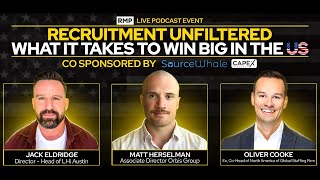
Ollie, Jack, and Matt, three recruitment leaders, discuss scaling a staffing business in the U.S.: how to attract top recruiters, pick markets, and use AI as a productivity tool. Jack shares how Lawrence Harvey became employee-owned. They debate when to walk away from clients and cover forecasting methods to predict revenue in a volatile market.
Chapters
Welcome everyone, welcome. Thank you so much for coming. First ever live podcast event in the States. So, uh, I used to commute every day to my recruitment job, used to take an hour, and that was the time where I used to listen to podcasts. Normally it would be the Joe Rogan podcast, in all honesty. And one day I looked for a recruitment podcast. I thought, wouldn't it be cool if I could hopefully try and get better at my job on my way to my job? A bit sad, I know, but that was, that was me. So, uh, looked for it, didn't really exist, and and for anyone that knows me, is friends with me, I'd like to think hopefully they describe me as someone that is willing to take action. I'm not the typical person that has an idea for 5 years and then never does anything. So I had this idea about starting a podcast. What if I interviewed top performers? I could learn from them, and maybe that could help one other person like me, uh, in recruitment that wants to succeed, that wants access to more content. So I took action on that. It was actually originally called the Recruitment Rollercoaster Podcast. Because my first year in recruitment was a roller coaster, so I thought that'd be a good name. And I started interviewing recruiters when I got home on my mobile phone in my bedroom, and, um, been doing that ever since for 7 and a half years. The sort of core mission behind it has remained the same really, which is to try and understand and dissect how people succeed in our industry so hopefully others can learn from that and apply those lessons to their career, their business, and hopefully have more chances to succeed with their their business or their career, because I just couldn't get my head around the fact that there were thousands and thousands of recruiters out there that were maybe struggling trying to figure out how to succeed in their career, and that knowledge wasn't accessible. I just— that just didn't really make sense to me. So, um, it's been a really cool journey. I've learned a lot and interviewed a lot of recruiters in that time, and now the podcast is helping 60,000 to 80,000 recruiters a month, and this year was really tried to set a goal around growing the international listenership. So it's cool to see, uh, some US folk in the room as well. Um, not just English people. So that's pretty cool. Uh, we went to Australia earlier in the year and then come to the US here. So, um, it's been a really cool journey and you're all now part of that. So it's really appreciated. So the goal tonight and how these work really, and hopefully this is on brand with what we do with the podcast, which is I want all of you to be able to walk away with at least one thing. I want it to be practical, I want it to be useful. So a lot of you submitted questions when you grabbed the ticket. I try and use that for context to try and understand what's top of mind of people. And we've basically got 3 core areas that we're going to focus on with the, the panel. So we're going to talk a bit about market strategy— what does good look like, what does bad look like. I've spoke to a lot of people this week, been recording podcasts and It's been interesting to hear about how people made some sort of real cute adjacent moves in their market, and that really propelled them to have more success. We're going to talk a bit about that. We're then going to talk about business development, winning clients, getting the most out of our client relationships. That's always something that's top of mind. And then we're going to talk about hiring. That's definitely something I've learned since being in Austin, is that it does seem to be a challenge for people to grow their businesses. So we're going to talk a bit about how can we do that effectively? When should we hire? What are the triggers? What does that look like? And then along the way, we'll get all of you involved, do live Q&A as well, is the plan, if you're all up for that. Yeah, awesome. So if you could put your hands together then, and then we'll get into it with the panel. Just turn these on. Try that.
Hello.
I thought you're going to sit at the end. This is Oh, next to me.
Yeah, you smell nice.
Just make me look tiny. Is that— turn that on, on there. Press that up.
Yeah, good.
We're in.
Matt, give us a little test.
Test 1, 2.
Nice. Awesome, awesome. So we've heard the sort of agenda, the plan. I guess before we just get stuck in, let's just do a bit of an intro. Jack, I'll come to you first. Give us a bit of a flavor of your journey. How long have you been in the US market? How long you've been particularly in Austin, where the LHR Group office is at, a bit of context on like your world, your market. I think it'd be good for people. And then we'll go over to Mike.
Absolutely. Hello, happy to be here. My name is Jack and I'm on the screen as you can see. I've been in the US now for 10 years, 5 of that being in New York and the last 5 in Austin. So we— I was one of the first 5 to launch Lawrence Harvey's. We were back then when it was just 5 British men in a tiny room working 15-hour days to, um, to our business set up. And if you fast forward 10 years to today, we're about 200 people across, um, 5 offices— 4 offices. And I've run Austin here for the last 5 years. Um, I initially said no when I got the opportunity to run the Austin office because I was pretty happy and content in New York. But actually taking that leap and taking that challenge has been one of the most fulfilling and fun, challenging things that I've ever done. And actually, there's quite a few of them in the room here this evening. So, uh, yeah, I'm happy to hopefully share with you some of the challenges that we've, um, we've come across over those 10 years and articulate them well enough that, um, might help some of you guys out on what you're trying to do as well. So happy to be here.
And then, and then just quickly, you're— so in the— in your office you've got the— you've got 3 brands, right? You've got Harper Harrison. Just, just—
I do, yes. Let me make that super clear. So we were initially just Lawrence Harvey, which was technology. We're now LHI Group, which is 4 non-competing brands. So here in Austin, we, um, very very heavy in the renewable energy, uh, sector, which is our Pipermatics brand. We have a strong presence in the real estate environment, built environments, that's construction and engineering. That brand's called Harper Harrison. We would have one individual called Jordan who's sitting there who still does technology, and he does very well. He does as much as a 4-person team does on his own. So yeah, 3 brands that we focus on here in Austin, um, and 3 very different challenges actually in those, um, different marketplaces. So Um, it's permanent contract. It's Jordan's contract. We have a contract presence in renewables, um, across those three brands.
Lovely.
Awesome. Matt, over to you.
Hishem, thank you, man. Appreciate you, uh, getting us together. I've been following yourself for a long time. A little shout out, man.
Thank you.
Really good. Um, hey guys, I'm Matt. Um, originally from New Zealand, uh, moved over to London when I was 21, fell into the recruitment space. Um, I've been doing it now over 10 years. Um, Software engineering and sort of product is kind of my bread and butter over those 10 years, and I've worked across 3 different businesses. Um, very, very small early stage startup for my first job, straight into recruitment, which was really cool and really fun, and learned a hell of a lot. Then went super boiler room enterprise corporate environment, um, which again was crazy. Um, and then found Orbis, my home for the last 7 years. Um, joined there as a senior consultant was a top biller first year upon joining, and been on a crazy journey with them over the last sort of 7 years. You know, we've grown to really high highs, and we've kind of right-sized as a business, which is kind of where we're at now. Um, and anyway, kind of climbed the ranks from senior consultant to building out a team, managing that team, getting into a director role. Um, I think at its height we had 16 people in my team across 3 different divisions. And then had the opportunity to come out to Austin, you know, the land of the opportunity in the US. Took it with both hands. That was about 2.5 years ago now. Started building from the UK for about 6 months before I landed out here, got boots on the ground. And yeah, I've been in Austin for almost 2 years and it's been great. We're a small team out here now doing software engineering and AI/ML, which is obviously a super hot market. You know, a ton of stuff going on. So super exciting. Um, we're on an interesting growth trajectory at the moment, but obviously there's a, there's a ton of challenges with that and building an office from such an early stage out here, which I would love to talk about.
Awesome. Last but not least, Ollie.
Thank you. Um, firstly, thanks for having me. Again, just to reiterate, I think what Hishem's done in this space is like second to none.
Appreciate it.
Rising tides raises all ships, and When I started in recruitment, that was really rare. Everyone's like, don't want to tell anyone what we know, it's all secret. And this is really good, and I love the fact that we're doing this live as well and networking and so on. So, um, thank you for having me. Um, so I, I was at Faden International for 14 years, um, and it was an amazing journey. Started as a grad, didn't really know what I was getting myself into. Um, did a year or two in London and was lucky enough to be part of the founding team of the US business that launched, uh, Faden in the US. I was 23 at the time, and they sort of asked me if I wanted to go, and I don't think I blinked before I said yes. Um, and, uh, yeah, got on a plane, and there was 6 of us that went and started the Faden business. Fast forward 12 years, we got to 800 people in the US, 7 offices, about 170 million NFI at its peak, uh, achieved 3 financial events. And, you know, it was amazing, amazing journey, and I was incredibly fortunate to be a part of that. Um, and about 6 months ago, I took this sort of semi-brave decision to depart and, uh, spent a bit of time out and a lot of soul-searching, uh, a lot of conversations. Um, and was fortunate to get a few really good offers, but, um, I've decided very recently to set up my own firm. I feel like it's a now or never kind of situation for me. I feel like I have sort of the hunger and the desire and ambition and also the experience now to go and build something really special with the next sort of 10 years of my career, which is arguably the prime of my career. And I am launching that in the next 4 weeks, which I'm really excited about. It's going to be called Oscar Faye Talent. Named after my two kids. So that's my nice North Star. Uh, when it goes wrong, I'll just remember that I'm doing it for them. Um, and, uh, yeah, I've partnered with two amazing investors and advisors. One of the guys is Sam Totham, who ran GQR globally. Some of you will be familiar with them. I think somebody here worked for them for a number of years. Uh, and another guy called Adam Sale, who, uh, ran tech recruiting at Goldman globally and now is at Millennium, the hedge fund. So I think we have a really compelling proposition and, you know, excited to talk a little bit more about what we plan to do and share a little bit more about the learnings and failures, a lot of them, over the last 12 years or so. Love it.
Well, I'm going to start with you, if that's okay, just because this is going to be really front of mind for you with your business, what you're thinking about. I just, I just wanted to start really just talking about overall market strategy. Like I said a bit in the intro, I've sat down with quite a few people this week, and I think sometimes people have really struggled to have the success that they expected in the US. And then it hasn't necessarily been like a silver bullet, but some people made a bit of a move. It was, I went from trying to focus on building, you know, Austin community, but actually I'll just focus now on placing people in New York, San Francisco, and that's been a big unlock for me. So I just want to just have a bit of a conversation first around you guys in terms of how you've approached your market How do we define a good market? Because I think sometimes that can be a real unlock for people, and it's something that is really worthwhile thinking about and being intentional about. So I guess I'll just throw it to you first, Ollie, because you had a really good breakdown. And what's interesting about Faden and LHR Group is that you've got multiple brands within a group. So you're not doing that unless you really back the market it's in, you see potential. So you would have, I'm sure, made bets that didn't work, but you obviously would have made bets that did work. So would love to hear like your take on the principles behind what makes a good market, because no doubt you're thinking about that right now in terms of what market you're going in. So let's start there.
A lot of deep thinking about that right now. Um, but, um, I think there's some key principles that I learned at Faden. I think one of the things Faden did really well is choose our markets very well along the journey. So there's a few like key principles that I think everyone should keep in mind. The first, and I think the most important one, is a supply-demand imbalance of talent. And what I mean by that is, you know, obviously it could be candidate-driven or it could be job-driven. It could be either. Like, for example, it could be a case where there's lots of jobs, but the skill set is really hard to find and it's, it's very candidate-driven. Or it could be there's lots of candidates who want to do it, but the specific skill set your clients want is really hard to find as well. And that's, that has to be number one, right? Otherwise clients are not going to pay us fees of $30,000, $40,000, $50,000, or $100,000 to find them people if they can't, if they can do it themselves. The second point is, um, it's got to be a growth market, right? It's got to be a market where there is not just business now, but also increasing business over the years ahead. That is really key. And all the markets we chose have always been growth markets where we, where we, where we see exponential growth in the future. The third point is probably where it's got to be underbroke to a certain level. Like, for example, right, sorry if tech recruiters in the room, but if you're just a generic technology recruiter, that's too broad now, right? There's, there's too many competitors, there's too many people trying to do it. You need to be specialized within a sector, within a niche, within a certain sub-vertical, or within a skill set. In order to differentiate yourself, differentiate yourself for clients, and then ultimately potentially investors and things like that down the line. Um, and, um, the last piece I'll say is, um, I think that there's a lot of debate on like, do you start narrow and then go broad, or do you start broad and then sort of figure out the signals in the market to where you go niche or where you go narrow? Um, and the short answer to that is there's no like silver bullet. It could be different depending upon the market. I've had success in the past where we started quite broad and then figured out based on the candidate and client signals, like, okay, actually this is the niche we need to be in. And I've had success where we've just— we started recruiting transportation engineers in Ohio and that's all we did. And then we built out to another state and then we go out to another state and then it went from there. So there's no right answer to that, but you've got to figure out in that market whether you start narrow or you start broad.
Can I ask Ollie a question?
Yeah.
So Ollie, we've been on that journey too as well, mate. It's been, um, so we were traditionally just technology recruitment company, Lawrence Harvey, before we were LHI. And if you look at our tech, uh, Lawrence Harvey, um, team in New York now, they've had to, um, uh, evolve quite a bit and go after now emerging markets. So that's like Rust or robotics or certain areas of AI. Um, so yeah, we've had to be pretty fluid with that. And then in Piper Maddox, which is obviously the renewables, um, brand, a lot A lot of that is determined by legislation and government bills and tax breaks and things like that. So you've got to be pretty well informed in terms of what's going on in the economy. Um, just for you as well, Wally, and I'd like to talk about this as well at some point, is that right now we are, um, we have to consider and make decisions quite decisively when you're operating in a space and the input that typically did generate the activity and the revenue that we wanted stops. Or it's not the level that it was. What's the key indicators? Because you, I mean, 800-person business, we're, we're two, um, you've probably done this more, more so than I have. But yeah, what, what factors do you look at before making those decisions, and how decisive have you been? I'm doing your job, I'm sorry.
That's a good question. So it's a great question. Um, I think first and foremost you've got to look at Um, if, if you're not informed about what's going on in your market, if your recruiters are not actually talking to clients, talking to candidates, seeing what's changing, going ahead in the future, reading the news every day, being aware of what market signals are telling you, that's the first piece, right? And I think that every good top biller that you guys have all seen is really good at that. Like, they, they're actually embedded in, in the space, and they can it helps them see the future a little bit better. That's number one. I would say number two, obviously there's the key indicators you look at with any business, right? Are they making money, right? First and foremost, are they making placements? Where— how many jobs do they have? What's the jobs per head? What's the, uh, NFI per head? What's the deals per head? Um, those are sort of key indicators you'd look at to, to tell you, like, you know, what do the numbers say? Um, And then I think like the one of the principles we would always look at is could this be a team of 10 that can do $4 million, right? Because again, sometimes you can go like too niche. You can have one guy or one girl sitting there doing $400K in this really niche market, but is that actually valuable to you, right? That, that might be valuable to that one individual, but if you're actually trying to build and scale a business you actually need to be 10 people doing $400K who hopefully do $4 million. That's where it can be a true scalable kind of business. And if you're looking at the business, there's not enough jobs, not enough clients, there's not enough other signals that telling you it can be 10 people and $4 million, I'd question should you be in it. Um, and I think one of the other things I'd say is one of the mistakes I've seen people make is they, they have too many market segments or too many verticals. Right? And like, at one point we did the same at Fade In. Like, we had like in one brand 26 different sub-verticals, and we had like 2 people in each. And we ended up just simplifying it, go, no, we don't need to be in this market, we need to be in this market, we need to be in this market. And we got it down to 10, and we had teams of 4 in those 10 verticals. And then that's how you build a scalable business.
I think that was the next insight that was going to come to you, Jack, on— and Matt, this is gonna be something that you're thinking as you're growing your team, which is why we're wanted to start here because I feel like we can make some good decisions here, smart decisions, and then our BD gets a bit easier when we're hiring, it gets a bit easier. And I do think there's just something to really consider here, or I think smart businesses are really thinking about this stuff and being intentional about it. Um, Ollie was just sharing around adjacent markets. That was the other thing that he shared with me around like being closely connected but not competing. And I think when I sit down with businesses that are doing well, they've got that collaboration piece right and they've been really smart there. Like, I've sat down with people this week where they have a even a team of 4 or 5 people, and basically they're where you're just saying, Ollie, where they've basically got 4 or 5 individual businesses. So you don't get that benefit of then the cross-selling or helping each other, and that's just making it more difficult. Um, so how— obviously you've got a few different brands in there. How— what have you guys thought about in terms of making adjacent markets and being smart there?
Yeah, I can definitely talk to this because we've been on a bit of a challenging, um, few years actually to be more collaborative for certain reasons, because we are an employee-owned business now and we're working towards a financial event, and a big part of that valuation is how collaborative you are across brand, across location, how much you're doing with your top 25 clients. So there's a real incentive for our business to be better at information sharing, to work as a unit, work across LA, New York, Europe as a group. So that's been really interesting case study, I think, for how to, um, you know, get recruiters and salespeople that are inherently quite— is greedy the word? I don't think greed is the word. We want to make as much money as possible, right? That's what typically is a good trait of a recruiter. So how do you then try and shape a way of working that is more open and collaborative, etc., etc.? But just back to the point on markets, so we, we made those decisions to expand to renewable energy, life sciences, and construction based on information that we were finding. The Cypro is our life sciences brand, and that was created purely because, um, basically the data analytics team that I was running in New York, we got a lot of pharma and healthcare business along the way. We stumbled across biostatisticians and computational biologists and had good relationships with these pharma companies that then it made sense to actually— this research— and pursue a market in cypro. So that's how that started. Harper Harrison was off the back of, um, successfully being in the construction, engineering, space, and renewables. So you do have to be you know, pretty, um, cognizant of what's going on in those worlds, and is there a way that you can branch off of that? Um, I've gone on a tangent and I can't remember what the question is.
So just to, I guess, just to loop it back, how do you then tie them together, or do you? Like, so yeah, people that spend money with Hard Paris and also spend money with Piper Maddox does not work like that.
Absolutely. So we've done a really good job, I think, of incentivizing that collaboration. We call it, um, we call it being goosey. Being Goosey, because if you ever watch Richard Attenborough or David Attenborough, sorry, documentaries about geese, you'll see that they find a formation. And when one is not— when one is sick, it will fly to the back and another goose will take care of them. So I use that as a metaphor for a collaboration and looking out for each other. So yeah, we have bonuses, incentivize people to hit our trips and things like that. Goosey Award of the Month and things like that to show that you are thinking about how you cross-collaborate. With other brands and other locations. For us right now, it's like, it's data centers, because a data center project will need, uh, energy. So there'll be an element of energy storage, and a lot of the time it will be renewable. It will need an element of construction because it has to be built. So Harpersen can pop onto that as well. And then it will need technology for the operating systems and everything else. So a data center project for us, um, can be worked across all three of our brands, maybe not like SitePro, but you know what I'm trying to say.
Then you incentivize that. Okay, Matt, tell us about the story of you, because I think when you first came over here, right, let me know if I got this wrong, but this was just a bit of a nugget that I picked up this week, if I'm honest, where I think maybe 2, 3 people told me they were initially focusing on, you know, the markets locally, whether that be Dallas, Austin, Texas, because I can meet them a lot more easily. That seems like a good idea. And then actually ended up just focusing on the New York, San Fran market because of the fee sizes. That has come up quite a lot this week. Tell us a bit about your journey of— because I feel like originally your plan was Austin and then you pivoted. Just tell us a bit about that.
Yeah, yeah, yeah. So I think just to some of these points here, like, I think what we do and what we spend a lot of time thinking about before we even hire anyone into the business is they need to— we need to know what market they're going into, which desk are they going to do. That should happen at the interview stage. Like, you shouldn't bring someone in and just say, okay, now let's figure out a strategy. Like, that, that should come from the business and the leaders in that business who know these spaces and strategically understanding, like, where do we want to build out. So to that point, I guess, like, people should be, you know, coming into the business already, like, ready to go and build that market. Don't get me wrong, there's going to be markets you'll choose by mistake that are not going to work out for whatever reason. Mistakes happen. But, uh, that happened to me, you know, like we were talking about this the other day. Like, I, I've been doing software engineering really successfully for, you know, my at the time 8-year recruitment career. Um, tried to do it in Austin, didn't get much traction, whether that was the size of the market, the, you know, supply and demand of talent out here, um, or whether like my strategies just weren't quite working the same in the US that they did in the UK. Um, and so at the time, like, AI was obviously the big boom. I was kind of keeping an eye on that, doing a few, you know, working a few roles here and there with AI, and naturally made the transition to go, okay, well, let me try build this out. Strategically, it fits in with our sort of ideal customer profile that we work with. Like, the way we set up our business is that, you know, we're also a multi-brand business, by the way. We've got an executive search brand, um, OV Search. We've got a consulting business, um, Coex. Um, and then didn't realize that.
Sorry, that's cool, man.
That's cool. So I'm here to clarify. Um, but my point is like, you know, a lot of businesses, we're trying to move away from old school contingent recruitment, right? Every, every decent recruitment company is trying to push towards being a staffing solutions business, moving towards annual recurring revenue, project statement of work, you know, all of that good stuff. And in order to do that, you've got to set your business up well to, to really service every avenue of the clients that you work with. You know, you want to do perm contracts, you want to do project work, you want to do their executive search. Like, that, that's important to understand. And I guess back to your, your question around, you know, um, the pivot. And, and, uh, I guess my point is like, you got to be fluid. You got to understand what the trends are, what's hot, what's not. And it's tough, man, to like walk away from a market you've been crushing for 8 years and and go, actually, maybe this isn't the hot stuff anymore.
And what was the— the new— because you went— go on, Ollie.
So I'm just going to give one, uh, example of how this worked really well at Faden. There were lots of examples where we screwed it up, um, but, uh, we had a legal division of our Selby Jennings brand. For those of you that are not familiar with Faden, there's 6— now 6 brands. At the time there were 5, um, and we had a division recruiting in-house legal talent into our financial services clients. So hedge funds, banks, fintech, so on. And what we realized really quickly is our pharma clients and our engineering firms and our tech companies were like, can you fill this general counsel role? And we were like, well, hold on, like, it's the same profile basically, but just a different sector. Um, and we started doing it as part of Selby Jennings, and then we eventually got to the point and said, hold on, this should be its own brand. Because it's sector agnostic. You could have specialists within that brand that are then, then perceived as true specialists in the legal space, not as part of a finance brand. Um, and, and we, we could, we could build it that way. So we launched Larsen Maddox, I think, in 2020, and we immediately just went after warm BD. All the 3,000 clients that we placed with that year, and they barely had to even do any business development. We just brought the jobs in from that warm business, those warm client relationships through the other brands. And that brand within 4 years was a $20 million a year business off the back of doing that, which is just like amazing how it turned around like that. But it was just following the signals, and to the point around closely connected but not directly competing, it was perfect and it really worked really well.
Nice. Should talk about business development then.
Yes.
Yeah, spoke a lot about markets. Hopefully there's some nuggets in there for you. Matt, I'm going to come to you first. If that's okay. Yeah, because you said something to me, didn't you? Said, I'm gonna— I'll die on this hill about your BD strategy. Why don't you break this down? Because I feel like people, um, online love to say, you know, certain ways don't work, do work. So just talk to us a bit about, like, you— I mean, this really is like your go-to, isn't it? This is how you—
Yeah, yeah, yeah. So I guess just for context, whenever people say, you know, cold calling's dead, spec emails are dead, like blah blah blah, nothing is ever going to be totally, totally dead. I think some things are going to work on certain people, and some people are going to be better at doing certain things and get better results from them. I think you got to appreciate that. Like, we don't necessarily have a super, super stringent blanket rule of like, you got to do X cold calls, Y spec CVs, X reach-outs, whatever it may be. Um, and I think that kind of— it helps us win a lot of business ultimately. But to your point, what I'm not gonna— the hill I'm gonna die on. Spec CVs work in my market, in my market in particular. Like, that's how I win 90% of my business, um, and, uh, it simply works. Like, I don't know about you guys, right? I'm not saying cold calls don't work, I'm not that guy, but every single time I try to call someone now, I get a Google Assistant and it's telling me to like leave a message and the person might get back to you. Like, it's so difficult to be able to cold call people these days. But in a candidate-led market, which is what AI is right now, you've got a great product, put it in front of the buyer, they will chomp your hand off.
Tell us a bit about your process. I know people will be interested in that because you're like— you showed me what— I'm not saying you're gonna get a demo of Bullhorn and how you do it, but just give us a bit of the process that you can do certain activities good and you can do them badly. So just give us a bit of your process.
I'm, uh, yeah, I'm definitely Mr. Bullhorn in my company. I'm a process-driven guy, like super meticulous. That's just the way I like to work. Um, it's, it's something I can cling to. And I've mapped out my market like very meticulously on Bullhorn, and it helps me just automate a lot of my BD processes. Um, I think it works really well, particularly at scale, like when you're trying to build a team. You know, if someone comes to me and says, hey, I've got this great candidate, where can I get them out to? Here's a list of 100 people. Email, spec, cold call. Easy. You'll definitely win business. So I'm a big fan of automation and like organization when it comes to the CRM. And then in terms of the actual nitty-gritty detail, I know you asked me this, so I will go through it. Like spec emails, honestly, just keep it short, sweet, simple. I use ChatGPT sometimes. I'm not afraid to admit it. Like, you know, let's be real about it. It works. It looks good. It gets me bites probably more so than my stuff sometimes. Um, and then my follow-up method. So the first time I send a spec CV, um, I won't attach the CV. I'll just do like a brief snapshot of the candidate's experience, hopefully get a bite that way. And then I'll kind of— the, the call to action will be, you know, do you want to see the CV? Um, and then the next step will be to follow up with the resume. If they don't respond, I'll just send them the resume as the next step, and then follow up, follow up, follow up. Like just be a pain in the ass until I get a response. Ultimately, there we go. Yeah, nice, easy.
I think all I— like my, um, two pence now when I sit down with people going through this stuff, I think that, that mapping market, mapping the market, some people do that really well, some people don't. I think if you've taken that really seriously, yeah, that makes this, uh, yeah.
People see it as admin and it shouldn't be admin. That's like your job to understand who the big people are in your market, who you want to speak to. You know, ultimately recording them on a system so you can keep tabs on everyone, that's such a big part of the job. It's not admin.
Well, they're going to come to you on this, if that's okay, because again, you'll be— you're going to be really thinking about this. Like, whenever I sit down with, um, founders like you, or, you know, first-time founders, might not have been on the phone for a little while, might not have been in the trenches, you know, doing the deals. So it's gonna be something that you're thinking about. So Give us a, you know, obviously you, you're going to take the things that you, I guess, really instilled in Faden that you liked it. Like, you've got a lot of data to look at to go, you know what, besides all the noise, besides everything that's changing, these are, you know, the, the core principles that we've seen consistently just play out over time. I don't know if you've got some ideas around this and how you're going to approach this. Tell us a bit about that because you're going to be really thinking about this as you start. Yeah, trying to speak to people, win your first client relationships, all that stuff.
So the first thing I'll, I'll say is there's no excuse with the tools that are available to us now for people not to map their market. Like, I just mapped the entire finance market the other day and it took me an hour using ChatGPT. Like, who are the key clients, how many employees they have, how many jobs they have posted, where their locations are. It was easy to actually pull that. 10 years ago, that would have taken somebody 5 days to do that. Um, so number one, like, have a clearly defined market, what you're going after, map it out using the tools that we have, and then define a plan from there.
Just quickly, when— did you do that for your employees at Faden?
For— I did this for our planning that we're doing right now.
So, and then in Faden, did you do that for you?
Yes.
Was it expected to do, or was it done for them, or, uh—
it was a combination of both. And I think like towards the end we got a bit more sophisticated with it and I think in the past, you know, we— some of you in this room have probably been there where we were given a laptop and a phone and we're like, you do finance, go recruit. And we're like, where do I even start? Um, but at the end we were going, right, these are the 10 clients that we want you to BD. Go and meet, go and call and email and meet these 10 people in each firm, map out each firm, and then work out who's hiring, who's not, who wants our services. Who doesn't need our services and why, and then go from there and get a bit more prescriptive about it, particularly with the tools that we have these days. But to your point around BD, like when I used to speak to junior consultants and so on, and they, they're struggling with business development, the first thing I'd say is like, how did you pull your last job? And they probably say, I got it from a spec or something. And then I go, how are you trying to pull your next job? And they go, I'm, I'm speccing loads. Because that is just evidence creates confidence, right? So when people see evidence of doing something well and it creates results, they just repeat that. And then I'd say, well, if you went to the last 5 people that rang a deal in this office and asked them how they pulled that job, you'd probably get 5 different answers, right? It's— one was from a spec, one was from a lead, one was from a key account, one was from a candidate flip, one was from a, you know, chasing, a cold call, whatever it might be. And there are actually so many ways to pull a job there's probably like over a dozen different ways. And the number one issue I would see people having is they're not utilizing all the different ways you can pull a job because there are so many different ways to do it. And they tend to revert to something they've seen success on in the past and then only do that because it's just, again, it's evidence. Um, and then the second piece was how much time are you spending doing BD? So you say like you haven't pulled a job for a week, how much time have you actually spent on it? Well, I've done 2 hours. It's not enough. You're in a 360 consultant, you should probably— particularly if you have a low job flow right now, you should probably be spending 60, 70, 80% of your time. If you're in the office 10 hours a day, that's 6, 7, 8 hours a day doing business development. Business development is a task that is, uh, high input, low reward, and that's the reality. You have to accept that if you're in this business. And I think training people to get in that mindset of like okay, I've actually got to do the reps and I've got to do different ways of doing the reps to get the jobs, then their mindset shifts and they start to pull jobs and start to convert.
Can I just add on to some of what Ollie was saying?
Yeah, of course.
You're saying— I agree with all that, Ollie. I think that's, that's a good way of looking at it. So you just mentioned there's like maybe a dozen different ways of doing BD, which I agree, and some people are better at, um, chasing a lead cold versus setting a candidate over the phone versus a flip call, whatever. And I think people should play to their strengths. But for me, my experience for, you know, 10 years of being here. It's like the US is the land of opportunity, right? That's what it's called. And in my experience, when you're trying to connect with senior individuals in your space and you do it the right way, they are more inclined and they're more open to making introductions, to scratch your back and— or you scratch my back, I'll scratch yours. You know, these sort of relationships can be formed, I think, more often in the US maybe than in the UK, in my experience. So for me, I allow I say allow, that's a weird word. I set up the team to be able to play to their strengths, but a non-negotiable for me is that you are always being a prominent individual in your space. The sort of analogy I use in trainings and stuff is being the billboard. So if you look at real estate agents and stuff, they'll pay tens of thousands of dollars a year to have their face and their number on the side of the highway. So what's the point of that? Is so that, you know, those thousands of people driving past it every day when they need to buy or sell a house remember Hishem's face and Hishem's number. So we don't have billboards, but we have the ability to have that same impact. So what— lean into whatever sort of BD makes you feel good or that you're best at, but at the same time, do not neglect building the network of senior people in your space that if they trust you and like you, they will go and do things for you in the way of introductions. And that's more holistically and naturally, in my opinion, a way to, to, to do BD and win business. And it's more fun.
I think the other piece with that as well is like, in this day and age, personal brand is massive. And it sounds a bit cheesy and some people are scared of doing it and you're sort of, you know, whatever, put yourself out there. But like, it's, it's a, like, it's a no-loss scenario. Like, the worst thing is you look stupid once and then people forget about it because they got a short memory. And actually, if you do it consistently, your outbound gets better response, particularly if you've got a community of people you're connected to that are in your niche space and they've seen your name more regularly talking about something that's either entertaining, enlightening, or, um, or, or educating them on the market and what you see every day, then when you actually reach out to them for a headhunt or you reach out them for BD, they're way more likely to respond. I did— I started doing the LinkedIn stuff 2 or 3 years ago, and I had a— I reached out to the head of private banking technology at JP Morgan, and I was in New York, and he said, yeah, let's meet. First thing I did, I sat down, I said, thanks for meeting me. Why did you take the meeting? And he said, honestly, I haven't taken a meeting with a recruiter for 5 years, but I see your stuff on LinkedIn. It seems like you know what you're talking about, so I thought I'd meet you. And it's stuff like that where I think people forget that your outbound gets more response if you actually have a personal brand. And then you also get candidates and clients coming to you. So there's like, there's, there's no reason why not to do it, essentially.
Obviously, Matt, you've been doing some good stuff on this as well, the community. Tell us a bit about that, because I do think that's a really— obviously the intention has got to be right, I think, with the community stuff. But I think a really smart move as well is if you're speaking to senior people and then those senior people don't know other senior people in their space, you can absolutely facilitate those introductions, connections, maybe even think about how we can bring those people together.
Yeah, yeah, just to that point, I mean, I think it needs to be really authentic because you see it done really badly quite often. And I'm not trying to scare people away from getting more involved on their personal brand, just be real, be yourself. Like, just, just try and be as authentic as possible because it really does shine through. And, you know, you'll know this better than anyone, Hishem. Um, but in terms of the, the community stuff we do, like, we're a very community-led business. Like, that's that— we try to really get as involved as possible in the markets that we work in. We constantly host roundtables, dinners, breakfasts, you know, lunches, whatever it needs to be to get senior leaders in a room together with us. And ultimately, like, the, the value is always there whenever we host these things. You know, I host a monthly event in this building, actually a few floors down, um, which was super easy to get involved in. Like, the, the way I got involved in this, by the way, is like basically I went to an event— it's like a founder entrepreneur event for tech founders, um— and met the two guys who were running it. They're from like a SaaS company just trying to do some BD and community stuff themselves. And I basically said, look, I'll buy you guys the drinks and I'll come out every month. Can I find the speaker and can I invite people along and stuff like that? And they were like, yeah, of course. So I spend $100 a month on some drinks and I get to basically message all the top CTOs and executives out in Austin and invite them to this thing, which is obviously great for building networks.
Yeah, I couldn't talk more highly of going out your way to do things like that. We did a data leaders roundtable This year we've been flying all over the place to see these clients in person. We've took one fishing. Sam over there was sick off the back of the boat for 3 hours in Florida. I think that was his hangover actually, not, not so much the, the boat. But yeah, getting out there, especially in the US, it goes so, so far.
And, um, yeah, just back to an earlier point, Jack, we spoke about this when we did the podcast. So you call that network like people with like potential to recruit, right? Just like, let's just talk about that for a sec because again, that has definitely been like a common theme speaking to people this week in terms of it. Again, not— nothing's ever a silver bullet, but anyone I'm speaking to that has had success, have really turned the corner with their desk, they're speaking to senior people, they're flipping that conversation, they're doing that stuff. One, do you need to have a fake job to do that? And two, how— like, talk to us a bit about how we can do that badly and do that well, because I think that again you can do that badly.
Do it— yeah, there's no such thing as a silver bullet, but the closest thing is having 50 50 senior people in your world that know and like you. Like, that's going to generate you stuff. PTR means potential to recruit. It means they can be either a great candidate or they can be a great client. So it's almost like training individuals in a way where it's just a person, and whether they become a candidate or a client depends entirely on the questions and how you influence that relationship. So yeah, for, for us, a PTR group or network or golden group, whatever you want to call it, just means there's 50 real senior people in your space that can be either or. Um, and you don't need a fake job to do this. That's what I'm saying. It's, it's in the US, people want to have these relationships. If they think you are respectable, trustworthy, professional enough, they will want to know you as well. So it's like, how can you train that confidence to just have these calls without having to pretend you've got a job on to then go and flip them? Because it's just a waste of time, and they're not stupid, they'll know what you're trying to do. So it's like, can you figure out a way to just create a reason to call. You know what I train individuals on? Just call it the intro call, whereas you're calling them being super upfront. I've got 3 things I want to talk to you about. One is opportunities that you might not know about at senior level. There's number 2, I'm building the industry's best teams, I can do the same for you. Number 3, it's been a bit of a weird candidate market this year, I'm really interested to hear how you've handled it. Let's swap some notes. Where do you want to start? If you can train that call well enough, you can call anybody that you want you can get them in your world, and you're not going to necessarily turn it into a job on that first call. But what you are doing is you're building a world of people that know and like you, that in 3 months, 6 months, 12 months down the line can turn into your best clients and your best relationships. And that's always been my go-to method for creating, um, you know, a world in an industry you want to operate in.
I think that's a really good nugget. Ollie, I'm going to come to you because I think this will lead us quite nicely into the hiring stuff. Speaking to people before we started, that was something of, uh, interest to a lot of people before we bring in questions. With your journey with Faden, like, how do you feel about this 360 model? Not like what's better, what's not— how you just think about overall from what you've seen. I think definitely something that I've sort of noticed this week, I'll be honest, a lot of the firms that I've met are, you know, from UK originally, and it seems like a lot of people found it really tough to like grow their teams here, grow their businesses. It's been challenging. So how, you know, when you're thinking about growing your business now, are you thinking that I want to get people that are all self-sufficient and capable of bringing their own clients? Are you thinking about actually I'll get one of those and then I'll get 2, 3 people that they can normally support them? How are you thinking about it from, you know, what you saw at Faden?
So I'll firstly just touch on like what I saw in the past and the pros and cons of that. So at Faden, we were almost an exclusive grad model. And we, we did a great job with it, right? Like, and there are tons of pros to that and there are tons of cons. Um, I think we were at the right place and right time, right? You can't confuse luck and timing with genius, right? Like, it was just the right time where when I got to New York, um, we were hiring grads on a $32K base and we were hiring good people from good universities at that level. Nowadays, the minimum salary to hire somebody in New York is $65,000, even as a grad, because of minimum wage requirements. And then you've got the desk costs have now gotten much higher. So the cost of hiring a graduate is exponentially more than it was 10 years ago. So we were— we rode that wave and we did it really well, and it worked really well for us for lots of reasons which we probably don't have time for. My belief now going forwards is I think an exclusive grad model is dead. I don't think it works, it's too costly, and the chance of success is too low for it to make sense for businesses. That being said, I don't think any business in any sector can scale to a level that is exitable or truly investable unless you have some form of homegrown talent. and you, you have to have that blended into it. Um, so to answer your question on going forwards, um, my view and vision is it's got to be a blended model where you can have a mixture of people coming in, a mixture of experience levels. I'm, unfortunately, where I've had a lot of experience training like young people, and so it'd be stupid of me not to utilize that and use that. So that will be part of what we do, but primarily we're going to be hiring you know, junior to mid-level people, a couple of senior people. Obviously there are a ton of challenges that come with that. Uh, one of the principles that we're going to live and die by on that is we're gonna— we think we're gonna have the best compensation model in the market. We're gonna pay above market on salaries and above market on commissions, up to 60% actually at the top end. Um, and we think that that will attract hopefully the best people, and then opportunity for equity ownership as well, and then a great environment and all the other stuff. So Um, there are obviously lots of challenges with hiring experienced people, which is a whole can of worms which we can probably get into. Um, but that, that will be our model going forwards, and I do think it's something that can work, um, to, to build the scale that we want to get to.
Jack, do you want to talk about— because I think this would be really helpful for people— like, you've been here a good while now, you know, you've seen firms come here, you've seen firms not, you know, figure it out here, not succeed. Um, I know it hasn't all been plain sailing for you guys, but something that you shared with me that you feel like people have struggled with— and I'll be honest, it's something that people ask me here— which is around just really having smart decisions around when to hire and actually trying to have a bit of a scientific approach to that in terms of triggers to hire versus I've got loads of jobs this month, let's get someone in.
Yeah, 100%.
Yeah, let's just talk about that because I've asked that question to a lot of people and I'll be honest, not many people have like a really confident, intentional answer of like, when this happens, we hire someone.
Yeah.
So give us your thoughts on this, because I know you've had to build this into your—
for sure. I think I was probably lucky enough that when I was in New York and I saw us grow from 5 to 60 or 70, I saw us make this mistake many, many times. And I think it's probably the number one thing that smaller businesses can get wrong that really cripples them, um, is hiring before you're truly ready. And we've put in some pretty simple but pretty efficient hiring triggers that, that work for us. So we For me, when I first got to Austin, my goal was to generate at least 3 clients where we could forecast 10+ deals with, because I knew that there was a sustainable foundation to jump off. So now what we'll analyze in a pod or a team or a brand is, is that client base robust enough where we can forecast X amount of deals across 3 to 4 clients minimum? So that's got to be in place. If that's the case, you then look at the last sort of 3-month rolling activity. So we'll look at, is that operating at $20K per person, NFI or PPH, whatever you call it, and are you operating at least 2 jobs per person per month over that period as well? So if that's the case, then you can— let's go ahead, let's press the play and go and hire. There are anomalies and there are exceptions to the rule when we're super excited about pressing play on a new industry. We have one right now that we're really excited about. That guy over there is doing it. And even though we might not necessarily be able to say, yeah, there's 10 clients where we can do 10+ deals, or is operating at this or that, we know that that's a place or an area that we want to go all in on. So therefore we'll make a business case and go ahead and do it. And we're— I'm pretty lucky that I've got a very strict and a very, um, very good CFO that says no to things. Otherwise I might be more inclined to make stupid decisions.
So just to recap that, so the data that you look at is, um, $20K per month productivity per head for at least 3 months, and they've got to be— you know, when you said jobs won, as in like what, committed? Is it just—
is that— is there are there 2 new jobs? This is a baseline minimum, right? I'm not saying this is great performance, but is there a baseline minimum of 2 quality jobs per person per month over that 3-month period in that team?
Okay.
If there's any less, then it's like, well, you're probably not getting the contribution that you need. If you're, if you're not getting the most out of that individual, why would we go and bring somebody else in? So it's contribution of activity as well as contribution of revenue.
And then, and then if I'm thinking about my first few hires, you're not thinking about that until you can look at your client base and go we're going to do at least 10 placements with ex-clients.
Yeah, absolutely.
Yeah. Matt, talk to us about your journey, because I know it's been, um, challenging. You've had ups and downs with it in terms of growing this team. Like I said to you, a lot— when I started promoting this event, speaking to people, it seemed like a lot of people had the same challenges. So what, what have you found hard about it?
Yeah, I mean, just to that point, we, we've implemented some pretty strict, stringent triggers to hire as well. It's almost frustrating as a manager. You're like, this is so difficult to get this offer signed off, but it's great and I love it. And I think it's important, you know, putting the guardrails in place because I'll be honest, after 2021, you know, obviously we're all crushing it in recruitment. Like it was just going wild. We overhired.
Yeah, a lot of people did.
Simple fact. But we learned a lot in that journey. And so moving out of that, you know, we implemented a lot of really good processes and the triggers to hire Very specific and non-negotiable triggers to hire is super important. Um, but to your point about some of the challenges out here since I moved out trying to build this office, I mean, naively I thought there'd be more tech recruiters in Austin, okay, that I could headhunt from, right? Like, I, I think getting here and realizing how small the market is, I would say like a lot of the people in the room right now are probably a lot of the places where I would go to try and steal talent ultimately, um, just to be honest. But Um, but, you know, originally I came out here, I was, you know, all gung-ho trying to build this office. And I think potentially a little bit of vanity came in of like, I want to get some people in, you know, I want to get some good people in so we can, you know, kill this thing. Um, and, you know, ultimately our strategy was to bring in some senior people with good, you know, local knowledge and local market expertise, and they were going to fit in well into our strategy. And we kind of we, we went out, we drew outside the lines a little bit with some of the people we hired in terms of the markets they worked in, in terms of maybe their fit for the business. Um, and ultimately they were super senior, right, which come with, in the US, very high salaries. And when you're running a small office in the US, you know, you look at your P&L sometimes and you go, wow, how do things cost that much? Um, and so you got to be really careful because if you're not doing a lot of deals, you're going to be losing a shitload of money. Very quickly. Um, and so we learned along the way, like, we had some good months, some bad months, balanced out. Like, I think all the while over the 2 years here, we've been, you know, fairly profitable, which is great. But the headcount's kind of dipped in and out and up and down.
Um, you think if you came back out again, you would try and make sure you're coming out with at least 3 people, at least 4 people?
But that's it. Yeah. So we got a couple people who are getting out here, you know, seniors, all this OGs, like, been around for years, good billers. Um, they're moving out here, getting visas sorted and stuff like that. I think bringing along those two guys to be the cultural architects and, and drive some of the behaviors that we've been doing in the UK office for many, many years now, um, is going to be critical to like building the culture, being able to attract better talent, being able to develop and, you know, nurture that homegrown talent at the junior level as well. Um, because just to kind of talk about the journey again, we overcorrected and went, you know, okay, look, seniors aren't working out, they're super expensive, you know, I've trained and developed people into good billers before. Let's just go grads. Um, and then we did that. And then, you know, the younger generation, that their stickability in some things maybe is, uh, questionable at times. And recruitment's a really tough job. And in the US market in particular, I feel like it takes a little bit longer to ramp up. But once you do, you know, the sky's the limit. Um, but to, to get a bit of traction, especially in your first recruitment job, it can take a while. So people need to be patient, but, you know, a lot of people don't necessarily make the cut after 6, 7, 8 months.
Just to round this bit out, and then I'd love to, um, bring some questions, uh, like I've met people this week who have heard that it was like them, 2 people in your office, they hired like 4 or 5 grads and within 6 months like they're all gone. Like I've heard a bit of that, so I'm being a sort of bit intentional here around for the folks in the audience that, um, are UK-specific trying to grow something. Jack, share us a bit. I learned some really good nuggets from you this week in just the bits that are going to be a bit different around, you know, being good at, uh, bringing great American talent into the business, particularly grads or maybe second jobbers. I think there's some really good things in there that maybe people can take and actually really think about when they're looking in the mirror of like, are we actually doing those things? Have we thought about them?
So there's probably— it's probably two sides of that coin that you can discuss, right? One is, um, in my experience— and I really hate to generalize because I know there's Americans in the audience, but I'm about to say a nice thing about you, by the way— is that typically the American graduates, or that are coming from school, their ability to interview and present themselves and impress is way higher than we can in England for some reason. I think they just have more exposure to corporate and business throughout their school system. It must be something to do with that. But it's harder, in my opinion, there's less hard nos, there's less times you look at someone and be like, nope, not hiring you. You're really inclined a lot of the time to be like, actually, I can see the good in this person, I can make them good. And you make some vanity hires, you hire some rough diamonds, and you have to learn the hard way. So there's no silver bullet for me to be like, you have to ask this, you have to ask that to find good people. That just doesn't exist. But if you could be more cognizant and more diligent that actually what you're seeing in front of you might be a facade, right? You might ask the extra questions Um, so that's one side of it, is just keep that in mind. And then on the other side is it's more of a two-way street here than it is in England. These kids— is a really derogatory term— these individuals that have come from really good schools, really well educated, parents have funded this education, they care a lot about this company they're coming to join. So how are you differentiating yourself from every other geezer from Essex trying to start a recruitment company, right? Are you investing in your L&D? Are you Americanizing? Are providing an environment that is actually motivational and is going to develop them, because they'll tell, and you just, you just won't get the talent that you want. There's enough English recruiters out here that are going to be going after that talent too, and you'll just lose out. So in my opinion, investing heavily in your perception, selling your story, showing that you care, showing that you want to develop— our tagline in Austin is 'a place where you will come and get better, but you can still be different,' right? And I think that works really, really well. So yeah, there's two, two things to think of there definitely when hiring. And trust me, I've messed up many, many times over that 10 years, and I think now we're just getting closer to, to solving that puzzle.
Um, yeah, well, you round us out then. What, like, anything to build on Jack there? Or obviously you hired a lot of grads, a lot of entry-level talent. Anything that can really be helpful for people?
I think to your point around people sounding really good in an interview, it's Everyone's a hard worker in an interview, right? Like, you always see that tagline, hard-working graduate, and you're like, are you really? Never had a job in your life. Um, and so there was, there was what we got to a point of is having 3 core buckets that we would ask for tangible examples on in the interview process. So that was number 1, this is particularly for junior or grad hires. Number 1 was, do you have evidence and track record of working hard? And that could be a variety of things. That could be, you know, have you worked since you're 15 in a variety of different jobs? Did you do a really cool internship? Do you have great academics? Did you do 3 sports at college? Or whatever it might be. Evidence of working hard is number 1. Number 2 is a track record of an ability but also an enthusiasm to learn, because there can be 2 things, right? You can be— you can have an ability to learn, but if you're not enthusiastic to go and inquire the— not acquire the knowledge, like We've all seen those super smart people that just don't care, and you're like, well, you're not going to become good. Or the opposite, they could be really enthusiastic, but you've told them 5 things 5 different ways and they still can't retain it. So, it's got to be both, and again, it's got to be evidence of that. So, this could be something stupid like they play a musical instrument to a high level. Playing a musical instrument is one of the hardest things you can do. You got to be persistent, you got to stick at it, you got to be good to memorize things, you got to do it for a long time, and then you got to be good at it. And you've got to be really shit for a long time. And so, a bit like recruitment. Um, and so, um, things like that. And then the last bucket is more of the cultural fit. And to your point, Matt, you raised that point, and I think we all have made mistakes. I certainly did in the past of like, oh, they're a good lad, I'd go for a beer with them, like, I'm gonna hire them, I, I sort of back them, they're rough diamond, like, they're a good lad, and they just end up being terrible. So the, the point that we got to is like do our— do their values and do their principles align with ours? And there are different types of personalities that can align with that, right? Like, I've had like the quietest sort of introverted people who were just so money hungry and really wanted it in terms of their values and principles that end up being the best hires I've ever made. And I probably wouldn't have hired them because I actually wouldn't go for a beer with him, but like, he's ended up being one of the best hires I've ever made. The last point I'll say on this is to, to mitigate the risk of those mistakes is we always had real-world, um, actual, uh, tasks as part of the interview process, right? You've got to put someone to the test. Software engineers do it all the time. They do a coding test, right? Put them on the phone, like actually get them to do a presentation or a pitch. Get them to do a role play with you, like stuff like that where you actually see, okay, is this someone I can train? Is this someone I can coach? Is this somebody that can think fast in those situations and on their feet? And then you actually see, okay, this person sounded really good, but actually they completely fluffed it in that role play or on that pitch. And then you go, actually, then they're a no. And that helped us mitigate that risk of making those mistakes. And we still made many mistakes.
So nice. Should we bring in some questions? I've got some questions that a number of you submitted, but anyone brave enough to kick us off as a bit of a question? We can go anywhere. I know they'll be happy to talk about anything if anyone is willing to ask a question. Yeah, we can probably hear you, to be fair.
Yeah, congrats on that, to launch a new agency. I was really curious What are you hoping to achieve in your first year?
Headcount, revenue?
And then what's worrying you most just in general about starting something? Great question. I'll start with the facts because that's an easier answer. Um, we're aiming to get to 2 million and 7 to 8 heads in year 1. Um, we have an initial $600,000 investment to help achieve that. Um, we think that's a realistic goal. Uh, what am I most worried about? Um, I'll be really honest, I'm shitting myself. Um, when you've worked for like one place for 14 years and you've experienced like relative amount of success in that time, there's something in the back of your head is like, how much of it was me? And like, how much of it was like right place, right time, right company? That sort of like, uh, imposter syndrome a little bit. Um, and I've also just taken 6 months off, so like the concept of just sitting in front of my laptop and doing some cold calls is, is quite scary. Um, so that's scary. And then the last bit I'd say is honestly like I've been massively motivated by a fear of failure my entire career. And some people view that as a negative, but it's always like my driver. Like I'm not, I'm not afraid to fail. I've failed many times. But when I fail, I fucking hate that feeling. Like, I will— that's my driver. And so my biggest fear is, will I fail, right? And that, that's going to be painful if I do do that. But ultimately, like, where I got to is like, what's the worst case scenario, right? I fail, and then at least I know I've tried. And for me, it was a bit of like a now or never type thing. If I don't do this now, I'll— I won't ever do it, and I think I will regret it.
So Just to build on that, I'm just curious. I'm gonna put you on the spot here, Ollie, but I think that like it's probably something you're thinking about, and I think everyone can benefit from thinking about it, which is have you thought about like why you're different, or why would someone work with you and your business? Because that's another factor, right? You've been in one— you've been part of an organization for 14 years that builds a brand, that builds a reputation. I think even more like in today's market, like having a differentiator and actually going, this is why you should work with me, this is why we're different. That's evolved so much from when you started your career. Like, how are you thinking about that?
Really put me on the spot.
Sorry.
Um, yeah, look, like I, I alluded to some of it earlier, like first principles: reward people better than anyone else. Okay, right. Number one, right?
Recruit—
recruiters are inherently money and success driven, particularly the best ones. And if you can have a structure where you can reward people at least on par with the best in the market, if not better, you're going to attract some people. So that's point one. Point two is we want to be in really good markets where there's a lot of opportunity. Um, so that's point two. Point three is between myself and my partners, I think we bring a lot to the table in terms of credibility, pedigree, people who've actually been there, done it, and have seen the sort of exits and things like that that everyone talks about but very few actually achieve. Um, so hopefully that adds a bit of conviction to what we're doing. Um, and then the last piece, ultimately, like, it's, it's hard to like articulate this now, but like, I'm a massive believer in culture. Like, and that's such like a cliché thing to talk about, but like people have to enjoy coming to work every day. They have to feel challenged. They have to have certainty and uncertainty. They have to have both, because if there's too much certainty, they're bored. If there's too much uncertainty, they're like, shit, what the fuck's going on? Um, so you have to have a bit of both. And, um, you have to make people better at what they do. Like, as a leader, fundamentally, like, if you can look somebody in the eye and go, I've made that person better today, or I helped them, or added value to them or whatever, that then they're going to come back and work hard for you. They're gonna, they're gonna do it again. And that's a really hard thing to like articulate somebody when like we don't have a business right now, we don't have much evidence apart from that, apart from what we've done in the past. Um, but hopefully I think we can create that, and like a massive belief in that. And I believe I've created cultures like that in the past.
So, and what, what, uh, what about customers? Yeah, I mean, like, why, why would a company work with your business?
Um, really something we've all spoken about.
Um, I did, I did actually mean that was the first question.
Sorry, that's okay. Oh, sorry, did I go off topic?
I didn't make it.
I thought you meant for employees.
No, yeah, I meant more like for clients. Yeah, when everyone out here is going to market.
Yeah, yeah.
Why would I use you over Ollie at Faden? Like, because I think that, like, that's been, that's more harder than ever.
So, so I think one of the things we're looking at heavily is this embedded piece, like how can you embed yourself in a business. And so we've already got one tentative contract agreed verbally with a client to do a sort of 6-month project to help them not just fill jobs, but it's actually to build their talent function. And I think that's a unique proposition where they don't have a talent function right now. They want to hire 50 people a year. They spend $800K a year on agencies right now to fulfill those needs. How can we come in for 6 months, you charge us a monthly fee, and between us we've got the skills, pedigree, and experience to actually build a talent team for you and a talent function, set up the processes, set up the, yeah, train the people and hire the people for them, so that at the end of that 6 months, for that, call it, $300,000 or $400,000 investment, they've now got a talent team that's actually going to serve their needs for the most part going forwards. And I think that's that's fairly unique. I think a lot of people look at the RPO embedded model as like, we're going to come in and just fill the jobs, um, whereas actually like clients want long-term sustainable solutions. Um, so that's one of the things that we're going to do. Um, and then frankly, the other piece is while we're small, I think you have the opportunity to pick and choose the clients you work with to an extent. And if you come in with experience and pedigree and a track record, you can say, look, there are 150 financial services firms we could work with. We're talking to you because we think you're one of the best and we want to partner with you, and this is the type of arrangement we would like to go with to, to do that. And you're going to be like our number one attention for the next 6 months. And I think if you can explain that proposition to clients in a way where they really feel like you're going to be highly valued by them, um, that's, that's when you tend to win business. And also, a lot of clients particularly in the type of space we're going after, sort of hedge funds, trading firms. It's very competitive. So they want to, they want to work with you so you won't steal people from them. So that's part of the pitch as well.
Nice. And I'll put you on the spot there. Appreciate it. Anyone have any questions? Go, Michael.
Question for Ollie.
You mentioned about pivoting markets. So I now have a business with 5 people doing ServiceNow, right? Super niche, leading edge.
When would you pivot and go and do a different market, build out a team in a different market?
I don't know that space, so it's, it's tough for me to comment on that specifically. I think, um, I think you've got to look at what's the TAM, what's the total addressable market that you're going after, um, what market share maybe do you have of it right now. And how much market share could you feasibly get with the people that you either have or want to grow into it, um, and then make a decision based on that. I think to the conversation earlier, there are always adjacent markets that will be closely connected to that. So for example, in like my world, you know, you might recruit, uh, technologists into a hedge fund, but inevitably you're going to end up pulling quant research roles and risk management roles. So once you feel like you're at a stage where you, you're placing enough of the software engineers or technologists, you're probably gonna— it makes sense to build a team that does quants or does risk. So I think I would ask yourself the question is like, are there adjacent markets that would make sense? Like, are there clients coming to us and going, can you do this? Like, can you help us with this? What about this search? Um, we had a— it was a great example of this in like '14, '15. We were placing software engineers into fintech firms. They kept coming to us asking if we did salespeople, and initially we were like, no, we don't do that. But so many did, we ended up just going, right, I'm— I'll take a job on myself. I worked it, placed it, learned the market through that placement, hired 2 people, and then they did a million bucks in their first year. And we were like, right, that's that's a, that's a great market, right? So just listen to your clients as well.
Nice. Who else had a— go on, James.
Question for Jack. You joined Lawrence Harvey, which was a quintessential IT recruitment company. Obviously you're now more innovative, like employee-owned business. I guess two questions. Firstly, why the change?
Like, what happened there?
And how has it been on that journey?
Yes, that's a good question, James. I think for us it was— so we was— our founder was a guy called Tom Granfield, and he started the business in 2002 in his loft in Clapham off of a student loan, actually. And then obviously we launched in the US in 2015 and sort of went from there. But the goal was always, I think, for Tom to have some form of exit. So the first scheme that you put in place was, um, it wasn't everybody involved in that first exit, it was just the top sort of 50 or 70 individuals that benefited, which, which was nice. But this next event, we're basically employee-owned, so every person will get a piece of the pie. But for us, it was— I know that he was always really close and interested in S3's model. So it was obviously they have what, Progressive, Computer Futures, and Huxley, and all of the others. So he took inspiration from the 4 non-competing brands, and we sort of pressed play on that in 2015, 2016. But your question, being part of it was, was mad. Seeing the growth from 5 to 80 in like 3 or 4 years was, was crazy. And seeing how we were creaking along the way, um, it was really, really exciting to be a part of. And the story is a pretty cool one. Um, yeah, that first event happened about 3 years ago, so that was basically us, um, refinancing the business. We got investment from HSBC, basically paid out Tom he still keeps a percentage of the business, and a few of us were rewarded for that, which was great. But now this next event, we made the decision to be fully employee-owned because, um, why not? It was a wealth sharer. It meant that we could retain our top talent. It meant that we could go to market with a proposition that I don't think anybody has. I heard— please don't hold me to this— but I think we were the second largest UK business behind John Lewis to be an employee-owned trust. So the fact that we are that is great because everybody wants to make it happen, everybody wants to achieve that revenue. But it can also be a bit of a poison chalice because you have people just hanging on because they want that to happen. And it's not a given, right? We still need to achieve X amount of revenue, X amount of EBITDA. We have to find a buyer and a good market, and that might happen— well, we don't know when that's going to happen, but hopefully sooner rather than later. But yeah, it's a good, it's a good story. I love telling it, and clients enjoy hearing it too, especially clients of ours that are launching from UK into the US, and we can talk about those problems and challenges that we've had and really get on their level. So yeah, a lot of fun, a lot of hard work, and yeah, we're hoping that in the next couple of years we'll achieve that goal. And you know, if you're a grad and you've been with us for 12 months, your net worth will go up £200 grand. You know, not— you're not getting it paid in one day, you're getting paid over 3 or 4 years, but that would be an amazing day for us to celebrate in time, you know. And then the goal is maybe we we're going to do it again every 4 or 5 years. And sort of, um, yeah, so that's the goal. But yeah, a lot of, um, a lot of fun. Thank you for asking.
Yeah, speaking about—
oh, hi there, my name is Aldo. I think I'm one of maybe 3 Americans here, but I hope you answer my question anyway. Um, and this question is for anyone. Um, as a recruiter, when do you know that it's time to stop? Whether it's to stop chasing a client, whether it's time for you to go to a different company. Um, when do you know when to just stop? I think personally, as a recruiter, resiliency is, I think, one of the better characteristics that anyone should have, but when do you know when it's just time to stop?
I can take this one. I think I'm probably more in the weeds, I guess, than you guys. Yeah, look, I think persistence is like one of the main parts of the job, right? But there is a point in time where it's just not going to happen for whatever reason. But then you got to analyze that, right? I think you got to understand why they're not responding to you in the various different approaches you're trying to speak to them in. And typically it comes down to your product and your proposition ultimately, right? And then I think you gotta always be accountable to yourself and say like, what can I do differently or better to be able to get that response? Now granted, there's a high percentage of people who are just not going to respond to you because they don't need what you have right now, right? And in that instance, you've got to go find someone else who does potentially want that or may want that at some stage. So I think to answer your question in a long roundabout way, you know, look at yourself. What are you doing and what can you do better? Because there's always something. And then find more people who are potentially more willing buyers.
I always live by the principle of 2 times no equals go. And if they've said no to you definitively twice, they're probably not going to get to a yes. And a no is better than no response, right? Like you might follow up 7 times and then you get a no and you're like, okay, now I can engage. They say no again, then I'd move on. And that can apply to like everything, right? Asking a promotion, closing a candidate, you know, uh, BDing, whatever it might be. And I think it's just a good principle to kind of live by. Like, if you're that person who's like an annoying fly to somebody, people tend to get annoyed after 3 or 4 nos. Um, so I think it's a good principle to live by.
I always like the term professional persistence, so you're not an annoyance.
Thank you. Appreciate it.
Want to see more? Here you go, Johnny.
Hey guys, thanks for coming out here. I've flown a long way. One of, I guess, another American here, which in my opinion is unacceptable. There's some awesome staffing agencies here and it's their loss they're not here tonight. I'm about 2 to 3 months into starting my own business with a niche in quantum computing and semiconductor. And, uh, but again, 2-3 months in, I've got almost a full book of business right now with clients, and I think possibly more roles than I personally can fill. And I have a pretty high work threshold. So I'd like to hear— this is the question to anybody who wants to answer— uh, what are some of the, um, what are some like specific frameworks or thought processes when you're in the same position where you're like, do I hire? Yes or no? How much? When? like, full-blown W-2 employee, temp contractor to help with sourcing. I'm curious about your, like, when you were in that place, because all of you were at one point. So just talk me through that.
I'll go quick and someone else can hop on after. But I'd say look at, like, what's the risk-to-reward ratio here, right? What, what's the worst thing that can happen if you bring somebody in, um, and they don't necessarily turn out exactly what you wanted them to be, but they can fill a few roles along the way, versus not hiring anybody at all. Like, how much revenue is there to be made? If it's a quality, committed business and clients that you have, there's no reason to not try and roll that dice, because the— what you're leaving on the table is going to be way higher than what you could possibly lose, dependent on what you do have on your, your plate.
Another point to that, I mean, is that under the assumption that you want to bring someone in, like, there's a scenario in which you look at the portfolio you've got and maybe you walk away from some business, maybe you try and convert some business into higher-grade jobs, i.e., retained, exclusive, solutions-based, whatever it may look like. But yeah, I think there's always an opportunity to upskill those jobs and potentially walk away if they're not great.
I agree. Yeah, cool. Thank you. Cheers, mate.
Thank you. Anyone else? One at the back.
I'll come to Uh, so question for, I guess, all three of you. But so each of you, I think, at some point mentioned, um, using AI at some point, uh, in your daily schedule. I get approached myself about products where, hey, um, I'll sell you this, you won't ever have to work again, we're gonna AI is gonna take over the entire recruiting process. Two-part question. One, are you concerned about that just within your own business or the future of the industry? And then two, if you are, like, what do you think we can do to kind of fight against that narrative? Because I think it can become a really lazy value proposition if, if that's the way the business goes. But at the same time, I can't ignore it either, right? So, yeah.
I can go on this one, given my space is AI. I hopefully should know a thing or two. Yeah, look, I mean, obviously there's a big anxiety around what is happening right now and how our jobs are going to fundamentally change at such a rapid rate. And I think you've got to be very mindful that that is inevitable and you need to adapt quickly. And then I guess I would say I feel— and look, this could be badly aged in a couple of years' time when maybe this isn't the same kind of a job, I feel like we're super relationship-driven in recruitment, and that's not going to change through AI, right? Like, I think AI should be there as a, as a, um, a lever to help us spend more time with our candidates, clients, colleagues, build better relationships. Like, that's what we should focus on as, you know, humans. Um, but I'm a super big advocate of utilizing as much AI as possible in whatever workflows you have in your business. I mean, I don't know if you guys work with, um, the— when you pay the $20 a month for ChatGPT, you get the, the agents who can do stuff for you. That is a game changer, you know. You can set a task, it can just go on LinkedIn and do things for you while you're doing other things in the background, speaking to candidates, clients, whatever. So I think it's going to be fundamental to what, what we're doing as a business. And, and, you know, we're putting a lot of time and investment into exploring these things and Don't get me wrong, there's a lot of shit out there that is not worth its weight, but there is some really game-changing stuff coming through the pipeline. So I think having an open mind is critical.
I am— I just— is anyone on Atlas here? Yeah, I just demoed it this morning and it literally blew my mind. Like, I came off that call earlier and I was like, this is mental.
Um, it—
the, the features and the productivity and efficiency gains that it gives you, taking away like some of the admin that we would typically do like 10 years ago that would take us hours and hours to virtually nil, is incredible. Um, and so, um, that's the first point. To Matt's point, there is some really game-changing stuff that are going to enhance and enable every recruiter's ability to do more of the actual stuff that matters, which is building relationships with people, selling, uh, closing candidates, getting face to face with people, whatever. That's another key point is as a result of this, all the automation and all the sequencing and all that stuff that's out there, getting in front of people face to face, shaking hands, eyeballs, not emails, is what we used to say. Like, that is going to be massive. It's going to be a game changer for everyone. And if you're not out there meeting your clients and meeting your candidates, you're going to lose. The last piece that I'll say is that is a massive, uh, competitive advantage for smaller boutique firms. And I saw this at Faden. We're 1,500 people globally. We're trying to roll out new CRM features or new AI features, and we had the money to invest in it, but there were two issues. One, our data quality was terrible. So without good data, you actually can't even roll out the ML and the AI, uh, initiatives and tasks because the data is bad, so it's going to give you the wrong outputs. Um, so there was a major push to change the quality of data going in the system, and to do that across 1,500 people was really challenging. The next piece was when you roll something out, it's— you've got to do all the learning and development and the training of it, and then you've got to do— it's a whole change management process. And then you might spend a ton of time on the change management, but then the adoption is shit. Like, no one actually ends up using it, and so the adoption is bad. So one of my views is there's a massive competitive advantage right now for smaller, more boutique agencies who are building like AI-native systems and processes that can roll them out fast and get the latest and greatest in front of their recruiters. And they're going to eat market share of all the big like PE-backed or publicly traded, um, agencies because they just can't roll this stuff out fast enough, uh, just from a logistical standpoint. So Um, that's one of the big things that I see is I think smaller, more nimble businesses will win in the next 5 to 10 years because of that.
Nice. Do you have your own, uh, do you have your own firm or are you— okay, nice. Um, just on that, and then we'll wrap up with a question. I was just going to say, like, by far one of the most consistent things I've seen this year is like people going too far down the AI automation rabbit hole. It's where the question came from. It is— there is a bit of a line. And the amount of conversations I've had this year with people where it's like, you know what, I got lost in that rabbit hole. And what I'm back to now where I'm getting my best return for inputs is making sure I just look at that person I'm sending a message to, send them a voice note, just actually going a bit more manual and a bit more— but it's a balancing act, it's hard. So that's where the question came from. So it's— you've got to have a bit of a balanced approach to it because I do think, um, It's just got so noisy, hasn't it, with all the AI automation, everything. Let's round out then. Did you still have a question?
Yeah, um, with the volatility of the last 5 years, some of the most damaging mistakes that I've seen leaders make have been off the back of poor GP forecasting or poor NFI forecasting.
What have your biggest learns been there?
What have you done to fine-tune your financial forecasting? With some of those learns since then?
That is a tough question. Yeah, uh, for me, um, forecasting can be tough. You have to look at— I think Ollie might be best placed to answer this, but for me, you've got, um, how many different businesses are you doing deals with in a suggested the next month, right? Out of those 20 businesses you're thinking you might do deals with, how many have a past of actually generating revenue. So therefore, you know, those ones, there's a higher percentage that that pledge is going to go in. If you are then looking at a business that might be new or a business that you've never made money with, when there's a deal being pledged from that particular company, maybe just pledge 50% of it so that if it comes in, you're 50% up. If it doesn't, you're 50% down on that one particular deal you're trying to pledge. I really am rambling. For me, it's, it's that you can't— you— I always give a range when I'm trying to forecast for, uh, for a period. And you've got to be somewhat forgiven if that is sometimes wrong because it is recruitment. These are people, they are candidates that can change their mind. But for the most part, actually, our forecasting has probably been within 20% of what I say we're going to do versus whether it is or isn't. I don't think that's a bad run rate in this tumultuous market that we live in.
I'll just jump in quickly off the back of that. We, we do something similar. So we do percentage-based in 25, 50, 75% chance chance likelihood, I guess, based on all the different factors you'd expect when you're trying to close a candidate. Um, but I think something else to mention, you've got to have the right kind of culture, um, when it comes to trying to forecast these deals, because people often tell you what you want to hear. Um, so you really need to pop the hood and go deep in certain situations when you're trying to build a forecast as a manager or a leader, and not just say, what's the likelihood of this deal coming in? Yeah, looks good, candidate loves comp's great, whatever. You've got to really go granular. Um, I know my CEOs, you know, they love it when it's a good forecast and an accurate one, and certain people are stronger than others, and that's just the nature of it. But it is difficult. We're not— we don't have a crystal ball, unfortunately.
Anything to add, Adolfo?
Um, yeah, I, I agree. I, I think I'll answer it from a different lens of like when it's a team or an office or a business, because I've had some experience with that and Obviously individuals, I agree with 100%. Um, what we'd look at is obviously you go to an office, right? Tampa, what are you going to do this month? We can do a million bucks. Okay, well, what are you actually basing that on? So you look at, you know, where are their interview levels over the last 4 weeks as an office? Like, how does that compare year on year to seasonality for last year, for example? Uh, where are their job levels? Like, where was that actually the previous month is more important on the job levels than the current month, because the jobs they're placing this month are the, are the ones from actually 2 months ago that they pulled, because it takes 6 to 8 weeks to actually place a job. And then you'd look at it on more of a team-by-team or individual basis. So same principles apply, but just on a larger scale. You have to pop the hood, look under it. What are the numbers that are driving that forecast? Because again, even leaders will tell you what you want to hear. They'll be like, my office is going to do a million bucks this month. You're like, you haven't done a million bucks for 6 months. Like, where's that coming from? And your interviews are 20% down from last month. It's not going to happen. Um, so, and then I think the last piece on forecasting is like accountability is key. Um, I think if you don't have accountability around forecasting, people will inevitably just tell you what you want to hear, and then the next month they'll tell you it again, they don't hit it. So if you can create accountability systems around it, whether it's in monthly reviews or quarterly reviews and things like that, where people are held accountable to their forecast, that will help improve it.
I do think as well, that's why someone comes, I'll speak to, are like but how can we do as little contingent work as possible as well? Because then you can actually hopefully forecast a bit more effectively. Um, Matt, what was that bar called again? I'm putting you on the spot here that you said.
Um, yeah, I guess I'm choosing about Caroline upstairs. Caroline, is that a good spot?
I was going to say, before we finish this, um, a few, a few of us are going to go there. So if anyone wants to have a drink after, we're going to head there. Um, but let's end it there. I guess just wanted to say A massive thanks to all of you for being out here this evening, asking some great questions. And let's put our hands together for these guys. And thanks for being part of it.
Thank you.
Thanks, guys.
More from Hishem




You don't need as many clients as you think to bill $1 Million A Year In Recruitment



From 30 Direct Reports to Back-to-Back $1M Years as a Solo Recruiter with Zach Creighton



