John Lennon - Why you should hire for empathy in recruitment.
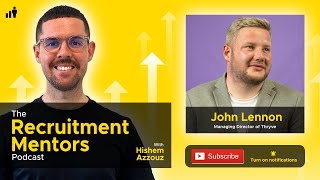
John Lennon, Managing Director of Thrive, a German tech recruitment firm, built his company on empathy and listening. He overcame a stammer and mental health challenges to become a top recruiter, and now emphasizes candidate-first methodology and core values of empathy and respect. Thrive recently implemented a four-day work week and saw productivity stay high while employee wellbeing improved.
Chapters
Welcome to the Recruitment Mentors Podcast. My name is Hishem Azzouz. Today I'm really excited to be joined by John Lennon, who is the managing director of Thrive, who are a tech consultancy that specializes in partnering some of the most ambitious tech companies in Germany. They're on a mission to disrupt the traditional way of doing recruitment as they believe it's stale and outdated. John started his recruitment career in 2011 for a company called Optima Search, where he went from consultant to managing consultant in 3.5 years before taking the leap to start Thrive. John is also a really proud champion of Mental Health and Recruitment, which is run by Rhonda D'Ambrosio, which all of you should know about on this podcast. And John actively shares his personal journey, uh, with his own mental health and is really vulnerable online and share things that he's really passionate about, which I absolutely love. And Thrive recently went through an exciting rebrand. They have huge plans in the coming years to become the number one trusted talent partner for ambitious German tech companies. So, John, welcome to the podcast.
Thanks. And hi, I'm Hishem, obviously. Thanks so much for that brilliant introduction. I don't think I could have said it better myself.
Now, I'm really, really looking forward to this. So where we always like to start is probably a question that you've thought a lot about in your sort of business owner journey. So let's just start with like, what, what are your thoughts and opinions on what characteristics and traits do you really believe make up a highly successful recruitment consultant in, in today's market, in the modern day?
Yeah, no, it's a really good question and one that we think about every day really. But, but I think in this current, um, market, in this moment, um, I think someone naturally who is hardworking. I've seen quite a lot of people who are talented or who are good salespeople, but if they don't have that kind of work ethic, I think that often it can not really work out too well. For me personally, I think somebody who is a good listener. That's often overlooked, I think, in our industry. We have two ears and one mouth. For a reason, I think. And this kind of stereotype a lot of people might have when they get into the industry that they have to be loud and have the gift of the gab, I personally think is wrong. So I think when you listen, you learn so much. So that's really important for me. And I think as well, being humble and having humility, you know, is really important too, because this job, you know, nothing can kick you down as much as this industry, I think. and it's important to have that kind of humble, um, open mind and willingness to learn and learn and accept that you're not necessarily perfect, um, especially when you begin. But that's part of the process. I think that those, those 2 or 3 things are really important.
Love it. So just to frame this up for everyone, there's, there's quite a few things that we wanna cover here. Mm-hmm. So just, just to give everyone a bit of a flavor of the things that we wanna make sure we talk about. We're going to talk about a lot of the time your journey as a business owner, but we're going to touch on obviously you obviously climbing the ranks at Optimus. Obviously you're really open around your journey with mental health, your stammer, ADHD. So we're going to make sure that we talk about that. And I know, obviously, yeah, I really like how you've executed your rebrand. I think it looks different, it looks fresh. So yeah, I definitely want to talk to you about that and what you've experienced, what you've learned, to quite, quite a few things. So let's, I guess, let's just start. We don't need to take it all the way to the beginning, but let's just think about those sort of first 3 and a half years of, uh, working in recruitment. I guess the first thing that would be great to, to hear from you was just really like looking back at those sort of first years, first 18 months, in hindsight, what were some of the things that you think you really had to, to learn, or what you learned from that, that period? You think what comes up for you when we look back at that, that part of your career? What did you learn most, you think, about being a better recruiter, becoming a more high-performing recruiter? What, what did you have to learn in those early days?
Yeah, um, you know, those, those early days, uh, 10 years ago now, they, they, they, they, they were the most important, uh, years of my recruitment career. That's where I learned everything that I know now and made lots of mistakes and had to really dig deeper a lot of the time. When I got into the industry, and you touched on it already, I have a speech impediment. I have a stutter, and when I got into the industry, the last thing I thought I would ever do was work in a phone-based outbound sales job. It was my worst nightmare, honestly. And even still today, I think, how has this happened? But it was something, you know, I was in a situation where I had to. Do well, and my motivation was extremely high because I was living on my mom's sofa for the first 6 months. I'd come back from uni, didn't know what I wanted to do. I had a German degree and I was like, "What the hell am I going to do?" And like most people who would listen to this, and a lot of people in the industry, they don't grow up thinking of being a recruiter. They don't dream of being a recruitment consultant. I didn't even know what it was really. And those first 6 months, they were really so important. There were times, most of the time, I didn't like it, didn't enjoy it. I was well out of my comfort zone. When you have a candidate who drops or you have those tough experiences in the first few months, I think what I took from it most, I think, was I learned more about myself as a person in those first few years. More so than anything I learned about being a recruiter. I think I became the person that I am, and before I got into the industry, I don't think I had a great idea about who I was.
[Speaker:JAMES] Let me just ask you something on that because I love that. Thanks for sharing that. I guess so on that, like what— so the question that I sort of recently asked people that were sort of like first, their first year in recruitment, just to give people a bit of an insight on like that first year journey and people actually who are in it right now. And the question was just like, what did you learn about yourself, or what did you get out of recruitment that you least expected? Because I'm sure you went into it going, right, I'm going to get off my mum's sofa, I'm going to be earning money, I like these things. But you just said there you find out more about yourself. So what were some of the things that happened to you personally that you just least expected?
Yeah, it was quite a whirlwind, I think, you know, it was almost like night and day, like the first weeks, the first few months were like so difficult. And yeah, you know, I wasn't getting anywhere until about month 5, I think. And I think I did my first placement in, in like, yeah, in month 5. And then after I did the first, first one, I didn't stop doing them. It was like night and day, something clicked. Um, but yeah, like, I, I felt that like if I didn't give this my best shot, then I'm not going to make myself proud. I think that was what I learned most as well, was like, I am capable of doing these things that I didn't think I could. I am capable of talking to these high-level CEOs or CTOs or guys and girls who have been in the industry for years, whereas in your first few weeks, I'm happy to admit I was petrified. I had one boss, one director on this side, one director on the other side of me. you know, I kind of had to do it, you know, otherwise I would have lost my job. Yeah. So it's like being forced, kind of, but obviously choosing to do it. And you learn so much about yourself. And I realized that I had this kind of resilience that I didn't realize that I already had.
Yeah, it's amazing. Yeah. Like just, yeah. What you're saying there is you re— yeah, like you said, you realized what you were capable of. Like you may have doubted yourself and you just you kept doing more and you kept surprising yourself. And what, obviously when you then realize that, it's like, okay, wow, what else can I do? What else can I achieve? What else can I put my mind to, right? And do things that I didn't least expect. I think that's amazing, mate. Well, let's, so I wanna touch on, we're gonna talk about the stammer piece. I wanna go through that with you, but I just obviously noticed on your LinkedIn, like you sort of say that on your LinkedIn, the first couple of months you're really finding your feet, you struggled, then you just had a bit of a sort of, um, yeah, like you said, it sort of clicked, and then you went on to being like the top performer for like 3 years straight. So let's just talk about that, because most people that listen to this podcast will want to achieve, will likely have on their goals this year or next year that they want to be the top biller, the top performer, whatever.
What—
let's just sort of unpack that a bit. Like, so you said that you, you kept trying, you, you kept putting yourself out there, you realized your potential, but what were some of the things that you really started to get right? Um, it could be on the BD side, it could be on the candidate side. I don't know. Looking back, what do you think really enabled you to unlock that potential to achieve those accolades that I'm sure a lot of people in the office were gunning for as well?
Yeah, I think the biggest thing for me was that I was very good at the candidate side. Um, I think it's, again, it's like a bit of a myth. Like a lot of people come into the industry and of course, you know, clients are hugely important. Like you have to have clients, but I found myself to like, if I was candidate-led and candidate-focused, then the clients would also come and they'd be happy as well. You can have all the clients in the world, but if you can't deliver on that candidate side, then again, it's not going to work. I think what I did very well was where I believed that I really understood what the candidates wanted. Um, so I, I would have really in-depth conversations with each candidate, but I would quickly know in the first 5 minutes by asking a few good questions what really makes this candidate tick. If this candidate, they have all the skills, but if it's not— if this opportunity that I'm trying to offer them isn't right for them, they're never going to take it. And that there's no point trying to put a square, you get a square, um, into a round hole, you know. Um, it's just not going to work. And so that's what I teach for my team now is, you know, from the phone calls. Like, you have to get a really good idea what the candidate wants, what really makes them tick. And it's much more difficult, I think, in this day, um, where, yeah, in our tech market, the candidates have so much choice. But yeah, I think it was my focus on the candidate side and really trying to give them a genuine service and understanding where I should put my time. That, that is key. Um, if you have loads of half-hour conversations with can candidates that never really end up anywhere, you're not going to achieve what you want to achieve by prioritizing, okay, this candidate is super invested, this candidate really wants this job, and I can control the situation or influence it. Um, they should get your time. If you have a candidate who really isn't invested, but maybe the client likes them or they're really highly skilled, like they still have your time, but maybe not so much. So I think time management's really, really crucial. I think another thing in hindsight, I don't think I really knew this at the time, but in hindsight, one thing that made me stand out to clients I think was that they could trust me. I wasn't and I'm not your typical recruiter. I had a very different approach and I think I was memorable as well because of my speech perhaps, because of the fact that I could speak some German to my clients as well, and I would just try different things. I think a big thing, especially when you're beginning in this job, it's so easy to do what everybody else is doing. It's what makes you memorable that sticks in someone's mind. You need to get a client to, when you call them, to go, "Ah, it's John. Yeah, I know you.
Cool.
Great." Or a candidate, "Hey, it's John. I know you. You helped me last time," or, "You gave me some good advice." I think it's being memorable is really, really, really important.
Yeah, love it. So just quickly, I'm sure people will want me to ask this because as you quite rightly pointed out, really difficult right now. Candidates are spoiled for choice. So it's crazy, right? Because what you're talking about, so you'd like to think it makes common sense, right? Double down on like really understanding what the candidate wants, um, really make sure that you're talking to them about opportunities that are sort of aligned with that. Give people the time that committing time to you. And like, it just sort of made like, why would you not be doing that? But it's crazy, right? That obviously there's just been this whole period of like transactional recruitment and you just decided to go, no, I'm going to really double down on these relationships. And clearly that's had a real impact on your performance. But what I wanted to ask was, so, you know, you said around you got quite good at understanding what made them tick. Just to get really practical here, because I'm sure people would want me to ask, what are some of your like go-to questions on that? Because I think that would be really helpful for people, particularly right now. Um, what's your advice around just, just quickly on like actually getting good at that, which is something clearly that you pride yourself on?
Yeah, I think too many recruiters will say, hey, it's John here from Thrive, um, I've got a brilliant opportunity for you, blah blah blah. It's rubbish, it's crap. Um, uh, the first thing you need to ask is what, you know, what not even what would your ideal job look like, but when you think of your ideal job, how does that look? Um, I'm being very specific in that question as well because it's a very open question. And then somebody might say something that challenges me, or, um, you know, progression, etc. But all those things are really surface-level things. But you ask them again, you know, what specifically about progression, you know, what does progression mean to you? And then you just say, say again, you know, why, why, why, why, why? And then perhaps even ask it again. So when you say progression is important to me because of this, this, this, and this, why, why is that important? Can you be specific? The more specific you are— and of course, you know, some candidates might not want to go into that depth, but it's so important because if you don't know what they want, you can't help them.
Truly. Yeah. Yeah. No, I love that. Great advice. Again, it's that commitment to listening you said earlier on. And then as you said that, yeah, being intentional around the questions and don't treat it as a tick box exercise, right? John's tummy's awful, progression tick, right onto the next thing, right? Which, as you said, we can keep it surface level. So it's just making sure that you stop yourself of like treating it as a bit of a tick box exercise and going, okay, John, You know, you said that this is what you said around progression. Tell me a bit more about that. Shut up, listen, and then again, keep probing, keep asking why. And then that, as you said, that can really help you uncover the actual true reason or the true motivators and drivers that then you need to get good at aligning with the job opportunities or the clients that you work with.
Yeah, I think that—
Great advice.
Yeah, I'm sorry to interrupt. I think that we as recruiters, especially when we begin, and it's for no fault of our own, We want things to happen, we want to do that first deal, we want to get these interviews, make our clients happy, hit our targets. But we assume a lot, and I think assumptions are one thing that we at Thrive try to deal with very, very early on because just because you think that Facebook is a cool company to work at doesn't mean that other people do. Just because you assume that this is a great job or a lot of money or this, this or that, that doesn't mean anything really unless you really know what someone wants.
Yeah, love that. So cool. So keen to go into then you becoming a business owner and that journey. Let's just talk about your journey with your stamina, John, if that's okay. And yeah, I've seen a couple of your videos. I saw your video the other day talking about it, which was brilliant. And I know that this is obviously like really important to you. So I guess What I'd just love to find out is just a bit about your journey with sort of, I guess, not letting it, what's the word? I wanna say like not letting it define you, but what I mean by that is like not letting it like hold you back is what I mean by that. 'Cause I just honestly wanna say like kudos to you to, like you said, being in an environment where you have to be on the phone speaking like no doubt every single day, that's something that you have to pluck up a lot of courage to do. Um, compared to maybe some people that obviously don't have to deal with that. Um, and I think, yeah, I just want to really just say kudos to that because I know growing up— like, how old are you, John?
Uh, 32.
Yeah, so I'm 28, right? So we were sort of on that cusp of like social media stuff as we were growing up, but like school is a fucking horrible place, mate. Yeah, like I think like a standard stuff. Like I remember we had a friend, right? And I'm just being completely honest here, we had a And I got my fair stuff as well. My name's Hishem, I'm a white guy, I was brought up Muslim. So I— there's all the things that make you who you are is what people pick on, right? So I remember we had a friend called Dexter who had a stammer and we literally used to call him D-D-Dex. That's literally what we used to do, right? So I know there would be so many sort of highs and lows of this, but like, I guess, would you mind just sharing, like, for anyone that might be listening that might be on the journey or these things, like how How have you gone about, like I said, not letting it define you and hold you back? What's been your journey with it for anyone listening that might be on a similar journey with something else that could relate?
Yeah, I mean, it does. It is a very central part of my character, but I remember like I was fortunate. When I was 16, I went to like an intensive speech therapy course. Up until that point, I really, really couldn't talk much at all because I chose Yeah, because I chose not to almost because it was too embarrassing or—
To avoid the embarrassment.
Yeah, I like the anxiety was like huge and yeah, in the same way and it's not the kids.
Everyone just take the piss. It's horrible, mate.
No.
At school, I can imagine.
Yeah, but like as an adult, obviously like that happens and that happens in school. But no, I think, you know, for me, like I, it's so important, but it's important in a good way because if I didn't have stutter if I didn't have the experiences that I've had and I wouldn't be who I am. And I think one part of myself as a person and as a recruiter and business owner that I'm proud of is that I'm quite humble and that comes from the experiences that I've had. Getting called duh-duh-duh-don is not very nice and going into a coffee shop now— still, you know, I find it difficult. To say, can I have this please? Um, and you get looks in this, but it doesn't really matter really, because I think it— everybody has their own thing or things. And I truly believe that it's made me who I am. And I think that I didn't know that when I was younger. I hated it. I hated, you know, I would give anything to not have this.
You do anything to fit in. That's what you do when you're younger. You do anything. You'd want those things taken away.
Yeah, and I think the recruitment gave me the confidence with my speech as well, because again, it was like on day one, you know, here's a phone, call up this guy, like, and I'm like, oh, fuck. Yeah, it's like, what am I gonna do? Um, but doing it and doing it, and I got some abuse on the phones as well. Like, I, I remember one time, um, a candidate sent an email to my boss saying, like, how can you have this guy on the phone? So it's a disgrace. Um, he, you know, like, you can't understand him. He's— and that, that, yeah, that, you know, hurts, obviously. But also, it fires something in, in me. Like, I like—
prove people wrong.
I like being the underdog. And I think that, that, that's a really, like, strong kind of asset to have. But, you know, it, it, it shaped me profoundly, but I think in a good way. And I wouldn't change it for anything. Um, Yeah, and yeah, like, I think that, that, that hardship is, is a profound thing in our industry as well because it requires resilience in our job. And I think that it's only done good things for me. And again, you know, some of the clients that I, I had, you know, I'm fairly sure they, they came back to me or they liked me just because I was different. Um, yeah, so yeah, it's a very interesting one. Yeah, yeah.
I mean, there's loads of— there's loads I'd love to talk to you about it, I guess. I guess the only thing I'll just be interested to get your take on, because you're right, it's just really weird, this, this sort of journey, right? Where as you're younger, you do anything to fit in, and then as you get older— not all the time, but this is definitely how I found it, seems like you have as well— it's like, but as you get older, the actual things that make you different are the things you're actually most proudest about. Yeah, I mean, and they're the exact things that you'd try and like avoid, like you'd avoid when you were younger because you want to fit in. So it's just so weird how it works out. Because if I could go and speak to myself when I was like, yeah, like if I was getting taken the piss out of or getting picked on for certain things, I'd be like, Hishem, don't hide, like don't hide who you are, like own it. And like the quicker— I think it's just the quicker that you can get comfortable with owning it and being comfortable with that, rather than looking at it as you said, looking at it as something that, yeah, makes you different in a negative way, is when you can more quickly look at it in the way that you're looking at it. So I guess I just wanted to ask you, like, for anyone who's listening, that whatever it may be, and they may be looking at it as a way of like, I don't want this, or this is making me stick out in a bad way and stuff. I don't know what, what's been— there'll be loads that we could talk about this, but like, what's been the process of you turn— like, looking at it in a positive way? Do you get what I mean? Because I'm sure that's been a journey. So I don't know if there's any advice there for someone to— yeah, like, if you could speak to them to go to— that could start going on that journey.
Yeah, and I think, um, I think acceptance is huge. Um, yeah, like you can't change, change a lot of things.
Like acceptance is like you accepting it yourself, like this is— yeah, I can't change it.
I'm—
that's first thing, accepting yourself.
Yeah, yeah, you know, like, like you can't change it necessarily, or like it might take a while to change the situation, but I think like being up, being optimistic and being hopeful, having good people around you, I think it's really, really key. By having a mentor or being a, being part of a peer network, trying to get rid of negative influences around you, I think. And I think that especially when people are younger, they need good influences around them. Our industry can be pretty crap for that, I think. But I think a lot of companies now have this kind of modern approach to really trying to offer support. But I think it's different for every person. And if I gave an 18-year-old me this advice, I'd be like, okay, cool. It's a really tricky one. But everyone finds their feet, and I think that if I was to talk to a kid who had a stutter now, I'd say, it will be okay, it will be okay. This is really— you might not see it now, but this is you, and this is a brilliant thing. Um, and yeah, again, like, coming back to our industry, this is why our industry is so brilliant. I do believe in its best form, in its purest form, it's— I— the word meritocracy is thrown around so, so easily, but it is an industry where young, old, you know, regardless of your, your religion, color of your skin, whatever you do, your background, like, it is a leveler. And it— you can create kind of your own destiny part of that career. Um, but yeah, it's a— it's an interesting one. But, but I think that everyone has their own things, and I think, yeah, like teaches you a lot, and it's a brilliant thing when you have to learn some things the hard way. I think hardship can be a good thing because it's where learning happens.
[Speaker:JAMES_EARDLEY] Yeah, I think it all starts with acceptance. I really love that. Let's segue this then. John Lennon, the business owner. I know you've been on a bit of a journey, right? 2 years ago, is it 2 years? It wasn't 2 years ago you rebranded, was it? When did you rebrand to Thrive?
We've rebranded twice, actually. Okay. 2019, yeah, 2 years ago. We were previously known as Lennon Wright. It wasn't really a name that I liked. I've never been a massive fan of having your own name, and it sounded a bit like an estate agent or a legal firm. Yeah, 2 years ago, we changed from Lennon Wright to Thrive. Last year in August, I hired our marketing manager, J.O., brilliant, fantastic person. The first thing she said to me essentially was, "John, you need to rebrand again." [Speaker:JOHN] You need to rebrand. Okay.
All right. Let's break this. Let's just paint a picture for people. When you started the business, you started with a business partner, right?
[Speaker:JOHN] Yeah.
[Speaker:JAMES] It's called Lend and Write. Obviously, you've been going for nearly 7 years now, Lend and Write thing. That's where you started. Then where are you now as a business? How many people are there and those sorts of things?
Yes, so we're still relatively small. We're 17 people and we are focusing exclusively on the German tech market. We have a pretty big, for our size, back office team. We have 2 people, 3 people soon in marketing, we have 3 people focus on admin and operations. I think a lot of people might think I'm a bit mad for that, but having that strong support team enables our sales team to do so much more. I'm very happy with that. This time a year ago, we were half the size, so we've doubled this year in terms of headcount. We've got a very ambitious 3-year plan to become the number 1 tech recruiter in Germany, um, uh, be a company of 100+ people, but more importantly, be a company where people want to work for and stay and have a career, like a, a genuine career where they can progress. Um, yeah, at the moment that's where we're at.
Yeah, no, lovely, great overview. So, okay, cool. So let— I'm, I'm quite keen to— because I, I feel like I know when we spoke before, you feel like in the last, like couple of years you've been on this sort of bit of a rebirth journey. It felt like, yeah, like whenever I spoke to you and stuff. So I guess I want to sort of focus on that because there'll be loads of things in there that you learn, um, on that, like in hindsight, that I think would be really beneficial for people. So yeah, obviously. So for how long, again, so how long was it obviously, Len? And like, so when was it that you obviously parted ways amicably with your business partner? Was that 2 years you said, 2 years ago?
I think I'm wrong. I think it's 3 years ago. 3 years, okay. But yes, so myself and a guy called Rob Wright, he used to work for a company called Rob Wright.
There we go.
There you go, yeah. He was a fantastic— he is a fantastic recruiter. He was more of a contract-focused guy. I was the perm guy. We thought, perfect. We did very, very well. We got on well, we kind of grew the team out well. We made loads of mistakes, a lot of mistakes, but we did a lot of good things as well. We were kind of focused on Germany mainly, but we did bits in the UK, France— America as well. Then we decided to try and crack the American market. Rob moved over to America and he's settled down there now and we had a few people here in London doing it too. But quite frankly, to me, it didn't work. I could see the effect that the kind of having to do later hours was having on a few members of our team and I felt that we weren't really famous for anything because we were doing America and Germany, but it felt like two very different companies. Me and Rob decided, as she said, to amicably part ways. I made a very conscious choice to write, "We are Germany. This is all we do. This is what we're famous for really. It's all I know. Let's double down and nail this." The first thing we did was rebrand to Thrive. Our colors were still blue and yellow because they were what our colors were before as Learn and Write, and it was all good, all fantastic. We had a decent brand, but essentially we were still kind of me, a marketing assistant, and like a lot of sales guys and girls. I think it wasn't until that rebrand that things changed and things really started to kind of kick off, and the last 2 years has just gone like that really.
Yeah. So, so, okay, cool. So that, that's what I'm keen to unpack. So let's just, what, what I'm, what I think the people would be interested to hear is firstly, so, cause I've asked this a few times and I think it's just interesting for people. So I think most people, if they were to start a recruitment business, would rather do it with another person than do it on themselves from the conversations I've had.
Yeah.
So the, the question I have for you is sort of, is twofold really. One, for anyone listening to this that does have a co-founder, what advice would you give them to, I guess, like give them the best possible chance of like making sure that they're both aligned and going in the same direction? Because sometimes that can be a challenge, right? And then two, like how did you make sure that it did end amicably? Because it doesn't always. Yeah. Is what I wanted to ask you. So how did you make sure you were both aligned?
Yeah.
And then how did you make sure, like, yeah, you just didn't— it didn't go sour?
Yeah, so, um, myself and Rob, we weren't, you know, best, best, best mates, but we were like acquaintances of some common friends. And so we knew each other quite well, and that was a really good base— basis for the future. Um, we didn't have any kind of, you know, signed, um, agreement that says, you know, if this happens, this happens, and, you know, if this goes wrong, this happens. So that would be one thing that I'd recommend with— get some things written down, have that in place before you even begin, because that solves a lot of issues further down the line. But I think in hindsight, again, it's about being open, being really transparent with each other. I couldn't and I wouldn't, I don't think, have set up Thrive on my own. I don't know if I had that push at the time to want to do that. And having the support of Rob was instrumental. But I think, you know, just over time it just changes and that's fine too. When it came down to, you know, the like buyout essentially, you know, I think we were both on a really similar page. So it wasn't acrimonious in any way really. And like we're in contact and we chat still and, you know, it's all good. We wanted different things and that's normal and that's fine. Um, but yeah, like, if there's anyone, you know, who's thinking about setting up a business, or, um, I think a lot of it is it's not as easy as, as you might think it is. Um, when I got into the, uh, when I got to setting up the company, like, you always think, you know, I can do this better than my boss, and I can do this a million ways. Um, but it's— I think having a good network and support is really, really crucial, and that's where having a co-founder can be really helpful because it can be tough, you know.
Okay, nice. So let's just, let's just go into the last 2 years then, because clearly, yeah, like you said, like you've, you've— this, this is where the real sort of, um, I don't want to just discount all those early years, of course, but I get— I guess to be fair on that, you said, just to make sure we do touch on it, so you said you made a lot of mistakes. Like, what would you say were some of the biggest mistakes you made?
Um, first Yes, I kind of see the first 4 years almost as like, that was our mistake phase. I mean, obviously, okay, yeah, talk to us about that now. But I guess the biggest one was like, uh, we hired some good friends of ours. Um, okay, and that just doesn't work. It just doesn't work at all. Um, yeah, we, we thought we, we were being really clever that it happened to be Rob's best mate and my best mate too, but Rob would manage my best mate and I would manage his best mate and it'd be fine. It was fine for about a year, really making a lot of money, doing very well, everyone happy, and then it just imploded. It was a serious time where the relationships with those guys aren't the same anymore. I think one key rule is don't go into business with friends, I think.
[Speaker:JAMES_EARDLEY] Don't just hire loads of your mates.
[Speaker:PAUL_LEWIS] Yeah. It didn't work for us.
Yeah.
And yeah, I think also we were trying to be too broad. We were trying to do little bits here and there because obviously in your first few years, it's tough. Cash flow, finances, etc.
You just want to say yes.
You just want to do deals anywhere. And I think if I could go back in time, I would have chosen for us to do one thing very, very, very well. And another thing as well is the marketing, branding, in my opinion, is absolutely crucial. I would hire an internal marketing manager and even an operations or administrative assistant too because what I know now is that having that support and that expertise would have been game-changing in the early days where no one knows who you are. You can't approach your old clients, all this stuff. No one knows who you are. Your website cost £100 off of Wix or something. And you know, like that, the brand I think is key.
Really, really. Yeah. No. Yeah. Thanks for being honest. So let's just talk about, cause it was one of the early things that you said. So talk to us about like what, so before, as you said, you're doing a bit of bits here, doing a few bits in America, UK, all of that. So talk to us about what, why would you say to someone, listen to this, they should really make sure that— because you hear all the time now, having a niche, right? And I'm just always interested to hear from people what being niche means to them. So when you rebranded and it was thriving, like, right, we're just going to do Germany. How did you break that down for it to be— so obviously Germany, that's part of the niche because you're only doing one location. But then how did you— how have you now made it even more niche if you have? How does it now work?
Yeah, so yeah, like again, I'm saying kind of niche, niche, niche, but at the same time, like when you're a smaller company, I think like, like you have to, you know, look at other opportunities as well. So our niche really is German tech, but that in itself is huge. Um, yeah, so we have broken it down into what we call critical and emerging tech, but really that is broad. Um, so, you know, like What we're trying to do is a balancing act, but as we grow, the intention is to become much more niche. I think there's a big opportunity there for companies to— yeah, if you're known for one thing only, and even if that thing is relatively broad, if you're known for one thing only, that can only be good because you are known as the experts. People start to hear about you. If you're a jack of all trades and you do little bits of your impact on that market is so, so, so small and because you're spread so, so far. But for us, you know, Germany tech is very broad, but it's also quite niche. And over the last 2 years especially, we have seen the impact of that by so many clients, candidates, you know, people coming to us, which didn't really happen in the first few years because we weren't famous for anything. So I think it's about being famous.
Yeah. And then, so just because I think people would be interested, so how, so you've got critical tech, emerging tech, all in Germany. How do you then break it down? Do you then have people doing like particular roles? You have people doing, I don't know, how do you then break it down a bit more or have, or do you?
Yeah. So we, we kind of break it down based on location. So, um, in our team it's, it's kind of mainly Berlin, Munich, and Hamburg, North Rhine-Westfalen. So it's more location-based, and then within those teams, there are people who are more focused on, say, front-end software development, back-end, or data. [Speaker:JAMES_EARDLEY] Got it. [Speaker:ANDREW] Yeah. [Speaker:JAMES_EARDLEY] Okay.
So, because I have to ask you, I wanted to make sure we ask this, and then we'll carry on the business journey. Where, like, I definitely see this, like people, are really conscious of like making sure that they, that in terms of their portfolio as a recruitment business is diversified. So it's not just all in UK. They might want to have a team in UK, Germany, America, right? Which makes sense why you would obviously trying to do different things. So, um, so I think most people would say the UK market is so fucking saturated.
Yeah.
And you might even start to say the same for Germany now because I do see recruitment companies that only do Germany, or I only do Netherlands, etc. So I mean, you don't have to give all your secrets away, but just, just curious, like, what do people— like, if I was a UK recruiter right now and I might be speaking to you and I've never done the German market before, but I've done the UK market, like, what things would you say, don't do this, Hishem, or like avoid doing this? Like, where do people go wrong when trying to take their recruitment skills or try and build their recruitment desk in the German market after maybe working in the UK market? What are the nuances that Yeah, they had to learn the hard way.
They, they don't, don't try and be a British recruiter, I think. Like, um, it's, it's, there's like so many nuances, and I think I, I have an advantage because I did German and I lived in Austria and Germany and all this. But like, too, too many people, like, they think it will work, you know. That's what we've found out in America as well, is like, we had to learn the hard way that you can't necessarily apply the British way of doing things to there because it's a different culture. Similarly in Germany or Netherlands or anywhere, you have to tweak things. Obviously, the British recruitment industry is very well regarded as being the number one best quality, best results, but you have to adapt to that local culture. It's just even very, very small things. If you're talking to a candidate who's from another country or a client from another country, don't use English phrases that they won't understand. If you say, "Oh, it's a game of two halves," they don't understand it. So, I think it's about talking a lot more slowly as well and just trying to immerse yourself in that culture. So, whether that is trying to read the— in English, but read local news or just knowing about that country, you have to visit it and you have to try and understand it because it is different. You can't apply the same things, I don't think. Yeah.
And obviously most people do business in English, right?
Yeah.
In Germany.
Yeah. I'm one of the very, very— well, I'm the only person at the moment in our company who speaks any level of German. And I must say that my German isn't particularly good at the moment.
Yeah, I love that. Fair enough. Yeah. So yeah, you just got to commit to immerse yourself in that culture and I guess just don't be ignorant, right? And just, yeah, be, yeah, like be mindful of the things that you're saying and yeah, you might have to learn some of those things the hard way. Yeah.
Yeah.
Yeah. So cool. So let's just talk about the last sort of 12, 18 months and as we come towards the end here. So you've invested a lot in, yeah, marketing, um, operation, admin assistant piece. What, what else Would you say, have been like, clearly you must have gone down the journey of like making sure like you've got the best possible tech stack that you feel enables you and your team to perform well. Like what are some of the tools that you've invested in over the last 18, 24 months that you feel like you just couldn't live without now?
Yeah. And I'm all right to obviously say names and stuff. Yeah. Yeah, yeah, of course. Yeah. Yeah. I mean, the most important thing that a recruiter or recruitment company can invest in is a good CRM. We use Vincere. We moved over from Vincere about 2 years ago, and it's been probably the best investment, you know, piece of kit that we've made. And this is coming from somebody who, as a recruiter, I was terrible at using our database. I was shocking because I was making deals and money. Like, I thought, I don't need to input this, I don't need to to code this up. I was lazy essentially. But as a recruiter, if you really get to know your system well, it can double, triple the amount of money that you make because it works for you. So yeah, Banchero has been a huge one for us. About a year ago, we started to move over towards Trello for time management and for planning your days and weeks and the consultants. And have handled that extremely well. So we use that not just for like, you know, tracking candidates or, you know, making day plans, but we also use it kind of company-wide to like kind of keep everyone in the loop between the marketing operations and the sales teams and myself as well. We, during the kind of first year of the pandemic, you know, like most people, we moved over to like Teams. I'm not a big fan of Teams. It just killed our computers essentially. So we moved over to Slack, which is a difficult word for me to say. Nice. But that is brilliant. It really has been a game changer. A, for internal collaboration. So if we're at home—
It's just better than WhatsApp, isn't it?
It's like—
I don't have to be speaking to my, like, mom or dad and then I get a work text. It separates it better, do you know what I mean?
And it's awesome because the team can collaborate better as well. There are various channels for different things going on. So they're like some really, really small things that were very impactful as well. We use, you know, Sourcebreaker, which is great too, although I do still think that every recruiter should know the fundamentals of, like, Kaboolian search. I think you need to know that. Um, and yeah, you know, I think for me as well, like, kind of using Google Sheets and, um, spreadsheets and Docs has also, like, been a bit of a game changer for me as well. And, um, Calendly as well is wicked because, um, I have ADHD and my time management isn't the best. So actually having somebody book into me is Fucking amazing.
Yeah, yeah, I love that. Yeah, mate, I love it. Obviously, clearly been on a bit of a journey on it there. You said some really good, interesting tools there. So talk to me about— I want to obviously, before we finish, I want to touch on the 4-day working week and what you've noticed so far, because I know you've recently implemented that. But like, so as you said, you've really grown in the last 12, like 18 months. What would you put that down to? Out of interest, like, what are some of the key parts of that recipe that you think you've really got right that has enabled you to, yeah, take the, the business to where the best place it has been in a while?
Yeah, I think the COVID the, the whole pandemic, you know, it was a bit difficult for individuals and businesses everywhere, but for us, it, it made us. It made us because we took a very kind of big, I suppose, risky decision back in March 2020 where we didn't put anybody on furlough, we didn't make made everybody redundant, we decided as a team as well that we were just going to fight it. So, we kept our marketing function when a lot of our competitors didn't. [Speaker:MICHAEL] Yeah, I got rid of that. [Speaker:JAMES] We had a sales team who were— they weren't calling up clients saying, "Hey, give us your jobs," because there weren't any jobs. But they were calling up with a long-term mindset. So, "We're here if you need anything." 'Let's catch up again, you know, in 3 months' time.' Like, it was like a long-term game that we played, and we were giving, like, genuine value to our clients. So our team, particularly our sales team, they worked their asses off tirelessly during the really hard, hard months— March, April, May, June. You know, those months were really fucking hard, um, where they're working in their bedroom or, you know, in, in the kitchen with their little brothers and sisters running about and stuff. And they worked their asses off in really, really tough times. And I think that made them as well. Yeah, if they can work through that and push through that, and we obviously supported them as much as we could and wanted, kind of felt that we needed to. But when the market started to pick up again, we were just starting to smash it because we learned so much and grafted so much, and also because we had that long-term game, clients were coming to us now saying, hey, you really helped us back in April because you gave us some great advice. We hosted, I think, 5 or 6 webinars as well, which were like, you know, how to find a job in this market, how to find candidates, how to bounce back from the, you know. So we kind of took a very, very educated, um, risk in terms of doing it, but we hired someone in April, in May, and we kind of decided to go against it, and it worked.
And then talk to us about, well, I guess, what's been— have you got any better at hiring for your own company yet? Still like—
Yeah.
Do you know what I mean? Because that's always a real— I mean, yeah, like what— have you come to grips with like what is an absolute non-negotiable for you guys?
I don't know.
Yeah, how have you got better at the hiring piece?
Yeah, again, made all the mistakes there. Um, and I think it's— I, I always find it amusing how crap recruitment companies are hiring for their own team. Um, but I think, you know, it's a tough job to hire for because there isn't a type, um, of person. So like, you have to be really forensic in your interview process. Our interview process now is pretty, um, defined and non-negotiable in terms of what we asked. And if we lose people to that, but it's fine.
How many stages is that?
It's like, it's like a 3-stage essentially, but it'd be like a very short telephone chat with me just to find out more about Thrive and us to find out about them. And then they would talk to one of our sales managers for 30 minutes and then we would invite them into the office. So yeah, it can move very, very quick. But again, you know, it can be a bit slow, but that's fine. But that's fine for us. Um, but non-negotiables for us, you know, we are very strong now in terms of what we— we know who we are, um, and therefore we know what kind of people we want to attract. And so our values are really important.
And stay true to that.
The biggest thing for us, you know, is empathy. It really is. Um, we don't want any dickheads in our team. Um, yeah, someone could, could come in and say, I promise, you know, I've— here's, here's my bid for billions of a million pounds last year, but if you're a bit of an asshole, you won't come in. And that's because every single person in our business is so important to us, especially at this stage, that one person who doesn't align to those values will bring everything down. So it's really important for us, empathy is huge because it not only helps collaboration in the team, but it creates a really nice environment and a collaborative competitive environment too, but not competitive in the traditional way that a lot of people think. Then I think also finally, respect, because we're not like a virtuous, fluffy company. We're not doing the 4-day week because we're super nice people or we don't want to have empathic people because we're super nice. Respect is important too. So like respect for the company and the process that we have and the way that we do things, but also respect for each other and respect to yourself as well. So that's super important to us, those kind of 2 or 3 things there.
Yeah, and I think it's really, really important right now that you really stay true to those values and what's important. Like I spoke to a recruitment owner this morning, we're just talking about like we said before, like it's so difficult right now. I'm sure you could look at the amount of job opportunities you have and it could be quite easy for you to sit in front of someone and go, yeah, they could probably come in. They're not quite right what we normally go for, but let's get them in. Like, we need help, blah, blah, blah. It'd be quite easy to drop those standards. And this guy just openly said to me, like, we dropped those standards on 3 people we knew we were, but we were busy. And the other people they ended up letting go because they weren't right. Right. And that's what I said to him. Like, If you really know what your standards are and you hold those to even now, even how busy it is, and you know you've got opportunities that they can make you money for, it'll work itself out, won't it? That if you really stay true to that, it's just about working out, knowing what those things are and then staying true to it even though it may take a bit more time, but you're going to grow more quickly, but you're going to grow more quickly if you take it more slow, if you get what I mean, rather than trying to grow really quickly, hire really quickly. And then you get quite a few of them wrong, you know.
It's so tempting. It's so tempting. But, you know, like we've had experiences too in the last few weeks even where we're like, do we, don't we? And but it's about being like really strong to what you believe in. And I've had some of my managers say, come on, man, we need to hide this person. It's like, no, you know, you've got to stay true to it. Yeah.
And it will work itself out. It'll work itself out.
Yeah.
Yeah. So before we finish then, Let's like biggest, biggest challenge so far in the 4-day working week. Biggest, like, I guess maybe insight from it so far. And then final thing is biggest surprise so far since doing it. Those 3 things and we'll wrap up there. So firstly, biggest challenge so far on the 4-day working week.
Biggest challenge. So it's early days, you know, we're in week 5 now. It's early days still, but the biggest challenge so far was to convince some of our team members that this was a good thing to do. A lot of them thought, we don't even have enough time in 5 days, how the fuck are we going to do it in 4? So, that was a big obstacle to overcome at first. In the first few weeks, there was more stress, I guess, and pressure because it was very new to the guys and to me. But over the last couple of weeks, that has noticeably increased, I mean improved.
What was this biggest learning or insight that you've sort of taken so far?
I'm even more convinced now that it's the best thing to do. Obviously, before we did it, we did lots of research, spoke to a lot of people, and I knew it was a good idea, a good theory, but obviously there's some doubts in your head. Is it going to work? But the biggest thing I've learned is that if you trust your team, they would do spectacular things. So it's, you know, we have— we're in a very, very good, good place, and I think it's for sure the right thing to have done for us.
And then biggest surprise so far?
Biggest surprise, biggest surprise was that actually a lot of the guys aren't finding the temptation to do work on a Friday. Because our team, like most companies, you know, they're super ambitious, committed, motivated, and I thought, I really don't want him to do this, but I bet he or she—
He's always in the company on Friday.
Yeah, but they're not, and that's great. And so the best things have happened, you know. Just to round up on this, because I think it's very nice.
That's all right.
My biggest source of happiness from this 4-day week is that one of our guys is able to go to jumu'ah on a Friday, which he was never able to do. He wasn't able to go to mosque on a Friday, and he's been doing this, and he's so happy from it. And so, you know, that ties into the whole reason for the— if our team are healthier, happier, more productive in those days, then everyone's going to benefit from that.
I love that. John, been an absolute pleasure.
Thank you, John.
Thanks for being nothing but yourself, honest, Yeah, really excited to see where you guys are in the next 2, 3 years. But yeah, kudos to you, mate, on building out the career that you have despite you maybe thinking when you were younger the things that you wouldn't be able to do. So yeah, honestly, mate, it's been a real pleasure. I know that you'd be more than happy if people want to reach out or anything around maybe like a 4-day week or different things on LinkedIn. Yeah, 100%. So yeah, John, thank you so much for coming on the podcast, mate.
Thanks so much for having me, man.
More from Hishem




You don't need as many clients as you think to bill $1 Million A Year In Recruitment



From 30 Direct Reports to Back-to-Back $1M Years as a Solo Recruiter with Zach Creighton



