Justin McGuire & Dan Matthews - Scaling a global business, retaining staff & the power of CoFounding
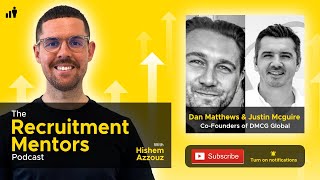
In this Recruitment Mentors Podcast episode, host Hishem Azzouz interviews Justin McGuire and Dan Matthews, co‑founders of DMCG Global, about their journeys building recruitment agencies across Dubai, Singapore, Hong Kong, London, New York and Sydney. They discuss the personal traits that make a recruiter successful, the decision to launch their own businesses, and the challenges of expanding internationally—including legal, visa, cultural and resource hurdles. The conversation then shifts to DMCG Global’s unique licensee (franchise‑like) model, where partners receive 70‑80% of placement fees while the central organisation provides branding, technology, finance, marketing and operational support. They explain how the model mitigates risk for recruiters, offers higher earnings than traditional salary‑plus‑commission, and enables rapid scaling. Trust, long‑standing personal relationships, shared values and clear communication are highlighted as the foundation for their joint venture. The hosts explore talent retention strategies—high earnings, autonomy, supportive community, and transparent culture—and the importance of a strong brand and social‑media presence. They also reflect on lessons from the 2008 financial crisis and COVID‑19, offering advice for recruiters considering expat moves, and outline future goals such as launching 100 licensee businesses and creating a sustainable, enjoyable enterprise.
Chapters
Welcome to the Recruitment Mentors Podcast. My name is Hishem Azzouz. Today I'm delighted to be joined by Justin McGuire and Dan Matthews, who have recently become the co-founders of DMCG Global. Before this, Justin was a founder of his own recruitment business called MCG Co that he founded in 2010 and successfully grew that business across Dubai, Hong Kong, and Singapore. And also previously, Dan was the founder of his own recruitment business called Daniel Marx, which he also successfully grew in London, Europe, and America. And actually, both of them built recruitment businesses that service the creative marketing and advertising sector, but have now joined forces along with Alan Smith, Adam Tochton to form DMCG Global. Absolute pleasure having you on here, guys. How are we?
Hello. Always well.
Good.
So Justin is joining us from Singapore for context, and Dan is joining us from New York. So morning and evening. So I think the comparison there is Dan's joining us with a big jug of coffee and Justin's got a whiskey, is it? I think so. Where I want to start, Justin, I'm coming to you first. Like, in your opinion, what characteristics and traits do you think make up a highly successful recruitment consultant?
Hi Hishem, so I think the characteristics you need to succeed in recruitment are really down to, it's an attitude. You've got to have the right attitude to succeed. You know, we can teach the skills. I often look for people who are hungry, who are determined, who are passionate, you know, all those words thrown in. But ultimately it's someone that really is a good salesperson because it is a sales job and that someone that's willing to learn and is incredibly resilient. Love that.
Dan?
Yeah, I completely agree. Completely agree. I think relationships are very important. You've got to be a people person. You've got to understand relationships, communication, repetition as well. It's doing the same thing well again and again, not stopping and keep on going. You've got to be resilient. Yes, there's lots of things that do make a good recruiter. It's hard to box it into a few words, but Those are the things I would say are the things that stand out to me.
Okay.
So what I'm excited to dig in with you guys is starting DMCG Global and talking about your journeys and taking your career and businesses international and speaking to you, Dan, around the sort of licensee agreement that you now offer people to join DMCG Global. But where I want to start really quickly Justin, let me come to you first. But from what I look and see online, right, you worked in recruitment 2 years before you started your own recruitment business.
Yeah, yeah.
Let's talk about that for a second. Like, what, what gave you the right or confidence to start? Like, what, why did you take the plunge with that little experience? Because some people never take that first step. Even though they may have way more experience than that. So what helped you take the plunge?
Well, to put it into context, I wasn't a spring chicken. I was 30 years old when I started. There was flecks of grey, but I'd worked in the industry, I'd worked in the communications industry for 7 years, and my journey into recruitment was on the basis that I worked in digital comms and no one, I couldn't find a recruiter that really understood what I did. So I saw that there was an opportunity to get into recruitment because no one really knew what I did. And I then proved that I could do it when I was working for someone else pretty successfully. And then the financial crisis came across in 2008 and I lost my job. So I was a bit stranded. And at this point I'd accepted a job in Dubai. So I'd moved out to another part of the world. The financial crisis came in. I ended up doing Long story short, I ended up doing facilities management recruitment, which I knew nothing about. I mean, this is a guy that did comms and advertising and then moved into facilities management. It was essentially placing security guards and toilet cleaners as far as I was concerned. I knew nothing about it. So stepped out of that and really thought, what have I got to lose? Because I could use my experience from working in the industry and my short but sweet, successful time of recruiting in that industry And I was in a position, I was in a place like Dubai where there was a massive opportunity. There was Dubai had been given quite a lot of cash from Abu Dhabi. It was starting to grow again quite quickly and recover from the financial crisis. And there was no talent there. So it was, it was, it was, it was an unsuccessful journey when I first moved out to Dubai because the financial crisis happened. And then I ended up being the right guy in the right place at the right time. Because Dubai started to grow and I just thought, what have I got to lose? Let's give this a crack. And look, it was optimism, naivety, a bit of stupidity and perhaps a bit of youthfulness still that was in a 30-year-old.
And you started out on your own, right? Just for context.
Yeah, yeah, yeah.
That's right.
I mean, I had a problem starting in Dubai in the sense that it was great that there wasn't any talent there, but also there genuinely wasn't anyone there. So I couldn't. I ended up going back to the UK quite a bit just to find talent and start moving people out there and actually ended up doing a split time between the UK and Dubai. And I had this office in— well, I was living with my girlfriend, my now wife at the time, just in Dalston. And it was basically above a lawyer's. And when people used to call me, they'd think that this office was really busy because the lawyer underneath, the floorboards were so thin and he had such a loud voice, it sounded like I had someone in the office with me. And my Dubai clients thought I was this big shot recruiter who had offices in London and Dubai. And it was just me on my Jack Jones, who was just bouncing backwards and forwards between the two. But I managed to, you know, basically promote Dubai when people were kind of losing their jobs still in the financial crisis. So I was bringing out that first wave of sort of digital talent to the Middle East in 2010, that was then. And I didn't really look back from then.
Yeah, no, that's really interesting. And Dan, I had the sort of same question for you, but instead what I want to get your thoughts on— so thinking of what— so hearing what Justin just shared there, do you see sort of some of the similar sort of things happening now with, with COVID So from my lens, I've seen so many recruiters start their own business because of that question, isn't it? It's like, what's the worst that can happen? Been made redundant, or I've been doing this job now for the last 6 months from my living room. Like, why can't I do this myself? And sort of this environment is encouraging it. So what have you— because obviously you're now having conversations with recruiters about DMCG Global, etc. Like, what have you found? Has that sort of translated into 2020?
Yeah, it has. I mean, my markets have more been the developed markets— London, Europe, America. They've always been very competitive. So you've got to have a bit of an edge and support network over your competitors, I suppose. What we're offering is people the opportunity to sort of run their own business with our support. A lot of the people who we had at Daniel Marks who were— most people had 6, 7, 8 years experience, were kind of running their own desk autonomously. When my MD moved on last year, I didn't need to replace him because people actually were very much a case of running their own desk and treating it like a business. So what we've done here, this license agreement, is pretty much to take take that to the next level and say, look, you are now literally running your own business. This is your business that you can then ultimately sell. So you're responsible for yourself, you're autonomous, but you have all of our support— operations, finance, marketing, products, platforms, services— and they take like 70-80% of the lion's share of what they make. So it's kind of a mix between taking a step on your own. So it's doing it on your own, but doing it with our support. So it's a nice middle ground for people that do want to run their own business, have the autonomy, flexible working, unlimited holidays, working around their own schedule, but not be completely isolated on their own. Because as Justin said, it's not nice being on your own. I worked on my own for a couple of years when I set up Daniel Marks in my living room with a couple of mates in Putney, and it was pretty lonely. No one's here to chew, no one to share successes, no one to collaborate with. And it's probably one of the hardest things about setting up your own business is that you are on your own. And that can be quite soul destroying and actually quite demotivating to a degree. So having a support network and people around to help is actually one of the things I think helps our licenses, our licensees, our businesses to really grow and expand with the support and the collaboration. Okay. Really having other people to— we've got a Zoom chat, we've got a webinar later with like 25, 30 people, a Zoom chat on Friday where everyone's going to get together and just chew the fat and having other people to sort of to the age we can work with.
Okay, so, okay, cool. So we're definitely going to dig into that. So I guess let's just go into this then. So Justin, like, why, why— let's just talk a bit about like why you guys have joined forces, right? Because there's a couple of you that obviously have formed DMCG Global. So hit us with the why have you decided to do that?
Okay, so the obvious one is that we recruit in the same sectors. So if you were to, you know, there was a marriage in the sense that we shared the same clients, we shared the same skill sets, excitement about the industry, etc. Dan and I actually, probably the first bit is Dan and I know and trust each other. We've known each other since we were kids. So our parents were friends. So that's, yeah, that's a, that's a massive box ticked. We work in the same sectors. And we both tried and essentially, well, I can certainly for myself and failed in elements of trying to scale our business as well. And it's not very, it's, you know, it is very difficult trying to take it. It was even difficult. It was very difficult having a business in Dubai and opening up in Hong Kong and Singapore and that. And then I tried to move the business and open up in London and I had a real tough time doing that. And I pulled back and shut that office after a year. So I had an experience of trialing Europe and realized, you know, I couldn't do that on my own. And Dan was interested as well in coming into the Middle East and Asia. And again, he was pretty stretched because he was opening up in the US and Europe as well. So it made sense for us to pull our resources together, particularly after we'd both given or experimented in expanding into the markets that we reach in as well.
That makes sense. So Dan, what, from your perspective then, so Justin has given us why, like what would you say has been the most positive impact so far since joining forces? Because this, if you were to talk about this maybe 5, 10 years ago, how many recruitment business owners would you hear talking about collaborating and actually forming another business with competitors? Not sure, right? So like, what's been the most positive impact so far from your perspective?
There's been so many positive impacts actually. Like I said, I've known Justin for, I don't know, Christ, 30 years or something. Our parents know each other very well. I think I was actually working in Sydney at the time when Justin was launching Actually, I'd already done that. I was back in London and running Daniel Marks, and I heard that Justin was doing what he was doing in Dubai, and I thought, that's great, I should catch up with him. And I was in Dubai every now and then, caught up with him, and we said, look, why don't we start to do things together? I've gone west, you've gone east. It makes sense to collaborate. What's been really good is having a global unity. So we've got shared clients which we can share globally. Shared resources on certain things from products and services, even certain hires we've made in marketing. We can share resources on that. Having someone to talk to. In fact, we did anyway. Actually, we'd speak quite regularly just about the trials and tribulations of running a business. But it's having a community, a wider community. So we've got our patch of London, Europe, and USA. But having colleagues and coworkers in other parts of the world is really quite energizing. The sun never sets on DMCG Global. It sounds a bit cheesy, but it's kind of true. So I've got messages coming in. We've just appointed someone for Sydney, which is a JV between myself, Justin, and Allan. So this person is starting in a couple of weeks. And like myself, Justin is always working. We just kind of enjoy it. It's kind of our life-work hybrid. So having something going on all the time, I really enjoy. In the morning, UK stuff, in the evening it's Asia. But I think the collaboration piece, the someone else to talk to, someone else to bounce ideas off, someone else to implement ideas, and obviously shared costs allow us to operate this on scale.
Yeah. So go on, Justin. Yeah.
Well, I was just going to say the other thing is let's put COVID to one side, but we live in a connected society, in a connected world. And actually the flow of talent, what we were finding was that in Singapore or Dubai, I could have then someone on site and on the ground in London if we wanted to relocate someone who'd go meet candidates or go meet clients or can go and discuss or globe. That was a real unique selling point for us as well and something that a real added value that we could offer people. And the other nice thing for Dan, I guess, is that I was in Asia when I knew this COVID tsunami was coming. I was like the warning system. I could tell Dan that there was, you know, 'Be prepared, buckle up, this bad boy's coming in.' We were about to make some more hires, weren't we, in Amsterdam, London?
And you were like, 'I think we should put the brakes on.' Yeah. You're like, 'No, no, seriously, this thing is coming.' So it helped me to be probably more reactive and realise how big this thing that was hitting us was back in March, having had that insight from Justin. So thank you, mate.
Yeah. So, look, I think that's so unique and I absolutely love that. So, look, Justin, let me ask you this then. So not just you two, but also the other chap involved. Like, you've gone from being a business owner, you make your own decisions and being only responsible for your own decisions. That's a big reason why people start their own business, to have that freedom of decision choice.
Right.
So positive is great. But how have you managed now to— that you can't just be like, right, wake up, Justin is going to decide to do this. There's other people involved now, right? How have you— how has that been? How's that been?
Well, I think it helps the fact that we knew each other. So with Dan and I, we've never really come to any sort of blows on anything. And you've just got to accept if you're going to merge, you know, parts of the business together or, you know, build something new together, then you're going to have to compromise and you're just going to have to— you can't go and do whatever you want and you have to listen to other people's thoughts and opinions. And what you also learn as a business owner is particularly after 10 years, is that you're not necessarily right all the time. And that is quite good to get other people's opinions as well, and you should listen to them. And with Alan, who joined us in Australia— well, Adam, and Adam, my business partner at MCG beforehand, we obviously knew each other, and Adam and I worked very closely. So I already had someone to bounce off with there with Adam. And then I'd met Alan about 2 years before we actually ended up doing this as well. Firstly, he was referred to me by a client in Dubai saying, oh, you've got to meet this guy in Australia. He does the same thing as you. So when we met him, it was like meeting an Aussie, Justin and Dan, right? So it was a very easy stitching and he was interested in growing, but also was a bit, you know, put off by the, or daunted by the fact that going into another country was a big step for him. And he'd already been burnt setting up a business in Perth and then moving it to Brisbane. So like me, certainly, and like Dan's agree, he'd experienced the good and the bad of trying to expand a business. So he was bought in.
We were looking for a JV in Sydney, me and Justin, and we were inquiring about an acquisition or just hiring good heads down there. And then when Alan came into the picture, it seemed like a natural thing to join that part of the puzzle together, to have someone on the ground in Australia, because again, we're both so stretched on timing. Like, my days are very long, as are Justin's, because he's dealing with Dubai in the morning. And so having someone on the ground and someone who's got reputation, the footprint, a business, a great reputation, it made sense to us all come combined together. And now we're pressing ahead with Sydney, and it's all sort of the cogs are clicking into place.
Yeah. So it seems like if I'm listening right now and I'm thinking about joint ventures, that the main recipe that you have to have is trust. Clearly, right? So, so really quickly then, I, so I just want to ask you this, just, and then I'd really appreciate if you just really just spell out the licensee agreement that you guys have put together. I know, Justin, you're trying to formulate the best way to replicate this also in other areas, but the commercials, right? So just make this really clear. So I'm a recruitment business owner listening to this, or future recruitment business owner. Joint venture sounds great, more people involved, global footprint. But how do you actually structure this then? So is it the— yeah, so that then the London business that you own that business, but then other people are directors have part ownership of that business. Like how do the actual commercials work?
Yeah, no, that's a good question. A licensee would have their patch and their specialism. So it could be someone that specializes in web development or cybersecurity or planning and strategy. So their license would be for that particular type of sector and it's done by territory as well. Some people are UK, some people USA, some like Natasha's Amsterdam.
Sorry, is this the licensee?
Yeah, the licensee.
But just quickly, as a recruitment business owner, so like Dan Matthews, Justin, how have you structured it in terms of the actual— just quickly on that, I think people will be interested in how you've done that.
If there's someone who specializes, like I say, in web developers and that's their thing, they set up their own business, which we assist them with, it's a limited business. It could be called I Am Limited. That I Am Limited has a license agreement with DMCG Global and that agreement provides, we, it's actually very weighted in their favor as a partnership. So we are sure we're going to give them everything that they need to be successful. It's even like training, development, sort of, probably all products, services, operations, but they get all of those things included and they will then operate as their own business as a licensee akin to a franchise really. There's no sort of, I suppose, financial commitment to either party. So if it's not working, that's absolutely fine. And we've chained in, we want to work with partners that are commercial and want to make this work. Does that make sense? Does that clarify how it works?
Yeah, sorry. I think what I was trying to— the reason why I cut you off there, Dan. So that's the licensing, right? I guess what the question was, sorry if this isn't clear, was basically I was interested in if I was in the position of you at Daniel Marks, How have you structured it where I don't know how you structured it from a— I go from Daniel Marks being the sole owner of that business now being a co-founder of DMCG Global. Commercially, how have you structured that with Justin, with Alan, with Adam? That's what was interesting because I think people would be interested in that.
Yeah, well, I've got my patch, which is UK, Europe, and USA. So I can appoint licensees in those territories and those licensees would then have their own business, which has the license agreement, which they can then develop and grow and then ultimately sell. And it's always to keep it when they sell it. And then someone else might take that license on. It's actually easier to sell a license agreement than selling a business because you might be a one or two-man shop. So that's how it works. And people have a patch of territory and a specialism that could be planning a strategy. It could be, like I say, it could be a niche of cybersecurity. We don't want to be limiting people, but they've basically got the area that they think they would work on. If it's an area which is not untouched, no one's working, they can obviously go with it, but no one's We've got a license that's restricted beyond like they— it's not they can't do things they'd want to do. So it's their specialism. But we've actually appointed a person recently in London who's dealing with the sales side of things. So no one was dealing with national sales advisors, sales directors, sales managers. So it doesn't encroach on anyone else's patch. We're looking at bringing on someone next year to do accounting and finance for all our clients, for all the media agency consultancy clients, someone to focus on the accounting and finance side of things. So we're going to stick to our core, but then you can radiate out from that.
Yeah, sure. And then just because obviously recruiters want to know this, so if I was to become a licensee within DMCE Global, so you've explained sort of, yeah, the what you'd support them with, um, and how it would work, but like, so if I— how does it work with earnings then? Because I know you made this quite simple when we spoke.
If they make a placement and say the fee is 20 grand, um, they would get between 14 and 16 grand of that. So we take care of all the invoicing. We just process all that. We've got 2 people that specialize in just invoice chasing. So we'll raise the invoice, get the money, and we pay that person within 5 days. So we basically, if they make a placement, we collect the money and just pay them straight away and we pay them as their own limited business. So if it was I Am Limited, we would pay I Am Limited and that person can then pay themselves how they want to. They can pay themselves a salary, they can pay themselves in dividends. They can buy tech and stuff that's tax deductible. It's running their own business essentially. And we've got financial forecasts for them so they can work out how they're going to manage it. But essentially running your own business and we support that.
Nice. And then Justin, for you then, what's been the journey so far in trying to replicate that in your part of the world?
Yeah, so we have in Singapore, Dubai and Hong Kong, we've got expats, quite a few expats in our business and quite a few legal, shall we say, loopholes to jump through to get an expat to set up an independent business that franchises into a holding group. So we've got to run a bit of a hybrid model there. So for local, it's— we can do this plug and play design and structure that Dan's just run through. But for expats, for quite a few of them, particularly in Hong Kong and Singapore, you need to, you need to basically have a salary to work here. And that doesn't— obviously having your own business then and plugging in on a franchise model doesn't work very well. So we have to, we just have to adapt to the rules that there are in the different territories that we have. So for locals, we can run it for expats. We run a more typical kind of recruitment salary and commission structure. But from talking to people, The bit that everyone loves, you know, is the big bit about it is our brand, right? So we've— both Dan, myself, Alan, Adam, the four partners, we've really invested a heck of a lot into our brand. We've got, you know, on social media, we've got nearly half a million followers. We've got invested into marketing. We do branding courses. We've, you know, we really make a point of showcasing who we are. So we naturally have a lot of candidates, a lot of clients, and people can just plug into that. And so the benefit of them not doing themselves is obviously that we can do all the groundwork for them. They can feed off our brand, but then they can earn quite a significant chunk of their earnings.
Yeah, I might ask, I might— Daniel Mark's website was great, it looked good, but what we've got now is completely different beast. It's built from the back end by recruitment specialists. We've got marketing specialists in digital marketing and all the products and the platforms and services that even a large or mid-sized recruitment company probably wouldn't be able to have the capacity to accommodate having all of those functions and services and products and platforms. But we can do that on scale and every licensee gets to benefit from having that at their disposal, from LinkedIn sites to Recruiter License, all the cyber marketing stuff that goes with that.
Yeah, so definitely keen to dig into sort of the conversation you've been having down with people around this, but I guess also, Justin, feel free to jump in here, but Dan, so I think as a recruitment business owner, if I'm listening to this right now, sounds great. Mitigate the risk. I'm not paying people salaries. I may not even have to pay an office, all these types of things, right? But you actually obviously put people on this agreement or communicate this agreement to people that you had on a salary, right? So let's, let's just talk about that for a sec.
Like how?
Because I'm, I might think, you know what, Dan and Justin, this is really innovative. This is actually something that I might think about for my own business. How was that received, Dan, by your team?
I told people, they were like thinking, okay, how's this going to work? And I talked them through it. And there's an element of trust. I've known a lot of the people who were with me at Daniel Marks for 7, 8, 9 years. I think they trust me that I know what I'm talking about. And it was a step of faith initially, but everyone, every single person that came over is still with us. And then we've actually taken on maybe another 9, 10 licensees in the last month and no one's left. Everyone's joined and they're actually enjoying it. I said the other day, I said, as soon as the placement happens and it's starting to happen quite quickly now, do you want to get back to the old model? And I just get a laugh back. He's like, why would I want to get back to getting like, I don't know, 15%, 20%, 25%, 30%, even 40%? Because the salary, as much as it is, it's nowhere near. Like, if people are bidding $200K, $250K, $300K, they're now taking home $180K, $200K. And I worked it out and everybody was making double, sometimes 3 times as much as what they were making when they were on a salary with the commission. Because it's just a better model for that. And if you're good at what you do and you're self-motivated, why would you want to give everything to someone else? And if you do leave, you leave all of that behind. Whereas this is something you can then build up and when you leave, you can then sell it. It just makes a lot of sense. I think, you know, the people that are doing it are now seeing the benefits of it and wouldn't want to go. I don't think anyone's going to want to go back to a salary after this. Why would you? If you're taking home, you know, 70%, 80% of what you're making, it's a huge amount and it makes a real difference.
Yeah. So initially, oh my God, what the hell? I'm not going to have a salary too, right? Okay, let's actually understand. Last year I built this. If I build that this year, this is how much I'd make.
Yeah. Okay.
Well, one placement, I'd say $20K, you get $14,000, $16,000. That's quite a lot of money. We have some people in the first 3 weeks that are making placements, and one chap made $45,000 in the first month. So he took home $30,000 in the first month. He wouldn't have got anything like that. He'd have made maybe $5,000 or $6,000. But we do have like docking hubs everywhere. We've got a hub in New York, a hub in London. It's a place where people can go and meet, collaborate, work. It's open like 9:30 till 6:00, and then It's like a jazz bar, Soho, like in Soho after that. So it's like a place for people to go to collaborate, to work, to meet clients, meet candidates. We provide all those things for people to do that. So there really are, it is like working in a recruitment business, but you just got more responsibility and more reward.
Okay. So on this sort of part of communication, Justin, we always talk about this in podcast whenever I talk to recruitment business owners about their journey and things like that. A lot of the advice that they give or share is around the importance of defining the purpose of your business and then why you do what you do and being clear on your values. So, obviously, I think, obviously, maybe you guys had slightly different values for MCG Co. and Daniel Marx. So, I guess from your point of view, Justin, communicating to your teams, right? I know it's not straight away segueing into the licensee agreement as you explained.
Yeah.
Like, how did you approach sort of communicating the purpose of this sort of collaboration, right? Because that would have been important that that went right. And how important was it defining your purpose for DMCG Global?
Yeah, I think so. We've— the foundation that the business was, was set up on was, was basically, if you go back to that story I told you, why I got into recruitment, it's because I came from industry and realized that people didn't really know what I did. So it was always around integrity and being specialists in our field, and we've always fed back of that. So I have a really good bunch of specialists who understand our sector, but they all— most of them, as I said, it's quite an expat-heavy business that I've got. Most of them aren't from the country that they actually work in. And that's probably the big difference between what I've encountered with Dan. And so there isn't that security blanket. If all else fails, you can go and live at mum's, if you know what I mean.
Yeah.
If you need a visa to be there and you need medical insurance or something bad happens. So it's having some of those conversations. Some people are open to it, others are a little uneasy because it's just there isn't the legal framework that can support them. So we, we're looking at building this in, building a model like what Dan's got into Singapore, Dubai, and Hong Kong. But we have to— it works as a city before, it works really well for the locals. So for Singaporeans.
Yeah, that makes sense.
And in Dubai, actually, there basically isn't any Emiratis that work in recruitment. In fact, I have never met one that worked in marketing and advertising. They tend to sign the checks, not do most of the work. They're the guys that sit at the top. So we essentially need to help with the way it's looking like we need to do it in Dubai. We need to help them set up their own separate business that then plugs in. I'm not going to get down to the complications. Yeah, it's a lot, it's a lot more difficult. So the conversation I've had with everyone is, yeah, Most people are up for it, but they want to know that they're going to be safe, that their families— because we as a business, we also have a responsibility to people if they've got families as well, because if they're the main breadwinner, we've got to make sure they're all right. So it's just those little nuances that we've got to try and help them and shape with in an expat society.
And just on that, so, yeah, completely understand that. I guess it was just more of like if you had people that have been with you for a long time, Justin, you're going Hey guys, look, so we're now actually going to become DMCG Global and they're going, hang on a minute, we've worked hard to build the MCG and Co brand. I guess I was just interested in how that landed and—
Oh, okay.
People listening to this might be thinking about JVs and stuff like that, but worried about how that might be received internally, right?
It was— there was not a single person that didn't understand why we were doing it. And we made a point of talking about this from the outset. So I think one of the things I've learned in business and as a leader is always just to be— treat your employees, don't hide stuff from them, treat them as adults. You know, just be straight with them. And so when I started having these conversations with Dan, I pretty much was quite open and honest with everyone about where we were going, what the vision and mission was.
Took them on that journey.
Yeah, yeah, yeah. I've always been very open. I think, you know, I'm the sort of person that has always been like that throughout my life. I like to keep people communicated. I don't mind showing a bit of vulnerability when things are bad. I don't mind explaining to people what I want to do, how we want to grow it. People had seen our success. People had seen, particularly like the long-term members of staff, they'd seen we'd given London a go and didn't necessarily go according to plan, um, and what we'd learned from that. And most people could see that that made a lot of sense.
Yeah, okay. So, um, just a quick one. So Dan, with, um, Daniel Marx, how many, how many people ended up working in the New York function? Just out of interest.
In March we had, well, in February we had, what, 7 people in the New York office, 25 in London, and a couple in Amsterdam.
Yeah, what I wanted to ask—
yeah, everyone's remote basically, apart from just a couple of people in London.
What I wanted to ask was, and then Justin, be keen to get your thoughts on this, from a business owner perspective and keen to go on a recruit recruitment consultant's perspective. But I think from the conversations that I've had on this podcast and also just from a business perspective, this year has sort of highlighted for some businesses how valuable it has been for them to diversify their business. If that's making sure they don't have freaky accounts that give them X amount of revenue, or if that's not being reliant on one country for their revenue. Right? So I think from the conversations that I've been having, there'll be a lot of recruitment businesses thinking about internationalization and diversifying their business. I think 2019, most ambitious progressive recruitment businesses I spoke to would have America on their business plan as an area they want to grow. The fees are bigger and the competition is less, and a few other sort of key things that always jump out. But like Justin said earlier, when he tried to start London and it failed, a lot of recruitment businesses do fail, right, in taking their businesses internationally. So I guess what's been your learning on that that you can share with recruitment business owners that listen to this? What do you think are sort of the 3 most important things in giving yourself the best possible chance of growing your recruitment business internationally that you've learned, Dan?
Oh, it's very good. You got to allocate a lot of time and resource for this. It wasn't the case of, right, let's have a New York office overnight. Night, it took about a year and a half of paperwork, filings. Ultimately, it was a 185-page document and $100,000 investment to actually start getting this thing moving. I'm on an E-2, as is the company, which is good to get. It's 5 years and I can extend it. But it takes a lot of time. It takes a lot of legal. Yeah, time, resource, and putting a proper plan together, a proper business plan. Me coming over to lead it really helped because I was here on the ground and I still am in New York now. London's great and it's got such a really strong team of people. And last year I was back to London 7 times. I moved to New York permanently last January, about 2 years ago now, but I was back and forth before that. But last year I was back in the UK 7 times, every 6 weeks for a week. This year, obviously, I haven't been able to leave New York State for a year, which is very different. Yeah, being here on the ground, like Justin found, he was in Dubai when he moved to Singapore. It can really start to grow here. So having a presence here for me to actually be hands-on and to help grow it really helped. But I didn't want to leave London alone. Obviously, it's the core of the company. So that's why I'm up at 5:00, 6:00 every morning, because the UK is already 5 hours ahead of me. So UK is a really strong part of our business and the US is another part of the business that I'm here on the ground and growing. And we've got Merit on the West Coast and growing the LA and San Francisco office. But like I said, my time was so split, time, money, resource, all of these things, which is why I was really thinking it would be good to collaborate on Asia. So I was looking at an office in Dubai and an office in Singapore, Hong Kong, and I started getting processes underway. Then it's another country to do accounting on, another country to do all the legals on. There's so much time and resource into it that I've gone west, you've gone east, Justin. We can collaborate on this and we've got the whole world covered.
Justin, what about you? What's been your journey with this?
And while you were talking, I was just thinking, God, what was I thinking? Because not only did I set up a business after only 2 years in recruitment, but I actually set one up in a country I'd really never been to before. It was a bit off the cuff, kind of. Wow. No, it was basically, I was in Dubai and it was going great for 5 years and we were really— I thought I could do no wrong. I thought everything I was doing was touched to gold. So my natural movement, I felt, was where's the other expat place that a lot of people like going my side of the world? And Hong Kong was the first one I could think of. So inevitably, when we were looking at bringing expat talent into Dubai, we were competing with Hong Kong and Singapore. So that sort of triangle, if you will, was always my idea of where we wanted to build the business. And my thinking for London was, well, we take a lot of talent out of London, so why don't we try and put something there and make that sort of the 4 hubs? But once we realized that London wasn't right for us, we really sort of doubled down and focused on Hong Kong and Singapore. And actually, you know what, because I'd already built a business in the emerging world, let's call it the emerging world. Um, it— there were sort of nuances and complications that setting up in Dubai that were quite similar in Hong Kong and were quite similar in Singapore as well. You know, there's a lot of red tape if you're an expat business. You've got to put quite a bit of investment in. You've got to prove that you've been a successful business for 2, 3 years at least. You've got to have clients really that, you know, you can work with or you can bring with you. Otherwise, it's an enormous amount of money. But the hardest thing, the hardest thing, and again, this goes down to the biggest irony in recruitment, isn't it? That it's finding the right people. And I always— you have to kiss a few frogs sometimes, you know what I mean? It's hard to find people that you can trust to run a business thousands of miles away. And I think that was the hardest bit, was taking the DNA you had in your business and teleporting that to somewhere thousands of miles away and also trusting someone to build and set up a business with the same passion that you had. When you had in Dubai. So you've got to find partners, you've got to get them to be business owners, you've got to trust them to do it in a foreign land because we had a mixture of expats and locals, but most of the leadership we had when we first gave it a go were expats. So it was a real— there was lots to learn from it. And as with most things I found in business, you've got to fail before you succeed.
Yeah, I love that. Some really interesting points there.
So I guess core mission statement, core values, things that everyone knows. In fact, in Daniel Marx, we had obviously mission statement and values as well. We've got new mission statement values for DMCG Global, but they overlap a lot in having the type of individuals who are collaborative, communicative. They like to, I suppose, they're commercial, but the slight difference more in DMCG Global is more the entrepreneurial side of things. But having those mission statements and values that everyone knows, no one got promoted at Dany Marks without living those values more so than the billing side of things. And although this new model, the values are very much the same, but adding in that layer of extra layer of autonomy and an extra layer of commercialism, an extra layer of entrepreneurism.
Yeah. So I guess what I wanted to touch on there. So you're talking about from a business owner perspective, some great insights there. Justin, but Dan, from your experience then, if I'm a recruiter listening to this and I want to become an expat in a country that I might spend some time in, may not spend some time in, like from your experience from speaking to recruiters about going over to America or wherever, Amsterdam, like what do recruiters typically wrongly assume when taking their career out of the country that they grew up in? Typically, let's say the UK, like where have you sort of typically found that recruiters maybe didn't think about? I mean, a few things that have come up on this podcast is around that. Look, that's great. You could earn more money in America, but actually don't forget the personal side. Then you have to put yourself out there. If you don't make friends, you don't try and make social circles, you're going to be really lonely and that could impact your time spent or end up, yeah, cutting your journey long short. So I guess from your experience, if I'm listening to this right now and I genuinely love the opportunity or think about the opportunity of taking my career internationally, What should I definitely be sort of understanding about that move?
I think you have to be wary of the fact that people have, like I've mentioned before, about having professional equity. You've earned it. You've got clients, you've got candidates, you've got people who you know and trust and they trust you. And you can take that wherever you go. When you relocate somewhere, you lose a little bit of that actually, because you don't have those people who used to work within that territory anymore. We learned that we've got a lot of shared clients, shared types of roles, but you lose a little bit of your candidate base and your client base. It's a little bit of a reboot. From doing your market. You have to sort of scale it and grow it again. Your reputation, your relationships. So that's a bit of a reset. Being in New York, the biggest problem I've found is just it is such a hectic place. It's so caffeinated and commercial. We've had a president here for a year and a half, like year before last. After a year and a half of being in Manhattan, he wanted to go back to London, back to the UK. It was just so noisy, so hectic. Quite expensive. And it's that sort of culture shock, I suppose, that people want to do it. And then after a year or so, they think, actually, I've kind of done it now. I want to go back, which is a shame for us because it's such a great place to be. But it's not for everybody. I'm sure Justin will find that as well. When people go to Hong Kong, all of a sudden it is a busy city.
What have you found, Justin, in sort of going through this journey with people?
Yeah, I found that particularly in the areas that I've set businesses up and the it's just not easy at all, right? For a start, setting up businesses in the locations that I have, there's quite a significant amount of investment and red tape that goes into it. Then once you've got the people there and you start hiring people, particularly if you're going to bring in expats from the UK over to, say, Singapore, Hong Kong, or Dubai, the biggest thing you've got to remember is that they might not have any network whatsoever in that location. So not only do you bring them over, You're not only are you their boss, but you're also their kind of dad or at least their friend. And I feel really sorry for everyone having— imagine having me for a dad and a boss.
Wow.
But, you know, you are taking a big responsibility there because you're looking after people's medical, you're moving them away from their home. You have to help them. You inevitably help them out with their housing or their moving elements that are involved there. Opening up bank accounts. All the necessary things that they need to do. You basically have to go give people an induction to the country. And then if they haven't got any friends there, your social world and your work world combine completely together. So you end up socializing and working with people and it's quite an intense relationship you have with them and you form very close friendships and very close bonds. Or, you know, if people don't get along, sparks can fly quite quickly as well. So you've got to— it's a real tough thing bringing people out from their home country into such a foreign land. And let me just talk about some of the areas that we recruit in because Japan, for example, I mean, take everything you learn in the UK and put it in Japan and it's like landing on Mars. Okay? It's completely different. It's the way they work, the cultures, the processes, the how you find people. There's barely anyone on LinkedIn. It's a very different way of working. So it's, you know, I remember, I'll never forget it, when I had a guy training on new people that came to Dubai, and the first thing he used to say to them was, everything you've learned in the UK, I'm just going to tell you now, beyond the basics, you need to forget it because this is a whole new world. And it is, because you're talking to— most of our clients in Dubai had 35 different nationalities in them, their offices. So imagine if you're talking to people from all those different countries, or, you know, the way you interact with them, the way you handle them, the way you might think they're being rude, you know, when they actually— that's just the way they go about talking. You know, you've got to learn all those things and it's a blank canvas. It's a real tough thing to learn. So it can take people 3 to 6 months just to understand the cultural nuances.
I think it will take at least a year right away, right off the bat. There's quite a lot of resource needed for that. And it is a New York is a great place. It's a wonderful city, but it is very lonely if you don't know anyone. So when we walk people over, it is a case like Justin saying, social calendar, taking them to places and let them find their feet. But this model that we're doing, we can't really bring people over on visas because they're not being sponsored. So we're always looking for local talent who have a local market already, and then we support them on that basis.
Yeah, sure. I think what I take from that is, yeah, if I'm looking to take my recruitment career internationally, I need to meet more than just the manager that I'm going to work for and things like that, because that's going to be a big impact on people that I might end up spending a lot of time with. Yeah. Regardless of not just being in the office with them, but actually they could likely form your first social circle, right? Which could make things a lot easier at the start.
Yeah. And even, you know, I didn't— I got offered a job in Dubai at the time of the financial crisis, and I could see, you know, my office wasn't far from Lehman Brothers. I could see people leaving their offices with boxes in their hands. I was like, this isn't the right place to be right now. So when I got that job offer in Dubai, I went there, but I'd never actually been to the Middle East. You know, I didn't even have the chance to give it a recce. And I wouldn't recommend people do that because it really was going into something blind, quite literally. And so if you get the opportunity to go out there, think about where you want to live. If you've got some mates from school, I was amazed by how many people I actually knew from my periphery social circle that were out there as well. And people tend to be very friendly in expat locations. If you just drop an email saying, hey, I know Jeff, Jeff said that I should meet you for a drink, inevitably that person will go and meet you as well.
Yeah, because I guess a lot of people, a lot of people have been in their shoes, right? And know what it can be like and feel like the early days. So what I wanted to ask you, Dan, and also can come to you, Justin, but when I look at the people that worked for Daniel Marx, a lot of the— if you look at the average tenure, it's a long time, right? So we always— so you always hear recruitment companies talking about the challenge of hiring new new talent, but what would you say have been the sort of 3 core principles for you that has really enabled you to retain your talent, actually keep hold of some of your best staff, which I think a lot of the time doesn't get focused on as much, right? So what do you think you've done, or advice for people listening to this, that, um, has really helped you retain your best people?
Well, I have to say it just comes down to being Good recruitment. It's like a plumber with a leaky tap. We're not a plumber with a leaky tap. We recruit for people, our clients, and we recruit for ourselves. So we just make sure we hire really, really good people. It's not like it's a massively lengthy interview process. It's announced that Justin would have as well from spotting good people quite quickly. We're taking on new licensees maybe 1 to 2 a week at the moment, and a lot of people we could be going with, and it's how It's how they interact. A lot of these chats now, these meetings I'm having are on Zoom. It doesn't matter. You can still pick up a vibe very quickly. So figures are there, obviously. Figures have got to be good. We've hired people who've had good tenures at places before. We don't want people who've had like a year, year, year, year, year. Everyone has hiccups. Everyone moves for different reasons, especially at the moment. But generally, if you're a good recruiter, I wouldn't suggest you move jobs every 9 months for 5 years. There's normally a reason why. So it's being smart about who you're hiring. It's been quite transparent and honest at the start about what the opportunity is and how it's going to work. And then providing a supportive, collaborative environment where we look after people and everyone feels genuinely part of a team and supported. And I'm here to support everybody as well. I'm always available. Everyone knows that. So it's just making the right hires and looking after people and doing what you say you're going to do and being honest and quite transparent and being trustworthy. The same things that Justin was saying earlier, actually.
Justin, what's helped you retain some of your best staff, do you think, that you've done well or that you've noticed has had an impact on retention?
It's attitude. You know, it goes back to that sort of first question you asked me, what's the traits that I find in a recruiter? It's that willingness to succeed. I know that sounds really cheesy and corny, but when I first set up, I really had not a lot of money, like most business owners at the beginning of their journey. So I had to put together, and I know the guys that were with me at the beginning of that journey won't mind me calling them that, but a riffraff pack of people that didn't necessarily, a bit like me, hadn't necessarily got the longest recruit or, well, a great deal of experience in recruitment, but had that passion and willingness and stupidity, should we say, to succeed. And I had a team at one point. There was a guy that when I met him, he didn't speak English. I had to teach him English as well as recruitment. And he ended up being our top salesperson for 2 years or top dealer for 2 years, which is a brilliant story. There was someone that I knew again, I knew his mum and I thought, well, I know his mum, he's a good egg, I'll give him a go. And yeah, you know, he became a loyal guy. There was another bloke, actually, he works for Dan. Who came fresh out of uni. He met one of my guys whilst traveling in Thailand. I got a bit of luck with him. So I put together this group of people that were, if you look at it, the common trait was they had this real hunger and desire to succeed and win. There was a couple of stories where I took failed recruiters and turned them into really successful ones because when they landed in, say, Dubai or Singapore or Hong Kong and they saw the opportunity in front of them compared to uber-competitive low, lower margin, really hard business in London, they took it with open arms and they milked it and they worked really hard and they became super successful really quickly. And that was the— seemed to be the trait that ran through everything. And what makes it quite tough, not necessarily if you've got— well, if you've got locals in Singapore and Hong Kong, you'll find that they get approached quite a lot by other recruiters because lots— there isn't many great recruiters who are, say, Hong Kong or Singapore nationals.
Yeah.
Respect, because it's just quite a new industry. And in Dubai, it's really an expat market. So, you know, one of the frustrations you can have is you can have someone that you're having a great relationship with, is doing brilliantly, and unfortunately, for personal reasons, they might have to leave the country, or they might be sick or have another job opportunity, and they then leave. So, you know, that can be a real sort of kick as well when you train someone up, had a great relationship with them, they've been a success and you want to build something around them and then they just have to leave for situations that are really out of your control.
Yeah. When we set up DynaMask in 2006, we're just getting started to grow, it started to build in. It's quite hard to grow a company when it's just you on your own. No one knows your company name and so on. So 2008, I started to grow it properly. That's when the financial crisis hit. So just hold steady. 2010, I want to start growing it, but there's no one with 2 years of recruitment experience because everyone was either pre-2008, because no one was hiring recruiters in 2008, 2009. So we thought, if we need to grow this, we can't really afford to hire people at this point who've got 5 years, 4 or 5 years experience. So we did our own grad schemes. We ran 3 of them over 3 years and we hired 2 people in 2010, 2011, 2012. And we put a lot of resource into that. We had 150 applicants each time, chiseled it down, presentations, really went to town to get the right people for those roles. And 3 of those 6 are still with us today. One of them is a consultant, senior consultant, he's now director, he's now managing partner. So it's making those key hires that we, at the time, there was a lot of investment and time and training from scratch, and you just watch these people grow now. It's amazing to see how they've grown on this journey over the last 9, 10 years. So having a core crew of people who we'd brought in board and trained up the way we do things really did help. And then after around that, you start— once you've got a reputation and people know you're good at what you do, then people start coming to you and you can be a bit more selective. But it's quite hard at the start when you're just starting out to try and get people from well-established competitors to think, why would I leave here to go to you guys? Fortunately, we're not in that position now, but that's how we did it. We scaled it growing through grad schemes and getting really good people at the grassroots and then training them up.
So I've got a couple of sort of quickfire questions to end this, but before I do, Justin, let me just ask you, like, you've been in this game for a while now, right? How dare you?
Are you implying I'm old?
Learned a lot. So like, what if you were to go back and start this journey again, being a recruitment entrepreneur, run your own recruitment business, what would you do differently?
You know, I don't— I can't look back and say I would do anything differently because my journey would be— I wouldn't understand the journey I'd have taken. I think it's been an absolute blast, actually. I've loved it. And looking back on it, there's been parts of it which have been brilliant. You know, opening up a business in Dubai and growing that for the first 5 years was so much fun. And then I had 2 or 3 years of hurt from various things that happened outside of my control, from financial crisis to oil price crashes to growing businesses in countries I'd never really lived in before. But, you know, through all that failure, I learned how to be successful again. And actually, my patch, should we call it that, my Dubai, Hong Kong, Singapore patch, even in this year of COVID because of what I learned from those failures, has actually had a really good year. We've done the same as we did last year. So it's, it's shown me that actually I learned from the things that happened before and I wouldn't want to change my journey because perhaps I wouldn't have coped so well in something like this, in a pandemic.
Okay. Okay. And what about you?
Would you do the same thing? I'm quite an optimist. I look forward, there's always a positive in anything. If something goes wrong, well, there's a positive there somewhere if you look for it. So I'll be stretched to find something that I'd actually say was actually quite bad. I don't know. I suppose we could have done this model that we're doing a bit sooner, potentially. It's great. It really, really works. But like Justin said, you have things like we had a time 3, 4 years ago, we're growing, we had great people, we were going on work company trips, Dubai and Paris and it was a really fun time of growth and we're just sort of firing on all cylinders. Then obviously COVID hit and we have to kind of retract a little bit, remodel, reposition and now we're back and we're actually growing at a rate of knots now. So it's tricky. Yeah, I think the challenges actually make us who we are and if me and John hadn't had those challenges, we probably wouldn't be where we are now.
Yeah, I love that.
There is one thing I would add though, that I definitely could have done better. And there is some good people that slipped through our fingers that I wish were still with us. And my hiring, my interview process at the beginning of setting up a recruiting business and even till quite recently wasn't the most thorough. It was very much a gut feel, which, you know, I can't believe you— I did recruitment for a business and relied on that for so long. So I think I'd have been a bit more thorough in my interview process and worked on my attrition a bit harder. And the other thing is we weren't so great in our database at the beginning, and I really regret that because those bad habits lasted for some time. So, you know, get a good database system together and as a leader, be someone that uses it a lot and can show others how to do it because I wasn't necessarily the best. And that might be because I wasn't you know, the most experienced recruiter when I set up.
Interesting. So I've got a couple of questions for you guys to finish this, right? So first question, I'll come to you, Dan, first, and then Justin, you answer it, and then we'll do vice versa. So first question is, Dan, if you could change the industry, recruitment industry, what would you improve?
I'd probably like to elevate its status a bit more. Where I don't want recruiters to be regarded as these pesky people. Ultimately, we add a lot of value and the relationships we have. So I suppose it would be putting it more in the realms of what a lawyer would be, or raising the profile that we are consultants. We've got a lot of experience. Like our lady Kate, for example, she works for the account directors. She's been with us for 7 years, account manager, account director, senior account directors. She's met over 5,000, maybe 6,000 account directors now. That value, that worth that she has from that network of interviewing 4 or 5 people a week over the last 7 years, that has an inherent worth and a value. And it's the consultancy, the relationship she has. And she might say, yeah, I'm representing a great account director. They'll say, no, we're fine, thanks. But she's saying that I've met 7,000 account directors. This person is very, very good for your role. So I suppose it was raising the whole recruitment business up a bit. So that it's actually regarded as being more of a consultancy than perhaps the reputation that it has.
Justin, what would you improve?
Yeah, look, I think the reputation thing is the journey we're all on, right? You know, that's why you're— partly why you're doing this podcast. We all want to bring best practice into the industry. So I just can't stand— I couldn't get it coming. It's a bit I still can't stand now in recruitment is this transactional element. It's like people just sling, you know, clients going, oh, send it out to 10 people, give a job to 10 people, let's see what I get back. You know, I just can't stand that. So if there's something I would change, it would be to, to, to bring the professionalism in, to actually make people— like, if people are going to call themselves consultants, like, that actually means something. You've got to be consultative. You've got to be able to talk to a candidate about the journey thing they're going on, going on, talk to the client about the industry, the best people in the market, the shakers and movers, who they are. You've got to actually consult, use that darn word, right? And I think I heard someone say this analogy that you wouldn't give your expense receipts to 10 different accountants and pay the first person that sends you the tax receipt back. You just wouldn't do that, right? So why do we do that in recruitment? And that's the bit I want to try and eradicate, is get that, raise the reputation and bring in the consultative element.
Yeah, I love that. That's what I'm saying. People wouldn't go and buy like a Gucci bag and go, it's 3.5 grand, I'll give you a grand for it. It's like you just don't, you don't haggle on things like that. I mean, you wouldn't go to a doctor and go, well, can you do it for half price? So I'm going to go to the cheapest doctor or the cheapest lawyer because they're cheap. So it's raising that status. I think we're on the same page, Justin. Yeah.
Yeah. So Justin, let me come to you with this question then first. What book have you read that has had the biggest impact on you?
Oh man, you put me on the spot here.
Books.
My book collection is not something that I'm very proud of. It's—
oh wow.
I think actually—
maybe something you listened to, watched, or it could be—
I'm going to turn this question on its head, right? Because I've really got into one thing that the pandemic's got me into is audiobooks and actually listening to podcasts. I wasn't a massive listener to any podcast till I— till essentially this year happened and I started listening to different business people talking about their success and failures, their vulnerability. And I've really enjoyed listening to people like Martin Sorrell. I think he's got a hell of a story. Yeah, the recruitment stuff like James Caan, autobiographical stuff I find really interesting. I'm not so much a good fiction reader. So James Caan, His book, I thought, was particularly— if you want to get into recruitment, you've got to read that, right? Greg Savage, he's pretty interesting. He's got quite a lot to say for himself. So the bit I've really enjoyed is listening to entrepreneurs set up and build their businesses and listen to people talk about their success and failure.
Like it. Dan, are you a reader? Are you a listener?
What?
When I commuted into London, I had quite a long commute. I just got a Kindle. I just chew through books. I don't know, 2 a week or something. Jesus, a load of books. And then when I stopped, I moved into London again, into North London. The Kindle just died about. I haven't used it.
It's ridiculous.
I listen to podcasts more when I'm walking into town. I'd say actually I'm more of a butterfly between all the different media outlets like The Economist and things like that. I find them fascinating. I think most people's attention span is quite short now, so it's jumping on an article, reading that, LinkedIn Insights articles, The Economist. Justin off from sharing articles and things that we've seen even last night at 11 PM my time, midday for you. We were sharing articles, weren't we, around this latest acquisition of Slack and, you know, yeah, I suppose me, it's more like business stuff and relevant industry stuff that I find like bite-sized that I can chew through and learn from.
These podcasts, mate, I picked up two coaches and a personal branding expert from listening to you being one of them. So it served me pretty well.
I've got 2 more questions for you guys, then we'll end this. So Dan, back to you. What did you spend your first biggest commission paycheck on?
Oh, crikey. Shit. This is— this has been back when I first started then. I think I bought a Vespa.
Yeah.
Yes, I was living in Putney, I was living in Fulham and working in Hammersmith, and it was a 30-minute walk or a 5-minute Vespa scooter or 6 minutes if I hit the lights. So I bought a Vespa and it was £2,500. It was green, what's it called, like a racing green, brown leather. Yeah, I nearly died several times nipping from Fulham to Hammersmith around that bus station. But yeah, I bought that and it saved me quite, it saved me an hour a day and it was actually be really fun.
Love that. Justin, about you.
Mine's definitely not as glamorous as that. Mine's paying off a credit card and going to Ibiza and getting in more debt again. Probably a couple of near-death experiences mixed in there.
Love that. So final question, guys, and that is, Justin, first to you. What is the ultimate goal for your your recruitment career?
Me? Yeah. Yeah. Look, I think it's to continue to build on this credibility aspect. I think we've really— I think if you look at our business now, we've got 10 offices, we've got like 60 people, we've got a really nice name for ourselves. So if we can— we've got a brilliant platform to grow from and we've managed to survive and thrive in a pandemic year. If we can do it now, I think the next 10 years are going to be dead exciting. And it's, you know, it's to build something. I'm not of this mindset of building something to sell. I want to build something to enjoy and have a series of mini retirements whilst doing it. There you go.
Love that. Dan?
I mean, I was working out with literally thousands of people over the years, and that's also something we're quite proud of doing. But right now I'm really proud that we're able to— I'm looking forward to launching like 100 businesses because these 100 people have their own businesses that they can then develop and grow and then ultimately sell and go on to lead another life or do what they want to do further down the line. So I think for me, it's being able to organize this and manage it in a way that people are able to develop and grow their businesses successfully. We're not here to take over the world like Amazon or Walmart, but we are here to to scale it in the right, right ways and get the right people on and give them the opportunity to succeed. And ultimately those people go on to help other people to succeed. So it's, we're like catalysts here making things happen. So we're, I just want to keep on doing that really, just be that catalyst.
Love it, guys. Been an absolute pleasure.
Thanks everyone.
More from Hishem




You don't need as many clients as you think to bill $1 Million A Year In Recruitment



From 30 Direct Reports to Back-to-Back $1M Years as a Solo Recruiter with Zach Creighton



