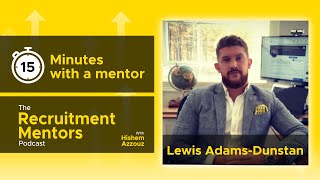
In this 15‑minute interview for the Recruitment Mentors podcast, host Hishem Azzouz asks recruiter‑turned‑business‑development director Lewis Adams Dunstan seven rapid‑fire questions about his career, challenges, and habits. Lewis reflects on the fatigue he experienced in 2020 after neglecting vacation, explaining how a three‑week break restored his energy and prompted self‑reflection. He stresses the importance of a disciplined work‑from‑home routine—getting up, exercising, dressing as if at the office, and creating a dedicated workspace—to maintain productivity. For winning new business, he advises against cold calling and instead recommends warm outreach: deep research on the target company and hiring manager, personalising the approach, and focusing on conversation rather than a hard sales pitch. He also shares a personal habit adopted during the pandemic—twice‑daily gym sessions—that fuels his energy and mindset. When presented with a scenario of contacting a long‑targeted hiring manager, Lewis suggests a soft, research‑driven introduction that references shared background or recent events, avoiding a direct recruitment spiel. Finally, he encourages recruiters to celebrate small wins (interviews, conversations, offers) to sustain motivation, especially when remote work limits traditional office celebrations. Throughout, his tone is conversational, supportive, and pragmatic, offering actionable advice for recruiters navigating post‑pandemic challenges.
Chapters
Welcome to the Recruitment Mentors podcast. This is the 15 Minutes with a Mentor series that we are releasing in line with the Recruitment Mentors community opening. And in this series, really simply, we're going to ask some of the mentors from inside the community 7 questions in 15 minutes. I'm delighted to be joined by Lewis Adams Dunstan. He's one of the mentors inside this community and has been on this podcast. But for those of you that may not, for those other people listening that may not know you, Lewis, if you could do a quick intro and then we'll jump straight into the questions.
Yeah, absolutely. Thanks again for having me, Hishem, initially. I realise my watch is going off like crazy here. I'm not sure if you can hear that, but first and foremost, my name's Lewis Adams Dunstan. I've been in recruitment for over 10 years now. I've worked in every role you can imagine from entry-level through to team lead, to team manager, and I'm now the director of business development at Darwin Recruitment in America.
Amazing. First question: What was your biggest challenge in 2020? How did you overcome it? And what did you learn from it?
Yeah, so biggest challenge is actually something I didn't realize until it hit me. And that was fatigue. So I didn't really take any time off at all for the entire year and got to the end of the year, looked at my vacation time and was like, wow, I've maybe taken like 4 or 5 days off. And I think that was a combination of being at home, like what was there to do? It's not like I could go on a trip. It's not like I could do anything, same as anyone really. And I got to the end of the year and I realized that actually I was being less productive I was less motivated and I was just generally fatigued. So I've always been someone that just kind of tries to power through it. And I had 3 weeks of vacation time and I took it at the end of the year. I'm not encouraging everyone to go and take 3 weeks off, but actually it was really good for me. I realize that it's not like a one-size-fits-all solution for fatigue. So I just decided to switch everything off, everything. I played a lot of PlayStation, I did a lot of eating. I worked out a lot, but it took me a while to realise what I needed. And after I took that time off, I came back energised, motivated. It gave me time to self-reflect on things I did well and things I didn't do so well. So don't take that for granted. When you need time off, take it, because recruitment, generally speaking, is a pretty high-pressure, very demanding role. There's so much value in just giving yourself time to rest. So that was my biggest challenge that I didn't know, didn't even know was existent until I just kind of hit a wall.
Yeah, I love that. So yeah, don't always think the only path and option is to just power through, right? And I definitely felt a bit of that over the Christmas period. So second question, this may tie in actually, but second question I have for you is like, what working from home tip could you share with other recruiters that has had a massive impact on your productivity?
Um, routine is, is the biggest thing for me. Like, I still get up in the morning, I still go to the gym at 6 AM, I still do my hair, straighten my beard, I still get dressed up as if I'm going into the office. Um, I've created an office environment for myself as well, which is cool. Like, don't, don't lose that mindset. Don't roll over to the side of your bed, grab your laptop, sit in your pants all day. And then get showered at 8 PM. Like, that's a terrible habit and you're not going to be successful doing that. So I think to build a successful mindset, you need to have a successful routine and it doesn't really matter if you're working remote or working in an office, you need to have one in place. So that was the biggest setback for me.
What's been the most effective way for you to win business in the last 12 months?
Um, not, not cold calling. Um, warm calling after I've found a reason to connect with a recruiter or a hiring manager. And what I mean by that is not just looking at what jobs they have open and saying, I can find a solution for you. First and foremost, trying to understand the business, what they do, um, putting time into researching the individual who might be the hiring manager or the point of contact that can introduce you to the hiring manager. And approaching them in a personable way. So don't just try and take all the time. Look, look at, look at their background, compliment them. If you've got something in common, talk about it. Like, make sure you're bringing value, but try not to pitch your recruitment services. They've heard it too many times, 8 times in that day, by the way. So like, be a little bit more innovative with your approach, and, and you will start to have conversations. And conversations are business development opportunities, even if you don't get a job end of it. Conversation with a hiring manager, whether that's on a comment on a post that they've created and they respond to you, whether that's getting them on the phone, whether that's introducing someone to them. That's how I've measured my success in, in that respect. And I've started to forge some really good relationships that now are starting to turn into really good business opportunities.
Love that. So, but this would be interesting to hear from you actually, talking about routine and stuff like what, what habit or hobby did you start in 2020 that going to continue in 2021?
Uh, that's an interesting one. I think just the consistency in my— in my— honestly, it's not necessarily work-related per se, but just consistency in my gym workouts. Um, I typically train twice a day, um, just because again there's nothing else to do once you finish work outside of watch films and play PlayStation. So that, that was a habit I picked up and it's just given me so much more energy and I don't feel fat and flobby at the end of it, you know, like I'm not getting to the end of remote working, if that ever is a thing, and thinking, I just feel, I just feel terrible about myself. So I'm just making sure that I maintain a healthy lifestyle, and that creates, you know, a healthy mindset when, when working in recruitment.
It helps everything else, doesn't it?
Yeah.
Um, we can't wait for these gyms to be open in the UK, trust me. It's absolutely—
oh, they're not, they're open?
Um, no, they're not, not open.
Sorry about that.
Yeah. Um, so slightly different one here. Which do you think is better, the first coffee in the morning or the first pint post-work on a Friday?
Pint, definitely. Yeah, yeah, no question. I've taught myself not to need caffeine unless I absolutely like am in a like a terribly exhausted space. I don't think I'll ever teach myself not to need a pint. I like it too much.
Right, so this one's a bit different. This one's a bit of a scenario. Okay, so I want you to sort of share with us how you'd approach this situation or scenario that you might find yourself in. So a bit of what you're talking about. So a particular business has been on your target client list for over a year, right? And you've had a couple of touchpoints with them. With different hiring managers in this organization. So over that time, you might have had a couple of their people in that organization like some of your content on LinkedIn, or some of them may have received an email from you, or even introductory email that you've tried to reach out. But through your candidate network, through your relationships, you manage to get one of the hiring managers' contact details, and you call them, right? And they pick up and they answer, and they say, hello, who is this? What do you say? What would your approach be?
I think just pulling on the fact that you've spent a year trying to get hold of these people, you probably know way more about them than they know about themselves if you've been doing your research. Like, leading up to that point, I wouldn't have just been calling that person hoping they picked up. I— every time I wanted to, to get hold of them on the phone, I would have had something armed and ready that I could find relevant. So I would very quickly introduce myself. I would not give them the recruitment spiel, but I would very quickly, out here it's quite common to do it, is talk about perhaps one of their college degrees or perhaps talk about their education, talk about something that happened with a local team, letting them know who I am and maybe just making a joke out of it. Like, I'm pretty candid, I'll be like, finally, do you know how long I've been trying to reach you? I feel like you just got to try and at least turn it into, into something and not just go, right, I've got to sell now, I finally got them, because they'll just go, no, no, stop selling to me. Dude, find something like that you can, that you can talk about, a middle ground, and then go in with that approach. Like, that's just, it's a soft way to do a hard sell.
Yeah, I like it. Last question, question 7 is, so final question really is I'm thinking of when recruiters will be listening to this, it's still going to be in the first quarter of 2021. I'm sure everyone listening will be thinking about, I want to have a better year this year, right? So would have probably set some goals for 2021, feeling motivated. So like, I guess what, and I'm sure you might have said this to some of your team or even to yourself, like, what would your advice be to me if I wanted to have the best possible chance of achieving my goals this year that I've set? What would your advice be to me?
I would say it's pretty common in a working environment to have the opportunity to celebrate small wins where you're in an office and you get a high five, you grab that beer that you just mentioned on a Friday with your mates during lunch or after work. You can't do that right now. So, and it's very difficult to do on your own, right? It's weird if you keep high-fiving yourself. But you need to find a way to associate like a celebration of some kind or award of some kind with a small win, because I think that trains your mindset into understanding when you're being successful. So find something that works for you. It could be taking time off to go for a run. It could be having a beer. It could be anything, anything that you, you see as a celebration. Associate that every time you have a win, because I think that would just keep that motivation up, knowing that you are making progress. So yeah, that would be my advice. Celebrate the small wins that you no longer can do in an office space at home. Somehow.
Yeah, I like that. And yeah, I think sort of celebrating the process, isn't it? And putting more emphasis on that rather than just the outcome, I think is—
An interview is a win. A conversation is a win. Like an offer accepted is a win. Like, they're all wins. Don't just wait for the deal and then wait for the money. Just celebrate them.
Love that. Lewis, that was 15 minutes of a mentor.
11 minutes to be exact.
Lewis, absolute pleasure. Thank you so much. And yeah, excited for people to learn more from you and about you. So thank you.