Lewis Adams - Dunstan - The US market, the power of patience and why a British accent always wins!
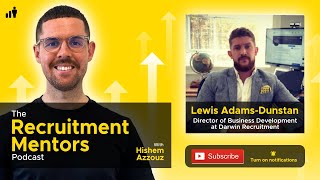
In this Recruitment Mentors Podcast episode, host Hishem Azzouz interviews Lewis Adams‑Dunstan, Director of Business Development at Darwin Recruitment. Lewis shares his ten‑year recruitment journey from trainee to director, highlighting the core traits of successful recruiters—especially patience and long‑term relationship building. He contrasts experiences in large corporate environments (Adecco) versus smaller agencies, recounts his Rookie of the Year achievement in the untapped Danish tech market, and details his transition to managing a team. The conversation then shifts to building the US division, covering cultural differences, the trial‑and‑error approach to market entry, the pivot to a niche machine‑learning/NLP focus, and the financial targets required for expansion. Lewis discusses client development tactics, the importance of referrals, adding value beyond placements, and cultivating strong internal‑recruiter relationships. He reflects on personal resilience, the challenges of relocating to Boston, and offers three pieces of advice for recruiters considering a move to the United States. The episode concludes with quick‑fire questions about industry perception, motivation, financial habits, and long‑term career goals.
Questions this video answers
People's perception of recruiters – reduce the negative connotation and help businesses see the value recruiters bring.
He doesn't read books; he listens to motivational YouTube videos, especially Eric Thomas.
Eric Thomas talking about pushing yourself until you can't breathe.
Start listening, stop talking.
A brand‑new white‑leather A‑Class Mercedes with AMG kit.
Chapters
Welcome to the Recruitment Mentors Podcast. My name is Hishem Azzouz. Today I'm very excited to be joined by Lewis Adams-Dunstan, who is the Director of Business Development for a company called Darwin Recruitment. Lewis has worked in the industry for nearly 10 years, and in that time has progressed from consultant all the way to director level, achieving Rookie of the Year and more recently Perm Sales Consultant of the Year along the way. And for the last 4 years, Lewis has been involved in building the American division, part of Darwin, and now lives in the States in Boston. Lewis, thanks for joining me.
Thanks for inviting me, Hishem, it's a pleasure. Seen you on LinkedIn for years. I feel like I made it. Mum, I made it.
Now I'm excited to dig into your journey. But where I want to start is, in your opinion, what characteristics and traits do you think make up a highly successful recruitment consultant?
Yeah, this— I would say the first thing that springs to mind, and this is something that took me a while to master, and I'm not even sure that I've still mastered it, but patience. Um, stop thinking short-term. Short-term wins are great, and you, you know, you'll get some cash in the bank, but they are only short-term wins. So build relationships, be collaborative, be patient with those relationships, don't push them too hard, and that will set you up for success in the future long term with clients and candidates. So that's pretty much the core for me to success that I've seen. I mean, I've been doing it for 10 years, so I've been somewhat patient. I haven't jumped ship yet.
Yeah. So like, and do you think part of like what can maybe sometimes make it difficult to see what the long term looks like, like when you was maybe a bit more short term, was it, did you not have goals? Did you have goals? Like, did you have complete clarity on, right, so all of this I'm doing today hopefully will help me get here? Was that part of the trouble? Could you not see, have your head above the water sort of thing?
Yeah, I'll be honest, it's difficult because When I first started in recruitment, I entered into an environment where there were loads of really high performers and not so many juniors. So I was kind of like delusional when I went in and I was like, wow, this is some life. You can just come in and go out every night and enjoy yourself, buy Rolexes and nice suits. And I was just like, I can have that tomorrow. And then I realised you can't and it does take time and you do have to set goals and those goals aren't just monetary. You have to set personal goals, development goals. You have to think about— you think about the future and it's difficult to do when everyone's already there around you.
Got it. So that— yeah, that's an interesting dynamic, isn't it? And I had recorded an episode with a lady called Gabby who sort of spoke to that where she entered the environment and saw all these people doing really well and that actually had a knock-on effect on her confidence. But what you're saying is actually when you see all these people around you living the recruitment dream, it's like, I fucking want that now.
Yeah, it really motivated me, to be honest, but it motivated me in different ways. And I actually realised that that particular environment at the time, although it gave me the foundation of my kind of knowledge today, it wasn't necessarily the right environment for me to be able to grow. So, I mean, I guess we'll probably dive into that a little bit, but I moved away from that business to go and find a smaller shop that was going to give me a lot more attention, a lot more focus to hopefully then get me to that level, you know?
Yeah, yeah, sure. So let me just ask that question then, because that was one of the things that I get asked quite a few times and the listeners want me to ask is, so obviously, yeah, so you started the Adecco Group, obviously huge brand, huge organisation, loads of process, great training, no doubt. And then obviously, yeah, you've been part of the Darwin journey for, is it what, nearly 7 years or a bit longer?
7 and a half now, I think.
Yeah. Yeah. So, so you just mentioned that. So obviously, look, there's pros and cons of both. But for you, like talking to people listening, like, should I enter the world of recruitment into a big corporate? Should I leave more of a smaller agency to go to a bigger corporate? Like, how would you describe the positives and negatives, would you say, of working for a large organisation compared to a growing, more smaller business?
Yeah, so I would say certainly at DECO, I mean, it's an interesting, I guess we'll dive into this as well, but it was an interesting journey how I even got into recruitment, but more so when I got there and I was just set back by how many people were there. We got sent on a training course, which was up in Birmingham or something like that for a week or two, and the teachers were great, but I was in a group of like 30 or 40 people. And although that was good to have lots of experienced people, some not so experienced around me to get different perspectives, the difference I noticed moving to Darwin was that there wasn't as many people in the group. It definitely felt more like a one-on-one and it just felt easier for me to, to kind of put my hand up and, and for someone who didn't know much about the industry, ask for help. So for me personally, although I built all of the foundational experience that I have, at Adecco, and I'm thankful for that. I learned a lot faster in a smaller organization.
Interesting. How would you describe your first year in recruitment, Lewis?
Uh, it was— I was hungover a lot.
Um, yeah, no, it was making, making deals then if you're going out for the drinks or what.
Well, that's, that, that's the thing. So I, I picked up all of the, all of the skills that I needed And it just took me a while, you know. I, although thought I knew recruitment, really didn't. It takes time. But I was celebrating like I was doing deals, and that created like a very confused path in the first year or two of my career as to what was success, because I was feeling and experiencing success when I wasn't actually making placements, you know, on a large scale. So it was, it was a confusing time, um, but it was fun. We had a lot of fun. Um, would I, would I have changed my journey into recruitment? Maybe not, because it did give me that immediate insight into what being successful might look like. Um, I think it might have been, for me personally, in terms of my personality, a negative feel for me to walk into somewhere and it take me 2 years to even see that kind of like or experience that kind of lifestyle. I needed to see it in order for me to want it.
Yeah, got it, got it. So, so keen to, to really unpack the, the Darwin journey, but final question on the sort of early days. Like, obviously one of the, the great advantages of— you already said, like, being joining a large organization is you can get access to high-performing billers and recruiters, right? So I guess you've already shared what you think make up a successful recruiter, but was there any sort of common themes or things that you saw from these high performers in that environment?
I think the confidence was amazing to me. Like, I've— I guess my ego at one point was pretty high and it probably still is somewhat, but it's definitely been dampened or like softened a little bit just because I don't want to be perceived as a dick. All the time. But when you look back at some of the high performers, they were just so confident. They entered every single month with pipeline, which allowed them to be confident. They were like just resilient as well. You know, when I saw the failures just didn't seem to hurt them as much as it did me. If I had an interview drop out, it was like the end of the world. I really didn't know what I was supposed to do next, how I generated another one. But they were always keeping consistent pipeline and that gave them confidence and they walked around the office with confidence. And for me as a junior, I was like, man, I want to be these guys. So I think, I think that really stood out for me. Um, I actually knew the guy who brought me into recruitment quite well and he was one of the high performers at Computer People at the time and he showed me this paycheck one day and it was like £27,000 or something. I was like, holy shit, like, that's— you just— I earned that. That was what I was earning annually at the time, um, if not, if not slightly less. And he showed me that, he was like, you know, do you want to get into recruitment? I was like, what the hell is recruitment? So there is an interest— there is quite an interesting story of how I got into recruitment, um, but he was someone that I aspired to and he worked very closely with me initially. And, um, and yeah, just, just screamed confidence. He's now got his own agency and, and super successful.
Love that. So let's talk about the journey for the last 7 and a bit years then, mate. So just for context, so, um, have you in the last 7 and a half years with Darwin, so have you always recruited in tech?
Always tech, yeah, always tech.
Um, so joined in as a, what, a recruiter I'm assuming, or resourcer, right?
Yeah, yeah. So joined as a trainee essentially. I I left Computer People and was just looking for that smaller shop and was happy to just get the opportunity to learn. So went in as a trainee consultant.
Yeah. And then you've been on that typical trajectory of people that achieve it, of like getting in at that level to now obviously directorship, right? And we'll unpack that.
Yeah.
But have you always been then— final bit of context for people listening— have you always been in perm then, or has it been contract and perm? What's been your journey with that?
Yeah, always perm. I think I've probably placed 3 contractors in my career.
Okay, so predominantly perm, yeah?
Always perm, yeah.
All right, so let's talk about that first year quickly then. Rookie of the Year.
Yep.
Why did Lewis achieve that?
Um, I entered into a new market, was working the Danish market. It was untouched for our business at the time, and to be honest with you, it was pretty untouched by recruitment in general. So I did definitely have some level of advantage going into this market. It was a market that was picking up, it was booming. There were some hot technologies that just landed around kind of Node.js, Angular, JavaScript at the time. And no joke, mate, when I was calling clients or prospect businesses and saying, hey, look, I've got this guy or girl that could be of interest to your business, these are their skill sets, they were like, Wait, what? You're going to help us? I was like, yeah, yeah, yeah, I'm going to help you. It just costs you 20%. They was like, oh cool, let's get started. It was like, wow, this is— this is really— honestly, it was so untouched. I probably could count on one hand the amount of competition I had. And even then, we weren't— there was so much opportunity there, we weren't even knocking heads. And when we did, there was like a really good level of respect that, you know, we are the almost the founding fathers out here of the recruitment space. And I know it's changed quite a bit since then, but that allowed me to pick up some really good businesses and repeat business was the key to success in my first year. Multiple placements at, you know, 2 or 3 companies that really valued what we did as a recruitment agency.
Let's talk about that for a sec and you can sort of share how you've refined this or got even better at this as you've gone on. But so I guess firstly, like what, so just for context, what did you end up billing in your first year then, do you know?
£156,000.
Okay, £1,000. Pretty much standstart market.
From a new market that didn't exist, clients we didn't have. And I'll be honest, you know, I probably fluffed up some of the numbers to even get my job in the first place. So I ultimately said I probably did better than I actually did just to secure the job because— so I kind of almost applied an immediate pressure on me to perform, which actually was really beneficial. So they expected more from me than actually I'd ever delivered. Yeah.
So when you started to realize that this was on tap, like what did you do to make sure you weren't complacent?
I spent a lot of time going on business trips. That kind of stopped me being complacent because every time I went on a business trip, I forced myself to go and meet new businesses. And I really enjoyed that part, to be honest. Like, who doesn't? Traveling, going out, having nice meals, going for drinks. Like, I tried to make the business development side as fun as I possibly could for me. And I think from a young age, when I spent a lot of time on golf courses and around, like, older people, I developed an ability to be able to just communicate with people from all different walks of life quite quickly. So I just enjoyed it, mate. Like, that's what kept me fresh. Consistently trying to create new relationships and quickly the team developed and grew around me. I wasn't actually initially leading that team as it grew. We had a couple of different managers that done that until there was a point where, you know, I got kind of tapped on the shoulder and was like, hey, do you want to lead this team? And everyone seemed to kind of buy in. But yeah, just keeping it fresh by consistently meeting new businesses and new people.
So how long did you work the Danish market then before you transitioned to the US market?
So, um, in terms of joining the business, um, I was there for 4 years, 4 and a half years. Yeah, 4 years. And then, uh, and then we started transitioning, handing over everything we had in Denmark. Literally, I mean, it was crazy. We was working all hours under the sun, but till 2, 3 in the morning. We were incubated in the UK but working the US markets. And, oh, okay. Yeah, it was really fun. We built a really good team up initially and we just enjoyed it. It was quite nice waking up at 10 o'clock in the morning, going and making some breakfast, going down to the gym and then starting my day like at 12. So that was pretty cool, but it was a slog. It was a real slog.
Yeah, definitely keen to dig into that, but I just want to make sure that we just uncover some learnings that you experienced in the— Yeah, going from untapped market doing that first year and then let's dig into the US, if that's okay with you.
Of course.
Yeah. Yeah. So, so 4 years on the Danish market. When did you start taking up management responsibilities?
So I won Rookie of the Year 10 months into my career at Dogue. And shortly after that, 7 months after that, I actually moved into a senior position. And then about a year or so after that, I moved into a team leadership position. So yeah, I led that team for just, just kind of 2-ish years.
And how many people ended up in that team?
Uh, 6 people in the team.
Okay, nice. So how was, um, how did you manage that? Like, just having to focus on Lewis and Lewis's billings to being responsible for other people, how's that transition?
To be honest with you, it wasn't smooth. Um, I just assumed early on that I could just hire people that were like me and they would just follow the same process that I did, which really didn't have my structure, and they would just pick it up. You know, maybe I was a little bit spoiled when I went to the market. The BD came easily. You know, now we're like 2 or so years in and it started to get a little bit tougher because more agencies were out there winning business. Um, so my initial approach was wrong. I just, you know, I hired a couple of people that were very similar to me and they were really good, but it became a challenge because we had 3 or 4 personalities that were exactly the same. And, and it was, yeah, there were some heated moments, shall we say. But they were all, but they were all super capable individuals. Like, some of them have gone up. In fact, one of them's gone on to start his own agency. Um, a couple of them have gone internal. Um, but generally speaking, very good individuals. We just— I just should have created a little bit more diversity, and I didn't really know what that meant. When I first went into leadership.
Yeah, because what would you do different then to avoid that?
I would just be more open-minded when I was interviewing. Um, I wouldn't be asking specific questions that were relating back to me, and I shouldn't have been looking for people that I wanted to go for drinks with. Um, you know, that kind of— I should have perhaps separated that personal interest just to have a good laugh as opposed to like, what's going to make this team successful? So I think the interview process— and let's be honest, like, we're all recruiters and we all give advice on, on what people should do when they're going for interviews, but how many of us actually know how to interview? Like, a very small percentage of us actually know how to interview effectively, what traits to look for, um, how not to be biased. Like, it's difficult. Like, it is an art.
Yeah, I think that there's like a lot of people are quick to do what you did and then they then learn, right, okay, we need to actually build a bit of science around what we're looking for, what we need, where, and those things, right?
Exactly. Yeah, yeah. We just, we just didn't have that when we first started. Um, so we kind of, we started to develop and change that and we brought in some different people from across the business, not necessarily just managers, like there is an element of involving other people and empowering people in the business that can be involved in decision-making when it comes to growth. That just does so much good for the company. So we changed that and we started to see much better progress.
Interesting. So what would you say was the— so at Adecco, did you do the UK market?
Yeah, yeah.
So what— keen to get your thoughts on this for the America as well, but like in the Danish market, for those listening that might be I don't know, in the process of expanding to the EU and other markets, but like, what would you say were the main differences in terms of culture that you had to adapt to quite quickly and learn and get better at? Between here in America, between Europe and the Danish market, what things did you have to pick up on quite quickly in terms of the culture that you had to adapt to?
To be honest with you, in the Danish market, you could just be very direct. You go straight to the CEO, straight to the CTO or the hiring manager. Tell them what you've got. Um, they're quite direct, kind of black and white people as well. So, you know, bring value immediately, um, and, and they'll respect what you're offering. Um, you can only really do that if you actually research a business and understand what they're doing, understand what they might be looking for. That's the quickest way to add value, like putting that little bit of time in before, um, and then going straight to the, straight to the heart of the business, you know. Whereas moving to America We thought we could essentially bring that same approach here and it just work, and it didn't. It, it, it just didn't. We failed miserably at it, and we struggled to pick up business. We pissed a lot of people off. Um, we realized that actually there is a much bigger focus on internal recruitment out here in America, and that actually a lot of the internal recruiters at businesses essentially are your clients. And if you try— yeah, if you try and bypass them or try and kind of cut them out, they do have the power to stop you working with the business. So there's an element of just kind of— we didn't know that when we first got here, so we, we just kept making mistakes. And then just over time, we started to realize that, wait, what are we doing wrong here? And we had a couple of good relationships with recruiters, and they can do so much for you. And any recruiter that really values your, your worth, maybe even they've come from an external background themselves, so they know what the grind's like, you know, um, that will still involve hiring managers. It's just a slightly different sell. You just have to convince them that you're not trying to like push them out of their role. You're not trying to create an opportunity for, for them to look bad. Actually, what you are is an addition to their skill set, and actually their ability to be able to build a good relationship or partnership with an external agency is as valuable as them finding candidates themselves.
Yeah, that's really interesting. So, so let's talk about, um, the journey of America then. So then, so where, where, why did Lewis get this opportunity to look at the American? Like, where did that come from? How did you get that opportunity?
I think, to be honest, I've always quite— I found it quite difficult to have like a really clear vision of where I wanted to take my career, but I had really good management around me that could see potential in what I was doing. And the impact that I was making, they kind of saw and was like, okay, cool, you're really someone that people follow, that someone wants to actually kind of imitate and potentially try and kind of like beat in terms of a competitive nature around recruitment. And I think that would be a good trait to take to America. And I guess just my enthusiasm, my— I guess you can confuse it for passion. For recruitment and just like winning, my CEO kind of had a chat with me and said, hey, do you want to kind of lead our US operations? And I was like, okay, that sounds cool. He said, all right, think about it. I was like, no, I'll do it. Definitely. I've always wanted to live in America. I don't know why. Yeah, I guess I'm a golfer as well, so I guess the golf out here is good, which is kind of one of the reasons I wanted to be here. Yeah. But yeah, it just gave me the opportunity. And then kind of like along the way trained me to get to better understand how to run a business just from a business strategy perspective as opposed to just a recruitment perspective.
Yeah, so like what was the go-to-America strategy? So obviously you made plenty of mistakes, but like what was the actual initial plan? How long was you gonna be in the UK for and build it up before you tried to go over? Tell us a bit about the plan and how you approached it.
Yeah, so the original plan was we grow the team to 4 or 5 people, which—
In the UK.
In the UK, which was kind of difficult as well because we gave the opportunity for anyone internal to put their hands up and no one did. Really? Yeah, surprisingly. I think we had quite a young culture at the time. It's much more diverse now. And I think it was just a big change for a lot of people. Our office is located in Essex, in Bittericky HQ, and I think people just really liked being in Essex. I don't know, but it's quite a big jump to take for, you know, someone in their early 20s, I guess. And the commitment initially as well, which would be to be working from 12 to 11, 12, 1, 2 in the morning and pretty much sacrificing your personal life for that period of time before we get there. So there was an expectation around us being able to achieve certain figures over a 3-month period that would then kind of unlock the door for us to go to America that said, okay, now we're profitable to be able to cover the costs of travel, visas, salaries, commissions, everything like that.
And what was that out of interest?
It was $100,000 per month for 3 months consistently.
So what, $100K months?
$100K months for 3 months consistently. And to be honest with you, yeah, it was, it was a stretch.
Um, and what would you— what would the— what did you end up doing, like, finishing when you was experiencing the Danish market? Was you doing anything near that in terms of the team? In terms of, like, yeah, just billing? Yeah, billings as a whole. Like, did that seem like completely unattainable?
It, it didn't, because as far as the, the deal size and deal values go out here, like they're not comparable. So I was probably averaging between $12K and $15K in Denmark, my average deal size, and I finished on $250K, $300K year on year for, you know, for some time. And we did a couple of placements in America quite quickly and they were like $30K, $40K each. Wow. And it was like, holy shit.
And why is that? Is that because salaries are larger? Is it because the percentages are bigger?
Why is that? Salary is larger. The percentages aren't big. Well, I guess they are comparative to Denmark. You know, it's much more— you see kind of 20, 22, 25, sometimes even 30%. It's much more common in America. Yeah. And then depending on what kind of market you work in, obviously, like we kind of shifted towards data eventually. The average salary ranges between $150K and $180K. Okay.
So you had to do $100K months, 3 months back to back. Yeah, did that. So like, so you mentioned you did a couple of deals quickly. Like, how, how did you even approach this? Because America is so vast. Like, what state did you go after? Did you just focus on one state? How, what was the strategy?
Well, that's, to be quite honest, and I, you know, I wouldn't be lying in saying I think that's what our challenge was, is that we didn't have a clear enough strategy to turn around and say, okay, these are the exact markets that we're going to be working. These are the technologies that we're going to be supporting. These are the types of businesses we're going to be focusing on. And don't get me wrong, like, we were all experienced, so we kind of knew what we needed to do. But we— it was a lot. It was a lot of trial and error. And I think, yeah, if we were to do it again, we would go in with a much clearer strategy, with much more research in terms of like which locations, which technologies, which businesses. Also on top of that, where are we most likely to be able to grow in terms of the actual team itself? And, um, initially we was actually going to Atlanta, so I was quite fortunate to go back and forward to Atlanta 7 or 8 times, um, meeting businesses, checking out offices, um, obviously running the social side of it as well to see what it was like to actually live there. And it was fun, it was super fun, but it was very clear that in I guess in the South, the salaries were just so much lower. And funnily enough, I ended up leveraging one of my relationships from Denmark with a gentleman that ended up going and working for a major corporation out here. And he brought us in and secured the client in Boston. So he was like, yeah, he— and that kind of actually shaped the rest of our business because we ended up with a load of machine learning roles. And we all looked at each other like, what the hell is machine learning?
Really?
Yeah, we were going for like front-end, back-end product-based roles and there's huge demand for that, but the salaries are a lot lower. And then we learned about machine learning. I think one of our first placements in America was an NLP guy and the fee was like $40K and we was like, what? Cheers.
Yeah, cheers.
So instantly that carved out our strategy. We was like, okay, we're now data experts.
Nice.
At least not experts, you know, we were going to develop the business to become a success. Yeah, use that as the focus.
So I think what I love about that, Lewis, is like a lot of people can not give themselves an opportunity for that to happen. And what I mean by that is what you did was take action, right? And I think like that's the sort of lesson there really, whereas yes, ideally if we were to go back and start again, let's have a bit of a strategy and a plan as to what we're going to focus on. But at the same time, don't discount the power in taking action and learning, making mistakes, and then going, actually, fuck, this is a great opportunity, here we are, let's go, do you know what I mean?
Absolutely.
So how did you go about learning that market then, once you recognized that?
I think there's really only one way to learn it, and that's to be in it. So picking up the phone, talking to as many people as we could in the industry. I mean, we're here now, right? You're asking me questions, everyone loves talking about themselves. So it's very easy to talk to someone, leverage that next relationship with the next one and the next one and next one and just Just ask, just ask questions. Like, I'm a true believer in there's no stupid questions. Actually, you're stupid if you don't ask certain questions because at the end of the day, if you don't ask them, you don't pick up that knowledge and you end up missing out on a placement or, you know, an understanding of a job requirement. You end up taking too much time trying to find the wrong people. So I was always cool with just asking very basic questions and looking for very basic answers. And I guess data science is quite a broad term. We kind of initially really kind of went into a niche of NLP and machine learning. And natural language processing is pretty simple to understand. And once you get that understanding of it, what's also very good is that there really is only one or two different styles of NLP candidate that are good. And then you've got all the aspiring ones. So we, instantly knew who to reach out to that would then lead to us having really good product to take to the market.
Right. So how, um, how long did it take to get up to the 100K months?
Took a while, mate. It took a while. Um, it was funny because we, we actually, we hired a guy and in his first month did 4 placements for the business and did 98K. Like and was like, they went in within, I think we was actually at our Christmas party and you got 4 separate calls from the hiring manager saying, we're hiring him, we're hiring him, we're hiring him, we're hiring him. And we was like, what? So that was the first time that kicked in and that was after 3 months that we kind of got very close. And then we kept like having 1 month where we almost got there, then we'd miss it, then we almost got there, then we'd miss it. And we were incubated for a year and a half. Before, before we got to that point. It took a while. That being said, there was also some processes and stuff behind closed doors that were going on in terms of getting our visas, um, securing office locations, um, everything else that goes with setting a business. So it wasn't— that kind of unlocked the door, then that would allow us to get everything in place. And I think it was 2017 or '18 now, I can't remember, in January that we arrived. As 3 people.
So just real quick one. So if I'm listening right now and I'm in the process of building out a brand new market or looking at building out a market, like how long would you give it, do you think then? Because you've done it, ended up doing it in the Danish market, done it in the US market. Like, how long should I be giving it before I'm like, right, actually, do we need to pivot? Do we need to make changes? What would you say is like the ideal time period?
I would say the ideal time period is 6 months, being that you've done the research prior. Yeah, I think you have to allow for time, and especially now the way things are, you know, um, with the world and COVID and what have you, 6 months is a fair run rate that allows you to pick up business, that allows you to make some progress, build relationships, maybe get a client or two that might have multiple hires. Um, at that point, if you're really not seeing progress I would really consider pivoting into a different industry or sector.
Reevaluating.
Yeah.
Yeah. So, Lewis, what was your most effective way of growing your client base then in this American market? So you went on that trial and error journey of, yeah, machine learning, old contacts helped you, end up focusing on that. Like, what ended up being your main way of generating clients?
Recommendations. That almost plain and simply, I, even when I didn't place people, I asked for recommendations. Even if they went to a new business, I would follow up with them, see how they were getting on. Even when I did place them, you know, even more so following up, seeing how they're getting on in the job, asking about who they know. And it's quite, it's somewhat of a small market, the machine learning world, when it comes to like the big the big fish or the big players. There's a lot of aspiring data scientists, but it is quite a close-knit circle. And if you land a good client or you land a good contact, you're kind of in a very, very good position. And I was very fortunate to land a client. And the particular gentleman that founded that company was one of the godfathers of NLP. And having that access to his business in terms of growing it, which firstly they were paying like $300,000, $400,000 per employee that they brought on. So the fees were huge.
Oh my God.
Yeah, the fees are huge. But these are like the most elite people in America. But that gave me access to call people and say, hey, I'm working with this guy. And regardless of whether they were interested in moving or not, they wanted to talk to me. So it kind of— I was very fortunate in that sense. And I think anyone can do that if you pick up the right business or you find the right leader. You leverage that to then, you know, make yourself more successful elsewhere.
So you always hear like referrals, right? But like, in your opinion, you mentioned a few ways, but like, in your opinion, like, what would you say is the best way of consistently generating good leads and referrals?
Hmm. I think consistency is like you just said, just being consistent. Always adding value. People don't necessarily want you to be consistently following up saying, how are you? Like, what you've been up to this weekend? Like, people ain't got interest in that unless you're friends with them. And, you know, I've developed quite good relationships with people here to the point where we probably could do that. But always trying to bring value then meant that anytime an opportunity came up on their side that they could recommend me for, they did. So I just stayed very consistent in that. And it's very easy to do when you have a niche because you can always—
So when you say value, Lewis, people will be going, what do you mean? Like value what? How do you mean?
So right now, I mean, I run my own podcast, which is certainly one value that I can bring. You know, I can give them a platform to actually come onto my show, have access to a network that they wouldn't normally have access to. And talk about themselves or an interesting project or an experience that they've had in their career. That's one way. Another way is introducing other people to them that are also in the space. Like, I don't know why people don't do that more often.
Being the connector. So would it be like, hey, Lewis, look, we spoke the other day. I spoke to this other lady the other day who's on a similar journey. I thought I'd connect you because she might be able to help you. Or is it literally as simple as that?
Simple as that. There's no science behind it. It's just like, okay, cool, you do this and it's relative or relevant to this person. So why don't I connect you two? One thing I would obviously be a little bit cautious of is if you've got a hiring manager and you keep connecting him to potential candidates, you're probably not going to make money. But if you are hiring leaders with other leaders or other data scientists with other data scientists, and they, you know, they posted something recently or you perhaps tag that person in their post, just connecting people. People appreciate that.
Yeah. And I think what I love about that, and I've experienced this in my own career, is like basically it's the mindset of give more than you take.
Right.
And actually what actually ends up happening is you end up getting more in return anyway when you actually do that in a real honest way. Do you know what I mean?
Agreed. And that's the key point. If you're doing it authentically. If you're actually doing it because you want to make the community better, but obviously we're recruiters, so there is a, you know, there is an underlying thing there that we want to pick up business. But if you're doing it because you're interested in the space, and that would probably be another thing, like it's very easy to find interest in something if you actually pick a vertical that you're interested in or a space that actually excites you. It's very interesting. It's very easy to pick up skill and knowledge around it. And natural language, if you look back at my school days, which I hated, I probably would have never thought that I'd be working very closely with linguists. In fact, I probably didn't even know what a linguist was. But there's something really interesting about language that actually makes my ability to be able to talk to people much more genuine.
Yeah. Okay. So where do you think most people go wrong with client development?
Follow-ups. Yeah, follow-ups. Like, so I think people tend to follow up with an agenda, like they're always trying to get something out of it. Again, coming back to adding that value. So client development isn't, again, it's not a short-term thing. You will get short-term wins sometimes. I think I actually hold the record at Darwin for the fastest ever placement made was like 19 hours from picking up a new business, finding a new candidate, and having them sign a contract on a perm role with like 3 interviews. Yeah, so it can— I'm testament to it can happen really quick, but if you don't do anything with it thereafter, then you're not going to build a relationship with that client. And so many times I see people that do great work with the business, they do maybe 1, 2, sometimes 3 placements, and then you never hear anything more about that business ever again. Because they get, you know, I guess distracted or sidetracked and start doing the same for another business and the same for another business and the same for another business. And then when they look back on the year and they go, well, who are your clients? And they go, I did some placements, but I haven't got any clients. So I think following up, showing a genuine interest in those businesses, understanding the projects. Yes, we're recruiters, but there's so many other ways that we can actually add value to that team. Again, whether that be introducing them to people, whether that be bringing them on a podcast, whether that be sharing relevant knowledge or competitors' knowledge with them, data on the market, like there's just so many things you can do to continue adding value beyond just placing people in their team.
Yeah, love that. So recruiters might be listening now, Lewis, and be going, okay, well, how do I make sure I do that with the right clients? So how do you sort of judge it yourself, or what do you look for for you to go, you know what, one, I need to have a bit of a plan as to how I take this client from 2, 3 placements a year to 6, 7, 8. But like, what, what do you look for in, from a client relationship to be like, right, I need to make sure that I put more effort into this to expand in this account?
It's kind of weird because I'm not, I'm not entirely sure that I can give a fair response to that because I don't necessarily have a strategy. It's just in me to stay stay in touch. It's just, it's just important that I, I never— well, I try not to look back at a business and go, when was the last time I contacted them? But I always know that I'm doing something with them. And try not to overstretch. Like, you don't need 50 clients, you really don't, to be successful. You can have 5, maybe 10 businesses— 10, even a stretch— 5 businesses that you just see as, as, as your next 12 months of, of success, and you just invest all of your time into getting to know those companies. I think just don't overstretch yourself. And it's kind of easy to then stay in touch with people and to constantly loop them into things you're doing. That for me is how I've seen success in the relationships I've built.
That makes sense. I guess because you do stay in touch so much, you've got a real understanding of where the business is going. And I guess if you just have a lot of touchpoints and you're like, well, actually, they've just told me that they failed at securing more funding, or they've just got funding, it's like, right, that'll spur that on, I guess, won't it? Because you're making sure you've always got current context that I guess will encourage you to be like, right, I need to stay on top of that, or actually I probably need to start looking up getting more referrals or whatever, do you know what I mean?
Yeah, I will say as well that in the American market, as I mentioned earlier, that you do have a lot more relationships with internal recruiters those, those internal recruiters out here move quite often. So you can pick up a business, build a great relationship, and that's, and that's good because wherever that internal recruiter might go next, you might end up building a relationship there. But if you don't create multiple points of contact in that business, as soon as that recruiter leaves, you've got no chance of working on that business. You've then got to restart the whole process of trying to build a relationship with someone, and it doesn't matter if you made 6 placements there or not. So having multiple points of contact in a business is super important. And that creates more opportunity as well for people to reference your work internally.
Yeah, that's a really good point, especially when, if you've learned through mistakes that the best way to get in with businesses is internal recruitment, I'm assuming you've had to, that's where you start because you don't want to rub them up the wrong way and that's what you did wrong. But, and then I'm assuming once you've started to form that relationship, What then, do you openly communicate that, look, it'd be great if I could communicate to X, or I don't know, like how do you then expand that? Because I guess like you don't want to rub them up the wrong way.
You just, you just let, I mean, at the end of the day, they can actually be really helpful. And I know that kind of goes, maybe I'm talking out of turn here, but I think that goes against a lot of the mindsets of external agencies in European markets.
100%. Oh, I hear it all the time. I hate internal recruiters. Yeah, like I hear it all the time. So yeah, for sure.
But that's just not the case here. If you build those relationships well, you almost won't have to ask for that opportunity to speak to a hiring manager because if you're servicing them well, you're making them look good, you're doing what they ask, occasionally if you need to push, you push, you don't push too often, they'll introduce you to the business because it's one less thing that they need to do. One thing to keep in mind here is that a lot of the internal recruiters aren't specialists in a vertical either. So they do everything. I spoke to a business recently and they were looking for 12 immediate hires in engineering and then 30 over the next 12 months. But I was like, okay, well, that's huge growth. And they was like, oh, there's only 2 of us. And I was like, wow, that's a lot just for 2 of you. She said, no, no, that's just engineering. I've got 120 roles. I was like, oh, okay. So how can you service your business as 2, 3 people for 120? You can't. It's too many and you can't specialise. So they do really value these specialist relationships. So if you bring a niche to the table and you can add value and you understand the business and you respect the process that they're giving you, because they're all slightly different, you just have to— I guess you just have to become a little bit more emotionally intelligent with the people that you're working with. And, you know, I'm not necessarily someone to be told what to do all the time, but you kind of do have to honor the process, and that process will create opportunity for you if you stick to it and you continue bringing value.
So to tie this all together then, Lewis, is like American market, like internal recruitment, you need to make sure you're on their side, you're building relationships, don't, yeah, go rubbing everyone up the wrong way. And then also, as you're just saying, like make sure that you make them aware how much value you can bring, you're a specialist, and that goes a long way. So I guess, what has been your most successful way then, to wrap this together, of building these relationships with these internal recruiters? Is it just, again, just staying in touch, delivering value, respecting the process, just doing those things? Then when they do give you that opportunity, they do give you that branch, you grab it with both hands and absolutely deliver a high level of service?
Yeah, there's nothing There's nothing more to that really. I'm not saying that you just have to do, again, you don't have to do everything they tell you to do in terms of like following the process. You can speak to the hiring managers, like as long as you're including them in stuff. You know, if there was a reason for you to reach out to the hiring manager that you're supporting, as long as they're involved in the process, they're pretty cool with giving you freedom. They just want to have some level of oversight. And again, like we're here to make them look good as much as we are us look good. So as long as you're, As long as you're expressing that and letting them know that that's why you're here and not to, you know, to damage their career in any way, like, for me, that's been the key to success.
Yeah, love that. So, took you 18 months or so to get to the mark you needed to, and then that's when you moved over to America. Where did you initially live then, Lewis? Where did you move to?
So, moved to Boston. The 4 of us actually 3 of us, sorry, moved into a shared house or apartment, which was interesting.
Did that help, living together?
I hated it. Oh, you hated it? Yeah, I hated it. Yeah, it was— and don't get me wrong, I loved and still do the guys that were in my team at the time. They've kind of gone into different journeys now themselves, but we had a good time. But it was in the depths of winter when we arrived. It was like— they called it the bomb cyclone. No joke. Got off the plane, ice hit me from this direction. Really? Wind hit me from this direction. It was like, what have we done? Like, where are we? So we were like confined to the office and then straight back to this apartment with the same people all the time. And it was, outside of it being exciting, being somewhere new, we really couldn't go out and do much. So we just spent a lot of time together, which it was, again, it was fun, but it just wasn't for me. I didn't move out there. Yeah, I didn't move out there for that reason. Um, but that being said, we needed that time to, to actually go and find ourselves an apartment and move out and stuff. So I moved into my own apartment and actually now I've moved just slightly outside of the city on the basis that we've actually decided to go fully remote as a US entity now. And that's given us the ability to be able to hire way more people and much better talent, which actually reverting back to something we said earlier when we were talking about Atlanta, We thought that would be really difficult to hire. Boston's even harder. And I think a common problem that I've seen in European agencies that have come to America is that it's very difficult to hire Americans because there's such a great career path for internal recruiters. You can go into a business, have your lunch paid for, have a great environment, comfortability, 401(k), healthcare benefits, because by the way, they cost a bomb that people don't even consider when they get here. The cost of staying healthy is unbelievable here.
Really?
Yeah. Like $600, $700 a month you spend on healthcare benefits if you're not covered by your business.
Wow.
That's before you go to the doctors and then they smash you with a $2,000 deductible. So it's like, yeah, things that you need to consider. But there's this illustrious career that you can go and work internally. Go straight in on $100K and like have none of the stress that you would in an external agency when it comes to going out and winning business. So it was very difficult to be able to convince people to come and join a startup that no one knew about in an office space that at the time was dated. So it wasn't that attractive in terms of a location to work. We actually upgraded it to a WeWork office that made a big difference. And then to say, okay, cool, well, we're going to pay half the amount of money as a base salary than you would if you were working for one of these really cool companies that everyone wants to work for. It was just hard. And I think this now remote opportunity, COVID has done us wonders in that respect. It's forced our hand. We were kind of going in that direction anyway, but it's forced our hand and we've already made two really, really good hires that one has joined us and one that's going to be joining us mid-November.
Amazing. So how has the American business done performance-wise then, mate? So you gave us a bit of an insight into 18 months, had the target, like how has the trajectory been since you've been over there in terms of billings and stuff like that?
So in the first 18 months, you know, it was, I guess I want to call it a research trial and error period.
Yeah, sure.
And when we got here, to be honest, we were still figuring out the direction. So we still had one of our consultants doing a lot of work in Georgia, in San Francisco. We had a few clients in Boston. We were doing some stuff in New York and it was kind of like trial and error. And I guess you almost don't factor in some of the challenges as well of moving people from one country to another from a personality perspective, like from a— they're no longer at home and they struggle with other things. The first few years were slow. Like, I can't sit here and say that we were super successful. Over the last, over the last year though, in the last kind of 12 to 16 months, we've seen much more success. And we're now, I think we're probably closer to the million dollar mark from last year and we're probably on target to achieve that or $1.1, $1.2 million. Realistically, I believe our business really started about 16 months ago. When we finally had a strategy, when we finally had a team, when we finally created an environment that people wanted to work in. We just wasted a few years. And I'm sure, like, I'm sure if my CEO could claw back some of that cash and time, he would. And I would love to be able to do that for him. But, you know, I guess it created the foundation of where we are now. And I know that that would be a good investment long term when we look back and be like, okay, cool. At least we figured out what not to do.
Yeah. So I'm definitely gonna ask you for those UK agencies, UK recruiters looking to come over to America, like how they should approach it, whatever, from your learnings. But before we finish, mate, like just you talking about there, the challenges and what you had to go through, you do strike me as someone that has really cultivated resilience. What's been your journey in that, in terms of Lewis's mindset, um, and what helped you mentally get through that period? Because you're in a completely different country, haven't got your family there, I'm assuming. Obviously with your guys that you're seeing 24 hours a day, which would have been fucking annoying, right? So like, what— like, how did you get through that mentally? What, what did you do there?
So it wasn't, it wasn't something I developed when I got here, if I'm being honest. We, we spent a lot of time together as a team And in those initial 18 months, there was a level of dedication that we all, you know, we, we put our personal lives aside and we committed to each other that this is what we were going to do. And this is— and without each other, we couldn't get to America. Yeah, simple. Yeah, collective goal. And what made it very easy is, although I didn't want to live with these guys, um, they, they were people I wanted to be around. We created a albeit, you know, it was, it was only 3 or 4 of us. It was a culture that I just wanted to wake up and be involved in every day. I didn't want to wake up and be involved in that at home, but I wanted to go to the office and, and, and their motivation motivated me. So it was a collective effort, and I think that's what kept us all sane. And that being said, you know, we're in a new environment. It was just exciting. Yeah. Um, from a personal perspective, I just don't like losing.
Really?
I just, I really don't like losing. Um, I guess in my, I want to say my older age, in my 30s now, um, I'm 30 by the way, not in my 30s, that makes me sound old. I guess, I guess I've become a better, a better loser. Um, I just, I hated coming second. I hated it with a passion. And for me to have people look at me on a personal level and say, well, you failed, crushed me. So I was like, I have to win. I have to come out here and make this successful. And actually, funnily enough, did that mean that it was— I was the right person to be leading the team? Actually, in time, we realized that there's probably someone better suited to that and that I can motivate the team and be part of the team in a different way, which is then when I moved into this more director of business development base position where I still have a lot of involvement in mentoring and working alongside the guys and bringing in business and that kind of stuff. But we brought in a fantastic team leader who just understands how to, to manage people in a team that perhaps is still quite junior. Um, so just being accepting of the fact that I can't be great at everything and, and to then focus on, you know, a few things. The same with the clients. Bring in a few clients and focus on them. Like, hone in a few of your skills and focus on those skills and have other people around to support you. Yeah, that's what got me through it. Yeah. And then, and then that being said, coming to America with an English accent, mate, it makes it very easy to make friends.
Does it?
Oh, honestly, I didn't believe it until I came here.
Really?
Yeah, I didn't believe it. And just, you—
are we talking about guys, mates? Are we talking about birds here, Lewis? Both.
Both. Honestly, both. You just— just people want to know you, um, people want to talk to you. We— Boston has a very good fitness scene, and the guys that were in the team at the time were all into fitness. So we went to this gym and it was just full of people, and we were the only English people there, so everyone wanted to train with us. And then without going into too much depth, I've got a, you know, I've got a baby on the way and a very secure relationship. But it helped. It helped with the decision.
Amazing.
Yeah.
What I was going to say, so like, Lewis, 3 best bits of advice then for recruiters that are like, that really like the opportunity or like the sound of opportunity of taking their recruitment career to America. Hopefully that can still happen with all the madness that's going on, but like, what would your 3 best bits of advice be for those looking to take their career to the States?
I would say, again, going back to patience. Be patient. Don't expect to hit the ground running. Don't expect to be able to bring the skill sets you have and then just work here. You have to adapt. I think Be prepared for change because everything changes, not just the market that you're doing recruitment in. Your entire life changes. It's as much a mental game as it is anything else. When you get here, you don't have the resources that you had at home. You can't go out with your mates on a Friday for beers. You can once you've got mates, but that period of time when you get here is difficult, especially if you're not someone who's really comfortable going up to talking and talking to random people. So mentally, you need to be prepared for that disconnect. You're going to be on your own, even if your business is with you, even if your colleagues are by your side. There are going to be times where you sit there going, oh my God, I don't know anyone.
Like, I can't be prepared for that.
Yeah, be, be really, really prepared for that. That, I would say, that's probably where a lot of people fail and they just get homesick. Um, and then finally, be prepared for the success. Like, doing a placement in Europe is cool and you can earn good money, but doing one in America when it's worth 4 times more than it is in Europe, you earn a lot of money and you can earn it very quickly. And I would say just be prepared for that. So it can play as much into the mental game as when you earn a load of cash, don't just go out and spend it all at once. Because you're back in that lonely place again with no money. Like, be strategic with how you save and invest your money, which I've started to do more so now, I guess, with my responsibilities that are pending. I did have fun, you know, we were on the tables, we were dropping thousands of dollars, we were buying nice suits, and we did all that when we first got here, and, you know, we saw the short-term success. But just have a plan for how you're going to manage your success. And it would just put you in a great mental state. And that would be my 3 tips, really.
Yeah, no, I love that. And I don't think enough people talk about that, Lewis. So thank you for sharing. You just hear about people buying all the nice things and all that, right?
It doesn't mean anything. It's actually, at the end of the day, like, you can have a Rolex but have $100 in your account and you're not rich. You look rich, but you're not.
Yeah, exactly. Um, Lewis, I've got 5 quickfire questions for you, mate, at the end of this.
All right, let's go.
You don't have to answer them quickly, but I'm just gonna hit you with 5 questions. All right, so first one: if you could change the industry, what would you improve?
If I could change the industry, what would I improve? People's perception of recruiters. Um, there's a very negative connotation around our industry, and I can understand why in certain cases. But if there was one thing I could change, it would be businesses' perception of recruiters, and that if they didn't slam the door as soon as we picked up the phone or sent an email because of the fact that we're called a recruiter, that would, that would change a lot because we, we bring value. I truly believe that.
Yeah. What book have you read that has had the biggest impact on you?
I've got to be honest, I'm not a book reader. Audible? I, I've got— I like listening to like the cheesy motivational YouTube videos of like The Rock or ET, um, getting— and I know it's pretty sad, but I listen to them in the morning when I'm in the shower.
All right, all right, let's do that. What's your go-to motivational video in the morning that gets you g'd up?
I like, I like Eric Thomas where he talks about, you know, walking into the sea and, and keep going, keep going, and until you can't breathe, um, and that's, that's when you know. Yeah, he's the man.
If, uh, if you could write a LinkedIn post that could be seen by every single recruitment consultant across the world What would you want it to say?
Ah, what would I want it to say? That's a tough one, man. I think you might have stumped me. Uh, listen, start listening, stop talking.
Like that. What did you spend your first biggest commission paycheck on?
Uh, I bought a car. Yeah, at the time it was an A-Class Mercedes. Um, it was brand new in the UK at the time, white leather interior. It was all tricked out with the AMG kit on it. Um, felt like a badass. Yeah, yeah, it was like, it was like a poor man's Mercedes. It was like it had all of the bells and whistles, but it was the cheapest one in the range, but it still felt good.
I love that, mate. Last one: what's the ultimate goal for your recruitment career?
Honestly, I think asking me this question 6 months ago probably would have been different, um, but to create a very good stable foundation for my family. Um, I have a baby on the way, my perspective's changed, and it— and I'm sure it will come March 4th if he arrives on time. Um, Don't worry, I've got a bet on it because I'm competitive. But I would say just creating stability for my family whilst also not sacrificing the niceties. You know, what I'm not doing is just putting money away for his college degree. Like, I'm not sacrificing going out for nice meals and having a good time and like surprising my girlfriend with gifts and sending stuff back home. I'm never going to sacrifice those things. But I want to make sure that I'm able to do that comfortably with no worries. And I know that recruitment can give me that platform. So do I have a career goal in mind? I'm not entirely sure of how high I can go. I think that the sky's the limit. But yeah, that's the aim.
Lewis, it's been a pleasure.
Lovely. Appreciate it, Jim.
More from Hishem




You don't need as many clients as you think to bill $1 Million A Year In Recruitment



From 30 Direct Reports to Back-to-Back $1M Years as a Solo Recruiter with Zach Creighton



