Linkedin LIVE with Farooq Mohammed - Starting a recruitment business advice and much more.
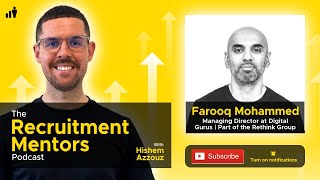
In this LinkedIn Live session, host Hishem Azzouz interviews Farouk Mohammed, Managing Director of Digital Gurus and board member of the Rethink Group, about building a recruitment business from the ground up. Farouk shares his personal journey—starting Digital Gurus in 2008, selling it in 2016, and later expanding it within the Rethink Group—while reflecting on lessons learned from an MBA program. The conversation covers a scenario where two founders launch recruitment agencies in January 2021, highlighting the differentiators that lead one to a successful exit. Key themes include selecting high‑growth sectors and geographies, avoiding over‑niche positioning, establishing data‑driven KPIs, making non‑emotive decisions, and maintaining cash‑flow discipline (including a three‑month runway and robust invoicing/collection processes). Farouk discusses hiring timing (when to grow headcount from 1 to 5), the importance of talent retention through transparent communication and competitive packages, and the post‑COVID industry outlook—highlighting growth in fintech, healthcare, cloud infrastructure, public‑sector projects, and the shift toward outsourced recruitment. He concludes with three practical tips for new recruiters or owners: deep market research, KPI planning, and direct conversations with candidates to shape a differentiated service offering.
Chapters
Hello LinkedIn, we are live. I'm joined by Farouk today, excited to have you on, Farouk. And obviously you're joining me in Dubai, and we're just going to have a bit of an open, honest conversation for the next sort of 30 or so minutes. We want to answer your questions. I know Farouk's keen to help, so if you have any questions whatsoever, drop them in the comments. But let's start by, for those that may not know who you are, Farouk, if you could introduce yourself and then we'll get into it.
Great. Thank you, Hishem. So my name is Farouk Mohammed. As Hishem mentioned, I'm the MD of Digital Gurus. We set that business up in 2008, just after, just before the recession, about 2 weeks before the recession. And we grew that and sold to the Rethink Group in 2016. Subsequently I grew the business internally for the Rethink Group over the last 4 years, and that's what I've been doing as the MD in there. Now I sit on the board of the group as well.
Awesome.
Amazing.
And I have to obviously share what you're doing in Dubai.
So I'm in Dubai. I started an MBA a year ago, and as part of that, you do a week in a different city learning about different businesses and different industries. So my week was in the Middle East. So I've been spending it meeting lots of different businesses like airlines and pharmaceuticals and all sorts of different businesses and business leaders. And that's why I'm here. I wish it was just doing whatever else is doing in Dubai and having a great time. Actually, it's been more work than pleasure.
Why have you decided to do the MBA?
I decided to do the MBA because I reached a point where I was like, okay, I sort of I've got comfortable in the pattern of what I do, as in, okay, so if we do X, we get Y, we get Z. And I didn't know what I didn't know, right? So I wanted to expand that, push myself a little bit more, meet people that were outside of the recruitment bubble was a big thing. So I decided to do it at that time and it actually has ticked pretty much all of those boxes. I've met loads of good people, I've pushed my learning on, I've learned more about different businesses and then realised how you could apply those lessons to recruitment and also how businesses think, both small startups and large corporates, and how they think in terms of growth and development and strategy and how you apply that to talent and recruitment really. So it's been really good, really good. I love that.
Always be learning.
Always be learning, man. I'm like always having a book in my hand or something. Like, I just like to read, I like to learn and I think it's important for everyone because otherwise you just become stale. You just— yeah, you don't know what you don't know, right? So always be learning.
I love that. So I wanted to start, as I said, for anyone that's joining us, if you want to ask Farouk any questions, hit them in the comments. But I wanted to start by giving you a bit of a scenario and give you a bit of an opportunity to sort of share some things that you've learned on your journey. So the scenario is Farouk starts a recruitment business in January 2021, right? You've seen the back of 2020, you've had enough, right? I'm taking this back into control, I'm gonna start my own business. And at the same time, another person starts a recruitment business in Jan 2021. You both have aspirations to build it, scale it, sell that recruitment business, and they get to 30 people over a time period. You get to X amount of headcount and you've successfully sold and exited that recruitment business. What did you do differently to that person?
Okay. And the first thing that you've done differently to that person is that you've researched and analyzed the sectors and geographies that you wanted to go into. So what I mean by that, you might have gone, right, one person might go, I'll go into digital because that's what I know and that's what I've been doing. One person might go, actually, I'm going to go into quantum computing or artificial intelligence. I've heard that that's growing. So you research the sectors that you think are going to grow over the next however long the period that we're talking about. Let's say it's a 5-year period. Which are the sectors that are going to grow in those sort of areas? You've done your research, you know that you can get a certain amount of roles short, medium, and long term, and it's only going to grow. So what I mean by that is that you look at an industry and you go, this industry is going to grow 10% year on year. So next 5 years. So for example, fintech, you'll be like, right, this industry is going to grow 10% year on year over the next 5 years. I'm going to that. And the other person might have gone, actually, I'm going to stick to what I've already got, and that industry might be only growing at 1% a year. So you've chosen a better industry, you've done your research. The second thing that you've done is that you've put your business aligned to certain metrics. So everyone has certain metrics that they work towards that feed to the bigger goal. So you'll be like, okay, cool, we know that our metric might be the amount of first interviews that we've got. That translate into second interviews, that translate into deals. And everyone is aware of their own personal metrics, because you're gonna have different metrics for different people. So that's gonna be the second thing, you run your whole business on data. And finally, you're gonna be non-emotive when it comes to decision-making, which is really, really easy to say. And listen, I've been plenty emotive in decision-making in the past, but the more that you can be How can I put this? I don't think there's a nice way to put this, but the more that you can be ruthless about decision making in order to drive the business forward, the better your business is going to be short, medium, long term. And then obviously alongside that, you've got the best talent, you've got the best advisors, and all of that feeds in of itself. And what happens in that journey, Hishem, and I'm going off piece a little bit, but what happens in that journey is that Success breeds noise. It breeds people looking in and going, well, what's happening over there? And that, that it becomes easier to attract good talent because people are looking at you all the time anyway. So it becomes a self-fulfilling prophecy. So the key things that those businesses have to do is pick your right market. First of all, it's really— that's the most important thing. Secondly, make sure that you understand how you operationally want your business to be running. So, okay, these are key metrics that we want. And finally, you're executing on that plan and reviewing that plan all the time and amending it as you go along as well. Those are the 3 key things that I'd say that would really put those 2 businesses separate over the next 5 years.
Love that. Just a quick point on one of those. Can you be too niche? You always see it, don't you? Like, you have to niche, blah, blah, blah, which I completely understand. Can you be too niche?
In my opinion, I'm not going to be saying that. Yeah, you can actually. In my opinion, yes, you can, because you can go into a sector, let's say, for example, a sector that I know. Let's say you go into digital and you pick creative. Within creative, you've got different sectors as well. So you go, right, I'm only going to specialize in copywriters and there's only so much of that marketplace that's going to grow. So one of the points that I made there was how How much is that market going to grow over the next 5 years, year on year? Is it going to be 5%, 10% growth rate, 15%? If you niche into a market that's so small, it won't grow. If a market is not growing, there's only so much you yourself as a business can grow.
Hmm.
So I do believe that, yeah, you can be too niche. You've got to pick a sector and then obviously you have niches within that, within your organization.
Where, where, what's your sort of typical go-to place to sort of look? What sort of core things do you look at for you to be, to have confidence that a market is going to grow? I think that's it.
Honestly, not many, not many. And then it's, look, and I didn't. I'm just giving you lessons of what I've learned of how to do things better, um, and what I would do differently now. Not many do that at all, but you can find a lot of this information online, right? So the first thing you do is like You identify a couple of sectors, you go and have a look at how much of these sectors actually growing, what the analyst saying, they'll get paid to do this stuff, why they're saying it's growing, what's it underpinned by. When you've got that self-confidence that you've got the right area, then you go and pull the building blocks alongside that to go, actually, I've done the research, I'm going to go and speak to some candidates. Oh, how many job offers do you get? Or who are the growth markets? How many companies call you up? You start to understand the the area that you're in, right? So I'll give you an example on this. Let's say, for example, you choose an area that's growing 50% year on year, but every recruiter's— every single recruiter is in that field. So then you work out how much of a percentage am I going to get, you know, what's the likelihood, and be realistic on that. And you work out what that's going to be in terms of sales. Then you work— you see another sector that's growing 10% year on year, there's 2 recruiters in that sector. Then you work out similar percentage, what am I going to get in sales? And you work out which is going to be more and it's always going to be the one where there's less competition. So that research, that bit of detail that you put in beforehand is huge. It's huge in giving you an edge. And it's something that actually is— sorry, go on, Hishem. I was just going to say strategically, that's something that we don't really do because we're all trained as salespeople. We don't really think strategically sometimes.
I just think like this, especially this time of the year, I think it's the perfect opportunity. I know, I know, I always spent time— so at the end of the year, I always spend time to just sort of reflect on me as a person, really, not just professionally, and go back through sort of my journal and these things. But like, I think this— I wish I did more of this for sure. And sometimes actually look at my recruitment desk in 2020 I'd be like, right, like 2019, I got these amount of jobs in this particular job title. Now I've got this, you know what I mean? I think it's also something that people should be looking at for their own individual desks, right? And actually recognize, well, actually, maybe sort of there's more senior positions here. Maybe I actually have a focus that's more focused for me, do you get what I mean? I just think it's a good practice getting for yourself as a recruiter.
Listen, what you said in terms of let's take it down to granular level as a recruiter, right? If I'm sat at a recruitment desk, because we were talking at the macro level, but let's take it granular. I'm a recruiter, I'm reviewing my desk for next year. I want to go from 150 to 200. What's the typical recruiter going to do? He's going to say, I'm going to bill more. Okay, cool. How? How are you actually going to get from 150 to 200? You've got to review your marketplace. So you go, okay, I did it in, let's say for example, you work in healthcare. So doctors and nurses, for example. Okay, I'm going to work with doctors and nurses. I've got these amount of customers. I need to understand how much are those customers going to spend. Then I need to understand also, is my sector still growing? Is there any legislation coming in that's going to impact me? What impact is that going to have on my desk? Let's say, for example, they ban using recruitment agencies for hospitals, right? And they just blanket ban it. And I know there was some stuff around that before. That's going to have a huge impact on your desk. Okay, once you're aware of that, then you can put together a plan to go, okay, what other markets am I going to need to do, or am I going to pivot into in order to deliver 200? So you can start to put together something. You're absolutely right, you should be doing this at a granular level. It's super useful, and it's definitely something that's going to make people more successful because it's just a piece of analysis that is invaluable. We tend to do the job all the time. We'll go in, we'll graft every single day, we'd put our calls in and whatnot. A little bit of planning beforehand will help us do the job so much better because it just gives us a guide. And that plan needs to be reviewed monthly and quarterly and every 6 monthly and yearly, just so you can navigate your way through.
Not always working in the business and work on the business. And I think that's something that how you should be sort of treating your desk for sure. And had a question come through from Anthony Faz, and I know that this is something that you can't see his name, but I can see it on my screen. Anthony Gargan. So basically, if you read that, I think you gave some really interesting insights on this on the podcast around the sort of metrics that you looked at. But it seems like just for the people that listen back to this, the question is from a permanent recruitment perspective, which things would you make sure are 100% in place when deciding the right time to begin hiring? Is, are there any specific metrics you'd look at when trying to grow headcount from say 1 to 5? So I guess what I'm saying there is I want to grow. What, where should I do this? Going to give me confidence or what should I be looking at?
Yeah, there's a couple of things and it's the sort of things that we've been touching upon is like, what is the market saying? Is the market growing? So you've got to be confident enough to go, okay, yeah, the market's growing. So that's the first thing. The second thing that you look at in yourself is like, how many perm jobs have we had come in? How many have we filled? How many have we not filled? Okay, if we had another person, would that help us fill more? Would it not help us fit more? How are you going to put that person into your structure? So for example, let's say you had 10 jobs a month come in and you were filling 1 or 2 of them. You felt that if you had another person come in, you might fill 3 or 4. Well, what are you bringing that person in for? You bring him as a delivery person? If you're— you bring him in as another recruiter. If you bring in another recruiter, then maybe that 10 jobs is going to become 15 to 18 jobs. And you might be filling 3 or 4, you might want to actually think, should I be bringing in another recruiter or a delivery person because I've already got 10, so I'm filling 2, that'll help me fill 4. You'll actually end up making more money doing that sort of stuff. So those are sort of metrics that I'd be looking at is what's coming in, what's the market saying in terms of growth, what am I not filling? It's really, really important to know what you're not filling and what you expect to fill. If that person comes in. I'd always used to look at a really simple metric. I'd be like, okay, what's the percentage fill rate that we've got with our staff? And then once we started hitting a certain metric of, okay, this is our percentage fill rate, that automatically the flip side of that was our failure rate. Once we hit a certain failure rate and the market was still growing, i.e., I could see that all the analysis was saying the market's growing, the amount of jobs out there wasn't going quiet. You can look on LinkedIn to compare month on month, just really simple stuff. If we were having the highest failure rate, I used to start thinking about hiring people. And then obviously the infrastructure internally that you put in to determine their success or failure.
Yeah, no, I think that whole job-to-fill ratio, and I think that's what I really took from the podcast. And I guess as well thinking, Faz, what about thinking if I was in Anthony's shoes? I'm definitely thinking cash flow. I'm thinking all I've got to worry about right now is I know what my sort of overheads are. I guess, would you maybe even say to this person, have a bit of a runway? I don't know. How would you think about that in terms of cash flow-wise, in terms of— Yeah, absolutely.
I'd probably be looking at having at least 3 months worth of runway for this person. You know, you've got to give them enough time to become successful without you putting pressure on your own business and your own pocket and whatnot. So I'd be ideally looking that we've got enough in the bank for at least 3 months. Most businesses don't fail because they have a lack of work coming in. Most of them fail because of cash flow. They're just not managing the cash correctly.
So what I keep hearing is actually the collection of cash is actually the— so I don't know, there might be— I mean, you've heard the stories, right? Recruitment businesses have like £1 million worth of invoices left outstanding, right? Or even less than, like, substantial amount. And I think as a— when you're a recruiter day to day, I definitely was this person. You're like, yep, 25 grand on the board, smashed it this month. But you have no even idea of like, we haven't even got that money yet as a business. Do you know what I mean?
Yeah, I mean, look, totally valid point. And that's part of cash flow is that cash collection. So you've got to be able to get that money in. The money, if you're a smaller business like the one that we were just discussing a minute ago, where you're looking to grow from 1 to 5, that person's going to be doing everything, the recruitment, the hiring, the cleaning up, the cash collection, everything. And it takes away from doing the main core job. So cash flow is absolutely critical. You've got to build that in into your day to day. So for that person, another metric that they'd also be looking at depending on their size is how much time is that other per— the new person coming in going to free for me? Because let's say, for example, that one person was doing cash collection, invoicing out, talking to customers, setting up all the job boards, setting out adverts. Getting in another person would mean actually that one new person they've got can focus more on new business, which would mean that they're getting more jobs in, which also means that they should be filling more jobs, leaving the first person to focus in on the stuff that they're focusing in on in the first place. I'd say that I don't know how true this is, but it'd be interesting to find this out. I'd say that those businesses that start with 2 or 3 people tend to have more success because they have that infrastructure or that support mechanism internally to go, you do cash collection, you do invoicing out or accounts or whatever, and I'll focus in on sales. So it just allows them to spread that out. So I think if you are thinking about hiring, put that into the metrics as well.
Think about that as well.
Yeah.
What, so I know I always ask people on the podcast like sort of important attributes as an actual recruitment consultant, but I wanted to ask you, like, what do you think are the most important attributes for an actual successful recruitment business owner, do you think?
I think both as a business owner and as a recruiter, the successful attributes are, I'm not, and we touched upon this in the podcast, I think it's really important that people have a willingness, a hunger, a passion, and desire, 'cause you can't give them that, right? And we sort of touched upon that, I also think now more and more that they've got to be something that we were talking about earlier, willing to learn. You've got to learn new skill sets, especially in recruitment. Most recruitment business owners start as recruiters. We're taught a completely different skill set. So you've got to be willing to learn this new skill set. If you're just, you know, on the hands, the most important people, the ones that do the job, if you're a recruiter, what's the most important skill set that you've got to have? It's that tenacity, that will to win. That drive to go, I'm going to come in, I'm going to work really, really hard, I'm going to work out what I need to do and I'm going to execute on it. But you need to have a willingness to learn there as well, right? You've got to be able to do the research, choose your market, choose your sectors to be able to approach customers. And all of that goes hand in hand. So I think it's really similar skill sets for both. Yeah.
And how— what I wanted to get your thoughts on was like, because I'm sure you've been thinking about this a lot and yeah, with what you're learning and everything else. But like, how are you like looking at the recruitment industry landscape going into next year? Like, how are you feeling about it? What sort of comes up for you when you think about it?
I was reading a couple of reports and it's forecasted to bounce back and that's not going to be a surprise to many people. I've seen the talent sector in terms of growth of hiring is still forecast growing at 6% a year. Europe is still significantly growing. The US is growing even faster. There's other international regions like India and China growing faster as well. So I think that it's actually going to be fairly aggressive in certain markets. But then when you analyze that, it is 8% growth or 6% growth, which depending on which market you're in, there's certain sectors that are driving that. There are other sectors, for example, retail right now, if you asked, or hospitality has really suffered. I think it's difficult for me at this stage to, to go, how quickly will that bounce back? Do I think it will bounce back? I certainly think the hospitality will bounce back. I don't think people are going to get tired of going to restaurants or bars and things like that. Um, is it going to be different to what it was? Probably. So I'd be looking at things like, okay, I think the sectors are going to bounce back, but which sectors did really, really well during COVID I'd probably be looking to, to be going into those sort of sectors is growth. I think there's going to be significant growth in healthcare and social care because of the under— well, what was exposed as underinvestment in those areas over the last year. I think there's going to be significant investment in cloud and infrastructure with more and more people working from home, with the flow of money into those sort of areas. I think there's going to be significant growth in public sector recruitment as well. I think there's going to be more state spending over the next 4 to 5 years. So I think that if you are in certain sectors, the ones that I've just touched upon, I think there's going to be significant growth. And by public spending, I mean like infrastructure spending. So things like roads, hospitals, schools. So I think if you're working in engineering and those sort of sectors that touch upon infrastructure, I think they're going to grow significantly too.
And how, like, how, what do you think could be the biggest change actually in the recruitment industry, do you think? Like, how, obviously you're talking about the sectors and these things, but like, what changes do you think? Because I think, like, I think it's a really interesting question to ask yourself, like, what the industry or business owners in this industry have learned this year, like, what, what's going to stick with them going into next year, right? Like, I don't know, what, what do you think gonna be some of the biggest changes that you can see?
I think in terms of changes is that what's been proven is that the best companies that have invested in their IT infrastructure are going to have an edge. I think that that is going to be a differentiator when it comes to hiring now for the future. I think in terms of what's going to make a significant impact in this area, I think the use of data and analytics and the analysis of that data to drive decision-making in small and medium-sized organizations. Companies that gear themselves up to measure stuff and can measure stuff historically are going to do well. And I think that technology is going to continue to have a significant impact in the, in the talent sector. I think there's going to be more and more companies engaging with candidates directly, but I also suspect that more and more companies will outsource their recruitment to recruitment providers. And the reason being, it's not a fixed cost. So if you're a CFO now in a large corporate, you don't want to have a massive internal hiring team because you don't know when you're going to hire or which areas you're going to hire in and how you're going to hire. So you'd probably go, actually, I'd much rather go to a recruitment agency where we go with a flexible contract, we can gear it up or down, and haven't got fixed costs and the PAYE and all the benefits that you pay to staff and all of that. So I think that there's going to be significant growth of those sectors as well. So those are the sort of themes I think, um, of change we will see in recruitment over the next 3 to 5 years.
Would you start a recruitment business in this market? Yeah, like the conversation, honestly, I've seen a huge influx from the lens that I see the industry. And I've had so many conversations with people that started their own recruitment business within the last 6 months.
I, I think that this is the perfect time to start.
Why? That just won't make sense to some people.
Because, um, you're gonna have massive growth investment over the next 3 to 5 years in the right areas. You're gonna— it's a perfect time when a lot of your competitors, i.e., every other recruitment agency, have had to slim down, they've had to readjust their spending, which means that they've got rid of really good people which they wouldn't have got rid of normally. So there's more people that if you can get hold of, that's a unique time to do it and you can undercut your competitors. You can undercut price. Right now, price and quality matters. So if you can offer a brilliant solution and price it well, you're going to give yourself a bit of an edge.
And it'd be interesting to get your thoughts on what you've seen in this sort of Rethink group. But in the last, uh, couple of weeks, I've had— and obviously I know it depends on sector— but like, I've had numerous conversations with either recruiters or recruitment business owners who have gone, Hishem, I've just had my best month, or Hishem, in the last sort of couple of months we've had record month, record month, record month. Like, have you seen that? Or how did like, and why is that? I just find that so interesting.
Yeah, listen, I have seen that in certain sectors and certainly within the Rethink Group without touching too much detail within that. And it's been driven by being in the right space. And if you're in the right space, look, it's still not done. Just because you're in the right space, you're not going to make tons of money. You've got to be good at what you do. You've got to be brilliant at servicing your customers and your candidates. You've got to have a really strong brand, you've got to be ethical at all times because people see through that and they want to keep coming back for more. You still got to do the basics really, really well. And I think the overarching bit of that is you're in the right space. You know, I'd be interested to see, I'm not ruling out, but I'd be interested to see which hospitality recruiters have had record months in the last—
you know, I definitely haven't. The only one that I spoke to, I had them podcasted, And I don't think that's a coincidence.
I think that a big part of the drivers have been right, right space, strategically in the right space, smart enough to see the future coming. And secondly, they were brilliant at what they do. Absolutely. Yeah, you can't get away from it.
It's like what I've had, a lot of people have said either like, obviously the vaccine gave a lot of people confidence for sure, that a few people said that. And then also a lot of people sort of felt, um, tell me that like the companies that they were sort of originally who had always been working with at the beginning of this year were like complete brakes on. But and then in the last sort of 3 to 6 months, it's actually a real understanding of, okay, well, we're definitely in this for the long run. Like we need, we need to push on and we need to carry on. We can't just be stale or stop.
Listen, that's totally reasonable, isn't it, from a business point of view that you're like, well, actually we can't just Wonder what's going to happen. We put the brakes on. Let's sort of start to think about the next 2, 3, 4, 5 years. But as if you're in the space where they weren't even thinking about that, right? There's certain spaces where they were like, we've got more work coming through because of COVID because more people are working from home and we've got more deliveries going on. We've got more people buying because they're a bit bored or certain products being bought. Those areas, they would have actually grown significantly. I wouldn't be surprised in those sectors that people were absolutely cleaning up. No, like those companies that specialise in cloud and infrastructure talent. There is no doubt in my mind that they were cleaning up over the last 6 years.
Yeah, I know.
I'm—
yeah, yeah, I've got a mate in that sector, actually. I went for dinner with him last night and they've been cleaning up.
Listen, not a surprise, but they've been in that sector for over 6 years.
They've been doing it for over 6 years.
Exactly. You see, they saw the future coming. And it just, it absolutely boomed when a black swan event happened and they were able to take advantage. So they deserve the credit for being in the right space at the right time.
Let's just really quickly, Faz, before we finish, talk about— and if anyone else has any questions, please let us know in the comments before we finish— but, um, obviously we've spoken a lot about starting a business, all these types of things, but how do you— from what I can see, there's, there's going to be even more competition from a recruitment business owner perspective on getting the best people. right? Or keeping their best people, right? If that's— there may even be more opportunity now, people starting their own recruitment business or whatever. But like, what, what's been your advice to people that you've connected with, or people— the advice you give to people on retaining their talent? Like, how do you think about that?
I think in terms of what I've noticed, actually, let me just start with what I've noticed, is that people have actually really looked after their top people recently. Definitely. I've definitely seen that. There's not a lot of people moving and the ones that are available have been snapped up and have had multiple offers. So I think that's saying a lot about the sector at the moment, that people are really clued up to seeing their talent. And in terms of what could people do to attract talent, is that what you were sort of asking? Or were you asking—
Sorry, I guess I wanted to just get your thoughts on like, because You always hear people talk about, yeah, I want to grow headcount, blah, blah, blah, but not loads of people will talk about the actual retention of their best people, right? So I guess, how would you be thinking about keeping your best talent? So we just, yeah, you've picked up on that.
In terms of keeping your best talent, you've got to communicate all the time. What's the plan? What we doing? What's the ambitions? People like to work for a business that's ambitious, that's growing, that's moving forward. So you've got to be able to communicate that. What does it mean for them? Always make it about the staff because ultimately they're the most important people. They're the ones that are doing the job. You know, I'm not— I don't sign up to this thing that the people in a boardroom or the directors or whatnot, and I'm talking on my own behalf here, not anyone else's behalf, but the most important people are the ones that do the job. All directors for me work for them. Yeah, how do you retain those sort of people? You communicate that message, you communicate what the plan is, how are we going to get through, and you treat people with respect at all times. And obviously you've got to be competitive, you've got to be competitive in packages without, um, putting yourself in such a disadvantaged position where the company's suffering. So you've got to get all of those balanced things right. But for me, you've got to be totally transparent in what you're trying to achieve and getting everyone aligned to that goal and that mission.
Yeah, and I think if you haven't been that this year, people are going to want to know how you've been. I hear that all the time, like, that's even just from a— not just, um, interviewing recruiters through recruitment business perspective, but when recruiters— I'm speaking to them about their market and what they're hearing in conversations, they're going, hey Faz, yes, you know that client that you told me about, how have they— how they dealt with COVID what they've done? They want to know about how they've how transparent they have been, what they've done, how they've communicated. And if you haven't sort of emphasized that, people are going to remember that, right?
The one thing that I've learned over the years is the root of every mess up is communication, and the root to fix it is communication. Communication always is at the heart of it. Absolutely tell you, it's absolutely the heart of it. And the more you can communicate with people, the more you can empathize with them. The more you can empathize with them, the more you understand exactly where each side's coming from, and you can find common ground.
Yeah, I love that. Right, so to finish this, I want to ask you, like, your— what would be your— I guess if I'm a recruiter, or if sort of you're more leaning towards recruitment business owner, it's fine, but what would be your, like, 3 best tips for me to start next year in the right way or have the best possible research?
Right, research. That's the first thing. The second thing is, um, Plan which KPIs are most important to you. And the final thing is talk to your candidates. Go and talk to them. Find out from their point of view how they feel the market is, where the growth area is, who's hiring, what do they like about recruiters, what do they dislike, and make sure that your service offering is unique enough to go and apply to them. I know there's somebody out there right now that has done those things, and I think is going to be successful off the back of that.
Yeah, thank you so much.
Pleasure.
More from Hishem




You don't need as many clients as you think to bill $1 Million A Year In Recruitment



From 30 Direct Reports to Back-to-Back $1M Years as a Solo Recruiter with Zach Creighton



