LIVE Podcast | Building A Successful Recruitment Business in 2024
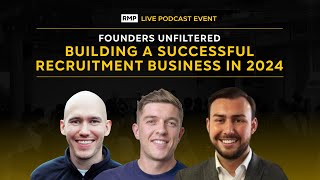
In this live podcast hosted by Hishem Azzouz, founders of three recruitment firms—Fraser McLeod (Nexa Search), Josh (Trident Search), and Calum Lyle (Zest)—share candid insights on scaling recruitment businesses in 2024. The conversation covers their current performance metrics (headcount, revenue, gross profit, NPS), the strategic shift from contingent to retained models, the debate between 360 and split client/search team structures, and the importance of mindset, culture, and data‑driven KPIs. Josh explains how a US‑focused retained approach reshaped Trident’s culture, Fraser discusses splitting client‑consultants from search‑consultants to improve fill rates, and Calum describes Zest’s use of video interviews, NPS, and tangible/ intangible employee benefits to drive retention. The panel also tackles hiring philosophies (senior vs junior, cultural fit), compensation splits, the role of ratios and performance metrics, and practical advice for other founders on sales, marketing, hiring triggers, and over‑communication as a retention tool. Additional themes include managing young, talkative recruiters, timing and importance of non‑billing hires, process documentation, leadership team risks, market pivot considerations, and the use of AI tools for delegation.
Chapters
Look at that, no tunes.
Sorry, we should have got some walkout music for sure.
Um, all good?
Give it a little test one-two. Yeah, can you hear them all okay, Josh? Yeah, perfect. Um, but yeah, let's, let's get sort of just straight into it as I appreciate we started slightly late. Do you guys want to do just a really short intro for those that may not know who you are? Fraser, I'll start with you and then we'll just work this way.
Yeah, so my name is Fraser McLeod. I'm one of the co-founders of a company called Nexa Search. It's a business that was founded in January 2020, so we've been running for 4 and a half years now. Myself, two other business partners founded the business. So our markets are senior level placements, managers up to VP, with inside manufacturing sectors, and most recently we've branched into tech looking at SAP.
Awesome. Josh?
I'm Josh, one of the co-founders of Trident Search. So Charlie's over there. We're a veteran-owned cybersecurity search firm. I spent 8 years in the Marines. Charlie spent 8 years in submariners under the water. And we work across US, Europe, just shut down the Middle East, which we can talk about. Don't fucking do it.
Sounds like a skeptic or something. Shut down. I'm Calum Lyle. I'm the founder of a business called Zest. A quick kind of whistlestop tour as to how I've got here. So I was really fortunate at the age of 25 to take over a recruitment business, 5 people, grew that to just shy of 30 heads, and had a bit of an early midlife crisis at 30 and decided to leave and set up my own thing. So, set up Zesk with a vision to radically change the perception of recruitment, loads of ways that we're trying to do that, which we can discuss. We focus purely within the tech sales market, mid to senior level hires, 100% retained first year, making a bit of a shift now away from that.
And it's all UK, right?
All UK, a bit.
I've been doing some, yeah, okay, a wee bit outside. Awesome, appreciate that. So I guess when we all prepared for this, the sort of goals that we had for this evening was just 3 things really. We wanted hopefully all of you to leave inspired, motivated. We definitely want you to walk away with at least 1 to 3 practical strategies that hopefully you can take to your business, to your teams. And we're def— I'm definitely going to make sure that these guys are honest and they share things. It is called Founders Unfiltered for a reason. And something that I learned year on year is that LinkedIn is not the truth. So yeah, these guys are not up here to talk about how great their businesses are. We're going to hear how hard things have been as well. But I asked these guys if they're willing to share, which they were, just to share where they are on their, their business journey performance-wise. So Fraser with Nexus, we've just basically shared year-to-date performance because I know there's a lot of different people, different sectors may have been having a challenging year compared to last year, etc. But let me know if I get any of this wrong, but Nex is currently 40 heads, 7 non-fee earners, revenue year to date £2.75 million, and then a gross profit of £500k. Josh, with Trident, year to date you've got 16 billers, 2 in operations, revenue year to date £1.75 million, and gross profit of £700k. And then last but not least, Callum, year to date revenue £462,000, GP £133K, and something I know that Callum is very passionate about, um, also currently year-to-date has a +95 NPS score, which we're going to talk about as well. Um, so we've got a few different pillars that we wanted to talk through. The first one is something that probably all of you have in mind when you think about your recruitment teams, your business, which is, wouldn't it be great if we had more clients or had the ability to get more clients that gave us great jobs? So the first pillar that we had was, was sales and marketing. Something that was quite interesting when we prepared for this was that all of these guys have operated a retain model. Callum, in the first year, as you said, it was 100% retained. Sounds like you're on a bit of a journey with that this year. Fraser, as you scaled, something that you're quite proud of when we prepared for this is 70% of the, the business has remained retained. And then Josh, for you, that's been a bit more of a transition for you this year, right? So you've done a lot more retained business this year, but wasn't the case last year. So I thought, let's just start there, because one of my first questions was I wanted to understand from these guys how important it is for all of you to have different lines of service, have different ways of working with businesses, offering different, um, parts of the way that you work. So let's just get into this bit. So Josh, do you mind sharing what changed at the beginning of the year, and maybe what did you think about retain that maybe wasn't true? Maybe there's a few reasons why you think, oh, maybe it wouldn't work, or maybe I'm not going to ask my client to work in that way. But obviously, just tell us a bit of a story around why it changed, what happened, and we'll start there.
Sure. So we, like Fraser, we set up in 2020, like 2 months before COVID So a lot of our work was contingent. And as of August last year, we set up a US team. So I gave all my European desk away, we went all in, and we were doing a bit of ad hoc US work with European clients. Hey, I need someone, first man on the ground or first woman on the ground, both ways. Um, so, and then immersing ourselves into the US team, hiring principals, directors that have done it before. They only know one way, and that was retained. And it was just the culture in the US was, um, there's so much respect put on the kind of headhunter's, um, career and just the value that we add, um, that we kind of bled that back into the business, into the European team. So, um, it was that, open up the US team, um, that really kind of drove that. But then also, um, another thing was we started looking at our data a lot more in terms of like fill rates. And we got to a point where our team— I know our team are really good. We hire principals, we hire directors, they're fucking good. But can I swear? Yeah. Okay. Sorry. Oh, it's unfilled.
Yeah.
So, and uncensored. So long story short is me and Charlie were looking at a team and going, our fill rate's like 30%. We're like, what the hell? These guys are so good. What is going on? And our billings were pretty good, but they're working a lot, like really hard for their lunch. And, um, we just turned around and said, uh, we've got a good track record, we're fed up with getting messed around by clients, which is the contingent agency world. Um, we're going to follow how the US have done it, bleed that blueprint into Europe, and the team are going to have to follow. So it's been a transition, especially in the European team and the UK team especially, to change the culture, the mindset, and kind of the belief that they can actually do it. All you do is ask. You have to coach them and you have to kind of train the right way to pitch differently. Um, but we do like— it's more committed work. So yes, we do exec search, we have a massive part of our business doing that, but our team builds still do retain work, but it's a committed fee upfront. So, um, and lo and behold, once the rookies start— or they say rookies, the senior consultants start winning those retainers, um, even like it could be like a 10K fee in the UK, but it's pay me 2.5 grand upfront, show me that you're committed, and it's changed the mindset of everybody. And then once we start getting a few small wins from people that aren't me or Charlie or other directors Um, it just kind of creates that belief in the business.
Was it mainly a mindset thing then, or did you have to maybe change the process of how you would talk about the way that we could work this out? Was there anything that you changed on the sales process, or—
Yeah, yeah, we had to learn very fast in the US. If you want to keep up, then you've got to operate a completely different level. They're very professional, um, but quite slow. The US recruiters typically quite slow. Sorry if there's any Yanks in the audience, but that's why we've been out there quite a lot. And if you look at all of the top, top recruiters in the US typically are British. They've either moved to Austin, the classic one, or they do it from here. I know you're opening up in Austin.
Yeah, so sorry, mate.
Um, yeah, it's absolutely shots fired. Thanks, um, so, uh, um, but, uh, yeah, it's a belief thing, but also it's learning how the US do it very, very quickly because we were losing bids and tenders and stuff for searches and we got to change our game really fast. Speak to board advisors, how do we implement a new search process and a new pitch and I knew like everything from the requirements capture straight through to long list, short lists, and just the whole search process is totally different to contingent because you, you have more time, even though we're pretty fast, but you've got less volume as well. So it's belief plus also adopting the new process from the US and then bleeding that into Europe.
Okay.
For me, when I think about retained, whenever I've worked retained, whether it was in my last business or this business, I don't think it's so much around the skill of the people pitching retained. I feel like you can upskill people on how to pitch retained and they'll go out there, they'll pitch it, and they won't win retained. Winning retainers and having a culture of a business that works retained, it comes from the mindset of the business and it has to come from the top. The top have to believe that their service is worthy of being paid up front, and that's got to then filter down into the company. And every single person in the business has to believe that when they're on a client call winning a retainer is standard. We are a business that offers a world-class service. The service we offer is better than our competitors, so why would I work without being paid upfront for it? And that has to be ingrained in the business from day one. The moment that you have people come into the business, you have to introduce them to retained model. You have to make them aware that this is the standards that we work at. Once they believe that, once the mindset's there, the actual training of pitching retainers is quite straightforward, because winning a retainer on a pitch The actual pitch is not what wins you it. It's the 30 minutes before where you're building relationships, showing that you're, you know, I don't need to win this business, I've got loads of other business, I've got more clients. That's what wins you the retainer.
I think— sorry, go on.
I was going to say Fraser's bang on there. To be fair, it is the mindset and it's the ability and the bravery to say no. Like, I still stand by working 100% retained first year, being able to be brave to say no to so much business when you're desperate to earn money and you're starting something new is really challenging. But it is having the bravery to say no and going onto those calls genuinely believing you are the best at what you do and being able to productize it as well. Like our retained offering now, we've got to think about offering a contingent model, so we're actually going the other way. And the reason why we're doing that is I think there are some instances where businesses just won't pay upfront, but it will still be an incredibly committed bit of work and we can still get it exclusive. But the second part is, how can we still make that zesty? Because—
Zesty?
Yeah, well, that's—
People may not know what that means.
Well, I don't really know what zesty means, to be honest. It's my company name. I've eaten enough lemons.
It means, like, a point of differentiation. So, I didn't build for 6 years, and there was no way I was working on anything that wasn't retained, just a bit of a spoiled brat, really. But we prioritize it, that we do a video interview for everyone that we speak to. We work in sales recruitment, so personality is incredibly important with the candidates. You're not going to judge that on a CV, but also we do kind of cultural assessment, and we can genuinely prove through NPS that we are the best at what we do. So Fraser's right, it is that mindset before going into the call thinking, we are the best, you either pay us 25%, 30%, or you go elsewhere, and that's fine.
Um, talk about that mindset. Just one last point is, I think from a consultant's point of view that's never done retained, if they're at month 3, they know they've got a target to hit, client's like, hey, I'll give it to you, uh, contingent is 18%, 20%, it's a good job, I know I can fill it, I've got candidates, and then the director turns around and says, nope, drop that, drop that role. Um, you like— that's tough for a consultant to then take, to go, well, one, that's commission on the table I've just left, but two, I can get fired. So it's down to us and the leaders of the business to go, you're safe, you're doing all the right things, but you just need to like tweak or switch your pitch up. Or, um, but you're getting there on the finish line, but you're then closing the wrong kind of searches. So, um, it's really easy for us to sit here and say, yeah, just do retained and just, you know, pick up 100K fees. And like, yeah, it's easy, but if you're a recruiter who's on like— who's literally on the last legs, um, they're gonna work whatever they fucking can get, right? So, um, even at 15, like, whatever.
Um, so Yeah, just quickly on this, obviously this isn't like a retainer masterclass, but we wanted to start here.
But yeah, fuck them.
Um, Fraser, just quickly on your point, everything that you said there I understand, but a lot of that is about like what's, what's in it for the consultant. Like, why would I work— why wouldn't I work upfront, right? But obviously for this to be effective, that end client, that prospect has got to feel like what's in it for them, right? So you said, yeah, we have a world-class service. Why do not work when you pay me upfront. But what do you believe are some of those bits that you've added in that service? Because clearly there'll be some stuff in there. Khan was talking about his video interviews and his process, but what's in it for the client to work with you in that way? Because it can't— do you know what I mean? They're not going to do that just because you're— it's in your consultant's interest. They've got to feel like it's the best way for them to work.
Yeah, so I think personally, I think it does differentiate to every client that you're in front of, right? Because you're selling to the client's pain, and you have to understand what the client's pain is at that moment. And I think then you have to tailor your, your pitch or your solution based on that pain. There's not one pitch that's going to win every single search, you know, it's based on what that client needs at that moment. For us, what we find in our market is we work generally in Germany, we work senior level placements, we compete with some of the big, um, shrek firms out there. And there clearly is—
there's—
it's slow, they're not fast, they're not reactive, and they, they're not agile to the process. Once they're committed to a search, they stick by that, and when the client wants them to change, they're not open to it. So what we do is we come in with just a bit different angle. We see that there's an opportunity and there's a gap for us to pitch that we're a different type of business. We're going to work faster, you know, we're going to provide you with a shortlist of 5 candidates that are perfectly matching the vacancy considerably quicker than you're going to see from your competitors.
How quickly is it? Is there—
we commit to 3 weeks.
3 weeks.
So 3 weeks for us at senior level placements in Germany is, is, is fast, right?
Okay.
Um, so we'll commit to 3 weeks for a shortlist of 5 exceptional candidates that we've you know, briefed several times throughout the process. And for us, what we see is the client is much more interested in that. So we can commit to a faster service, we can commit to more deeper, I suppose, a deeper interview process. And what we also show is that we're just experts in our industries. And if we can prove that we're experts in our industries, then the clients are more bought into wanting to work with us.
So obviously, what does that mean, experts in our industry? Because I feel like that's something very easy that people say, like, how would you define that? How, if I was to go on your sales floor, how would people say, how would people define that they're experts? Like, how do we develop that?
Yeah, so we're built, Nexus is built on really two core industries. So our key focus is the automotive sector and the consumer goods sector. So, you know, we don't work tech markets where we work across all industries. We really focus on honing in on them two markets. And our focus is to really understand in-depth of what their markets demand. So all of our consultants really from day one, we really focused on trying to upskill them around the industries and what makes a particular really good candidate. So a lot of placing leaders is around their personality, it's around their ability to lead, it's not necessarily around what they're actually, what they've done so much in their career. So we focus a lot on trying to train them on how to interview, how to really understand what makes a good leader, so that you can, when you're actually pitching that back to a client or you're pitching a candidate in, it's very clear that we understand what we're doing.
Okay, sure, nice. Um, let's go into, we're talking about sales, um, Josh, I'm going to come to you on this one. In your business, you operate a 360 model. Let's just talk about this, right? Sometimes we might scroll on LinkedIn and people say 360 is dead. Some people may not say that. Josh, talk to us a bit about your methodology here. And yeah, when we're talking about sales, people win on their own clients. You're relying on your senior people to do the full cycle. I don't know, just talk to us a bit about—
Yeah, so yeah, that's how we operate. We do So if you are a 360 recruiter, in my opinion, um, and you— we win a lot of business through the candidates, put it that way, right? So, um, the way we operate is I win a search, we have a Slack channel like most people do, and it's super, super active. Um, the reason why it's almost like we don't need delivery— I'm just going to talk generally— is because like I had a search yesterday, I won a search, put a message in the Slack channel, say, hey guys, I need a CTO in New York for this company, who do we know? And because 3 or 4 of us all work in the same space, it's, here's a candidate, here's a candidate, here's a candidate. So that allows me then not to need delivery. So, um, just talking generally here, but, um, I can then submit a shortlist really, really quick, same as you guys, and I can then focus on sales again and win more searches. So it's kind of like, um, there is absolutely a need for delivery in particular business units or particular business setups and models, but for us it's around if, um, the 360 recruiter is talking to candidates all day, they know what's going on in the industry. So when they're trying to pitch searches, they know exactly who's out there How much candidates look at comp packages, all sorts of things that you're looking at that clients want to know. If I am not engaged with the candidates because I'm not in that community, because my delivery guys or girls do that, then how am I meant to explain to the client that what they're looking for is unrealistic, or it is or isn't? Because I'll have to then call up someone who's in my delivery team and say, hey, can you just give me some information on that? So that's typically how we—
So you do a lot of split deals as well? That's something you really can't—
Yeah, over half our deals are splits amongst the team. So that's one of our non-negotiables, it's teamwork. Um, and we work in thirds, so of the deal, a third goes to the person that won the client, manages account, and delivers the candidate. Um, but we operate that from top down, bottom up, um, and it works really well because I would happily give a third of the split away if it means I could fill the job really quick. Candidate's happy, client's happy, I can move on to the next search. And then our biggest USP is time to hire, so we track it really, really closely every month, um, and that's how we beat the big Shrek firms. it's you took. So I had a case March this year, a California business. The last search took 405 days to find a CRO. We've done it in 67. And like, they, they couldn't— what took them 90 days for them to work out previously what they exactly wanted because the agency just didn't guide them, help them, etc. So yeah, yeah. So, um, and they're a big PLC Shrek firm. Um, so time's really important. Um, the ones that sponsor the golf, uh, essentially.
Uh, just because not everyone might be aware. Same point, left, right, center, just to make sure we're all on the same page.
So yeah, essentially to answer your question, it's a 360 recruiter in my opinion is way more immersed. They speak to the candidates all the time, all day. We win all our business through candidates. We don't cold call, it just doesn't work in our industry, and therefore we can talk to the client better.
Callum, how do you feel about this with where you're at, right? You're obviously currently a smaller business. Do you feel like everyone needs to be contributing to—
I know everyone needs to be contributing. I think there's a couple of interesting things there, and we could probably get to this later. Interesting, we don't sell ourselves at all on being quick.
Really?
Which is interesting, we'll get into later. Josh made a good point in regards to the retained piece, one of the reasons why we want to do more contingent. I would be that dickhead leader who Lizzie or Charlie or someone would come to me and say, great news, Callum, I've won an exclusive bit of business, it's 25%, and I'd say, is it retained? And then they'd have a glum face and go back to their desk and we'd not turn it, we'd not take it on, which is bonkers. So that's challenging a bit recently. That's kind of contingent versus retained piece, but From my position being just— there's 5 billing heads within our organisation, so much of it is still focused on me and so much is then given out to me, given out by me. So had covenants, had legal restrictions first 6 months, went and won 30 new customers, all retained in the first year. And at the moment, actually, the team are pretty much at capacity just servicing those customers. So We are 360. You try and make time for new business, but ultimately it's a capacity thing. We need to, we need to grow, we need to get new heads. So kind of 270 really, but everyone is responsible for bringing their own business. Everyone's bought in a retainer each this quarter.
I think also just one more point I forgot about, which is we operate a business where everybody's an SDR, everyone's a sales rep, whether you're in marketing or you're in finance, everyone's trying to win business or keep an eye out for leads or what's going on in industry. And I just find that if you are a delivery consultant, your mindset's not that way inclined. Yes, you can like KPI them on job leads and things like that, but if you operate in a small business like ours, everyone's a sales rep, then I think 360 kind of works better to that, if you know what I mean.
So Fraser, talk to us about your journey with this, with— because it's— yeah, how did it look?
It's gonna be controversial on this one.
Well, how did it look as you was building the business versus like now? What do you see the benefits, pros, cons?
Yeah, so I'm— I don't necessarily agree with the 360 model as such. Um, maybe it's just our markets, you know, I think it could work in other markets, but what I found as we was building Nexus, um, is when we was in the first year, you know, it's myself, Max, and John, we had 2 or 3 other people around us, um, and we were all exceptional at winning business, and we were winning clients on clients on clients. But what was happening was we're winning so many jobs and we're not actually placing them jobs, and we're only placing a small percentage of them. And the reason is, is that we're just focusing on hiring exceptional people who are good at BD, people that are unbelievable at running processes and what you would, I suppose, class as a 360 consultant. Because I think if someone's really good at BD, they can run a process, you kind of just say, well, that's a really good 360 consultant. But one of the core parts of recruitment is making placements. So what we then did in year 2 was we split it in half and we now have client consultants and we have search consultants. A search consultant is, I suppose, a delivery model. But what we did was we— I suppose I think delivery model today kind of sits as, you know, a side part of the business. They sit underneath 360 Consultants. The 360 Consultant runs the process, and the delivery guy, you know, he gets a little bit of love here and there, but he's not actually running the process. He's not— he might contribute for a candidate here and there. We switched that. We made search consultants. We looked across our business and we said, who is exceptional at finding candidates? Who actually enjoys finding candidates? Because I believe that the people that are unbelievable at winning business don't necessarily love going out there and finding candidates. They don't give the candidates the best experience. They want to be in front of the clients. So I looked at who's really good in front of clients, who's really good in front of candidates, and then the people that are really good in front of candidates, they're not a delivery team, they're a search team. Their responsibility is to join searches. Their job is to sit with client consultants at the moment that we win them searches, and they are there to run that process as the search consultant from start all the way to finish. And what it allowed us to do was then it allowed us to show our clients that we're more sophisticated than just one consultant working your job. We've got multiple consultants working the job who are skilled in different areas of a recruitment process. And what it allowed us to do is it allowed that my client consultants who want to be out there winning business can win jobs, they can manage the client, and they know they've got an exceptional person sitting next to them running the process for them, and they can go out there and start winning some more business. And we see that in year 2, That absolutely changed the way that our business operated. We saw a massive increase in our job to fill rate, the amount of business that we was winning, the quality of jobs that we were winning. And while I'm in— and because we sit in two specific markets, I don't have hundreds of clients to go at. So for me, I would much rather have the people that I know are fantastic in front of clients talking to clients, and I would much rather have people that are fantastic in front of candidates talking to my candidate network. I don't want to have someone who is trying to juggle everything and maybe does half of the job not so well. And I think for us, that's what we've seen has just worked really well, and it's enabled us to scale at pace.
Just a question, just of interest, how do you work with, like, how does the candidate flip work? Do the delivery consultants— because if they give a great service, which they will, right, to the candidate, candidate doesn't get the job through you, they go and become a VP or a C-suite somewhere else, they'll then go, right, I want to work at Nexus because the service, it was better than the search firm I worked with. Do they go back to the delivery consultant who then doesn't know how to flip that into a sale, or do they then go Like, how does that work?
So for me, I, I don't necessarily see them as a delivery consultant. So I see them as a search consultant. So I expect that my search consultants are still capable of being able to have high-level discussions with decision makers. They're not people that are just having, you know, a quick call, a 10-minute call, and then they're never speaking to that person ever again. They are trained to the point where they can speak to people at a higher level and they can interact with them to a point where they can extract information from a business development perspective. Because that's not what I think delivery consultants do. And then what we see is that when we see there's an opportunity for a flip, we pass it over to our client consultants to take over the process and to talk about where the opportunities are to win business.
How do you, how do you comp it? How do you do the— is it, you know, just shared how they do the third, third, third? How do you do that? Is it 50/50? Is it—
Client v Search is 50/50, so we split 50/50. If you win the job, then you, and you run the process, or you, you're sitting there as the high-level lead on the client, then you have 50%. If you're a search consultant and you run the search from the— what we call it— a lockdown, a job briefing through the process, then you get 50%. But what I see is that the client consultant for me always has to remain the front, the front of the client. The client bought into— they didn't buy into Nexus, they bought into that person. So that person has to remain as the front of that client. As we start to win more searches from them, of course the search consultant is going to have more and more face value in front of the client. But at high-level discussions, when we see that there's an opportunity to win business, the client consultant has to be active.
They're part of their sell is that we've got this team that work with us, etc. Um, something as well, just last point, when we, um, caught up, you also said one of the benefits you found— so many people here will win business through speccing candidates. Some people are great at that, some people aren't so great, but it is still a solid way for a lot of people to win business. That's something you also highlighted as well, right? If you've got these people out there speaking to the best people, they're also able to consistently provide great people to potentially open up doors as well. It's something that you shared with me. I thought that was quite interesting because again, that could be potentially harder for 360 Recruiters to do because they're not spending as much time on the candidate side.
Yeah, so we just, we, we see that there's, you know, again, our search consultants are so ingrained in the network of the candidates. That's what they, that's what they come to work for. They come to work to only understand the candidate network and to manage that network. We give them targets to run talent pools they're responsible to own, you know, a certain talent pool in a certain niche. And their job is to constantly bring A-star candidates to the client consultants to take to the market. Because I don't, I don't want people that are not fantastic at business development, which is, you know, it's a skill that you can train, but at the same time it's also a natural ability. I don't want them people taking them candidates to market and burning leads for me. I would much rather them people hone in and build a great network of candidates and then allow my people that are fantastic at BD to go and do the BD.
Okay, let's, um, let's move this on then, because I know that we could talk about the sales and, um, piece a lot. Josh, let me come to you on this one. Um, you will definitely hear a lot of people talk about the importance of following the data, right? I'm sure this is something you become more and more grown up with as you've grown the business. But, you know, however you feel about KPIs, um, for me, I think they're essential if they're delivered right and people understand how to be successful. I think most recruiters will want to know how to be successful. Um, what are, from your perspective, the sort of 2 to 3, maybe 1 performance metrics that like are absolutely essential for you to track in your seat running your business? What are like the, the 1 to 3 things that you, you really care about? Out of interest. Yeah, okay.
So, um, because we hire principals, directors, experienced recruiters, 10 years plus, um, our KPIs are less input focused. Um, so it's not how many calls you do a day, it's not how many CVs you send, it's the output. Because you hire a director and ask him or her to, hey, jump on the phone today for 2 hours, and, uh, otherwise you're not going home. Or, dude, why have you not done 25 calls last week? Um, but they'll be like, well, just close 2 searches. Um, so we're very focused on the outcome. So, um, actual metrics would be something like, uh, how many leads are you pulling from the calls? Um, because if you could pull 5 leads, that means I know you're going to fill 2 jobs or you're going to get 2 searches on, because we've reverse engineered the metrics. Um, I don't care how many calls that takes you to get there. You're an adult, you figure it out and do it from wherever you want. Other things we look at in just KPI, I can talk about health metrics in the business as well, we'll keep those two separate, but things like client meetings, so how many client meetings you have a week, and also jobs pulled or searches engaged on. So they're the main things we can talk about. And then lastly, it's first interviews. We don't care about total interviews, it's first interviews, it's consistent pipeline. So we track that on a weekly basis. From a company point, which might be relevant here, is health metrics we look at as a board. So we look at fill rate, um, so how many jobs you pick up to close, or how many searches to pick up and close. That's gone through the roof this year because of less contingent, um, 30 to 88%. Um, but yes, everyone has less volume but higher fees and etc. We look at average fee across the board as well. If our average fees are plummeting, that means we're probably picking up less contingent work or more contingent work picking up lower fee work for whatever reason, then we can kind of stop that really quick and stop that bleed. Um, and, uh, yeah, so average placement and then job-to-fill ratio. Yeah, and, uh, jobs for— and then last one's time to hire. Uh, really, really important for us because then we flip all of those into like how we win searches.
Did you want to say something?
Yeah, I was just going to say, Josh, um, obviously my model is not to hire directors and principals. It's not how we operate, but Um, if them principals and directors don't hit their first interview number, what— yeah, what, what, like, what, what do you—
expensive.
Yeah, what do you actually— what do you do from there then? Do you, do you then go, okay, we reverse engineer it? Yeah.
So do we— so if you think like, oh, if you visualize— I'm super visual. So our output KPIs at the top. Yeah. So the interviews, the meetings, the jobs, people, leads. And then below that you have input, right? Um, and 90% of agencies focus on input, and fair enough, because that's just the model. So if you are not getting your interviews, you're probably not sending enough CVs. If you're not getting— you're not sending enough CVs, or you haven't got enough jobs on, or you're not speccing out enough. Um, if you're not, uh, pulling enough job leads, then I look down and go, the input to that is candidate calls or meetings. Um, if you're not— um, yeah, so, so it's kind of— we, we reverse engineer. Everything has an input, but it's really hard to measure an experienced recruiter on input because then they feel like they've been micromanaged.
And yeah, but if the input is what creates the output then why would we not drive the output?
Because, yeah, yeah, I agree. I totally get that. And we've done that for 4 years, right? Because, uh, one, nobody hits their KPIs. You tell me a fucking recruiter in here, or anyone that you— we all lead teams, right? You have 5 KPIs. How many hit them every week? None.
None, right?
And it's frustrating. It kills morale. Culture's low because all you're doing is KPI bashing. Um, and, uh, that's the truth. And we can have a drink after if you disagree. Um, not you, mate. Uh, and we're going out the back. Um, but, um, but in all seriousness, it's Um, but it's a fair question, right? But you— because some recruiters, like, I might need 3 first interviews a week to hit my number, or to— and, and you can say, right, you hit your number, I don't really care how many first interviews you're having. Like, show me a recruiter who's billing— I'll show you a manager doesn't really talk about KPIs. Um, show me a bit, and, and the reverse, right? So, uh, it's almost like you don't want to handhold that adult who's 38 years old, been in, in the industry for a long time, um, because they didn't hit their first interviews, but yet they're hitting a big number. So I get it, and it's something we fall back on if they are struggling, because that's— the input is definitely the most important part, right? Otherwise they don't get the output. But, um, there's also an issue of quality as well. So if you're not getting your 5 interviews but you're sending a ton of CVs, then guess what? You don't understand what the client wants, or you don't understand the candidate market, etc., or it's time to build a delivery team.
I feel, I feel like I was going to come to you on this with where, like, what you measure, but I mean, you're literally having this conversation, Josh, so maybe Fraser, I'll come to you with this, but it was a question from Ollie and he basically said what you're talking about. What's the line between autonomy and abandonment when it comes to management and KPIs? It is, it's an interesting one, right? So how do you think about that? Because Josh is talking about that and maybe you've experienced some of that, right? That line of people going, hang on a minute, you've hired me as a principal, I know what I'm doing, fuck off, basically. But like, how do you think about that line?
I think it is a fine line. Um, no doubt about it, um, which I've crossed many times. Um, but I think, I think for me, like, I, I am a big believer in driving, in driving the inputs. Because if someone can, if someone can send 5 CVs in a week, um, based off of doing an input of 20% of what I believe is standards to be successful in recruitment, then if I can drive them to go and do 60% of that, then surely they would send 10 CVs. Or maybe I'd be able to increase that. So for me The way that I always look at it when I'm trying to coach and manage people on KPIs is how do I stretch that person to become a better consultant than they are today? So if you're able to send 5 CVs and you're able to send 5 CVs off the base doing an hour on the phone and I don't know, speaking to 20 candidates, what about if we try and find an opportunity to find 40, speak to 40 candidates, do 2 hours on the phone? And I reckon there's an opportunity that you might be doing way more money than you're billing today. And I think that's kind of the mindset I have on it. Obviously, my company is considerably younger than Josh's, so it may be it maybe is perceived better, but that's just how I see it. I just see that if I can drive input, if I can find a way to get people to work harder on the way that they're operating on a daily basis, become more efficient in what you're doing on an hourly basis, then at the end of it you should become a better recruiter.
I mean, the, the other word in there is abandonment. That's what I mean. I think if we start saying we don't have any KPIs, then people are just shooting in the dark and trying to be successful, right? So I do think there is that fine line, as you said. Callum, how are you approaching this in your business now? Obviously you've got people that are experienced. How do you feel about— what do you measure performance-wise? What do you really care about?
It's a really shit answer, this, but I think it's a good way to start any answer. I think it really depends on the individual. I think that the health metrics that I look at— 6 first interviews per person, so it's always first interviews— and I look at the health metrics. If I'm happy for people, everyone has got 3 assignments. So people, everyone has got, and we've got 100% fill rate. Might change if we do more contingency.
That's definitely going to change. Hopefully it's not 5% like Josh was doing.
But yeah, that's, uh, so yeah, yeah. So the two things I would look at is, uh, 6 first interviews per person, 3 assignments per person. And personally, because it might be slightly different, I've had a good day, I set myself a KPI, have done since the start, meet one person a day. So we meet one person a day for a face-to-face coffee, dinner, lunch, breakfast, whenever they have.
Oh, you're not talking like Zoom? You're not talking about Zoom? Actual in person?
Human beings. Human beings.
Okay, fair.
Yeah, which is maybe quite alien now, but my team think that's nuts. But they'll see me get pissed off and just go and try and meet someone at 6 o'clock.
I think also it got cool like 4, 5, 6 years ago, before, or even before COVID it was like, hey, we don't do KPIs, we're an adult environment, come sit on beanbags and just like, your Mac laptop, bro, And it was like, and then what happened is agencies are going bust in record numbers because people like, you can't, obviously the obvious thing which you can't manage what you can't measure. And then it was all of a sudden then like COVID come around, everyone's going completely opposite because we're like, fuck, I can't see you, I can't feel you, I can't touch you. What's like one-up saying? And then it was just like, well, why are you not logging on the CRM? So I think it's like a really tough balance, but it also depends on your business model, which are completely opposites. So it's tailored to that. We do have HR in place. Oh yeah, we fired him last week.
On, on the data piece, just quickly, Fraser, you shared with me that obviously you're talking a lot about inputs driving those, but you did say that recently, I don't know how recently, you've really focused on ratios and you feel like that's been a bit of a big unlock when it comes to performance. So do you want to just talk a bit about that? What changed? Why?
Yeah, yeah. To be honest, I've never been big on ratios. From my last business, they never really focused on ratios. I've only worked at one recruitment company prior to Nexa, so I'm kind I follow a lot of what they did and I wasn't really built into ratios. I always focused a lot on inputs, outputs. I looked at that and that was an ability for me to look at what my company was doing at that moment. But the moment that you go from being 15 heads and you've got grips on everyone inside the company to suddenly being 40 heads and half the business don't really, they're not talking to you that much throughout the day, that you have to look at ratios. It's the fundamental way to be able to look at what your business is doing at any moment. It gives you the story. Of every single thing that's happening across your business. You can go all the way to consultant level, you can look at team level, but it's the absolute way that you can make decisions to drive performance across your business. I think if you become a sales leader, you need to be able to understand at any moment what's happening in my business. I'm winning 20 jobs a week, which is great, but out of them 20 jobs, I'm converting 3 of them into first interviews, or I'm converting, you know, quarter of them into first interviews. You might think that your business is doing great because you're winning loads of jobs, you're not making any money, you're not turning any of them jobs into first interviews. So the ratio instantly allows you to tell a story, which is something's going wrong with the jobs that we're winning. Either are we winning bad jobs, or do we need to improve the lockdowns of our jobs? And it allows you then to go to your L&D and say, we need to work out how we can upskill our business on being able to lock down jobs better. And suddenly, as a sales leader, you're then making impact in where the business requires impact. Rather than just saying, do you know what, we're not getting our first interview, so we need to send more CVs. You know, that's not how you drive performance across the sales floor, because you're not, you're not sending the right CVs. And that's what Ratio has allowed me to understand. And I think in the last year or so, it's, it's really helped me take the grips of my business.
I think also on that point, I wish we'd done this super early, like from like day one, right? As in like the two founders in the, in like sitting in your rooms, um, because then it kind of bleeds into your fabric of the culture and stuff, and then it helps you scale, even if you're scaling from 2 to 8, right? But also what we found most recently is it allows you to not make as many emotional decisions. So you go, oh, she's shit, get rid of her. You're like, no, no, no, hang on, like, let's look at the data behind it. And actually, um, and we don't say that, by the way, in board meetings, but, um, but seriously, it's like you make less emotional decisions.
You go—
and also then you can speak to the consultant and go, hey, I'm asking you to do this because the data shows me that you're picking up all these jobs, wasting your time. So how about you work on more retained work? Or whatever the decision is that you want to get to, use the data to kind of build the story and the message rather than, I'm your boss, do it, do as I say.
Recruitment leaders are pretty emotional, so like that, but every decision we make is based on emotions until we see ratios and it changes.
Yeah, Callum, you measure NPS. That's something you're very passionate about. We're talking about job-to-fill ratio, interviews. We're not talking about net promoter score here. So tell us a bit about this. This is something we discuss a lot. On the podcast, you're a huge advocate for this. How's this impacted your business? How do you—
Yeah, I think it impacts our business massively. And I've had—
Can you just explain it just quickly?
So the NPS score is a score that we get from everyone that we represent that basically Julian will have to say wherever he's here, but 0 to 6 detractor, 7 to 8 passive, 9 to 10 promoter. So that person would promote you or Zest or the consultant to friends, family, etc. Enabled us to get over 90% of our business through referral. We have really tracked it really annually, like really focused on, on looking at that, really focused on trying to ask for as much feedback as possible. I guess my learnings in, in doing that, my, my mindset and my preconceived perception was we would get really good feedback, or we add value to people that we place. That that is bollocks. We— it genuinely is. You have a 20-minute conversation with people and they give you a phenomenal review. Lizzie was— review: having a really tough time, spoke to Lizzie for 20 minutes, really changed my perception, or really turned my day around. And it's so nice to read, but it's actually— especially for being, being kind of British and a bit awkward about asking for referrals as well— you really need to build that into your process. So at the end of any call, even if it's like a— we do retain searches, very targeted searches, speak to a candidate, they're not a fit for the role. Most recruiters would just put the phone down, probably never speak to that person again. It would go on the database and maybe in a Slack channel they'd come up again. But actually asking that person at the end of the call, if you've given them some zest, some service, some value, do you know anyone else? And it's so interesting, honestly, the amount of people that we get intro'd to the amount of business that we, we make, the amount of people that we place off the back of it, the amount of relationships.
I think the key bit here is when people, when you see people post about online, it's often when they've got the end result they wanted, right? You'll normally see people say, oh, we've got this great testimonial, is someone that they place and they got the successful outcome. But actually, time and time again, with what you're saying, a lot of the business that you can get are actually from people that have a great experience but they don't get the end outcome with you, and then they refer you in, right? You hear that so much. So I think that, because I remember on our podcast you said a lot of the, your scores have actually come from people you didn't place, right?
So 78% of our scores come from people we don't place.
Yeah, so I think that's great.
Since the start of this quarter, so last month and a half, we've had over 50 promoters, over 50 people give us really long qualitative data about how good we are, how good the experience was, and that is where we make all our money.
How do you find the balance though with not coming off as like a call centre vibe? You know, like the end of like a Vodafone call and they go, hey, I'm going to send you a text, it's gonna be like 1 to 5. Because it's super valuable, right? And you need feedback to then improve the team in a bit. I totally get it. But how do you pitch it to the candidate or the client at the end of the call to go, hey, by the way, like, could you mind doing this?
It's a really good question.
We don't—
what's really interesting is you think that, it's not necessarily the case. We don't even need to preface it a lot of the time. We'll just— we do incentivize by it, so we give a 5% bonus on whatever someone's quarterly quarterly figures are. So it's a big chunk of money, so thousands of pounds based off of getting a certain barometer MPS-wise. So the consultants are naturally brought in at the end of that experience, and it's when they've been rejected for a process or placed or whatever. But the majority of people were rejected through the process. But it's interesting, some consultants will preface it and will get really good results. Some consultants, you've had a 20-minute chat with someone you don't think you've impacted their life at all. They just automatically get a survey come through because of CRM compliance, and they're writing Callum, Charlie, Aaron, whoever was the best thing since sliced bread. It's bonkers, but it's great. What you don't measure, you don't sort of—
No, I was just going to say, we've adapted tenant analytics and we started that at the beginning of this year. So for the last 6 months, we've been trying to embed NPS into the business. I think what I've found is like I find that there's a lack of engagement from my consultants still. Like I feel like they're not quite still understanding what the MPS can offer. And I find that, if anything, I find that they end up, or they're pushing the client for the wrong reasons. They're pushing the client because they don't, they want the client to come back with a really good score so that they get a pat on the back from me, Max, or John, or they, and they're not actually quite understanding the concept behind the MPS. So I'd be interested, Cal, to understand how you've like really embedded that further.
It's a really good question. And Charlie, one of our team, kind of started this year, said in a flyaway comment, um, he got a great review and we kind of celebrate reviews like it's a placement. He got a great review and he said, well, it doesn't pay my bills. And I was like, wow, this is a really, which is a really interesting, interesting comment. And my perception, it does pay our bills because we've made over a million pounds since starting Zest for referrals. But it doesn't pay your bills and you can't get people engaged unless you use it. So every MPS score I get, I go on that person. So they're the CRO of a business, which is our kind of decision maker often, or a sales leader. So I would go on their profile. They've just given us a glowing review, said Callum and Zest are the best things since sliced bread. I've got to use that. So I would go on their profile, I would look at second and third degree connections, I would do a Boolean search, sales director, CEO, CRO, and I would send that review to everyone 'Just, just work with Fraser. Here's what he said about me. Here's the problem we solved for him. Not sure if we can help you do the same.' Short, sweet, but you've got to use it. The, the, the, the, the MPS, your consultants, won't buy into it if it doesn't pay their bills. But if they learn it does, success breeds success, start making loads of money, becomes easier.
Let's get into, um, hiring and retaining people. Fraser, biggest mistakes you've made hiring? What have those been on this journey so far?
Um, I think the biggest mistake we made at the beginning of Nexus was, um, when we started Nexus, I very— myself and my business partners knew exactly what we wanted Nexus to be known as. We wanted it to be a high-performing business, um, but we wanted it to be a business where people were bought into what we were doing and actually generally enjoyed working for us as a company. They weren't just super high performers and just hated the company and the culture they were built in. We wanted to try and create a business people enjoyed. And what happened was when we started to go to hire people, that all went out the window and we just focused really on the typical, you know, old school way of hiring people. Do I really like this person? Is this person the sort of person I'd go for a beer with? And then we looked at their recruitment profile and was like, oh, they look like they could bring us some money, they look like they could add some revenue, and we would hire them people. And what we then— what we were missing was we were focusing too much on that and not actually what we wanted Nexus to be known as. And the moment then people come through the door and they've got myself, Max, and John pushing higher performance, pushing higher standards, then people weren't up for it and they just weren't built for the culture that Nexus was trying to offer. So I feel like what, what I would say to anyone building a business, hiring, is focus on getting the culture fit right. Focus on finding someone that fits to your leadership style, to what you want your business to be known for and what you want people in your company to be doing on a daily basis. Get that right first. Don't focus on what someone's done in the last 5 years of their recruitment career because they might be a top biller there, they might not be a top biller in your business because the two cultures don't match. And that's what we got wrong.
That's so important to me. That's, that's the— I've got 5 people, so I can't really say I've made any mistakes because we haven't lost anyone. Um, but, um, contextually, Fraser's bang on. The top performer in one environment won't be the top performer in another environment. You've got to know what your what your ethos is, you know, you've got to know what your values are, and you've got to hire around that. I'm pretty flamboyant camp zesty. Yeah, exactly. Finally, that's out of the closet! And I can't hire someone who's monotone boring like lack zest, and I've met people who are phenomenal performers or build far more than me but if they're not zesty how can you hire them?
So— Josh, what have you learned so far? Obviously, have you always—
all the above.
Out of interest, it was a question that came through around thought process around hiring graduates, rookies versus experienced. Have you always hired principals and above?
No, no, because at that point we couldn't attract the principals and directors.
Okay.
Um, because we just didn't have the track record. Um, so no, but the biggest— I think the biggest mistake, uh, just add on to what these guys said, um, to put it quite specifically, is you hire a senior and you assume they're going to be a senior when they join you, so therefore you give them a load of trust and you do the abandonment piece, and then they don't bill and you think, what the fuck, like, what just happened? And they're like, you said $180K in the last company. And then it's— they're not probably a senior at what you believe is a senior or the way you operate. So we've got a method now which is like trust and check. So I trust you to be able to do the job, which is output-focused KPIs, but I will check it. And that'll just be a quick check-in, half an hour, how you getting on, talk to me, numbers are good, how's life? Or whatever it might be, right? So we were hiring seniors and then getting burnt, not because they're bad people, but they were just senior in one company, just wasn't at what we thought it was in ours. Not because we're arrogant, or we just hold ourselves— we'll try to, uh, a kind of high level. Um, so we got burnt a few times.
Have you got better at figuring out interview stage versus when they actually join your business?
Yeah, so we've, we've identified— so what do our top billers look like, and what's the kind of key characteristics? So hard or soft skills. So just to give you a few, it was like, are they— and this is a big one we spoke about in the podcast— it's like commerciality. Do people understand what a business is? And you can ask questions around like, talk to me about what a security vendor does. How do they operate from sales all the way through to product, customer success? Like, talk to me and give me an idea on if you understand. How does investment work? How do venture capital firms work? What's an LP versus a partner? All that kind of stuff, as well as intelligence. So that kind of ties in with itself. And then domain knowledge are the kind of 3 hard skills that we kind of look for. But I think we've got better. Our retention is pretty good. But yeah.
Callum, I know with where you're at, this might be something that you're thinking about. So Fraser, I'm going to come to you on this out of interest.
Like, have you—
are there specific triggers that you use as you've been on this growth journey? Because I think we've all seen it, you know, recruiters, recruitment companies online hiring all these people, right? And then the next quarter they're fucking making all these people redundant. And we see it a lot, right? Overhiring. Spoke to one business this week, they had 50 people in 2022, now there's like 20 of them, you know. So I think as an industry, that's something that doesn't help our case and change the perception, creating these experiences for people. And I think part of that is, are these recruitment businesses being run by operational people knowing when to hire versus not, versus looking at the job pipeline going, fuck, we need all these people to deliver these jobs, right? Let's just get people in. Have you— how are you feeling about this? Obviously you're going on this growth journey. Have you figured out a bit of a science behind it? How do you feel about the triggers on hiring?
Um, I don't— personally, I've not found the magic formula yet, so if anyone has it, then let me know because we've not found it yet. Um, like, I think openly, like, there is still an element that we do hire on emotion. Like, we still do hire when we see that there is an opportunity to bring more people in. You know, last year I had 6 people running a 6-figure account that was absolutely flying, and then they come in this year and turn it off. You know, and they went on a hiring freeze. And then we've had to find a way to try and move them 6 people around the business. So, but at last year that we needed them 6 people, we had to hire them 6 people to manage that account. So I don't think there is a magic formula for us. The way that we hire now is we sit down every 6 months and we look at the markets that we're in. We look at the all charts that we've predicted that we want their markets to be over the course of the next few years. And we hire based on where we believe there's opportunity sitting in their markets. So I hire based on the fact that I know that, you know, there's a desk over here, there's a niche there that I know is an opportunity to make money. And right now I don't have a consultant sitting in that desk. And I hire towards a budget. I don't try and hire based on whether we've won 10 jobs last week. And I try and stick to that budget. And at the end of 6 months I might review it and we might say, you know what, we feel like that's not quite right yet. So let's not hire into there. But I stick to a budget and I stick to a hiring plan over the course of the year. I fix my plan, work backwards, and I hire based on that. And I try not to deviate from it because I know where I want this business to be in the next 4 or 5 years. So I'm going to remain sticking to that hiring plan really no matter what happens.
Canem, how do you feel about this of where you're at? Because I know it's something you've been speaking about.
Yeah, it's hard to actually have a real hard fixed number in the matter. I don't think there is a magic formula. The way I would look at it is 3 consecutive months at target, but it's also making sure that sustainable— they're sustainable months, i.e., that, that split is across the board. I can't have 3 months at target because I've gone and won a £300K project and we've got 2 people blanking. I think, I think that the, the thing that a lot of recruitment business owners don't do enough is focus on retention over attraction, whereas actually it's, uh, it's so much more important to retain really good people than it is to attract new people and actually put the team out of kilter a wee bit because you've hired someone that's actually taking work away from someone else or something. And my experience having more previously, if you have, if you hire really good people and you keep them in your business and you keep supporting them, keep enabling them to be successful, they will turn into superstars. It's a time, it's partly a time thing.
So it's, yeah, well, that was gonna be my next thing about retaining people, right? So what What have you found to be— I don't know, there's not gonna be one thing that's most effective, but is it the trips to Ibiza and all those things that keeps people? Is it like, what— how do you feel about this in terms of retaining your best people?
Because I put a post on LinkedIn once— here we are— that said something like, taking your trip to Ibiza, um, doesn't make you a good boss, just like taking your son to Disneyland doesn't make you a good dad. I think there's, uh, there's, there's Pretty well, pretty well. Something about the lights.
Yeah.
I just really wanted to go to Ibiza. There, I think, so we were pretty aggressive with our benefits package from day one. It was just me, we had private healthcare, we offered people £750 a year to go travelling and spend time out of the office. We give people a £35 a month wellbeing budget, we give people access to any gym in London, whole host of different things, financial advisor, like benefits package is great. They're all tangible, that's all bollocks, really. It's bollocks, like, it's the intangible stuff, right? Like being a dad, it's making sure— I'm not just slagging off parents or people who are out late tonight and not there for the kids, but it's the intangibles, yeah, it's the intangibles, the things you can't— it's the intangible things, it's like the culture, it's genuinely looking at your development plan, it's looking at how am I going to make this person better tomorrow as than they are today. It's making sure you, you build that into your culture, because that ultimately, for me, that's possible now. I can look after 5 people and make sure I'm in control of that. For Josh and Fraser, that's much more difficult. So how can you create that culture where other people are looking after people intangibly, that the intangible behaviours that make people feel seen and heard, rather than saying we've got a problem with retention let's put an incentive trip on.
We did go to Ibiza this year and Vegas last week. Come on.
How do you feel about this? Because you're like, even you're— because of the type of people you're hiring, you're taking even more risk up front, right? Bigger salaries, these things, right? So it's going to really pay off in the long run. They're going to have covenants.
Yeah. 38-year-olds love coming to Ibiza. Fucking hell. And Dublin. But no, in all seriousness, the tangibles are really helpful and are good. And people do ask about— I mean, of course we're humans, right? We need healthcare, we need pensions. Um, for us, it's also why people join. We host as many events as possible. Um, shout out to Lottie over there, head of marketing, in your industry. In the industry. Yeah, yeah, sorry, in the industry. We do white papers, we do podcasts, we do as much immersive work into the community as possible, where a lot of people that do join us go, that's the number one reason why they want to move. It's never commission. Okay, it might— it, it could be, um, some tangibles, um, like the office environment, etc., uh, well, in terms of culture But it's typically, I want to be in an immersed— I want to be around people that are million-dollar billers, because then that's kind of— that bleeds into how I operate. And you'll see people join us that done 200K last year, they'll come here and they do 400K. And it's just because they're just around the right people. We do a lot of cross-selling and stuff. Um, but for us, it's, yeah, people want to be in the industry, be known, and actually have a budget to go, can I go host an event next week? Or not, maybe not that close. But, um, and then we go, yep, we might not see ROI from it immediately, that's fine, but we know long term, invest as much as you can to the brand, the marketing because people want to be a part of that, and then they'd be proud to be a part of that brand. And actually, I'm known. And then what you want is people go, oh, where do you work? And they don't— or what do you do for a job, right? They don't say, hey, I'm a recruiter. They say, I work at Trident. That's the idea, and that's the kind of alumni mentality we want. Um, so it's— they want to be part of something there as opposed to just all the tangibles.
Fraser, how do you think about retention? How are you thinking about this?
Yeah, I completely agree with what they've said. I think one thing that I think is an even simpler formula, and I say it to all my leaders Max and John is, is I always say let's overcommunicate. That overcommunication is what keeps people in a business. Every single time I've seen someone in my business that's underperforming or unhappy or they've resigned, when I go and speak to them and I get into it, there has been a lack of communication somewhere. Communication has broke down. Their manager has not communicated to them what that person wants to feel, wants to hear. If you are constantly communicating where your business is going, the journey that it's on, and you're making that person understand that they are creating impact to what you're trying to do, they will come to work wanting to work for your business. So what I say to everyone is communicate. When you're having a one-to-one with someone, ask them how they're doing, ask them, how are you feeling? And if they ask you a question around how they're feeling, make them feel that they are important to the business. People want to leave a company when they feel like they've been isolated, when they feel like they're not worth anything, they're not offering anything more to the company. So as a— for me, as a simple— to keep people interested in a company, communicate to them and over-communicate what your business is trying to do and how important they are to the company.
Um, oh, before I move on to the next bit, I'll ask you this phrase. This interesting question is from, um, Jodie. She said, um, I struggled to keep my younger members of the team focused sometimes. How do I tell my recruiters to stop talking, um, and distracting each other constantly? Without taking away the things that make them great, their personalities, ability to chat to everyone and anyone, and energy. I'm sure this is, I don't know, it might be not that specific thing, but you hire a lot of young people.
Yeah, I do hire a lot of young people. So a lot of my intakes are, you know, generally, um, you know, either coming out of their first jobs or second jobbers. So they are generally them people, and I do hire people with them personalities. If I'm honest, that was me my whole recruitment career. Like, I, like, yeah, it still is. I literally still, I'm still one of the biggest distractions in the office, um, You know what I mean? You're gonna get a ball hit you on the head at some point. Um, so for me, I don't, I don't stress too much about that. I really don't stress too much about that. Um, and I think if you have someone who is, is gonna talk, he's gonna be that person that's gonna, that's gonna be a bit of a distraction. You can't tell him to stop talking because they're just going to carry on talking. That's who they are as a person. I think what you need to do is you need to have a conversation with them. What I'll do is I'll watch, and if I see someone that's been just talking shit for 20, 30 minutes. I just let them do it. I'll go over to them, just sit with them, and just say, what have you done for the last 20 minutes? Simple conversation. What have you done for the last 20 minutes? Just show me what you've done the last 20 minutes. And you'll see them look at you like, fuck. Yeah. And all you have to say is, look, I understand that you want to chat. What you've just done in the last 20 minutes is not going to make you that guy over there that's doing a million pound. Yeah, so if you want to go and chat, go to the kitchen, take 10 minutes, have a coffee, have a laugh, come back to your desk and crack on. And that's how you stop people, make them realise that that 20-30 minutes of them sitting and talking shit is not going to make them a top biller. You can't scream at them across the desk, shut up, stop winding people up, because they'll roll their eyes at you and they'll carry on doing it the minute you walk out the room. So you've got to make them realise that that 20-30 minutes is not going to make them a top biller.
That's bang on, I love it, that's a brilliant answer. And I think it's understanding that, and it's interesting Fraser says he'll be talking, but he's a top performer, so it's understanding that obviously that's the route that you want to go on. So if they are a top performer, it's kind of not a problem in my mind. The only part of it is a problem is if the people around them, if they're dragging people around them into not being a top performer as well. Because ultimately you don't want that Billy Big Bollocks sat there and saying, yeah Fraser, I built a million pounds now, Well, the people around you haven't built anything in the last quarter and they're joining in. So it's like, it's trying to, it's trying to exactly what Fraser said there, trying to show what the impact of that 20 minutes looks like, not only on them but the people around them as well. If they're all at target, if that team is doing amazing, keep chatting.
A couple of last bits then, and then we'll go into Q&A. Just two areas. Josh, let me come to you on this first. Um, something that can be difficult for founders is that as they're growing, or depending on how they want to approach, um, growing their business, but when is the right time to bring in that non-billing hire, right? Obviously speaking a lot about hiring salespeople, etc., but if we want to grow, depending on how you want to grow, it's probably going to be important that we've got someone that is non-billing doing some of those bits that maybe you and your co-founder are doing. Talk to us a bit about your journey there.
Yeah, so, uh, if I was Callum, I'd hire him now. Um, heads up. Um, I— we didn't hire him fast enough. So, uh, I'd say it depends. You can use metrics or headcount, but I wish we had a head of marketing to build the brand early on. It's just me and Charlie all the time. I wish we had a finance person who's also very operational, so then we could dive into the data. He and Lottie, they run the CRM, and that's enabled us to make, again, less emotional decisions. So if you want an actual answer, I would say at 5 heads, obviously profitable.
And what would that person be? Would it be like someone that can get involved in everything?
Like, I'd hire someone whose core job is finance immediately. I know that's the first thing everyone outsources, um, and you can argue for marketing first as well because of brand, etc. Um, but we outsourced finance for 3 years, um, and they were great, so we perceived, until we had someone come in, really rip the books apart, and also add a lot more value on the operational side. Because there's not enough. If it's retained, if you do a lot of retained work, we've got like 12 contractors out in the cyberspace. There's just not that many contractors, it's just nothing. So therefore the actual financial operations is quite easy, so to speak. Sorry, Steve. Um, but it's, um, other than end of month, realistically he's just doing kind of maintenance finance. So hiring someone that can then go, look, I— finance is pretty easy for me and I've got it, I understand it, what else can I do? I'm really data-driven, operationally focused. How do I kind of drive the business objectives by looking at things like ratios? And so, yeah, to answer your question, I think within the first 5, 6, 7 heads, you really want to bring someone in, even if like our guy's remote, he lives in Bournemouth, right? He's in the office once a month and you probably want to keep your finance guy away from the office just for the culture. But they're ruthless. But no, seriously, they're ruthless. But they see everything in black and white, right? Everything's ones and zeros. It's data. But in all seriousness, it's 5, 6, 7 heads. Um, a marketer or a finance— I don't think that's the right way to go about it. Depending on your brand's really strong at Zest, right? Um, because you're flamboyant, it's really strong. Uh, but zesty, everything's very zesty. So, um, I would go finance, seriously.
Um, how do you think about this?
That's the only thing I'd say. Having kind of grown a recruitment business, it's really, it's really good advice. Um, having grown a recruitment business to kind of 30 heads prior and having a market, quite a strong marketing team, I'm not in any way saying we wouldn't hire a marketer But I do think the gap between a good recruiter and a marketer is becoming closer and closer. I think the future of salespeople won't necessarily be YouTubers, but I do think they'll have to have a really good marketing lens. I think the gone are the days 10 years ago of me joining a recruitment firm and just having to cold call. So I think Prakash is probably right, and it's really good advice. I'd probably go away from marketing, but I am looking at kind of finance operational type hires that that can really add value, especially as a solo founder.
It's all those other bits as well. Fraser, what's been your journey with this? Just quickly, as you've been growing, how's this? Because I know you've been growing this non-billing team. What ended up being the first hire? When did you start really thinking about it? Because you had— again, it will come with its own challenges, but you've got you and two other people, right? So that really helps. There's instantly things you can divvy up in terms of, right, you take finance, I'll take this. As a solo founder, you don't have that privilege. Um, so talk to us a bit about your journey on building that, building that non-billing team, which is essential.
Yeah, like you said, we had— there's 3 of us, and literally from day 1, we sat in a room and said, what is each of us taking that's non-sales, basically. So we knew we've always had our roles, and we kind of had them roles up until probably about 18 months. We then brought in— we brought in an operations manager, I suppose, which at the time we didn't really understand what an operations manager was. We had never really worked with an operations manager, so we brought in an operations manager. Which operations manager now, what we've seen is, is completely different profile. It's a higher level, looking at processes, upskilling your business on processes in the background. Um, we had a, you know, a really, really strong, fantastic office manager who'd done fantastic stuff to help the office run great. And I think that was a perfect hire for us at that time.
That was the first—
yeah, office manager, run the office, kept everyone in good morale. The things that me, Max, and John didn't think about she was thinking about it 10 in front of everyone. And I think that kept the business in a really good level. We then went into TA after that because we saw that we wanted to scale and we wanted to hire people. No offence to rep to reps, we wanted to avoid paying that as well. So we looked at TAs, we looked at a TA manager to help grow that for us. We brought finance and operations in way too late. We hired our finance person last September and our operations person in January this year, and it was way too late for the company. I would've wished I'd done that 2 years ago.
So 4 years, 2 years, let's— 2 years in finance.
Yeah, I would have said so.
Why didn't you then? Did you think it just wasn't needed? Like, it was just because you're very permanent, right?
I think with back office hires, you don't really know what you— what you're missing until they turn up. Like, you don't. You just assume that your outsourced finance is great. We had— I was running L&D. That was always my responsibility because I like to coach people and run L&D. I thought I was fantastic at L&D. I thought I could train anyone in the world and Yeah, I've now got a head of R&D who has made me look so shit because, you know, he's turned up with like these mad philosophies. He's doing some mad stuff. People are walking out of changing room, walking out of rooms like, what is going on here? So it's like, for me, it's like you don't realise what you're missing until they turn up. So I think if you've got the profit, if your business is going in a direction where you want to scale and you want to scale aggressively, then I would say make the hires when you can make the hires. If you're not fussed about where your business— if you don't want to be a 50-man company, you don't have multiple offices, personally I would say try and do it between you because it will crunch your margins. There's no two ways about it. Back office hires crunch your margins. You are going to feel the effects of having seriously world-class back office people in your business. So only do it if you really, really believe that you want to go somewhere and you want to take yourself— you want to take that business further, I would say.
So final area then, and then we'll go to Q&A, was just— I mean, there's a lot we can talk about this, but we were talking in preparation for this around delegation scaling, right? Not everyone, everyone, the really cool thing about, you know, building your business is there isn't one way of doing it, right? And we all have our own goals and these things can change over time. But if we do want to grow, then there's some things that we could do better versus other ways. Callum, how are you currently thinking about this? Obviously I know that you do want to grow. So what do you, what do you currently perceive to be some of the like biggest challenges to growing currently? For you?
Um, the operational side for me. So I've brought Adam, who's another very senior member of the team, into a lot more operational stuff. Um, because Fraser's right, you can do it all yourself, especially as kind of entrepreneurs, founders. Like, you can find a way of doing it. It's just, is that the best use of my time? Absolutely not. It would take— it might take my brain so long to do more operational things rather than just speak to people and be flamboyant. Um, so I think it's delegating to the right people. I also think in the way, in the world that we work now, delegation used to be a real people thing. So I delegate something to Josh. Actually, now it can be tooling like AI, different, different tools that you can use in your business to make sure that you're taking things off of, off of your plate. So again, it's great advice from Josh. It's something that I'm going to be starting to think about, actually making some more active hires in that space. But ultimately, it's trying to utilize the team around— well, for me, trying to utilize the team around me to actually play to our strengths and make sure that we're— the time that we're putting in every day is, is where we're most valuable.
What about, um, because I know kind of we were speaking about this, and I think it's something that a lot of people wrestle with. So Josh, what's your thoughts on, like, like, I think when I speak to a lot of founders, sometimes they can view it as a negative if they view themselves really reliant on to win clients clients to win new business, right? Because I think you can easily think, oh, how, like, how can I scale this business because it's so reliant on me? So what's been your experience of this in terms of, like, how do we get this balance of, like, it's not— it's— yeah, if Josh wasn't in the business, then we wouldn't be winning nowhere near as many clients. Like, how— when should we be getting away from it? I don't know, how do you, how do you feel about this currently on, on your journey?
So me and Charlie toy with this all the time, like, all the time. So, um, I have a view, a really strong view on— I left my last agency with Charlie to set up Trident for a number of reasons. But one of the main reasons was I— as much as I respected the founder, the CEO, he didn't win any business and he wasn't leading from the front, leading by example, inspiring people, saying, hey guys, because there's no skin off his back to rely on a 20-year network to go, hey, by the way, I've got these jobs, I've got this client, come with me to the meeting, come for lunch, come for dinner. Um, so I'm a big believer that even if you're 40 heads, I'm sure you still do it right. It's you should be at the forefront winning business all the time. Um, we've struggled massively because, back to my previous point, the perception of hiring a senior— hey, you can have this vacancy, work the account— and if they weren't up to the same standard as what we believe we needed, um, then the jobs didn't get filled. So then you're toying with this like trust issue, which is I'm going to give all my vacancies away because I should be doing CEO shit, um, whatever that is. And, um, and then you see the role's not getting filled, the NFIs are dropping every month, and you're like, shit, I'm getting back in the kind of captain's wheel and I'm going to start filling those jobs again and taking away from people. So it's a really kind of tough wrestle with that, um, delegating like vacancies and new business. But I think you should, no matter how big your company is, like the founder, the CEO, or whoever, the C-suite and the directors should always be winning business. Um, like it should be the number one. Like I said, every, every person in our company is a sales rep, no matter who you are. Um, but You talk to investors who want to take your business to private exit, and they go, oh, you need to get out of the driver's seat ASAP. You've probably seen this all the time, right? And it's like investors are going, right, how fast can we get you and Charlie not even like remotely, um, uh, important to the business? And then you go, yeah, but how soon is too soon? And all you're doing is just burning profit hoping that someone else takes the mantle.
Um, so how are you thinking about this then currently on the journey that you're on?
I think absolutely that for me, you know, me personally, I stepped away from, from billings about 2 years in. I was more natural, I was more naturally the manager out of me, Max and John. I was more the person that enjoyed managing people. It's what I'd always done. So I took that role managing, coaching, and Max and John are fantastic recruiters, exceptional. They carried on leading big accounts and today they still do that. I think what you need to be able to do, there has to be a point though where you've You have to build a process. You know, there has to— you have to build systems and processes which enable you to be able to step away. You know, how are you— what is the blueprint of Nexus's business development from start to finish? How does Nexus go to the market and win clients?
Once it can't be like in your head, basically.
No, it can't be in your head. I think what, what every founder does is they're always going to be fantastic recruitment, of course. But if you want your business to really go to the next level, you have to take what's in your head and you have to put it onto a piece of paper. and it's got to be documented. What we've realised, we've got an NED, and our NED, the first thing he did when he turned up to our business was said, show me your processes, show me your documents. Me, Max, and John looked at each other and went, it's in here. And he was like, you need to spend the next few months getting everything that's in here onto paper. It needs to be documented, it needs to be a clear process, and you need to make sure that your business follows exactly the standards that you three are doing. Because if you ever want to sell, the first thing a buyer is going to do when they walk into your company is say, show me how Nexus wins business. What is the blueprint? Because how can we know that we're going to win business when you step away? When you get a client, how do you run the process? So it's really about getting that process built out.
I think regardless of you wanting to step away or not, that's a useful exercise to do, right, in terms of have that repeatable process and spending time on that. Kind of, how— lastly, how do you feel about this currently? Because I know this is something that But it's hard, right, with where you are and what you're doing.
We've started putting together a sales playbook and we're starting to do that. So we're starting to kind of take that advice because again, it was just on top of your head, or everyone did things differently, and it's trying to put together something that actually feels scalable, something that feels like we can replicate that with anyone else coming into the business. And I think that's really important for us as we make these next few hires that we make. And it's really building that in and trying to do something slightly different. Anyone that comes into the business, we've just hired an SDR, actually to come and kind of just develop a pipeline. And we've put together a really strong process there around that, but it's—
But you felt like you tried to step away a bit maybe too early? Yeah, I think about, am I too reliant on it? It's a thing you're always going to wrestle with.
The biggest test is when you go on holiday. You go on holiday and you leave the office and you come back and you see what a shit show, or not, or not, it actually is, or like what's actually been delivered in the last period.
It's really interesting as well because I also had the period of 6 years where I didn't build anything. And I genuinely— I built for 2 years, I was okay at it, and then I just got put in a leadership role and people just followed me because I was quite a nice guy. And I knew what I was good at coaching, I wasn't necessarily good at doing. I proved I could do it, I came back, I went on honeymoon, pipeline's gone. So it's— so it was, it was a really interesting journey for me to actually think won all these customers, everyone, everything was being looked after, I went away, pipeline was healthy. There's always going to be an element, I think, of me. And to Josh's point, really, as well, the CEO, the founder's got to enjoy it. I bloody love what I do, and I love speaking to people, and I love solving problems. So you're going to have to kind of wrestle me away from doing it rather than force me to do it. But it is trying to put systems, processes, and controls in place, as Fraser says, to make that easier over time. But ultimately, you speak to loads of founders at my sort of level, everyone will have the same, the same thing. Love that.
Um, we'd like to do some questions if some of you are willing to ask some questions before we wrap up. Oh, um, I can run around with a microphone, but does anyone— hopefully I can see someone's hand, but does anyone have any initial questions to get started?
Cool, I'll go.
Hello.
Hello.
I feel like I'm in the hot seat now. My question is, what is the most important factor for each of you in your businesses right now that tells you your business is doing good? For us, it's— well, it's a couple actually. Time to hire, how fast we fill jobs. As simple as that. So even if your operating profit, your gross profit wasn't in a good place, that would tell you? I need 5 things. Uh, operating profit, um, time to hire. No, um, it's—
yeah, it's—
for us, it's time to hire. It's time to hire because if we're filling jobs fast, we're going to be profitable. Like, it solves a lot of stuff. Um, and if you're not filling jobs fast, you're probably picking up the wrong jobs. You're probably, um, not understanding the requirements, sending the wrong CVs, clients are messing around, it's not committed. There's a ton of things around speed, um, and then it creates urgency in the business. People know they need to fill jobs fast. It's how we also beat a lot of the US recruiters, because for us, the fabric, I believe, in the UK is like the agency world is get your jobs filled before you leave, like, or do something before you leave, right? Obviously you're fired. That's the old way of agency thinking. And then if that's like kind of been kind of born into all of us, it's in our fabric, then, um, that time to hire creates an urgency in the business and you just win. Um, so it typically solves a lot of stuff. So we've seen, um, speed Thank you.
Nexus right now, this year, we're on hypergrowth, right? So we really want to push on and continue to grow. We're not really looking at, you know, our profit. We obviously want to ensure that we remain in profit, but our margin's been massively slashed, so it's not really what we're focusing on. For me right now, what makes me understand if my business is doing well is I look at from the moment that someone joins my company, how quick does it take for that person to be an individual contributor and work in autonomy within my company. If I can get that conveyor belt right over the course of a 6-month period, and let's say I'm hiring 10 people a quarter, and 5, 6 of them people over a 6-month period become individual contributors, that tells me that my company is moving in the direction of becoming an autonomously running business. And that's what I look at. So I look at time to be an individual contributor. Is my L&D programme giving that person what it requires for them to be an autonomous That's what helps me know my business in a good place.
Mine is very simple, and I've said it, it's NPS. So, and the reason I would look at NPS is, A, it means we're reaching a minimum standard. So there's, there's NPS results only, or surveys only go out if we've had enough people for an interview process, or enough people are placing or getting rejected from jobs, etc. But also, I'm such a believer, if you look after people, if you do the right thing by your candidates, clients, the people around you, the zest will follow. The rest will follow.
Clever, clever.
See what I did there? Rest, zest. But yeah, NPS genuinely, it's the best promise of success. If people are happy, we will get referrals, we will get business. And I don't— bizarrely, Hishem asked me some questions about profit, revenue. I don't look at it as much as I would NPS or customer feedback or data.
I didn't hear the intro, sorry, like one other question. That's all right, just what was your— how long has your business been running?
Only 18 months.
And did you run working in a business?
So I was MD of a business that I took from 5 people to just shy of 30 people and then launched Zest to change the perception of recruitment.
Okay, cool, thank you.
Anyone else?
I'll come over here, mate.
Hi, um, if you guys were to start your businesses again, what would you like to have in— what would you need to have in place from day one?
And I'm talking about CRMs, LinkedIn Recruiter. What would you want?
Someone about to start a recruitment business, that question.
Find a co-founder. Oh, oh, you got one? Yeah. Okay, shit. Next. Uh, keep your co-founder Um, yeah, uh, oh, good question. So, um, yeah, back to actually the previous point, get your processes like slick. Even if it's just you two and you're the top billers and you know what you're doing, you cannot scale unless you have processes, playbooks. Um, this is how we do it, because everyone just goes off on their own and they just do their own thing, because then you get abandonment, um, and then it becomes a shit show, and then your profits start dropping, productivity per head starts dropping, um, because you put too much trust in those people. But hopefully a playbook will kind of guide them somewhat. And it also tells them, you might be a principal in this company, but in ours, this is what it takes to be a principal. And it's not just the billings, it's how we operate. Um, and then that becomes the culture, and then they then drive that down to new people that join. Um, so get those playbooks and everything out your head onto paper, not just because investors tell you to. Well, they tell you for a reason, right? Because they know that's how you scale a company. Even if, like, for us, scale is like it could get to 40 heads and we sell. But our productivity is really high per head. So that's what we want to get to. So that might not be scale for some people, but you still need those playbooks, like everything dumped onto paper that people follow, and then it's tracked into how your CRM operates. So is your sales process the same as how you then log it on the CRM? And do you then follow those leads the same way as what it says on paper? Because a lot of time you can say this is how we operate, then you go to your CRM and go, and they go, yeah, you can't do it that way. And you're like, well, fuck, now we need to kind of like bastardize how the CRM works for the recruiters to follow the playbook. So like, I suppose that's two kind of answers really.
Process and systems.
Yeah. Mark, do you want to?
My advice would be really, really, really, really, really think what you want to be known for and think about the mission, vision, values more than anything. Again, it can seem a bit airy-fairy, can seem like they just get in and do it, they start let's start making money. But that is going to cultivate how you grow in terms of the people that you hire, how you grow in terms of what a value-aligned client looks like. And if you, if you properly outline that and outline what good looks like, then you can start looking at the kind of tooling and how you're going to measure that in order to, to really sort of be the, the barometer of success.
Um, when I look back at probably where we started, um, I would say that myself And Max and John, we, we've all been super successful recruiters in a business that had great infrastructures, you know, it was a big company, we could lean on people. Suddenly you're sitting in a room with 3 of you and you're expected to go and do the same numbers, like, it just isn't going to happen. So what I would say is, between the 2 of you, get as close as you possibly can in a market to the point where you are literally working hand in hand. Every single job you win, you sitting next to him should be able to support you. And work completely collaboratively. Don't look at it like we're two ex-top billers who can go and build our own desk and we're going to be $500K billers by the end of this year. Don't work like that. Look at it and say, together we are going to go and do certain numbers together. We are working in partnership. Every single person, every single candidate and client that you are talking to, the two of you should be hand in hand on that. And look at it as if you're building your own desk between the two of you.
Would you mind a follow-up question? Thank you. When did you guys start hiring?
It took us 6 months to convince someone to join us. Um, that's more likely how you should ask it. Um, and we wanted him from day one, but it was also COVID. Um, we had no revenue, we had no track record, etc. It's just, hey, come join us, we're going to win this huge journey, we're going to make a massive impact, and we're going to do some cool stuff in cyber. Um, I think Sean joined in August, so we set up in January. Um, so, and he's still here, so employee number one's got shares in the business. Um, so yeah, um, 8 months. But how fast should you start hiring? Depends on your— what you want to do. Like, right, I know it's always depends, depends, depends, but like, if you want to scale massively, then it's fast and you processes academies and L&D, etc. Um, but you might also want to see through the first year and go, right, actually, what do we learn? Like, metrics, dashboards, ratios, finances— should we now kick in? If you're going to do that, then I'd start hiring in October if the numbers are looking good, to have someone coming in obviously to kick the next year off. Um, but, um, yeah, it might be a good idea just to see through the first year unless you come into the business putting in a load of cash and ready to burn it.
Um, we, we hired in, in the first month. So we hired, we hired a lad in the first month. I was going to hire my previous business before it went bankrupt, and I, uh, and he was, he was left without a job, so then we took him on. Um, the reason we did that was because Um, obviously I spoke about earlier, I believe so much in the fact that there is, there is a— the search model and delivery support is so impactful to the way that you offer a service. So if you're both client people, you're both people that win in business and you're great at winning business, I would say get someone in ASAP. Get, get someone in ASAP that you can train them on how to work and operate the way that you deliver and get them embedded straight away. And if you, if you get someone straight away that knows how deliver and knows how to do your searches that you can rely on over the— instantly, you're gonna— without a doubt, you're going to see a massive impact in your business. Because then at least you, you can go, you know what, for business that we win, we can feel comfortable there's someone that's going to handle that for us.
Yeah, I, I hired, uh, after 3 months, so I hired 2 really senior people after, after 3 months, and then took Josh's advice— before even getting Josh's advice, kind of saw out the first last year-ish and then hired in October and then in January. So that's the 5 people.
Anyone else have a question?
The tech market in particular has been pretty tricky over the last like 2 years, let's say. Have any of you had experience like pivoting in markets? And like, if so, like, how did that happen? What things did you look at that caused you to pivot? And maybe when you're trying to identify like a new market, like how would you assess that market as well? Um, so we've, um, we were traditionally obviously a leadership business in, in manufacturing. Um, we, we did pivot last year into software engineering because a client really wanted us to get into it. So our biggest client offered us a massive project to take on software engineering Nexus was doing fantastic, why can we not do software engineering? So we built a team, we, we handled that account, and then since then we've tried to develop in software engineering. It's failed. We didn't do it, we didn't do it successfully. And the reason for that was because we're not experts in software engineering. As a recruitment business, we are built based on understanding manufacturing leadership recruitment, and we got a bit cocky and thought that we can go and pivot into another market and we're going to be just as good as it. I would say stay in the market that you're an expert in, stick in the market that you're an expert in, become absolutely ingrained in that market and own that market. There's only pivot if you bring someone into the business that can bring knowledge of that market you want to pivot into. Don't try and pivot into a market that you don't have knowledge into.
We stayed in cyber, but we pivoted away from, well, I say away from, we've invested more in a different area of cyber. The venture capital-backed software vendors. And the reason why is, um, it's just, well, I'm the problem. So I'll have an idea, I'll call Charlie and go, fuck, I've got a good idea. He goes, oh no. And I said, right, we're going to pivot the business every time. And he goes, well, slow down. And then I'll say, yeah, but we're a startup, we should be agile, people can't keep up, that's their problem. And then, and then I, I've now have a good leadership team that go, well, slow down, let's focus, let's do it the next board meeting. Um, but there have been some gambles that paid off, or um, some kind of pivots into other markets like different, uh, geographies. So the US, um, last August we opened up the US. I gave away all of my European business I've done for like 8 years and just went, I'm all in on this now. And the reason why I make that decision is, one, yes, we back ourselves. Two, it is still within our niche, like super, super niche. Um, but three, we then talk to like investors in the business, in the industry, i.e., venture capital firms or private equity companies. Um, and we, uh, we get— we understand from them how are the search firms doing in that space? And if there's massive or low NPS scores or big complaints, then it's like, right, that's a massive gap there, I think we can do it, go hire the right people and go after it and kind of, um, don't look back. So we've kind of turned the business around from up, like, bottom-up recruitment through HR and hiring managers. Now we do top-down, so everything's for investors, um, and we build relationships. It takes a while with venture capital partners who then, um, will be operating partners into portcos or their portfolio companies, and we help them deliver talent because they're very good at go-to-market advisory, but they're not very good at supporting the hires and the talent for the founders that probably have never done that before. Um, so we have to back ourselves, uh, get the market research and ask the right people. Um, we move fast, and if it fails, we also, we drop it really quick. Um, but it does take a certain type of recruiter to be able to kind of keep up with that because they do get pretty frustrated when I'm chopping and changing. Um, but when it works, we stick at it, and it's working.
I think I echo Fraser's advice, really. If, uh, if you stick, stick as much as you can with where, where you are, if you can. The only, the only way I can answer that question with any sort of previous experience and value is we've expanded a bit into different, different geographies, but that is genuinely off of relationships and people trying— us trying to say no to business and them saying, well, Callum, I'll pay you more and we'll retain you to do it because we only want to work with you. So it's kind of like the market has got to lead if you are going to pivot, but I would slog it out and really just try and perfect where you are because it will come.
Yeah, just on that point again, I was just thinking if you're saying that right now the market that you're seeing challenging and it might mean that you need to think about pivoting, My advice would be rather than putting all the time into pivoting into a new market and trying to learn the market, look at what you're doing today in the current market that you're an expert in. What's the service you're offering? What's your USP? Are you different to the people that are also in that market? Are you doing what you've been doing for the last 3, 4 years in that market and expecting it to work? Because it ain't gonna work anymore. The world's changed, markets are changing. So I would say put more time into changing the way that you're servicing your current market, and you'll see that you'll get way better results.
Also, just lastly, um, is the market dormant or is it dead? So if it's genuinely dead and you're asking all the— like, especially in the tech space, right, ask investors who are putting tens and hundreds of millions into those, uh, like seed, Series A, etc. Um, is it genuinely dead, uh, and do they think they're never going to get a return on what they put into the company? If it is, then yeah, pivot. but try and stay as closely aligned as possible because your skill set— if it's dormant, do what Fraser said, look at the services, how you differentiate yourself, and like double down. Um, and the people, like even during COVID the people that stayed super, super niche and did not get distracted by picking up like an IT job or picking up a software role, um, then they were the ones that come out the other side of that like experts and, um, were better off for it.
Do one more, I'm gonna scan a bit late. Uh, Dominic, Um, so what would you say is the biggest threat to your business at the moment, and if so, what are you doing to mitigate against that?
It's the, um, the contributing recruiters, uh, that are over target. So you could talk about market conditions, yes, we're all in it, so, so be it, suck it up, pivot, be creative and innovative in how you're selling your services and stuff. But it's how many recruiters on a monthly basis are actually contributing and then especially if you're scaling massively, right? And how quick do they get up and running and start billing? So we track that really closely and we have this figure in mind and this perfect number that we're trying to— not perfect, but trying to get to. And we do everything we can, inputs, outputs, etc., into getting that number. Because if we stay above that number, then we're going to be good. So I think that's the biggest threat, which is that it could be— flip on its head— the lack of recruiters who are currently billing every month.
The biggest threat to my business right now is my leadership team. In the sense that if I don't get my leadership team right, then my business is going to fall on its head. So where we're growing and we're scaling, and myself, Max, and John are moving away from consultants on the floor, I have to get my leadership team perfect. And I've been working on that for the last year. I've built leadership, a leadership DNA. What's the DNA of a leader? What's the values of a leader? What's the process that a leader needs to be in the business? Because if I don't get that right, then in a year's time I know 100% I'm going to look into my company and go, whoa, Nexus is not what it was 2 years ago. The standards have dropped, the operating model's dropped, clients are not coming back to us because me, Max, and John are not there anymore in the coalface. So for me, and for any scaling business, you know, your threat is your leadership team. You need to get that perfect. You need to make sure that they are absolutely on the money and operating exactly how you operated in the first 2, 3 years. If you get that right, I think you'll be flying.
I love that.
Um, complacency, um, and lack of innovation. Just one of my biggest annoyances actually of MPS is people are judging us against other recruiters. So the people are making assumption that we are better than other recruiters, but we can still be far zestier. So, and we can get complacent because of that. I keep saying zestier, but we can get far more innovative. We can really service our clients in far more valuable ways, we can add far more valuable sort of input to those conversations, etc. And I sometimes think when you get really good feedback, you think, oh yeah, we've nailed it, but actually there's so much more that we can be doing to drive relationships, drive businesses forward, and the ways that we partner with businesses. So again, it's more of an internal thing ourselves, but being complacent and not pushing ourselves to really be zesty.
Awesome. Well, look, I guess just before we finish, wanted to say obviously thanks to these guys for being super honest. Thanks to all of you for coming. I guess just wanted to say some of you might have to shoot, but I think a few of us are going to go to Box Park if any of you did want to grab a drink after. Appreciate being patient. I know, patient, we run a bit late, but if we can just put our hands together for these guys and we'll call it a wrap.
Thank you.
More from Hishem




You don't need as many clients as you think to bill $1 Million A Year In Recruitment



From 30 Direct Reports to Back-to-Back $1M Years as a Solo Recruiter with Zach Creighton



