Live Podcast Webinar | Cultivating Resilience and going the distance amongst adversity.
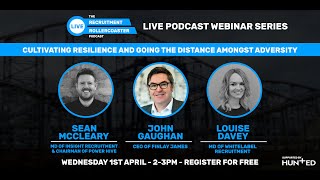
In this live podcast webinar hosted by Hishem Azzouz, recruitment leaders from Manchester – John Gorhan (Finlay James), Louise Davey (White Label Recruitment) and Sean McCleary (Insight Recruitment) – discuss how their firms have navigated the COVID‑19 crisis. The conversation covers lessons from previous recessions, the toughest decisions made (furlough, pay cuts, redundancy), strategies for keeping furloughed staff engaged, remote onboarding and training, business‑development tactics in a stalled market, pricing and service‑diversification ideas, cash‑flow management, forecasting, and the personal impact of working from home with children. The panel shares practical examples, answers audience questions, and reflects on the biggest learnings and what the post‑pandemic recruitment landscape might look like. The tone is conversational, supportive and pragmatic, with a generally optimistic but realistic sentiment.
Chapters
And then we'll have some fun, but good luck, guys.
Thank you.
Thanks.
Good afternoon, everyone. Thank you for joining us this afternoon. This is the third live podcast webinar, so really excited for this one. Joined by some great panelists, and it's the first time it's going to— it's an all-Manchester panel, which is interesting. Before we just crack on and we do introductions and stuff, I just very quickly, I just, I just jot down some names on people I just want to give a bit of a shout out to because they've been on every single podcast webinar so far. So I just really appreciate the support. So just wanted to give a very, very quick shout out to Mike Richards, Nathan Adams, Lily Shippen, Hannah Foley, Lauren Langstaff-Roberts, and Robert Hanna. So Thank you for your support. Really appreciate it. Let's have some fun. So, Louise, if you could go first.
Hi.
Great if you could intro yourself for everyone watching and tuning in.
Hi everyone. My name is Louise Davey and I am the MD of White Label Recruitment. We're based in Manchester. At the moment, we've got 19 staff and we cover the engineering market on a permanent and contract basis.
Amazing. Thank you, Louise. John?
Yeah, I'm John Gorhan. I'm the CEO of Finlay James. We're a global tech sales recruitment company. We've got circa 47, 48 people, and they're based in Manchester, head office, London, San Francisco, and New York.
Amazing. Thank you, John. Last but not least.
Yeah, my name is Sean McCleary. I'm MD of Insight Recruitment. We're IT and engineering recruitment based in Manchester. We've got 40 people currently. Yeah, cool.
Thank you, Sean. So just a bit of housekeeping, everyone that is tuning in. So you should be able to see to the right or left of us a Q&A section. So I'm just going to type in here to ask your questions here. So you should all be able to see the question that I sent and At any time, you can submit your questions. A big part of today is very much going to be you guys asking questions and making sure the panel answer them. So what you'll also be able to do is if you see someone submit a question that you really like, you'll be able to click upvote. And that will just mean that that's a question that you'd really like them to answer. So at any point, you want to ask Sean, John, Louise a question, make sure you type it in there, and I'll make sure it gets answered. So look guys, I've got a couple of questions before we start getting some questions from the audience. But look, I've got to start with this one. It was sent in from Michael from SW6, and the first question I've got is: are Northerners better than Southerners?
Yeah!
Sorry!
What do you think, Hishem?
My mum's from Oldham, so I'm a bit—
I'm a bit on it.
But no, when I saw that come through, I had to ask that. But look, what I'd love to sort of— where I'd like to start is, look, a lot of you guys have been in the recruitment industry for a while and definitely around when the adversity that a lot of people had to go through in the past. So the sort of first question I have is, what have you guys learned from previous times of adversity, challenges that you had to overcome that you think holds true in today's current landscape and the current challenges that we're all facing? What comes up for you guys when I ask that?
Okay, I'll happily go first. So my thoughts are, I think going back to 2008, 2009, we went through that last recession. We were a much smaller company. We were a 20-person company, but we quickly realized that kind of doing nothing and waiting for the market to change wasn't an option.
Okay.
So myself and my business partner Mark at that time, you know, we quickly decided that we weren't going to take any money for a period of time.
Wow.
And, you know, we sat down with the team and we basically said, look, this is, this is pretty horrific. You know, we went from— we were quite small. We were turning over all perm. We went from doing 100 a month to 220 a month. For 2 or 3 months. So it was a big drop-off. So we, at that point, weren't taking any money. And we asked the people within the team to take a pay cut, a pay reduction.
Any government grants at this point?
No, no.
Government, I'm not sure where the government were. I think the government were hiding behind the bankers at this point. But yeah, there was no help. There was no assistance. It was everybody was on their own. And also there was no help at all from networking groups, people like the CRN, people like The Hive, to basically talk to people in the same boat to get advice. So I think what we learned and what we did was act and act fast to make changes and stop living in the past. You need to start living in the present and the future and make some tough decisions and some pretty important decisions. At that time, we made one person redundant. One person decided to leave the business. You know, they didn't want to take the pay cut, but everybody else stayed with us. Even now, our MD, now James May, has been with me for over 12 years. He was one of those guys as an entry-level recruiter who took part in that and came out the other side, and he's progressed right through the company to be our managing director. So I think the advice is do something and don't stick your head in the sand hoping for it to be better tomorrow. Cool.
Anything else to add, Louise or Storm?
No, I think that's a really good point about not living in the past. There's been a couple of times where we've had a few things happen at White Label where we've had to make some big changes. And if you keep looking backwards and saying, that's what we do, that's what we usually do, you're not going in the right direction. So I think as long as you team are on board with making some big changes for the short term, yeah, you should, you should be okay. But if you've got people in the team saying, I'm not willing to do that, and this isn't what my job is, this is what I'm paid to do, and they're not willing to be flexible, I think you're gonna have a problem. So I think sort of laying that out quite early on, okay, is important if you think that's gonna happen.
Sean?
Yeah, I'd agree with both points there. I think on John's point around making decisions and making them fast, I think that's key, you know, whatever it is that you're going to decide to do. I think acting and giving people confidence that you are proactively doing something is important. I'd also say, you know, don't forget about the customer. Most importantly, some of the best relationships, if I think back to 2008, would be made then with customers where you can still add value when every other recruiter is probably not calling them or not wanting to speak to them because they don't want to have that difficult conversation. So, you know, you don't necessarily need to call them about jobs, for example, but being there to say, look, we're all in this together. Where can we add value to you right now? I think we'll come back with engagement when the market does inevitably pick up.
Okay. So on that then, making decisions, thinking about the present, communicating to your team, clients, etc. What— so right now in the present, what's been the most difficult decision that you guys have had to make so far?
Do you want me to take that one? Yeah, go on. Yeah, I'll start off. I think, look, pretty much every business, I would say, at the moment is looking at cash flow pipeline, looking at, okay, well, you know, have we, have we got the resources to be able to continue at the level that we want to continue at, which certainly from an Insight point of view, we've done.
Yeah.
And I think it's been difficult in the respect of, you know, you're trying to make decisions on people with different levels of experience, different markets, and you're trying to, you know, you're trying to put some kind of a formula to say, okay, well, how can I get this business through this difficult time but measure that we're in a position to still be successful when the inevitable upturn comes? Yeah. So we decided from an insight point of view to very much have a collective, we're all in it together approach to it with everyone committing to take a cut in terms of hours, and I think, you know, I've got to say hats off to everyone that's been involved from my staff. That family approach to it has made that decision a lot easier than it could have been.
Okay, cool. Louise, John, most difficult decision you've had to make so far over the last couple of weeks?
So for us, it would be discussing the furlough and putting that option in now, which is started from today. Yeah, it was quite hard because I think we've got all these networking groups that we're in that we're linked into, which is brilliant, but probably spent a long time speaking to different people and not actually making a decision. So that's been quite, quite hard. And thinking about what's other companies doing, is this the right choice, and not actually backing yourself and going, actually, this is what I think's right, and actually making that decision. I think I said that to you yesterday. I feel so much better just making that, making that decision. But yeah, it was really, really tough thinking, you know, how are the staff going to react to it? How are we going to come out of this? But today I actually feel like a big weight's been lifted and we can actually move forward with the business now and actually progress because we've got a plan. So I think just not making a decision has been harder.
Yeah, I totally get that. Obviously it's back to John's point there, like back in 2008 or whatever, there wasn't loads of help that you could see, etc. I think the sort of downfall of having a lot of help and support is that you can always look to get the answers from other people and prevent you from making your own decision. John, what about you then? Obviously, I know we had an open conversation yesterday, but is it sort of in line with Louise on difficult decisions around furloughing and how to help the staff and what's been difficult for you?
Yeah, I think the furloughing is definitely right up there, and I think in some respects that decision was made a little bit easier. So we had started to kind of consider the furloughing conversation. And, you know, we were thinking about, you know, looking at a matrix, looking at a list, you know, who can contribute and perform under these conditions and stay on the pitch and who are going to be better served, you know, on the bench, you know, ready to come back contributing down the line. I think one of the things that's great from, you know, talking to people is that, you know, we were advised to, instead of going to people and saying, look, you're on the list, you're being furloughed, it was who within the business would be comfortable and happy to be furloughed.
Yeah.
Okay. Based on kind of our understanding and our appreciation of what the world is going to look like. And we've done it from a protective perspective whereby we've said, look, you know, Being in this market at this moment in time is a bit like walking into a burning building. Now, yeah, if you're going to walk into a burning building and you've got the experience, the apparatus, uh, the know-how, the skill to navigate your way through over the next 2 months, that's brilliant. You know, be on the pitch. If you haven't, you can help us in another way and help our bottom line while the guys who were not furloughed are helping the top line. So what I'd actually say is what was going to be a really, really hard decision, it all kind of opened up in front of us as, as not being a difficult decision at all because it was— people chose and it was down to them whether they wanted to remain on the pitch.
Yeah.
Or go to furlough. So we haven't got anybody on furlough today out of 19 people. Including Sarah, my wife and business partner, who weren't happy and comfortable making that call.
Okay. Well, thanks for sharing that. So I think a lot of questions got submitted by people around the furlough piece. Neil, Neil Cluff has already asked one, and I think it's a really interesting one. So let's go to that question. What are you guys doing then to keep your staff motivated and sort of that constant contact? With them? Because yeah, the people that you have put on furlough, what are the sort of thought processes and how are you planning on keeping your staff motivated and engaged whilst on furlough?
I can take you through what we're doing. So basically, Sarah, as kind of the head of the furloughs, you know, she's already created a new site. Yeah, that could run and run. They've already sorted out a playlist, you know, but a furlough playlist, a furlough playlist. So we've got some interesting contenders already. So yeah, we've got, you know, 19 people, and the idea is that we're gonna have, you know, Sara's gonna be running some sessions with them in terms of, you know, having a catch-up on a weekly basis to check in, make sure everybody's okay. They've got a WhatsApp group to communicate on all non-work-related stuff. I'm going to give everybody an update every week in terms of the, like, the temperature of the business, you know, how we've got on, how things have done, uh, the good, the bad, and the ugly. So people are still connected to the business and understand what's going on even though they can't contribute and they can't be selling within the business. So the idea is we want those 19 people, including Sarah, to be you know, on the subs bench but keeping fit and, you know, being warmed up, ready to be called on when we come out the other side of this. And we may well find that people who are cracking on and, you know, selling today and, and placing people today, they may well need a breather in a month or two's time, and we need people ready to perform. So, uh, I think having two distinct groups but we're still part of the, the FJ family We're just helping the business in two different ways, you know, one on the top line, one on the bottom line. But it's all about communication. A number of the guys are going to be joining the NHS for the foreseeable. Yeah, so Saura is one of the guys doing that. Natalie is another. So a bunch of them will be helping the community and helping parents, elderly parents, grandparents, and still contributing to society. In a slightly different way.
Amazing. Yeah. So you're— yeah. So you're really doubling down on the communication with the people that you have furloughed. One week, weekly group video call, WhatsApp group. Sarah's dedicated to communicating to these guys. Okay, cool. Louise, Sean, what are you making sure you do to the people that you furlough to make sure that, yeah, you're keeping them engaged? And what are the plans on communication? Anything different to that or—
It's all really similar. And the only other thing I'd add to that is we're just still waiting on the the clarification around training.
Okay.
It's a little bit of a gray area at the moment. So obviously once we work out that, we'll be able to put full training schedules together for the team as well and just go back to basics.
Yeah.
With, you know, you've got the delivery guys, the sales guys, just to keep them motivated and learning.
Yeah.
And give them a few ideas on, you know, just make sure that they're upskilled using video.
Yeah.
I'm just kind of sort of put them together something so they can think, well, when I was in recruitment and I was in my office, all those things that I never had the time to do, what can I go and do now to make myself better? Yeah. Probably got a list as long as their arm of things that they wanted to do that they don't get a chance. So my advice to anyone that is on furlough would just be get that sorted out and get your house in order really, so you come back to work and you don't have those issues.
Yeah, nice.
It could even just be basic things like, you know, getting all your message templates organized. But research your clients properly, you know, actually, you know, put a client list together, actually go on websites and understand what they do and, you know, really get to grips with everything.
So yeah, a couple of people just obviously put a question in there or obviously just messaged very kindly, Louise, you'll check it. But yeah, Claire saying yes, you can train. Mark Bracknell saying HMRC confirmed today you can train. But I think, I think that is the thing though, a lot of conversations I've had is that with the fact that you can't even go into the pool right now, apply for the grant or whatever, like you want to do this by the book. Like you don't want to be dabbling in any grey area because if it then means that you're not eligible for the grant or whatever, you're going to—
Yeah, exactly.
Okay. That's— Yeah, I think I said to my girlfriend who was furloughed from today, what's on your— what's on the list when you said— when you always used to say, I wish I had more time? Yeah, it's a good question to ask yourself. And what appears on that list and start tackling those things on that list. Sean, anything to add, mate? Like anything that you sort of come up with?
Look, I think connection and self-development Communication is a key, really. As Louise and John have both alluded to, you know, it's still very much, you know, part of the business and making sure they feel like they're part of the business and can contribute in whichever way to the culture of the business. I think from a communication point of view, for my people, it's very much led by them. There is some people that feel that they want a bit more of a daily check-in call or weekly check-in call just to see what to see how they're getting on, whereas some people are very much more or less like, I'll call you if I need, you know, if I need anything, if I need to talk to you about anything. So I think, you know, letting them lead the communication and how they want to be kept involved as much as possible. And then I think on Louise's point, really just encouraging them to set themselves up as best as possible for success when the inevitable market upturn does come. You know, what can they be doing in their their own spare time to keep their skills up to date.
Yeah.
So that they, they position themselves in the best possible way.
Cool.
Okay, cool. Let's segue into what you're hearing from your consultants, or obviously what you're experiencing yourself in terms of the actual market right now. So is it fair to make the assumption that across the board with you guys and your teams— maybe very— that there are some opportunities, but the majority of stuff has been put on hold? And there's not much going on in your— so Louise, your market is engineering?
Engineering, yeah. So unfortunately, a lot— well, most of them that we've called this week, all the key clients and companies we've placed with, are either not recruiting or start dates are on hold.
Okay.
So it's not really bad, but it's not great for this month in particular. And I think, you know, this particular time right now, with as much will in the world, I think, you know, we've not even hit the peak of the virus at the moment, and there's a lot to consider when you're calling around to these companies. You know, people are going to start being affected personally by family members contracting the virus and knowing people that know people that have got it. So I think you need to be like morally, you need to sort of really think about how you do position yourself if you are canvassing. And you are speaking to candidates because it could be quite upsetting for some people and not do your business any good. So there's going to be a fine line and it's just probably managing that if you've got staff calling about still.
Okay.
Yeah.
And then Sean and John, then your markets, like, yeah, there's a lot of it sort of dried up, putting things on hold. Is it quite similar?
Yeah, look, I think it's changing daily, I think is, you know, it's fair to say. If you asked me this question 2 weeks ago, we were on for a record performance for this month. So, but I think it's changing daily. I think, you know, why it's probably quite unique to other recessions I've been through before is you're balancing the uncertainty in the economy with the obvious logistics of everyone working from home and, you know, not being able to onboard new starters or interview new starters even if they wanted to. So, and I think, again, probably different from other recessions I've kind of been involved in is it's pretty much every sector across the world that's impacted, whereas it hadn't always been that way. So I think there is still pockets of people recruiting, there is still opportunities. I think those particularly in tech, I would say those companies who were already set up for people to work remotely and maybe have a product that they want to deliver have got funding already for that product and have got a timescale that they, they still need to hit. We're finding that those guys are still pushing on with recruitment and, you know, trying to use it as an opportunity to maybe hoover up talent that, you know, other businesses can't at this moment. But I think that the general consensus is kind of caution around certainly the next few weeks.
Okay. So Louise was just touching on it a bit there, but I think this was really common from the last one. James Johnson's question. What is the approach right now to develop business, which as we were just saying, is difficult and there's a lot of stuff that's gone on hold. Louise is talking about being empathetic, being human about it, being understanding that the people you are calling could be impacted by this personally, right? So like, yeah, what do you think with this then, John and Sean? Like how can consultants right now approach business development and how should they be approaching it, do you think? What are you telling your guys?
I think the conversations we've been having is, you know, we, we've seen our job book drop from somewhere in the region of 250 live vacancies to circa 60.
Wow.
In 2 weeks.
Yeah.
Uh, now that could well be, we, we in some respects maybe had too many vacancies. So, uh, the upside there is, you know, we've got less and we've got enough people to concentrate fully on them. To get them filled. So our philosophy is let's fill the jobs we've got while we've still got them.
Yeah.
And let's be more efficient and more quality conscious than we've ever been. And let you know, if we're used to having maybe one person work on a vacancy, why not double down and have two? Or why don't we have three and ensure that we've got the best chance possible of filling that gig? And our philosophy is you know, let's kind of, let's deal with what we've got while we've still got it.
Yeah.
And in some respects, wait for the market to return to us. So, you know, we're not looking at a hard sell. We're not out there speccing candidates into companies. Yeah, we're basically, we're communicating with our clients and we're saying, look, if you are in a position to take on a tech sales or marketing person in April or May, let's talk now. Yeah, if you need some space and you need some time, you know, let's, let's park it and let's talk to you when you are in that position. So I think it's, it's honing in and being more efficient with the stuff you've got. Yeah, uh, than trying to push, you know, push water uphill.
Okay, that's interesting. So I guess, so yeah, like to tie this in, Stephanie Levinson's question on what, for anyone that isn't furloughed, what are the next steps in terms of like what, what should they be focusing on then? So what you're saying is If you've got— if your jobs have dramatically decreased, focus on obviously the stuff that you do have, which makes sense. But obviously, for some people that are— the people I've spoken to, that could literally— it could literally whittle down to one job or two clients, right? So I guess what you're talking about there, John, and these are some of the conversations I've had, so hopefully this helps, is that ultimately what's probably changed is the expectations of that BD call or the expectations of that sales call, as in instead of thinking about, I want to try and get a job out of this call, which would make it successful, is let's have a conversation about what your plans are over the next couple of months or start to build a relationship, which is a slightly different expectation than it may have been to the call a couple of weeks ago when you said, did you pull that job or not?
Do you get what I mean?
Yeah, yeah.
Is that fair? I can see where you're coming from. So I think the key thing is the, you know, the appetite to take, you know, have you got any vacancies? That's not out there. Yeah. Finding out where they're at and what they're doing and then thinking about what help you can give them. So, for example, you know, we're looking to help our clients who are hiring with their onboarding strategy and get material through to them that they can use to help onboard the individual. Okay. You know, we're helping them, you know, if they need any help and assistance in terms of, you know, what the market's going to look like in 3 to 6 months' time. If we find anything out in terms of what's going on in their space, we will look to communicate that with them. That might have an impact on their buying decisions in months to come. So I think the key thing is whatever a client wants to do, you can't kind of blame them for doing it.
Yeah.
And if, you know, if a client cuts headcount, unfortunately, even if a client, like, reneges on an offer that's already been made, which, you know, we've all had, That is the new life that we're living within. So I think the key thing for me is even if you've only got one job, then you should give yourself a very, very good chance of filling that job.
Yeah.
And most consultants, depending on the markets, don't place much more than one or two people a month. Yeah. So, you know, if you fill what you've got— so if we've got 50 to 60 vacancies and we fill all of them, over the next 6, 8 weeks, we'd be doing just fine.
So yeah, sure.
Think, think about quality and thinking about that added value and think about those 5-minute conversations you have with candidates that can now be half an hour. So they're upskilled as much as possible to go in and, and get that job. And instead of running around chasing your tail on 5 roles and doing a little bit on each of them pretty badly, do a fantastic, you know, awesome job on one role. Yeah, that client will remember you out the other side of this.
Um, just one point I want to just highlight then, Sean, we spoke about this, I'd love to get your thoughts on this. Um, so one of the questions that, um, I got, uh, that was submitted for this was, um, from a lady called Charlotte, um, Leitner. Apologies if I pronounce that wrong, but basically she said, we are fortunate to recruit within digital so some of our clients are still hiring but are hesitant, unsure on how to onboard new starters remotely, right? And this is a really common headache that I've heard from a lot of people. So her question is, how are your clients managing this, if they, if they are at all? And do you have any tips or advice that you can share? Because I think that's what you just touched on, John. But I know we spoke about this, Sean. What, what comes up for you on that, with that?
Yeah, I think, um, I think, look, firstly, it can all be done digitally, um, and I think the more that you can lay out a process. I think, look, what it is, we're humans, are creatures of habit, I think ultimately. And, you know, if you've always onboarded someone in one way, then, you know, you naturally fall back to that way of onboarding. But I think it's an education piece with clients. If you can educate them, look, you can— what are your objectives with onboarding someone? And what I found is it's moved, it's moved away more from like the policies and procedures side of onboarding someone because that's almost become less important, I would argue, in this current climate, to just focus on that and more about integrating people within the business, upskilling them and getting them as quickly as possible immersed into your culture and bought into what you're doing. So a lot of that side of onboarding can be done via video. You know, we're encouraging— we've got some of our clients who hiring managers are doing an introduction video for themselves to kind of introduce the person to the team. You know, there's obviously team meetings that can be done over Zoom.
Yeah.
You know, there's a lot of content or video or whatever that can be sent to people to learn. And so I think that the people who are doing it best in my mind are— they're not focusing so much on, you know, the policies and procedures and, you know, have they kind of read the staff handbook about X, Y, and Z. But they're more thinking about, right, okay, well, how can we kind of upskill them as quickly as possible in the role that we need doing? And can that be done virtually? And then how can we get them kind of immersed in our culture and more into what we are as a business as quickly as possible?
Nice. John, anything to add to that that you've been speaking to your clients about?
No, I think what we've noticed is even the kind of the slowdown in the market, we've seen less of a slowdown in the States than the UK.
Okay.
And what I'm seeing is that certainly the guys in the States, that they're used to onboarding people remotely, I think because the country is so, so huge, that's the only option on occasion. So they've just kind of cracked on and, you know, people have been offering people jobs last week and, you know, they started this week. So I think the key thing is, you know, we need to be thinking about what we're doing with our business now, and I'm sure the guys are thinking the same, that, you know, do we need that 2-week induction in Manchester and sending people up from London, and, uh, or can we actually get, you know, some stuff in the can from a training perspective and the intros and the processes and the procedures? So I think most companies will be looking at this and thinking, right, during this slower time, what can we build now that can save us money in the quarters to come from an onboarding perspective? So I think whether it's, you know, you know, being able to onboard remotely or whether, you know, we can do meetings remotely and save money and time kind of moving around the place, you know, I think that's going to be a big question for everybody moving forward.
Okay, interesting.
So we're actually, we're actually taking somebody on next week at White Labels.
Oh, your business?
Okay. Yeah, so for me, I feel like it's a good thing if we're going to communicate this to clients what we're actually going to be doing. But most of the time when you start a new job, you don't get given a lot of time. You get thrown in the deep end. You get expected to do, you know, work 100 miles an hour. Well, the way that I'm going to—
Who's going to take 100 calls on their first day?
Is speak to the clients about just taking it really slowly and just making sure that the candidate actually understands the business in full, because you'll, you know, every business is guilty of onboarding someone and then, you know, 2 weeks later they're like they've always been here. So the way we're going to do it is just set like bite-sized chunks for the new starter and then just keep feeding back to them and just keep checking in, have they done this, and what did they get from it. And they've got a real good chance to learn about your business properly, and, you know, reading your documents properly, learning about your products or your services. And so I just think it's, it's a good thing in a way. It's just, it's whether you can get that across to your clients or not. But I think you would need to have, you know, good half an hour, 45-minute conversations on a regular basis.
Yeah.
And to educate them on that.
Okay. No, that's really interesting. So What I just really love to expand on, and this is pretty much Rob's question, but the question that I'm just going to read word for word was from a chap called Darren Simmons, and it's sort of all linked with this. So his question is, has anyone had success diversifying their offering into broader consultancy? Right. So talking about here, could you impact the onboarding process? Could that be something you monetize or just add value around Rob's question around looking at different revenue streams right now? Right. So Darren's question is, yeah, so i.e., benchmarking, competitor analysis, talent pooling, etc. So have you guys, and you guys thought about this or I don't know, thought about some of the different things that you could potentially monetize in this short to medium term that isn't you hire this person, you pay me a fee. Have you looked at that?
Yeah.
One of the things I was looking at prior to this whole crisis, actually. So I was having conversations with a couple of guys in Manchester and Nick Guy over in New York about— I see the pricing of recruitment changing. So it's changed in everything else we do, bar recruitment.
Okay.
So, you know, the way we pay for Netflix or the way we pay for Sky or the way we pay LinkedIn, you know, it's not on how much you use it and how much success you have. You know, it's subscription-based and kind of quarterly-based. So I had talked to people about, you know, instead of charging clients on, you know, the win, you know, the higher the bum on the seat, whether we should be looking to kind of charge people on the monthly basis. Well, charge them on a subscription basis. Yeah. On certain metrics that, you know, we charge so much a month and what you get for that month is X, Y, or Z based on how much you pay. So I think what will come out of this in 3 to 6 months' time is I think we'll be forced into looking at the way we charge and the way we price and the way people purchase kind of our services from us. So we've not really thought so much about, you know, the additional services while we've still got live vacancies.
Yeah, that makes sense.
But if they run out, you know, it's kind of needs must, you know, what else can we offer that our clients will value and our clients will derive benefits from?
Okay, Sean, you have— you thought about this or heard anyone in the hive or anything like that?
Yeah, I think obviously the challenge at the moment is, you know, a lot of businesses are in probably a price-sensitive mode. So it's kind of, you know, a bit of a difficult conversation to say, right, well, I'm going to charge you for something else over and above actually finding people for you. But I think, you know, what we have been doing at Insight is evolving our offering and offering a lot more added value services, more based on commitment really than necessarily charging extra for them. And I think if you, you know, if you can hone those now, then potentially down the line when there is more confidence and it is probably less price sensitive, I suppose, then I think you would be able to charge for them. So some of the things we've been doing is working with clients on their EVP, you know, really as part of our process to helping them get people on board is looking at how they're branding themselves in the market. What's their process for onboarding and tying that into, right, look, we can help you get— part of us attracting the best staff to you is making sure that in the market your brand is represented in the right way. So again, I think that is a thing that can be, could be charged for at a later date. Yeah. And I think, you know, you touched on it, kind of competitor analysis, talent pooling, things like that. We've all done that more as a retained search process as part of that than necessarily a standalone product. But, you know, if someone's confident enough to sell that in the current climate then and can charge for it, then fair play to them. You know, get them to give me a call.
So on this then, I've seen a lot of it and I've definitely thought about it. So I'm coming to Dylan's question, basically talking about if an end client has lowered their fees due to the current crisis we're in, price sensitive that you're talking about. A lot of people I've seen online offer their services for free and things like that. Like, what do we think about that? Should you be offering your services for free right now? Like, I don't know. What do we think about that? Because I think a lot of people are thinking and doing that. So what do we think about that?
I don't think you should be offering— you shouldn't be offering your kind of core service of placing candidates or whatever the recruitment side of it, free ultimately. But I do think that more and more there is an opportunity to give value and give content and give information for free. That will, that will in return kind of win your business further down the line. So my personal point of view would be don't offer your core services for free. If businesses are asking you to do that, then they probably don't value what you offer. But I do think that you can offer, you know, additional things around your core service as a value add on the understanding that you're building relationships with customers that hopefully are then going to pay you for the core services you offer.
There will be clients that are going to use this to, to ask you for those, those discounts as well. I think you'd have to look at it on a case-by-case basis. I think a discount's a little bit different to obviously free. Yeah, so a discount maybe, but if they was asking for free, I don't know how they'd expect you to run. So like, say they're not, they're not going to value you long term, so maybe you'd look at your client base if if you were starting to get that.
Yeah.
Have you, have you, so like, have any of you guys had conversations around, just grown-up conversations around, look, we're both in a difficult situation right here. You, you have an invoice that you need to pay, or this is what it costs, but we can look at spreading it, or whatever. Do you know what I mean? I think that it seems like a lot of people having those conversations, just being grown up about it.
Yeah, I think, look, again, everyone is in a similar situation that, you know, cash flow and and things like that are important. So, you know, if companies are genuinely in a situation where they need more time to pay or whatever, then those are things you could definitely look at. But I would always personally try and advise on, right, okay, well, how can you tie them into some longer-term commitment? So, you know, for example, if someone is saying, right, well, I need a discount on a— particularly if it's a placement that's already been done and already agreed, then and tie it back to say, okay, well, we'll credit this against the future placement, or let's look at a piece of work over the next 6 months, which is going to cost X. And if we hit that piece of work, then we will discount you further. But I think for me, it would really be making sure you've got the commitment at the other end rather than just people using this as an opportunity just to get out of paying or —or get—
Yeah, that makes sense. —dropping prices. I think it is a bit of a weird time. It does feel a bit weird to chase invoices. And like we had this on the last one, someone asked about chasing debt, right? And it can be difficult.
We had a really good week last week chasing debt, thankfully. Did you?
How was that week?
The best week I've had. You have to see Louise chasing debt. She doesn't Smile. Yeah, yeah.
Anyway, no, we, we, um, we just had a little bit of a chat about it and just made sure again that the conversations were being done in the right way and that the clients understood where we were coming from. A lot of it was contract, um, contractor payments anyway, so it's not too difficult when you can say, look, I've paid the contractor. Yeah, it's, it's not that hard to, to, to say. Um, but you know, there are, there are ways around it and you don't have to go in all guns blazing. And I think it's you know, if you do it in the right way and the right person does it as well. It might be that you need to change who makes the call. If you've not got someone, you might have a really good credit control, but maybe they're brilliant at getting money in, but that might not be the right person right now to do this. So you just switch it, even if you switch it to yourself, so you're in control of it.
Yeah, no, that's interesting. So question I want to go to, Claire Mohammed's question. And this, this, this will come through a couple of times because I think it's fair to say the other question I'm just looking at that I've got prepared on my phone is from Rory from B Recruitment. And it's very much like if your market right now is just in the complete shutdown and you've got your niche, that's what you've been operating in over the last however long. Like, should— like, if you're in a place where right now everything is shut down and you can't see any opportunities. Should you, should you be diversifying right now or should you stick to your guns and stay niche? What do we think about that?
I think my thoughts on that are it depends. It depends on the niche you're in. Yeah. You know, a niche that you're potentially considering because what you've got to look at is if you're jumping into somebody else's niche. Yeah. If the company's already in that niche, furloughing staff because it's so tough, and they've got 10, 12, 15 years of experience doing it, it's been tough. It's going to be tough. So, you know, I wouldn't dream of jumping into Sean's market and be trying to compete with him and his business. Yeah, doing what he does. And I think, you know, he might think the same jumping into tech sales, and, you know, we compete with Philly James. So I think in that situation, uh, I think control the controllables And that's where you do take advantage of the furlough and basically get your cost base down to as low as you can. Yeah, because you could crack on and do more money in trying to attack a marketplace that you've got no experience of and no exposure to. Yeah. And that could cut your runway in half as opposed to sticking with your niche, you know, learning, development, getting all that good stuff done. And buying yourself time, which is— that's what I see the furlough as. Yeah, buying some time for the business and extending your runway to stick with what you know. Yeah, because, you know, education recruiters jumping into engineering recruitment or vice versa, I think that's potentially the way to the poorhouse. So it's not a route I'd go down, but yeah, yeah, that makes sense.
We went into panic mode a little bit when it first all started off and we started not going into different markets, but ones that were sort of maybe next to us. So obviously in engineering, we could start looking at like the PP companies, textile companies. It isn't what we do. It's quite easy for us to do it, but it wasn't what we do. And I realized like after sort of 10, 12 days of trying to do that, there's going to be agencies that have already got it covered. So why are we going to— just what John just said— why are we going to be any better at this? So I think the quicker you realise, just stick to what you know and learn more about what you know is the way forward. If you can take the option to do the furlough as well and buy yourself a bit of time to really niche down even further, I would say, in the markets that you're already in. Yeah. And like I say, doubling up on markets when you have got a job on, putting a couple of people on it.
Yeah, that's the point I was going to make. I think there is, you know, there's an opportunity for like a niche within a niche. So, you know, if you are, for example, in engineering, is there certain sectors of engineering that's still in your vertical but are less affected? You know, I don't know, for example, the utilities industry, because you've clearly got to keep the lights on, for example. You know, then I think there is the opportunity to look at sectors that are maybe a little bit more resilient. Yeah, but still sticking within your niche. But I wouldn't advise completely changing niche unless, of course, that niche was already challenging coming into this situation. Then I suppose you could look at it and say, right, well, particularly if I'm, say, furloughed, for example, is there an opportunity for me to take that 2 months to map out something new and restart something new? But if you're only doing it because of this particular situation and you're confident there will be an upturn, then I would say ride it out and position yourself in the best possible place to take advantage when it does.
Cool. So talking about riding it out, giving yourself more runway, these types of things. Mark's question, I know that Sean, we were talking about this before, like you've got to review on a day-to-day basis and things change. But I think people just think, wanting to know what other people are thinking and how they're approaching it. Like, yeah, like Mark has said there, what length of time are you currently planning and forecasting over? Let's just share that with everyone.
We were talking about it earlier, so I don't mind kicking off. We're currently forecasting on a quarterly basis, so we've got a plan for the next 3 months. But I think the term John used was cobra meetings twice a day, which I quite like. So it is staying on top of it daily very much just because things are changing. I think the variable that is also difficult to forecast is You know, we don't know how long we're going to be in a lockdown situation. So, you know, if we knew that, right, okay, definitely be out in 2 weeks' time, then I think you could probably predict when the upturn would be a little bit more confidently than, you know, at the moment. You've got to forecast for that worst-case scenario as well, really.
Yeah. Okay. Is that the same for you guys, John and Luis?
Yeah, I said earlier on the calls to Sean and John, I think I'm on plan 18 now. The paper bin at work's full. So yeah, I've spent so much time planning and then the next day I'd open my emails or I look on the news and then something different happens or you find out new guidelines from the government which totally throws you sometimes in a good way or sometimes in a bad way. So I would say my advice would be to plan. Yeah. Weekly, monthly, quarterly. I would personally be planning now till Christmas, but then don't stress too much if you've got to change it on a daily basis because probably by nature we're all planners and we want to, you know, see this outcome, but don't let it stress you out if you have to change it. Yeah, that makes sense. Yeah, I would be planning— well, I am planning personally till Christmas. Okay.
So just a quick one on this, which I think is an interesting point and probably really valuable, is sort of the things that you're like— so having visibility in your business, right? Especially if your team being remotely in terms of, I don't know, tools like Cube19 or whatever. Right. So how important is it to have— so what you're saying is you're planning, but what are the things are you making sure that you're checking on a weekly basis or looking at, the things you have visibility on that are sort of key things that you're keeping a look on that's going to help form the decisions that you make. Do you know what I mean? Is it just money in the business or revenue? Like, what are the things that you're keeping a close eye on out of interest in terms of data points or anything like that?
I think for me, it's— what one is sticking close to, you know, our financial manager and basically how are things looking for the month ahead and, you know, 3 months and 6 months. So, you know, we've got a plan for the next 3 months and then for months 4 to 6 as well. But I'm looking at Cube, you know, every 2 or 3 hours. Okay. See how things are changing. And I think the other thing I'm doing is I've talked about this before, but people talk about, you know, what, what things look like a week ago and 2 weeks ago. So You know, I had people telling me, well, I've got 25 roles, but 20 of them are on hold. And it's like, no, you've got 5 roles. So that's been quite kind of destructive, but people now know where they're at. And it's taken some people longer than others to realize that a job and a vacancy that you had on 3 weeks ago doesn't exist anymore. So yeah, you know, basically looking at the, the new world, and it's a bit like, you know, for me, April 1st, it's like starting a new business. So we have a good Q1, great Q2, a great March, but we're now a completely different company come April 1st, and we're basically back to where we were 10 years ago in terms of, you know, how many people are working on the business. And the kind of vacancies we're dealing with. So we need to lean on that experience of growing something and dealing with, you know, less volume and higher quality, which is what we did back then. So I think keeping a handle on the money and the cash and the bank and the pipeline and the debt chasing and all that cool stuff is important. And then the next thing is the visibility via Kube or the likes, you know, any business intelligence to basically say, look, this is where I'm at. At, you know, 3 o'clock on Wednesday afternoon, and this is the real number. It's not where I'd like to be or where I was 2 weeks ago. Yeah, that makes sense. Just kind of being comfortable with the present allows you to be more positive about the future, I think.
Cool. Yeah. Just a complete change of subject here, guys, but I wanted to make sure that we cover it. Being a parent, difficult in itself, but a lot of people I've spoken to, and being a parent at home, having kids running loose whilst you're trying to work from home, what's that been like for you guys?
Brilliant. You guys go first because they've got younger children.
How have you found it? Have you done anything that has really helped? Because I'd like to think there's quite a few people tuning in right now that do have kids. I mean, I've heard people taking turns to run school lessons in their kitchen, doing PE lessons in the garden, doing different shifts. Like, what have— Sean, Louise, what have you done? Anything that's really helped?
Although I'm sure it's still challenging, but I'll let Louise start because I call her super mum to do that. The best— she wants the real—
do you want the real honest truth?
Yeah, the real honest truth.
Right, you need to buy Easter eggs in bulk.
Easter eggs.
Pop them in the cupboard and then reward them every 3 hours with an Easter egg.
Really?
It doesn't matter if they don't get dressed, that's fine. Okay. I think just, I think just let them be kids. I think if you go back to like when you was younger, you used to play out on the street all the time, you was allowed to do all these cool things in the garden, like make dens, climb over the fence, get muddy, you know, do all this stuff stuff. And I just think if you've got the space, let them just be kids and it'll make your life a bit easier. I don't think so much structure is that necessary. I just think if they're happier, then everyone's happier. And the schooling's not going to change that much if you're not doing, you know, 6 hours a day. Okay. I wouldn't worry too much about that. That's my personal view. Enough.
Yeah, yeah. I mean, you know, I've got 3 kids ranging from coming up to 2 to 7 is my oldest. So thankfully my wife's been amazing in terms of support. But actually, in a weird kind of way, you know, getting time to have breakfast with them and doing more quality time but still working similar hours because I'm not traveling to and from work and various other things like that. You know, I've had to take more of an interest in— my son Charlie plays football, so we run on break times. I have a break in the morning, a break in the afternoon, which is spent 20 minutes in the garden playing football. But I think, look, just on a kind of a putting work aside point of view, you know, we're obviously going through— the world's going through a very difficult time. And I think trying not to be as stressed and not to be as worried and shielding the kids from that because, you know, last thing I think they pick up on that, that type of stress and worry, and last thing anyone needs at the moment is more of that. So that's been something we've been really conscious to do is try and keep the kids happy, as Louise said, just enjoying themselves and hopefully not aware of what's going on in the wider world so much.
Yeah, fair enough.
Yeah, ours is a bit different in that we've got 20-year-old twins. So we've had Joseph come back from Sheffield Uni, Aaron's come back from Leeds Uni, but we're eating better than we ever have in that week. Yeah, the kids are making us 3 meals a day and I can go out to my fridge now, the menu's up for the week. Amazing.
So as we sort of come towards the end here, just use it as a bit of a time to sort of reflect really, like what do you, over the sort of question from alien round, which was over the last few weeks, what's been the biggest lesson that you guys have learned, do you think?
I think it, you know, just on a personal level, um, I think it's reinforced how important time is, you know. I think previously, um, on a personal level, probably didn't feel like I had enough time in the day, and now, weirdly enough, you've got loads of time in the day per se because you keep doing a lot of other things, but you're not able to use that time with the same quality that you would want to use it in other things. So learning for me, really, both in my business and in my personal life is, you know, look, don't take time for granted and use it constructively.
Yeah. Louise, John, biggest learning over the last couple of weeks?
I think for me, it's brought me back down to reality a little bit. Grounded me a bit more than I was. You know, just being like really thankful for like basic things in life really. Yeah, but we're doing quite a bit of charity work at the minute trying to raise money for food banks and we've been going over to those places and just seeing, you know, this state that people are in at the moment that can't get food. It's just sort of made me really realize how fortunate we are anyway, you know, especially working in recruitment, you're very fortunate that you're in a job where you can control your earnings to an extent, so I think just made me really thankful for being in that position.
Yeah. John, biggest learning for you?
Yeah, I think for me it's, I think controlling the controllables. So, you know, not getting too carried away if something happens that's really, really good, or not getting too down if anything happens that is horrific. So just being in a position whereby my philosophy, you know, every evening myself and Sarah go out for a walk and our philosophy is, right, we're one day closer to the other side of this. Yeah. And, you know, the world's going to be a different place. You know, we're going to be, you know, in some respect, a different kind of family. Yeah. But just being appreciative of the fact that at the moment, you know, we're all healthy. Yeah. You know, we're all strong. And, you know, we're very fortunate to be in a position where, you know, we're dealing with this because there's many people who would swap with us tomorrow. Yeah. So, you know, being, you know, controlling what you can control and don't sweat it if things aren't going right and being there for your people and, you know, having everybody kind of, you know, ringing you up in recent weeks. And I mean, one of the most remarkable things for me has been, you know, people ringing me up saying, how are you? Yeah. Nobody's done that in 10 years. Not even my family. Yeah. Definitely.
How so on that note, as you said, one day closer to getting on the other side of this, like how, what are your guys' thoughts on how the recruitment industry or just how are things going to look at the other side of this, do you think? How different are they going to be?
I think, I think that the, the work from home situation, I think will mean that there's probably more flexibility. I think, you know, even my own personal point of view, I was a bit old school on that front, always kind of wanting to be in the office. But I think there is something to be said that you can be productive to a certain extent working from home. So I think you'll see more recruitment businesses kind of having a blended approach of people working from home and not. I think, I think, you know, hopefully from a customer point of view, I think it will continue to steer from you know, what are kind of purely transactional relationships of just someone trying to sell that one candidate or trying to get that one job on to building longer-term relationships with people because, you know, they will have had things to talk to them about when they haven't had that job on or when they haven't had that one candidate. So hopefully, and certainly the way we're positioning our business is to try and have stronger relationships, both with candidates and clients when we come out the other side of this.
Nice. Yeah, I think the work from home piece is going to be really interesting after all of this. Louise, John, how do you see things looking?
I think video is going to be obviously the big one, isn't it? Yeah, the big change. And from our point of view, engineering companies don't really use videos that much, so we always have to go over and drive to the sites, which is brilliant for us But I think those quick online meetings are going to help.
Say, drive over and show them how to turn on the computer.
No, drive over, obviously have a look around the factory and things like that. But sometimes you just want that quick job spec, especially on contracts where, you know, you want to have that face-to-face time. I think that's going to improve consultants' mindsets on that as well. And obviously the clients are going to have to get on board. It'll just become a bit more normal. Yeah. And so I think video and pushing each pushing people out of the comfort zone a little bit on that has already happened, so that would be a really big positive in all of this.
Definitely. Jon, anything that you're thinking about?
I think for me, where I see it changing is, I think what you'll find is the good guys who looked after their clients, candidates, staff, relationships, I think they'll come out of this in 3, 6, 9 months' time in a really, really strong position. Yeah, I think the, the bad guys won't come out of it. I think they'll go bust. Yeah. Which unfortunately does then create an opportunity for the good guys. So I think there'll be a bit of a reckoning. And you know how you treat your suppliers and candidates and clients now, and, and how our suppliers treat us. Yeah, it's gonna be remembered. It'll be remembered and there'll be a reckoning. I think I see, you know, a lot of people doing some great stuff and helping people where they can. And, you know, I think there's going to be an amazing opportunity for, for companies who've done that and recognized that during these tough times.
Yeah. Final, final question, guys. So it was from Sandra Patel. I think it's a great question to close on. I think fair to say a lot of people feel like they're in survival mode right now. I think that Sean, when we spoke the last couple of days, that's how you've answered the phone. Yeah, I'm surviving. Like, what's your number one sort of survival bit of advice for people listening right now? What's your number one survival bit of advice?
I think, look, just look for opportunities and celebrate any small win. I think, you know, when I'm speaking to my teams and my consultants, you know, conversation has not gone from, okay, well, I've not got a job or I've not got an interview, I've not made a placement, to, okay, well, I've progressed that relationship, I've got this bit of information from that client, and still celebrating that. As, as John says, that's one step closer to something that's going to yield something when this, when this upturn, you know, inevitably comes. So celebrate the small wins, I would say. Nice. Louise?
Say that, say that again, sorry, it's gone a bit off.
It's gone off. No worries. What's your one piece of like survival bit of advice for people?
Survival, um, I think for me would be understanding yourself and learning about what you're like as a person right now. And I've been reading my DISC profile recently, so if you've not done that, I'd probably advise you actually do it, and it sort of tells you how you behave in certain ways, in certain, like, conflicts and under stress and stuff like that. So I think when I reread it last week, it did actually help me go, oh, actually, I'm not an absolute psychopath. This is actually— that's why I'm like— that's why I'm doing this. So I think it just helps you stay a bit grounded and stay calm. So nice. Understand yourself.
Love that.
Yeah, my thoughts, I think don't lose your sense of humor. I think it's very easy in this situation, watching the news and seeing social media, to kind of go down that negative path. And there's enough of that out there. Yeah, I think keeping your sense of humor and keeping a positive mindset. And, you know, my kids are obviously a little bit older, but they were taking the mickey out of me the other day saying, I remember last week you owned a really successful recruitment company. Look at you now. But it was pretty funny, so, you know, so yeah, taking the mickey out of yourself and kind of remaining grounded and keeping a positive mindset, I think, is crucial.
Yeah, amazing, mate. Well, look, Sean, John, Louise, absolute pleasure. Thank you everyone for tuning in, really appreciate your time. Thanks for sharing your thoughts, perspectives, really appreciate it. So everyone keep safe, Wash your hands, and I hope you're all well. Thank you. Bye-bye. Cheers. Sending in 8 seconds. I need to time that better next time.
More from Hishem




You don't need as many clients as you think to bill $1 Million A Year In Recruitment



From 30 Direct Reports to Back-to-Back $1M Years as a Solo Recruiter with Zach Creighton



