Live Podcast Webinar - How are Recruiters surviving amongst the current adversity.
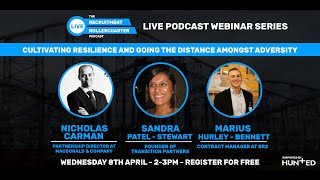
In this live YouTube podcast hosted by Hishem Azzouz, three recruitment leaders – Sandra Patel‑Stewart (Transition Partners), Nick (McDonnell Company), and Marius (SR2) – discuss how the COVID‑19 crisis has upended the UK recruitment market and share the tactics they are using to keep their businesses afloat. The panel notes a dramatic 80‑90% drop‑off in job openings, but also signs of gradual recovery. They describe the shift to remote hiring and onboarding, the personal challenges of working from home with families, and the importance of keeping teams motivated through reduced targets, daily Zoom stand‑ups, virtual social events, and one‑to‑one coaching. Business development has moved to virtual webinars, leadership podcasts, targeted outreach using public‑sector spend data, and offering free value‑added services such as CV‑MOTs, LinkedIn branding, training, and psychometric testing. Pricing flexibility – reduced fees, payment plans, retainers – is used to retain clients, while maintaining strong relationships through frequent communication and transparency about market conditions. The panel also advises recruiters to focus on quality client relationships, be consultative, and view the crisis as an opportunity to build habits that will pay off long‑term. They highlight emerging opportunities in tech‑health, remote‑first companies, public‑sector contracts, and e‑learning, and encourage newcomers to join the industry now to develop resilient habits.
Chapters
Good afternoon everyone, thank you for joining us for another live podcast webinar. I hope you're all well, hope your families are healthy, and we're getting through this together. So thank you for joining us. Where we're going to start is to do some introductions. However, I just wanted to help you all out in terms of how you can engage with the great panelists that we have today. So there's a few ways that we're going to do this today. So the first one is going to be using the Q&A section, which some of you are already using. So Joe Stacy is putting afternoon, Hishem Azzouz. If we can basically use that Q&A section for all of you guys to submit questions, then that's where you want to put your questions as we're going through this. And if there's questions that you really like and what people submit, then what you can do is click upvote like I just have on Jack Pryor's point there. Then we're going to make sure that we get those questions answered. That's the first thing. And then what we're going to do shortly after the panelists have introduced themselves, and we're going to do a very quick poll just to help us understand and the panelists understand exactly who's attending today to make sure that all of you get as much value out of this webinar as possible. So if we start with introductions, Sandra, if you go first and let everyone know a bit about you, and then we can go on to Marisa and Nick.
Yep. Hi everyone, I'm Sandra Patel-Stewart, CEO and founder of Transition Partners. I founded the business in 2011. We recruit permanent and contract across technology, digital, and business transformation UK-wide. We're based in Leeds, and we've got 19 staff. And a couple of years ago, or just under 2 years ago, we set up operations in Germany, in Berlin, where we currently recruit tech.
Amazing, thank you, Sandra. Nick, if you go next.
So I work for a company called McDonnell Company. My title is partnership director, And in the UK, we've got 65 consultants and 120 around the world.
Cool. And your sector is real estate and property. And you're perm recruiters, aren't you?
Predominantly perm, yeah. Cool.
And last but not least, Marius.
Yes. Hi guys. This is Marius from SR2. It stands for Socially Responsible Recruitment. We're just over 2 years old, like an IT recruitment startup. Recruit across the software development lifecycle. Mainly UK contracts and perm, but similar to Sandra, we've also just started recruiting in Berlin as well.
Okay, cool. And then I think just to add to the context of that, Maris, you manage a small team as well, don't you?
Yeah, 5 people.
5 people. And then Sandra, obviously you're one of the founders, so you're managing people in your business at the moment. And then Nick, you haven't got the luxury of managing a team, have you?
No, so I handed back my team about 12 months ago. Yeah, I'm sort of sole responsible for new business.
Cool.
So what we're going to do now, guys, is I'm going to submit a very quick poll and this is going to help us understand exactly who's joining us today. So the first one, which all of you should appear for you now, which is how experienced are you? So if you could let us know exactly how experienced you are and what— and as we're doing that, I'm going to ask these guys some questions and then this can help give them some context for when we think about answers. But the first thing, let's just set the scene, guys. How have the last couple of days been? What's been going on in your worlds?
I'm happy to kick off. So I'd say, so I'd say what I'm finding maybe over the last few days is that companies have almost, I guess, accepted the fact that like COVID-19 is here to stay for the foreseeable, and there does need to be a bit of a change in terms of how we do things and there seems to be a lot of content on LinkedIn and a lot of content out there. So it's talking about remote hiring processes and onboarding. And I think clients are starting to kind of buy into that and accept that. So I'd say it kind of dropped off drastically, but I'd say now in terms of like adverts I'm seeing and clients I'm speaking to, albeit it's still quiet, I think the market is improving, albeit like a small amount.
Yes, I've definitely found people moving into this sort of acceptance mindset. Whereas a few, couple of weeks ago, it was very much watching the news, what's going on, how things are going to change, etc. How have you guys found it, Sandra and Nick?
Yeah, we certainly, over the last kind of 3 or 4 days actually, found that things are starting to settle down, and the conversations that I've been having with clients and candidates are more, you know, everyone's kind of got into their routines, and it's more like you say, that acceptance stage now. Yeah, we've had Like most businesses, we've probably had about 80-85% of our work drop off, but we've been quite lucky with a couple of clients that have kind of kept us moving really. And so we've actually, last 3 or 4 days, I think we've closed about 3 or 4 offers, which is great. I'm certainly finding that things are starting to settle down a little bit, albeit who knows what's going to happen in the next few weeks.
Nick, anything to add, or has it been similar?
Yeah, very similar. This week the honeymoon period is over, I think, for us and everyone at home. So there is definitely a period where we're getting used to it, getting back into their routine. So hopefully some of those decisions are going to move forward to recruitment pretty soon. But we've been surprised, there are still pockets of activity. So just like Sandra said, we had a massive sort of pause of activity immediately, a shock reaction. But what happens in the next 2, 3, 4 weeks is going to be really interesting.
Okay, cool. So just to give you guys context, so 39 people with us today have got over 5 years experience, 3 to 5 years experience, 13, and then the rest of the people fall into the sort of 1 year to 5 year category. So the final poll, guys, which is just going to really help us with this, is it was just going to be really worth us knowing if you're currently on furlough or working. I think that's going to be really useful for us to know when we're talking about how these guys are adapting. Obviously, Marius, Sandra, and Nick are very much still working. But I've just opened up that poll, and it'd be great for all of you to know. I mean, the majority of people that have responded already— yeah, I mean, pretty much everyone with us today, guys, are still working. They are in the trenches, right? And this is why I wanted you guys on, because you guys are still very much in the trenches. Having to rise to the occasion and weather this storm. So I guess just for everyone's benefit, I know you just touched on it a bit there, but like how much percentage-wise, what are we talking in terms of live jobs being dropped? So like what are you got, what are the current opportunities for you guys to set the scene for everyone? What does that currently look like? So Sandra, what did you say?
We've probably had about 85 to 90% drop-off.
Drop-off, yeah, okay. Is that, I know Nick, we were talking before, it was about 80% for you. In terms of like immediately 80%? Yeah, yeah, in days. Yeah.
And then thankfully over the past 2 weeks that we've seen then, uh, several of those clients move from being on some freeze to moving forward.
Yeah, okay, cool. Marius, what about you? Obviously contract recruiter, so obviously in terms of new, new opportunities, new projects?
Yeah, I mean, I would say there hasn't been a lot of stuff that's been like pulled, but I'd say like in terms of actual maybe like our bigger clients that were giving us lots and lots of jobs and were very active before, there's a few of those that just like completely stopped.
Okay.
Yeah.
Okay, cool. So look, the first question I want to ask before we go into the audience's questions, that some of the ones that people submitted, is what have you guys found most challenging so far? What has been really difficult for you so far in the last couple of weeks since this has been going on?
For us personally or as a business and a team?
Either or, I don't mind.
Okay, um, so I've got two. First of all is, um, I'm a mum of, um, I've got a 4-and-a-half-year-old, and my husband runs and owns a recruitment business as well.
Wow.
Luckily he's in the healthcare industry, so he's been pretty busy, um, but the problem that we've had and where I've struggled is for us both managing working at the same time and keeping our son entertained. So, um, yeah, for the first 2-3 days we were literally at loggerheads. Like, I thought I was gonna—
really? What's been like— what's really helped through that?
What really helped, um, is we put a schedule together, um, getting ourselves organized. And we literally like have like 2-3 hour blocks throughout the day where one of us will be working and one will be looking after my son. And then I'm having to do more in the evenings, but, you know, I don't really mind. I've done that quite a bit in the past. And to be fair, let's face it, we haven't really got anything to do at the moment.
Okay, cool. What's been the second challenge?
The second, I would say, is, which I think we've done a lot of good stuff around this, and I'm happy to talk about this in more detail later on, is motivating the people. I think going back to your, one of your questions around business development, I think encouraging and supporting and motivating the people is anyone's, like, key to business development right now.
Okay, cool. So we'll definitely dive into that, but definitely been a challenge to making sure that your guys are motivated up for it. Okay, cool. What about you, Nick? What's been the most challenging for you so far?
So personally, like Sandra, dealing with children at home and sharing an office with your wife.
What does your wife do? She's in recruitment?
Financial services.
Okay.
So she shouts at me for being too noisy on the phone. I shout at her because she types really angrily. So, yeah, it's just— there's no real escape from work now. There's no office, there's no commute to break it all up. So that's what we've both struggled with the past couple of weeks.
How have you found switching off? Sorry, just to jump in there, because that's I've definitely found that hard.
I don't think we have. So the laptop stays open 24/7. So we'll do something in the morning while someone's making breakfast and then we'll go back and then equally bedtime comes and then you'll check it before you go to bed. So yeah, as regards to switching off, it's very different. But then I can't work a solid 9 or 8 hours a day So you've got to compensate.
Yeah, cool. Marius, what's been the most challenging for you?
I'd say pretty similar to Sandra, actually. I think probably from like a motivation point of view of the team, we've like put together like some small incentives that we can run, but we might be having some like good wins throughout the day. And then we've had a few cases where people we've recently placed have been given like notice, for example, and you've got a new consultant who's just done a few deals and he's been told that a few of his guys are like a few weeks in and just obviously going offsite. Where it's like a 6-month project. So I'd say, I guess, just trying to manage that and motivate people. And when they're having conversations with candidates and who are painting quite a bleak picture of the market, it's like, and you're not sat next to them, you can't have that kind of conversation or coffee with them. How do you, I guess, keep them motivated and like, I guess, kind of manage them through that period is probably the trickiest.
Okay, so just very quickly, Jeremy has asked an absolute cracker of a question, which I'll ask in a sec. But just quickly, as we're talking about managing teams, I want to make sure that we touch on it because I feel like a lot of conversations I'm having and some of the questions that come through, that's been a common challenge. But what's been the sort of thing that you've done so far that's been the most impactful on the motivation on the team, do you think? Has it been, I don't know, having the morning stand-up all the time or opening up the transition partners Zoom pub on Friday? I don't know.
What's—
from both your perspectives, what's been the most what's had the most impact on motivating your teams?
The team might disagree, but I'd like to think— I mean, obviously we're doing a lot of Zooms and I'm trying to have as much one-on-one contact with the guys where I can as well. I think initially when this all kicked off, the one thing that we did was we said, right, we're going to take away personal targets, individual targets for now. They're all going to be KPIs, and I try to take the pressure off them as much as possible. Like, for the next quarter, probably it looks— it's looking like it's going to be almost a full quarter. So we said, right, for the next quarter, we looked at what everybody's— if we added all the targets together, what that would look like. We reduced it 50% or something like that, and we just said, right, we're going to have a team target. Um, so we're all basically working together as one big team. I mean, it's easier for us to do that because there's only 19 of us. Yeah, so we're all working together as one big team. We get a role in, we've got more than one person, more than one consultant working that role, um, and between the consultants they agree their approach, how they work, who does what, who does job boards, LinkedIn, etc. Between them they agree on splits and things like that. And, and I, I think that that's had an impact.
Yeah, that's interesting. And then have you changed, have you changed like the commission structure or anything like that, or is it? No, it's not really. Okay, yeah, interesting. Marius, what about you? What's been really impactful?
I think it's hard to say like one, like one particular thing, but I'd say a few things we've done. We've done like the Zoom stand-ups in like the morning and lunchtime. We've done like a virtual pub quiz, for example, and like got everyone together to do that, which is quite nice. Then we've also said from like a contract perspective, like where we might have had quite strict verticals before, just to free that up a little bit. And if you've got clients you've got good relationships with, you've placed with before, and you've got good rules of engagement, then you can work on like permanent positions as well.
Okay.
So just, I guess, freeing up those rules a little bit and just trying to really share the wins as well.
Yeah, yeah, a bit more flexible with what they can focus on, or—
Yeah, yeah.
Okay, yeah, let's get to Jeremy's question then because I think that is an absolute cracker. Like, if you guys could go back in time 6 months knowing that COVID crisis was going to happen, what would you change in business practices to be better protected? That's— what a great question. What comes to mind for people on that?
Maybe like the sector, like focusing on— if we could probably see this like 6 months ago, then you may be like your Ocados, your like Tesco, Sainsbury's, all these like retailers that have got online shopping platforms. If you could wrap all those guys up, I imagine they'd just getting busier and busier.
Yeah.
Yeah.
Okay.
That's interesting. Nick, what do you think? Because I think obviously you, for you to start, obviously you're in the real estate world, right? So like what comes to mind for you when, when we look at Jeremy's question?
I think it's a really tough question because If we think about this as like another recession, you know, what would you do to really sort of steel yourself through? You could, like Maris said, you could look at other sectors, but ultimately I think you want to make sure that all the basics are in place, the team's gelling nicely, information sharing freely, there is a really strong incentive about building and developing client relationships. And fortunately, I think a lot of that was already in place. We've just got to do a little bit more of it now.
Yeah, no, I really like that. I think what, what, what we discussed in a previous, um, uh, podcast, um, on, on here was I think a lot of, um, recruiters going into this potentially have laid their bed. Like, if there was someone that wasn't too bothered about relationships, was really quite transactional, to really start forming these relationships and doubling down on those and building new relationships can be even more difficult, right? So I guess that's part of what you're touching on there, Nick. And one of the questions that I wanted to just sort of expand on that, which came from a chap called Jake Major, was sort of what are your guys' tips for progressing transactional relationships through this period to more meaningful ones right now? How can people go about to start forming meaningful relationships?
I'll take that one. So a transactional relationship, as it suggests, is about transaction. It's about providing a service that fits, that fits the right time for the right price. Well, now we've got an opportunity to improve those by just being a lot more personal. We're seeing each other in our, in our bedrooms, in our lounges, our kitchen rooms. Talking about people's kids, what they've been up to. So it's actually a lot easier to build relationships, I think, right now because we've got a lot more in common. So focusing on that, focusing on how you're developing those relationships by making sure they see you as a person, I think it's going to be really important.
Okay. Anything else to add, guys, to that?
One of the things that I've been doing and some of our guys have been doing that face out to clients is offering different services.
Okay.
So I guess some of it's not different services in that offering, just letting our network know and our clients and candidates know that we are out here, we're here to support, we're here to help everyone, we're all in the same boat. And so we've put together, I've been sending out as a CEO, I've been sending out to all our clients, anyone that we've ever had terms in place with, I've been sending out a newsletter and an email offering, just reminding them what services that we can offer, but also offering things like, I've been offering training and free webinars to internal recruitment teams.
Awesome.
I've been offering, we've been offering CV MOTs and like branding for LinkedIn. And because we do a lot online, we do a lot around podcasts and videos and ensuring that all our LinkedIn posts and things like that are in brand.
Yeah.
And so we've been offering help to help, you know, candidates, clients rebrand and rework their LinkedIn profiles, outplacement opportunities, and helping with furloughed teams. I spoke to a client yesterday, actually, for about half an hour, and that was a client who initially didn't put their recruitment on hold, but they were consultancy, so fortunately over the last week or two, they've realized that they need to, they've got people on the bench now, so they've had to put recruitment on hold. And when I spoke to him about the newsletter, and then I followed ended up with an email and sent him the newsletter, and he said, actually, that some of that might come in useful, and he said some of our business dev guys might benefit from a bit of training and a bit of support.
Awesome.
So, it's just, I guess, it's just getting that out there and getting the support out there and the personal element out there, building and cementing those relationships. So, our clients, candidates, senior candidates, they know that in 2-3 months' time, when things change and we're all back, you know, we're at, you know, back to full kind of full steam ahead, that they'll remember what you did for them and what you tried to do for them. And I think that's important. Like, I think that's a key business development right now.
So some of your services haven't been more on services to monetize, but more to pay it forward, give real value, which we're playing the long game here, right?
We've even said, um, like, if a client, um, has a role that's not within our sector, and that we've got the staff, we've got the capacity and capability to deliver, and we'll do it at a highly reduced fee.
Okay, interesting.
Like a payroll or finance, HR, any office admin type position, and just to help them out. And, okay, you know, we all need— everyone needs help right now, don't they? So it's about creating that kind of community and support where we can.
Nick, Maris, have you— I don't know, over the last couple of weeks or so, we've seen opportunities to deliver value if that's for a service or not a service. Have you guys done anything that, yeah, is a slightly different approach in terms of services that you can offer for clients and candidates that's helped?
I mean, I'd say one is like quite specific to consultancies. We support consultancies like obviously when they win the work, but sometimes when they're actually like putting together teams for bids and almost providing like a bit of a virtual bench. And consultancies that are a bit smaller that might want to bid for large pieces of work in like public sector. They might not have the capacity to like provide the team up front, so we can basically put together like a mock team, if you like, and they can then present that to the client. And if the client's comfortable with that, they might say, I'm happy to give you the work. And at that point, we can obviously help them fill the roles. That's something we've done for a while, but quite like a nice value add. And if they further people the bench, maybe it's not as strong as it usually is. We can give them that opportunity.
What about you, Nick? Have you seen any opportunities?
So, similar to Sandra about deepening relationships, working with people who you enjoy working with already, so that means sort of broadening the roles you might have considered before or might want to add value to, but also around whilst these clients are getting to testing themselves on video interviewing, people don't trust it yet, they feel very unfamiliar, so everything from helping them get set setup, yeah, through to maybe offering different ways to assess. So using personality and psychometric testing so that these clients can then have another layer of testing, another layer of assessment, so that they feel comfortable making a hiring decision without having ever met someone.
Yeah, wow, that's, that's really interesting. So I guess what I'd love to sort of segue this into, because I think this ties quite nicely into it, is one of the most popular questions that people submitted is definitely around business development. Um, so I guess like one of the questions that was, um, put through by Nathaniel Smith, which was what methods of business development do people feel is best suited to the current situation. I guess some of the things that you're touching on, Sandra, which I've been speaking to about that's been effective, is leading with, hey, Mr. or Mrs. Client, we're running this webinar or doing this you've been speaking to a lot of people that have similar challenges, I'd like to think you'd find it useful. How open would you be to getting involved, whatever? That, that enabled you to have some good biz development activity. But how, how, how are you guys approaching it and what, what are you finding that's working or helping?
So we've, we've, um, so we used to, before COVID-19, we used to do a lot of, um, meetups, um, doing about 25 to 30 a year.
Okay.
We had, I think, probably about 3 or 4 booked in that we had to cancel.
Yeah.
And so in the last week or two, we've started setting them up so that we can run them virtually. And same with regards to, we've set up myself and Ellie Greeney, one of the other directors, she'd been running a WIP podcast, which I think you helped us with, didn't you?
Yeah, yeah.
Going on that. And so we'd set up a leadership podcast for C-level stakeholders. And so we decided to just keep running with that as well. We just thought, well, I know we can't do it face-to-face, but why does it have to stop?
So, um, so how has that helped?
Two avenues. And that's really helped me. I reached out to a CIO of quite a decent-sized technology business the other week, and we've got booked in in a couple of weeks, another consultancy. That we've been trying to make inroads in with for some time. We're doing a podcast with them, with like one of the owners next week.
Okay.
So that's working. And what we've said to our guys is, and what I said actually only today on a Zoom meeting with our guys is, I said, look, we'll put the email together, we'll give you all the information and the branding. Literally all you need to do is put the target list of companies together approach, see the C-level, the guys at the top, book the podcasting, we'll do the rest. We get business out of that further down the line. That's your client and that's your BD.
Awesome, smart. Marius, what are you doing? What are you finding that's working?
So I'd say again, similar to Sandra, we run like a Leaders in Tech meetup in Bristol and London, and that historically has been really helpful in terms of like building relationships with key stakeholders, having like a different reason to approach them. But I'd say now, I think for me it's just about trying to be like quite smart with the way that you approach business development. So I do quite a lot of stuff in the public sector and there's that information available online that basically outlines all of the spend in the sector. So you can actually look at all of the companies that have won work recently, what they've won, the kind of teams they're going to need to build. That's all publicly available. So then the companies you're calling, you're fully aware that they've got to recruit X, Y, and Z, and you're speaking to people that regardless of COVID-19 or not, they've committed to delivering certain things. So I guess it's almost like less is more and just trying to target the business development or clients that you know are going to be busy in the climate regardless of everything else that's going on.
Smart.
Yeah, smart.
Yeah, the only other thing I'd say is trying to be a bit more like recruitment consultant, be quite consultative. So instead of thinking quite narrow-minded and just like about a single job, you want to be trying to think about the business as a whole and think you're speaking to a CTO. If he's furloughed his team, if he's got deliverables, well, what's he committed to? Just trying to think of the business as more of a whole, whole, whole picture and understand the company's problems. And then based on that, you might be able to identify opportunities that are not actual job roles. You might be able to sell contracts and everything else. So I think just trying to think a bit more commercially with it all.
Yeah, smart. Nick, what about you? Because obviously you're in a position which is completely focused on developing relationships, business development. So what, what are you finding that's working for you, Nick, besides staying in touch with existing clients and these types of things?
Uh, well, you see, you say apart from— that's it. There's no real secret to it. The key which, you know, people will be really— you know, and there will be people who will be successful throughout this, and they'll be strong on the other side, is the people who build the really, really strong relationships with those clients and candidates. So to answer your question, I think sort of what we explain to people who haven't been through tough times before, who've only been recruiting maybe the last 2 or 3 years, is you need to change your mindset about what you're looking to get out of this. Forget the idea of making 5 telephone calls and on the third one I'll pick up a job. Right now, your target is to speak to as many people as possible, learn as much from every call you can. Forget about if you think they're a client or a candidate. You want to find out market information, what's happening in their organisation. Are they contracting? Are they growing? What areas are improving? And then keep building this up and keep talking to colleagues to share this information. And the freer that information flows, the much easier it is then to develop that client base.
So change the expectations of what a successful business development call looks like is going to be really key to helping. I think that's obviously what you're touching on as well, Marius, isn't it? In terms of just being more commercially minded and—
Yeah, absolutely.
Yeah. So, so I'm going to attempt— So sorry if I pronounce your name wrong, Tanuja, apologies if that's wrong, but really interesting question there. I think it's safe to say that businesses that you have been speaking to have been reducing costs, etc. So The question would be good to get your thoughts on is, with reduced numbers of active jobs, roles getting on hold, the role of an agency recruiter is going to become more challenging. Obviously, companies tend to cut on costs and count on internal recruiters. What are you guys doing to try and ensure that, I guess, that sort of your service and what you do remains really valuable? So what do you think about that?
Personally, I think sort of an internal recruiter is that their role is getting tougher as, as really businesses sort of bring down the volume of hiring. I think, I think they're in more risk of being on furlough because suddenly it's easier just to use a consultant to support you on a much smaller number. There's a lot less farming that's needed by an internal recruiter, so I think keep, keep really close to all your relationships, whether they are internal recruitment, HR, line managers, C-suite, whatever it may well be. And I think that will hold you in really good stead.
Interesting. Anything to add to that, guys?
Um, I mean, I'd say maybe look at the clients you've had like good relationships with historically, and if they are maybe smaller companies that are struggling with cash flow, for example, and they're asking you to reduce fees, I think you just want to try and be pragmatic. And if the good rules of engagement are there, and if you know they're going to pay in the long run and they've maybe got a history of you working together, then I think it's definitely worth exploring creative solutions and maybe that's an opportunity to have a conversation, a segue into more exclusivity and everything else.
Good rules of engagement. You said that a couple of times.
What do you mean by that? So I'd say for me, like, I think now is the time to maybe worry about like the volume of jobs you have a bit less and more about that kind of the quality of the jobs. Yeah. I mean, if you've got 10 jobs that with a big PSL and you're dealing with a portal and you haven't really got much opportunity to speak to line managers, it's obviously almost, it's quite, your percentage of filling the role quite low. Whereas if you've got a client you place a number of people with and you understand the business and you have direct contact with managers, for me, I'd rather have maybe 1 or 2 of those jobs than 10 to 15 jobs that are just sat in the portal. So I think maybe identifying the clients where you've got good hit rates, good ratios, and then spending more time with those.
Nice.
I agree, and I think there's probably a couple of different options that you could look at. I mean, one actually that you touched on earlier, Hishem, is around payment, you know, consider, like Mari said, have a conversation, pick up the phone, have a conversation with them. There's different options, things that you can discuss, like potential payment plans. You could ask them to commit and agree to SLAs for reduction in fees. So if you are having to reduce the fees. Um, I would just, you know, kind of remember that we're all in the same boat here. We're all trying to survive. Um, so, you know, try and come up with a compromise that's fair, because doing that now will stand you in good stand longer term, and you'll be remembered for that. Things pick up and there's volume recruitment there, you're more likely to get that on an exclusive basis. Um, Definitely like payment plans or even retainers as well. Ask for part of the fee upfront. And so you'll reduce the fee if you can have, say, 25% on engagement and split it into chunks throughout the process.
Sure. I think this goes quite nicely into Sophie's question around— I mean, I think I'm sure you've all seen that people offering free services these types of things, like what are your guys' thoughts on offering free recruitment services and placing people for free? What do you think about that?
I think you've got to value the kind of service you're offering. So I wouldn't say you want to be doing stuff for free because I imagine if they've got customers, they're not going to be doing stuff for free there either. So I'd say, I'd say, like, again, you just want to try and be pragmatic. And if that's the conversation that they're maybe like teeing up, then you can, like Sandra said, talk about payment plan or talk about maybe some slightly different arrangement that is more like cost-effective for them. But I think if you're recruiting for free, then yeah, I think you've got to value your time a bit more.
Yeah, for sure. What I'd like to get some of your thoughts on, because I had quite a few questions around this, just around basically just being really effective and how your days have changed and sort of working out what you should be prioritising over other things. So One of the questions I got from Joe Bungee, hopefully I pronounce your surname right. It was, how has your day plan changed as a result of this? What new activities are you planning into your week? What do you think about that?
Mine's got simpler.
Okay.
It's a lot of outbound activity. It's a lot more telephone calls and listening, really, really listening to what's going on. Because often that will inform then what happens, whether it's that afternoon or later that week or later that month. So we have a lot less strategy meetings, a lot less internal meetings now, which is one nice plus. And it's just got a lot simpler.
Okay, interesting. Marius, Sandra?
I'd say certainly for the guys that are more hands-on, and I guess we've got quite a lot of recruiters on here that have probably in that 1-year, 1-5-year kind of bracket, is being on the phones a lot more. And I've certainly experienced with some of our guys, they've never had to work in a market where you haven't been calling a candidate about a job, so they're now having to call candidates when they don't really have anything to offer them. And I think, I think some of our guys and a lot of the recruiters that are still working have struggled with that. And certainly our daily activities have changed more towards working through our database, working through all those candidates at the moment that are unstable, unsure about their role, or they had a new role before all this started and the role's been retracted. So we're certainly spending a lot more time on the phone speaking to candidates that are stuck looking for work, out of work, a lot of contractors as well. I don't know if you're finding that, Marius, there's a lot of contractors at the moment out of work.
Yeah, yeah.
So just trying to do everything we can for our candidates really at the moment.
Okay, Marius, anything to add? What have sort of become the non-negotiables for you in your day plans?
I'd say probably it's been more like client-focused, I think, whereas before maybe I spent a lot of time as a contract recruiter like speaking to candidates, trying to get leads, trying to find out lots of information. Like Sandra said, if you haven't got lots of active jobs to speak to people about and the kind of outlook is quite bleak, then it's quite, it's quite a tough exercise to do. So I'd say, yeah, be more client-focused. And I think I just mentioned before, but just trying to think about like the data, like obviously the IF35 like OffPayroll, for example, they keep posting lists of all companies that have basically got rid of those contracts to IR35 and now they've got to hire them back in. So again, maybe you're just trying to think outside the box a little bit and thinking, oh, there's a great list of people I should be calling because they are going to now have to hire people. Yeah. So, okay.
So, so, um, Nick, let me start with you on this. So I was having this conversation the other day. So as you were saying, your day plans are coming a lot more simpler. A lot of outbound calls, speaking to people, listening, blah, blah, blah. How are you dealing with, like, you'll know, being a good recruiter and for doing it how long you've been doing it for, you will know that typically the outputs that you're putting in right now will typically lead to X outcome, right? And I'm sure that the outputs you're putting in now, because of the climate, because of the landscape, what's going on, you're not getting the outcomes that you may expect or that you would have got, let's say, a couple of months ago, whatever. So mentally, how are you dealing with that? Because I feel like a lot of people are going through that. People are trying even more or having to make more phone calls than they have had before, having to do these things, putting in the output, but they're not getting the outcomes that they would typically get. And that can be quite a struggle to deal with that. So how have you been dealing with that? And I don't know, anything to add on that?
I don't have any real deep and meaningful answer for you. Conversion numbers have gone right down. Yeah, the way in which we've handled it is we've got a good news WhatsApp channel. Nice. Yeah, I think we all sometimes need a bit of sort of reassurance or a pat on the back when, when something goes our way. And, you know, a few months ago that might have been doing a deal, you know, but right, right now sort of good news counts as having a really positive call, picking up a lead, you know, having, uh, having then sort of, um, a bit of industry knowledge then to pick up and come through. So as I mentioned before, the target of what you're looking to get out of each call has changed, but the buzz of getting positivity hasn't changed. We still want that reassurance, we still want that sort of recognition. And so it's up to sort of business leaders and companies then to make sure they're there to recognize that.
Yeah, so celebrating maybe the— a couple of months ago would be seen as smaller wins, But having a place where you can celebrate those. Yeah, I love that. That's awesome.
It's one step along that journey. The more information you collect, the more leads, the more positive clients, and right through to, you know, we've had an exercise recently on sort of boosting sort of testimonials. We all know how important these are. We've, you know, we've all got a handful across our website, across our branding. But right now, it's a real time to get in touch with those clients who you have done a great job with past 12 months and saying, 'Right, now's the time I could really do with that help. Would you mind then give me something for that?' And whether it's on LinkedIn or whether it's offline, now's the time then to be asking.
Yeah, no, love that. That's amazing. Sandra, anything to add? Because I think that's quite interesting to get your thoughts on that.
Well, we use Slack and we've got— we're very similar to you really, Nick, in that we, you know, any— I guess what's considered now as a positive or big win is you know, even things like, like you say, like a positive conversation or someone took the lead and, you know, and it's like we're all celebrating it. And I think the main thing is looking, is supporting the people and helping them with their mindset. It's a mindset thing. So we've been doing things like we've obviously, we're having daily morning stand-ups, like Zoom meetings. We've got a coach that we've used for about 6 months, Toni Coccozza. Some of you may know of her.
Yeah.
And she's been helping us out tremendously. She's been doing one-to-one coaching with the guys. I've been contacting some really decent— like, there's a lot of trainers out there that are offering free training.
Yeah.
And our guys are absolutely loving that. And it's just, I think, ensuring that the people are happy then breathes and that mindset and keeps them motivated and keeps them cracking on and hammering the phones as much as they can. And even simple things like yesterday, the sun— I mean, the sun's been out all week, hasn't it? And yesterday they were all chatting on Slack about the sunshine at lunchtime. And I said, you know what? I said, guys, crack on solidly for 2 hours, focus, and you can all finish at 4 and go and enjoy the sunshine.
Yeah.
And I just think things like that, no matter how many knockbacks you get, we, I touch wood, I feel like our guys, our team, the team, we're all really, really pulling together and, you know, and overcoming those obstacles as best we can and we're doing it together.
I like that. Do you think your business has got closer?
Yeah, 100%, definitely, yeah.
That's interesting, right?
Internally and external.
Yeah. Yeah, and that's interesting, that's true for a lot of businesses at the moment. I think, I think, I think there's going to be a lot of positives actually that come out of this moving forwards. I think a lot more businesses will be open-minded to homeworking and flexibility and will be more trustworthy as well. And I think there'll be a lot of positive changes that come out of this.
What, what do we think will be some of the, um, Well, I had a question for you from, um, Ryan Jacewell. Apologies if that pronounced that surname wrong. But like, what do you think, just on that, like coming out of this, the other side of this, how— what do we think some of the challenges will be for recruiters when we're sort of bouncing back, um, into the market?
Probably not to get complacent. The We've been forced into this situation, no one's chosen this situation, so we're all adapting because of that, and what we don't want to do is go back to some old habits. So if you were a junior recruiter whereby some of your relationships were quite shallow, you'll spend the next few months, maybe longer, about trying to develop those. Don't forget that when we are opening offices back, when we are going back to what we think was what used to be considered normal. Make sure you continue that attitude of just treating just how important these relationships are and building on those.
I like that. That's really— don't get complacent. Marius, anything to add? What do you think would be some of the challenges bouncing back out of this?
I'd say, yeah, I think don't get complacent is a really good one. Maybe on a more like personal level, if people haven't been out, left outside the house for like 3 months and then they've got come back into recruitment, maybe work's not gonna be the number one priority.
I don't know. That's fair enough. So just a quick one. I think just to build on, I think Marisson, Sandra, you're saying about definitely noticing a lot more candidates out of work, these types of things. So one of the questions that Ashley Davis submitted, which was, how are you approaching conversation with candidates that are wanting something immediate but the opportunities that live aren't suitable for them. I'm sure you might be having a lot of these conversations where a lot of these candidates, you can't help them. So, like, I don't know, how are you managing that? Because I'm sure there's a lot more of that going on than usual.
I mean, I've been having conversations with candidates directly. I mean, I don't always get involved at that level anymore, although I do always try and lead from the front, so I'm still quite hands-on. And the conversations I've been having, I've just been very open and honest. Yeah, I've been really, really open and honest about what we're experiencing and the drop-off rate of roles, you know, which of our clients are still hiring, but unfortunately there's, you know, there's a limited and reduced number of roles available. And what I said to them is, whether it's been a conversation over LinkedIn, I've said, look, I'm more than happy to speak to you and have a conversation with you to see if I can help you in any way, shape, or form. Or if I'm on the phone to them, I've been saying, you know, that I'm more than happy to help you with your CV, see if there's anything I can do with your CV, LinkedIn profile, why don't you write a post, or I can write a post for you, and if we do a quick interview now and then I'll put a post together that sells you and your experience and what you've done and I'll post it to my network, I'll get all my colleagues to share it, and so a lot of our guys have been doing the same with candidates, we've been sharing profiles, looking for work and out of work. Um, we've offered to speak to our contacts and networks just to see if there's anything that they can help them with. And obviously, you know, there could be some free placements that slip through there, but at the end of the day, I'd rather do what we can do to support those guys that, you know, they've— they've— we've all got families, we've all got other mouths to feed and families to support. We all need to survive.
Yeah.
And I think it's about creating that community feel, helping each other, and You know, I spoke to a BA contractor in Milton Keynes the other day, and I'll be honest, I've got no chance in hell of finding her a role and placing her, but I spoke for like 15 minutes. She's on her own as well, living on her own, and she just really, really appreciated having a chat with me.
Yeah.
And I just said, look, I'm happy to do a post for you. And she said, you know what, I'm going to write my own, but will you look at it before I post it? So I had a look at it, changed it around a bit for her. She posted it and then she sent me the link and I shared it to my network. It's just being, yeah, and open and doing what you can, I guess. That's all we can do.
Maris, anything to add to that, or have you been sort of having similar conversations?
Yeah, I think similar conversations. I think candidates are a bit more open to, when you're speaking to them about certain positions, maybe like spend a bit more time tailoring their CV and like writing cover sheets and maybe doing a bit of coaching around making them like, just maximising opportunities to gauge role. And I think also maybe like pointing them in the direction of companies that you're not maybe engaged with, you're not in the PSL, but you know they are hiring. So obviously that will come back around if you can help them.
Yeah, yeah. So even though, yeah, those people that you can't necessarily help in the short term, just trying to do your part because that will be remembered is a good way. Um, what about, what about, I mean, Louise Gilmore's, uh, question, and also Tanuja's. Maybe you can add some of this, what you've been hearing from your guys internally. But what, what about on the perm side? I feel like that could be more difficult, right? That there will be a lot of people that will be very cautious and uncertain about moving jobs in this time. Should, like, what, like, should people on a permanent basis, like, be moving right now? Like, how are you approaching that? Because I feel like a lot of people will think or assume that, yeah, they don't want to move or it's not the right thing to do. Like, how are you navigating through that? Because I'm sure that can be a real challenge for a lot of people right now on the perm side. Sorry, go on, Nat.
I tend to find that candidates are more bullish than employers. So I think the majority of candidates who I speak to are less concerned about that. They still feel this is a very short-term Okay, dip. And so the problems they might have been facing or the difficulties they might have been facing in their current role probably still exist. They might have gone on hold, but they, they don't feel that they're learning or they don't feel they're developing or they're paid correctly, whatever it may be. Yeah, they still exist. So yeah, having those honest conversations with them about really getting to the bottom of what they want to change I think it still holds true. As to how long it'll take for you to sort of make a change for them, no one knows that right now, do they?
Yeah.
But I would encourage them to embrace the situation and go along to a handful of video interviews. It's never been easier to go to an interview right now and learn what else might be out there and open up your eyes to how other organizations sort of ticks and how they might be handling certain situations. And it can only be a positive process that.
That's interesting. So what you're saying, Nick, is that those sort of motivations to want to leave or why you may be initially been speaking to these people, they still very much exist. And it's just making sure that those candidates on the perm side are just getting even more clarity on that. And I guess just digging a bit deeper because it's that— I think that's— I'd like to think that people are also taking that opportunity right now. They're going to have to really think about or getting the opportunity to think about their career, what they're doing, are they enjoying what they're doing and these sorts of things, you know what I mean? So that's interesting. Sandra, what are you finding, either yourself or with your guys on the sort of perm side, how are they approaching it?
Yeah, I mean, it's similar to Nick really. We have experienced a couple of candidates recently actually have been concerned about moving and that, you know, their wives have obviously been speaking to them about their concerns and And so, the recent situation we had, I just said, you know what, like, speak to the company directly. And I guess that's something that you can use in any market, in any situation, in any climate. But one thing that has worked for us recently is where we've got that direct engagement going between the client and the candidate, encouraging the candidate to speak to the client directly. About their future plans, their growth strategy, industry, doing your own research on the industry and the client as well. So, you know, obviously there are going to be some secrets. I've had some candidates that have said, you know what, I don't want to leave my team in the lurch right now. I'm really interested in the opportunity, really go for it, but I want to wait until all this is over. Be situations where, like, you can't really do a lot about it, but then I guess just see that as you're pipelining future.
Yeah, sure. Fair enough. Man, she just fall off your chair.
Um, I had to plug my laptop in.
I wondered where you went.
Yeah, cool.
So I guess, look, as we sort of come towards the end of this, um, let's just talk a bit about what, what we're all thinking about how this is planning out. Like, what's the current I mean, we've been in, what, in the UK it's coming to like the third week, isn't it, in terms of sort of lockdown. So I guess I think the businesses that I'm speaking to, recruiters I'm speaking to, I mean, they're reviewing this on a week, week by week basis, maybe even daily basis. But what are our current sort of thoughts towards where this is going and how it's going to pan out? What do we think? I know no one knows, but what's the current thought process?
I think you bet for the long term. That way you won't be disappointed.
What do you mean by that? Sorry.
I said I don't think this is going to end anytime soon.
Yeah.
And any change, it won't be an immediate turning back of the clock and everyone starts commuting back for all sectors. So I think probably the advice we give internally is, you know, let's assume we're in this for the long haul, and if it ends sooner than that, well, will we all be pleasantly surprised.
Marius, what are you thinking about?
It's hard to say, isn't it? I think reading the news, it's pretty depressing, really. Yeah. And you hear so many mixed views in terms of when lockdown is going to end and when it's all going to come back to normal. But I think one thing that will definitely change will be maybe, as Sitzu y Misandra said, like the attitude towards remote working, which I think could be quite a positive thing. And it might actually open up clients to a whole kind of new candidate pool, which maybe they haven't had access to before because they've been really rigid on 'need to be in the office 5 days a week, I need to see them.' So I guess the only silver lining is this maybe change of kind of attitude towards it as a whole. Yeah, yeah.
Sandra?
Actually might make hiring some businesses quicker and processes quicker moving forward. We've had a number of clients recently, and so one client recently, and they're onboarding 2 members of staff in April they've offered, and they're starting next month. Yeah, um, it'd be nice if we can have a bit more of that moving forward.
I think so. Out of you guys, who— so I think it's, it's interesting, right? Because I think there would have been a lot of people that would have been so like anti-work from home. Yeah, um, but obviously going into this, there's no other options. So like, like Maris, for you, for you, for example, like Before this, if I was to say, do you prefer work from home or in the office, what would you say?
Uh, definitely the office. Yeah, yeah, yeah, yeah, yeah.
Um, so I think that that's— what's that?
I definitely prefer the office. It's just nice. I love going in and seeing my team, and they just open me up if I'm in a shit mood before I get there. Yeah, I've had a— done a school run and, you know, trying to get out the door with kids. Yeah, it's just great seeing everyone and the banter that you get in the office. But we've always been really open to homeworking. Before we implemented 4-day working week, end of last year, but before we implemented that, we allowed up to 1 day a week homeworking. So we've always been open to it anyway, but I think majority of people prefer being in the office.
Nick, office or home?
I've always had a balance, so I used to spend at least one day a week from work, sorry, at home. And I think I look forward to rebalancing that.
So as we sort of finish this, where do we think the sort of pockets of opportunities are from what you're saying? And maybe specific to your sector or whatever, but on a sort of positive note, where do we think some of the opportunities are that you're seeing? Obviously, Sandra, you just said there that one of your clients is onboarding 2 people in April. That's amazing. But like, where do we— what sort of— where are the sort of pockets of opportunity, do we think, or the things that you're seeing and picking up on?
I'd go after tech within the healthcare industry.
Yeah, of course.
If you're into tech and it. And I'd also look at—
would you do that if you've never done that before?
Like, would you literally try and Or, I don't know, we're not specific to sector really, so yeah, fair enough. Most technology equipment businesses aren't, so yeah, you can, you can. And also remote companies that, um, already, particularly tech businesses that already operated remotely, um, because obviously they were all, they were already onboarding remotely and doing reviews and management meetings, etc., remotely, so there'll be no difference for those Marius, where are the sort of pockets of opportunity that you've seen?
Obviously, obviously I think public sectors helped, right?
Yeah, yeah, yeah, yeah. I mean, I'd say it's a mixed bag. Like, um, you know, I guess at HMRC, for example, they've obviously got all these different furloughs and all of these companies are expecting payment from them.
People build the furlough portal.
Yeah, yeah, absolutely. Um, so I think it's, yeah, just trying to think about stuff like that and, um, e-learning companies, companies like Zoom, obviously your online retailers like supermarkets, that type of stuff.
Nick, you're in real estate.
Well, I'd love to know how many marketing calls Zoom got the last two weeks.
Jesus Christ, did you see— has everyone seen the sort of the impacts and what their stock's been worth, what the shares— have you seen that? That's crazy. It's in terms of the last like month or so. The amount that that business is worth now, or it's increased, it's crazy. But Nick, what pockets of opportunity have you sort of identified or seen?
So I think probably anything I would say would be a bit too real estate, a bit too sector-focused. But the one thing I think a lot of our consultants have realised is how open people are and willing to help. And actually, I think that's always been the case. We just haven't always asked for their help. So right now, when you're working on maybe fewer jobs, make sure you enlist the help of every client you've ever had, every candidate you've ever spoken to, to help you fill those jobs by just simply asking them, this is what I've got. Do you know anyone? Who was the best person you've dealt with? And I think that will open up more doors for you there as well, because those clients will perceive you then as not only being busier than they expected, but then valuing their opinion and they'll want to come back and they'll want more of that.
Awesome. So Connor Kennedy just asked a question before we finish. So he's looking to come into the recruitment industry. Should he be trying to get into industry right now or wait?
I'd say if you can find a company that's hiring people, I'd say join now because if you can— If you can make it now and do deals in this climate, then when everything goes back to normal, you'll be flying. So yeah, it could be a good time, I believe.
And that— and if you join now, you won't be one of those consultants that becomes complacent, complacent, or— yeah, if you can crack it now, you'll be very, very successful.
Yeah, I think, I think this came up in one of the last ones when someone sort of asked this, and I sort of made this sort of just throwaway comment of yeah, you haven't been sort of dealt the best cards because they've been in obviously recruitment for a really short period and this has gone on. But one of the panelists really pushed back and said, well, actually, this is probably the best time that you could sort of earn your stripes and be in recruitment because the sort of activities, habits that you put into place now and cultivate will help you throughout the rest of your career. I think there's been loads of successful recruitment businesses born out of the '08 recession and challenging times like that. Um, so Connor, Go for it, I think is what we're saying, ain't we? Give it a go. So look, as we come to the end here, just want to say a huge thanks to Marius, Sandra, Nick. I've been very open, been very honest. Thank you for sharing. Hopefully all of you guys enjoyed that, got value out of it. So thank you so much for joining us. We'll be doing these obviously on a weekly basis. So if you enjoyed this, this is going to be here again next Wednesday. But just a huge thank you. So thanks again, Mari, Sandra, and Nick. Thanks for doing this. Thank you.
Thanks for having us.
You're welcome. Right, I'm going to end this now.
More from Hishem




You don't need as many clients as you think to bill $1 Million A Year In Recruitment



From 30 Direct Reports to Back-to-Back $1M Years as a Solo Recruiter with Zach Creighton



