LIVE Podcast with CEO of REC- Neil Carberry & Tony Bates
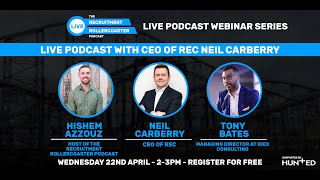
In this live podcast hosted by Hishem Azzouz, REC CEO Neil Carberry and co‑host Tony Bates discuss how the COVID‑19 pandemic is reshaping the UK recruitment sector. The conversation covers the REC’s role as a member‑owned federation, its intensive lobbying with government (including the furlough scheme, CBILS loan programme, business‑rates relief and sector‑specific regulations), and the surge in helpline demand from agencies seeking guidance. Practical advice is given on interpreting furlough rules, accessing government support, managing cash‑flow, and navigating serviced‑office lease issues. The panel also explores longer‑term industry trends such as consolidation, the shift toward professional‑services and digital models, niche specialisation, and the likely post‑COVID recovery timeline. Questions from the audience address topics like the future of regulation, the REC’s surveys, and how agency owners can sustain staff morale and client relationships during the crisis. The tone is conversational yet informative, with a supportive and cautiously optimistic sentiment toward the sector’s resilience.
Chapters
Good afternoon everyone and welcome to another live podcast webinar of The Recruitment Rollercoaster. Thank you for joining us today on a very, very sunny afternoon. So if you're outside in the garden, if you have a garden, hopefully you can be soaking up some vitamin D while you're enjoying this. So I'm delighted to be joined by and Tony Bates, who's going to be co-hosting this with me today.
Honored, honored, Hish.
Yeah, no, thank you, Tony. We'll do a very quick intro in a sec. And obviously delighted to be joined by Neil Carberry, CEO of Rec. And thanks for your time, Neil. We really appreciate it.
Hi, Hishem, Tony. Really pleased to be here. It's important that we all talk to each other in these changing times.
Most definitely. So very quickly before we do a very sort of quick intro, Just housekeeping for everyone, and I just want to let you all know how you can best engage with Neil and also me and Tony. So you'll have a couple of options at the top in the chat there where Marion and Liz have already messaged saying hi all. You're welcome to chat in there and speak. The next, the next panel is Q&A, and what you'll be able to do in there is submit your questions. So a big part of today is going to be all about getting your questions answered. And as we're talking, as we're chatting, you can use that Q&A function to submit your questions. And what you'll be able to do is click upvote on the questions that you'd love for us to ask, and we'll make sure we get those asked as well. So what I'm also going to do for all of you, just to help in terms of the context of what Neil can go into a bit more detail on or a bit less, is I'm going to submit a couple of polls in a second, which is just going to help us understand who, who's joining us today, um, to ensure that we give you as much value as possible. So Tony, let's just start with you very quickly, just, just for everyone's benefit, do a short intro, um, and then Neil, if you follow up with, um, yourself, and we'll go from there.
Yeah, so I'm Tony Bates, I'm managing director of a firm called IDEX Consulting. We have 45 staff. We cover financial services, general insurance, and legal with offices, 4 offices across the country: Birmingham, London, Manchester, and Glasgow. So Hishem's kindly invited me on after appearing on his podcast. So I'm keen to fire some questions your way, Neil, and appreciate you coming on to have a go at answering them if you can.
Yeah. And Neil, let's enlighten us all. CEO of Rec, what What do you guys do and what has been going on in Neil's world over the last couple of days?
That's a good question. CEO of the REC, look, the REC is the recruiters' organization, basically. I talk a lot about your REC when I'm talking to groups of recruiters because we're entirely owned by the members. That's 3,300 agencies and about 10,000 individuals. Wow.
And that's all in the UK, right? Sorry to butt in there.
Yeah, all in the UK, although I am on the board of an organization called the World Employment Confederation, which is the RECs from all the other countries. So we do a lot of stuff together globally as well, talking to the UN and other big opinion formers. But we're focused here in the UK, and we're all about making great work happen and the good that recruiters do. We as a sector, we open up opportunities for people and we help people grow their businesses. That's why I I thought I'd put my Love Your Work t-shirt on today. This is a campaign that was founded by our sister federation in Australia, the RCSA, and it is all about recruiter pride, and we should be proud. We do a great job. The REC is really here to help recruiters, so at the basic level, legal advice, training, qualifications. We run the awarding body for recruitment in the UK that gives out all the recruitment qualifications. But a really big part of what we do is also representing the industry to people outside recruitment. And strangely, that's been a bit busier than normal over the last few weeks. So our experience in the last couple of weeks has been of being massively busy. 300-400% of the demand on our time as normal, partially driven by huge numbers of calls to our helplines. From recruiters trying to work out how to access those government schemes, thinking about, you know, how do I navigate through what's happened with demand in my market, and all those questions that we'll probably go on to discuss about getting on top of your cash flow. But also lots and lots of interaction with government. You hinted, what have I been up to? Well, every day I have a daily call with the heads of all the other sector federations from across the economy. The hospitality federation, the retail federation, and so forth, where we talk about what we need to get through to government. We're doing regular calls with ministers to make those points, regular calls with senior officials, so really heavily yesterday on getting the details of the furlough scheme sorted out for agencies. And lots of media work. Before I came onto this, I was talking about the furlough scheme and the loan scheme to the FT, and just making sure that recruitment is heard, that our voice is at the table. Because we should be proud of, in normal times, we put a million people into work as temps every day and find a million people new jobs as perms every year. And that should be our calling card. We are going to be really important to the recovery from all this. And therefore, our campaigns is really about making sure the voice of recruiters is heard.
Okay, so my sort of follow-up question to that, and just very quickly everyone, before I do, and as you talk a bit about this, Neil, I'm just going to do a very quick poll with everyone so we can start getting just some insights into the audience today. So I'll share those with you, Neil and Tony, when they reply. But so just in a nutshell, then, Neil, I know you sort of gave us a really good overview there. Like, what is the actual sort of direct link and purpose of REC being involved with the government? And have you met Boris Johnson?
Have I met Boris Johnson? Yes, I have. Actually, when you think about the cabinet and people who are in the public eye right now, the best story I could tell is actually not about Boris Johnson, but about Matt Hancock. Matt and I were both sports correspondents on the same local radio station 25 years ago. I was the majority sports correspondent because I did the football, and he was the minority sports correspondent because he did the cricket. So we were both— we both cut our teeth on comms in the same slightly dodged but fully licensed student radio station. In terms of links to government, more seriously, there's a kind of ongoing formal link in terms of we've got an arrangement with DWP on how we help unemployed people in the sector. The government comes to us for advice on regulation. So cast your mind back to a couple of decades to January. Back in January, we were talking about, well, how should you regulate umbrella companies and their use in the sector? And civil servants don't really understand umbrellas, but we do. So we kind of help the government draft bits of legislation, think about how you do things well. And as part of that, there's a policy community that we can play into and show the value that recruiters are driving. I sit on the Low Pay Commission that sets the minimum wage, and on the board at ACAS, and those are places where it's really important recruiters' voices are heard, because it's really, really easy in government to assume everyone works like a civil servant, you know, the open-ended employment contract, same job for 10 years, paid every month, and actually what for instance, the furlough scheme has shown us is you have to be thinking about people who are on contract for services. You have to be thinking about people who are paid weekly, people who are paid variably, if you're going to do things well. And it's the REC's job just to make sure government understands that.
Okay, that makes sense. Yeah, just to help you, Tony, sorry to butt in, but just very quickly to give you context, we're 50/50 with— 50% of people do permanent recruitment, The other 50% do both, both contracts and perm. Majority of people with us today are business owners, and the majority of people with us today are actually working. They haven't been furloughed. So sorry to buy in there, Tony, but I just wanted to help you.
Yeah, no, no, no. So just on that, I think that obviously the burning question for me as a business owner is, I guess, is, you know, the actual, the furlough scheme that we're talking about. A lot of the questions we've got are around what furloughing means, obviously not the ability not to work. What does not working actually mean? Is there any clarification from yourself or the government in terms of what not working means and what people are able to do when they're furloughing or not furloughing?
Well, this is a good opportunity, Tony, for me to say to people, if you want information on everything that's going on, the first place you should go is the REC's COVID hub on our website. And I'm offering you a retro version of that now because you're getting a new version next month when we finally launch our new website. All paid for before COVID happened, I hasten to add. But on there we've got absolutely everything that we can give out, as much as possible at a time like this, open access. There's some things we, because of legal insurance, we have to restrict to RAC members, but the advice on there should be people's first port of call, and it's been really getting really good usage. We had 30,000 individual visitors over the last few weeks. They're staying more than 5 minutes, so it's clearly cutting through. But that piece about furlough— if people are furloughed, they should not be working. What does that mean? It means they shouldn't do anything other than things which they are statutorily required to do. So if you furlough a director and they have to be involved in filing your accounts, they can help you file your accounts. They can do training. While on furlough, but you probably have to pay them for that training at more than just the, the 80%. So furlough is a full-bore not working thing. I absolutely have heard from across the industry that a kind of more German short-time working arrangement would be better. We haven't got government there yet, but it's a unified— I talked earlier about that group of trade associations from across the economy who are working together. We all think that a furlough scheme where you could furlough someone for 3 days a week would be quite a good idea. At the moment, you can't do that. We're still working on it. What you can do though is you can unfurlough someone for a week a month if you need them to do something in your business. Wow.
Yeah, one of my clients has actually been doing that.
Yeah.
Go on, Tony.
So, Neil, if you were a business owner right now, a recruitment business owner, What would you be doing personally?
That's a good question. I think it's really— well, first and foremost, get across your cash because it's your cash that will tell you. I've overused Pat Carberry's aphorism too many times on these things, but my dad always said, turnover is vanity, profit is sanity, cash is reality. And so first and foremost, I think most business owners are actually there now, is understanding what your cash glide path is. Assuming that this is definitely going to last 3 months. It might last 6 months or even 9 months. So think about what your key decision points are, and then take advantage of the government schemes as far as you can.
Furlough—
I would encourage people to use furlough for those staff for whom it makes sense for. So if you don't have demand and throughput coming through, and people aren't involved in your kind of marketing and your senior client relationships, furlough probably does make sense. CBILS, the loan scheme, I'd encourage everyone to have another look at. So I know a lot of recruitment agencies looked at the government-backed loan scheme in the first few weeks after it was launched.
Sorry to butt in there, but yeah, that was one of the questions submitted by Dave Lewis. It was, is there any specific advice you have on firms trying to access that funding? It'd be great if you could go into that.
I'll say a little bit now, but there's a podcast that we launched last week on the REC Podcast channel on our website, which is just me and Simon Connington from BPS World, who's on the REC Council, who's been through the process. I'm not claiming to add any sheen to that at all, but Simon offers you absolute gold in that podcast about the work you need to do to get it right. The most important thing with CBILs is lots of people looked early on. and it wasn't really working. The government retooled it completely. It's gone from lending £115 million in the first 3 weeks. It's now lending £150 to £250 million a day.
Wow. What are you finding recruitment agencies are typically getting funding for or help with?
Well, I think it's primarily about bridging that gap on their cash flow so that they don't— so that they don't build up a cash position that makes recovery of the business very difficult. If you think about it intelligently, it should be aligned to your recovery plan. And that's probably the biggest bit of advice I've got for agency owners, which is, yes, the world will recover. We know the sun will rise. It will come at some point, whether it's June or September or December or early next year. Your clients will come back. I'm not sure clients will necessarily come back building the same businesses they had before. So that advice that we've all heard about getting into your niche and making sure you've got a USP that differentiates yourself, I think that's even more important than normal because I think this crisis will amplify some changes we were seeing in the sector. That big move towards being more of a professional services sector. Where advice and trust with the client and long-term relationships are really important to retaining your position. So if you're an agency leader right now, get close to your clients. You don't need to be selling them stuff because they might not be there, but understand the business that they're trying to build. Build those relationships. I think those are the things that will pay you in spades when it does come back.
Okay.
Good advice. I just want to go back onto the furlough piece. When you say no work at all, but I think it's really vague, isn't it? So, for example, if I'm furloughed at the moment, am I okay to be connecting with people on LinkedIn? Am I okay to be posting content? Is that classed as work? For me, recruitment work is arranging interviews, getting jobs on, sending candidates out. So is work still classed as me posting content to say, how you doing, or connecting with someone that might be someone I want to talk to in future? Is there anything you can provide information on that?
Yeah, that's been a really positive question.
Yeah, that's a grey area for us really, as to what working looks like and what actually work is in recruitment.
Yeah, that's a really good question, and part of the challenge with giving a really definitive answer is, of course, that I can claim to be one of the small groups of geeks who knew what furlough was before COVID-19, because it's actually quite common in the US labor system. It's never— there's no legal definition of furlough in our system, and that's why you get these questions about what work is. I think the analogy that I would use is paid and unpaid work experience. I think we all know that if someone comes in on an internship and is doing stuff that's helping to earn you money, you should probably be paying them. And in fact, the National Minimum Wage Act says you should be paying them. But we also know that if people do things that are around the edges of your business and they're getting experience, then you maybe don't need to pay them for that. And I think that's where we should think about furlough. So I would say the core productive process that involves billing clients, resourcing, interview scheduling, doing the interviews, added value client conversations about the work that you do with them. All of that off-limits for people on furlough. Activity on social media, I think, is fine. Um, and I genuinely think some of this is about, um, is about a balance of probabilities. I don't think anyone at HMRC is going to be auditing people's LinkedIn feeds for Here's an interesting thing about the sector that I've read. They might be more concerned if they get evidence of, we've got all these opportunities, please get in touch with me.
Yeah, yeah.
Interesting. So based on your experience then of talking to Bojo and all his mates up there, and so you've got 3 weeks, you work for IDEX Consulting and we've furloughed you for 3 weeks. So congratulations. Welcome to IDEX.
I mean, it's been a career ambition for some time.
But unfortunately, we've got to furlough you for 3 weeks. What things are you going to be doing at home? What would you be doing at home as a furloughed consultant right now?
Well, first and foremost, I think we should all acknowledge that this time is a big resilience challenge for all of us, whether you're furloughed at home doing very little, or whether you're working every hour God sends, or somewhere, somewhere in between. And we're all at home trying to educate our kids while also both doing— I'm in this room doing this. My wife's in another room doing a call with some of her students, and the kids are downstairs allegedly doing some schoolwork. Chances practically zero. So I think there's a lot of just— we're not all going to be that kind of lockdown hero that we see on LinkedIn. Much as I would love to, I am not going to lose the 2 stone I need to lose during lockdown. And so we have to start with, what can I realistically achieve? And then after that, there is so much creativity going on. And I think you hinted at it, Tony. People on furlough during lockdown, there is so much content being created that is of interest to recruiters. And will be helpful as we go back and as we recover. I think dive into that, but dive into it in a way that's sustainable for you. I'm very aware— I was reading some research that came out of China, because of course China's ahead of the curve on this— that week 5 of the lockdown, which is where we are now, is a particular challenge because you've lost the kind of newness of it and you can't quite see the the end of it yet. So I think making sure that you're focused on things that will help, but you do that in a really sustainable way because everyone's got 5 pots to boil on the stove right now.
Cool.
Yeah, I guess the big— sorry, sorry, Hishem. I'll shut up in a minute. My apologies, man. I know it's your podcast and I'm a co-host.
Are you right?
Let me continue to talk.
Yeah, of course, mate.
All right, thanks, Hishem. So yeah, I guess the biggest concern is that we— you follow a number of people they're sat at home and you tell them not to do anything and they post a bit of content online and a few months down the line the government come back and say they were actually working so we're taking the money back. I guess that's the worry for ourselves and any business owner, I guess. And also it's quite nervy for furloughed individuals who are sat there that they don't want to compromise the business as well. So we've got furloughed people that I know want to work and they know that they're furloughed, you know, they want to work but they're also scared to do anything in terms of content because they don't want to compromise ourselves and the business. So I guess that's— have you got anything that you could sort of assure us on that at all, or anything that can make me feel a little bit more comfortable, or the people feel a bit more comfortable about what they're doing?
Just to add to that, Neil, which is what all I was going to say, Tony, was, yeah, people were messaging about this in the chat panel here. Daryl Hughes has said, yes, it's class's work, it's marketing. Melissa Tang is saying our colleagues have been told no activity on LinkedIn, Instagram, not allowed to like any other colleagues' posts. So this really is a big gray area. So I'm glad you're pushing on it because it's the business that I'm in and a lot of people are unsure of this because of the reasons that Tony just said.
Yeah. And also you've got a lot of people from what I see, you know, with one of our competitors, a furloughed, you know, 60, 70 people for 2 months. So you're talking about a huge amount of cash that they're taking from the government. If in 3 or 4 months' time the government come back and go, actually, you were posting online, so we're going to take that money back, it's, you know, we're back in a situation where the business is going to have to fold in a few months' time because they've taken that cash, I suppose. So it's a gray area, but it's something that we must— I guess we just don't want to be bit in the bum, do we?
Yeah, exactly.
So I don't know what— I guess that's what I'm asking for yourself. Is there anything Is there a chance that we could get bitten in future, take the furloughed money and we get penalized for someone posting and marketing? You know, there's even variants on the Q&A here from people having completely different opinions and business owners. So there's definitely not enough clarity on that. What— how can you help me with my dilemma?
So first of all, it's a good question. And I don't think any of us have ever thought about in this kind of detail about the difference between the individual and the corporate on LinkedIn. and that's really where the line is, isn't it? So my first bit of reassurance: HMRC's audit is not going to be particularly focused on what furloughed staff are putting on LinkedIn. They're going to be focused on people creating fake employees and trying to claim furlough cash. That's why the whole RTI event thing is so clear in the rules, because the government's intention is, unlike lots usually when they want to control where money goes very, very tightly, is to get support to employees who are not being paid by other ways. So that's just a bit of framing to the comes to LinkedIn posts. Yeah, I can understand why some agencies want to take a caution-first approach.
Yeah.
And, and ultimately that's a decision that individual businesses will make. What I have said to friends who are furloughed is there is a distinction on LinkedIn between marketing activity for your business and and what you as a professional in the field are doing. I share an awful lot of REC content on LinkedIn every day. If I were furloughed, I probably shouldn't be sharing everything the REC puts out. But I probably could comment on some of it. And as long as I'm sharing other content as well as my employer's content, and that none of the content that my that I'm sharing from my employers is overtly commercial, then I think it's fine. So it is that piece around, are you acting because you are a professional in the field and you're commenting on things? Like, I might see something from the Low Pay Commission or from the TUC or the CBI as a policy leader and say, that's really interesting, I'll share that and put a little comment on. I think that's all right. If you're blasting out stuff from your employer, absolutely not, I think would be the line.
Okay, so just a quick one. So question, just as we're talking about this, so question from Andrew Gibson: can you ask Neil what his advice is around recruitment agencies now applicable for the business rates relief and how we go about accessing this?
Well, thanks, Andrew. That was something we pushed really hard for. It only applies to some agencies, so do read the guidance. It applies to those agencies who are open to members of the public for interviews and so forth and the business site. It applies per site as well, so if you have a branch network, it applies for each individual branch. The first piece of advice is talk to your local authority. So we found out about this We got the confirmation of this Monday, 2 weeks ago. I know that some of the REC members that got in touch with their local authority that day have now been paid. So pick up the phone to your local authority. They all have teams that are working on this and work it through with them.
Okay, interesting.
Neil, first of all, before we go, I know I've fired a lot of questions at you there. I think it's really great that you've actually got the balls basically to come on and answer questions. So fair play to you because I do think it's really commendable and I think it's great that you're doing it, first of all. But that's my pre— before I fire some nasty questions at you now.
I saw that coming a mile off. The one thing I'll say is what I said to you, Hishem, before, which is if I don't know the answer, I regard it as a strength in leaders to say I don't know and I'm going to say it.
No, I respect that, mate. I respect that. But I think I've got a question from a guy called Matt Green. And he was saying, what have the rec managed to achieve to help recruiters through their political lobbying during COVID-19? So I guess, yeah, what's been your achievement? I guess, what have you done for us lowly recruiters while out there while talking to BoJo?
Literally just talked about adding recruitment agencies to the list of business rates support sites. That's really important. We worked really, really hard in that first week to get CJRS set up. So if you remember Rishi Sunak standing on that platform thanking the business organisations, we were the recruitment business organisation that he meant, and we had a huge amount of work in that week. CBILS, we were less involved in because it was really the financial sector that took the lead with the Chancellor and were working through that. But what we are finding is I was talking to Nadine Zahawi, the Bays Minister, last week about some of the changes that need to be made to make sure that recruiters in particular qualify. And if you're not a kind of finance geek, sorry for what I'm about to say, but the debt profile of recruitment businesses is different to most businesses because of course what we do is we have a lot of short-term debt, which is people we've placed on the temp side, people we placed and have paid, but the client hasn't yet paid us. And so last week I was talking to the British Business Bank about how we make sure that banks understand that recruiters should look different in debt profile, and they've taken that away to the provider, the provider Susigo. So it's that kind of stuff that we're really knee-deep in at the moment.
Nice. Quick, quick question. Great question from Chris Sheard that just come through, and I've seen a lot of people post about this. I think, I mean, I, um, I'm, I'm down in Eastbourne at the moment where I grew up, but, um, live in London. And if you were to go in a shared office space like WeWork or like the one Chris has put in, um, like Runway East, you are going to bump into a recruiter. There is a recruitment business in every single one of these offices. So Chris's question is, our office is a shared space called Runway East in Bristol, which is like a WeWork-type serviced office. And I found that this makes claiming the government grant hard because I don't directly pay business rates myself. So any advice or knowledge of what work has been done, for example, what has worked? Because a lot of people will be in that situation for sure.
So rent in general is an open topic for us. Clearly there have been some changes made in terms of the rules about, around commercial leases. I think that, but, you know, Chris is absolutely right. The point is sharpest for those who have spaces, who have taken spaces in places like WeWorks and Regus. And that is primarily, unfortunately, a commercial arrangement that Government is not particularly keen to get involved in. They say, "We're delivering the business rates rebate." But of course, you aren't the people who pay the business rates, so we can't rebate you the business rates.
Yeah, it's tough.
It's really difficult for us as an industry organization. Well, I did a post on the REC blog a couple of weeks ago, and I've written to a whole slew of organizations, jobs boards, serviced office companies to say, can you do it? Yeah, you guys benefit from this industry and have benefited from this industry over a decade of really spectacular growth. And it's on, you know, we either all come out of this together or we come out of it separately. And I think particularly for the serviced office providers, let's be clear, the one sector I wouldn't want to be in coming out of this is commercial property. Because, you know, case in point, I'm a chief executive of a business, right? We've got 70 staff. Our HQ is 10,000 square feet, right? It's too big for us as it stands. Our lease is up in 2022. I'm coming to 8,000 square feet, if you ask me, in February. Today I'm coming to 5,000 square feet. Yeah, I have seen my business operate remotely in a way that To be honest, I didn't think it was possible. So it actually comes back to trust and long-term relationships. It is absolutely in landlords' and service office companies' interests to reach an accommodation with tenants. Now what I would say is everyone—jobs boards, tenants, LinkedIn—are really, really cautious about putting a general offer out there because everyone will take it whether they need it or not. Yeah, go specific. Talk to your relationship manager, to your client, the person who deals with you, and say, look, I really need you to help me out. By the way, the REC says you should help me out. You can use my blog post. Feel free to bring me in, bring me in aid. I'm happy to be the the bogeyman for all these things and just see what they'll do. Because I am starting to see people doing interesting things. I had a story from a member last week about a landlord who had come in and put up a temporary divide in their office so that they were using the space they needed and adjusted the rent accordingly. That was in a serviced office space. So get the pressure on your account manager.
Yeah, I think just to add to that, I mean, I just have a coworker membership in with the Office Group and I reached out to my— the content I have there and they've froze my membership for 4 months. And yeah, yeah, if you don't ask, you don't get, right? But I think, yeah, well answered. Tony, did you want to ask something?
Yeah, yeah. I think it's interesting you're saying that the industry you wouldn't want to be in is commercial property. And I know that you do a lot of trends analysis at The Record. So if you was— and I know there's a guy, James Howell Newton, that's asked for advice for an agency startup. During this crisis. I guess with the analysis that you've looked at, what areas do you think are going to be the sort of the growth areas in recruitment over the next 12 to 18 months or even longer?
So I was on a call with an old mate of mine who's now HRD at a charity, but previously was at ASDA and one of the big rail companies and the BBC and so forth. And his take was that he— and I agree with this, I spent 15 years at the CBI before I came to the REC and working with 50 to 50 HRDs— he and I both haven't met an HRD who isn't coming back to this to accelerate something that they knew they were going to have to do anyway. So recruitment will be there, but your clients will be drawing in different places. What do I think that means? I think it's really telling that across all the sectors that aren't really COVID-fight relevant— logistics, healthcare, and so forth— where demand is still strong because of what we're doing, you know, Tesco hired 45,000 people in the last month. IT and technology technology and science-led stuff is actually not down very much. It's down. Don't believe the idea that it's resistant to the fall. But I think it and particularly things which are about people's digital user experience and digital journeys, I think are going to be super important, not least because— I don't know what your experience Tony, at your place was we saw the lockdown start before the lockdown started. Most businesses were already shutting their physical space down before Boris banned us. At the other end, we know from China that when the lockdown ends, you know, Boris stands up and ends the lockdown on a Thursday night. Believe me, we're not all going for a curry on the Friday night. No, no chance. So that piece around How has our economy changed? Lots more digital, lots more things. So marketing, for instance, I think you'll see a further enhancement of that long-term shift towards digital. If you look into industries, I think it'd be— the trend that I think will be most interesting is how far the idea of just-in-time production will be damaged. And whether we are going to see more belief in building up domestic supply chains. So I think, for instance, manufacturing might have a gentle recovery over the next decade. I mean, I think the original question had FS and insurance. Britain will remain an FS and insurance leader, and it will bounce back. What—
can I just build on to this? So a great question, and I've been speaking a lot of my clients about this because I think, I think it's fair to say that when we start bouncing back out of this, however that looks like, that you might have less competition. So I guess what, what's been— so the question from Suki Sidhu was, by how much will this, uh, situation shrink the number of recruitment firms? What have you been seeing right now? Um, and yeah, could the survivors who best adapt to benefit from a less saturated saturated market when it's all over. What do you think about that?
So I said earlier that I think moments like this are an amplifier of changes that are happening. I think the best businesses will rely on the long-term relationships and the trust they have with clients and the good financial planning that they've got to survive. I think some businesses may be struggling a little bit, might, you know, might not come back, especially in that very small space. Where they're very small but not quite niche enough. I do think that— I think we all know that the industry will shrink a bit this year.
Have you seen that in your members?
We haven't seen a lot yet. What we have seen in a really big way is kind of the beginnings of a big debate about consolidation. I think there'll be a lot of merger, and realignment activity as we begin to see the path out. I'm aware that there is finance out there for some, for some firms and investors who are looking to be acquisitive. And there's a kind of a logic behind that in financial advisors saying this is a time, if you're going to invest in a recruitment business, this is probably the time to be thinking about it because clearly you've got you've got a certain generation of owners who are maybe thinking of exit at this point, but also you've got, um, we've got 30,000 recruitment businesses in the UK, but actually only about 4,500-5,000 of real scale. I suspect we'll end up with more of scale and maybe a smaller number in that 30,000 in a year's time.
So Neil, I read today that the recruitment sector last year was worth £38.9 billion. Is that right? Yeah. What's the forecasted figures for post-COVID numbers?
About £12? I did see a joke from one of my council meetings today that the big measure investors will be looking for now is EBITDAC, which is EBITDA but after coronavirus effects as well. But I think I said earlier, I'd say I don't know if I don't know. To be honest, that's unpredictable. What I would say is two things. One, the industry shrank to about $18 billion in 2009 from about $25, $26, $27. I think that kind of level of demand is probably not, you know, not out of step here, but The big difference with this is this recession hasn't happened in a normal way. If you go back to your Keynes, the economy is driven by animal spirits. If people feel a bit worried, they stop spending, businesses stop investing, they stop hiring, and you get this kind of gradual downturn that happens over months. And actually, by the time you realize you're in a recession, it's over and the recovery recovery started to happen. That's a kind of demand-driven recession. What we've got here is a supply-driven recession. Governments decided to turn the economy off to save people's lives. The shorter the gap is before we turn the economy back on, the less damaging this thing will be. The longer it is, we have to accept the more damaging it will be because there'll be more unemployed people and businesses will will be in a weaker position to invest after the recession. That's why all of the business organizations are not campaigning to end the lockdown now, not like these nut jobs on the Michigan State House lawn. But we're saying when we get to the point where we feel it's possible, we need a really good plan. We need a really good plan for a staged opening of the economy and a plan for what happens if there is a second wave, because it Really, what we'd like to do is get to a plan that means we don't all have to spend 12 weeks inside if there is a second wave in October or November. Please no. Yeah, and so that's a developing part of our discussion with government now.
Yeah, so that's good. I mean, there's a lot of talk about staged return to work, and obviously priority roles would go back sooner. Where does recruitment rank in terms of priorities, you think, to the government if we're in terms of a staged return, would be first, middle, or last?
Um, did you see that picture? Did you see that picture shared? A few got shared around from the Daily Mail.
Obviously it wasn't true, but is that what you read?
Do you read the Daily Mail? I don't read the paper, but like the, the red, green, and orange, the like traffic light system. Yeah, yeah, yeah, yeah, yeah.
And I thought that was the most sensible thing that I've seen from government so far.
Really? Yeah. But where would recruitment rank really in terms of the phased return? I guess I think the priority roles will go back first. But I guess what I'm getting at, when do you think we'll be back in the offices? Now I'll ask you a question that isn't related to the REC. It's just your personal opinion.
So I'll give you an estimate at the end of this, and it is an estimate and a guess, nothing more. Where does recruitment sit? I think actually we go subsector by subsector there. You remember that we have actually got some recruiters who are deemed as key workers, people working on-site with food supply companies doing blue-collar supply into food manufacturing. And we've been supplying letters out of the REC that people can carry on their way to work to show that they're key workers. So I think, and I think we'll see a bit of that. I think when recruitment goes back probably depends when the sectors you're serving go back. Right, that makes sense. I think we're in the middle, basically. We all know that probably there isn't much of a loosening of the economy until the schools reopen. And I think the schools will probably be one of the first bits. Because that enables people to go to work in a really substantial way. I think the next stage will be offices that can open that aren't attracting, aren't open to large numbers of the public, and your classic recruitment site can open in that space. You might still be doing your interviews digitally, but you could, you could find a way to, to bring people back. What I'd encourage encourage every— in fact, I had this call for the REC this morning— every recruitment business owner to be doing is thinking about, if I could open but the government said to me I had to take sensible social distancing steps, how would I open? So, case in point, we are dividing the REC staff in two. We have enough space in the office for half of the staff to be in and be socially distant enough from each other. I know the first stage of us reopening Dorset House, the RSE HQ, will be having half of the staff in on any one day and the rest working from home. And so what's my planning for how we do that? And then when it happens, obviously big gatherings, you know, in the drawer behind me here, I've got two tickets to Wales versus Scotland in the 2020 Six Nations, which was of course famously called off at the last possible minute last month. I don't imagine I'm going to that game anytime soon. I don't imagine pubs are opening soon. I think recruiters can expect to open before that. At a guess, I think I see May, late, very late May and into June is the point where we start to see things open up.
Yeah, yeah, yeah, yeah. Good. I know you want to fire into some questions, don't you, from, uh, that have been sent across.
Yeah, yeah. All I was going to say, I guess, as we're sort of talking a bit more about what things are going to look like when we come out of this and these types of things, I guess, Neil, what's your thoughts? There's a question from Rosie Murray, which is basically, how do you think the recruitment industry is going to change after going through this? I think I've spoken to loads of business owners who, if you were to speak to them a couple of months ago around what's your thoughts on flexible working, they would have gone, fuck off, I want my people in the office. But their hand's been forced, they're now doing that. So I think, yeah, I think what are your thoughts on our industry, the recruitment industry, and how it's going to look and be different as we come out of this?
Well, you know, we had a model that was working, and for 10 years it worked really well for lots of people across the industry. And of course, when you've got a model that's working, what you tend to do is you tend to stay in that, what government would call that silver command space, and get the tactics right, getting their marketing right, and push from there. You don't spend as much time in the kind of gold command space of what's the strategy and the direction. I think this forces you into that space. Case in point, the, I need to be able to eyeball my people and look at their pull rates. Well, yeah, you do need ways of measuring your staff's productivity, but they're probably different. Even before this, we were getting a a different feel from recruitment agency leaders about what the expectations on staff were and how they were changing. It wasn't the industry that I joined in the '90s where, you know, if I didn't bash the phone enough times every day, I was in real trouble. Always had my number, so it was fine. The challenge is The challenge is that we're finding new ways to be productive. And I think the thing, as I hinted earlier, the thing that cuts through for me is how are we becoming a professional services industry? How are we becoming more advisory? How are we spending more of our time on the added value conversations with candidates and thinking about candidate experience and clients and thinking about client planning? So The sensible business owner is thinking, get close to clients and understand how their business is changing. Find my niche that I can deliver a USP. Build a team that can deliver that without me being the critical point of sale in everything at all times. Obviously, if you're small, that's it. And then on, on the candidate side, just think about why candidate experience will get continue to matter ever more. And so think about that throughput. And all of the process stuff that we ask staff to do— digitize, digitize, digitize. I think that package is probably where people are going. And all of that, actually, you could have said in January, but the driver wasn't there in the same way because the old model was still delivering. The thing I'd— the example I'd point to is retail in Britain between 2005 and 2015. So if you remember, yeah, those— I know you're not old enough to remember this session, but there was a time when Marks Spencer's ruled the high street. Really?
Yeah, I think Woolworths had something to say about that.
Yeah, as you can tell, I'm still mourning the loss of the Woolworths pick and mix.
I remember Woolworths. Come on, Woolies, mate.
So anyway, what happened in retail was there used to be a curve that was kind of an upward-pointing arrow, and you had a few kind of pound stretchery shops on the low end that people were a bit snooty about, and you had one or two really expensive shops at the other end, and everyone else bought their pants from Marks Spencer's. What happened in retail was we had a massive growth in in a really transactional business at one end, and we had a massive growth in high luxury at the other end, which became a bit more affordable, and it was the middle of the market that disappeared. I think we'll see that in recruitment. So at one end you'll have people who are doing staffing, who are doing much more deep structured supply arrangements with their clients, where they're involved in helping the client design that, where the margin comes from the level of throughput, or rather where the profit comes from the level of throughput on the margin, and where there'll be a big pressure on compliance and treating candidates well, because that's not going to go away. Government is not going to get smaller after this, I suspect, for a while. And, you know, we're all going to be be paying for the government support in tax for years to come. And then at the other end, I think your deep specialists, high margin, lower throughput, are going to benefit. So if I were advising a recruitment agency owner, pick which one of those you're going to be. I think the kind of the day of the generalist recruiter was already ending. We know that, we've talked about it for years. But this will just be be the nail in the coffin.
I've definitely got another question, but Tony, do you want to add anything to that or anything?
No, the question is actually a little bit left field, I guess. Obviously for you, it's good to understand the views and how the industry works. Do you listen to the Recruitment Rollercoaster podcast?
I have been known to. In the interest of fairness, I also do enjoy Brain Food on the weekend. Okay.
What was your favorite episode and what did you think of Hishem as a host?
Hishem as a host is good. I didn't realize he'd snuck in on me at a presentation at the expo. Unfortunately, I had to shoot off to a meeting with members, so I didn't get to see Hishem, which is one of my great losses. Favorite episode? How could I possibly pick? This one's pretty good.
I like that guy from the REC. What I wanted to ask, it was a question from Amy Owens, hopefully I pronounce that right, but I think we're talking about sort of what I'd be focusing on, the positives sort of as you come out of this for the industry and how it's going to look and be shaped. But I think it's a great question. She said, what do you see as being the top 3 3 challenges for the recruitment industry in Q3 and Q4 of this year. So you've spoken about, yeah, we've spoken about what you should be doing and what you should be thinking about. What have been the top, what do you think would be the top challenges in the next 2 quarters for recruitment businesses?
One, understanding the new normal. So I think there was a lot of talk when this first started happening last month of a kind of V-shaped bounce. You turn supply fly off, you turn it back on, everything's back to normal. I think it's a softer return curve. So, you know, a big challenge is on right-sizing what you're doing in your business to the market as it is and not resting on hope that everything will just return back to normal. So keeping that even as things are improving, that discipline that we've learned over the last month is going to be really important. I think the second one is you're going to be a bit like Sherlock Holmes with the magnifying glass finding the demand. So getting close to the clients and understanding where there is potential for growth and maybe looking at where there are other things that you can do. Back in the financial crisis of 2008-9, we had a lot of members who got into things like candidate advice and coaching and things like that. So there might be some additional services that you might be willing to offer, outplacements and other, that you might be able to offer in your niche that would be helpful. And then I think the third thing is your own people. Not just because the furlough scheme is time-limited by definition, if the furlough scheme comes to an end and you can't take all your people back on, you're heading for laying people off. So there's that, but there's also the whole survivor syndrome thing, which is with the team, once you've done that rightsizing, with the team that you then have, how do you get them focused on the right things for the future of the business? And I do think there's a real risk that the kind of baton down the hatches, get over the cash, hold on to everything tightly, we're not doing the marketing, that persists into the upturn and actually holds businesses back. So it's about having some confidence about backing the marketing and the outreach and the challenge, the growth potential that you see in your market. And you can only do that by getting course supplies. Nice, okay.
I think as we sort of come to the end of this, I guess it'd be great just to sort of wrap up really on sort of if everyone listening right now and joining us were Rec members, what, what, and what would you be saying to these people and how would you be communicating to them? What should they be doing? What should they be thinking about? And sort of parting words really for hopefully future Rec members.
Well, of course they all should be REC members and we'll be happy to bring them on board in due course. We've had 6 new members this week, which in this environment you'd think it's not— it seems unlikely. Look, the REC is here to help your business grow, even when that's not what your business is doing. We're here to help your business. Our advice, well, one, all recessions end, all economic activity returns. While it might not be the time for super optimism, it is a time for pragmatism. Right now you've probably got across your cash flow. Assume that your worst case is your core, build on that, make some decisions about how you grow now, and do that based on spending the time you have to get close to your clients. We will do everything we can to help you with government. We'll do everything we we can to help you in other ways too. The most kind of, the strangest thing we've done this week is we've written a brief to dealing with local journalists for agencies because suddenly local journalists started talking to agencies around the country. Well, one, that's a great way actually to get your name out there and you should definitely do it, but clearly there can be some difficult, not as difficult as Tony's questions, but some difficult questions that come from journalists So if you look on the COVID REC COVID Hub, there's a link that you can email our head of comms to, to get the REC guide to talking.
Why do you think, why do you think they're, why do you think they're doing that or interested in that?
We're getting through the initial shock and people are interested in, you know, the jobs market and how, and how it reacts. But they're also wanting to ask questions about temps and furlough. We haven't talked a lot about the holiday pay issue for furloughing temps, and that's something they're that we're working really hard on at the moment, and we're starting to see members get questions about, you know, would you furlough tents, under what circumstances? So that kind of work, just making sure people are well supported to do their business right when they're talking to journals or things like that. The RSC ultimately is a members' organisation. It's like a building society. My boss is the chair, but the chair is elected by the members. And there's no— the only profit we make is stuff that gets reinvested in the REC for the good of the industry. So at the end of the day, it's your organization, and we do the things which help you best. So get involved and tell us what those things are, because while it's a bus and not a taxi, you know, we don't do— we have 3,300 members, we don't do what every single member tells us all of the time, we are pretty good at working out where the bus routes should be. Okay.
Yeah. Just one last question, really, Neil. Do you ever see the industry becoming regulated?
Well, my answer, of course, is the industry is regulated. Well, you know what I mean.
Yeah. Well, okay. Okay.
Do you mean licensed? Licensed, yeah.
Ignore the regulated and replace that with licensed is what I meant. Yeah, we need— is there going to be a point where you need to have qualifications to be a recruitment consultant, to advise clients or candidates, is my question.
I don't think that kind of regulated profession piece, you know, like a lawyer or a doctor would come in. I do think that— I think, I do think that a more robust form of quality control is likely, whether that's a strengthened EAS as part of this new single enforcement body, or a really interesting topic which is that Matthew Taylor, who wrote the workplace reform report for Theresa May and is now Director of Labour Market Enforcement and therefore technically the Employment Agency Standards Inspectorate's boss, put out a couple of months ago, which is how can we take some of these industry codes that we have— you know, you have to pass a compliance test to be an REC member— and how can we make sure they're really robust? And I think we'll come under quite a lot of pressure from government on that, and not just us, other actors in the industry, APSCO and others. To have a think about how we can further invest in standards in the industry after all of this, with the threat being that we'll license you if not. But I actually think that something robust run by the industry is probably better for clients and candidates because it's just going to be more relevant than something designed in Whitehall.
Yeah, no, good. Just a quick one, Tony, I'd love to get your sort of put in words already, because I think you're in the trenches right now, you own a recruitment business, so I think it'd be good to just get your thoughts on what your message is to your people. But just a quick one now, just before we finish. So Marion submitted a question which was just really simple, which was, are the REC running any surveys at the moment, or will be running surveys on sort of how this is affecting or impacting agencies that could be useful for people to keep an eye out on?
We've got some flash surveys on what the market is doing. There's one coming out Friday morning on where the temp and the perm markets currently are. Obviously that has an impact on agencies. We are doing some surveys pretty regularly at the moment, so there'll be stuff coming out over the next few weeks.
Okay, cool. And Tony, parting words, mate. What's the message that you're saying to you and your people? I think to look through it.
I think it's really easy, you know, to look at now and what's happening and you get so many knockbacks at the moment, whether it's canceling interviews or pulling jobs. I think it's to look through it and build your personal brand and your business based on how it will look post-COVID. And I think there'll be a lot of positives that come out of it for the industry. The fact that we're pulling together with you coming on this and all that sort of stuff now, you know, people pulling together for ideas and sharing experiences and actually a slicker recruitment process with companies appreciating the value of recruiters and the value of the process as well. So I think the only message I'd say is look through it and look at what it looks like post-COVID. And yeah, it's tough at the moment. There's a lot of knockbacks, but we'll all be better for it longer term.
Awesome. Well, look, just want to say thanks, Neil, for joining us. Really appreciate your time being honest with the audience. Tony, really enjoyed this with you, mate, so thank you for your time and your input. Um, thanks everyone for joining us. I'm gonna end this now, but really appreciate all of your time. Um, and yeah, just a huge thanks. Keep going and we'll get through this.
More from Hishem




You don't need as many clients as you think to bill $1 Million A Year In Recruitment



From 30 Direct Reports to Back-to-Back $1M Years as a Solo Recruiter with Zach Creighton



