Matt Davies - Looking after your candidates & propelling your clients from “good” to “great”
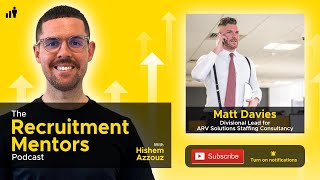
Matt Davies, divisional lead at ARV Solutions, shares how to move clients from good to great through candidate care and commercial smarts. He built a Trader Tracker system to map temporary staff in the public sector, uses ego-stroke introductions to reach candidates, and adopted video interviews to win deals despite early resistance.
Chapters
Welcome to the Recruitment Mentors Podcast. My name is Hishem Azzouz. Today I'm really excited to be joined by Matt Davies, who is the divisional lead for sales and marketing at ARV Solutions Staffing Consultancy. Matt has worked in the recruitment industry since 2014, initially joining Near People in Birmingham as a trainee, where he progressed from trainee all the way to section manager within 6 years, where he was leading multiple teams within the business. And then 10 months ago, Matt decided to move closer to home, which is Bristol, where he has now joined ARV as a divisional manager to grow and take their sales and marketing function of the business to the next level. Matt, thanks for joining me on the pod.
That was a good intro, I like that.
Yeah, so let's get straight into this. So where we always like to start is the million-pound question. So what, in your opinion, what characteristics and traits do you think make up a highly successful recruitment consultant?
Good question. In terms of my own, this is my opinion on this. I believe a lot of it, having coached people, is down to, first of all, high intrinsic motivation. I think that is something that really is part of someone's DNA. It's hard to learn that as a skill. You can be extrinsically motivated by a manager or being put on a PDP or whatever that might be. But I feel to to make a manager's life easier and actually be self-sufficient as a recruitment consultant, a lot of it needs to come from within, within yourself, within the fire in your belly. I think you need to be very highly confident and have no fear, just go straight in, especially for a trainee in your first year or so. I believe that you need to learn a lot, fail a lot, and learn really, really quickly and stop making those same mistakes. So You just got to have no fear of being thrown into it, not really worrying too much because you can be dealing with some quite highly, highly status clients and candidates. But at the same time, just be easy on yourself to understand it's going to be a big learning curve, as I found in my first year, as probably everyone did. High emotional intelligence. I believe that that's something, again, naturally, I think as you get older, that always should slightly get better from experiences through life. Um, but at the same time, a lot of that is again in within someone, I believe. So it's trying to spot that, ask the right questions, how they approach different situations, using psychometric tests, that sort of thing, to really dive down deeper and, and understand how someone will work in different situations. Um, someone that for themselves again that constantly probably looks at themselves and wants to improve and learn. That could be not even in recruitment, it might just be in life, it might be in a hobby, in sport. But there has to be, I believe, some sort of elements of coachability because in any job, in any sector, everything is always changing. It's always getting different, especially with the likes of COVID or situations, Brexit, whatever that might be. It's being able to react to your environments well and want to learn for yourself and want to, I suppose, try and be successful within whatever arena that might be. Temp perm sectors, it's all a little bit different, isn't it? Horses for courses. And then finally, you can have all that, but if the commercial acumen is probably the best term, commerciality, thrifty if you want to, if you want some deals. Um, I just think that comes— I don't know, I don't think that's— you might make— you might think I'm wrong, but I just think you naturally want to get a deal, or you naturally enjoy negotiations. Um, and actually want to be able to have your services and believe in a price and spot, I suppose, passes as we call them in recruitment, where a bit of intel or a bit of information might be able to lead to further fees or revenue down the line for yourself. But that's difficult to teach that. I think that's more from the DNA. So a lot of this has come back to DNA and testing it out. But those are the bits that I like to test out personally.
Yeah, that's really interesting. I think really interesting.
Yeah.
That you reference a lot of things that can't be taught, but maybe can be cultivated or learned. But I think the part that I just— what I found interesting, yeah, curious about. So you've mentioned the first thing there before we sort of start talking about your early years in recruitment, being intrinsically motivated.
Nice little word, that, innit?
Yeah. What would you— would you mean by that?
So you get intrinsic motivation, which is myself, Matt Davis, Hishem Azzouz, you've got your own intrinsic motivation. Like doing this podcast, whatever that might be. We all have our goals in our own life, and personally, my own goals are what drive me to want to do recruitment and be successful in my life. I've got my own plans by 40, it'll be now 30. So those are what drive me intrinsically every day to try and do the best job I can in the limited amount of hours with the clients and candidates I've got. Extrinsic motivation, so that is from external sources. So like if you went to the gym, personally I can go on my own, I want to be in good health. If you're in recruitment, you might want to put good fees on the board, um, just as a bit of a comparable there. Whereas it's intrinsic, it's like if you need someone like a pt, it's fine, and if you work this way, it's fine. Extrinsicly motivated, you might need someone there potentially beating you with a stick if you're that type of person. You might need them there just for the emotional support so you get there or you've got accountability there. Personally, for me as a manager, when I was managing a slightly larger team, if you've got so many that are extrinsically motivated, it can be difficult to keep them constantly there ticking over with your own job if you're a billing manager like I was. It made life a lot easier and I felt like the recruiters were a little bit more successful if it was more from within rather than externally, someone putting that, putting that motivation there for them. I believe both is great and you need both, especially accountability, but I just personally felt that the recruiters I've seen do really well for a longer period of sustainable time rather than a high and a low. They just all seem to come more from within and want to, yeah, more intrinsically rather than someone there helping them along the way, if that makes sense.
That makes sense. So just got 2 points for you on this, which I think people find useful. So first one is what are like practical, good questions people listen to this can ask themselves that maybe you ask yourselves or check yourself on that can, I guess, uncover or tap into what those intrinsic motivations are? Out of interest.
So what, when I'm doing an interview or when I'm doing—
As in, like, so you're saying, you're saying, obviously intrinsic motivation is important. You're saying that that's, yeah, that's something that you've had. So like, what questions did you ask yourself? No, no. What questions do you ask yourself to, like, I guess, uncover and really understand what that is? Out of interest, because I think a lot of these types of things come from good questions that you ask yourself?
Yeah, for me, it's what my personal success looks like for myself. Everyone's is different. And it's a question I ask people in my teams, like, why do you— recruitment's hard. It's a champagne and razor blades industry at times. And it's knowing why they turn up for work, I think. What it means to them to be successful, because I think it is an industry where you want to be successful, you can earn some decent money, you can progress through the ranks, you don't really need a degree or anything from, I suppose, life or college or school to come into this. But the questions I think I personally ask myself are, what do I want in the next 5 years? What's my next 10-year plan, how can my recruitment career facilitate that for me? Because it can. It's looking at what controllables I have which are putting money on the board for a business, and in return, what do I get back from that? So that's what intrinsically motivates me, which is generally money, monetary. And then with that monetary, what can I invest in, in terms of my own goals to make my personal life outside better? Better for myself because I like freedom. I like financial freedom. That's what personally really motivates me, Hishem. But I'm different and everyone's is different. It might be someone that has a point to prove. I've seen people that have always been, I don't know, just run of the mill. They've done different jobs in customer service or other forms of life, retail, which is very difficult. Loads of hours, don't really get much back from putting a good effort in. There's nothing in it for them. But then when they start putting the effort and time into a career such as recruitment, and then financially they see the benefits of that to them, and then they're able to buy the house that they've always wanted, they've been able to get a motorbike or go on a holiday of their dreams. It's really understanding, I think, going back to your question, what you want to do in your life and how your work and recruitment can facilitate that for you. Because it is a commission-led industry. I don't know many, if any, you'd probably be better at telling me this, that don't have a commission scheme. I don't know. Personally, I don't think I could do the job if there wasn't one. But yeah, I think that is it, it's learning how you work and how you can get the best out of yourself to show up every day. Because sometimes it is hard to show up, especially if you're not having the results in this.
Yeah. Yeah. So no, thanks for sharing that. And then the other point I had— well, I'm going to have two now and then we'll move on to this. But I think—
sorry. Yeah.
So the next point is so on that and let me— let's keep this short and sweet on this. But I'm just interested. I think, I think, I think I think this is where people find— I know I struggle with this. So I get what you're saying there. And I think if you're listening to this and you haven't taken a step back to think about where you want to be in 5 years, what you want to achieve personally, not just I want to build X, like you need to think about that. Right. But two, I think what makes that— what actually will make people actually achieve that is then constantly checking in with that. So how often do you like look at or think about or yeah, like look at, right, okay, this is where I want to be in 5 years or these are my goals. Like, do you look at it on a weekly basis? Do you remind yourself on a monthly basis? So I think it's easy to think about these things at the beginning of the year, then some people don't even think about them or look at them again until the end of the year.
Yeah, we all— I think it is embedded in most PDPs. It should be if it's not. Personally, I'm just— I don't know. I met a guy, he was called Pete, and he had his goals written down in a diary and he said to write them down every day. Okay. I'm not— I did actually do that for 3 months. 3 months and I think this is where it really struck with me, how much they change. When I used to sit down with people going through their PDPs and their goals at the start of the year and then yes, they might have ripped some of them off there, but they were so different when we'd sit down in 6 months, in 12 months' time. So it's hard to do it every day. I personally do it every day. I don't write down every day. I'm just trying to evaluate where I'm at in my own life because life changes. And I think for me, a career is— and being successful in my career is quite important to me. I've realized that. Very self-aware. And not everyone is like that. Like, I do my job to have a good— to live. I don't live to work, if that makes sense.
Yeah, that makes sense. So you remind yourself every day. That's interesting. I do the same, but that just really works for me. So I Okay, then the final point. Obviously, you're 30 years of age now, you've got more wisdom, right? A lot of people listen to this will be, uh, younger than that, right? Like you said, recruitment obviously has a reputation of that champagne and razor blades. So when, like you said, you obviously can earn good money, and like the likelihood of you then spending that on obviously getting a table in nightclubs when they're open and just all that crap, basically. Like, the question I have for you, because I don't think it gets spoken a lot about in recruitment You said one of your major goals is financial freedom. So the one and simple question I have for you is what's been the best financial advice that you've had in your life so far?
I'm not sure. Invest in bricks and mortar.
Okay.
That's pretty much it. I've dabbled with investments and I've read books. I've been doing it for about a year and a half. It's just not me, mate. Unfortunately, my brain doesn't work that way. It's too much info. And I think it's a job that I'd probably need to do full time. So I just personally feel like investing in bricks and mortar, you're never going to lose your money. As in property? Property, yeah. Any form of property, mate.
Okay, nice. Interesting. So that— okay, cool. Because I don't think many young people think about that, right? And I think it's important to think about these things sooner rather than later.
I didn't know when I was younger. Like, it's not a problem as well, but Everyone will tell you, but it's down again, it's down to you. Um, when I was 25, I didn't— I wasn't doing it. I wasn't interested.
Yeah. Okay, so right, early days in recruitment, early years in recruitment. Talk to me how— obviously, as we all know, it can be some of the most challenging periods of our recruitment careers. So basically, worked at Near People for 6 years. Like, talk to us about the first couple of years, how would you describe them?
I love recruitment. It was awful, mate. My first 3 months, I hated it. I was basically on the line to getting fired. I had one— at the time when Neil was there, we had 2 business directors, owners. I think one wanted to get rid of me straight away, and I was working for them. The other I don't know what they saw in me, to be honest, because I didn't see anything in me. I was from Hereford. I was very naive, not commercially astute at all. Basically everything that I've told you we look for, I didn't really have it too much, but it was deep down, so it did come out from recruitment. Really struggled. I started in facilities management doing a perm desk recruiting engineers. Just, we didn't click. Never spoken to them in my life. Haven't really since. And then I got switched into this. My manager at the time and the owner were like, all right, we'll take a punt on this geezer. He's all right. He's probably not got the best fashion sense, but we'll keep him in the business. They put me on a desk that no one had ever done or just dabbled on. So I did put a temporary public sector property and surveying recruitment. Purely into local authorities, universities, and NHS. So how much red tape's there? Masses. We weren't on any RPOs, we weren't on any frameworks, just me really not knowing what I was doing. And I got very successful at doing it round the back door, getting the clients to write business plans somehow and going from there. And I think I think it was the best thing for me. They just chucked me into it, was there for support, and I think I had to learn the hardest way doing it all from the get-go with no branding. No one really knew me, no one knew us, and I loved it because it was all me. I'm myself, my personality. They probably didn't know what to think being in the councils and local authorities, but it just really worked. I had such a good role model to look up to. Just copied him. He was doing it for housing associations at the time, and we both just, we just both really worked so collectively well together. And it was a lot to do with filling jobs rather than candidates to market.
Okay, so a couple of things here to unpack, right, for people. So, so just for context, yeah, so when you then got switched to that public sector desk that you obviously had to build from scratch, Yeah. How long did you end up then doing that for?
On that particular desk?
Yeah.
It would have been, so I did 3 months on there, been about 3 years.
3 years. And then after that, is that after that you went into leadership?
Yeah. Well, I was, no, in the third year of that, I started growing a tiny little team. Right. All within, again, hadn't had any training in leadership. But this was the beauty of Nia. We were all going through such a growth phase. And everyone didn't really know what was going on. But yeah, I think collectively we all had the same goals in mind, so we just had to make those.
Yeah, yeah, yeah. You went into a bit of a leadership off towards the end of that then, yeah?
Yeah, I went into leadership on the third year of my career.
All right, cool. Right, so let's unpack this a bit. Cool, right. So first thing that I want to know is, so a lot of people will be struggling or, um, have struggled, so let's just talk a bit about that very quickly.
What—
so you said there, what were the, like, the main one or two things that you really struggled with that nearly led you to obviously being one of the many people that fail in recruitment in those first couple of months. So you said that you didn't connect with the people you were speaking to. That's obviously a factor. What else did you really struggle with? Was it like, was, yeah, was you willing to pick up?
Was it dynamicness?
Everything.
I wasn't dynamic, I was slow, uh, attention to detail, the emails I was sending, uh, it was more just lack of pace. I was just so— I come from a golfing environment where we just chill and we sell bars, bars, and we coach. Like, all I did was coach, mate. So I come into this fast-paced industry. I was like, what is going on? I've just moved to Birmingham. That's another culture shock. Recruitment's a third culture shock. I was just shocked, mate. I didn't really know what was going on. I was just slow, commercially awful. With terms. Clients would just walk all over me. I had no control of candidates. Just didn't get it, mate, at all. Yeah.
You were shit, basically.
Yeah. I still billed. I still did about 10 grand in my first 3 months, but—
Oh, fair.
I think it was 7 grand. Yeah. There was a guy—
What was it? Yeah. Why?
Oh, what was it?
What was his name?
Sim. Sim. You'll never forget your first. Yeah, I didn't even know if he had a passport at the time. He was a refrigeration engineer, but he did, luckily.
So basically, it's just to be fair, it seems like there's a lot of change in your life. It was adapting, it was pace, energy, amongst other things. Okay, cool. So then let's talk about obviously then obviously you mentioned a couple of things, but then obviously then went into this temp desk, they gave you a chance there, had to build it from scratch. And then this is where it seems like built confidence, had more success. This is where you really like, yeah, got improved, right?
Yeah.
So let's unpack this a bit then, because we obviously, people listening will want to know what did you do differently? What were the sort of aha or light bulb moments that really clicked for you? And then what I also want to know is like, I guess what I want to know is you said that you had a really good role model. So I want to know, you said you copied him. That was most of it actually.
Really?
Okay.
So why don't we start there then?
Start there. What was it maybe like, what were they like, I don't know, top 3 things that you really learned and took from this person that really changed things for you out of interest? Could be on the BD side, client side.
I hope they're not. So there's no personal stuff in this. But yeah, when I first came in, the 2 people I was reporting into, a bit more old school. I felt it was a bit more not scaremongering, but I definitely was scared. I was actually nervous as hell being in the business. If I got something wrong, the impacts of if it went wrong, uh, I was just on, you know, when you're on eggshells. I don't know if you ever—
yeah, that's not a good position to be in.
No, I was just mad. And that's why I was making so many mistakes, because you know when you're overthinking everything, you're just like, yeah, well, what's going on? So as soon as, as soon as I moved over and I had this other leadership and this role model to look at, I just relaxed and I was able to be myself, which is what you've got right now. Before, it was someone nervous, very unconfident, couldn't really do any conversationals. And I was just in an environment where they accepted mistakes and I felt okay because I was in this new industry. I feel like especially when you're cutting your teeth at this, it's so much about the environment, um, that you feel at peace and have that a bit, a bit of leeway. Obviously you want the training embedded and you want to be able to do it correctly, but if those little mishaps happen, because there's so much to do in recruitment, it's, it's understanding and being empathetical and then showing you what you should be doing quickly. So that's what they did. They just let me do me. Make loads of mistakes and I'm just a type of person from the mistakes I will learn because if you're not, this is the difference. So when you are constantly making the same mistakes, that's when potentially you need to exit or you need to look at the methods of training that's been delivered because something's not clicking there. But they just used to say, oh, it's a training issue. And once we went through the training, I've got it. I'm quite intelligent. That's when results started to happen and money started to just come through the door on its own. I think the commitment and the effort was always there. It was just a tweak in actually what I was doing because I was the type of person just to— if I was shown, I'll just give it a go and do it. But I think because I had that role model and believed and I saw him doing it and he was just so suave. He was like Brad Pitt, mate. He's a lovely guy. I just want to I just wanted to be like him, mate, really. And then I started billing the same sort of amounts as him and it was beautiful. It's a beautiful budding relationship. How's that?
Yeah. So, okay, a couple of things then. Yeah. So, first thing that I want to ask you is a lot of people listen to this will make mistakes. So what was your process framework of going and taking a mistake and actually learning from it? Because I think it's easy to say that you do that, but how did you make sure you didn't keep making those mistakes. Like, once you made a mistake, it was a process.
Yeah, if you knew the business, you'd understand. But if you made a mistake, it was usually a call back straight away. It was in a nice way. Doing it hands-on straight away. The environment was very much like you're around your team, you're all listening. There were set hours when you're on the phone. They're very hands-on, and personally, that's what gets the best out of me, if you're hands-on. And I'm just me though, you've got to remember everyone's slightly different, and that might not work for another recruiter. And I think they just— the beauty of those guys were they understood how I worked and just did it like that for me. So like, just let him get on, give him the autonomy. When he— when I hear him doing something incorrectly, or when I've done something that wasn't quite right, that's when they'd grab me, mate, right, what's your process? What are you doing here? And then be nice with me and be like, why don't— have you thought about doing it this way or this way? And just going through different scenarios. So then I was actually using my own brain and being like, oh yeah, that makes sense. But because I never thought that way of thinking, Yeah, they showed me the way of thinking that was probably better than what I was doing in a, in just the way that I learned very quickly. So going back to how it probably is best, again, it's that self-awareness factor of understanding how you operate to be able to tell your manager for them to get the best out of you as well. So, okay, I didn't know that at the time, but looking back, they nailed it on that. Yeah, yeah.
So, okay, cool, fair enough. And then the next thing then, so obviously people want to know, like, what were the main changes that you, maybe 1 to 3 things that you changed about the way that you were doing things that had the most impact in your success out of interest on maybe on the client side, maybe leads. Talk to me, talk to us about that.
What, why leads? Trader trackers, mate. Oh my God.
Leads and what, sorry?
Trader tracker, we called it.
Trader tracker.
Trader tracker, mate. Yeah, yeah, yeah.
Never heard of it.
It's absolutely brilliant if you're a temp consultant. It's basically just tracking every temp ever that's working for one of your clients, getting them on your database and on a spreadsheet, and that's literally it. I just tracked— I think I had 138 temps that weren't mine, that were in someone else's pocket, and my job was about getting them onto my pocket, out of theirs, and then backfill in the job that they were in and I'd double up. So it's market share. I basically mapped out my market as best I could apart from Birmingham City Council because that was just locked and I couldn't get in it. And there was at least probably 300 temps in a desk there. So I just let them guys have that. But it was looking at all the other authorities, who was in there within the property department, that wasn't working for me, me talking to them, understanding their rates, understanding what their motivations are. Usually they were getting ripped off from a margin and I was at the earlier stage, it would be monetary. But then as it got better and better and our relationships progressed, that's when I could stretch the margins for the clients and obviously get that monetary value back. And when I was doubling up, it didn't matter if the margin was slightly less because two margins would always be equating to a bigger margin than that one person that I was pulling out. Does that make sense?
Yeah, that makes sense.
So Trader Tracker was incredible. Hiring managers, uh, targeting those, just you have to be there understanding your competitors, how they work. Um, mine was a guy called Louis, uh, and it was Nick and Louis Temps. Matt Masters, he still does it, he's a fantastic guy in public sector. Um, understanding how they operate to be able to nick some of their, their candidates because they had so much share, some of these guys, that they couldn't manage it. And that's where I could come in, and that's why people—
yeah. So what, out of interest, and on this, for people listening to this that are temp or contracts, like, what, like, let's just put aside like monetary, so as in like give, getting them a better rate or whatever, like, what were the main levers that you typically pulled that gave you the best chance of them deciding to go with you rather than Louis, who they've worked with for the last year and a half, out of interest?
A lot of it for the— a lot of it for a contract temp worker was either longevity of the contract. That was always brilliant. But in a council, they would start 3 months and it would last like a couple of years. And it was a brilliant desk because once you got them in there, you just had to look after them. A lot of the time what I did was speak to the clients, understand the charge rate, and then I would get the candidate and understand their pay rate. And I would be talking to the client, telling them what they were paying the candidate, and it would be sometimes a very solid margin. And then I would tell the candidate what they were actually charging the client. So sometimes I was squeezing their margins and they weren't even moving. And it would disrupt my competition. I know, I just know they would have known that. But I think it was more the fact of utilising the intel and building really good relationships with these people that weren't even my workers. And I was speaking to them more than their own consultant. So I felt it was an element of trust and I was giving this information that they weren't privy to. And then that built that relationship before I had even had them on the books. And I told them the margins that I would be operating at, and I told them the industry average and what they previously had. So it was still really strong, but I was just completely transparent. So I think it was having that transparency factor, and that's probably where I stood out with the candidates in that market.
And then was you transparent with what you was charging when you got them on?
Pretty much, which I think is— can be positive and negative. Um, but I told them after a certain period of service I'd I would increase it. So some of the time, if they've been there a year, they'll get an increase and that'll come out my margin. And I was quite upfront about that. Sometimes I would get it back off the client, but it was one of those, it depended on my relationship. But I was very much, I like to get out there, meet them, get them a piece of cake. Like that wasn't happening with a lot of them. And it was a lot about being out there and actually present with these with these temps to build the relationship. And then they would give me the leads. They would call me and say, look, thingamajig's got this. Could you get me in there instead? Or thingamajig's come to me with this. Do you want it? And because I'd put invested time into them, they were giving me quality intel. And that's what I told them I needed. And I'll look after them if they could look after me back. So it's a bit of a, like a relationship in life, just a two-way street.
I bet your competitors, I'd love to hear the conversations about you in other rooms. Bet they fucking hated you, mate.
Oh no, it's all right, I'm a nice guy.
I hope. I think, I think what— I think what's important about that is like, like you then, you then didn't— like you then didn't do what they did, if you get what I mean, when you then were working with these people. I think that's—
you have to do everything.
Yeah, that's what I mean.
Yeah, yeah.
Like you— I think that's the most important thing I take from that is like people listen to this would be like, Matt's a bit of a rat for doing that, right? Or whatever. And then it's like, I'm just honest. Yeah, that's what I mean. But as in like, oh, like, why? No one was doing that. So why do you have to do that? Blah, blah, blah. But, and then you've then been transparent. You've given them information that typically people won't give them. You've then actually gone, hey, look, this is what it is. And if we do work together, this is what I'm going to be charging. And like, you just kept it transparent and honest throughout. And that's obviously scalable because you're being yourself, you're being transparent, being honest.
Yeah. When you're honest.
Yeah. So I mean, but I think that's, I think that's most important thing is then you weren't doing that and then like then trying to do the same thing that your competitors were and not telling them and or charging as much as they were. Do you know what I mean?
It was basically they told me they wanted and I gave it them. And that's why I think the element of trust was there with me. Yeah. And why they wanted to, I suppose, continue that relationship via us compared to someone else's. Yeah.
Yeah. So what I'm keen to do now, so we've got like 30 minutes left, right? So we've gone into some of the things that you had to get really good at on the temp side when you was at Near People. So we can obviously, the next bit, let's like, you can reference like now, past 10 months, or throughout your career. But what I'm really keen to go into, 3 main things, is one, day plan, time management structure, is what I want to sort of uncover with you, like what that looked like, how good are you with that. But as we're talking about candidates, let's just sort of zoom in on this for a second, and you can use like right now, Every single recruiter I'm speaking to at the moment is saying how candidate short it is, or like that's their number one challenge, right? So what I want to know from you is like, what has been over the last 12, 18 months, what has been like the most trusted and most successful way that you've consistently been able to build relationships, get candidates on your side or in your network that you've been able to support, place, whatever? What's, what's been your most best way of achieving that?
That's a good question. The market I currently operate isn't really candidate-led, so this would probably be going back to when I was doing more of a candidate-to-market approach, doing technical staff. But what I found, especially with some of the consultancies, was just calling candidates at work and having a very strong pitch about why I was contacting them at work with clients that I wasn't currently working with. And a lot of, a lot of the reasons why I would have done that would have been a recommendation from someone that they would have known that I'd either spoken to prior or known about and asked them. Because a great question in recruitment is, can you tell me the best quantity surveyor at the time that you've worked within a department prior? And if you get that, yeah, if you get that intel, it's a call, right? I'm calling you because I've asked, uh, I've just been speaking to a couple of QSs. I'm not going to name names, but they've, they've recommended that you are the best in your department, and I want to be, I want to be associated with the best talent with my clients. So I feel like we need to have a conversation, like, where are you at? You might not even be looking. You're probably not. You've probably been one of the best paid people if you are that good. So it would be very soft and it's, it's building up the relationships with those candidates you want to be representing that are going to show your clients you're good as well. So for me, I just used to like to go straight in deep and LinkedIn was a great tool for me because all of the consultancy QSs and PMs and building surveyors are all available online or on the company websites. And yeah, you might get a name for yourself, but when you've been in the offices there, try to win the business and you don't get it, you know the office environment so you can talk to the candidates about what they're probably— this is prior COVID, so I used to say, yeah, I know you're in the office, this is really awkward, but blah blah blah. The aim was to get their mobile. A lot of the time these people are very commercially smart anyway, so want to know what's going on in the market. It's surprising how much they want to know if they're getting paid correctly. And at the same time, I did help a lot of those candidates that were recommended get a pay rise internally because of the intel that you'd be giving them. And that is a lot of power. And then if you've given— if you've helped someone get 5, 6 grand on their salary or 10 grand in some occasions because they had been there that long, they're going to help me back. And that might be with a referral or someone else or getting them in getting me into actually working with that client. So for me, it was— I'm still— I don't know if that's called old school, but I just like to call them and I felt very confident in situations where it was awkward doing that. I'm like, no, no, it's not awkward.
Yeah. Yeah. So I think what I think if you listen to this and one of your questions that you don't ask your people is who is the best X person you've ever worked with? You need to be asking that every single day because you can then build— instead of a trader tracker, you've got the best people tracker or whatever you want to call it, right? That you're just building out all these names, best people. And what a great— I actually love that opener of like, hey, like, it's just an ego stroke, isn't it? It's like, hey, I am calling you because people have told me you are the best at what you do. Yeah, like, it's all of a sudden, it's like, oh wow, okay, yeah, this guy's made me feel good. I better give him a minute or two to see why he's calling me.
And if you're recommended, you want to know who recommended it. And all my aim is to get their mobile number so I can get them on my database so I can then talk to them and then I can interact with them. I can send them content that's going to be relevant to what they want. And if you go in with, look, someone's recommended that I contact you regarding X position. I know you're at work. Please, can I— have you got a mobile number for me to contact you back on later on at a better time? They 9 times out of 10, they'll give you that mobile number and they appreciate the ego stroke as well. So yeah, for me, that was just the best way to build.
Yeah. What about, what about then? And then just again, think obviously COVID vibes last 10 months. And so you said in the market you're in now, which was construction, engineering.
Yeah.
Yeah. So like what, why? So what has been, what have been sort of some good trusted methods for you in the last 10 months?
Again, again, um, my— this is more for the technical part of our division that is really high candidate to market-led. Um, I believe it's, it's good quality newsletters like sent out, um, on a regular basis that they can actually inter— integrate with. It's, it's current topics. So it might have been remote at the time, it might have been How's your current employer looking after you? You've got to remember that a lot of people about a year ago were just really appreciative of being in a job and they might have actually moved and had a really poor salary. So there is opportunities to, like, how a lot of it now is how are you being looked after and finding out from the candidates about a company and then understanding that company and then comparing it to other companies and showing them what they might be missing out on. Because we have a lot of technical roles, it can be working from home, and some of these old-school companies are missing out. And we've managed to pull a lot of candidates out knowing how they've been treated during the last year. I don't know if you found that prior, but again, it goes back to the candidates to be able to give you that intel. But then you have to have something to give them first to compare it against. So it's knowing their competitors, getting some information about them that might be positive, that might make them think that they want to move. So personally, I know when we, when, when some of the guys were doing this, they knew how their, their staff was getting looked after, which is really poorly, really old school. And there was murmurs. And we used one of our clients that we know was really looking after its staff technically, its technical staff and what they were doing to look after them. So all you do is call these people that are currently not being very well looked after and telling them about how another client is currently operating with exactly the same staff and they just wanted to go. You would, wouldn't you?
So that's interesting.
Yeah, that's just, I think that is the product, isn't it? A product side of a really good job, really good company. Or it's a really good candidate that you can then take to market. So we were looking at it that way.
Okay, cool. So next thing that I want to speak to you about— no, that, that is— that, that makes sense. So again, I feel what I really like about this is like you've really got good at doubling down on intel. And I think sometimes recruiters miss this, is like sometimes they feel like all they— the only— like they feel really good when they've got good candidates, but actually there's a lot of other things that you have as an asset, information that you can actually use to leverage, you can leverage to build relationships, get that open, that opportunity to get what I mean. So that's why I like when you keep talking, because these are all things that you can control rather than, or that you have, you should have, rather than like just always having to rely on like the candidates.
Yeah, sure.
Yeah, I mean, yeah, I knew you said so. Yeah, so okay, cool. So let's, let's talk. There's a couple things that I do want to still ask you around that, I think, because I know when we— before we started, you were saying around the video piece that you use that a lot. So I just want to ask, like, you're like top tips in that. But the next thing then, business development, right? Maybe let's keep this practical because I think some people may listen to this and go, yeah, that probably doesn't work. It wouldn't have worked if obviously through COVID, blah, blah, blah. So like when you joined the business that you joined 10 months ago, like in the last 10 months, have you had to do BD? Or like, was there like an existing basis for you to go out? Were you building things? Have you had to invest in the business?
So much more inbound, but I've not personally been a part of before or used to. Yeah, because I was prior in the business, it was a lot more new business, BD heavy. So that's probably one of my strengths. With Nia, when we were setting out the permanent section, It was all new business. No, they hadn't worked with us before. So coming into somewhere where there's existing work and it coming inbound and it's more about maximising what you've got initially was so different. And again, it goes back to good basics of BD. It's making sure that you've got all the right decision makers on that client, that you are maximising it and not losing your share. So I think that's what I've been trying to do. I haven't had to do that much BD because the job flow has been so high.
Let's talk about that then, and then maybe I can just get your, like, best piece of advice for people to get better at BD who are doing more outbound, right? So I guess because I think this is the whole thing, right? What you're talking about, and maybe you're still learning this, but obviously some people call it one-night stand, spot business, but like, obviously, ideally, we want to be doing repeat business, right? Yeah, that's what you're used to.
Exactly.
So what you've had to get better, I'm assuming, is, yeah, mapping out businesses, understanding the key stakeholders, understanding, yeah, who are the decision makers, who can refer you, blah, blah, blah. So like, how, like, what's your advice for people who have got a good client, they've done sort of repeat business, they might have exclusive terms with or whatever, and there's an opportunity there to take that client from a good client to a great client? Like, how have you gone about doing that then? What have been some of your—
it's asking. I think not, not enough agents actually test where their relationships are and tell them.
How do you test it then?
You've got to say, look, what, what do I need to do to be a recruitment partner of choice? How can I get rid of my competition if it's contingent? Or like, the way we work now We do very modern methods of recruitment and a lot of it is retained or it is exclusive. And that's why our business has gone— we've hit company records the last two quarters running. So, and the reason for that is that we've got better at doing our more modern methods of recruitment and the clients liked it. They weren't used to it at the start, which is video tech, but now they want it. So I think it's Coming back to your question, it's very difficult. It's a very good question. And it's more about around— you want from me, sorry, just to get this right, more around how you connect with a client that you've already got to maximize it. Yeah.
So you're saying you've been working with a lot of inbound. So it's more about how can I get better? So for example, one of the clients that might come inbound, they might typically give you or in the last 10 months they might have given you 10 roles to work on, right? But you know, 'cause of your intel, that actually this client could be, as a business, it may not just be in your team, could be giving us 30 roles 'cause you know they've got that team, that team. And I'm assuming that's what you're thinking about. How can we get this client that's spending 150 grand with us a year to 300 grand if you see the opportunity there? So it's like, how have you gone about that? Is it getting referrals within people?
No, it's using internal relationships. They're so key and you need to, if you're nailing one person or one client and you're supplying them staff and you're delivering, yeah, you have to actually have the balls, I hope. That's not meant to be sexy, but you have to have the confidence, that's the best word, better word, to be able to go to the client and get them to recommend you. And if you ask this to recruiters, how many times have you got one of your clients to send an email to other people in their organisation recommending you and CCing you in? It works. I used to do that with consultancies, and it would be ideally one of the more senior directors. If you are using a middle manager, you need to make that jump up to a decision maker. And get the decision maker to either give you a testimonial and send that to a manager internally. So it's just working what you've got, if it's working well, and getting it in writing and utilizing the client to say, look, we, we love working with you, the candidates love it, we've got testimonials, we know that when we put them in there they enjoy it, we really understand your business, we want to try and repeat this, like, we want to repeat what we're doing but with other people in your business. How do we do that? And they'll help you if you are doing it, if you are delivering a good service. So you need to be confident in that delivery piece and they're going to tell you. And if they don't want to do that, that's a great learn because obviously you're not doing something currently well enough.
Yeah, it's wrong to put them into something. Yeah.
And I would say, okay, that's fair enough. And then you learn and then you have these honest conversations that actually then strengthens your relationship. Because until you ask, you'll never find out. But I think it's having the confidence in what you're delivering to just have a straight up conversation and tell them what you're looking to do or how they can help you because you've helped them. And again, it comes back to that. It comes back to that relationship. And you can only do that face to face. I feel it's very difficult to do that over the phone.
Yeah, fair enough. So thanks for sharing that. I think what So people listening, I'd really underline, I absolutely love that question. I wish I asked that question more of like asking that direct question of like, Mr. and Mrs. Client, what do I need? What more do I need to do to be the preferred recruiter of choice or whatever? What a great question that is. Like, how many of your competitors are asking that question? But actually being willing to find out where you need to improve, what we need to be doing, I think that's such a great question.
Um, back to the start when you want to constantly learn, I just want to keep getting better for people. So If you do that for clients, they'll appreciate it. Yeah.
Yeah. I love that. So what I want to talk about, I want to make sure that we box off day plans because everyone right now keeps telling me how busy they are. But I want to know how Matt's got good at making sure you're busy with the right things rather than just being busy for busy's sake. Right. So I want to find out day plan structures, how you got good at that. But before I do, video tech, video tech, right. Would you mind just sharing a bit of that? So it seems like that's been really useful. Influential for getting exclusive business retained. So I guess what I just want to find out is basically, if you wouldn't mind just giving us a bit of an overview of like, okay, we use video tech, but what does that actually mean? Does that mean that throughout the interview process it's mainly done over video or whatever? And then, and so I just want to, if you could give us that overview, and then I just want to ask you one or two questions about that that could be beneficial for people. So how, how has it been used?
So we, the way we use our AR view, which is currently a software for ourselves, we have a small fee initially upfront, which is basically commitment from the client. I'm not going to, I'm not just going to disclose what the fee is, but it's not too much. And that basically will enable us to have 4 weeks on this job. If we can't provide a shortlist, that's up to their standard, which is the client's decision, we'll give that feedback. And that's a no quibble. So there's a commitment piece there from the get-go that they're not actually getting too invested. But all we want is they've put the money down, they're going to take more time to actually go through the job with us, and we feel more confident because it is actually a job because there is a lot of jobs out there at the minute. So it's, yeah, it's dealing the ones that are actually going to be a return on our time. And then from there, it's a portal system so the client can log in whenever they want. And the way I personally do it, I try and get them involved in this as a first stage interview, so it shortens the recruitment process. So I say, look, I'm— I— you can utilise me as ever you want. If you don't know how to utilise me, this is what I suggest. But I'll have 4 or 5 questions which are quite key for that position. I'll go through it with the candidate. I tell the candidate, obviously, this is like a movie trailer. So you want the client to buy a ticket to come and see your movie. So it's not usually the best what you're saying. It's about how you present yourself, how prepared you are. And the better you can get them prepared, and it can be anything from how they look on camera, setup, you name it, you have to go through it with these people if they've never done it before. But if you can get them present in such a nice way that actually shows they're beneficial and tell them like the benefits to them as a candidate, because they'll get more— you already know if their CV is just going across compared to them meeting me, uh, you've got more commitment from the candidate, you can get more leads out of them, they're face to face, your relationship's built as well. There's so many benefits of using it. Same with the client, because I like to get them on the platform and utilizing it so they can understand what we're actually doing and how it can benefit them, saving them time, um, where the candidate isn't coming all the way over and they have to sit there for half an hour, an hour, rather than a brief 5-7 minute clip where they can instantly know if they're hearing the right signs or not. And again, it goes back to that, um, old school halo and horns. If the client's still there 7 minutes down the line, they like them and you know that as a recruiter and it's already alleviated a bit of speed because they don't have to go through that, do we actually like them, right, so you move directly straight to the second interview and because of the market at the minute this is cracking because you know how quickly candidates are going, um, in multiple offers, they, we sort of prep the clients that if you want them and you like them you need to get them now and, uh, it's a lot The candidate's more invested because of what they've had to do. They've had to do more prep compared to all the others potentially. So they, they're invested in this job as well. So it just helps, it helps you as the recruiter get to the end goal, which is—
is it just for the first stage and then it's—
yeah, just for the first stage and then directly, um, sometimes they'll do a Teams and go to offer, or they might even just go straight to face-to-face and it's usually a one stage rather than—
okay.
Yeah. So what—
Thanks for sharing that. So you've shared obviously some of the positives. So what I want to ask you then, a direct question, because I'm sure people will be thinking this, but where people can get value is like you said, so when you first doing this with clients that hadn't really done it before, would have been resistance. I'm sure you have candidates that go, fuck off, man, I'm not doing a video. I hate video. I'm not up for that. Do you know what I mean? So like, talk to me about like resistance? How did you get through the resistance of like, 'Matt, I'm not doing video.' Do one. Like, what— how did you get through that?
What, with clients or with candidates or both?
Both. Just tell— because I'm sure you've got it on both sides. But like, how did you work through the resistance?
I think with the clients it was more monetary. So if they utilised— initially when we did this, it was in lockdown, COVID, things were a little bit tense. So we actually put a scheme on. If we went through this Modern Methods of Recruitment, we work in a modern methods of construction industry, so they should be bought in because we had that equilibrium there. So we actually gave them a further discount of that fee that they initially gave us back at the end. So it was for a certain period of time to get them on board utilizing it because we know once they utilized it, they'd like it. It was actually the cheaper option compared to contingent, compared to exclusive. So that was the way we utilised it to get the clients on board mainly, and it worked because MDs with COVID a lot of the time it was all commercials and you can't—
you can't— so it's time and money.
For the candidates that were a little bit nervous, um, because I do sales and marketing, for me I didn't really have much of an objectional handling, so I can't help people on here that much because I said like in sales you need to be client-facing. You have to be. So you need to— it's a good opportunity for you to get more prepared for the modern methods of the world. We don't know when COVID's happening, so just use it as a training course. And I would do a pre— sometimes a pre-screen with them for 10 minutes just to get them, like, train them on actually how to do a video. Because, uh, it was— some of them, mate, was so poorly done. Um, yeah, and if I sent it across, it just would have probably been less than just sending a CV. I'd have more chance of getting them in that way. So I think it's just being honest with the, this is the way we work with this client, you have to do this. And then if they said no, you'd ask them why. And some of the times it was because they already had a second stage interview or they already had an offer or they already had something else would come out of the woodwork as to why they don't want to do it. If it was a confidence issue, generally, would you really as a recruiter want to waste your time utilizing one of those people? Because when it comes to interview, they've got to do it anyway. So it didn't— that's just my industry and my desk, so I can't really add to it.
Yeah, that's right, that's fair.
I think with the technical guys, it is a lot different, but how much value does it really add, um, for someone that's it? Or— I don't know, that's, that's, that's out of my remit.
Yeah, fair enough. No, thanks for sharing. I think there's a— we won't talk about it now, but I think it's just interesting that because I do think there's a real thing, a real point in there around like interview bias when you're down that route, you know what I mean? Because I do, because, you know, and that's a huge thing. So all of a sudden, like, I can receive videos, I'm going to see what they look like, who they are, what they're about. And like that can even then encourage even more bias. I've done a lot of stuff. I mean, so I don't know. I, yeah, I understand how that can really help, but I don't know. I think, I don't know if that's like going to be the long-term solution forever, just because I think that's, if you are one, if you are really focused on building diverse teams that represent the world today that we live in and stuff, I think seeing human beings on a screen, you're going to make even more judgments and assumptions. You know what I mean? It's just how it is. So I don't know. I think it's interesting. It makes sense. But, um, And then so, okay, cool. Let's wrap this up then with a really popular area that everyone wants me to always ask people about is like the— everyone's saying they're busy. Yeah, I'm assuming you're quite busy at the moment.
If you're having—
yeah, talk to me about day plans, mate. So as I said, like, what do you— talk to me through— let's finish this off with like, what does a typical day for Matt look like?
Yeah, yeah, yeah. So for me, I like to do it, uh, so I've got— come into the office, I've got a little board, right? So what is important and urgent today that has to be done, no negotiables, like they're doing, I'll do them first because you're— personally, I'm up for it in the morning, I need to get it done, I know it's done. If I can't do it, I've tried, I'll come back to it at 2 o'clock in the afternoon. Basically, that's how I prioritise stuff that has to be done in the day. Second of all, second of all, I'll look at, right, what sort of tasks have I got that are important but not necessarily as urgent? How long have I been putting these off for? If it's longer than 2 weeks, that's when I need to like actually say, are they on the right list here? Because if I, if they've been going on longer than a week or 2, you should be doing something towards them or you need to like look back at what you're actually doing. That's just me personally. And then thirdly, what's all that stuff that doesn't really matter, but you know, probably you should get round to at the end of the day if you can do it. That's just how I begin the day. When I come into the actual office, then I'll look at my job flow, what's coming overnight, what is— where's my desk at? Like, you have to analyse your desk every day. So prior to coming into the day, I've actually got my day plan done. I don't like to come in and be reactive. I like to know that I've shut off for the day. I don't have to do all that stuff when drinking a tea. It's just there. So I just get on with it personally, mate.
What does your day plan look like then?
So it's laid out with those boxes, all of that. I've got emails that have to be sent, tasks, callbacks. Voicemails, I just go through and I highlight the ones that I have to do. I've got CVs that have been sent out or video interviews that have been sent out that I need to chase. So that's always there. Which leads are hot? I've got a hot leads board. Like if they haven't moved in 3 days, they're not hot lead anymore. Like what have you done around those leads that are actually going to rep? Hot leads, I don't really need to go into that, but that's just where my business development's at. Which I've got a little booklet next to me here with managers' names in and the companies to add into the database. That's at the end of the day. I need to add at least 2 a day, um, just to make sure you're constantly— because your database is key, isn't it? It's king. You need to make sure that's all up to date. And then I just have, um, so between, uh, like 9 o'clock and then half 9, I usually got my team meeting there. So after that, that's when I have core activity until 12. I like to switch off and do my admin for 2 hours and then I'll come back in and do core activity again.
What's core activity? The stuff that's not important and urgent?
Yes. No, core activity is when I'm on the phone. Generally, I like to be on the phone between sort of half 9, half 11, and then 2 until 4. So that just keeps my desk from doing this long going.
You're doing like just candidate time and client time every single day?
Depends. You can't say that. You need to do BD. Constant. I've always had that built into me because you never know where your client's going to go, if they're going to go RPO. We've had this recently, two big clients have just gone RPO. So you need to constantly be freshing out what, stripping candidate CVs, keeping your database up to date because there might be business and revenue of SMEs that would be going to be growing in these markets. So you need to keep an eye on doing that constantly. It's all constant. But it's, I think it's learning that experience that if you don't feel busy and you're at work and you're like, right, I need to just tick off calls here. I personally don't believe in that. There has to be like a reason behind things.
Intentionally.
Not just, I'm not into this KPI numbering, mate. I like tasks. Like, what's my task now? I need some jobs, right? How do I get jobs? Where does it go from? So it's all outcome and then I go backwards and what tasks do I do? An alternating tack on what that might look like.
I love that. Yeah. Thanks for sharing that. And I think key thing to sort of highlight there from the conversation I've been having is I think it's really easy for people right now to, because they've got jobs coming out their ears, to not do that constant BD piece, as you said. But I think, trust me, and everyone's learned it the hard way, right? Where your best customer, yeah, flips into an RPO or whatever and it's like, fuck, haven't done BD for 3 months. So Now, like, you don't even want to see a BD, like— Yeah, exactly.
Yeah, exactly.
You get in the groove of it as well, don't you? You get confident. Yeah. So, and also, like, you're definitely going to be more confident doing BD if you know that, like, you've got jobs. Like, you know, like, worst case scenario, I'm flying. Like, if you don't give me— if we don't do business on time, that's cool. I've got all these other clients. But so, so definitely highlight that. And then I absolutely love that grid. Absolutely love that. I think that's really practical for people. So, like, If you've got loads of tasks, you've got a to-do list, great. But go a step further. Like, what is urgent and has to be done? What is urgent and isn't as urgent? What isn't urgent and you don't need to do or whatever? Like, yeah, non-negotiables. Yeah. So I think that's great. So final question. What? Final question for you. You ready for it?
Do you reckon I'm going to spill it or not?
Yeah, maybe. We'll see. But, uh, final question, mate, is, um, love asking this, like, if you could change the industry, what would you improve?
I think personally it's just recruiters getting on with it, everyone. Um, I still feel like there's a bit of a stigma in sharing intel and sharing, like, knowledge. Um, there's enough market share to go around.
Um, I just think the whole point of this— you're completely—
yeah, mate, I, I just I don't feel like I sit— it's getting better actually, I think in the last few years, 100 million percent. But we're all humans, we're all here on this planet. There's always enough to go around. I just, I don't know if this is a personal thing for me. I just think help everyone out. This job's very difficult. It'd be nice to— I think we all lack that intel from other businesses. Me personally knowing that, I don't know if you do. When you were a recruiter, you've got a gist on how others operate. But I think we've all got very similar problems. Everyone's got very similar ways and different ways of looking at it. But collectively, I just feel like we could get a bit more, we could be stronger as an industry if we just chilled a bit and helped each other out so we all get better.
Well, that's absolutely the mission that we're on with Recruitment Mentors. So I couldn't agree more. So, Matt, been an absolute pleasure. Thank you so much.
Yeah, no problem. I didn't swear.
More from Hishem




You don't need as many clients as you think to bill $1 Million A Year In Recruitment



From 30 Direct Reports to Back-to-Back $1M Years as a Solo Recruiter with Zach Creighton



