Nicola Broomham - Recruiter, mother, wife - how she built a business & powered through adversity!
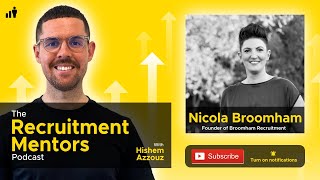
In this episode of the Recruitment Mentors Podcast, host Hishem Azzouz interviews Nicola Broomham, founder of Broomham Recruitment, a specialist property recruitment agency launched in January 2020. Nicola recounts her decade‑long career in the property sector, the challenges of returning to work after having three children, and the obstacles she faced when re‑entering the job market – including age‑bias, lack of part‑time options, and a gap on her CV. She describes how she taught herself recruitment, started as a self‑employed associate with Crux Careers, and quickly secured placements using LinkedIn and relentless business development. When COVID‑19 hit, she pivoted to a positive, community‑focused social‑media strategy, offered free CV help, and secured a key contract that helped the business survive. Nicola explains the core values of her agency – Human, Effective, Reliable – and how they shape a "no‑assholes" policy for both candidates and clients. She discusses hiring her first employee, the importance of diverse traits and emotional intelligence in her team, and lessons learned about cash‑flow, over‑extension, and scaling. The conversation also covers advice for mothers planning a career break, tackling imposter syndrome, her critique of KPI‑driven recruitment, and her ambition to become the go‑to property recruiter in the UK.
Chapters
Welcome to the Recruitment Mentors Podcast. My name's Hishem Azzouz. Today I'm really excited to be joined by Nicola Broomham, who is the proud owner of Broomham Recruitment, who are a property specialist recruitment business that Nicola officially started in Jan 2020. Nicola's had a long career in the property sector before she entered the world of recruitment, and And what is clear from what I can see is that Nicola has a huge passion for servicing the industry that she spent over a decade working in. Nicola's on a mission to provide an ethical recruitment service to the property industry, building real long-term relationships and giving as much value back to her industry through things like her podcast, mentoring professionals in the industry, and even being involved in campaigns that are focused on driving diversity within the property sector. And I know how motivated and big of a plans Nicola has to make sure Broomham Recruitment is the property recruiter of choice. So Nicola, thank you for joining me on the podcast.
Thank you for having me. That was quite an introduction.
No, I'm really excited to unpack your journey so far. So first question, which we always like to start on here, is in your opinion, what do you think, sort of what characteristics and traits do you think make up a highly successful recruitment consultant?
Okay, so I think some of the most important traits for a good recruitment consultant ultimately lie in communication. I think that if you can't learn to listen, and I mean properly listen, not just already be thinking about what you're going to say next, if you can't do that effectively and then transpose that information into a need and a desire and a proper understanding of what somebody you are not going to service whoever it is that you're speaking to, whether it be a client or a candidate. I think that far too often we don't listen properly to what somebody is telling us that they want, and we can make assumptions, or we can— I think it's picking up on and asking the right questions of that individual to really drill down on what their aims are, whether they be hiring or whether they be looking for a role. So I think that listening piece is key, and then communicating it back to— through your CRM, through to your colleagues, through to all of it. It's, it's that communication is key for me.
Yeah, I like that. So you've been on a really interesting journey. I think you've been on like a really sort of untypical, like, recruitment business owner journey, which is why I was really excited to get you on. So just to paint a picture for people then, and correct me if I get some of this wrong, but obviously you worked in the property industry, right? It seemed like you worked for a couple of different brands, and you was like a, it seemed like a sort of manager or led a team in different branches. So you was involved in leading teams that obviously were letting property, in charge of letting properties, selling properties. And you did that for, yeah, over a decade, like a real long time. Yeah.
Yeah.
And then after that, it looked like you then sort of went into an interesting consultancy role where you then, I'm assuming, draw— drew on like all the experience that you've got from working for other people and getting the best out of your teams, increasing performance, to then do that with other branches and help them increase their performance and do those things, right? So you did that.
Exactly.
And then you then went into recruitment. So you did that for like, yeah, 3 and a bit years. And then you went, joined a company called Crux Careers. So like, how, where, how did that happen? Like, why, why do you then end up going into recruitment? And why didn't you stay? Obviously, I know you then recruited into the property sector, but like, how come you didn't then continue supporting estate agency businesses with, I guess, what you had been doing for the last X number of years?
Because I had kids. So I did 10 years in property, 10 years in lettings, went off and had children. Yeah, I had 3 of them. And then during— and so in between me having 3 kids, I did a little bit of consultancy and things like that. I dipped my toe in the water. What isn't on my CV is I even did a whole stint of childminding. I am a qualified childminder. So yeah, there's all sorts of weird and wonderful things. I've kind of— I can turn my hand to most things, and I set up a proper childminding business and things like that, which isn't on LinkedIn, but yeah, it's there. And anyway, I decided that my youngest was old enough to— that I wanted to go back to work. And when I tried to get back into working in property again and try to go back to where my skills really sort of lay, I, I couldn't. Everybody was saying to me, you can't work part-time, or you can't work reduced hours, you can't do any of that stuff. You've taken so many years out of the industry, despite being a consultant, that you'll need to come back at entry level. And I spoke to Crux, who said to me, do you know what, Nic, we're trialing a self-employed, work-from-home kind of associate-type model.
Right.
Do you want to give it a go? And so I did. I made my first place. I had to go and get all my own clients, had to go and get all of my own candidates, very much sort of a lone wolf as a self-employed recruiter quite often. And I had no idea where to start. I hadn't had no training. Nobody told me how to be a recruiter. I was literally given an email address and told to go and recruit. So yeah, so I'm completely self-taught. But what I did was I went back and thought about all my experiences of when I was in property and when I was hiring and hiring. Yeah. What were my pain points, what were my, you know, when I, when I was a consultant and I was helping businesses doing things like recruitment, because staff is always an issue, what did I, what did I, what were they telling me and what should I learn from it? And I basically taught myself to be a recruiter.
Um, and so, um, I am, let's, I'd really like to just, uh, if it's okay with you, just sort of honing in on sort of Nicola's journey being a mum growing a family, because like what you experienced in the property world definitely translates into the recruitment world. It's definitely changing for sure, and probably has changed because of COVID However, when we've had women on this podcast before, what I learned around it and why there aren't as many women in sort of senior leadership positions in recruitment businesses was because they approached that crossroads, it seemed like you appeared to, and it was like, right, so I've just built 10 years of my career and I really need to, I really want to have a family and I'm not, I have, there's a certain timescale where it's going to be easy for me to have children, right? And you have to really be aware of that and understand that. And then it's all of a sudden you have to, it seems like some industries make you feel like you have to choose almost like pick and choose. Is it going to be my career that I sacrifice and then it's all in on children. So I guess I just want to ask you, like, what kept you going? Because I guess a big part of you might have just felt like really deflated and unmotivated and like, oh my God, I've just spent all this time building this career. Now I've sacrificed it all for my children. I'm back to square one. You're getting rejected, saying no, even though you've got all this experience. We're not supporting you part-time. Like, what kept you going on? Like, what— where— yeah, how was that experience?
I did feel really deflated. In fact, it, at that particular time in my life as well, my husband had just been headhunted to come and do a new job. We relocated from the West Country to Buckinghamshire where we live now. And we, he was, he started a new job. We put our house on the market and we sold and moved in 6 weeks.
Oh my God.
Yeah, it was so fast. And we moved into our current house on the 23rd of December.
Wow.
With 3 kids. And he— I don't do anything by halves in my life, it seems to be. And he was already starting his new job. He was working up here, staying in travel lodges Monday to Friday. And I— we moved here, my kids started the school in January, and at that point was when I decided to go back to work. And I had no friends. We hadn't, we have no family around us. We were, I was in this completely strange place. My husband working long hours in a brand new job, kids loving school with new friends, and me being completely alone was probably, probably one of the hardest times in my life and probably when I was at my lowest. And I actually had this conversation with somebody the other day and I was saying that I'm a, I'm a doer. I, you know, nothing stops me. I'm, you know, set my sights on something, I'm off, I'm going, I'm going to achieve it. It doesn't matter what hurdles in my way, I'll do it. And for the first time in my life, I didn't want to get out of bed. I didn't want to do anything. Couldn't be bothered to walk the dog, just nothing. And I then realized that I needed to do something, and that doing something was going back to work. And was that because—
did you feel like part of that was because you wasn't working? Like there was an element of purpose there that was taken away.
Yeah, completely, completely. I suddenly had no— yeah, no purpose is exactly what it was. And I needed to go back, and it didn't matter who I spoke to, nobody really cared. They just— all they saw was a CV with a huge great chunk missing. And despite, you know, me owning and setting up a childminding business and running that and and also doing all of this consulting for various other estate agents in that time, as well as dipping my toe in the water with some admin support and things like that for my husband's business.
You sure you was like really proactive, like, and that was being showcased?
Yeah, but nobody saw it like that. All they saw was a CV that where somebody wanted to go back into doing lettings and hadn't been doing it for 8 years or whatever it was at that point. Um, 7, 7 years. So it was, it was really horrible. It was really deflating. And I was applying for jobs which I knew I could do standing on my head and wasn't getting a call, wasn't speaking to anybody. And I felt, I felt even worse. And that's why I didn't feel good enough. No, absolutely not. I felt completely worthless, which just added to how I was already feeling. But I've been through quite a lot of adversity in my younger years and I've got a fire in my belly and I just needed to almost give myself a big shake and say, Nick, this is not you. You are not this. You are not worthless, which is how I was completely feeling. And then I started to look at, you know, do I set up a crafting business? And I was trying to think about other entrepreneurial things to do. And that's when this idea of trialing recruitment came along. I had nothing to lose at that point.
That was the thing. Yeah. And it's completely reliant. It was completely reliant on you. There was no, there's no one to say you can't do this because of that or whatever it was. It was completely reliant on you, which is, I guess, which is why you was thinking of ideas on what you could do off your own back. I guess I have to ask them, for people listening to this that are thinking, oh, I want to have children in a couple of years' time, I'd like to, I'd like to, I'm assuming here, but again, I still feel like there'd be a lot of challenges. That, um, mums face when it comes back to getting back into their career. Like, firstly, is like, for someone that's thinking about having children in the next sort of year or so, what would your advice be to them to like, I guess, mentally prepare? Or like, what would you say to them as to what to expect when coming back to their career?
Um, that's a tough one because it depends on what what they want to do. If so, for example, my sister has recently had a baby and she was back at work within 4 months. And she— yeah, because she knew how important her career was and she knew her career wasn't going to wait for her. And she's managed to agree with her— because she's very, very good at what she does— she's managed to agree with her employer that what she's going to do is work part-time hours and work from home. But she's, and she's able to do that and to juggle that. I think that anybody that's thinking about having children and is working for an employer that is going to offer zero flexibility to them, I think they need to be firstly questioning why they're working for that employer in the first place, but also I think there is a very, very strong argument because of COVID and because of what COVID's done and shown that you don't have to be in, in the office every day of the week. But also, you can do quite a lot to maintain your career whilst being a full-time parent as well. And what I mean by that is you can do regular, constant learning, constant development. You know, one of the things that I probably did wrong is that with lettings in particular, legislation changes all the time. And if someone's in recruitment, for example, and they are, they want to take 2 or 3 years out to have a child before that child goes to nursery or whatever, make sure that you're still keeping your finger on the pulse of the industry and what's happening. It doesn't mean that you've got to go to work, or perhaps do a little bit of volunteering or keeping in touch days, those sorts of things. Keep that connection there. I very quickly just sort of walked away and washed my hands of it, and that was my downfall, very much so.
Yeah, no, I think that's great advice, and I know it is very intrinsic, isn't it? It's very like, you have to be aware of like Yeah. How important your career is and like what, yeah, what you're willing to do. But I think that's great advice is don't just check out like, yeah, keep, keep understanding what is, what is current in your world. And you can obviously the great thing now in today's world is there's, there's loads of channels and ways that you can do that. And then I guess what comes up for me, just thinking about what you said is then also, I guess like really trying to over-communicate to your employer on? Because I feel like, again, I'm assuming here, I think the conversations I've had in the past with women when I was in recruitment, or just in general for people that think about having a family, I think sometimes they can try and, uh, people can try and be like strategic of when they tell them or, and, and stuff like that. And I feel like, like trying not almost like hide it, or like, I don't know, I feel like if you're in a company where you want to find out are they going to support me, is there going to be flexibility, I feel like you're better off trying to understand what that looks like before you're then in the position of having children and then expecting it, then you don't, I don't know. Yeah, I agree with that.
I agree. We actually, we actually have a client at the moment who is recruiting because their, their manager in their team has said to them that they would like to have children in the next couple of years. So what she's actually done is she's approached her boss and said, I want to have a family in the next couple of years, so So can, but I don't want this team to dissolve while I'm away for 9, 12, 18 months or however long she just chooses to have off. Um, so actually, can we think about planning ahead and future succession and make sure that we've got the right people in that can look after that team when I'm not here for a few months?
Yeah. And I, not everyone's going to react like that, but I think that's great. Yeah. You're going to feel way better about it when you then have that time off. When you do then, when you are raising your child, aren't you? Because it's, it's been, it's been collaborative rather than like, oh, I didn't, I don't know. Yeah, okay, that, that's, that's interesting.
The other thing as well though is that I think that I know quite a few people that where the, the woman is the breadwinner and she's gone back to work very quickly and they're, the dads are the ones that are taking that, that leave. The dads are very much sharing it. I personally think we could do very well to learn a lot from sort of Scandinavian countries and the way they do things. I think it does need to change, but that's probably a conversation for another day.
No, I love that. And I'm glad we went there because I think that's— this is sort of— we don't talk enough about it on this podcast for sure. So obviously then ended up in an environment then where it was completely reliant on Nicola. To support yourself. Um, and what I just love about this is like, obviously you're self-aware enough to be like, right, what challenges did I face when I was hiring and stuff like that? But obviously you was— I guess the advantage that you had is that you really went into like this whole recruitment naive, really, and just like— so I guess— so, so it looks like obviously you did it for just over a year. So like, let's just touch on that really quickly and then we'll go into you then transitioned to starting your own recruitment business. But like, what, what was that sort of first year of like, yeah, building up candidates, getting clients? Like, what was that like?
Um, it— I loved it. I absolutely love business development. Business development for me is like, yeah, I'm in my element doing that. So I, I just— you've just got to be ballsy when you, when you're doing something. And, and it's something that I don't struggle with. Um, luckily. But I think very quickly I just learned, like I said, I pulled on all my old resources in terms of what I felt and what I'd learned and all of that sort of stuff. And I just went out there and attacked it, made my first placements within 2 weeks. I, yeah, I just very quickly established that LinkedIn was my friend. And the more I worked LinkedIn and the more connections I had and the more I became real on there, 'cause that's the other thing is that I think I have quite a good identity on LinkedIn and personal brand. And I think that I learned that quite quickly. And then I was working part-time, juggling 3 kids, picking them up from school, trying to multitask, cooking tea whilst on the phone to clients and candidates at, you know, half 5, 6, 7, 8 o'clock at night. Whilst bathing 3 children, because my husband is an MD of an estate agent, so he works long hours too. And I just became this expert at multitasking.
Really?
Absolute expert at multitasking. My kids became experts at YouTube, unfortunately. I just— it was mad, and I was probably the top performer even though I was part-time and and working from home, and everything I was doing, I was doing my own way. There was no sort of rule book. There was— all I had to do was kind of send my figures in once a week of what I had done, how many interviews I booked, how many, you know, how many things are coming in, all of that sort of stuff, my KPIs, if you like. And other than that, I was completely left to my own devices, which for me works really well.
I love that. So, so then obviously then there was a period of— so then when did you— I feel like because you started in that context, in that environment, the thought of you then doing this on your own, it just makes sense, doesn't it? I feel like, like, like surely you would have thought about that after you've done it a little while. Did like those thoughts start coming quite, quite quickly around having your own recruitment business?
They did come quite quickly. But I think, I think I was— because I went into recruitment going, you know, if I'm crap at this, it really doesn't matter, I've lost nothing. And because I realized quite quickly, actually, I wasn't crap at it, I was actually alright at it. Yeah, I did start to have those thoughts very early on of, why am I doing this? Why am I paying a huge chunk of my commission to somebody else when that could all be going in my pocket? Definitely went through my head. It went through my head almost on a weekly basis. And then like those feelings that I had when I was looking for a job again started to come in, that little niggles of self-doubt. Actually, Nick, what is it? Is it that other, their brand that they want, or is it you? You know, what is it? And I don't know, I think again I wasn't sure I wanted to risk it for quite a while. And then it got to the summer, and I think I was having a conversation with with my best friend who also actually works in— she does internal recruitment. And she was like, Nick, why are you still doing this? Just go out and do it on your own. And I was like, oh, I don't know. Anyway, I seem to have a bit of a blip where I really wanted to spend some time focusing on my kids and I didn't want to be focusing too much on recruitment. And it just meant that actually my placements were dropped off. And it was naturally then, it seems like it was a good time for me to go, well, I'm not walking away from shed loads of commission. Yeah, so let's give it a go. And so I said, I left in the, I left in the August and I set up in my kitchen in the September. Um, I probably actually realistically left about, I don't know, end of May, beginning of June. In my head I'd mentally checked out knowing that that was going to happen and then set up in my kitchen.
Yeah, so we're, that's what we're going to really uncover, but because you've mentioned it I'm doing an event next week, which is all about overcoming imposter syndrome. So let's just talk about those feelings, because I think I saw you share something around this on LinkedIn at some point. Like, I'd love to speak to people about this. Like, I don't know, I guess what a lot of people want to know, it seems like that you recognized that you was having self-doubt and you are self-aware enough to sort of maybe find out what the reasons for some of those feelings are, but I guess people want to know, like, what did you then draw on that helped you snap out of that? Or I don't know, things that helped you go, well, no, actually I do have a right to do this, or I am someone that can do this. I don't know, when I sort of say that to you and ask, is there anything that have helped? Because I'm sure these things, feelings still come up now, right? Because I'm sure for you there continues to be like a lot of firsts Right? And I found that, right? So there's a lot of firsts and you're just like, this is like, am I just winging this whole thing? And obviously I haven't got to the point yet where I've got employees. I'm still relying on freelancers, stuff like that. So for you, you've now got employees and you've got people's livelihoods that you're supporting. So I guess, yeah, things that helped you make you go, no, you know what, Nick, I am the person to be doing this and I am right. I should rightfully be doing this. What comes up for you?
It actually goes back to something, as I referred to earlier, adversity of when I was younger. I have massive imposter syndrome, huge. In fact, on a daily basis, I go, I kind of question so much of what I'm doing. And actually, it's probably my team around me, in particular Jake, who kind of like almost gives me a metaphorical slap around the face and it's like, sort yourself out, come on. But the reason why is because when I was a teenager, my parents— just give you a very quick summary— when I was a teenager, my parents split up. I stayed living with my dad. My dad got together with the most vile woman in the world. She was horrible. First time we met her, she turned around and said to me, look, mate, your dad doesn't like cats. I've got a cat. I don't like kids. Your dad's got kids. Oh wow, she was horrible. Absolutely horrible. Yeah. And so she actually suffered from bipolar and made my teenage life hell. She threw me out at 17, and at 17 I kind of— I was still in the middle of doing my A-levels, dropped out of my levels, actually only finished with one AS level because I kind of had to go to work. And at that point I kind of reached a— I was at a point in my life where I kind of felt sorry for myself and could have gone down the poor little me route, or I could do the screw you. I'm gonna— I've got this, I've got this. I'm gonna forget you, I'm gonna move on with my life, and I'm gonna be something, I'm gonna be somebody. And actually, interestingly, the whole reason I became an estate agent is because I needed a car. And it was the only job I could get which would give me a car. So, so yeah, I had, I had a bit of a challenging few teenage years. And every time now I question myself or I doubt what I'm capable of, I pull myself back to when I was that 17-year-old, like literally with pretty much nowhere to go, had to move in with my boyfriend at the time who I hated, didn't want to be with because I had no other option. And, uh, and yeah, it's every time now I pull myself back to that point and go, well, you got through that and you managed to make something of yourself. You haven't got any— haven't got a degree, haven't got A-levels, have complete university of life experience, and look what you've done, Nick. Look where you've gone. Yeah, yeah, do this, you can do this. And that's what I kind of try and get back into that.
Yeah, yeah. And I guess so, I guess It can, yeah, that's interesting. So I guess at that point in your life, obviously, especially that when you're that age, there's so much wrapped up in like what you're doing if you've gone down academic path, what you're achieving there. So I guess there would have been a lot of feelings of like, wow, I haven't even— yeah, all of my friends or peers or whatever have got these A-levels, so that's why they can do that, whereas you, there's not nothing.
Yeah, at that point it's like, well, Yeah, yeah, I was a Grade A student. I absolutely Grade A student. So all of my GCSEs, all A*s and As.
Um, I would say that makes it even worse then, doesn't it?
Because you—
yeah, I was like, one A*, I'm a failure. And so why would someone hire me, or why would someone give me a chance?
Yeah, no, I'm— no, not at all. Because I, I knew I was— had— I knew I had the ability to learn. I knew I had that intelligence. Yeah, I was on track to do Economics A-levels and all sorts of of pretty heavy stuff, um, and I knew I had that behind me and I knew I could do it. Um, but I'm also big sister. I've got a little sister and a little brother, and I needed to show that I could do this. And, and I still feel like that now. Even now, I'm still— you still take that sort of matriarch of the family type thing.
Yeah, yeah. So started— so what, what was like in your head? Obviously, we're really like— obviously, before we started this, so we started in your kitchen, but And as you shared with me, and we'll go into it, like, it really started like Jan 2020, right?
Yeah.
So I guess, so I guess you was feeling like, yeah, why would I not do this for myself? I've got some success. Let's give it— was you also thinking like, what's the worst that can happen still then? Like what? Like I'm not going to be in the worst position if I give this a real go or—
Yeah. I mean, I'm very— I have to admit, you know, I'm very fortunate. Like I touched on, my husband's got a very good job. We weren't financially reliant on me doing well necessarily. Yes, we needed the income, but I could have probably done something differently or something else if it had all failed. But I think I was confident enough that because, like I said earlier, because I was this lone wolf working at home on my own anyway when I was working for the other brand, it didn't really feel any different. I was just, yeah, email address. Everyone just knew me as Nicola Brumman, so it didn't really matter. There wasn't a huge shift. What I didn't do is I didn't take a single client with me. I didn't take any data with me. I cleared absolutely everything off, as of course you're supposed to do, and I very much went into it on day one with a brand new notepad going, right, here we go again. So, um, yeah, I love that. But very quickly people came back to me. I didn't go after anybody, everybody came to me and everyone said, look, whoa, where have you gone? I've got this other, somebody else has emailed me, where are you?
[Speaker] Yeah, yeah, yeah. So when did you start thinking about, so obviously then we're just smashing it out like a lone wolf, like as you have been, like what, I guess the first thing, like what did you then have, did you then think about this in a bit more of a strategic way? 'Cause you'd been doing it, for over 12 months before? Like, what was— did you have a plan, or was it just like, right, let's just— like, did you decide you're going to focus anywhere? Like, or was it just like, let's just get money in the bank, let's just do deals?
Yeah, it was literally let's just do deals. No, no planning, no strategy, no nothing. I just, I just thought, right, let's just see what happens and see where it goes. If I'm honest, I kind of thought it would be something I wouldn't necessarily do really full-time almost. I kind of thought it would still work around the kids and things, and I think I got to about the end of October and I was literally on the phone and every time I was on the phone, my phone would ring 3 or 4 times to have 3 or 4 voicemails to phone back and it was relentless, absolutely relentless, and the market was crazy busy and I realized very quickly that this couldn't just be a part-time thing. This was actually going to be a big deal. And I went and spoke. I had a man, I contacted some companies and said, look, I've never set up a business before properly like this. I mean, I've done, like I said, the childminding bit, but it's totally different industry. Help, what do I do?
Recruitment businesses?
Yeah, I think I need an accountant. Do I need an accountant? Do I need to set up as a limited business? What do I need to do? Because I'd always done it as just a sort of self-employed thing. And I went and met with a guy who's still my mentor now.
How do you approach that? A lot of people want a mentor or feel like they could benefit from one. Like, was it— did you just put your cards on the table? Was like, look, this is where I'm at, this is what I'd really love help with. Did you like— I don't know, like, was it— did you say like, hopefully I can help you in some way? Or like, I don't know, how did you try and share, like, ask in a way that maybe they could feel like something in it for them as well, or did you, or didn't you?
Well, I went to social media, so I went to LinkedIn and I went to Facebook and I spoke to friends. I actually went and met with 3 business coaches and, and I said, look, this is me, this is what's happened. What would you, what can you do for me in the next 12 months to help me? Because obviously I was going to pay for that business coach advice. And I came away from 2 of them going, Yeah, they're all right. And I phoned my husband and he'd be like, oh, you don't sound particularly full of beans. And I was like, no, they're okay. I kind of work with them. And then I went and met Mark, who's my current business coach. And I remember getting in the car and I phoned Paul and went, right, I could do this and just talked at him with so much excitement and energy because he's a mentor and an accountancy firm in one. So it means that it's all under one umbrella. So for me, I was like, right, tick, tick, tick. But also he's just, he's like a male version of me. Yeah, really. If you do DISC assessments, we're both really high Is on the DISC. So we're in-your-face, bubbly, chatty, all of that stuff. So we just bounce off each other. And actually, he helped me and said to me, Nick, first thing you got to do is read The E-Myth.
That's a great book.
Fantastic book, and it really shaped my business from now. Now it has really, really shaped my business. And he said, go and read The E-Myth and then come back to me and tell me what we're going to do to set up your business. And you need to come up with a name, and we need to get you as a limited business ASAP. And that was the December. And then at the beginning of January, 6th of January, Broom Recruitment was born.
I love that. I just absolutely love your willingness just to take action and take the first step. I think it's amazing. So let's talk about this. I know we're sort of— you're going into your second year in business now, right? Yeah. So wait, so that means Jan 2020, obviously March 2020 COVID hit then, right? Yes. I just realized. Okay. Wow. Okay. So like, did you then— what, just talk to us a bit about, because I think this is what people like. So you've had all that experience, obviously you've got this relationship now. Did you then start to like— what, what had you like— what did you then have a plan like, or like, did you then— how did you, how did you think it was going to be different? Because I feel like up until that point you was really reliant, and I can— I feel like anyone listening to this can really see why would I not work with Nicola. Like, I feel like she'd really do a good job. Like, I'm sure people really bought into you and then you did, and then you delivered. So like, how, how was you thinking about this now recruitment business where it's bigger than you and with thinking of employees, thinking about things, doing things that aren't just relying on you? Like, what was the thought process then to try and be different? Because I'm sure he was aware how competitive it was.
Yeah, very aware of how competitive it is. There's lots of people that work in this industry. All I wanted to ever do and is be real. And that's probably the— I mean, our words that when I set up Broomom are human, effective, and reliable. And that's what I want.
Your values.
They're our values. And that first value of human is where I saw our biggest change. I knew how I had been treated when I was looking for a job. I knew the people I spoke to, I felt like I was just a tick box sometimes, ticking the box of, have you called her? Yeah, I've called her. Yeah, not got anything for her.
Yeah.
And I really wanted to provide a service to the property industry of ultimately someone that gave a shit. That's where I saw how we would be different. Now, how did I have a business plan? No. Did I have an idea of where I wanted the business to get to at that point when I started it? No. And in fact, I actually started with a self-employed model myself.
Really?
Yeah. So Will was my first employee. He still works for me now. And Will came on initially as a complete trainee to do my admin. I was thinking—
Was he employed? Or was it—
Yeah, he was employed. Will had been working at Tesco's. He was a grad. He'd done a business degree. And as soon as I spoke to Will on the phone, I loved him. I was just like, Brilliant. Really, really like this guy. Let's get him in for an interview. Met him, knew straight away that he would be like a little Duracell bunny, which he still is.
Um, and what was the sell on that? Quick, because I think sometimes people who have smaller, who are early on in that recruitment business journey can sometimes be— what's the word? Um, they can think about how that person may think about their business, and it's not the biggest business in the world and it's just one person or it's growing, so they can be aware of that. Like, what was the sell to Will? Obviously, I'm sure he bought into you, but what did you say? This is where we're going. This is where we are. I don't know. What was the—
I, my sell to him is, was that I just told him my story. I told him what I'd done before. I told him how much the business had gone through the roof since September, which was ultimately why I was hiring him. And I told him that what I wanted is I wanted somebody that was excited about the idea of a startup. I actually wanted somebody that went, oh, there's an opportunity here. I'm joining it at real grassroots, not even grassroots level, but like further down than that, real seedling of a business. I want to join that and be part of that and be part of that growth. I didn't want somebody who was cautious of that. I wanted someone who saw it as an exciting new prospect, not a negative thing. So that I didn't, I didn't want to have to sell it. And if I did have to sell it, for me, that meant they weren't right.
Right. Yeah, that's fair enough. So when we say— and I, I love this, by the way, and I, I, and I think what you've done a really great job on is like really stay true to who you are, like now and also online. And I think clearly, like you said, you recognize that quite early. I think if anyone was to connect with you on LinkedIn and start seeing your content and stuff, like, we can all get a real clear picture of who you are and the things that you care about and that that's who you are. So I guess how does like being human then translate into like commercials, if you get what I mean? So what I'm saying is like, so I want to just do the right thing and be a good human, care about people. Like, how do we then— how does that then help your business? So is that our sort of pitch to people as to why they should work with us? I don't know. Like, how does that then translate into you growing this recruitment business and it being well received by people?
So, um, during COVID when COVID hit and, um, we paid back pretty much every rebate that we'd done, um, from— well, it hit in the middle of March and so many of our placements that we'd made then in January into February were still during in their rebate period and they all got sacked.
Wow.
So almost every single bit of money that we made at all in the whole of that first quarter was wiped out. And in fact, I think we were in a negative by the time I'd taken on Will's salary, et cetera, taken on an office, all of that stuff. And I was convinced that that was it. Brooman Recruitment was no more when COVID hit. And I was like, right, it's done. Fine, we'll just kind of pack it all away and we'll start again when we can. And then I again gave myself a bit of a talking to. I was like, no, that's not what you're going to do. So during COVID what I did was I just went out and did every single possible thing I could that was really positive. So if you were, if you and I were connected on LinkedIn or Facebook at that time, you probably would have seen me dressed up as somebody from Anchorman, the film. And every day I would join with 4 or 5 other property industry suppliers and people, and we would just read good news stories. So rather than trying everything to be about negativity of COVID we'd go and we'd talk about, I don't know, a whale that had given birth in, you know, blah, blah, blah, or whatever it may have been. Or we talk about all this, like Captain Tom was a big one. And yeah, every single thing we tried to do was try to put a real positive on stuff. And people love that, people needed that. And then I very, very quickly established that actually the industry as a whole needs this. And working in the property industry, there's a real lack of women, there's a huge lack of diversity, there's a mental health issue that no one talks about. And I felt that because of that presence on social media and because of all that good news stuff— and actually, I quite like having— I quite like being vocal, I quite like having a voice, I like being controversial, I like standing up for for things that I care about and that other people care about as well, I decided that what I would do is I would be that recruiter that would champion things that other recruiters were perhaps a bit wary of because, you know, the estate agency old boys club might not like it if I start causing waves. And I very quickly became known, and I think, or I hope, I really hope I'm known within our industry as the recruiter that you can trust that's got your back, that will listen to you regardless of what your situation is, that will help you, that will try to be positive and put a spin on things, will fight your corner for you. And so, what that did was that meant that from a candidate perspective, we could be relied upon, and all of the guys that work for me can all be relied upon because we have those same values and those same beliefs. And actually we are a little bit different, but also from a client side as well, those clients were also seeing those same things and those same traits. And I got interviews, and one of the things somebody asked me about is that as a business we have a no assholes policy. And what that means is that if a candidate is an asshole, see ya, we're not dealing with you, don't be rude to my team, off you go. But also if a client is an asshole, as well, bye-bye, I'm sorry, we're not willing to work with you. We're not here to just be a supplier, we're here to partner with you.
Not enough companies out there that see you as a partner, yeah.
And because I was interviewed on an industry publication about this and was quite vocal about it, almost overnight, a lot of our clients suddenly stepped back in line.
Really?
Yeah, invoices paid on time, every time. They knew that if they were— they didn't behave, if you like, I'd call them out. We had a couple of clients who said to me, oh, can we, can we maybe not, maybe not sort of like, you know, that late 20, 30-year-old women. I'd probably prefer someone either younger or older. Why? Well, the chance that they're probably gonna have kids, so I don't really employ them. Right, okay, go off and find another recruiter because I'm not recruiting for you, bye-bye. And because I would go to LinkedIn and say, look, had this today, off you go if you are a company that has these types of policies, don't come to me. All of a sudden people got scared, and it didn't mean that they got scared as in they don't want to use us, it just meant that they suddenly thought, oh God, we've got a recruiter in the property industry that's actually being true and real and honest and And that, and some of my values are actually like that. So what it's done is it's meant that we attract clients that have the same values as us most of the time.
I love that.
And which is great.
So I love that you did that during COVID So like, when did, if you remember, I'm sure it's a bit of a blur now. So like obviously March and then like you did all of that. So you stay in front of mind, you're trying to be positive. I think that's when that human value really got tested, right? And clearly you showed up, you was human. And like, when, when did business start picking up again then? Like, was it long before people were going, Nick, we're starting to see things move now, I want to speak to you, I've loved seeing your stuff? Like, when did things start to pick up?
Well, we offered, we offered out our services to, um, when I say we, Will was furloughed because Will was employed Jake was self-employed at that particular moment in time, so he and I worked together, and we— what we did is we offered our services to everybody and anybody, regardless of industry, to help with their CV. We just said, look, if you want somebody to help you to tweak it, give you some advice, whatever it may be, call us, email us, we'll do it for you completely free of charge, off you go. Just again, try to be that really helpful person. And there is a company that in our industry that came to me and said, I absolutely love what you guys are doing. We're recruiting for 10 work-from-home roles, and because of how you've kind of acted and the way you've been and how ethical you are, which is really in line with what we do, we'd like you guys to exclusively recruit for 10 roles. And this was in June, and it was probably our savior at that time, both financially and kind of, I suppose, emotionally to a certain extent. And that's a long time, isn't it?
March, April, May, doing a lot of helping. I'm sure you're in your head like, this is good karma. I'm not doing it because of just that, but it will come back. People will help, things will start turning. And that's one of those moments, right? It's like, wow, people have seen what we're doing. And that gives you even more motivation then, doesn't it?
I think it was May. I think it was May because the reason why I say it was May is because We suddenly— the housing market came back very quickly, and the housing market came back, I think, at the beginning of middle of May time. It came back, and estate agents were allowed to go back to work. And almost instantly, all of those people that were still hiring back in March and February that had probably laid off all the people we'd placed were straight back on the phone saying, we're busy, we need more people again. And we got busy overnight. And at that point, I recruited Joan, um, and Jake was put onto a permanent contract of an employee. We don't do self-employed anymore.
Yeah.
And actually, ironically, he and I had had a conversation about putting him employed about the 14th of March.
So, so how is it, how is it, so like If we were to— how would you describe the last, like, 6 months then? Obviously, you've hired more people. Like, what— how is it like in hindsight? What have been some of the biggest learnings then during that period and over the last sort of first 12 months for you?
Cash flow. I didn't monitor and didn't look at my cash flow. It's something that used to give me sleepless nights. And I just sit there panicking knowing what was in the bank account or what was coming out of the bank account. And putting in a cash flow forecast and things like that really helped me to understand things better. I'm very— I can be very flippant with money generally. I can— I think as well, I'm very reluctant to say no to things. I've got— I get quite a lot of FOMO. I miss— I, you know, I don't want to miss out on stuff. And I can sometimes be too quick to try and do too much as well. For example, when I set up the Brooman Podcast, I probably wasn't ready to set the Brooman Podcast up at that point. And, you know, we've got this we did new branding, we've got a new website that's being designed at the moment, we had new podcasts, we had new offices, we had new employees, all in the same— at exactly the same time. Um, and I know the saying of, you know, if you want something done, ask a busy person, and that probably is me, but I was running around like a nutter. Um, and actually, yeah, but too much. I'd just taken on too much and there's only so many plates that you can spin at once. And I think for me, I learned that I need to slow down sometimes. You know, I can be an absolute bull in a china shop with things, and I have my heart set on something, and I'll just decide that's what I want to do. And I can be very tunnel-visioned with things. But that's why I've also got the employees that I have. And by that, I mean, for example, Jake Rayner, who works for me, is very sensible in terms of money. He's very good with money. He's very good with— he's a very dominant person. He's a leader. He knows the end goal. Whereas I've got other Jake, Jake Holtz, that works for me, who's like this little voice on my shoulder every time I go a bit crazy. That's like, rein it in, Nic. Just calm. Just calm down. Right, let's sit down. Let's think about this. Let's talk about this. Let's be rational. And, and because I've tried to employ people that are the complete opposite of me and have very different traits to me, rather than surrounding myself with people like me, it's given a real feeling of balance.
I love that. And that was a real conscious thing that you did. Yeah, yeah, I love that. So how, how did you end your first year in business then? What did you end up doing revenue-wise?
Uh, 205 grand.
And how are you feeling about this year? Do you think it's gonna— what's the goal? Is it double that? More?
No, this year we should do 6 or 650. So it's gone mad, it's gone absolutely mad. So it's— yeah, last year was a bit pants, but yeah, hey ho, we were in and out of lockdowns.
Yeah, and how are you— so like, obviously I just feel like you've been through so much to get to this point, and I feel like I feel like there's obviously, there's still plenty of ground to do, and I'm sure there's a long list of things that you can improve, but I feel like you've got a sort of solid foundation now, at least. And how are you feeling about the future of this recruitment business that's been really organic? And yeah, like, how are you feeling about the future of it?
I'm really excited about the future of it. In fact, I took a phone call yesterday from somebody who said, oh, Nick, you know, I'm not ready to join you yet because I've got a couple of bits and pieces I need to sort out, but actually, can we have a conversation towards the end of the year? Because I've watched your growth, I've seen what you guys do, I've seen what you stand for, I want to be part of it. And I've made hiring mistakes in the last 6 months. That's probably one of my biggest, actually, learning points is I've made mistakes. I've hired the wrong people, which as a recruiter, it's probably not something you should admit, but I think I'm really looking forward to what the next few years hold. I don't want us to grow too quickly. I don't want us to grow too fast in terms of hiring again the wrong people. I need to make sure I've got the right people in this business because we are, you know, we're a people industry and a people business. And I love my team and I love my guys fiercely and will do anything for them and they know that. And yeah, I'm looking forward to what the next, next, well, the rest of this year holds actually.
So what, I'd be silly not to ask because it's a real common thing that we always hear on the podcast around the hiring for your own business thing, I guess. What were the things that you are now sort of non-negotiable for you, I guess, when you're hiring for your business that maybe you didn't do before?
We've established our fit. We hadn't properly actually sat down and established, whilst I said I wanted to hire different people, and I still stick by that, because I'm a big believer in diversity, what we've established, things like all of us have been through a challenge at some point, or all of us have pushed ourselves at some point. We are all, there are certain characteristics and certain traits in all of us that make us who we are. And I think we've now learned what those are, and I was unfortunately trying to hire somebody who was just chatty, bubbly, and kind of good on the phone. But being a recruiter is so much more than that, and a big, big one for us is emotional intelligence. And I don't think— I think we need to make sure that that is really high in recruitment, and I think that's probably where I went wrong.
Yeah, fair enough. So look, before we finish, just a couple of sort of more like quick, quickfire questions. Um, obviously you've been part of the recruitment industry now for a couple of years. What, what, what would you love to see improve about the recruitment industry? Because I'm sure you've come to learn the, the perception the industry has. And like, you're— yeah, you're now going to be a real, hopefully a real real part of the recruitment industry as well as the property industry, right? So I don't know, how do you think we can change or improve the industry? What would you like to see improved?
I'd like to see a reduction in KPIs. Yeah, I'm not a big KPI fan, and I feel that a lot of the time, big companies that are constantly monitoring calls, monitoring number of interviews, CV sent, I don't think that makes for good recruitment. I think recruitment needs to be better quality, not more quantity. And unfortunately, I've spoken to several people that have worked for large companies, large recruitment firms that have just had KPIs being bashed over the head all the time, and they've now fallen out of love with what this industry is really all about. So that's a big issue.
You do hear that a lot. I think the language around it needs to change. I think. Um, so I always like asking this question. So to be fair, I was going to ask you like, what book have you read that's had the biggest impact on you? But would you say it's The Emissary then? Have we covered that? Really? Yeah, yeah, it's such a good book. Um, what— you can maybe go to the estate agent days on this, but I think it's a fun question to ask recruiters because of all the stories that you hear. But what, what did you spend your first biggest commission paycheck on?
A holiday, actually. Yeah, holiday. Um, yes, yes, when we were allowed to go. Yeah, yeah, I'm hoping we could do one soon. But yeah, I paid it on a very, very, very nice holiday that we'd been wanting to do for a long time.
Nice. So the final question I always ask people, I know you sort of mentioned this, but like, what, what's the ultimate goal? For your recruitment career now, do you think?
I want to be the go-to property recruiter in the UK because we cover all of the UK. I want to be that go-to one. We've been— we're involved in quite a lot of industry events and bits and pieces over the next, next few months, and I would really like that, that name and that brand of Broomham to be synonymous with property recruitment. I think it's time that there was a change and a shift in this particular part of the industry, and I want us to be at the forefront of that change and be recognized as being different for the right reasons.
Yeah, I think I have no doubt you'll achieve that, and I think you're well on your way. So yeah, thank you so much for sharing and being honest, and thanks a lot for coming on the podcast.
Thank you for having me.
More from Hishem




You don't need as many clients as you think to bill $1 Million A Year In Recruitment



From 30 Direct Reports to Back-to-Back $1M Years as a Solo Recruiter with Zach Creighton



