Oliver Cooke - The power of building relationships to drive business and the US recruitment market
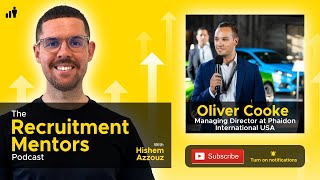
In this Recruitment Mentors Podcast episode, host Hishem Azzouz interviews Oliver Cooke, West Coast and South Coast USA leader for Faden International. Oliver shares his journey from a 2011 graduate recruit to a senior leader overseeing multiple specialist brands across the US. He outlines the traits of top recruiters—hard work, mental toughness, commercial awareness, rapid learning, authenticity—and challenges generational stereotypes, defending millennials’ work ethic. Oliver describes Faden’s evolution from a small London finance‑focused agency to a global 800‑person firm, emphasizing meritocracy, organic growth, and a culture built on ability, character, and loyalty. He stresses the primacy of relationship‑driven business development over transactional deal‑making, the importance of consistent daily activity, and the role of dedicated client‑service teams (the Faden Partnership Group) in expanding accounts. The conversation delves into US market nuances—higher fees, less saturation, professional perception, cultural differences, and the need for tailored client‑service models. Oliver offers practical advice for firms expanding into the US: grow organically with internal teams, build a pipeline before opening offices, target at least $1 million in regional revenue to justify a 50‑person office, and stay adaptable to regional cultures. Leadership themes include creating leaders, coaching across unfamiliar sectors, fostering self‑awareness, celebrating small wins, and maintaining a strong ‘why’. He also shares personal anecdotes about early commissions, his favorite book (Dale Carnegie’s How to Win Friends and Influence People), and his ultimate career goal of impacting people beyond personal success. The episode provides actionable insights on recruitment strategy, culture, leadership, and trans‑atlantic expansion.
Chapters
Welcome to the Recruitment Mentors Podcast. My name is Hishem Azzouz. Today I'm delighted to be joined by Oliver Cook, who leads the West Coast and South Coast USA offices for Faden International across 5 specialist brands. Uh, Oliver joined the recruitment industry straight out of university in 2011, and since then he has climbed the ranks at one of the fastest growing recruitment companies across the world, as well as taking his career to the States and has been there, as you shared with me, nearly more time now than, well, the most time in his adult life. So really interested to dig into your story, Oliver. And how are you?
Yeah, I'm good. I'm good. I was just saying I've got a bit of a cold, so I'm sorry if I sound a little bit congested, but otherwise it's good. It's Friday. I'm in Dallas and the weather's awesome at this time of year. So it's Yeah, it's nice.
Feeling good, love it. So where we start is, Oliver, what is your opinion in what characteristics and traits that you think make up a highly successful recruitment consultant?
Yeah, I think that's a good one. You know, I'm probably not going to say anything that people haven't heard before, right? I think first and foremost, I'm a massive believer in hard work beats talent every single day of the week. And, you know, if you don't have the work ethic, then, you know, regardless of how talented you are building relationships, communicating with people, or how charismatic you are, if you don't work hard, you're not going to succeed. You get beat, you're going to get beaten by your competitors out there. So I think first and foremost is having the work ethic, the mentality, the positive attitude, mental toughness, competitive mindset, you know, all of those things that, that I think people would typically look for. A couple of things that I tend to look for in, from a mental aspect as well, is particularly in junior people, the way we hire people is fairly organic. We do tend to focus on graduate hiring and kind of build people from there, but sort of both the commercial awareness of how business works, I think is important. And not everyone has that naturally. And secondly, sort of a bit of a, particularly if you're in specialist markets, the ability to learn quickly and the ability to, and the enthusiasm to learn quickly as well. And I think that, you know, having sort of that intellectual curiosity to go out there and actually learn your space, learn your market, become an actual expert. You know, we're living in the age of the internet where there's unlimited resources to learn what you need to. So there's no excuse really in my mind. So I think first and foremost, the mental side and piece, it's that. In terms of skills, obviously, you know, the ability to communicate, the ability to build relationships, the ability to be authentically yourself and, you know, and persuade and convince people to look at opportunities or use your service are all important things as well.
Interesting. How different— obviously, you as a graduate, right? I saw where you went to, is it Portsmouth you went to? Correct. How different do you think the graduates are when, if you look at back who you are in 2011 compared to the graduates that you see now and meet? Do you think, because a lot of people talk about it, right, snowflake generation, whatever you want to call it. I didn't go to university, I was born in 1993, so might be in that bracket maybe. But what, I don't know, any distinct distinctions you think?
Yeah, I mean, look, I, I, I, we're a cut, I think millennials first and foremost get an extremely bad rap, right? Like us millennials, uh, you know, everyone's always complaining that we don't do anything. We are a business that's being built exclusively on millennials. So frankly, I think it's— can I swear on this podcast?
Yeah, of course you can.
Come on. I think it's bullshit that millennials don't work hard and don't want to achieve things and be successful. And I think we as a business have proved that, right? We have 800 people around the world, and I'd say the vast majority are millennials and one of the fastest-growing recruitment businesses in the world. So I think certainly our generation has that. I definitely see in like kind of the newer generation coming through. I mean, you know, I think every generation looks down at the generation below and sort of like, you know, I worked harder than you and, you know, it was much harder in my day. I didn't even have LinkedIn and all the rest of it. But I, you know, I think if you find the right people, like I'm an optimist, right? Everyone wants to be successful. Everyone wants to achieve things in their life, even if it's down to small things like owning a house or sending their kids to college or owning a car, like small things like that. Like everyone has goals, whether it be financially or also in terms of your career. And I think you can find the people that will do that who have the right motivations.
So interesting. So, uh, just for, for context for everyone, I know we were talking a bit before, but a big chunk of your recruitment career has been in a leadership capacity. Um, so you just mentioned sort of where sort of Faden International are today, but where— what did Faden International look like in your first year in recruitment? And how would you describe your first year in recruitment?
Uh, it's, it's a very different company to, to what it was 10 years ago. I'm now in my 10th year in the business, which starts to make me feel quite old, to be honest. But yeah, it's, you know, when I joined in London, we were a fairly, you know, fairly typical London-based recruitment business. We were mostly finance-focused in terms of the markets we covered. In terms of the culture, it was, you know, your standard kind of London recruitment agency, right? Like, it was work hard, play hard. There was good banter in the office. It was fun. Like-minded people. I think that was one of the things I loved about it. Like, I made some of my best friends that I still have to this day in that first year in recruitment, or people who started around a similar time as me in, at Faden. So, um, you know, it was kind of your fairly typical environment back then. I think what we always did have and what attracted me to the business was It was just this relentless ambition that was running through the entire business. And I even got that from the interview process when I went in and met them. And that was super inspiring. And this idea of like, you could be, you know, you could be the CEO one day if you wanted to. And, you know, my boss who hired me, Harry Yutan, you know, had a team of 5 people when I started and he's now the global CEO. So I think we're one of those businesses where meritocracy is banded around sort of willy-nilly in recruitment these days and in most businesses, but we are kind of an ultra meritocracy and that's kind of proved out by the people in the business, you know, and where they are now and how they've stayed with the business and grown with it. In terms of who we are now, you know, we're obviously 800 people, as I said, globally. 12 offices. We're much more corporate than we probably were 10 years ago, which I think is a good thing in a lot of ways. Comes with its own challenges with that obviously as well. And as you scale, there's always growing pains. But it's been an amazing journey and I've been very lucky from my own journey in the business and I feel very grateful and lucky that I found this company specifically I've had basically a different challenge and a different role for 10 years now, 10 years in a row, every single year. And it's sort of like, okay, do this role for 3 to 6 months, make it work, probably screw it up a little bit at the start, and then, you know, do it well the next 3 months. In the final 3 months, you'd finally get it going really well, and then they're like, okay, cool, new year, new challenge, go and do this. Um, and we really do put a lot of faith in young, ambitious people who who have shown the ability to step up. And like I said, I feel, I feel very grateful and lucky that I found a company like that. So I love that.
So, so just to sort of put that together then, so obviously you're saying, so for the last 8 years you've been in a sort of hands-off role? Yeah, and we'll break that down.
Not, not quite. Um, I spent a year and a half in London and, uh, was obviously a biller there learning the ropes and learning how to do recruitment and learning my market and then moved to the US in January 2013 and got the chance to build a team as we scaled that New York office from the 5 or 6 of us that moved out here. So did that in my original market, which was quantitative finance. And then took on a wider role within our Selby Jennings brand, which is our finance-focused brand. And then, you know, after I took on that wider role of managing a couple of desks, I went hands-off at that point. So that was probably about 6 years ago or so.
Okay, cool.
And yeah, since then I've been mostly hands-off, still keep my hand in the game a little bit.
To prove it to the people that you can get some deals on the board.
Yeah, exactly. And I, you know, I love the client side of the business and what we do. I get massive buzz off that and have always been very client-facing. Um, through any of my roles. And, you know, it's something that, that's important to me, and I think it's okay to show that to, to your people as well.
Yeah. So, right, okay. So a few things before we, we dig deep into leadership and, and mindset and, and scaling. So what was the best piece of advice you got early on in your recruitment career?
Good question. I think that I have this phrase that I call, that I say that the best recruiters are relentlessly consistent in terms of what they do every single day. Recruitment's a game where it's about a consistent amount of effort and work over a period of time. No one's ever had one good day and done a deal. No one's ever had one good week and done a deal or done multiple deals, right? It's about, day after day, week after week, month after month, building that pipeline and being really consistent with the activities and the things you do day to day that produce the end result and give yourself the best chance of doing deals. And I think one of the things that our founder said to me one day, we were in New York and we were stuck in a snowstorm in a cab in New York on our way to a lunch club. And I thought I'd got him in a cab here, I had him cornered. So I was like, I'll sort of pick his brain a bit. And I said, you know, who was the best recruiter you've ever seen? He'd come from S3 in the past. And he said, firstly he said himself, which was not a surprise. And we laughed. And then he said, no, actually there was a lady that, you know, was at S3 and she was just unbelievable. She was Everyone got 10 interviews a week, she'd get 20. Everyone sent 20 CVs a week, she sent 40. And she wasn't even necessarily particularly talented at any one thing, but she was just, she completely set her own standards. And it wasn't like, okay, the target is to get to 10 interviews a week, hit 10, and then just sit back and take your foot off the gas, or do one deal and take your foot off the gas for the month and move on. She was just relentless and I really took that to heart. And I remember when I started applying that, that's when my billing took off as well.
Love that. So relentless consistency. And I think combined with that, what you just said is also have high standards, right? So let me ask you this question. I think this is a great question to ask on top of that because you've got some more insight now. So I haven't got the person's name that sent me this, but I think it's a great question. So It is. Um, he said, when you have a top biller on, it would be interesting to know what they think is the most important action or KPI that contributes to their success. What do you think that is?
Ultimately, it's the amount of jobs that you generate, right? If you don't have a job platform, you can't place jobs. You know, that's pretty simple for me, right? Having good business development. I think that recruitment gets easy once you get 4, 5, 6 clients that hire consistently, have headcount, actually partner with you, you know, who value your partnership and you build a really good relationship with them and, you know, you get a consistent flow of jobs from 3, 4, 5 accounts. As an individual contributor, that's the dream, right? You can then just fill them. And if you can build good relationships like that and deliver jobs, you know, every day, every week, you know, that fall into your lap or that generate from the activities you do, that, you know, after that, it's fairly simple in my view. So—
Yeah. It's really interesting that, because I think that's probably— I reckon there'll be a lot of people that weren't recruiters that listen to this that wasn't surprised by that, but it's definitely an area that probably people think that they can develop the most in, in terms of client development, or they find it the most difficult area. So like, why do you think that recruiters have challenges in that area? Do you think what are the common sort of hurdles or common obstacles that recruiters face that prevent them from getting to the position that you were just talking about?
Well, it's hard, right? Business development is not easy. There's a lot of rejection. You know, you get the doors slammed in your face and, you know, I think it's not easy. I think one of the biggest mistakes that people make when it comes to BD is they get some success with one activity that produces results. For example, I spec candidates out and I get jobs. And then they'll revert back to that because they've had a bit of success doing that, as they view that as the only way they can pull jobs. Whereas I'm sure if I went through the last 5 deals we rung in Faiden, out of those 5 deals, that job that was placed was probably pulled in 5 different ways. One might have been a spec, one might have been from a lead, one might have been from a client inquiry direct to us or from a key account that we have. One might have been from flipping a senior candidate into a client. You know, there are so many different ways to develop business and pull jobs. As a 360 recruiter, I think being able to connect the dots on that, that's the number one thing that I don't see people doing enough of, is doing enough of business development and keeping with it. Because it is hard, like people give up on it pretty easily. And two, doing enough different types of activities that can generate you jobs. Obviously there's a skill to how you do some of those activities and being, you know, you develop that over time, but at the end of the day it's BD, right? It is a volume-based activity. Yeah, no, enough of it.
I think that's a really good insight that you've shared there on, yeah, don't be one-dimensional with it. I think that's a really good point. But what, 'cause people always wanna know like, okay, Oliver, but what is the most effective way of doing it? People wanna know the one way, do you know what I mean? But like, what have you seen? I guess if you were to put it down to maybe 3 core ways, like what would you say has been maybe for you personally or for the highly successful recruiters that you've seen grow? Like what do you see be the most effective ways of growing clients and growing your, client development and network?
Um, I, I don't think there's one silver bullet, right? Like, I, I think that, that question is, is, is the problem, right? Because people think that there's like a silver bullet, there's this one way to, to pull jobs and develop your business. Ultimately, once— I think going back to the point I made before around developing a client into an account that comes back to you. Once you get a job, you've got to deliver on it, and you know, you've got to deliver for your clients, right? And I think in the recruitment industry, sometimes there's not enough focus on client service and being, you know, just, just providing an amazing service to your clients and delivering ultimately the candidate they want to hire who ends up—
because it's always— you always typically hear— you always typically hear, like, I need new clients, new clients, did you know what I mean? So I guess How many of the sort of high achieving recruiters that you've seen in Faden, how many of them would you say actually have an effective existing client strategy in terms of growing those clients into accounts?
I think they all do, certainly in the US. When we, I'll be honest, like when we were in London, we had grown very fast and to the point when I joined the business 10 years ago and I think we had, some issues with client relationships as a result of that. There was an approach at the time of do the deal, don't worry about the relationship, the deal's the most important, right?
Yeah.
Onto the next one. And when we came to the US, we very consciously talked about how we wanted to build the business. We wanted to do it the right way and build actual relationships that lasted over years. Became better because we are a perm-focused business. That's super important to us from a company valuation perspective as well, of we, you know, we need to show that we can grow accounts consistently year after year with permanent fees. Um, and we've been really successful at that. So we, we did implement a client services team which is called the Faden Partnership Group. You know, we do have a list of 25.
What's their job?
Sorry. So their job is, is purely client service and account management. So it's really land and expand business development within those accounts. They don't take any of the commission away from our recruiters. So they get paid from a completely separate pot on a bonus structure. And, you know, their goal is just to enhance that relationship with that set of clients. And, you know, we've now got a number of accounts across the US that are in the multi-millions of dollars on an annual basis. From doing that. And, and, you know, that strategy has paid off. And, you know, it's the world we live in today. Like, gone are the days where you can, you know, sort of, you know, throw a deal in and not, not follow process with HR and sign terms at the end and kind of thumb a deal in, um, without, you know, following process and developing the relationship.
So yeah, so real quick on that, because I think people will be interested, like, so let's just talk about from this angle, what So they, one, you've got dedicated resource developing that, amazing. And so I guess, what do you see, let's say there'll be a lot of typical 360 recruiters that don't have that resource, right? Or dedicated team that do that. So I guess from your perspective, what do you see 360 recruiters typically do wrong that prevents them from turning that client that might be spending 100 grand with them a year or less than that, to that client becoming a 200, 300 grand client, would you say? What are the typical things that people do wrong?
I think it is, uh, the point I made earlier— caring too much about the deal versus the relationship as well, and how to develop that. Um, and, um, not following process with HR, not following process with, with, with the client, going outside of that. And maybe they end up doing a deal off the back of it, but the HR then goes, okay, great, you've done a deal, but we don't want to work with you again, uh, because you follow what we wanted you to do. I think that's one of the number one things. I also believe like we're in one of the most relationship-driven businesses in the world, right? At the end of the day, you know, it's cliché, but people do buy from people. And if you are able to get past the transactional nature that sometimes is there with recruitment and into a personal relationship with your clients where they want to work with you, they want to partner with you, versus seeing you as a sort of necessary evil. I think that's the key, right?
Yeah, for sure. Okay, and then final thing, well, it might not be the final thing, but just real quick one on sort of client development, real, a bit granular here, but I'm sure it's something that comes up a lot in conversations for you from people, but this always gets messaged to me, like, what, I'd love to hear your thoughts on how, your people get over the 'we work to a PSL' objection? I'm sure that— I don't know if that's even more common in America, but like, it's just something I always get messages about. Like, I don't know if you've picked up on things or like what typically comes up for you when you hear people go, 'Ollie, I just can't, like, they're telling me they work to PSL. I just don't know how to crack this account.' What comes up for you?
Yeah, absolutely. I mean, I think it's again taking that long-term approach. And being open to it. Yeah, okay, we do work towards a PSL, but how can I win your business? And staying in touch with that contact, at least if you've got to that person that's telling you that, that's better than no response at all. And then developing the relationship from there, like a bunch of accounts, our biggest account in the US right now, which is a a large hedge fund. Um, we tried to crack them open for, for 5, 6 years, right? And, and we worked on it, and, you know, eventually we got there. They gave us a chance. When they did give us a chance, we delivered. Then we delivered again. Then we built the relationship. And then now, you know, we're doing 2, you know, 2+ million dollars a year with that single account.
Do you think recruiters underestimate the power of follow-up?
Absolutely. It's all follow-up. That's, that's that, you know, that sending one email and not getting a response, going, I BD'd that client, like, that, that, that's, that's not the game, right? It's, it's, it's all about follow-up. And then when you do get a no, that's better than no response. So you've opened the conversation now and you can, you can then develop the relationship from there. Um, and, and look, at the end of the day, if some clients have PSL, they don't want to work with you, there's hundreds or thousands of others in your market that you can work with. So don't waste— I always have a rule with my guys of spend as much time into clients as they put into you. And that goes for business development as well. If they very clearly don't want to work with you and you've tried a number of times, you keep in touch with them, move on. Like, there's always another client that you can work with. And at some point they may come back around and may work with you in the future if you keep in touch and keep up the follow-up.
Yeah. Okay. So let's dig into leadership, Ollie. So like, firstly, I have to ask you, like, you've mentioned some big numbers. You joined an organization where, yeah, there's close to 100 people. There's now 800 people in the organization. So why is it, do you think, that Oliver Cook has sort of ended up taking on the opportunities and responsibilities that you have? And not your colleagues? Like, why has it ended up being you, do you think?
Look, I think, like I said, I try and be a bit humble with it, but I am lucky and grateful that I joined the company I did. That puts a lot of responsibility and trust in young, ambitious people, and not every business is like that. When we got moved to the US, the 5 or 6 of us were all in our early to mid-20s. I was 23. And they basically said, look, here's a million bucks, go make it work. Which was an amazing opportunity. Pretty daunting. I'd been to New York for 3 days when I was 12. So that was pretty weird walking through Times Square the first time being like, I live here now. And I think, you know, first and foremost, I'm very lucky that I work in a company that gives me the opportunity to step up and do that. Secondly, look, I think I was, I have always been good at teaching recruitment and coaching people how to do the job and doing it in a way that hopefully makes sense and explaining the why behind everything and you know, making them quite skillful at what they do. And then hopefully inspiring them to work hard and achieve what they want to achieve after they know how to do the job. I think, you know, if you're a billing manager, that's the key thing, right? You know, get good at teaching how to do the job and how to make people good at what they do rather than just giving them a phone and a computer and going, go make some calls and see what happens. And then, you know, afterwards it's all about inspiring and motivating and encouraging people and making them better. I think obviously a lot of people get into recruitment because there's a lot of rewards financially, progression, things like that. I think the best managers that I see are really passionate about developing people. I think that goes for any industry, but particularly recruitment where it becomes a game of scaling. I believe in, if you create, you're not a leader until you create a leader who creates another leader. And that's what the game is about at the end of the day. So I've spent a lot of my time in the last, you know, 5 or 6 years creating leaders beneath me who can also do the things that I mentioned, right? And that's how I think, you know, how we operate as a business at Faden as well. Because we are an organically grown business, we very rarely make experienced hires, particularly at the management level. And that gives us some weaknesses in some ways, being that insular, but I think it's a massive strength of ours as well. So, you know, really that, I think, it's those 3 things that have kind of helped me be successful so far.
Okay, interesting. So, and then, uh, I'd love to know this then, like, what do you think of like the 3 non-negotiables of the Faden culture that everyone abides to?
3 non-negotiables that you think makes Faden Faden?
This, like, yeah, that's really what, what everyone—
I, I'm trying not to give you the corporate answer, and I'm trying to give you the real answer. I think, I think, I think back in the day, right, I'll give you the corporate answer and then I'll give what I think is the real answer as well.
Yeah, okay.
So, um, the corporate answer is, you know, ability, character, loyalty. That's our 3 values.
Yeah.
And I do actually believe, like, although it's a bit of a cliché corporate thing to talk about, I do think that is consistent across our business, right?
Okay.
Organically grown, people are loyal to us, we are loyal back to them. You know, an example of that is throughout this pandemic, we didn't cut any commissions or any salaries. For anyone in our business because we are very aware that the people driving the value in the business are the ones that are there day to day, that are hitting the phones, that are building the relationships and doing the deals. To disincentivize them in an environment like we've all just been through, like, we have to sell our way out of what this position we're in. And we took that view, and as a result, you know, we've actually held up really well throughout the crisis. Character You know, like I said, you know, we put a lot of trust and value in young ambitious people that want to step up and want to succeed. And likewise with ability, like if you show the ability to step up in this business, we'll give you the chance to do it. So that's probably the corporate answer. And the real answer is like, we don't have anything proprietary that no one else has, right? Like our people and our culture are who we are. And like, you know, we used to say back in the day, work hard, make money, have fun, right? And that sounds, that sounds like kind of cheesy a little bit now, but like, it, it, at the heart of it, like, that's the environment we want to create where people do work really hard, you do get rewarded for it, and while you do it, you have fun with like-minded people. And, you know, you can develop your career with that. So That's what I'd say.
Interesting. So let me ask you this then, Ollie, because I feel like you would have come up against this. Like, how have you gone about leading and creating leaders in sort of areas of this business that you previously haven't worked in as a consultant? That must be challenging.
Yeah, definitely. And, you know, I've been through that the last couple of years. I like— finance has kind of been my bread and butter, the financial services world, and In the last 18 months, I've moved into a role where I'm managing a number of offices across all of our brands. So we have a life sciences brand, we have an infrastructure and renewables brand, engineering brand, supply chain and procurement brand, we have a tech brand, and then we have our FS brand, which is our largest business. So that was always my comfort zone, and I've had to to step out of that, particularly in the last 18 months, uh, and it's definitely challenging. Ultimately, I'm not gonna go and work with a leader who's the best, um, at, um, you know, life sciences recruitment in the market and tell them how to do their job and recruit in that market better than them. They've done that for 5 years. I'm never going to add value for them in that world. But I do think that leadership and coaching and development is consistent across any market. And there are some recruitment skills that are also obviously consistent across any market. And I think that's where I've tried to add value for people of like, okay, how do you build a team? How do you retain people? How do you develop that person from 1 deal every 3 months to 8 deals a year or 10 deals a year? And being a value add on that side is where you got to be, right? Like as you progress, you're not always going to manage people in a market that you fully understand or know really well. Obviously gaining some initial basic knowledge of that market helps and understanding the nuances of that space and how they, how to recruit because it does vary. But ultimately it's more about how can I add value to you from my experience and it's more around that sort of leadership development and people development piece.
Nice. Yeah, so making sure that you go into those situations with the humility to be like, look, I know I probably can't add value this area, but I can add value in these areas and then work away from that point. Yeah, that's really interesting then. So I guess just on that then, if you work with a lot of people like that, I think you, I'm sure you've heard this saying that the sort of billing lead, the billing manager is the most difficult role in recruitment. Um, well, what do you see— what do you typically then help leaders with then get better at or improve at that you typically find yourself doing with people?
Um, I think a big weakness of my own was, was definitely time management and organization and being— having structure to the way that you do things. Um, and so I had to learn the hard way through a lot of mistakes that you need to have all those things. Those are things that I'm not good at naturally. And so I think that's something that I've been able to help people with. I think how you manage your business, how you spot problems ahead of time, how you can be a proactive versus reactive manager, how you, how you train somebody to manage. Which is also not easy to do. That's something that I've always kind of worked on. You know, how do you drive activity without being a KPI monster, right? How do you inspire and motivate somebody to set their own standards, like I said earlier, and go above and beyond without being like, send some more fucking CVs, right? And, you know, I think there is a skill to that, which hopefully I do. I mean, now and again I may have said that, but you know, we try and avoid that, right? It's more about explaining the why behind things. How can you inspire somebody to go above and beyond versus the stick, if that makes sense?
Yeah, yeah, for sure. That was one of the questions that I definitely had down. If you look at your organization and the world that you live in, there's going to be so many systems that Faden have, and we have the Faden way of doing things, and that would have been a big part as to why you scaled, right? But I think there's then like your experience chair, and one of the questions I wrote down was like that sort of you can be, you can potentially go too far one side, which is overemphasis on KPIs, which can then potentially be counterintuitive, right, in terms of people's performance and activity. So it's interesting you say that. So I guess this comes up a lot, and it's all, it always comes up around drivers, which is typically the word, right? You're saying why, and for them to encourage them to overperform and set their own standards, but I guess, how have you— and I'm sure you've obviously put together maybe a bit of a system now, got better at working out how to encourage consultants to find out their drivers or what their drivers are. Like, is that, is that being important, do you think?
Yeah, absolutely. I mean, I, you know, we, we try to figure that out in the interview process itself, obviously. Excuse me. I think everyone's got a I think particularly when you're hiring young graduates, for me, I like to hire people that have a self-awareness where—
How do you look for that?
So I think, you know, it's asking people like, do they understand their weaknesses? Like, I, you know, the typical interview question is, tell me about your biggest weakness. Everyone has a canned answer prepared for that, right? Like, you're still— I'm a perfectionist, right? Okay, thanks. Um, So I ask them for, name me your top 5 weaknesses. And by 3 or 4, they really have to think about it and they start being honest.
Okay.
Or somebody that sits there and can't tell me 5 weaknesses, okay, you're 21 years old, you're a graduate, and you're already the finished article. Probably not the case, right? So, um, yeah, that— I, people have a self-awareness, and I think is, is very important. And people who know themselves tend to understand their why, what gets them out of bed in the morning. And that will change for people over time, obviously, with different priorities and things like that. But we always like to establish that in the interview process. I have this thing that I talk about a lot called the 8 great working habits. Again, it sounds a bit cheesy, but I learned them doing door-to-door sales at university where I literally walked around with a bag selling makeup, which was— Wow. Which was kind of weird and embarrassing at times, but it taught me a ton about rejection and business development and building relationships and all the rest of it. I didn't wear the makeup, so sometimes, but yeah, so it was the last one on those 8 great working habits is remember why you're here and what you're doing it for. And I think if, you know, for any, whatever career you're in, right, whether it's recruitment or anything else, I think if you when things don't go well, when things don't go your way, when you have a bad week, a bad month, a bad day, whatever, that's the thing that gets you through it, is knowing your why and knowing why you get out of bed in the morning and remembering that. And, you know, I talk about that a lot to, to my guys and the people that I manage, because if, if you don't know what that is, you need to figure it out quick because you will have those days all those weeks or those months where it is shit and, you know, it's not going your way and you need to get through it. So that's something that I talk about a lot.
Yeah, interesting. So just to build on that, and then I'd love to just pick your brain around the nuances of the US market, and I think you're very well positioned to talk about what you've learned along the way, and I think there's loads of recruitment businesses wanting to expand internationally. And some get it right, some get it wrong. But I guess obviously you, as you've shared with us, you've become very successful at developing fresh talent, right? And I think a lot of recruitment businesses ideally would want to be able to grow fresh talent like Faidan have, right? But this question I have that sort of someone sent over is like something that I guess you have to deal with as a manager is How you help people that doubt themselves, but how do you actually help people overcome that doubt? So you're talking about the anchor point of their why, but a lot of this, and when I speak to a lot of recruiters on here that might have 3, 4, 5 years experience, a lot of the reasons why maybe they didn't excel in the first year is confidence. So like, how have, what's been your, what's been, yeah, learnings on that, on like how you've got better at people actually getting better and not doubting themselves?
Yeah, I mean, like, confidence naturally comes with success. You know, when you get, you know, when you see the process through, when you do the deal, it's gonna come. But I always say to my guys in the onboarding process, build, build, build, right? Tell, like, celebrate the small wins, even if it's pulling a lead or, you know, like getting a great candidate in or just the basics of the job, celebrate those wins and build someone up. Half the battle with a graduate who's in their first job is convincing them that they can do it. Like, and now I massively believe in that. Like, build them up, reinforce that, that, and, and reinforce that positivity and encourage them to, to know that they can do it. Because like I said at the beginning, recruitment is an accumulation of small gains over a period of time. And if you can get somebody excited about pulling a lead, excited about generating a really good candidate, excited about having a good conversation with a client, That's half the battle, and then the rest of it kind of follows from there. So yeah, like giving them the confidence they can do it just by positive reinforcement is there. I think getting like the onboarding process with that generally is super important. You know, how do you get somebody comfortable coming into the office in a— it's their first job, How do you get them, you know, like making sure they make friends across the office, right? I said it before, like a big part of who we are is we have fun while we do it. And it's pointless if you're not having fun. So, you know, hopefully, you know, we do a good job of kind of making people feel comfortable when they join us quickly. And, you know, if you feel comfortable getting out of bed and getting to the office every morning and you're making friends and you're enjoying the people around you, the work's going to become more enjoyable as well. Yeah, those are things I like.
That, yeah, build, build, build. I really like that. So, um, Ollie, like, how would you— that— how would you sort of wrap up maybe in like 2 or 3 things, like the main differences in terms of the nuances of being a recruiter in the American market that people should be aware of if, I don't know, thinking about expanding into America or, um, are in the process of doing at the moment? What are the main sort of cultural nuances or differences you think from a recruiting perspective that we need to know about?
I think there's a lot, right? We're quite different, us English and Brits versus the US, much more than I realized before I moved here. I think I always say when we moved here, like, we didn't know what we didn't know, and we just sort of like, we're a bunch of 20-somethings moved out. We, I think we had a collective experience across the 6 or 7 of us of like 15 years recruitment experience, like cumulative, we were pretty junior guys. And so like we had to learn from our mistakes pretty quickly, even down to like using American spellings in your emails versus English spellings, like putting a Z in there versus an S and stuff like that. Because you do that in the US and some people think you can't spell. They don't know that in England we spell it differently. So it's small things like that. Um, what, what I did love about coming to the US is recruitment is a much less developed market. It's less, much less saturated. Um, and the industry as a whole is seen as a much more professional industry than maybe it's perceived as in the UK. Um, and clients and candidates treat you accordingly, right? I used that phrase earlier, sort of a necessary evil. I think that's less, you know, that there's less of that perception in the US. And sort of headhunting, as they tend to call it here, or recruitment, is seen as that, is a very professional industry. That is changing as it's becoming more mature here over the last 7, 8 years. In particular, there's a lot of British companies like ourselves and others that have come here and scaled really fast. But I always loved the fact that I felt a bit more respected by a client here and a bit seen a bit more as a partner versus as somebody who's like, you know, I think it's really unfortunate in the UK. Recruitment is amazing because anybody with any background can pick it up and change their lives. And if they have the work ethic and the talent to do it. But at the same time, because of those low barriers to entry, there are, you know, there are people that—
some of the standards can be low.
Yeah, the standards get reduced, and there are people that maybe, you know, shouldn't be in the industry. And it gives, you know, the perception that, you know, the— it gives the industry a bad name at times. And that's a shame because I love the industry. It's certainly like changed my life and I've seen it change a lot of lives, you know, for whether it be friends or people in our business. But well, I think it's quite nice in the US that it doesn't have that perception yet. And so that's a good thing.
Are the fees bigger?
Yes, our average deal size in the US is bigger than our average deal size in the UK. And so yes, you can generally, I think back to the original point, right? Like because it's less saturated, there aren't people driving down the fees by undercutting everyone else and reducing the overall standard of the work done. At the same time, I think if you work in markets where it's over-broke, where it is saturated, if you're gonna go and do accountancy recruitment in the US, the fees are going to be the same or lower than they are in the UK, or basic IT recruitment. I think where we've done well is we've always focused on that, those business-critical spaces where it's underbroke and there's not a lot of competition, and it's really that mid to senior level talent that is hard to find, um, and you know, kind of that needle in a haystack that no one else can find and being real specialists within those markets. If you do that, then the fees are definitely bigger. So yeah.
And then, so look, you've got, I mean, look, you've been there for a long time now. So like, how do you see it? As you've said there, there's a lot of different UK originally, obviously agencies starting in the UK going to the US. Like, how do you see it shaping up? So like you mentioned, like it seems like maybe there might be some more saturation, obviously. But like, how do you see it shaping up over the next sort of 3 to 5 years with probably more and more UK firms going over to the US?
Yeah, definitely, definitely. And that's— it's a compliment to us and others that have done it that, you know, people have seen some of the success that we're having and want to replicate that. So there will be more competition inevitably, but at the same time, I think that, you know, we've all learned a lot this year about ourselves, about our businesses, about the world we live in, and it's been a pretty crazy year for everyone. I think that one of the results off the back of this year is that we've seen is the strength of client relationships that you've built in the past. When the times are bad, those are the clients that will, will rely on you and you'll rely on them. And I think if you're a business that doesn't operate that way, then you'll always struggle, um, to, to scale and, and also to, to go through those, those harder times. Um, that's definitely something I've learned this year, and, and it's been a big positive for us, um, as a business as well.
So, so do you think that's where typically UK firms might get it wrong then, is that not invest enough into the client relationship side, because isn't it quite the norm then to have the sort of setup that you have in the US, that more sort of 180 model where you have people just focusing on the client side and people focusing on delivery? So do you think that's where people could potentially slip up, is not, yeah, maybe taking the client relationship part for granted or not investing enough in it?
Yeah, in my experience, yes. It's, you know, I said earlier the fact that we're so insular and we've all grown up in the business. Um, you know, I've done a lot more networking the last couple of years, um, you know, within the industry than I had prior. But, you know, I don't know a lot about how other businesses operate, to be honest. Um, and, and like, like I said, that's, that's a strength and a weakness for us. Um, you know, we, we have a way of doing things and we have the things we believe in and we think we do them very well. And we tend to focus on that versus focusing on what other people don't do well or do better than us or whatever. And, you know, like I think we could do more of that. So it's difficult for me to answer that question 'cause I just, I don't necessarily know how other businesses operate. What I will say is if you look at the big US recruitment firms, like the KForces of this world and Insight Global and kind of some of these other businesses that are pretty large and have scaled pretty fast, they, you know, do have that 180 model, and that's a lot more common out here. But again, I think where we've taken market share away from some of those firms is the 360 model does work well if you're a specialist recruiter, and there aren't many large US recruitment companies that operate that way.
So yeah, I think that's the other thing I picked up on, nuances of like, yeah, they like— if I get Ollie the business owner as a client, I'll say, yeah, Ollie, I can do all your recruitment, rather than I'll do that mid to senior job title and only that, which is obviously way more common in the UK. But as we come to the end here then, like just to tie that together then, if I'm a recruiter listening right now and my business plan in 2021 is to take my market from the UK to the US, what's your 3 tips to me, mate? What would you be saying to me if I was in the process of expanding into the US?
Yeah, absolutely. I think the 3 things are things that we have always done when we've launched new locations, new offices, is do it with an organic team, right? Don't go and hire in some director from the US who may know the market but doesn't know you as a business. 'Cause I think the danger is if you do that and then you hire a bunch of other experienced people, you know, who are local, whatever, you just end up franchising your business. You know, if you're big enough and doing well enough to expand to a new location, new geography, trust in the people that got you there in the first place and grow organically. So whenever we launch an office, you know, we always try and make sure that we go with an organic team of at least 4 or 5, and we've done this now with 7 offices in the US, at least 4 or 5 that have grown up, understand us, understand how we operate, and can go into that new market and replicate it there. So that's number one.
Just quickly, I think it's just like, be protective of that, because I think you may think you might have the perfect person, you might think— you may not view it as a bit of a shortcut, but it might be the quicker route, mightn't it, to go down the route of hiring someone that knows that market? But yeah, be protective of your culture, and what you know that works.
And go, yeah, and trust in the people that want to go out there. Hopefully if you can find them internally in the business and move them out there to start it, because that's how you create a, we call it like a kind of golden thread within your business where the culture is consistent across lots of locations. I think where other companies struggle is they go, right, we're going to launch in the US, let's hire 5 locals and try and replicate what we do. It's not going to work because it's going to be franchised, they're going to do it differently. So that's number one. I say number two is work in that market from afar, develop a client base and a candidate base and develop that before you actually land. So yeah, let's just quickly—
I've heard that before, let's make that a bit clearer. What would you— I know it's different, different markets, but what would you say are like the core metrics that you're looking for to be like, you know what, 'Yeah, I'm confident that we've got a market there.' We talking, I don't know, X amount of clients? We talking get your billings to X? You know what I mean?
What would you say the sort of typical barometers that you'd look for to be like, 'Yeah, let's do it.' So we tend to look at at least $1 million done in that region, you know, to warrant opening an office and the potential to grow that office to 50 people. I think unless you can grow that office to 50 people, Like there's not really much point in launching it. You can plant—
why 50?
Well, I think by 50 you can get the scale where it actually becomes a profit center that's valuable to the business, right? Like yes, you can make a decent amount of profit with 20 people or 30 people, but they all have to perform really, really well, right? If you're going to generate an amount of profit, let's call it a million dollars plus in a location, You're going to need 50 people really, because then you, half of them won't do a deal every month perhaps, and the other half will. And to get to that level where you're generating an actual value-add amount of profit, then is kind of 50. That's what we look for. And then so like doing $1 million before you actually land kind of proves out that concept that it is scalable and you can do it there. And then go with an organic team. Nice.
Third tip then. What would the final tip then be?
The final tip. Third tip, I would say be open to new ideas and new ways of doing things as well. I know that might be slightly contradictory to my first point about keeping that consistent culture. But, you know, like at the same time, like we've learned a lot since we came here. And like I said, we didn't know what we didn't know and we made a lot of mistakes. Like we did screw some things up. Like it hasn't been a smooth ride all along the way. And we've learned a lot from those. Like I said, the culture is different out here. Like we are a different kind of business to the one we are in London and Europe. Right? Like we do operate slightly differently. The same values are consistent, but the culture's different, right? Like the culture's different in Hong Kong and Singapore to what it is in New York. And I think being accepting of that, even I think we found in the US as we've gone to different regions in the US, it's different even in the US. Like the culture is different in California to what it is in New York. It's different in Texas to what it is in Boston. And so I think Having that sort of golden thread, like I said, of values that are consistent and similar ways of doing things, but also being open to managing people and your teams and your business slightly differently based on the culture is important as well.
Yeah. So I guess what you're also saying there is respect the culture, isn't it? And don't sort of think or make the decision that it's like it shouldn't be this way. Do you know what I mean? Yeah. So I really like that. So Okay, got 5 quickfire questions for you before we fire away. All right, so first one is, if you could change the industry, what would you want to improve?
I, I, I said it earlier, I think, um, higher barriers to entry will improve the standards.
What book have you read that has had the biggest impact on you?
How to Win Friends and Influence People by Dale Carnegie.
Yeah, that's an absolute cracker, that one.
It's a great one.
If, uh, so if you could write a LinkedIn post that could be seen by every single recruitment consultant across the world, what would you want it to say?
Good one. Um, I'm, I'm gonna be kind of like selfish in that I'd like more.
Oh, it's not a fading job advert, is it?
Oh yeah, that's— I can't really say that, can I? Um, I, uh, yeah, I mean, look, like, we, we— I, I think I— we, we would like to publicize us, what, you know, what we've done more. So if I can talk about, you know, our journey a bit like we've had on, on, on this hour, why I was really open to doing this I think that's a big plus because, you know, hopefully whether it inspires, you know, somebody to work in their own company harder and do something different or new or join us, you know, that's a good thing, right?
So yeah, that's fair enough. What did you spend your first biggest commission paycheck on?
That's a fun one. So it was funny, so can I tell a story on this?
Yeah, of course you can.
So, um, I did a couple of deals quite quick in the first few months I joined the business, but they're all 3-month notices. So we pay a month in arrears on invoice, right? So, uh, after candidate starts, we'll pay the next month. And so I had 3 deals kind of stacked up, and I was about 6 months into the job, and I, I was on an £18,000 base salary, right? Like, it was peanuts at the time, as most people start on in recruitment. And yeah, yeah, and I, I was at the point where I was having to make a packed lunch every day and I had to borrow money off Wonga.com the last week before I got that paycheck because I was too proud to ask my parents for money. And I borrowed money off Wonga.com, £150 just to buy my packed lunch and get me to work every day. And then I knew I was getting about— it was about £11,000, something like that. Which was for me, it was like, yeah, that's big. I thought I was fucking loaded at the time. Yeah, exactly. So, um, we— yeah, I, I had my mate's birthday party on the Saturday and I thought it was coming in on the Monday. I woke up on the Saturday morning and I just thought, I'll, uh, I'll check whether it's coming, why not? And I looked at my bank account and it was sitting there, uh, and I was—
I was— you got more money out of Wonga?
I think, I think I'd— yeah, I paid Wonga back straight away. I think I did a ravanelli around the house, like I was And so, yeah, and then we went out and had a very, very big night that night. So that's probably the first thing I spent my money on and then paid back all my credit cards. So awesome.
Love that, mate. Last one. What's the ultimate goal for your recruitment career?
Tough one. Um, it, it, it's tough, right? Like, for my— I, I don't know whether recruitment career is the right answer or career in general. Like, I want the same things as everyone else, right? Like, you want to, you want, um, to be rewarded for your hard work and, and, you know, whether that, you know, financially and through significance and progression and things like that. You know, those things are important to me. But ultimately, like, if I look back on my career now so far, and there's a long way to go, but I think we've also like impacted a lot of people, whether that be people who've joined us as a business who may have gone and left and gone on to do great things elsewhere, or people that are still with us and like That's something that's personally like really inspiring for me day to day now of like seeing people progress and seeing them succeed and not just about my own achievements but like seeing that and I think, you know, I'm a big believer that and I talk about this with the managers that I work with as well of like be unselfish, be more motivated about their success than your own because, you know, everyone hates that selfish manager that's clearly in it for themselves. And so I think that that's quite a cool thing and it's kind of intangible to say that, right? You can't really put something specific on that, but being able to look back in 10 years' time from now and be like, cool, like all these people that have worked for us or worked with us or even clients that we've helped like a lot over the years and worked with for years and years, being able to be involved in that I think is pretty cool.
So yeah, amazing. Ollie, it's been an absolute pleasure. Thank you.
You too, mate. Thank you very much.
More from Hishem




You don't need as many clients as you think to bill $1 Million A Year In Recruitment



From 30 Direct Reports to Back-to-Back $1M Years as a Solo Recruiter with Zach Creighton



