Recruitment Mentors Podcast LIVE with Lewis Adams Dunstan
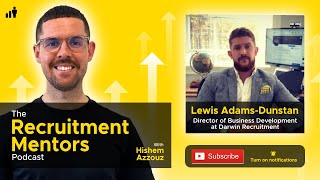
In this live episode of the Recruitment Mentors podcast, host Hishem Azzouz interviews Lewis Adams Dunstan, Director of Business Development at Darwin Recruitment. Lewis shares his 10‑year recruitment journey, how his role blends business development with candidate sourcing, and how the COVID‑19 pandemic forced a market pivot toward sectors like e‑commerce, pharma and data science. He explains why maintaining a candidate pipeline is essential for business development and how senior data scientists remain in demand despite a flood of candidates. A major focus is Lewis’s use of a self‑produced podcast as a multi‑purpose business‑development engine: it helps him stay informed, builds relationships with hiring managers, creates a LinkedIn community of speakers, and opens doors that traditional cold‑calling cannot. He offers practical advice for recruiters wanting to start a podcast, emphasizing authenticity, clear goals, and leveraging existing client and target‑client networks. Lewis outlines his daily structure—weekly podcast production, investment‑tracking via the Index platform to spot funded tech firms, and a disciplined work‑hour routine that balances remote work with personal health. The conversation then shifts to the US versus UK recruitment landscape: higher fees (25‑30% commissions), larger salary bands for data scientists ($150K‑$400K), and the need to navigate internal recruiter gatekeepers. Lewis provides three key tips for UK recruiters aiming to move to the US: build a local friendship network, respect the US recruiting process, and enjoy the experience. He also discusses hiring remote teams across the US, the financial runway required before relocation (e.g., $100K monthly revenue for three consecutive months), and the typical 18‑month incubation period working US hours before moving. The episode ends with actionable takeaways for recruiters looking to expand into the American market.
Chapters
Hello LinkedIn, we are back live this week. I'm joined by Lewis who works for Darwin Recruitment and, uh, really excited to, to have, uh, Lewis here for 30 minutes or so. If you didn't see the episode released this week, Lewis joined me on the Recruitment Mentors podcast, so we're going to chat for the next 30 minutes, have a bit of an honest, open conversation dig into sort of the now, what challenges Lewis is facing right now, how he's overcoming them, what he's hearing from his teams. And Lewis, a lot of his role is focused on business development, so we're definitely going to dig into that. But for those people that may not know you, Lewis, and your background, if we could start there and then we'll dig into it.
Yeah, sure. Thanks again for having me, Hishem Azzouz. So, brief intro into myself. I've been doing recruitment for 10 years. The last 7 of those years have been spent at Darwin recruitment where I started as a trainee, kind of worked my way up the ranks, working in Denmark, now in America, and I currently sit as the Director of Business Development. So my role for the most part is centered around initiating relationships with businesses, starting to build on those relationships, and then predominantly introducing someone from the team who would then start to nurture and, you know, expand those relationships over time.
Okay, that's good to know. So, and that's remained the— and that's remained the case, um, during the whole COVID period? Like, you haven't then got back sourcing candidates? Is— has it still remained like business development? Yeah, just for context for people and for me.
Yeah, so I'm still sourcing, so there is an element of my role that, that requires me to find candidates for two reasons, really. One, because you have to stay close to the candidate market to be able to stay on top of leads. Like, doing candidate development is part of doing business development, in my opinion. First and foremost, you never know when those candidates are gonna be hiring managers, so it's good to build relationships early, thinking long-term, always. And then secondly, I'm more than happy to pick up 100% of the 360 deal if I find a candidate myself on occasion. Now, for the most part, I'm passing those relationships over, but if I know a candidate or have someone in my network, I'm going to find them, get them in process, place them, and pick up the commission.
Okay, cool.
I'll just add.
And then final bit of context. Yeah, you live in Massachusetts?
Well, yes and no. I moved, um, 5, 6 weeks ago now to New Hampshire, so I'm an hour away from Mass. Um, Couple of reasons, again, being first one is a tax-free state. So, basically promoted myself. And then secondly, I'm growing a family. So whilst COVID is going on, it's a much less densely populated area and you're just, you know, you're not on top of people. I much prefer that while my wife's pregnant.
Fair enough. And then you recruit in the tech sector. Mm-hmm. And in terms of the businesses that you support, is it typically limited to the state that you live in, or just find a bit of context on that in terms of typical states or where businesses typically are based where you support?
Yeah, so the way the business is set up is that we have consultants looking after each technical vertical. Um, in the US, we have a little bit more freedom and flexibility in terms of what we, uh, what we look after or who we support, and we're not tied geographically to a specific state in America. So For the most part, a lot of our business is done in New York, Boston, Chicago, and California, San Francisco. Although we do have some other opportunities going on down in the kind of Florida and Atlanta areas.
Okay, interesting. Right, so let's get into this. There's a couple of questions that have come through already, but everyone that's joining us, thank you. We will get your questions answered. So for me, I think the daily conversations that I have, COVID, no COVID, business development typically is the area that people want to develop most in. Um, so let's talk about that for a second. Like, what has been your biggest challenge over during COVID on the business development side, would you say, that you've come up against a lot and you've had, had to work really hard to overcome, would you say?
Well, I would say that obviously it's been challenging for everybody, but we pivoted quite quickly It's very obvious that you're not going to do much business with a travel company right now, but you are likely to do more business with a company trying to produce vaccines or pharmaceutical drugs or someone who's heavily involved in the e-commerce world because people are still spending money, although they're being laid off left, right, and center. We've got Thanksgiving coming up, Christmas coming up, people are still buying. So it was more a case of pivoting initially trying to just see where the demand was. But I will say that we, at least I focus predominantly on data science, and people haven't stopped looking for high-level data scientists. Although the market has been flooded with, with candidates, potential candidates, that hasn't changed the fact that all the good guys and girls are still happily employed. So there is still a huge demand for, for senior-level talent in, in this particular space, which just means that we haven't been really that affected during COVID Okay, fair.
That's fair. That's good.
Yeah.
Yeah. So I guess number one challenge then that I've heard numerous times, which I'm sure you've heard, which is in line with what you just said, Lewis, why would I pay you a recruitment fee when we can, we can source this directly? What are you saying to that?
Um, more often than not, the reason they're having that conversation with me is because they can't. So I think where we focus specifically on data science and kind of like surrounding technologies— we do a bit of product as well, we've got a new employee that just joined us— um, there's always going to be demand. It's not easy to find these people, so as long as you're taking time to research businesses understanding their need before going in and, and kind of trying to sell them something. If you're bringing value to them, you typically don't have to sell why you would work with me, you know, the candidate does that for you. Um, I feel like if you have good product, people are always going to want to buy from you. So staying on top of the market, staying on top of the trends, really just identifying where the needs are. Some obvious places for me right now, at least where I see machine learning, data science going is automation. And then certainly crypto is a hot topic right now with digital currencies and security and everything surrounding that. So I think if you just, if you just are aware of where the tech market's going, you really shouldn't have to sell your service too much if you have a good product.
Okay, so let's dig into this. And this question has come through and this is what I guess I'm most interested in. My question when I prepared for this was, okay, great, get that, but like what has been or what has continued to be the most effective way for Lewis to generate business and pick up business? So this question has pretty much come from Richard James. How have you adapted your approach? If you have adapted your approach, you're talking a bit about, well, you need to make sure you're on top of the market and if you've continued to do that, you understand what problems you can solve by making sure you're still getting the right talent or talent that you know can solve problems for your businesses, then you should still, there should still be plenty of opportunities, but like what's been the most effective way of you winning business or continuing to, and also have you adapted your approach in any way?
Yeah, thanks for the question firstly, Richard. And to answer that, I wouldn't say that I'm, you know, pushing the boundaries too far, but I actually have a podcast that I run myself and I leverage that in many different ways. First and foremost, for me to gain a better understanding of the space. Secondly, so I have some relevant topics that I can go back to the industry and talk about. And then thirdly, a lot of the people that I bring onto my podcast are hiring managers. I might not be supporting them in the short term. I've always got a longer-term view when I, when I do recruitment. Um, so I'm not necessarily picking up the phone and trying to push candidates down people's necks. I'm just trying to create those initial relationships and, and leveraging my podcast to do that. Um, and then creating some exclusivity around it and, and bringing some value to them after. So for example, I have a group on LinkedIn which is full of the speakers that I've had on my podcast, and they all chat with each other. So now I've got a group of hiring managers that I've brought value to, and occasionally I'll ask them for help on something, whether that be introducing me to someone else, whether that be what's the opinion on this candidate, whether that be has anyone got any jobs. And it's been quite effective. So just thinking outside of the kind of just pick up the phone or send an email box, like what other tools do you have that you can use and leverage? And also like what other social media platforms can you use? If you are working in certain industries, LinkedIn might not be the best place to source or do business development. For example, if you work in the security space, Twitter is a fantastic place to be. So just being aware of what you've got available to you has helped with not only keeping it fresh as well, because after 10 years of picking up the phone, you kind of want to try new things. And this podcast has been really exciting. For me, and it's generally— When did you start it? It wouldn't far off be almost 12 months to the week.
Okay, awesome. So it's been a year. I obviously, you know, you know what I do, and I think podcasts is a great— it's like if a recruiter was to ask me, right, if I was to do one, if I was to choose and give everything to one marketing channel or one marketing activity, what would it be? It would be starting a podcast for sure, because of the reasons that you're talking about. So for anyone joining us today who are thinking, how the hell do I start that? Because I'm sure you had these worries or whatever, right? So what if I'm thinking now, right, you know what, that's, that's a great thing for me to do. What would be your like, I don't know, 1, 2, 3 bits of advice that you'd, you tell me so I can actually kickstart this and maybe share what you did to get this started? Instead of being paralyzed by, I don't know what to do?
Yeah, definitely. I think be authentic. Like, most recruiters aren't experts, although we proclaim to be them. We don't know the depth of what we're selling, certainly in the technology world. If I did, I'd probably go and be a data scientist. They earn a ton of money. But generally speaking, like, stick within your wheelhouse. So for me, the mindset behind my podcast is I bring HR knowledge. Or recruitment knowledge and then combine it with technical experts. And we talk about recruiting processes or hiring processes, um, or, or just career general kind of processes. And, and, and that's really worked for me. Um, I tried to do a couple of deep technical dives and I just look like an idiot. So I just had to publish them again. Well, they were the first one or two I did and they were actually in person, so it was even more embarrassing. Like, they, like I can wear gray now quite confidently and not worry about sweating. But back then it was really difficult, really difficult. And I just changed it up and stuck with what I knew and it made it a lot easier. As soon as you have like one bad conversation or one bad podcast, then you do a second one, it could be quite discouraging and it's hard then to go on to a third or fourth or fifth. So just stick with what you know. That's my first bit of advice. Second piece of advice is, I guess, just have a plan, have a goal. Like, what are you trying to achieve from your podcast? Let's not shy away from the fact that it's a business development tool. It really is. And you should make sure that you're leveraging it to create business. Don't just do it and then become a podcaster. Like, that's fine if you want to go down that route, but your boss isn't going to be happy if you're just creating content and not money. So you have to have some end goal to it. Um, and, uh, and then there's, there's a fine balance between doing it too often and not doing it enough. And I think I'm leaning on the side of doing it too often because it starts to have a negative effect. Once a week, once a week, um, and sometimes twice a week. And, uh, and then I, I post a lot of content, like my own content. I don't do as much resharing of content, but I feel like it's starting to have adverse effects now on LinkedIn. So I still haven't figured it out, but sticking with what I know made me a lot more confident in having these conversations and then just ensuring that you're bringing value to the speaker because the speaker will give you time. But if you don't bring in value and don't follow up with them after, then you've just had a chat with someone that was recorded once and no one remembers.
And you do that by— you've got— you're connecting them with other experts that they could learn from. Yeah, yeah, yeah. Awesome.
Nice.
So, okay, final thing on this. I've definitely got just one piece of advice that I've given that has helped people in this, but the people that are joining us and going, okay, that sounds great, but like, how does— like, let's just be really practical here. Like, how has this helped you on business development? Like, how was that? How has that then actually helped you? Like, has it enabled you to pick up the phone or reach out wherever you've done it and you've got more yeses, you've got more of an opportunity to start building relationships? Like, how has it actually helped you?
I think the latter really is that it's created an opportunity for me to have a conversation with someone that might not already normally pick up the phone. So I've kind of got over that first hurdle. I think there is no gatekeeper in the sense of introducing a podcast to a hiring manager because the gatekeeper is not going to go, we're not interested in working with recruiters. You'd be like, well, I'm not selling recruitment services. So you've already kind of crossed that hurdle. You're already in the door, so to speak. And again, if you've brought value to them and you've introduced them to people after and you see them communicating, like, I don't want to say they owe you because that's not the right way of putting it, but there is an element of, okay, cool, he brought value to me. So is there an opportunity for me to help him? And I've seen that.
That's how we operate, isn't it?
Like, if you help me, I'm just naturally inclined to help you at some point. Yeah, yeah, exactly. Okay, exactly. And they're just way more open to to doing that, whether again, whether that be next week or in 2 years from now, I guess time will tell. But it's just definitely created that opportunity, that open door.
I think just really quick, I just want to add my 2 pence in there just because it's something I can add value in. So what I— so when you're talking about the strategy piece, so if you were to sit down with me, Lewis, when you— when you—
if you—
if we had— if we sat down together before you started this podcast and you're like, right, Hishem, I've got this idea, I think it's really helped with business development, blah, blah, blah. This is what I would have said to you. So you're completely right. One of the main reasons why you'd stop or you, Lewis, wouldn't be sharing podcast episodes 90 days from that initial sit down would be because it hasn't generated results quickly or it hasn't— you haven't seen this sort of direct correlation with how is this helping me as a recruiter. And that could come from you yourself or it could come from your boss or whatever, right? So for me, if you're watching this, you're like, right, you know what, I am going to take action on a podcast. Then what you need to do is map out your dream 30 guests, your first dream 30 podcast guests. First 10, existing clients. Number 1 reason, because it's a great relationship building exercise. Also, you're comfortable with these people. I'd like to think you're comfortable with them, so you have more of a chance of having a decent conversation if you know each other. And then thirdly, it can become a great digital asset that you can utilize when headhunting and recruiting for their teams. The second 10 are then target clients. Who are your target clients? You should know who those are. And then like Lewis has been doing, proactively reach out to these people and talk to them about your podcast. The third 10, and to make this a 30, then 10 thought leaders. Hate that phrase, but 10 people that already have a brand in your space. And what you're then doing is piggying back off their brand. And that can, accelerate the viewership, accelerate the listens, etc., etc. So the reason why I give people that advice is if you make it from day one, like intertwined with your recruitment desk, existing clients, target clients, these things, then you're going to have a much better chance of continuing it. So that, that was what I would have said to you, Lewis, in terms of like strategy. And then that hopefully would have given you the best possible chance of continuing with it.
Um, yeah. Yeah, definitely.
Love that. So I've got a couple of questions. So I definitely— so if you're still with us, I'm definitely going to get Lewis's take on his thoughts and what he sees in like the US market landscape. I've got a question where someone wants your opinion, Lewis, on like the difference between UK, US. But let me— I've got a question here from Nathan that I didn't want to forget. Everyone loves this question. What is the structure of your day? Everyone wants to know what people's structures are, right? So you could, yeah, like tell us a bit about what's like, what are the non-negotiables in your days or weeks? Lewis, what does your, what does a typical day for Lewis look like, which you always aim to achieve because that gets you closer to your goals?
Yeah. So leveraging the podcast again, that creates the structure for me and then I work around that. So Every Thursday at 11, I go live with a guest. Again, I might be adjusting that soon, but that then means that on Monday I have to follow up with that guest. I have to create an event page. I have to start pushing that out to people, having conversations with people about, about the show, and then trying to have conversations about whether they'd want to come on it after. Um, one of the things that I do, which I, I don't know if lots of people do it, it's a bit of a— I wouldn't say it's a secret sauce, but At the start of every week and the end of every week, I look at investments that have been made. And that was one of the things that helped me get through COVID. So there's a number of different platforms that you can use that actively follow large investments being made into tech companies.
Right. Give us some websites that you look at. Go to one that you'd recommend.
Just be practical. Yeah. So Index is, it's I-N-D-E-X. And that then shows a list of businesses that First and foremost, you know I've got cash because it tells you how much they've got. And I try and then target the ones who aren't quite established enough to have that really built-out recruitment team internally. Because again, I think we talked about this on the pod, that that's quite common out here for a lot of businesses to have internal recruiting businesses. And then I reach out and I talk about their investment. I try and figure out where they're going to be putting that money, how much of that's going to be put into tech and research and development. And then I start to create my, you know, business opportunity from there. Whether that be introducing candidates I've got, other people in my team that might be valuable to them in terms of their growth. And then there's not a lot more to it than that. It's all about like following up with those businesses, following up with those potential speakers, finding good candidates. I mean, obviously if we've got a good candidate in process, we'll take that candidate to market and build a project plan around them. You know, identifying businesses that are similar to the ones he's interviewing at now or she's interviewing it now and their interests and stuff. So there isn't too much more to it than that. I start my day 8 o'clock, 8:30, finish 6:30, 7 o'clock most days. I used to be, I don't want to say really bad at it, but I used to never, there was never an end to my working week. So I work Saturday and Sundays and I've kind of decided that I've taken those back. So make sure that you make time for yourself. To stay fit, to stay healthy, to eat, to, to, to just, you know, have a personal life. Recruitment— a lot of people are successful in recruitment when it's— that's all they do. But you do need to find a balance. Um, so my job is Monday to Friday unless it absolutely requires me to work on the weekend, and it has to be a damn good reason for that. Um, otherwise it's, you know, just helps me enjoy what I'm doing and keeps me fresh.
Yeah, I like it. Let's dig into the US market. So background, so I've got this question just while we're talking about this. Let me just get it up for you. Ollie Thompson, how much more of an opportunity is it in the US for tech DS recruitment compared to LDN, London, industry-wise related to financial services? I know that may not be your world, but I'm sure you can give some context here. But obviously background you started your career at Darwin particularly, did you ever recruit in the UK or did you straight— was it straight away in Stockholm?
Not at Darwin. Not at Darwin. That was, um, I mean, that was right at the beginning of my career, so I couldn't really compare the two. And I really didn't know a huge amount about recruitment or the market at the time. And data science really wasn't even on people's lips.
I mean, why don't you compare— because you used to recruit Stockholm, right?
I would say just generally speaking, like, yeah, technology is more advanced in America. They are the early adopters of tech. You see most of the advancements happen here first, followed by London and then other areas in Europe. Germany is another good place for that. Denmark are late adopters. So there's a big time delay between when something innovative happens here and then you start to see that happening in Denmark.
Yeah.
So I don't know enough about London in that sense. I just know that America are way more advanced, and because of that, there's always a lot of excitement around technology, and there's always that demand because there's always something new.
And then how does that translate? No, no, that's— I appreciate it, but then how does that translate? I know we spoke about this on the podcast, but just for context for people, like, we're like— I've had a number of people on the podcast that have said Fees are typically bigger in America. Let's just talk about that for context, not because, yeah, that's what we're just here to talk about, but I think people want to know that, right? So if I am recruiting right now in the UK market and I'm typically recruiting this particular type of skill set for this industry, what if I then try and build the desk in America? Does that mean I can potentially earn more money?
Definitely. Yeah, it's not wild to think that you can secure 25-30% terms with these finance organizations for these data scientists, at least again, from my experience.
From your context, yeah.
Yeah, from my perspective. And the average data scientist earns anything from $150K to $200K. That's the average data scientist. Yeah. Once you start getting into 4 or 5 years of experience, if they're a US citizen, you know, they've got very specific skills. In machine learning programming, they can be anywhere upwards of $250,000, $300,000, $400,000. And then when you start putting a 25% or 30% fee on top of that, you really can't compare the fees in America to anywhere else in the world. Yeah, I think you should be able to quite easily see the comparison, right?
I'd like to think. Surely you could go on job boards and stuff and search for the typical job titles that you help. Then I don't know, could you do that, I guess?
Yeah, you could. I'm sure you could. I think that's, that's one way of looking at it. The only thing is, is that I don't necessarily think job boards dictate what the, the salaries are in the market. Yeah, because in data science they're so, they're so individual. And if one person's a data scientist at a, again, let's just say a travel company, and one person's a data scientist at a quant fund there could be $200K difference in their OTE. It can't be that big. Same level of experience, somewhat of similar skills, but there's such a difference industry to industry. So a lot of those businesses aren't always advertising either. So although you can look on a job board, it's not necessarily going to give you a really clear understanding. Yeah, yeah. It's not realistic. And when businesses look at job boards and say, well, this is what the market's paying. It's not. That's not what they pay. Every single business is different.
Yeah. So I guess for those of you that are with us, I've had a number of people that have taken their recruitment career to America. I would say from the people that I've spoken to, and it has been a variety of sectors from tech to engineering, manufacturing, like main— we don't know, we can't just say for every sector, right? But I'd say most of the time recruiters have said typically they will— typically they've been able to secure 25-30% terms, and typically the salary bandings have been typically on average high in America. So like, if you're with us and you've identified there's a potential market for you in America, then mainly I've heard that generally you can potentially earn bigger fees. Now, it doesn't mean that it's still not hard work, But I think a lot of people are interested in that, aren't they? Like, can I actually make more money in America or are the fees bigger? And I'd say from the conversations that I've had, most of the time I'd probably answer that question yes. And obviously you're testament to that as well and you've seen that. But we can't obviously say for every sector, can we?
It's not the same for every sector. I think the one thing you just need to keep in mind is that when you get here, you will come up against internal recruiters. And they're an integral part of the process and you can't get around them. So whilst you can earn a lot more money and there's not some immediate competition externally, you will be met with internal competition all the time. So it's not easy.
Yeah, typically what they're called. Yeah, yep, yeah. Okay, so let's— so as we finish then, if you're still with us and you, you want to get your question answered um, put it in the comments. But what's Lewis's perspective? So I think I mentioned this on the last live with Oliver Cook from Fading International. Like, before COVID I would say a lot of recruitment business owners who are serious about growth have like mentioned about taking their business to America. Like, a lot of UK-based recruitment businesses, that came up in a lot of conversations, right? So you've been there for a while now and you work really hard to get yourself to the point where you've moved over there and these things. But I guess what's Lewis's perspective and just from what you can see on like the landscape or potentially more UK businesses or UK recruiters taking their career to America, like how realistic is that? How is that going to evolve and take shape going into 2021, do you think?
I think it's very realistic to see more UK presence in America, for the most part, a lot of the successful recruitment companies here are English or UK-based originally. Um, again, I think that's just because there's such an attractive career path internally for people out here in America. I would say that the key to success, and I think this is going to be— we're going to be a testament to that as we continue to grow, is hiring remotely around America. So there's loads of really talented 360 recruiters, and often they're split between account development and delivery here. So to get the 360 people, it's unlikely you'll find them all in one place. So I think if you're a UK business looking to come to America, really be open to the idea of having hubs across the US. Um, you might not consistently find 100 people in Boston, for example. We've just hired someone a little bit further south, um, who's going to be— I think she might be moving to Denver or something soon. Um, but we've got a bunch of people that we're looking at across the US, and, um, the talent pool has just opened up completely.
And, uh, maybe that wouldn't have happened before, right?
It wouldn't have happened. It just wouldn't. We tried to hire in Massachusetts and it was nigh impossible.
Difficult.
Yeah, just really—
that's exciting, I guess.
Really exciting. I did— I think there's just, you know, we spent a year and a half, 2 years trying to get applicants coming through the door, and we just, we just couldn't. And now we opened up the doors, so to speak, to, to the rest of America, and we just have loads of good talent in the pipeline. Um, and, you know, as long as the team keeps producing, it's going to be a pretty exciting 2021 for us, I think, as, as a, as a team.
Yeah. So let's wrap this up then, Lewis, if it's okay with you, if like If I'm watching this right now, I mean, I'm sort of thinking, right, long term, I'd love to be able to take my recruitment career to the States. What would be your, like, 3 best tips to me if I'm like, right, so I've done a bit of research. It seems like there's definitely an opportunity for me to take sort of what I've been doing in the UK or Europe markets to America. Like, there's a bit of context there. And I'm like, you know what, I'm really serious about taking my career to America. Talking to Lewis at the beginning of your journey of doing this, yeah, what would you say to me? 3 best bits of advice.
First tip is a personal one. So when you get here, very quickly try to establish some form of friendship group, whether that be going and joining a sports club or a fitness centre, or I know you could join a choir, whatever it might be that you're into. I don't know. Um, but, but create a friendship group because it can be incredibly lonely moving to a, a different country and not having a support group around you. Your business is there to support you, but when the lights shut off and the office is closed, you're on your own. So, so make a conscious effort to, to get to know people, to, to build those relationships externally. Um, second, respect the, the recruiting process. I think naturally everyone's taught in European markets to go around recruitment teams and work directly with hiring managers. Whilst you'll see a lot of opportunity doing that, you'll get shut down a lot and you'll lose potential business, businesses, and clients if you don't include recruiters in the process. They can be a really helpful part of the process if you build that relationship right to start with. Um, if you start the process Yeah, respect the process. And thirdly, just have fun. Like, I think, what's the worst that can happen, right? It doesn't work out and you go home. But you can leverage that to motivate you in that if you're really enjoying yourself, if you decide to put your feet up for a little while or you don't focus, you go home. So see that as a positive and a motivational tool. I'm sure your mum will, or your mum or dad will have a room available and a bed made for you if it doesn't work out.
Yeah, yeah. And I think just for context, I know we spoke about this in the podcast, so feel free to add anything on this and then we'll leave it here. But like, it's great advice there. And then I think final bits of context was like, you, you, you had a goal of billings and certain things that you really worked hard to achieve before you even thought about getting on a plane. Mm-hmm. So like, why don't we just talk a bit about, just really quick if it's okay with you, like just timeframes and a bit about that, because I think that would be really good final context for people because they might be like, sounds good, but how do I even get there? Or like, because I've heard most, not all the time, but a lot of the time people do start working American hours in the UK and try and build towards something before they even think about getting on the plane. So like, if you don't mind, just tell us a bit about that and then we'll leave it there.
Yeah. So we had a, obviously a desire as a business to make sure that we could afford moving to America. I think initially there's a huge outlay when it comes to getting your visas, when it comes to relocating packages, everything like that. And then there's a period of time that a business needs to anticipate that in the first month or the first few weeks at the very least, you're likely to not see a lot of production because people are out there enjoying themselves, experiencing the country, the state, whatever it is that they've moved into. So the recruitment drops off. So there is an amount of money that typically is going to cover your overheads. And then obviously there wants to be a bit of profit involved there. So we had set a figure which was $100,000 per month for our team consecutively for 3 months that would then unlock the doors to us then relocating. Um, for me personally, I think initially we probably tried to reach too far. You'll do less— I can only talk from, from the perspective of data science and tech, but you'll do less deals initially, but they're a much higher value. So don't be disappointed if you only did 6 deals in one year, but if they're all valued at $50,000, $60,000, all of a sudden you've got a very productive recruiter. But you just, you just have to be prepared that you might not have as many processes going on. You have to be way more involved in the processes than you do in Europe. And just don't be disheartened if you don't see an impact or a return straight away. I think 6 to 8 months is a fair run rate to getting here, getting the exciting part out of the way, starting to establish relationships, starting to see progress, and then starting to make placements. Seems like a long time if you say after 6 months you might start making money. But when you do start making money, the deal sizes are so large that you forget about those quiet months.
Yeah. And then really quickly, and I'll let you go. And then so that's great. And then how long was it before you even got on the plane? Because it was quite a while, wasn't it?
We did a year and a half incubated in the UK, which was working from midday to 1 or 2 in the morning.
Solid amount of time, that. Do you know what I mean? 18 months of graft, American hours, late, before you even thought about the American birds digging the British accent and all that. You know what I mean? Like, before you're over there, you're putting in all that work.
Yeah, you have to. You give up your personal life completely. Yeah, you have to give up everything. You know, on that Friday when the boys and girls are down the pub and they're calling you like, come and get some shots, you can't. You're still working.
Yeah. Nah, I love that, Lewis. Absolute pleasure. Thank you so much for joining us on this live. Hope you all enjoyed that, got value from it. If you didn't get your question answered, I know Lewis is super keen to help, so drop him a message. But thank you so much everyone for joining us, and Lewis, thank you for coming on.
Appreciate it. Cheers.
More from Hishem




You don't need as many clients as you think to bill $1 Million A Year In Recruitment



From 30 Direct Reports to Back-to-Back $1M Years as a Solo Recruiter with Zach Creighton



