Simon, Ollie & Pat founders of Soap - How to get good at hiring for your own recruitment company
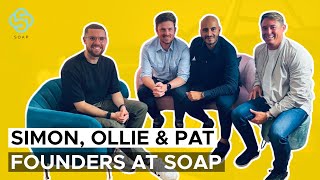
In this face‑to‑face podcast hosted by Hishem Azzouz, the three founders of Soap—Simon, Ollie, and Patrick—share the story behind starting their recruitment firm, the development of their Talent Acquisition as a Service (TAS) model, and the strategic choices that have shaped their growth. They explain how early internal talent‑acquisition experience revealed the limitations of traditional agency models and inspired the creation of TAS, a subscription‑based service that promises cost‑effective, results‑guaranteed hiring. The conversation moves to common misconceptions about internal recruiters, the importance of understanding client business drivers beyond budget, and the pitfalls of selling on price alone. A major focus is their hiring philosophy: they prioritize intelligence, character, and coachability (the ICE criteria) over experience, using a structured interview framework and a three‑day values‑first onboarding program. Continuous development is embedded through weekly mastery milestones, playbooks, call‑review sessions, and a dedicated Business Services function that handles training, marketing, operations, and personal development plans. They discuss the evolution of their service offering, the role of video‑driven marketing and the "Hunters and Unicorns" podcast series in building brand and culture, and how they design career lanes to retain high‑potential talent without forcing top sellers into management. Finally, they outline their vision: to become the global leader in technology recruitment, known for world‑class training, a culture of continuous learning, and a platform that elevates both the company and individual brands. The founders emphasize belief, self‑confidence, and a shared North Star as essential to scaling the business over the next four years.
Chapters
Guys, welcome to the podcast.
Thanks, mate.
Been looking forward to this. It's the first face-to-face podcast I've done in a while, so I'm looking forward to it. And I guess where, where I wanted to start is let's sort of dig right into the soap story. So I guess, Ollie, let me come to you first, like, from your perspective You can speak on behalf of the other guys as well, but like, what gave you the confidence to take that leap in starting Soap or being involved in this business journey?
I'm actually going to pass the baton on right at the very beginning. Yeah, I think Simon can articulate this quite well.
Okay, cool.
Yeah, I think it's important to note that when— I think Ollie was the one that came with the idea and said, guys, we've been successful doing what we're doing for such a long time, we've got our own clients, we've got a very clear way of doing things, But actually, we were quite reluctant to go and do our own thing. And the reason for that is because we were doing well. We were in a really good rhythm. We had each other. We had, you know, we were established. But I think the reluctance was we don't want to go and just get into the back of the queue and just do what everyone else is doing.
Yeah.
And so there was a bit of a back and forth saying, well, we don't want to do that. And so we said, well, why should we do that? Why should we get to the back of the queue? If we're going to do it, let's do it differently. Let's really take the time to go and think about you know, what, where is the industry going? And part of that was we actually went internally for a while as well to really do some talent acquisition work, and this enabled us to get a very different perspective of the industry, really understand the challenges, how decisions are made internally. And so when we came to creating Soap, Talent Acquisition as a Service was created because we understood that a lot of our clients were looking at building capability in-house, and recruitment conventionally goes against the interests of our clients. So these were the types of things that we were really trying to kind of really understand early, early on, and that's the reason why we thought, okay, let's just go and solve this.
So as, as you said, a lot of people start a recruitment business and then you'll hear them go, we want to do it differently, blah blah, but that's what you really thought about, which then meant, okay, let's, let's really give this a go and try, as you said, which is where TAS came from. Very on. And I guess just quickly on that, and feel free to any of your answers, what do you think is the—
if—
did you all go internal for a bit or not?
So yeah, me and Simon did.
Okay.
No, I stayed on in agency for a little bit longer.
Yeah.
So I guess for you two then, what do you think is like the most common misconception of like being an talent acquisition person that agencies make, do you think? Favoritism.
Yeah, hands down. I think there's this stigma attached to, oh, if you're internal, then you're not very good at recruitment. And I have to say now, not only are they paying big money, they're attracting big talent, but actually there's so much complexity within an organization internally that I don't think you actually really understand it until you've experienced that.
Yeah.
And so what you tend to find is that, you know, from an agency perspective, you're quite blinkered, you're quite selfish with, oh, that, that job's been pulled or I was told it's exclusive and now all of a sudden something's changed or the job description's changed. When you work internally, you understand how those decisions are made, you understand how, you know, what they're thinking and when they're going to market. So the communication is very different, and having that experience firsthand means that we can address those challenges from that perspective proactively. So even as an agency, having that knowledge gives us the ability to really understand the internal makeup of our clients and appreciating that sometimes there are going to be things that are going to change, and we can be proactive to ask the right questions to understand exactly where we stand. So it's all about qualifying where you stand within that sense.
Well, um, just curious, yeah, where did you deal with agencies when you was in client acquisition? Well, did you have any— have you got any— like, I've, I've had a few people that went internal agency, and there's always normally like, I don't know, a pet peeve or a story where you're like, I just can't believe these agencies actually tried to do it. Because you see it on the other side, that might be— you might have told an agency 10 times, look, we just don't look at CVs that you spec in, so this is the way you do it. I don't know, they'll send you another 5. I don't know, was there anything that you saw that comes to mind? Or not really? Not that comes to mind.
I think there was, um, see, I was quite open to spec CVs.
Okay.
But the problem for me was you spec a CV in and not follow up with a call and actually sell me the candidate. It's you've only done half the job. But yeah, I think that presenting a CV— and I think there's a lot of people that will just spec a CV in without following up on the call and actually selling that candidate in— it's worthless really. There was a couple of candidates I received, and yeah, on paper they were shocking. It was only then for a reference that I actually then ended up going back to an agency to say I'd actually like to speak to your candidate. And should that person have actually, you know, done and referenced that candidate, probably would come out a different conclusion.
So how would we describe first year? So just, so obviously I said where the business is about today, like what did the business look like in the first year? Just quickly, like where did you finish the first year? Was it just still just you three? Was there a couple people involved straight away?
So it actually started as a fr— it was kind of a staggered entry, but So it was Ali, Ben, Patrick, myself, and then there was another who was with us at the time as well. So there was a few of us at the beginning.
We were actually 6 when we started. We were actually 6, yeah. So yeah, we obviously had a few connections in the market who were lucky enough to be interested in, you know, being part of the business from its birth. So we always, knowing that we didn't want a kind of lifestyle business and the plan was always to really scale the company, we wanted to get off to a start where we could always deliver from day one.
So how would you describe the first year then?
Exciting, I think. Obviously we were working across two different locations, and I think that maybe only even in the last 6-12 months we've realised what kind of complexity that brings.
So you're talking about Brighton and London?
Yeah, so obviously Ollie's based out of Brighton, myself and Simon in London, and I think that you can— it's quite easy to fall into the trap of almost running two separate businesses. And it's taken us a long— obviously we've always worked cohesively, we've got really good relationships, it's good collaboration across the business, but creating that one kind of unified company with the same processes, the same go-to-market, has taken time.
Yeah, yeah, I can imagine. So what I'm really interested in then, just I guess you can talk about— it may have changed, but like, how, how have you ensured all three of you have like remained looking at the same North Star or have the same vision out of interest? Has there been challenges with that? Like, you know, I mean, you're talking about Brighton and London, I can see that straight away. Yeah. How have you made sure that you three are sort of locked in into we're all in this together, this is where we want to go out of interest?
I think we've always had, we've always, you know, from all three of us have always had the same vision. I think that's really helped.
Plus we've worked together for 10 years, right? So it's as much a marriage as it is a business.
And I think that from a trio, we complement each other really well. We each have our strengths, we each have our weaknesses. We don't actually identify those strengths and weaknesses until time, right? Time is—
I think that over time you really realize what those are.
Exactly.
Yeah, yeah, yeah.
I think it's taken us years to actually find out who's— what lane you need to be in, what lane we fit in. Um, and yeah, that's kind of a constant process as well.
And kind of, you know, that's, that's still an evolution for me because, you know, the business is obviously— we're growing to 17, we want to grow way beyond that in the next 4 years. So everyone's got to go through growth to get there, but at the same time also play to your strengths, which is like you're having to develop new skills but also then reassess where your strengths are and where you're— where someone else is strong and they should be in that lane.
Since you've got the benefit of hindsight, like advice for people now that I think— oh, most solo founders I speak to, when I say, oh, like anything that you maybe would do differently, they'd like the idea of starting something with someone else or other people because it obviously can be— imagine if you just did this on your own, there was no song, no pattern, etc., right?
Yeah.
I'm sure you think that'd be so hard.
Yeah, completely. So like, I think it'd be a really lonely place.
Exactly. So I guess with that hindsight, advice for people that may— I don't know, is there maybe good questions they can ask each other to find out where their strengths are? I don't know, how— what advice would you give people that could enable them to work out what lane their co-founder should be in earlier, maybe?
Or I think, I think it's kind of breaking it down into the pillars of what a successful business needs to look like, right? You need, you know, you need strong business development skills.
Yeah.
You need strong, I suppose, resourcing skills. You then need good training skills. You need good entrepreneurial skills in understanding how the back end of a business needs to work. You've then got contractual elements that will always come in play. And so I think really understanding what those pillars are be true to yourself around where your strengths are, and then potentially look at identifying people that, you know, may have those. Easier said than done, I'm sure. I think we've been really lucky that, you know, we each, you know, it's— we've complemented each other in that way.
Um, yeah, and some of that's almost accidental, to be 100% transparent, because you don't realize that you are going to complement each other really until you get into that situation, right? Even though worked together a long time, it is a different thing to then go and fully own a business and, you know, start to operate different parts or pillars of that business, as Ollie said. So it is like, yeah, constant discovery process.
Yeah, I think there is also, um, the natural tendency to maybe try and pair up with someone that's like you.
Yeah.
And I think that's probably the biggest mistake you can make. Yeah, I think, you know, we look at a lot of things like DISC theory and stuff and look at personality types and stuff. It's quite interesting. But I, I think finding someone that's, you know, you know, proactive, someone that's more detail-oriented— if you look at the personality blend, um, you know, even though that can be frustrating that someone really wants to move fast and someone wants to move slow, yeah, sometimes if you move too fast and you're just, um, task-oriented and results-oriented, having someone to rein you in and say, actually, yeah, let's look at the detail, let's look at the process, and slow you down. So actually, what you think you need might actually be completely different to what you really need. And, and actually, if you look at us as a 3, we're so different, but yet because our values are aligned, because our work ethics are aligned, because our standards— everything we talk about is about standards. And I think because of that, because we're very different We find a way to work things out and we're always just take it and go, take it and go and just learn, constant learning.
I think that's a really good point. I think that's, maybe it's part of a different question, but that's really important from a hiring perspective as well and creating that blend within a team, you know, the people who are not just the kind of recruitment almost cliché of like super money motivated, driven. Obviously those are important things to have in your team, but you also need someone with an eye for detail, someone who's a bit of a visionary, someone with ideas, you know, someone who's a bit more of the glue between the people. Yeah, I think the same things you need for a business partnership you do need in kind of, you know, the teams you're hiring, the teams you're scaling.
Yeah, I'm sure you've met other agency leaders where it's so easy to, like you said, hire what's like you or like the same similar people, right? Yeah, I guess, um, just, just, I guess a bit of a final bit on the early on day, just, just curious for, um people who might be early on in their agency journey. Like, obviously you, Pat, you said you knew that you didn't want this to be a lifestyle business. So yeah, you would have shared that. Is it—
is—
did you self-fund the business? Like, how— what, what would you think in terms of, like, do you like, right, let's give ourselves a 6-month run where we're gonna have to think about finance or doing deals? Because obviously you hire people right away. What did that look like?
Out of interest, it was TAS, wasn't it? TAS helped fund that.
Exactly.
Okay.
So obviously tenant acquisition as a service is an upfront fee, so they pay your time. And we were really lucky that we were able to block out a 6-month contract.
So that massively helped with cash flow.
Massively. But then I'm of the opinion of, you know what, if, if you've got the right attributes to step out and do it, then you're gonna make it work. The more pressure you've got on yourself externally to you make it work, the more likely it is to work. The more comfortable you set yourself up, yeah, and the more sort of cushion that you've got, you've got something to fall back on.
I guess it's about being like smart and not—
totally.
And I think this is—
this goes back to the DISC theory, you know. I'm very red, which is, um, if you haven't read it, it's worth reading, um, which is, do you know what, just get involved. Yeah, um, And so, so yes, I think that, yeah, the not having necessarily lows behind you, I don't see as— it shouldn't necessarily stop someone from going and doing it, depending that you're the right characteristic.
Yeah, right.
But at the same time, yeah, if you, you know, think about it sensibly, you know, there are always costs that come up, and there's always other people looking for you to fail as well. And so with that in mind, you've got to understand that there's gonna be unforeseen costs that are going to come your way, and people will work against you wanting to succeed.
Yeah, um, so that leads quite nicely then. Let's talk about TASS then for a second. So as you— that was a big driver as to taking that leap, doing things differently. So what, what— just talk to us about, I guess, like, what— obviously I'm sure you agree with quite a few agencies have some sort of like talent partnership model, it's like a subscription model, whatever it is, but Like, what— how did that— how was that received initially from the clients you were speaking to? Tasson, like, what were you trying to achieve with it? Like, what were the maybe different problems you're trying to solve that maybe typical agency recruitment may not solve?
The biggest challenge of selling a talent acquisition as a service solution, yeah, is that it sounds too good to be true. Okay, right. So basically what you're doing is you, you're comparing talent acquisition as a service across the different blends of recruitment services that you offer, right? So you compare it to a standard recruitment contingent or retained, either way, and you're comparing it to it, to that solution. So fundamentally, you're doing it for a lot cheaper and you're guaranteeing results. So we were guaranteeing a certain number of hires over a period of time, okay, for X subscriptions Exactly. So it's kind of like you're willing to cut your costs in half theoretically if you produce the success that you're talking about. Why are you doing that?
Yeah, right.
And for us, it was long-term.
Like, what's the catch?
What's the catch? What's the catch? It sounds too good to be true. And to be honest with you, we set ourselves up for failure because by initially— and obviously this was again, and you know, it had a big impact on us as a business, because what we were willing to do is ensure that we were, I suppose, you know, giving them everything, but forgetting that for a talent acquisition as a service and this type of business model to work, both parties have to give. Both parties have to come to the table and say, right, this is what I'm willing to do, but you've got to meet me in the middle. This is what I'm expecting you. No relationship works if it's by itself.
Sure, right.
Yeah, that's great. And actually, that's why we created white papers like the Trinity Search Methodology, which is a process which looks at things like what is the utopian best practice for, you know, clients being able to streamline their recruitment process. And part of that was, in order for us to be able to service our clients, they need to get their house in order, right? It's not just about, you what we're providing them, it's also about helping them. So we became again quite consultative in really helping our clients understand these are the bottlenecks that are slowing your process down, help them help us.
So yeah, so, and what it was born out of, going back to where we started at the beginning of this, in terms of talent acquisition, not just being a USP, but like genuinely solving an industry challenge where internal TA isn't working against agency, you know, it's an actual partnership, right? Getting away from the transactional, being closer to the business, understanding, as Simon was saying before, about those business drivers, and as an agency aligning to those rather than just looking at your own motives or your own, um, you know, desire to just make placements there. So I think the benefits of TAS in terms of being a genuine USP, solving the transactional relationship between TA and agency can also be its biggest issue because you're also assuming that the client is going to work to your process, and a lot of the time it is a lot of kind of re-education around the client's process because you're committing a lot in terms of your candidates— sorry, our consultants' time being aligned to that business. And if their internal processes is not as good as you think, then tasks can become quite difficult to work.
Yeah. So why don't we— so keen to like segue to like where your sort of services and solutions, what they look like now, because clearly this is a learning period. So I guess let's just talk a bit about like what were some of the key learnings then? So that 6-month period, had that recurring revenue, really trying to focus on the different— that problem you're trying to solve, like what were some of the learnings that you took from that experience early on?
So I think it comes back to a strategy which has always served us well, which is we've always always try to align to the business objectives. And so I think TAS, we thought was the answer, right? But actually we were selling on, on money.
Yeah.
And actually what we've tried to do since is to really, really understand the drivers, really understand the business objectives, the business strategy. And anything that we do from a recruitment perspective, we ask about the strategy of the business, and we see recruitment as an enablement of a business outcome.
Yeah.
And so the— everything that we do as a business, it really kind of is, is kind of born, it manifests from that mindset. Yeah. From our training, from our development, from the way we engage with our clients, with our candidates, all around that. So I think what's happened since then is because we've always had that mindset, even though TAS isn't our flagship service anymore, what we are able to do is still win those big retain projects. We are still able to go and win global projects, you know, with some of the best clients in the world, because we understand the challenges, we understand the pains, and we attach ourselves to that. Whereas before, we were just selling on features and money.
Yeah. And I think that instead of paying one-off fees each time, as players each month, like, you focus more on that rather than what you're talking about.
And I think it was assuming that the client's driver was budget.
It was just to save money.
Yeah, yeah, and for some clients it can be, you know, a lot of clients do base it on a recruitment spend, but others are looking for something completely different. And if you go in, you know, to any sales process not understanding what the business drivers are or what the value is to that customer, then you can go wrong, basically.
We took it at face value because the common concern of the objective is setting up a talent action acquisition function within a business is to reduce agency dependency and reduce agency cost. So we thought, okay, let's just attach ourselves to cost, whereas there was so much more. There was so much more than just it being a cost implication. So we then helped build that out. So yeah, it was an interesting journey. And, you know, as a business, obviously we still do it, but it's, you know, maybe not like the flagship.
When maybe when you started, you thought that that would have been the flagship, but through the learnings and stuff, it's evolved.
Yeah, we feel as though we've got different weapons that we can use for different scenarios, and I think our journey of sales is really understand the business and really understand why, why, why, you know, ask those why questions, understand those situation questions, and also attach ourselves to the personal win of who we're selling to. Because a lot of the time, the reason why they're taking you down a direction or they're blocking you is because you, you're misaligned. So if we can really understand that, we can sell retained if that's time. We turn retained work away, you know, retained isn't everything. We turn it away if the outcome is not going to be worth the effort. So it's about understanding the drivers and then tailoring the right solution. Task could be the perfect solution if they've got the right processes. So we can be a lot more objective and much more tactical with our approach and Bespoke by just listening and investing that time with the client.
So what I'm keen to go into now then, that's what I've always admired about you guys, like the way that you think, like it's just completely— it is different. I know it's like a cliché, everyone will do things differently, but I think as you said, you're trying to get away from just the recruitment talk and really understand what are they trying to achieve and why, and then understand if you can enable that by getting them the right people or giving them the right advice and those things. So How does this— the way that you're talking about things— how does this manifest then in terms of like the types of people that you guys hire, or the types of people that you look for, because— and the way that you train them and develop them? Because I think it isn't going to be like Pat said, the typical cliché, just like only in it for them and wants to just make that deal, not thinking— do you get what I mean? No, this— because I'm sure you've been on a journey with that in the last 2 years, 3 years alone.
Like, how is that Yeah, I think it's probably the most ironic thing, isn't it? A recruitment company is really struggling to recruit their own people.
Yeah, number one challenge is recruitment.
I think that's common in the industry though, really. I think the biggest thing we've got away from is looking at experience or just looking for, you know, certain client connections or even market knowledge. I think so the biggest switch that we've made is looking for really specific characteristics within people. Some sales experience is great, but apart from that, it's intelligence, character, and coachability.
Intelligence, character, and coachability.
Yeah, yeah. So we know that with the training development program, which we can— Simon can give a bit more detail about the playbook side— if we find those people with the right characteristics, and you know, some of those clichés are still important, right? You know, hunger, drive, competitiveness are still things that can make you successful in sales, but It's not about, you know, having 18 months experience in recruitment for us. It's about how driven you are to learn not just our methodologies, but really like continuously learn and develop and become a master in your market.
A lot of that was born through our clients. So we're working with some of the, well, most exciting high-growth software companies in the world, and, you know, they, they turn CVs upside down. They look at attributes before they look at experience, and that was kind of a a bit of a eureka moment for us when we kind of thought, okay, hold on a minute, that should be how we— is that how we should be thinking about recruitment? And, and that's where we changed our sort of tact.
And how long was—
how long—
when did you think that really— you really like committed to that? Because I'm sure that along the way you've maybe just been a bit lenient with it at times.
It's the podcast, wasn't it?
The podcast bit, that was the real kind of wow. Um, that's then also then pulling, which we talk about in a bit, you know, when we talk about non-exec directors, influence, and people coming in. The influence from our side is influence from the people in our industry that are scaling software companies, that are scaling sales organizations. So a lot of our kind of inspiration has really come from them. The challenge was how do we go and qualify those?
That's it.
Yeah, it's not necessarily about Exactly. How do we then— but again, the individuals that we are working with have mastered this, right? They understand how to qualify individuals around intelligence, right? I think when you look at intelligence in itself, people are thinking, okay, you know, academic, academic, academic. Now academic is not necessarily the only thing of intelligence, right? Got book smart, we've also got street smart people. I definitely wouldn't class myself as a as an academic as such, but at the same time I'm pretty street smart. I can see opportunities and I look at things not in a necessarily linear fashion. I look at it very from an objective. The characteristics are, you know, give me examples of where you've been challenged, you've dealt with adversity in your life, right? Not necessarily just in work, but what have you overcome? When you've been pushed up against the wall, how have you managed to fight back? Then the coachability is simple, right? People have got to be willing to learn. People have got to be willing to take on new ideas. And so yeah, so the intelligence characteristics and coachability piece is really interesting, but I think if you look at all the software companies that we recruit for, Jeremy Duggan being a big influence in there, people like John McCollum, Marron, you know, Jeremy Duggan himself has actually called it ICE criteria, which is the intelligence characteristics of coach ability. So it's an actual terminology used in the industry.
Yeah, yeah.
To go back to your question as well, I think it took us about 2, 2 and a half years to get to that point.
Okay.
And so it's really last 12, 18 months, and I would say even the last 6 months has still seen another leap in identifying those characteristics. It's easy to fall into the habit of just hiring people you like. Yeah, you want to like them and see those attributes and values for your business as well.
Yeah, because I think that's— I definitely— obviously I've known you guys for a little while, and I do feel like since we last spoke and stuff, I feel like things have just gone up a notch and stuff. And that's what I was interested in. It seems like a big part of it is like what you're talking about, like just being really committed to like what you want to build and staying true to that. So obviously, Oli, you're talking about getting better at identifying those things in the interview process. How does it manifest then when we're measuring performance? Does that change anything? I'm interested, do you look at anything different in terms of measuring those characteristics? We're continuing to see, is there anything different maybe that you look at that might be away from the typical performance metrics that recruitment agency leaders look at?
Yeah, absolutely. So I think we were guilty of really just judging people on results, even if we didn't want to. I think everything was results. If you're performing, then that's fine. And I think that's probably the biggest transformation in our business, is that that's not all right just because you're doing well. So what we're looking for is people that are genuinely dedicated to their continuous learning. I think that it's very natural that, you know, as a recruiter, once you reach a certain level of competency, you become— you enter a comfort zone where you kind of just— yeah, you get really complacent with where you are. And I think that within this business, what we're trying to do is make sure that people are continuously— we have to inspire them as to why they should better themselves, give them the tools that they need to better themselves, but we have to constantly push that. Now, the reason I say that is because when we measure success, and for promotions within our business, it's not just revenue, we're also tracking mastery. So we've got playbooks that we're rolling out specifically looking at different areas of what we do, and it's all around the best practice. It's all about, you know, that whole elevating yourself above the noise and that whole advisory service in everything that we do. And so we're constantly pushing our consultants to reach mastery. So even if they're hitting revenue targets, we still— we, we show them the potential. We make Imagine if you were able to master this more, if you were able to squeeze that little bit more, what that can mean for you. And this also ties into the attributes. If you've got the wrong attributes, you're not gonna buy into that. That's why the coachability, that's why the intelligence, that's why the horsepower needs to be there. So it all ties together.
I think, again, looking at it from a results perspective, I think particularly in the last 6 to 12 months with less focused on outcomes because we know if the characteristics, as we've said, but also the inputs are there, the attitude's there, you know, they're working to a consistently really high standard across everything, then they're going to bill way above the industry average. You know, we've had people billing $25,000-$30,000 on average per month consistently and, and way above that, but it's almost taking it away from X amount of money per month and looking at breaking it down into every little element of what people are doing to enable them to, you know, really master their market and perfect the art of headhunting in the tech space.
So how— so I obviously, I speak to a lot of agency leaders around learning and development, and I think most agency leaders will tell you that they want those types of people in their business, like they want to develop and those types of things. But how does this actually look like in practice in terms of like, is it every week, at a certain time everyone's doing training development, like, how is it really important in your onboarding process? So from day one when I'm work for Soap, I know training is important. How does it actually— I mean, how does it show up in actual practice? Like, how have you gone about ingraining it? Because I feel like the size you're at now, it's so important to really have those. And then when you grow, it's just part of the fabric of Soap, right? So how are you ingraining it in practice, out of interest?
So there's two things, obviously. There's the initial training, and 3 days before they even learn anything technical is about understanding the values and the importance of that dedication to mastery. And it's really spending 3 days is just aligning to the values of the business. It sounds remarkable.
In a dark room with Simon.
But in that time, we're literally talking about what are the things that are important to you, you know, where are you going in your career, why are you here? You know, what does it take to be world-class? Why do athletes master— you know, what's the difference between a world-class athlete? If you're going to be here, be the best you can be.
Yeah.
So how can we do that? So that's where it starts. So the mindset needs to come before anything. So if we get the mindset right, that's when we can get to work. And if the mindset's not there, there is no work to be done. But once we're in, It's 3 weeks intense learning curve like you wouldn't believe, but they come out of it and they sound— this is non-experienced recruiters— they sound like seasoned, seasoned advisors, you know. And, and, and that's a consequence of, you know, the playbook and hiring the right people and the training and lots of other things, which is a work in progress. But then continuous after that Every week they have mastery milestones that they need to meet, especially for the first kind of 3 to 6 months. And then it's constantly every week there's listening to calls. We've got the crib sheet, so we have in our playbook, we've literally mapped out standards across what exceptional looks like. So everyone now can sit down together, listen to a call, and they've got exactly the same perspective of what's exceptional, what's good, what— yeah, of those standards. So there's no— it's no longer subjective. Everyone knows what the standards are.
I think it's really important as well that training is not just something you need in your business, and then it's, you know, management passes someone over to the trainer because they're weak in one area. I think it has to be an actual core pillar of the business. So as well as the management side, as well as the business development side, you you've also got continuous training development, and that is bred into people from day one, because then as you scale the company, that same dedication to that is always there.
Yeah. How— I'm just curious, um, one of the biggest challenges I always hear from recruiters early on in their journey is that lack— is like the lack of self-belief, or that feel like that lack of credibility early on. How do you help them overcome that, out of interest? I always said they go But they sound like seasoned advisors, but do they actually believe that?
Yeah, so they have to believe it. You can say the most scripted thing in the world, perfect words that you've spent 2 days writing, if you don't believe what you're saying, neither will the candidate.
There was an epiphany moment, I remember we sat on a call, so as a whole company we sit together and we listen to a call together, together and we want to analyze it. So the whole company together, an hour, right? And we're on that and we were talking about, you know, I don't believe you, I don't believe you. And there was a bit of a penny drop moment, which was belief system, okay? So actually part of the playbook is if you believe the things that you're saying and you see yourself above the noise— we talk about above the noise, so really elevating yourself— if you see yourself above the noise, you will find the words to communicate that belief.
Yeah.
So I can give you the script, can teach you everything you need to know, but if you don't believe it, it's always going to— you're always going to communicate from how you see yourself. If you've got limited beliefs of yourself, that's always when you're going to be anti-selling. So to really help, you know, people break that and communicate in that right way, we need to give them those perspectives. And the whole playbook is built on the psychology of selling So things like, you know, tonality and, you know, how you influence people, but also the belief system is people attach themselves to the emotion and justify with logic. And so, you know, creating that opportunity for people to attach themselves to that emotion is the hope. It's through the belief. Yeah, that's—
yeah, a lot of leadership training focuses on building influencers, right? And people who can obviously talk about the value they can give to you, and, and, and in, and then why you should follow those people. And I think especially in our market and a lot of other headhunt markets, you're asking people, you know, maybe mid-20s, late 20s, in a lot of time in our case, to have a belief system as that they can go and influence very senior people very quickly. So you almost built needing— obviously you're training recruitment, but you're training those kind of influencer and leadership skills, even though they're not directly managing, they have to believe that they have the value to influence people.
Yeah, no, I just love that because I've recorded a recent series which is like early on in recruitment, and one of the biggest challenges that they have to work through is that self-belief, that self-confidence. So the fact you're trying to like really support and attack that from day dot is just going to mean that they're going to have an even better chance of being successful and build on that. So So let's just, before, before we finish, let's just segue to like where this business is going then, because I know that you're— all of you guys are really excited as to where it's going. So talk to me a bit about, I guess, one, how you're viewing the next 6-12 months. Also just talk to me a bit about what have been some of the maybe recent investments that you've made, maybe in people or certain hires we're looking to make that you feel is really going to enable you guys to achieve that vision that you're—
yeah, I, I suppose I'd like focus on the last question, which is, you know, I suppose where we're investing our time. So we're investing our time a lot within our— in our business service department, um, and a lot— one of the biggest areas of that is on video production and marketing.
Okay.
Um, now we're not looking at traditional marketing solutions, you know, building our brand. We're looking— to be honest, it was inspired by you, you came to us, right? Which is that process that you went through in helping us build our own brands really set us off on a journey. It set someone on a journey, you know, not only, not only is it what we want to be as a brand, but we believe our business is made up of the people within our business, and we truly believe that. And so we went on a personal discovery session with you, which is, you know, what, who do you want to be, what do you want to do, which then led us into our podcast series, Hunters and Unicorns, a really successful series of 33 CXOs. Yes, that is a plug. But no, it was a real interesting journey, and I think, you know, I think it's a really, really important thing that we're really now supporting people, whoever joins our business, in that ability to be able to help them go through that same journey that you helped us go through. And with the Hunters and Unicorns platform itself, and with an actual team of developers, videographers, we're actually able to put together really professional, you know, I suppose, marketing material and supporting document for individuals joining our business, right?
Yeah.
Okay, business services.
Yeah, well, Business services is quite a well-rounded function, so actually business services enables everything to really prop up. So you talk about the challenges of managers not really, you know, being spread too thin conventionally in recruitment. Business services takes a lot of that burden away to be able to elevate people. So business services takes care of training, it takes care of a lot of the processes which take a lot of time you know, marketing, development, recruitment, enablement, a lot of the operational functions which you take for granted, a business our size is investing so heavily in that, which is quite unique, and that's because we are scaling, you know, we're building the foundations of a scalable business, because we don't want to retrofit that, we want to bake that in from day one. So business services is a huge, huge play, personal development plans for every single person this business, you know, mentoring program, management frameworks, all of these things that were— all of these processes are really kind of baked into that business service function.
I think it's because we've also got not necessarily a complex business model, we're trying to steer away from being managers. The only way to be able to progress in a business is by going into a management position, you know, we'd be—
as a high performer, as a high performer.
And we believe that, you know, not necessarily the highest-performing sales individuals are going to be the best managers, right? And so to enable everybody with an opportunity to have some form of career progression, get to director, associate director, you know, directorship, board level, everybody needs some sort of plan, which again goes back to what we're talking about at the beginning, is understanding your lanes, right? I might be a really good business development person, and I love doing that, right? But that's all I love doing. Okay, well, we've got a lane for you here. If you want to become— you know, you just love the candidate sourcing part, you just, you know, that's, that's what you really focus on— you become a director in this business and do nothing more. And so, as I said, but in order to be able to create that framework in a management— it's a story— to create that, you need the complexity of having a business service around you to support those functions?
It's going back to the characteristics piece and hiring, you know, everyone wants intelligent character, good characteristics and coachability, right? But those are very high potential people naturally, so what kind of platform or what kind of business or environment do they need to be in? And I think, you know, by trying to create the platform that we are to then scale it, we need to give the people right now at ground level and associate level with no prior recruitment experience the opportunity to grow into those senior roles rather than bringing in experienced managers over the top of them. It's about identifying not just that they're good recruiters, but yeah, this person has great characteristics to be a future leader, and how do you then develop that person? So rather than, you know, bringing in just senior experienced people and bringing in inexperienced under them, really give those opportunity, give those people the opportunity to grow through the ranks.
Yeah, that is like the most common driver I hear from young people, is progression. That's what they want. So I love that. So look, let's, um, let's wrap this up then. So I guess what I just love to hear from all of you is really like, where, what's the, I guess, ultimate goal, vision, ambition for soak then, and we can finish it there. Like, what— how do you see this business in another 4 years? What, what does the future look like?
Well, in one line, we want to be the number one, uh, technology recruitment business globally.
Yeah, sales, technology sales, go-to-market practice.
Yeah.
Okay, there's a basic overview.
Yeah, I, I think we want to see ourselves as the— at one of the best, um, training and development recruitment companies in the world, and I think there's no shying against that. We want to hire extremely high potential people, give them a platform where they really feel inspired and enabled, elevate their belief system to a level that they perhaps didn't even realize they could achieve, and just really, you know, create an environment where people can feel part of something quite special. It sounds a bit generic, but actually, genuinely, we are dedicated to that, and we come to work every single day to work for that. And I think that's, that's the common vision that all three of us and everyone in this business is all working towards.
Yeah, I think furthering, you know, personal development is, is part of it, but also giving, you know, individuals the platforms and, you know, on the back of the podcasts, you know, and helping people create their whys, you know, create their, um, their brand, their brand, you know, establish themselves. You know, I think that in today's market, you know, businesses recruitment companies are likely to shy away from doing that because at the end of the day they're helping that personal brand rather than the company brand, which, you know, inevitably could lead on to, you know, the individuals going off and, you know, starting up themselves. You know, I think that then becomes the retention part. How do I look at retaining those individuals so they don't go off and do that? And I'd rather deal with that challenge rather than the suppress— don't invest— suppressing somebody and not allowing somebody somebody to grow and get better. And, you know, for me, as I said, you know, I still absolutely love the recruitment part. And, you know, I think some of the people that we've got in the business, you know, I just look at, I think, you know what, not only did you show high potential, what you're now doing is far surpassing anything that I could have ever achieved in recruitment. And to see that, you know, for me is just, you know, it's fantastic.
That's obviously what makes going on all your own business journey so special, isn't it? Like, because that clearly what all you guys get so excited about is seeing these other people, what you can build to help these people maximize their potential. Yeah, that's just obviously the great thing. So look after your staff, they're going to look after you. That's it. Well, um, it's been a pleasure. Excited to see where you guys are in another 4 years. But thanks a lot for coming on the pod.
Ah, thanks everyone.
Thanks for having us.
Cheers.
More from Hishem




You don't need as many clients as you think to bill $1 Million A Year In Recruitment



From 30 Direct Reports to Back-to-Back $1M Years as a Solo Recruiter with Zach Creighton



