What It Takes To Win in 2025 | Live Podcast in Sydney
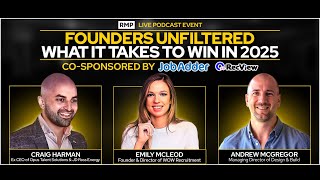
In this live Sydney podcast hosted by Hishem Azzouz, a panel of recruitment leaders—Andrew (Searchful Group), Emily (Wild Recruitment founder), and Craig (former Opus Talent Solutions CEO)—discusses how recruitment agencies can position themselves for success in 2025. The conversation covers strategic scaling, financial runway, head‑count ratios, and cash‑flow monitoring, emphasizing the need to set clear end‑goals and accept calculated risk. They explore hiring metrics such as consultant‑salary‑to‑gross‑profit ratios (target 35%) and capacity signals (job‑board fill rates, conversion speed) that dictate when to add staff. Technology and AI are examined: the panel stresses a purposeful, non‑hasty adoption, focusing on automating repetitive tasks, improving candidate sourcing, and enhancing consultant‑client conversations, while acknowledging the noise around AI. Change management is highlighted as a critical skill; leaders must balance the pace of change with team readiness, using structured processes and limiting major changes to one or two per year. Business development is framed around a job‑centric, value‑adding approach rather than speculative CV‑sending, with emphasis on relationship building, market mapping through candidate feedback, and multi‑touchpoint campaigns. Leadership time allocation, the importance of QBRs (Quarterly Business Reviews) for turning accounts into key accounts, and internal resistance to new practices are discussed, noting that confidence‑building training and senior‑leader involvement help overcome push‑back. Throughout, the panel shares practical anecdotes, metrics, and actionable advice for recruiters and agency leaders aiming to grow sustainably and profitably by 2025.
Chapters
Everyone grab a coffee, feel free to take your time, but make your way in as soon as you can. But for everyone that is in the room and seated, welcome. My name is Victoria. I am delighted to welcome you all here on behalf of JobAdder. The team at JobAdder and I here today are really aimed at, you know, making sure that we can help recruiters make their lives more easier and efficient, and particularly in a market like the one that we're in today, being able to come together collaborate, share, and learn from each other is one of our key focuses, which is why we are really proud to be partnering with today's live podcast on what it takes to win in 2025. We'd really like to thank you all for taking the time out of your day to come and participate in this morning, but also a massive shout out to Hishem Azzouz as well for flying all the way here and making this happen. I've had a few quick chats this morning and I think we're in for a great discussion, so Thank you and welcome.
Awesome. Yeah, I really would not be here without JobAdder's support and JobAdder's money. It's the honest truth. So I really appreciate you getting behind the mission and what we're doing here. So what I'm going to do, for those of you that do listen to the podcast, uh, hopefully it comes across, but I'm all about the practical. But I thought where I just want to start very quickly is just give you a very brief story on the podcast because this is, it's a bit of a moment. This is, uh, something that I'm really grateful for that I get to travel over the way over here, meet all of you, um, and put on an event like this. So I just want to do a very brief, uh, story on the podcast, how we got here, and then we'll introduce, uh, the guys and then we'll get into the practical stuff. So Where this all started for me was 2016. Um, I had a perm sort of thing then, and I recruited in the insurance— recruit the insurance market. I was one of those rare few people that actually wanted to get into recruitment. I had no idea what I wanted to do career-wise, fell into sales, got a sort of classic call center sales job. And then I had a friend who got into recruitment, sold me the classic 100K first year dream. Wanted to get into it, and that was me, uh, in 2016. Now I'm a big advocate for journaling. This is a journal— I was looking at this, so this is a journal entry I'll do on, on Google Docs. So, um, 2016, I reflected. So when I entered the industry, you can see here that I definitely had one of those hard starts in recruitment. Um, it wasn't easy. I was in a small business of 8 people. and it was difficult. I went from sort of being the sort of top salesperson in this call centre environment to being bottom of the pack. It definitely wasn't straightforward and I definitely didn't earn £100K in my first year. So I had this experience, I had a challenging start, and by this point I was in a very competitive market, the regional insurance market, and I was coming up against people that had been doing it for a very long time. So I was quite early on building your brand on LinkedIn because I, would do anything that I feel like would sort of help me get an edge over my competition. So that's me recruitment days with one of the clients where we, um, I managed to get them 2 people in their small insurance brokerage. And the actual podcast started, it was called Recruitment Rollercoaster when we started because that, that was my experience. And it actually started as a blog, um, back in the day. This is actually where I met Andrew. He's actually been a long time supporter, and, uh, I did one of these guest blogs with Andrew, um, and I always had, if I'm honest, a lot of people in the Australian market get involved, contribute, uh, so I always had support from early on. But it did start there, but I, I was willing to take action. So because I was sort of comfortable sharing content, I had this idea around creating more content that can help other recruiters like me, and I decided to take action. So This is my very humble abode, my bedroom at home where the podcast started in 2018. And that was the first logo, the Recruitment Rollercoaster. Very obvious, as you can see. And I started recording the podcast on my mobile phone when I got home from my recruitment job in 2018. At the start, no one really listened. As you can see there, not much engagement when I was talking about it. Um, so, but as you can see there, I don't— I was, I was meant to look at him on LinkedIn. This guy John Cousins, episode 3, you can see there, candidate short market in Sydney. I've always sort of spoke to people in the Australian recruitment market from, from the get-go, so it's really cool to, to sort of be here and bring this to life now. But yeah, no one really listened at the start, but I remain consistent. I've been pumping out one a week every single week for, uh, nearly 7 years now. We started to get more plays, which obviously felt a lot better. Um, and then we did our very first event in 2019. This was pre-COVID, so just on the, the cusp. This was like November 2019. We had 50 people in the room, um, which was really cool to manage to, to bring those sort of numbers that I used to see on the screen into, into real life, into, um, a real live podcast event. And then ever since then, I've been plugging away. Again, I originally planned to come to Australia in 2020, but then COVID happened, obviously. And again, Andrew, big supporter. I did that remotely and had those people on the pod. So I've always sort of hopefully been trying to cultivate, you know, getting content out there around the Australian recruitment market. And then I've just been consistent, like plugging away. These are just all different events. Manchester, London, London again, Manchester, took it to Bristol for the first time. So that was in Everyman Cinema in Bristol and just being super consistent. So at this point now, 600 episodes, silly amount of content, 36,000 hours, millions of downloads, you know, over 1,000 people now have attended our event. And we're now here in Sydney doing this. So I think for me, I do feel really grateful. First ever podcast event in Sydney. So like a big thank you to all of you because, you know, I wouldn't be here without the support and you supporting the show. A big thank you to the people that got behind the mission, JobAdder, Recview, and the team at 360 that put the coffee on and helped me put this together. So I just wanted to start this with just a bit of gratitude and I really appreciate it. And like now it's time to deliver, time to deliver some good content. That's, that's the goal. So the plan for this morning, we've got 3 different recruitment leaders. There's a lot that we could cover. So the way that I've done this this year so far that has worked is we've got a few different pillars that we want to work through. So the first one that we're going to sort of COVID and go through is go-to-market strategy. So under that, we're going to be talking about client acquisition strategies, account development strategies. How are they thinking about attracting talent in their industries? We'll then get into people and culture. So how are they thinking about retaining their best people, attracting people, driving performance standards, which is the next part. And then I've been asking people before this, what's top of mind? And I've definitely heard AI too much. So we do have operations and tech, but, you know, this, the next sort of 30, 40 minutes isn't just going to be about AI. I think there's a lot that we need to get right to really leverage and get the most out of technology and AI. So that's sort of what we're going to work through. So if we could put our hands together, let's welcome on the panel and we'll get into it. These are all on site. Yeah. Thank you. Awesome. So what I'll do to sort of just kick this off, let's get my document up here. What I'll do to kick this off is I'm going to do a bit of an introduction to these guys and it just enables us all to sort of get on the same page. So we all have the same context. So Andy, I'll start with you. If I get anything wrong, let me know when I do this introduction again. Yeah. So Andrew, part of Search4Group, 20 years in business. You've got 3 clear brands now, data public set to design and build, circa 100 full-time employees, around 85 billing heads, around about that. On track, obviously your financial year is due to end, so on track to do $90 million Australian dollars this financial year revenue-wise, split holistically across the business, 60% perm, 40% contract. But then I know you said in the public sector division that's more 80% contract. And that's Andrew. I think the bits that I also want to give is what are these guys' priorities, what they're really focusing on this year. So this will probably come across, but when I sat down with Andy to prepare for this, the word that I heard a few times was trust. And that's your big vision, right, is really how can we be the most trusted agency. So the things that really is top of mind in Andy's business is how can we win with fewer clients, and how can we build more 1,000-day clients, which we're going to get into. And then really making sure that you're doing a good job of developing your leaders and future leaders in your business. So some of the priorities. So that's Andy, Searchful Group. Is that okay?
That's great. Thanks.
Awesome.
Not a lot of talking going on.
Emily, obviously founder of Wild Recruitment. I've been going now for 8 years, recently hit that milestone. So your sort of disciplines are sales, marketing, professional services. Uh, team of 18, 15 billing heads, on track to do $9 million revenue this year, and you're currently around 80% perm, 20% contract.
Nailed it.
Yeah. And then big priorities for you is, uh, real top of mind is how can we, uh, have more of a contract split is really top of mind for you. And then also I know you've— you're really doubling down on building ultimately enterprise value, and one of the big levers you're looking to sort of pull on that is brand equity and building your your brand, um, and those things. Last but not least, Craig, uh, again, let me know if I'm getting this wrong, mate. Uh, so I know you've been getting a bit of jib about this, ex-global CEO of Opus Talent Solutions, JD Ross Energy. So like parts here, obviously you're in a slightly different spot. So 10 years, you built the Australian part of that group from scratch, grew that to around circa 100 people, really predominantly on the trainee model at Opus here. And at the time of the private equity deal that happened, the Opus Group in 2021, 50% of the group's profit was the Australian business. So around that stage, it was around $22-24 million gross profit at that stage when that deal went through in terms of the Australian business. Then had a stint as interim global CEO. So there's around circa 200-250 people in that group. Exited that business.
Stop, stop, stop, stop there.
Is that wrong? Okay, so since then— we won't go into any details, man, don't worry. Um, the thing, the thing why I wanted you involved is obviously all of that experience, there's things that people can learn from. But then since then, you've, you've got out of that Opus bubble, you've met with maybe nearly 30 different recruitment founders in, in the Australian market, actively consulting a handful these agencies anywhere between 10 to 100 heads. So now you've also got that out, you know, that external perspective, right? So you can talk from both those perspectives. So if you're in a slightly different position in terms of, right, what are the priorities in your business? But I think what you did share with me is a lot of the things that are coming through with your conversations are a lot of founders you're speaking to are really trying to master and grasp their people strategy to get that right, get the most out of their people, drive and build leadership. What keeps coming up in your conversations is what's our client strategy, how are we approaching that, how can we get more out of existing clients, win new business. And again, you put on here, obviously Opus had a real, um, a contract part of the business. So again, revenue strategy, how can we build a contract book? Hopefully we're on the same page. So that's the sort of context that we can speak from. So where I wanted to start is we're going to start in this area of sort of go-to-market strategy. So there's a lot that can go into that. I think what's definitely been a common theme, and Andrew, I'm going to come to you first if that's okay. What's really been a common theme from my time here in Australia and also this year, if I'm honest, is how can we really achieve our goals by getting more out of our existing relationships and our existing clients versus every single month thinking what new clients do we not know yet that aren't doing business with us that we can win. So I'm going to come to you on this, Andrew. Would you mind talking to us a bit about how you guys are thinking about this? You know, I mentioned that 1,000-day clients piece, but talk to us a bit about how you're thinking about this in your business, because I know that's a big initiative for you, and like, how can everyone win in our business with fewer clients? And we'll start there.
Yeah, thanks. Um, morning everyone. Um, so look, uh, I'll probably rewind back to 2019 when we looked at what our vision was and our mission and our goals. And when we came to the vision to be the most trusted recruitment agency, we talked a lot about building trust, building trust. That's what we wanted to be. That's what we're going to be seen as. And so we started going out there and doing that and I think we did it okay. But then sort of got to '24, '23, '24 and like most of us, we'd come out of this real boom area at time and I kind of looked at it and went, did we really build any trust or did we just make a shitload of money back in that period of time? And did we really leave clients feeling like they got a lot of value? And for the most part, I said to my partner, my business partner said, I think we did well. But I don't think we did great. And I think next is the next 5 years, I really want us to do really well at this. And so then I looked at building trust and went, what are the 4 aspects of a client relationship? And you land one, that's the first part. You then do a deal, you execute the process, then you advance the relationship, and then you want to protect it. And what I looked at was that we're really good at landing and executing clients. We know how to do deals, we know how to go and win, but we're not taking these relationships any further than what they are today. I said, well, why is that? And then I looked at the clients and went, well, a lot of these are 30-day clients. You're in, you're out, you're doing a deal with them and then they're gone because there is no opportunity for further placements down the road. There's no opportunity for further revenue. And so I started to talk to the leadership group and this is sort of manifested and developing this year is we've gotta start looking at clients differently in that, in construction, in the area that I live, you look at a client and go, they're a tier 1 client and that's because of the size of the business. But I want people to look at it as a tier 1 opportunity. What's the size of the opportunity? Not just to you, but to Design and Build. Can we really foresee us doing business with this company 30 days beyond 30 days? Are we just doing a deal? Because if you're gonna do that in 5 years' time, you're not gonna look back and say, I've got 8 to 12 key repeat business clients. I'm just out there doing the same shit day in, day out. So I want you to look at a client and go, okay, what's their goals for 300 days' time? What are they looking to achieve in 1,000 days' time? Because what will happen is that the person you're sat in front of, if it's the wrong person, they won't be able to articulate that. They'll just know about what's in front of them right now. But if you really want to define your value and really big conversations, you should be sat in front of the decision makers, those who can articulate what their plan is, not just 30 days, 300 days, but they want their business to look like in 1,000 days' time. And then you start to go, okay, well, From a strategic perspective, from a talent perspective, what skills do you need? What talent do you need to achieve that goal? And that's some— suddenly you're separating yourself from 90% of the market, which is all about, I just want to do deals, I just want to win right now. So that's how we are starting to look at it from a go-to-market strategy. And then naturally, obviously, then you look at your business and go, okay, where can we support this business? There's obviously construction, delivery, white collar, there's business support. There's many different facets that an organization— there's tech. So naturally, as we've done that, we've created the Tech and Data People brand as well to support clients, to effectively do more business with less companies. So that's been our go-to-market.
And I think we, we spoke about this, but like, how have you found getting your recruiters out of that sort of mindset of like just thinking 30 days? Because a lot of recruiters are in that mindset. They've always been incentivized to get the job on, fill the job, versus what could we be doing them with them in 1,000 days? Like, how have you approach, you know, cultivating that mindset? Because I know that isn't easy.
Yeah, look, you're absolutely right. A few different things come to mind. Firstly, the promotion pathway. So we don't promote you based on how much you bill. We promote you based on how much trust you build. So we look at what is your repeat business rate? You know, how many clients you do repeat business with. And if you're 2, 3 years in the journey and you can't talk to that, then your journey is going to take longer to get to where you want to go. So that's part of it. I think also something that I talk a lot about is that you've just got to repeat, repeat, repeat the message. And some, somebody said something to me a few years ago. They said, if you think you're saying this too much, you're probably just saying it enough. And that's always stuck with me. It's just keep repeating the message, right? This is steps of success. This is necessary. Trust the process or process, cuz you will get there. But it's just repeat, repeat, repeat. And then think about the people you're onboarding. 3 years ago we were onboarding people who could just do deals and get things across the line. You've gotta be thinking about the people you're bringing into your business now. In terms of what's their mindset, what are they looking to look for their life to look like in 3 to 5 years. And if they can't articulate that, you need to rethink whether or not you're going to onboard that person.
And just quickly, because people might be interested, so if you don't promote people on billings on how much trust they build, what, what are the— like, how, how do you quantify that? So you said repeat business. How else do you typically quantify that? Because I think that, that's interesting.
Numbers don't lie, right? So what's their job to placement? What's their CV to interview? what's their replacement rate, what's their candidate source, what are they doing to get out into the community. So we've got 4 pillars: client, candidate, colleague, and community. So we're looking at how we measure that across those 4, 4 elements. And so there's many different things because ultimately if you get the front end right and you get the middle ground right, you are going to make money. That is going to happen if you work with the right candidates, the right clients, and you work around good colleagues and you do the right thing by your wider community, you are going to make money. And that's how we look at it.
So if I'm a top biller, my ratios are rubbish, I'm not getting promoted?
Pretty much. And again, I hate to say it, but there are people that have left my organization and gone, this shit don't matter to me. I'm like, that's fine. It's business first. It's vision, it's mission, it's values first. Because you can go alone, that's no problem. If you want to isolate yourself and run your own race, no worries. But this is a business, this is a vision. And so that's what we're going to do.
Emily, you've done a lot of work on this as well, right? So talk to us a bit about— I really liked your— I don't know, you're also in the trenches on this as well. Are there still things that hashing out, but you're really pleased with how things look currently in terms of this key account strategy? Do you want to tell us a bit about this? Because I know this is really top of mind for you in your business, uh, as well with where you're at.
Yeah, for sure. Morning everyone. Um, yeah, so for us, I mean, coming into 2025, we knew that we couldn't just be going after brand new business as much as we need to because we're not as established as, uh, Andy over here. We We're still trying to grow our territory, grow our patch, and so new business activity is required. But we quickly figured out that based on the market conditions, we definitely need to double down on our key account strategy. And so the first place we looked was our actual brand. I know that's taking a step right back, but we went through a brand refresh, um, thanks to our new general manager who started with us and the team at 360 Digital, and started to make sure that our brand was really I guess, supporting our consultants in the right way, because when it's done right, it can be a real force multiplier to support the consultants when they're going out to market with their existing accounts. And so once we did the brand refresh and we got our branding right, we then started to look at the content they had to add value to their existing accounts. And so that was things like white papers, and it was all very consultant-led, but white papers. We also were looking at resources they could provide, doing the face-to-face events, getting on back in front of their clients. And then we started to look at strategic account planning. So it was a layered approach for us. And the strategic account planning, we just doubled down around QBRs, so quarterly business reviews, and putting a team lead or team leads on each account. And then having somebody support that account from every division. So we make sure we've got representation across sales, across marketing, across business services, because they're our three industries. And that we're going out there and we're going as a team and spending face-to-face time with our clients. And then looking at, we're in the process of doing a full remuneration review for our team to make sure that we're incentivizing the right behaviors around account growth as well and targeting the account growth. So everyone's working towards 25% year-on-year growth on our key accounts.
And then they only get promotion if they hit that.
Yeah.
And then talk to us a bit about how have you, if I'm listening to some of the calls of your team, how are they positioning those quarterly business reviews to, to their clients? Because I think that is getting into that sort of 1,000-day client— like, a lot of these companies also, they're used to just interacting and working like, I've got this job, can you help or not? So how, how are you finding that? How are you positioning, positioning it to clients?
Yeah, it's a good question. I think we've had to really reshape the mindset in our office around them as well, because I'm constantly saying an account doesn't turn itself into a key account. We have to do that. So the QBR is positioned in a way where we review the work we've done together so far, whether that be 1 quarter, 2 quarters, 2 years, 5 years. It's a way to review the work we've done, give them insight around the work we've done. We've got AI able to bring that information to our fingertips now, and then presenting market insights so that we can really position ourselves as understanding their talent landscape and everything that, that entails, and show them the performance we've had, our KPIs, our metrics, how have we done as a business, but also how are they sitting in comparison to their market, how are they positioned in market, and what should they be thinking about to help them attract and retain talent. So we're able to add value in those as well. But I spend a lot of time out in market doing that with our team, and the team leads do that as well. And it's become part of our ways of working. It's one of our meaningful interaction KPIs as well.
Craig, I'm going to come to you because this sort of ties quite nicely in some of the things that you shared with me when Andy was talking about if we want to develop more key accounts, you need to be speaking to people that are looking ahead. So talk to us a bit about some of the success you've found in your business, your teams around just really having that top-down strategy. So I think that is something that people can use here or be mindful of, like starting from the top and going down. So tell us a bit about that because I know you've had success with that.
Yeah, I think we obviously grew quite a bit. We started off with a very small office and so there's only so much you can service and then we ended up growing very quickly. So we got to the point where we had a lot of consultants doing a lot of niche markets. And we were able to expand our client base into some pretty big organizations. And I think once we got to that level, you know, most people go up into team lead manager roles once they start getting promoted in recruitment typically, and spend less and less time with clients and more and more time with their staff. So we tried to flip that on its head and make sure that a lot of our senior people that had been in the market for a long time had a lot of industry knowledge, were out there meeting clients and working from the top down. And I think where that started to come into play a little bit just before COVID Um, and then after COVID, it really took off. So, you know, myself, all the MDs, all the regional directors had a lot of, uh, sort of emphasis put on going and meeting clients and having larger conversations. And what it allowed us to do is create some high-level relationships that you get referrals from, and that starts to span out within a business. And all of a sudden, when one MD recommends you to another MD, so on and so forth, you start picking up a lot of different work. And so I think, you know, we in the early days, we were scrappy at Opus. We had to go and win business from nowhere and we were very transactional at the time. And then I think you fast forward to like 2022, we had clients, we had one client where we did $3.5 million worth of revenue with them in an 18-month period. And we had a lot of clients where we were doing more than $250,000. And that was all multiple placements through multiple different teams.
Why don't you quickly share that story? Because I think that, that's evident of that top-down, that top-down approach, right? Because you went straight to the CEO of the business, right?
Yeah, so we obviously, we had 4 different business units at that time, all with a different service proposition across energy, tech, and then the knowledge business where we're, we're training people into, into sort of junior engineering roles. Um, the same companies were coming up in conversations across each sort of business units. I think first thing as a founder and a leader, you need to make sure that you're across every single consultant's business and identify the companies that keep coming up in different areas and then put a strategy in around that. So same company kept coming up. So, you know, I jumped onto that with a bunch of the other leaders and we made it a quarterly target for this particular client and make sure we were just all across them. They knew exactly what we could offer and what we can deliver on. And we were— and, and that sort of spiraled into probably 2 or 3 video calls where there was 6 to 8 representatives from their business, all in senior hiring positions, all wanting to know what we were offering, what we can do. And, you know, an example of what came off one of those conversations was there was a hiring manager that was trying to recruit 30 people. They were, they were interviewing people, offers were being made. This was obviously the 2021, 2022 mad period of time. And every time they went to second stage interviews, those candidates were had accepted something else and they were back to square one. Um, and at that point in time I was like, well, just block a day out and we're going to do 13 interviews and you're going to have to hire off the back of those interviews. And they actually went with it, sort of put down the phone. I was like, okay, try that more often, that worked. Um, so the next two Fridays we had this one MD did 13 interviews each day and there were 10 or 11 placements off each one of those. Perm jobs as well, by the way. So, um, so I think just being able to be at that top level, have a bit more influence in what's going on, and then filter that work back into your teams, um, and then hold your teams accountable to delivering to those clients. And yeah, it was— that was probably a period where we started to really expand our big enterprise-level clients, really.
And then Andy, for the people in the audience that do have maybe different markets, uh, different niches, like, how— what have you found to be the best way to cultivate that cross-selling? Um, because again, you know, it could be very easy for people just to think about their business, their market. Uh, Craig's given us an example there, but like, what, how, what, how have you found that to be effective in your business, out of interest?
Yeah, look, so it's interesting. I was talking, I interviewed someone on Tuesday and she was talking about splits, right? Good candidate splits, client splits. We've never done that. I think it's absolute lunacy, um, to do splits. What do you mean, like split a fee?
Oh wait, why is that?
Because for me, you've got to hire the right people, right? Get the culture right, and then they should be out there supporting each other and wanting each other to win. And they should be never looking at what their colleague's doing and where that candidate's come from or where this client leads come from. I just— because it creates this weird conversation in your business and it creates the wrong focus, which is about what's in it for me. Okay, you know, I, I found that candidate, I found that client. No, you bloody didn't. The business did. The business provided you a framework to go out there and identify and connect with opportunities. And so it was the business that did that, the value of the brand. And we're here to serve each other, right? So I know my own journey in recruitment when I've onboarded persons who were about what's in it for them and them only, it's gone wrong. So for me, cultivating it is hiring the right people with the right mindset.
Okay.
Who understand that you are working in a business of people and that you're serving each other. And again, it comes back to how we promote and develop. You know, again, if you're seen to isolate yourself and not want to succeed with others, if you're going out on client meetings on your own, big no-no. How can we support each other on this journey? So whilst there's strategies you can put in place, I think the first one is just always hiring the right people and sticking to that. Do they fit the vision, the mission, the values, the way of the business. Fair.
Do you guys incentivize split deals? I think that's interesting.
We do, yeah.
Yeah.
Yeah, we did.
Guys, it's absolutely fine. I just think it's batshit crazy.
Like the Soxies.
Do you?
We wanted a bit of robust discussion. Here it is. Yeah.
No, no.
Two against one.
I do get, I do get your, uh, perspective on it a bit, but I think that, yeah, we did do it. Um, I think we did it at the right time for where the business was at because I think, you know, in, in recruitment in particular, people business, if you want results, if you want certain results as a business, you've got to incentivize it. Um, and, um, you know, I think a lot of the people I hired were, you know, they wanted to have fun, they want to have career development, and they wanted to learn stuff, but they also wanted to earn money.
Yeah.
So I think We, we did do the incentive. I think we, we, we sort of made it work. Uh, yeah.
Here we go. Right. One point. Don't split the fee. Just give them some money then.
What do you mean?
Don't split the fee and say you get a bit of this, you get about that. Give them a bonus. Say, look, you went out there and did the right thing. Give them a grand.
Right.
Like, just do like the lightning moments, the stuff they don't expect. So rather than they sat there going, hold on a minute, I spoke to that person 28 days ago and I, I reactivated them. Get them— get out of that. Just say, hey, you did the right thing, give them some money.
We're a bit of both. No, we— for our 360 consultants, we split, and then for our 180 consultants, it's bonus.
Okay. Yeah, it's interesting.
You said you want it spicy. Here's spicy. Yeah, everyone's woken up now.
Yeah.
No, I think it's good to have, like— it's good to hear different perspectives, right? Because— so I'm going to come back to you, Andy. I want to hear about this particular strategy because oftentimes when we talk about this type of topic, oftentimes people are interested in the business development side, winning clients, getting myself clients. Would you mind just sharing a bit about when we sat down, we were talking about, right, the talent side, the candidate side in our market, because obviously that's going to be absolutely crucial to get that right. I think sometimes can be overlooked, like we've got that covered. Tell us a bit about this candidate care program because that's been really pivotal for you guys. I think the sort of stat that you gave me was you really— was it like 5 years ago where in terms of where the placements came from, it was like 70% Seek, 30% like maybe referrals, database, these things. And then now that, that's completely flipped. It's like 70% database source referrals and 30% Seek. Is that right?
Yeah, look, um, I won't tell Seek exactly how much money we made from Seek. They'll be asking for more money regardless. Um, look, I would say more about it was reactive. They were coming, they were advertising for a role, they were approaching us about a position, and it was heavily weighted towards, um, them coming to us and not us going to them. So we implemented the candidate care program, which was pre and post start. And that's been a good journey. But in this last year, I sort of reflected on it and went, well, the problem is that it gets to 6 months and it stops. Communication with the candidate stops. And I'm like, well, that's just stupid. We should be constantly in touch with the persons that we placed in the role, not to seek to take them out of the role, but this is where, this is where the gold is. This is where you get your referrals. This is where you build your relationships and I mean, I'd ask a question to the audience. Has anyone ever spoken to their first placement they ever made in the last 6 months? I keep in touch with my first placement. I'm a bit weird. One of my, my best man at my Australian wedding was a contractor of mine in 2008. I'm a bit weird, but I'm like, this is where the gold is, right? And so rather than me spending all my time with other recruiters, sorry, I was like, I'm going to spend my time with the candidates. And that's what I've done over my time in recruitment. So that's why I actively encourage everyone else to do is like, What are you doing each week? Not just to outreach to new candidates, but you've got hundreds of interviews you've already done. You've got hundreds of interviews you've arranged for clients and candidates. You've got hundreds of placements, maybe after 3 to 5, 10 years of doing it. Just keep in touch with them. Like, meet 5 people you've dealt with a week. Just do that.
And then I think I asked you, like, why, why would they meet you? Like, like, why would they, you know, 12 months from now, what, like, what, like, why are they motivated to meet you? Like, what are you speaking about? You're just speaking about anything, you know what I mean?
What's Ultimately, if you've done the right thing by them in the journey and you've placed them on, well, they want— they're gonna want to meet you again. So make sure you do the right thing early on. Make sure you create a good experience in that process. Keep in touch with them and they're gonna want to meet you. Cuz probably like if you're a recruiter, you're gonna go back to the rec to rec who dealt with you previously if they've done a good job rather than going to deal with someone you don't know. And so you keep that network tight and small, but it comes back to just giving a good service. And then giving compelling reasons to why is that I am going to be doing this for the next 15 years. And in the construction space, and I think most spaces now, the average career lifespan, 3 to 5 years maybe at best. So you've got an opportunity to do 3 or 4 pieces of business with them. But the more you keep in touch with them, the more that you can ask questions, referrals. And if you want to separate yourself from everyone else, you want to put a candidate in front of a client that client has never seen them before. And you do that, you're building trust.
Yeah, I think it's great. I think it's something to think about. So now, so if it's not 6 months, what's the expectation of your team then? Is it like over a 12-month? Because I know you're quite—
Forever.
Forever. Okay.
Until you—
Okay. Right, before we move on to a different section, Craig, I want you to talk about, for the people in the room that mainly work on a contingent basis, maybe exclusive, some people will be working retained, some people might work 100% retained. I think, you know, when we speak about these types of things, a lot of people struggle with. They have to oftentimes maybe spend time with clients and mess them around. Client commitment, that's something that they're looking to improve. I really liked, I really like this sort of mechanism that you shared with me around the 5 and 8. I thought, I thought that was really smart. I think that was a really smart tool that you, you know, people here can give their leadership team to test if their team are doing a good job on the commitment side. Tell us a bit about that, where that came from, because I think that's a nice tip here for people?
Uh, yeah, I think, well, first and foremost, I think we, we in recruitment, we tend to do a lot of work and see minimal reward off it, right? So if we're working, I don't know, 8 to 10 jobs, you're probably only placing 2 or 3 of them or something like that. So I think as a leadership team, we put in place pretty tight parameters around what we would spend our time on, right? Because you're going to put a lot of effort in and you don't get rewarded until there's a successful outcome. So, um, so for Ever in a Day, we just had a process where any job that came in, it had to be really well qualified. We had to have a certain level of control over that job, whether that be interview slots or, you know, making sure we were in contact with the right decision makers. Um, you know, that job hadn't been worked for the last 6 to 8 weeks, whatever it happened to be, and just making sure that we were, we were really focused on good quality work from the outset. Because contingent is, you know, it's— I think it's even tougher now. I think there's a lot of— I think there's a big, bigger gap emerging between execs and what's happening in a boardroom and what's happening in a business. So you can spend a lot of time dealing with a hiring manager who thinks they've got approval for a and then, you know, something might change. So I think really testing the commitment and well-qualified jobs was something that we were very good at, um, but we put a lot of, put a lot of emphasis on that. And people wouldn't typically work stuff unless it was sort of, you know, agreed that that was a good job to be working, and so on and so forth. Um, I can't remember what the 5 and 8— I can't remember what any of the 8 were.
Give the 5—
anybody remember what the 5 of 8 were?
Have you got interview slots? Yeah, it's interview slots, it's have you met the manager, you're making sure you're speaking to the right decision maker, um But, but the, the idea is, so if any of you that have people in your team and I say to you, Craigy, I've got this job, I then ask you up to 8 questions. If I can't get 5 of them right, I'm not working it. Yeah, that's the mechanism.
Yeah, something like that. Yeah. And, and then it wasn't a, you know, you can't then go and work that job. It would go back and speak to the client and get the, get the extra commitment or qualification you need to work it. Um, and then that, that all leads into, you know, better ratios when it comes to job to placement. Fills and all that sort of stuff.
He wasn't feeling 2 and 8?
No, no, that's the 5 and 8 minimum.
Nice.
It was negotiable on some occasions.
Right, let's sort of segue a bit then. Like, Andy, you've mentioned it a number of times, like, it's such an overheard piece of advice around it's all about the people, getting the people in the right seats, but it's just true. So, I mean, I'm going to come to you first on this. I think everyone for the leaders here, people have their own business. Talk to us a bit about your journey in make— having to make those tough decisions around top performers, people that are doing well but maybe aren't aligned culturally. Or let's talk about that, because I know everyone will have to go through that, and that, that can be tough. So talk to us a bit about your journey with that experience, because I think people can learn from that.
Yeah, so I think people and culture broadly is, um, one of those things where you have to fiercely protect culture. I always say that. And your team look at you when you talk about values. You can't just talk about values. They look at your actions. Actions speak louder than words. And, um, we have had to make hard decisions in the past around whether you prioritize top billers or whether you prioritize people who align with values. And so we went through a journey about a year and a half ago now where we really cleaned up our values, got clear on them, and then it came time where the team are looking you, and I'm sure every leader in the room has had a top biller who doesn't quite align. And yeah, we made the decision last year where we let go of a top biller based on misalignment with values, which was probably one of the hardest decisions to make as a business owner. But I think when you really dig deep and you dig into like what matters and why you're building what you're building and what you want your team to represent and what matters ultimately at the end of the day. I think you want to be surrounded by good people and do work with people who are bringing your mission to life and bringing your vision to life in all the right ways. And so yeah, that— I knew you're going to bring that up.
No, yeah, I think a lot of people can— may have gone through that at some point. And do you feel like— because I know you've been honest with me, probably it could have happened a lot sooner, but like you had— now you've gone through that, do you feel like you're going to be more confident the next time?
100%. Yeah, I think once you start as a leader making decisions in the right direction, it becomes self-policing. The culture ends up rejecting people who— once you make a decision like that, you see that the culture actually rejects other people who may not quite align, and it becomes a self-policing thing in the end, and you're left with A-players who align with the values.
Andy, tell us about your journey with this.
Um, yeah, look, so I've obviously been doing this a little bit longer, um, and I certainly haven't always lived up to the Vision Mission Values myself. Um, yeah, look, you go through versions of realization and you go through a lot of pain to understand that you don't want to go through that pain before ever again. Um, big change for me, probably a couple of points, 19, 20, we had to go through a big change in Melbourne. So I looked at the team and there was 20. I was like, oh, there's gonna be about 2 left by the end of this. And so that was pretty painful. Um, but my main lesson I'd say to anyone, whether or not you're a leader now, aspiring leader, or not even aspiring to be, is that leadership is really, really simple. It's everything you do and everything you say. The issue with that is it's everything you do and everything you say. So as you walk in that room, that room will feel you and they will feel your vibe. And if you've got bad juju, the room has got bad juju, right? So that's something I had to really work on myself in that Yeah, you're driven, you care, you want the things to be the best, but you have to always understand that it's up to you. What you do each day matters. And something that I've had to heavily reflect on over the years, in particular sort of coming through that COVID period, weird time, obviously having to lead and inspire people via Teams, which sucked. And so, yeah, that's what I say to any leader is, you know, whilst you're working on your systems, your processes, the mechanics of the job and the business, think about the dynamics, think about the people, and really look at your own self and work hard on yourself.
I think what's been really, you know, Connie shared it with me, which I really respected, which was— and I'm a big advocate of this— like, as you go on that entrepreneurial journey, leadership journey, you've got to keep leveling up yourself. So around about that period, you invested in a coach, and that's been really pivotal for you, hasn't it, on the leadership front?
Yeah, a couple of things. I, I joined the RCSA 10 group at the time just to be around other recruitment leaders so that we could all cry and go for the highs and lows. But I also then joined the Executive Connection, which is now called Vistage, and that was in a room of business executives across private and public sector organizations of 10 to 1,000 people. And you just gotta level up. You just gotta level up because you're not a recruitment business owner, you're a senior leader, you're executive. And that mindset shift changes. And the final part was getting my coach, Todd. Todd is the ex-CEO of BridgeGlide, so he's an interesting guy, established it back in '96. And yeah, like the level of learning that I took from him and all the phrases that I use around leadership all come from him. I didn't create any of them. I bastardized all of them to work for myself. But yeah, I think you've gotta consistently work on yourself and you've gotta call it out when you get it wrong as well. You've gotta own it, right? And then if people notice it, it's probably a good sign because it means you're getting it wrong less. If they don't notice it, it means you're getting it wrong all the time. But coming back to your business, like Emily said, You know, everyone has to be part of a team and bigger than themselves, and that starts with you.
Craig, you shared something with me. I can't remember if you said that your— I think your dad shared this with you, maybe around that sort of mantra that you say to yourself around like, would you work for yourself? It's like a quite nice framing of like thinking about your approach to leadership, how you're getting on on the people side. Tell us a bit about that as to like why that was a good tool for you to reflect on the news.
Uh, yeah, I think it was a good— we obviously again transitioned from me in a room on my own to over 100 people. So you have to change with, you know, with that growth comes a lot of change. And I think a good reflection point for me was always, you know, like the, you know, lifting the mirror up and kind of saying, would you work for yourself again? And I always used to think to myself, if I was a high performer in another business, would I make the switch and come and work for me? And if I was a high performer working for me, would I stick with me? And, um, you kind of know as a leader, like, you know, the stuff that you're not so good at, you know, the stuff that probably annoys people. Um, so you know, you don't have to stop doing them if you don't want to, if you feel like it's, it's the right thing to do. But I think asking that question of yourself all the time, because this is a people business, right? And the best recruitment companies retain good people. And I think that the first way you do that is, is by making sure your connection with your people is good. And I think, you know, you don't always get it right. And we— there was periods in that 10 years where we grew too quickly and it became too tough. Um, but I think there were periods there where I was asking myself the question, but I was also staying very close to my team. And I think if you ask me a question, what motivates anybody in my team and what their personal drivers are, I could have answered you straight off the bat, and I could have answered what they liked and disliked about the job. And I think if you know those, those 4 things about your people and you reflect on yourself as a leader, you're largely going to get it right.
Do you think those types of things really enable you to, like, have a pretty good track record of retaining your best people while she was there?
Yeah, because I think we had, um, you know, we never— I think in our worst year we were about 30% churn rate, and every other year we were significantly below that, which for a trainee model growing as fast as we were was actually pretty good. Um, so I think we retained good people. Almost all of my leadership team, who now most of them run their own recruitment businesses now, they were all people that came through as trainees and all the way through the journey, um, or hired as seniors and came through the journey. And I think that boiled down to the connection. Like, no, you know, if you know somebody well, you know what drives them, you can push them beyond their own beliefs, um, and you can have difficult conversations with them and come out the other side and all those sorts of things. So I think, yeah, that's, uh, and take feedback. I, I was half serious, but I could also take, you know, them giving me some, giving me some crap at times as well. So like, there was a, there was a two-way thing to it, and feedback is, uh, you know, was mostly taken, I would say.
And then Emily, I know you're in the thick of this, but Craig, maybe you could share around like one of the quickest ways to not retain some of your best people is putting them in a management position that they don't want to be in, having to deal with other humans because they're a top performer. The classic sort of billing manager role, a lot of people end up there frustrated. They expect to still hit their target whilst then managing other people and dealing with their shit. So tell us a bit about, because you created a whole nother career path. I know, Emily, you've got some lessons on this as well. Just share that with us quickly.
Yeah, well, very quickly, we just had a lot of really, really good— they were experts in their fields, they were excellent dealing with clients, ran really solid processes. So instead of pushing them down a route that we all know is not going to work, we created the practice lead roles and gave people a pathway to sort of be promoted within the business and have a bigger contribution, but mostly out with clients. So winning bigger pieces of work. Um, you know, we had a practice lead in, you know, consulting businesses, fintech, healthcare, whatever it happened to be. And those people would spend more time with clients and then pull in who they needed to from the business at times. Um, hard thing to implement. You've got to incentivize it. You've got to make sure that they've got the training and support, and leadership have to lead from the front yet again. But eventually it, it played through.
Yeah, I mean, tell us a bit about your journey with this because I know you're in the thick of this. You've got the team leads, getting that balance of like expectations of them to still perform. Like, that can be hard and a lot of people will go through that.
Yeah, we're at a size of company where that middle level management is a tricky one because they are billing managers, and there's been a lot of learning through that. I mean, I built out a leadership team because I was going on maternity leave, so I did need people to step up and be support. But in that, I learned a lot about the dos and don'ts of creating leadership. And I think my biggest lesson out of all of it is you can't want it for someone more than they want it for themselves. And leadership is not for every person who's good at recruitment. Like, good recruitment skills does not equal good leadership. Uh, leadership is— it's about doing what's best for the greater good of the company no matter what, versus what's best for the individual. And I think sometimes top billers are just wired a certain way, and it doesn't ultimately work in their favor when they can't make decisions that are best for the greater good of the business. But I think there's a learning of that from a company perspective as well, in that they have to be incentivized in the right way. So that's why, um, Hishem says we're in like the thick of it at the moment. We're really looking at the entire incentive structure of leadership and how that looks so that you are incentivized to act in the right way. The behaviors align with the reward structure.
And you built that other, like what Craig said, right, into the other pathway Whereas before it was very like, yeah, you go into management.
Yeah. So I had, years ago, I had someone resign, and when I did the exit interview and asked him why he left, he said, well, because the only way I can progress here is become a leader. I don't want to be a leader. And so then I developed the whole individual contributor pathway. That was probably about 4 or 5 years ago now.
Let's move this on to, uh, performance and standards, KPIs, data. and I'm going to come to you on this first, if that's okay. You've got a quite interesting perspective. I quite like the way that you put it, which is anyone that joins your business, like, um, anyone that joins your business, the first thing that you look at, first 90 days, 180 days, it's all input-led, and then after that it looks a bit different. So tell us a bit about your philosophy there.
Yeah, um, so I suppose it's subject to the person's level of experience, but early on I think you're really assessing what they put in. And so you really want to understand what they can put in, but I'll come back to the associates. And so, and again, please excuse me, I say some stuff sometimes. They start and they're unconsciously incompetent. They've got no idea what to do, right? And so your job is to make them unconsciously competent, which is do this, do that, do this, do that, and you will win and you'll be successful. And then they become consciously competent. I know what I need to do each day to get to the outcomes and I know what the standards are. And then your job is to make them or stop them becoming consciously incompetent, which is leave me alone. I know what I'm doing. I don't know why I'm failing, but I know I'm doing the right thing. So you gotta work hard on that. So come back to the first 90 days. It's really about, you know, let's, let's set some standards around input and then, and see what the output happens as a result. So let's look at your business development techniques and set some standards to see how many roles that you bring in. Same with the candidate outreach, the same with the candidate phone screens, all of it. You've gotta, I think you've gotta get to a position of activity to be able to stretch yourself and challenge yourself, right? And that's what you're looking for in anyone is how much drive have they got? You know, what are they gonna put in each day to get to the highest levels of success? And I absolutely believe in KPIs. I think it's again mental when people go, oh, KPIs are rubbish. You know, I want to, at the end of the day, how many deals do we do a quarter? I mean, in construction, if you're doing 12, you're doing pretty well, you're doing $240,000, $250,000. Well, that may only happen once a week. What about everything else that goes into the job? What about all the connections that you're making with clients and with candidates? That all matters. And so sometimes you want to get to the end of the week and say, I haven't done a deal, but look at all the other stuff that I've done. And you want to celebrate that other person. So for me, KPIs, absolutely critical. Standards, absolutely critical. Because if you then accept a lesser standard, well, that's the standard of the room, and then everyone falls to that standard.
And then just to build on this for the leaders in the room that have grown and scaled their business, still may apply, but I asked you, I think it's always interesting, like when you look at your business and it gives you an idea, is our business in a good position? Is it healthy? Is it not? Give us your sort of daily dashboard, like metrics, what you look at that you seem like it helps you understand exactly where the business is.
Yeah, well, Craig talked about it earlier. We're a heavily contingent business. PSP is more search-led in the perm, but Designable is heavily contingent. So I'm looking at what's the average number of jobs per head. And what's the age of the job? So I kind of think if I look at the sort of 45, 50 people in design and build, if everyone's got an average of 8 and the age of a job is less than 30 days, we're in a good spot because we're moving things along the way. If the average is 8 but the job age is over 60, well, there's a problem. They're sitting on old jobs. Those jobs aren't moving. So for me, it's always about how many jobs the consultants bringing in per week, how many CVs they're getting to those jobs, and how many interviews are happening. And then, and look at some of the averages, because then I know my average fee. I know our conversions. I know we're going to win. And then I'll leave everyone alone. If I don't like what I see on the dashboard, I'm like, what's going on here? And what's going on there? That's for each office and each team.
Craig, and I'm coming to you on this. What was your, you know, when you got to the size of you got to, or along the way, did those metrics stay the same for you in terms of your dashboard? Because you was, I think you said to me consistently, like you was really obsessed with that productivity per head. You was always looking at that. So tell us a bit about that, the data that you always religiously looked at that gave you a good understanding of the health of your team and the business.
Yeah, it changed a lot, obviously, because in the early days it was very much about the minutiae detail and what was going in to, you know, create the results. And then as the thing grew and we had different teams and, you know, different responsibilities, PPH, productivity per head, or GP per head, whatever you want to call it, was always a really strong— it was really clear metric to me because not every business unit's in the same stage. So PPH will vary quite significantly, but you know what stage the business is at and then, you know, therefore know what's an acceptable sort of productivity per head. So that was always a key metric right through, you know, even, you know, to the point of doing a private equity deal. That's something that gets talked a lot about during the due diligence process and so on and so forth. So it's a really key, key number to be always on. I'd say outside of that, I think we touched on this when we have a chat. I think ratios is such a great spot to be in recruitment because if you're a You know, if you've got enough experience and you can look at ratios and you can identify what the unpleasant ratios are in your teams, it allows you to focus down on those. And that could be anything from number of candidates spoken to or client calls right through to what your interview-to-placement ratio is, or even, you know, how many final stage interviews are you having and not getting an offer? There's a problem if that ratio is, you know, not good. So it allows you to, as a leader, decide where you want to drop in and spend your time and where you see the, the improvements to get that PPH up.
And then why don't you share those as well? Because I think it'd be interesting for some people is like cost per head as well that you aim to work towards. Because I think sometimes when people are growing, I think that's something worth thinking about. What is the typical average cost per head that you've looked at recruiter-wise in that equation?
Yeah, I think you, um, again, it's actually a more simple, simple equation than, uh, some people sort of think it is, and which is why I don't think it's done that much. But yeah, being able to look at all of your costs in total of your business and then allocate that to all of your sales heads it gives you a really good idea what the cost per head of your business is. And therefore then, you know, every business is different. You'll decide on what the ratio is above that that you want to see per person. And if your cost is, you know, I think there were periods of time for us, we again, we were heavy trainee model, so we had a lot of L&D costs, IR costs. And, you know, naturally you, yeah, we had a huge office, very expensive, all these sort of costs creep up. I think we were, we got to about 20 grand a head was our cost base. So every person needs to do more than $20 grand ahead for us to be profitable. And we were, we were about $24, $25 grand ahead. But we were obviously, every time we, we had a decent runway of cash flow profitability, we would add more people in or expand different, you know, start up new business divisions or whatever happened to be. So, um, but yeah, being able to look at the individual contributors and the gap between the cost and the profit was something to keep a really close eye on as well. Yeah.
And then just final thing on this, and then we'll get on to tech, which I know, uh, people are interested in. But quite a few people ask me this outside, and it's something that comes up, and they'll come to you first. When I've asked this, like, there hasn't always been like, this is what we look at, but like triggers for hiring. I think sometimes that can be hard for people that are growing their recruitment business. How much money should I have in the bank? What runway should I have? I feel like that's quite personal in terms of how much risk you want to take. But I think, you know, any sort of holistic view on that I think would be helpful for people because I think that that can be a tricky one for people to work out. I feel like when I have spoke to people, I feel that you've got to understand, right, what business do you want? Do you want to grow? Do you not? You've got to be clear on those things. If I do want to grow, like what have you typically worked towards in terms of, right, this is a good time to hire, this is a good time to add headcount?
Yeah, look, so first and foremost, we'll begin with the end in mind, right? What are you trying to achieve? Are you trying to scale and sell? Are you trying to scale and grow and exit and let someone run your business? So think about those things. Um, if I look at an individual team level, certainly we're looking at— I don't necessarily get too hung up on pipeline because our pipeline moves quickly. Like, we're a 30-day pipeline business. Um, so for me, it's just a momentum of new clients acquired in the month, the level of job flow, the level of CVs, interviews, all the stuff that you know to be true that with your conversions means that you're going to get an outcome. And then there's a little bit of like, again, I'm the owner of the business, so what risk are you willing to take as well? You know, um, I, I think if you're trying to establish a team, and again, what we've done in Tech and Data is we're like, right, we'll get that to Not 1, 2, not a little bit of sprinkles. Let's, let's go hard at this.
Oh wait, say that again.
Sorry. Get it to 12 in a year. So that's what I'm, you know, setting some goals around that. But I'm willing to accept that risk. All right. That, and so everyone's got different risk levels around that. But yeah, for me it's just begin with the end in mind. What are you trying to achieve? And obviously if you're looking to do an event in 2, 3 years, then you might want to add some headcount now and sacrifice some bottom line, but you're going to need to put the brakes on at some point. But yeah, come back to your original question. Just, I still look at the jobs, the clients converted, CVs out, just those basic numbers.
And then early on, did you think about financial runway? We've got like 3 months in the bank, 6 months in the bank. Did you think about any of that?
Look, I mean, our situation was slightly different. You know, when I came into the role that I do now, there'd been history before. But again, across your cash flow, I look at it every week. I know where the cash is. I know where it's at. I don't wait to the end of the month to have that conversation. You know, hiring a good CFO when you get to a certain point is important. Now, we brought on a person back in 2018, '19. and then we brought in a different person in 2022, '23. Because the reality is you scale your business, sometimes the skill that you've got in your business at 2018 for us is different to what you need in 2023. So you have to be brave and make some decisions around the capability of the people in the room as well.
Craig, any differences there to add, or is that quite—
no, I think that's pretty comprehensive, to be fair. I think like there's— yeah, your point more so, do you know what you want to do in your business and have you made a decision and are you going at it? I think there's a lot of companies or founders that I speak to are kind of flirting with, we want to grow aggressively and sell, but we also want to make money. It's hard to do both. So you need to kind of make a decision and stick to that. Cash flow, I think, is— I think a lot of the people in the room here today are coming from sort of 1 to 10 people businesses, from what I understood. I think at that point, at that size business, you need to make sure that you've got the financial runway and you're bringing people into an environment that is going to get results. So we talk about you become a product of your environment. If you're, if you feel like your business is in a really good spot and adding somebody in that's, you know, either no experience or got some experience that you're going to make them better, then do it. Take the risk. Now's the time to bring somebody in. If all the numbers look great, but there's something that's not quite right about somebody coming into your team, then hold off and try and address those things if you can. I think environment for people coming into is a massive, massive part of it.
And then finally, Emily, how are you? Because yeah, you're at this stage currently. How are you thinking about that? Have you got a bit of an equation that you work to or? Doing some of the things that the guys are.
Yeah, I'm into the ratio side of things. So for us, it's consultant salary to GP ratio. We're working towards 35%. As we start to get down to 35%, we know we've got the room in budget to hire. Obviously there's an element of risk because when a good person comes along, you make it work if you need to. But the dream on cash flow is 3 times runway in the bank.
Okay, nice.
Right, let's move on to One matter as well, as you scale, you have to get used to your bank looking very different each week and how much money is coming in. It used to be a 200 grand week, now it's a 2 million week. I'm like, whoa, that's a big thing. You've got to be prepared for that.
What in terms of what you need to bring in the bank each week? Right, right. Got you.
Yeah.
Thought that was a little flex, mate. Making 2 million a week. No flex. Okay. Right. Let's talk about tech and then I'll take the microphone out to the audience. You can ask some questions. Andy, how are you? Like, I was asking a lot of people, like, what's top of mind? Like, AI came up a lot. So like, how business of your size, where you're at, if I'm in your boardrooms, I'm in your leadership team meetings, am I hearing AI technology a lot? Like, what? Just give it— let's keep it real here. Like, how are you thinking about technology? Do you not want to get left behind? Are you feeling like there's a lot of noise around it? I don't know, what, what matters? How are you cutting through the noise on that? What are you really thinking about in your business?
Leader or the MD, CEO, whatever you want to call yourself, you should be looking 5 years down the road and thinking about the systems and processes and the technology you've got. Is it going to get you there? And then it can get you beyond that. So clearly it's at the forefront of our minds and everyone's talking about it every day. What I'm very conscious of is just not going full throttle at it and adding all these lots of weird and wonderful things or ways of doing things because everyone's got their own way of adopting technology. So for me, I'm looking at fundamentally, what are we trying to improve in those tasks? You know, how can we remove some of the tasks of the role to get people doing the consulting part right? I don't know who was at the Bullhorn event, but the guy asked, who here thinks AI is going to replace recruitment? And no one put their hand up except for me. I was like, it will replace recruitment, it's going to replace the consulting part.
Okay.
So it's going to make us be better consultants. But as the leader of the business, you've just got to manage change because the more change you create, the more chaos you create. And so from a tech perspective, What's the strategy? And stick to that. Review it, reflect on it every 6 months. But once you've agreed it, do it. And subject to the platform that you use, your ATS, your CRM, what again, what you wanna call it. Okay, what's it doing well for us now? What's it not doing well? The stuff it's not doing well, is it really important? Because I think people adopt technology and they generally do 40 to 70% of it. They don't do everything that it does. So again, from our perspective, we're looking at our tech stack and going, is it fit for purpose today? Is it doing what it wants for us today? But if I can close my eyes and imagine what I want the world to look like in 3 to 5 years, can it get us there? And that's what's on my mind. And right now we're going through that exact process just to reflect on the tech.
And what are some of like, just help us out, how you, when you say like help recruit, did the consulting part, what's the not consulting part? What's like, how are you thinking about that in your head?
Ultimately, you know, imagine a world where a client says to you, I need a project manager and you just create the job and because the AI looks in and goes, okay, they work the jobs with that company. And I know the 50 other companies that that company's recruited project managers for. It does the search for you. It delivers the most likely candidates and then you pick up the phone. Like, so for me it's just the magic moments is when you talk 45 seconds you've got on the phone to make a compelling reason as to whether or not this candidate or client wants to buy. So for me, the tech is about the systems, the processes before you make the call. And identifying the right people to call. Because I don't think people are gonna do more calls now. Everyone in society is looking to do more with less. Ironically, it's my business development strategy as well. So the 50 or 75 calls they're gonna make, they're gonna wanna make an impact. They're gonna wanna have an impact. They want every conversation to create an opportunity. So if your tech allows that event to happen in each conversation, then you're on the right track. But also, we're not innovating. We're not creating this tech. Other people are doing that. We're just adopting it.
Yeah.
So we're already behind.
I think you said it was quite a good insight for people. So you try and work to like, did you say one big change, like one project change a quarter, or was that right?
I mean, change in general, when you go through change and again, when you're a 1 to 10 person business, it doesn't, you can kind of make it work because there's not many people in the room and you can get everyone on board. Then you get to 20, then you get to 40, then you get to 60, 80, 100. And generally speaking, 20% of people don't like change. Just the way of the world that we work in. So the scalability of change enters your mind and you've got to think about, is this change just for me and affecting me? Is it affecting the team? Is it affecting the business? Is it affecting more than that? And then you've got to go through a change management process. And then again, you've got to consider one or two big changes a year. If you do that over 5 years, that's 10 great changes.
Okay.
That's a lot. Yeah.
Nice.
How are you thinking about, I mean, how are you thinking about this in your business currently?
Yeah, we're looking at AI a lot. I think everyone is. I, I believe that you can either be someone who is a change leader with it or a change adopter or first follower. Sometimes there is benefit in seeing other people fall off the cliff and then, and being just behind them. I think with the size of company we are, we're just behind them and trying to leverage that and capitalize on that. In terms of what we're using it for, we're using it to streamline operational efficiencies, our finance function, and using it smartly from that perspective and also streamlining the repetitive tasks that our consultants do. We're really trying to make sure that we're leveraging the team for what they're best at, and they're phenomenal at building relationships. Recruiters naturally aren't good at the administrative side, aren't as good at the process-driven side, or the people that I hire anyway. And so I'm trying to ensure that they're using their human-led approach and being super front of mind, in front of people, face to face, virtually sometimes, but of course using the relationship building skills that they have and then support them in the background with efficiencies. So whilst we're ahead kind of 18, we pretty streamlined through AI and technology in the background for our entire operations function and finance function. And then I guess the service delivery aspect of the recruitment side of things. We're on Bullhorn, sorry JobAdder, but on there they're releasing a lot in the AI space now and our GM is in charge of leading that side of things.
Yeah, awesome. Let's go to some questions, I reckon. I've got some questions here that people have submitted so I can help us out, but does anyone want to kick us off? I'll bring the microphone to you, but does anyone have any top-of-mind questions for the team? We can go sort of anywhere really, I guess, if anyone wants to kick us off. I know there's a lot of people here that used to work for Craig, so no nasty questions to Craig. Anyone want to kick us off? We need the first person. Yeah, nice. Hello. Um, when you speak about growing too quickly Is there a metric where you decide when to hire? Like, I guess, or is it just down to a feeling?
Like, when do you know when the right time to scale and when is the right time to pull back? Hello. Do you want to answer that one?
You go.
Okay. Um, it's funny, I was talking to Jeff out there and, um, I was thinking about our Perth business and we established that in 2001. And early on we went from 0 to 6 in sort of 6 months and 3 of them didn't work out. I wasn't surprised by that. And what I talked about was you look at the average experience that they've got, but the average time they spent in your business, because the longer they spent in your business, the more they understand your business and your cadence and the way that operates. And so naturally then when another person comes into that business, if there are people there that know what their job is, they know what their expectations are, they know how to do it, then it's easier to onboard others. Um, but ultimately, you know, when you're a team of 2 and you're doubling to 4, that's, that's a lot. And 4 to 8, it's a lot. There's a lot in that. So I think just, um, consider the 5 years and then work it back and know that attrition rates of 20-30% are common in recruitment. So think about that in your, your hiring strategy. Um, but I don't think there's one set way of doing it. Again, it's about what level of risk you're willing to take. Are you willing to put aside profit for a period of time to get to that growth? Would be my perspective.
Yeah, we work towards, I think I mentioned it earlier, the 25%, sorry, 35% consultant salary to GP ratio. That's a pretty good measure. Someone once told me early in my recruitment founder journey that whilst you're in investment phase, you can creep it up to like 45%, but if you're getting to 50%, you're starting to run a pretty unprofitable business. So my biggest learning with this is keep an eye on those ratios because you can get caught up in the headcount growth and forget what really matters. And headcount's more of a vanity metric, whereas your profit is what's reality, and cash is even more so. So I think if you've got some really good ratios and benchmarks in place for your size of company in the industry you're in, ours is 35%. I think it's a pretty industry-wide metric that you can work towards. I think that'll, that'll help make decisions around that.
What about at like desk level? Because I know, because you, you work for a company, right? Yeah. So like, what would help him that you think at a desk level where he can turn to his manager and go, look, I'm, I'm really at capacity, got too many jobs? Because I'm sure you guys have that. What is it like at a desk level for someone?
Yeah, I think it's when you're not filling your job board based on capacity. Like, if your job board is full enough where you're missing opportunities or your conversion rate's slowing down, so time time to fill slowing down, conversion rate is slowing down, any of those things, I think you're ready to bring something on. I always look at job volume, and I know Andy's kind of similar, you might want to talk to that a little bit, but job volume and fill rate before you're ready.
Everyone was talking about like everyone wants to be a manager. I think everyone wants to be a leader first and foremost, right? And so to be an effective leader, you've got to have the ability to provide time to the other person opposite you because leadership is selfless. So if you're sat there saying I want a new team member and you've got 3 to 4 repeat business clients and you're kind of still out they're doing deals, transacting, you might not have the necessary time to support them. So just consider that, like, I would, I put myself in a position too early where I didn't have enough to win myself, and therefore I lost myself, and therefore I lost the respect to the person up next to me because I didn't give them the time. So be in a place where you can look at your dashboard, you can look at your clients, you can look at your desk and go, yeah, I can give a, what, I can give 25% of my time away. You know, I can give that Monday to set that person up. I can give that Wednesday to check in with them. I can give that Friday to finish the week with them, but I've also got time available in the day to support them.
Nice. Anyone else have any questions? A question? Yeah, um, Andrew, I think it was you. You spoke about, um, marketing business that are growing and stuff. I just thought, like, practically, how do you guys find those businesses first of all, and then how do you break them down? Especially if they have, like, let's say you're a new recruiter here, you've only been here 2 years, it's a new company, like a startup, whatever it is. You haven't got a relationship with someone who's been here 10 years. How would you talk knows this, like, so how you find them, how you target them, and then how you like practically break them down as a company?
Yeah, look, I'll rewind back to 2010 when I came to Melbourne and then came 2012, came to Sydney, and first and foremost is meeting candidates, right? It's getting out there and speaking to candidates to understand, you know, who the good businesses are and who the not so good businesses are. So I spent a lot of time with candidates and then got curious of candidates in terms of how many people went for the business last year. Oh, there was 80. Oh, okay, cool. Well, what was it this year? 60. Oh, okay. Right. What's the plans? Are they gonna grow next year? And I kind of went, well, hold on, right? So they've gone back last year, which means the recruiters have stopped calling them and they're about to grow this year. So I'm gonna call them because I want to get ahead of the game. So for me, I use the candidates as a way of understanding where the opportunities lie. And then as I developed, obviously as a consultant and I got in front of clients, that's when I assess the opportunity. What was your business last year? What is it this year? What does it look like next year? What's your recruitment strategy now? Who do you speak to now? And where's my opportunity? I.e., if you're hiring one, one recruiter each year, well, there's not a lot of opportunity for me. I wanted to sit in front of companies where there were 4 to 6 opportunities for me to do business. But I'm a data-led guy. Again, I'm a weirdo. Did my maths when I was 14, GCSE, and then did A-level at 15. Numbers. So for me, it was all about getting the data to make the decision.
Nice. Anything else? I think that's a great question because I've learned here a lot of people move to Australia. A lot of recruiters are UK or Irish, so they've got to build things typically from scratch. And I met someone here today who's literally just moved, so his question was very much like, yeah, what would be your advice for someone to, you know, make it a successful first 12 months in Sydney? Anything to add there?
Uh, yeah, I think when you first get to Sydney— I think it was you in the front row. Yeah, we got the lift up together. So when you first arrive, the first thing is building out network because you don't have anything to leverage. And that's the benefit that people who have been here longer than you have. I think you start with candidate. It's the best place to start, really map the candidate market and start speaking to candidates from that first week on the desk. Once you've got your market map there, then you want to map it out on the client side. I, I think there's a lot of power in building a touchpoint sequence. I'm going to go real tactical for a second. If you can build a 15-touchpoint campaign and be able to start with your low-touch things, what might be just like LinkedIn connection, quick conversation, then start adding value and add value before you ask for anything in return. I don't think you asked a question. I think it's on back down speaking to this guy. But if you can, yeah, if you can add value before you ask for anything in return, that's going to massively help you start to establish trust and establish your relationships in market. We have just got the green light on introducing Source Whale, which is going to really help us do that. So that's an AI platform that helps the sales funneling process where we can really map out 10 to 15 touchpoints and be able to canvas the market like that. So it's strategic. I don't think this approach of— yes, reverse marketing is really great when layered with other approaches, but I think if you can be strategic about adding value and doing it in your target market, choose a lane and stay in there and have inch-wide, mile-deep mentality, then you'll start to really get wins in that first year. But first year is going to be up and down. It just will be. And then second year, if you do that and you stick at it for 12 months, you'll start to really see the wins for sure.
Keeping it tactical, one of the questions that come through on the business development side, and I'll come to you on this one because interested to hear your take, how are they approaching BD given the days of speccing CVs look to be dead?
Yeah, well, fortunately for us, we never spec CVs. That wasn't our approach. We've been a client-centric business since I've been running the business, which is we work jobs, not people. So talking to Emily's point earlier, who's read Adam Grant's Give and Take? Anyone? No? Read it, it's good. Um, when you go to someone and say, I've got something you want, you're taking. And so they know where your relationship is with them. You want something from them. Whereas if you approach them and you give them something, content, insights, and you— I mean, my always question was, what do you want from me? You know, what does good look like to you for this relationship to build over time? And then I'll deliver to that. Um, so I think for me that was always what was on my mind, was just be out there giving and connecting, and then eventually people want to do business with you. But obviously I haven't done business development for a little while.
It should— so your team aren't sending targeted—
no, I think because you're— yes, you want to have good CVs to talk to clients about. So, you know, you start with building the talent pool and you pick up the phone. But if you pick up the phone with, I don't know who your business is about, I don't know what you're about, I don't know what your culture is, but I've got someone you want, There's a lot of assumptions in that. And so we've always trained our consultants to work jobs. And so when the market shifted from a candidate, like, we want candidates, just send us who you got, to we haven't got a lot, our behaviors didn't change because our standards were 2 jobs per week, 3 to 5 candidates to those jobs, get 2 great jobs on and send 3 to 5 candidates. And so we didn't have to shift. Did we have to upskill the consultants in terms of how to have a conversation? Absolutely. Because when you go in with what you're looking for right now, well then you're going to be stuck in the right now. So again, we've had to upskill the team and we are looking to upskill our team in terms of how to have a better conversation to start. But expecting that when I started recruitment, it took me 7 to 9 months to get any sort of momentum. It wasn't about getting jobs early on, it was about learning.
What, you blanked for 9 months?
Alright, no, I didn't blank for 9 months. But I started October 2006, I think the first one was January 2007, so it took a bit of time.
Emily, how do you think about that question in your business, out of interest, with your markets?
Can you repeat the question? Andy threw me with you.
I was just talking, uh, like, basically the question was like, like, spec and CVs are dead, basically. Like, how, like, how would you approach this development if it looks like that's dead?
I don't believe it's dead, but I think there's— you do need to be strategic about it. I, I think what's dead is the spray and pray approach where you're just scattergunning and hoping for the best. But if you have a targeted account who's on your dream 10 or your dream 20, and you know that they're an account you're trying to get in with, and you've got them in your 10 to 15 point touchpoint campaign, and touchpoint number 7 is that you're now going to look at a job they're advertising and you're going to spec somebody in there, I think that's fucking brilliant. So I don't think it's dead. I think it's dead when you just spray and pray. Nice.
Anyone have a final question? Last question. You can probably just speak from that.
Yes, I love what you talked about influencing who we are as a company. I appreciate like a brand kind of refresh went into it, but there's people involved kind of behind the scenes. So how did you ensure employees were like coming along on the journey?
What resistance like did you meet from perhaps doing things in a slightly different way?
And what have been the results so far?
Good question. Resistance was not from a place of not seeing value in it, but probably more of a confidence thing around can I actually stand in front of a client and run a QBR and add a lot of value to this client. And so it was more education internally. And other people had the assumption that— some of our consultants, sorry, had the assumption that it needed to be this really large account that we'd worked with for 2 or 3 years to run a QBR. And that's why I always come back to a key account doesn't turn itself into a key account. You have to do that. And so I will still run a QBR with a client I signed last quarter because I still think that's how you turn them into it. It into one of your largest accounts. So the pushback wasn't around not seeing value, but more a confidence thing, trying to understand where it fits. And so we did a lot of internal training, a lot of education around how we do it. And then our leaders and myself go out with the team and present with them. I do think that the first— as your team gets practice with running a QBR, there's a lot of value in having leaders in the room who can help really showcase, or at least principal consultants who are great at adding a lot of value when drawing talent insights and being able to speak the talent landscape in a more sophisticated way than a junior, say. And there's power in numbers. Like, we go with 3 or 4 people in the room to show that we're really cross-selling across our different functions and able to support them, not just where they maybe started with us, which might just be sales recruitment, but we can support across a whole breadth of areas.
Love it. Let's end it there. I think just want to say massive thank you to you guys for coming along, and let's put our hands to these guys.
Thank you.
¡Gracias!
More from Hishem




You don't need as many clients as you think to bill $1 Million A Year In Recruitment



From 30 Direct Reports to Back-to-Back $1M Years as a Solo Recruiter with Zach Creighton



