Hour of Hope | 1-hour of grief support & community with Hope Edelman & Cole Imperi
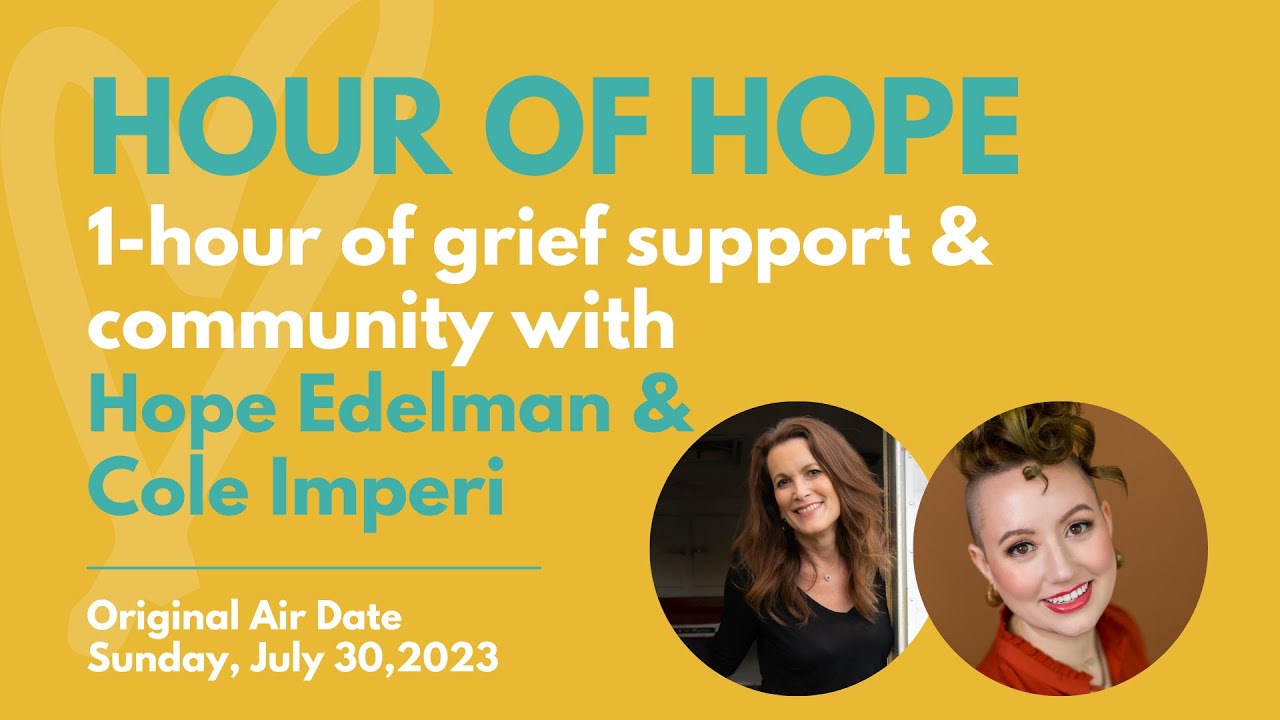
In this one‑hour live webinar hosted by Hope Edelman (author of Motherless Daughters and The After Grief), grief therapist Allison Durant, and thanatologist/chaplain Cole Imperi, participants explore the concept of “shadow loss” – a non‑clinical term for losses that are not the death of a person but still cause grief (e.g., divorce, retirement, estrangement, health crises, loss of identity, infertility, job loss, etc.). Cole explains how shadow loss relates to clinical constructs such as disenfranchised grief, ambiguous loss, and secondary loss, emphasizing that the brain does not distinguish between a “big death” and a shadow loss. The discussion highlights the power of language and naming, the role of narrative therapy, and the importance of social validation and ritual. Cole introduces “thanabotany,” the intersection of thanatology and ethnobotany, describing how plant‑based rituals (e.g., rosemary, daisies) can make intangible grief tangible. Practical advice is offered for coping with multiple concurrent losses, reframing grief as an ally, building resilience, empathy, and presence, and communicating about estrangement or secondary loss. The session ends with a Q&A covering stuck grief, crying blocks, and resources (free column, upcoming books, workshops, and community calls). The webinar also promotes the Motherless Daughters community calls and offers a discounted trial.
Chapters
Hello, everyone. I'm Hope Edelman, the author of Motherless Daughters, Motherless Mothers. My most recent book is The After Grief: Finding Your Way Along the Long Arc of Loss. And today you're joining us for an Hour of Hope. This is a series of free quarterly calls for the Motherless Daughters community on topics that are of interest to the group. And we often highlight guest speakers. It's a way to introduce women to the community at large. I'm just curious, on the screen, um, we've got— oh, we have 91 women right now. We've got 4 screens, but, you know, just on whatever screen you're looking at right now, how many of you have participated in a Motherless Daughters event before or participate in the Motherless Daughters community calls? If you'd be willing to just raise your hand, let us know. Oh, we have quite a few women here today who are part of the larger community. Great.
Look at that.
Fantastic. Good to see you. Well, as you know, if you've taken part in a Motherless Daughters community call before, we want to make sure that your first name is on the screen if you're able to do that, so that we can feel like a community. And we love to see your faces. If anyone is willing, willing to be on video with us today, it helps us feel like more of a community instead of looking at a big block of black screens. This is the 3rd Hour of Hope this year. We'll have another one in October. We often highlight guest speakers.
Speakers.
Again, it's a way to introduce women to the community at large and also to offer free support to any women who may not otherwise be able to access it. We are really very much about access in this community. So, um, but these, these calls, the Hour of Hope, are not just for motherless daughters. Anyone is welcome to join us. So if you haven't lost your mom or your mom is still living, you are absolutely welcome on this call to come learn about bereavement. I am here today with Allison Durant, who is a longtime member of the Motherless Daughters community. Allison is a grief therapist in New Orleans. She's the founder of a grief center in New Orleans. She came on the— she's been to a Motherless Daughters retreat and also came with us on the first service trip to Peru. And she's going to be helping out on the call today and reading the chat box and making sure that we don't miss any comments. Allison, would you like to say hi to everyone?
Hi, thanks, Hope. Yeah, I'm really excited to be here. Motherless Daughters is really one of led me to go and get my master's in counseling and to work with other, other, um, people, particularly women. And I have found that, like, my approach to working with women who've lost their mother is really sort of based on attachment and also the wounded inner child. And I am really excited to hear what Cole is going to talk about in terms of, like, what we've lost in our childhood and early adulthood as the result of not having our mom. So I think it's going to really put some good context around it. I'm excited.
Yes, we are so lucky today to have you with us. Thank you, Allison. And also to have Cole Imperi joining us today. Hi, Cole. Great to see you.
Hi, everyone.
Normally Cole and I are in Los Angeles together, but today I'm in the Midwest and she's on the West Coast. I'm just going to give you a brief introduction to Cole before I hand it over to her. I know that some of you have already watched I'm sure many of you have watched Cole's fantastic TED Talk. We included it in all the promotional material that was going out. Cole Imperi is an author, she's a speaker, she's an educator, she's a chaplain, and she's a triple-certified thanatologist. And she's been described as one of America's leading experts on death, dying, and grief. She's best known for her work pioneering the fields of thanabotany and death work. And we're going to ask her about that— those later. And through her development of what she calls shadow loss, which is what we're here to talk about today. Cole is the founder of the School of American Thanatology, which has students from 29 different countries. She's worked as a chaplain thanatologist in one of America's largest jails. As a mortuary college professor, as a crematory operator, as a hospice volunteer, as a grief support group leader for children as young as 3, all the way up to adults. She has served on the board of a green burial startup and traveled the US and Canada for 5 years training funeral directors. She has a book called A Guide to Your Grief, which will be published in September of 2024.
Sure thing.
We are so, so lucky and so happy to be joined today by Cole Imperi. Cole, I'm gonna say, um, let you say a few words to the group.
Hi everyone, thank you so much for making space for me and welcoming me into your very caring community here. This is such a treat, and I look forward to getting to share some of my work with you all, and hopefully you'll find it meaningful and useful in your real life.
So, Cole, we're here to talk today mainly about shadow losses. When— as soon as I saw that term shadow loss and watched your TED Talk, I said, oh God, yes, we needed a name for what that is. We all needed a language and a vocabulary for it. So I think the best way for us to get started, perhaps, is for you to tell us what shadow loss is and why it's important for us to talk about them.
Yep. So I want to share a few slides with you all that kind of introduce shadow loss and its friends, its friends of disenfranchised grief and secondary loss and ambiguous loss, because they're different from each other. And I think sometimes it helps when we have the opportunity to learn and strengthen our vocabulary that we can use to describe our own lived experience.
Words Matter.
How many of you have heard the wrong words at the right time, at the wrong time, right? Words matter. And I'm really interested in language. You will see that some of my slides are in both English and Spanish, and that's because I work with a global audience, and some of you no doubt do not have English as a first language. So hopefully this is helpful. So what is shadow loss? If you saw my TED Talk, you know that I refer and conceptualize all of this using the terms a big death, which is it's a big death to you. It's a big death to me if someone you love dies or an animal dies. And it's a shadow loss. It's anytime a thing that we love or loved dies. So a big death is a loss of life, and a shadow loss is a loss in life. And another way to say it is a big death is when someone dies, and a shadow loss is when something dies. Now, any— if you are sitting there and you're like, oh my gosh, this experience was a shadow loss for me, I validate you because you— we can only claim a shadow loss for ourselves. You cannot be diagnosed by another person as having had a shadow loss. It is only for us to choose for ourselves. So there's all different types of experiences and events that happen in life that we might feel was a shadow loss for us. And up on the screen, you'll see some examples of some of the most common ones that are often reported to me. The brain grieves big deaths and shadow losses the same. The brain doesn't have like a light setting for grief for shadow losses, right? Like, it can't— it's not that specific. You don't get a choice in what you grieve, just like you don't get to choose your losses. Now, with a shadow loss, a common example that people share is divorce, but you could have 2 different people that both had a divorce. One person may feel and describe it as a shadow loss. Somebody else might get a divorce and it wasn't a shadow loss for them. That's fine. The word shadow loss is not a clinical term. It is not a diagnostic term. It was not developed within a clinical context. And it's not intended for use within a clinical context because nobody can diagnose you with it. This is terminology. The English language, we have a limit in the words that naturally exist in the English language in and around grief and grieving. And it's different than how other languages handle grief. Spanish has a different vocabulary for the word grief and related experiences. German handles it very differently. So what's interesting is, in the US, I've observed we tend to use clinical language to talk about our lived, our lived grief experiences, because our language doesn't naturally possess and house those words. And we do this. We, we don't use medical or specialized terminology in other categories. So, for example, the medical terminology for your belly button is umbilicus. But at home in real life, we call it a belly button, right? It would be weird for me to be at the dinner table with my friend talking about my umbilicus. I mean, talking about my belly button at all at dinner would probably be inappropriate. But anyway, being able to accurately describe our own lived experiences is really healthy and really necessary. It's also really empowering when you have the right word. And shadow losses are often not seen by society. And this is why a lot of people that are grieving a shadow loss I will hear them say, gosh, my divorce would have been easier if there was a dead body somewhere, because then everybody would have understood how seriously impacted I was by the loss. Part of what makes grief so challenging is it's invisible. It's intangible. You can't see it, hold it, taste it, touch it, feel it. And we know from Dr. Alan Wolfelt's research that people who are grieving People who are bereaved, whether it's from a big death or a shadow loss, we need to have our losses socially legitimized by others. And that's what funerals do. And it's also what language can do. It's also very possible for you to have a shadow loss in life that affects you more than a big death. And this is a source for a lot of people of a lot of guilt and shame. Doesn't always happen, but it can, and it might be you. Now, there are some friends— all of these words are friends with each other. So we have the word shadow loss. We have the, we have the phrase disenfranchised grief, which is developed by Dr. Kendoka, ambiguous loss from Dr. Pauline Boss, and secondary loss. Disenfranchised grief is grief that is not usually openly acknowledged or public, like seen by people in your community. An ambiguous loss occurs without a significant likelihood of reaching emotional closure or a clear understanding. This is a clinical term. And then there's secondary loss, which are experiences that flow from a death. These are often called secondary losses. It means that these losses come as a result of the death, not that they're any less impactful or any less difficult. Now in America, in the US, we tend to have confusion between the differences between loss and grief sometimes, and it's partially because we have a limit in our language. So shadow loss is a nonclinical term. Those other terms are clinical terms. They were developed by clinicians in an office, in a setting for the purpose of diagnosing, assessing, and treating a patient. A shadow loss is a type of loss. Disenfranchised grief is a type of grief. An ambiguous loss is a type of loss, and a secondary loss is a type of loss. Now, with shadow loss, grief from a shadow loss may or may not be disenfranchised. It may or may not be ambiguous. It may or may not be secondary. And grief stemming from a secondary loss might have the same impact on the bereaved as grief connected To the primary loss. Being labeled by a clinical diagnosis is not always empowering to—
That fly is getting very annoying.
Shadow loss is the word people choose for themselves, and our research indicates that this is often experienced as empowering, validating, and positive because you own it. Only you can give that word to yourself. Only you can label yourself with that word. And we have found that within clinical environments, it's really empowering for clinicians, therapists, counselors to be able to tell a patient, okay, I think that this is disenfranchised grief. I think this is what you're dealing with. But also you may feel this is a shadow loss. Being able to pair the clinical and nonclinical language together is often experienced as very positive, very helpful, and helps make the medicine more effective. So that is my little shadow loss primer. You all now have the 411 on shadow loss.
Thank you, Cole. You know, I find that so interesting because we do use a lot of those terms in the bereavement world, and particularly when we're talking about losing a mom, we're often talking about secondary losses. And I'm really struck by what you were saying here, um, about how a shadow loss and a secondary loss can overlap, or they can be The same, but they are grieved in sometimes different ways. Like I'm thinking, for example, if your mom dies and then that has an effect on your primary relationship with a spouse or partner, and that relationship suffers or ends as a result. Maybe they don't understand your grief, or they just they can't handle being around you know with that intensity, or they're not they turn out to not be the person that you had hoped. That would we would consider that normally a secondary loss of the primary. Loss, meaning the death of a mom.
But you're—
I mean, in your terminology, it's also a shadow loss. It's a loss in life. And sometimes we have so many shadow losses that are concurrent with a primary loss that we feel really overwhelmed, right? We call that a pileup of bereavement, or bereavement overload is, you know, one of the layperson's terms. Um, when— and so do you have any suggestions or research on You know, if someone experiences several, several shadow losses at once?
Yes. So the thing that I would— that probably comes to mind is that, at least for me, this is also helpful. No matter how many losses are piling up at once, if it's 1, if it's 2, it's 27, the loss is the thing that hurt you. The loss is the thing that caused the harm that is the source of the pain. The grief did not hurt you. The grief shows up to help you heal. And for, for me, sometimes conceptualizing, just understanding that the loss is what hurt me and the grief is what helps me. The grief is that loyal friend that shows up when things are rough. The grief is what tells you is happening. It's up to us to listen to what our grief needs. Sometimes I think that that reframing can be really helpful because it's more actionable. Because the truth is we cannot change, choose, or affect our losses, but we can choose how we treat our grief. And if we are going to be angry and punish our grief, we may have a different result than if we view grief as this ally that's there to help us and lift us up.
You know, some of you know that I have studied narrative therapy. I did certificate training in it last year. And narrative therapy is very much about looking at our relationships with different pieces of ourselves. So instead of saying, I am a griever, we say, I have a relationship with grief. And that's reminiscent in what you're saying, Cole. Let's externalize that emotion and say, what is my relationship to grief? Because a relationship to grief can be changed. It can be examined, and it can be improved upon, or it can be altered. But when we're locating it inside of ourselves as something immutable, we feel like we have less agency. Over it.
Yes.
Something that you said is so interesting to me. You said the brain doesn't discriminate between the loss of a person and a shadow loss, like the brain just goes into griever's mode. I've been reading Mary O'Connor's book lately about the grieving brain and the, you know, what happens to the physical structure— Mary Frances O'Connor. Yeah. What happens to the physical structure of the brain when we are In grief. But you're saying that it will do that for shadow losses too. And this explains why so many of the women that I work with, I think, may go through a divorce or go through empty nesting and say, this is just as hard as losing my mom, or I feel like I did when I was losing my mom. Is that— is that why, do you think? Is that— would that be an explanation?
Yeah. Um, and I think, like, so science will have us try to research this. Science has never been able to show us that there's, like, different like levels of grief. But what we notice from a somatic experience, from a lived experience on an individual level, is you may have periods of time in your life where you're noticing your grief more, where it's showing up in different categories. As you know, we now know grief is not an emotion. That's outdated science, and now we have new stuff. And it's something that requires listening because it happens in the body. Grief. That's where it shows up. So it takes listening to that. And there's times in life when we're better at listening to the body and not, you know.
Um, our population is particularly sensitive to loss. The population of motherless daughters, whether we lost our moms when we were children or teenagers or young adults or in adulthood, we're exquisitely sensitive to separations. of any kind. And we often go out of our way to avoid them. Yet shadow losses are kind of inevitable, right? We're all going to, in the course of our life, experience some of them. Reminds me of Judith Björst's book Necessary Losses, where she talks about the transitions that we go through in adult development, and how many of them are experienced as loss. Launching children, for example. when they leave home. Empty nesting is part of the adult developmental phase if you're a parent, but it can feel like a form of loss. You know, I'm just curious, those of you who are here on the call today, Cole, let's talk about what would qualify as a shadow loss. I'm just interested in knowing what shadow losses our community has experienced, and maybe we can see if there are any here that are more prevalent than others, and we could maybe zero in on some of those. So you've mentioned divorce. And I've mentioned empty nesting. I've also heard you talk about being ghosted by a friend or losing a close friendship, losing a job that we loved, especially if it's abrupt, like a termination, moving geographically and leaving behind friends, neighbors, colleagues. What else? Infertility, you mentioned in your— of course, in your TED Talk.
Yeah.
Major health crises, when you lose a feeling of health or invulnerability. What else would you put in the category of shadow losses? And if any of you would be willing to drop in the chat box and let us know what you've lost and what shadow losses you've experienced, or which ones you might be struggling with right now. And remember, these are not loss of death of a person. These are a loss in life, not a loss of life. What else might qualify or fall into the category, Cole?
I love seeing what you guys are putting in the chat because one of the most powerful forms of community support from griever to griever is being able to share openly something that we have grieved. It's that, like Dr. Alan Wolfelt's research has shown, the importance of having your loss socially witnessed and validated. So over the years, I have had people self-report all kinds of things as shadow losses, from things that I may not personally identify with because I haven't had that experience. I didn't have that relationship in that specific way. But Over the years, hearing about other people's shadow losses have helped me, I think, develop a broader sense of compassion and empathy. Because, because when you see someone's pain firsthand, you see someone's grief over something, it helps you understand the world to a deeper level, because you're getting a window into somebody else's life experience. And that is where we connect. And that is where we support each other.
I'm seeing a lot of diagnosis here. I'm seeing a lot of— Catherine's saying she's not sure why naming what it is is beneficial. It is what it is. It's painful. Do you want to say anything about that?
Yeah, I think if something is helpful, it's because it's helping. And I think with naming, I think it's possible for sometimes that to be a very powerful beneficial experience for someone. But I think it's also possible for somebody else to not find validation or strength from naming an experience. And I love you all the way that you show up in this.
Yeah.
And you know, what works for some people doesn't work for others. But by and large, what we find in the bereavement community is that most mourners benefit from validation, normalization, and support. And to be validated and to be normalized We need a language that we can share and a framework for our experience. And that's why I think having a language to discuss it is so important. I see family estrangement here. And retirement. Yes, that would be considered a shadow loss, wouldn't it?
Yes. And I'll say that specifically with retirement, that is something we get messaged about a lot from people who are like, I'm not allowed in my life to be anything other than happy about my retirement. But a lot of people, it's the death of identity. Like for me, for example, at some point in my life I'll retire hopefully. And the conversation about me will switch from Cole is not a thanatologist. Cole used to be a thanatologist, right?
Mm-hmm.
Or people knowing me as Cole, she's that lady down the street that gardens and having my, cuz I very much identify with my work. And I imagine that retirement will probably be something that has some grief in there for me.
Right.
Well, a shift in any big shift in identity means we are leaving one identity behind or a single identity behind maybe, or defining identity behind and in favor of another one or to be superseded or added upon by another one.
Also, I have some genetics. a lot of people do genetic testing and they find out a parent isn't their biological parent, or there's a sibling or a half-sibling or all kinds of things. And that is also something where a lot of people end up experiencing shadow loss or, um, are confronted with that because it's the death of the what, what you thought your family was and the way you thought it was and all of that. So.
I'm seeing something in the chat that I think is really important to acknowledge in our community. Um, Sophia wrote that for her, a shadow loss was losing her father emotionally after her mother died physically.
Yes.
And that is, that is something that many women in this community have experienced, and that I've worked with a lot of clients on, is that feeling that I lost both parents when my mother died. If that, if that, if you want to drop in the chat box or, and let us know if you experienced that too, it will help with some validation. If For the woman who, woman who wrote it. It's extremely common because men grieve in different ways than women, typically, and often don't have the support that they need either. And so daughters are often left feeling like they don't have an emotional connection with their father at a time when they may need him the most.
Yeah, that's, and that's a death. That's the death of something.
So, as I was saying, our particular— our population is particularly sensitive to loss. And I've worked with a lot of women who will really go out of their way to avoid any kind of loss that might be a shadow loss. And the classic example that I encounter most are women who remain in relationships longer than they know is good for them, because they don't want to experience the pain of separation. And so they will convince themselves that some form, some amount of affection or attention is better than being alone, because being alone is going to reactivate those feelings of helplessness or isolation that they may have felt when they were younger, especially after a mom died. So in guarding against that shadow loss, they can be holding themselves back from making necessary or even helpful changes in their lives. What advice do you have for someone who fears shadow loss, who doesn't, you know, painful. Who wants to go through a loss if you have a choice? Some shadow losses are thrust upon us. We don't get to choose. All we can do is adapt. But sometimes we can, you know, initiate them. And, and we choose not to because we don't want to experience that pain. Maybe you can tell us a little bit about some of the gifts of shadow losses and what advice you have for women in those circumstances.
Yes. So I have the perspective on losses of all types that they're something that I cannot delete from my history, as many of us cannot, and they're not necessarily something that we ever want to delete from the history, because most people eventually— usually time has to pass— get to a point where they feel or identify things that they grew into. Because of the loss that are positive or beneficial. And this is not toxic positivity, because my belief is like, let's take the loss along with us, but let's also make the best of it and do the best that we can. Some of our initial research has led us to identify 3 learned skills that we most often learn after adversity, after a challenge, after a loss. And they are REP, like think muscle rep, resilience, empathy, and presence. People who have experienced loss are more resilient. People who have experienced loss are more empathetic. People who have experienced loss are able to be present to discomfort their own and others in ways that they were not before. And those are the type of people that I want to be around. I wanna be around resilient, empathetic, and present human beings.
Mm-hmm.
So you're saying that we're essentially, by allowing ourselves to experience shadow loss, by making those hard choices sometimes, we are building those muscles of resilience and empathy and presence, and hopefully, you know, the kinds of qualities that make other people, people like you, want to be around us because we are able to offer that to others. I see that in this community all the time. You know, I see it on the Motherless Daughters community calls. how resilient, how incredibly empathetic, how present the women are to each other, how much they want to be there to support each other through this, through this journey. And that comes from having this shared experience of tragic loss. And that is the loss of a person, but in addition, the shadow losses that may have come around that, or, or that they've experienced after that as well.
Yep.
Yeah. And the loss is what hurt you. The loss is what caused the pain. The grief shows up to help you heal that. And the grief shows up to help you get to a more resilient, empathetic, and present version of yourself.
Yeah.
We talk about the different— I talk about quite a lot, the different elements of grief and the ones that get the most attention are the emotional, the emotional element of grief. The psychological, because grief very much is cognitive. I mean, we're talking right now about reframing our understanding or our perceptions of loss and how helpful that can be for us. That's a cognitive process. We talk about the physical components of loss, and that is, you know, that would include the neuroplasticity of the brain and neurobiology, as well as somatic experiences that we feel. And also the spiritual. And by spiritual, I don't mean just religious, although certainly that falls into that category. But in the spiritual category, I also put the existential crises that comes with A major loss. But the 5th one, and the one that doesn't get that much attention, is social. And I know you've talked a lot about how important it is and how shadow losses bring people together. Could you talk a little bit about that and why that's so important?
Yes. Humans have evolved— one of the earliest social ritualistic practices humans evolved was the funerary ritual. So we are inbuilt and designed to see and witness each other's losses. And what's interesting, particularly here in the United States, because we have data for it, is statistically today adults are more likely to live away from this, from the town that they were born in. And we know that when you move away from the proximity to your community of origin, or where your family has traditionally been for generations, we tend to be separated from the community and social support that was present there. We also see this happen as America becomes less religious. Many of our religious communities have been the source of like what has provided bereavement and aftercare support. And so as we become less religious and become more mobile, we are more detached than ever from those inbuilt community of care systems. And that's why I always try to just encourage people like, If you don't have that community of care and support, perhaps that is something that you want to lean into in your new role, in your new identity, as you are changing your relationship to your loss and to your grief. Perhaps you can help catalyze that where you are.
And the importance of ritual too, because when we become detached from community, we get— become detached from those shared rituals that can bring so much Familiarity and comfort. This is why on the Motherless Daughters community calls, we begin with 2 opening rituals every time, because rituals link past, present, and future. They create continuity. And continuity— I think humans find comfort in continuity, and continuity is often something that we lost when our parents died when we were young. Cole, we're going to go to a Q&A in a couple of minutes, but before we get there, I have to ask you if you can talk with us about thanabotany because I find it so utterly fascinating, and especially because of some of my own training with plants and herbs. Um, but we shared a bit about it in our promotions for the call, but I, I know that some of the women here want to know what is thanabotany, how do you use it, and where can we learn more?
Thank you for asking about that. Um, so several years ago I had a research fellowship, and that is at a botanical institution, and that is where thanabotany was born. Thanabotany is where thanatology intersects with ethnobotany. Ethnobotany is the study of the plant-person relationship. Humans and plants have had a relationship since day one. We rely on plants to survive, and for anyone who identifies as a woman, you should know that women traditionally have been the people in communities who have held the plant connection to death, dying, grief, and loss. And in Thanabotany, we have people in 30 countries around the world and partnerships with 3 academic institutions and universities, including an herbarium, where we are working to preserve, identify, dig up, classify, and save this thanabotanical information and knowledge. And then on top of that, we're interested in how do we help get this information to grievers to apply thanabotanical knowledge in real life in a way that is helpful. We also know horticultural therapy, study after study, has shown that it has positive, beneficial mental health benefits to garden, to touch dirt, to, to be with plants. So that is a little bit about thanabotany.
Can you give us an example of like how some plants or flowers might be used in a, in a Healing way?
Yes. Um, okay. So does anybody here have ancestry from Wales? If you have any Welsh ancestry, you may be interested to know that when a loved one in those communities would die, the female next of kin would be responsible for sourcing rosemary and keeping it on top of the grave of the recently deceased for a 2-week period. So rosemary is something that would probably be meaningful to you from a heritage standpoint. In modern day, another thing that is helpful to know about is the daisy. So the daisy has been associated for several hundred years, based off of our sources from different parts of the world, with child loss, infertility, death of a pet, or for children that are grieving. Giving them daisies is a way to acknowledge that connection that has been there. So I find that thanabotany Helps people take the intangible grief and make it tangible, and better yet, turn it into a flower.
Wow, that's, that's just incredible and fascinating. And how many other thanobotanists are there in the world?
So there are currently no other certified thanobotanists because we are building the program so that it is actually a job that has value, which that's a whole other discussion, but we have had Hundreds of people finished the Introduction to Phanobotany course at the School of American Phanatology, and then the second follow-up course is going to roll out at the beginning of next year, which is called Phanobotanical Plants.
Incredible. Can anyone take that, or do you need to be a phanatologist?
Um, anybody. And I— this is, this is knowledge for people, you know what I mean? Like, we— this knowledge belongs to us already. All I'm doing is distilling it in a way that makes it easy to absorb in your brain.
Incredible. Wow, wow, wow, wow. Okay, we're going to move into a Q&A because I know that there are some people that are going to have questions for you. But before we do that, I just want to let the women on the call know about our larger community, and we have an offer if anyone wants to become part of it. And lots of women on this call are part of our weekly community, and a number of women on this call have been to our retreats. So if any of you who are on the calls or have been in the retreats want to share any of your experiences in the chat box. Please feel free to do that because we've got a lot of people on this call who I don't think have met us before, and we want them to know what, what they might experience or expect. So I'm just going to go ahead for a couple of minutes and share my screen. My screen doesn't want to be shared, but let's see if I can do it. Here we go. All right. Let's do a slideshow right here, and I'm happy to Tell you just a little bit for a few minutes about Motherless Daughters community calls and what they involve. They are weekly check-ins that we do, live Zoom calls that occur on Tuesdays and Thursdays. They're just for motherless daughters, 60 minutes on subjects that are of interest to you. Participants choose the topics. I believe this month we're going to be talking about hypervigilance and how that becomes a thing for a lot of us after our moms die, especially if we were young. We've talked about mother loss at different ages. We've talked about the difference between losing a mom suddenly and losing her over a long period of time. We have had just a whole host of topics that the group votes on and chooses. We have live chats and interactions, and then at the end we have an optional 30-minute open conversation where women can talk about anything that they'd like, or often it's an extension of the 60 minutes. That they just finished. Our calls are international. Women really come in from anywhere around the world, especially the Thursday call. Women from the UK and Europe are on that call. They're intergenerational. We have everything from college students all the way up to retirees and women in their 80s, which is part of the magic, is the way that we all learn from each other. They're interactive, they're eclectic. No 2 calls are ever the same. And they're very intentional. We co-create the community, we take suggestions from participants, and we optimize and improve, or try to improve upon them every year. Once a month we have a guest. We have Tips, Tools, and Therapies Week where we introduce you to a different modality of healing or a new book that's just come out or some kind of bodywork that you might be able to do at home. Here are a couple examples of the different guests, or some of the different guests who we've had over the past couple of years. We started the calls in February of 2021. They were an outgrowth of the pandemic, and they keep going.
I am there.
I share 25 years of research and insights— more than 25 by now— into the long arc of loss. We have 2 associate coaches. On Tuesday, Zan Hollingshead is there. On Thursday, it's Christine Meyer. They co-facilitate with me. And they lead the optional 30-minute discussion. If you join on Tuesdays, it's a large group, and we have breakout room discussions twice a month by affinity group categories. Some examples that we've done are motherless daughters of color, very early mother loss for women who were 12 and under, recent mother loss for adults, motherless mothers, and childless by circumstance or choice are some of our most popular breakout rooms. So we meet— you choose either Tuesdays at 5 PM West Coast time, 8 PM East Coast time, and everything in between. That's morning in Australia. We do have some women joining from Australia. Or Thursdays, 11 o'clock on the West Coast, 2 o'clock on the East Coast, and that's evening in the UK and over in Europe. And if you can't make it live, we always send you a recorded link within 48 hours. You can watch it at your convenience. We know a lot of women listen to it like a podcast. And they listen to it while they're in their car or on walks. It costs $59, and for that you get 4 calls per month, which is less than $15 a call. You pay for month 1 and you're billed on the same day every month, so you don't have to worry about signing up over and over again. And you get 50% off our online Motherless Daughters courses. If you can't start in August, we welcome new participants the first week of every month, so you can Just remember this and start in September or October if you'd like. Our special offer right now, if you sign up before next week's calls, use the discount code FLASH— excuse me, something's in my throat— FLASH39, and you'll get the first month for just $39. So that's less than $10 a call to try us out and see if you'd like the community and want to continue to be part of it. So to join, you just go to motherlessdaughters.com/communitycalls. I'll drop the link in the chat box. And you use the code, all capital letters, FLASH39, and you'll get a $20 discount for the first month. We would love to welcome you into the community and have you join us. It's lots of open conversations and Good stuff that comes up. And if there are topics that you want to share with the group or talk about with the group, you let us know and we work them in as best we can. So over there is a link in the chat box. We'll also follow up with an email for any of you who would like to just see the link and click on it. And we look forward to seeing more of you online or at an upcoming event. But in the meantime, we're going to bounce back to Cole and see if there's any questions for her, anything that she can answer, and hear some more from her. So, Allison, were there any questions in the chat box that you think we might want to focus on after we hear from Anna and Brenda?
The one thing that I saw come up was, what about when you're stuck in grief?
You're grief is stuck. Yes. Okay. So I'm going to give you a non-clinical response to this. This is the way that I just talk about it around the dinner table. So grief is like a reliable, loyal friend that always shows up for us when everything is terrible and awful. It shows up to try to help us, to try to help us heal. But grief is a lot like a compost pile in the garden. So what is compost, right? You save your kitchen scraps, you save your trash, you save the stuff that you don't want anymore. And you put it outside and you put it in a big pile and you give it some sunlight, it gets some oxygen, and every so often you turn it because heat builds, right? And then when time passes, it becomes soil. And you get to choose where you put that soil in your life. Do you want to grow tulips? Or do you want to grow vegetables? You now have something that will provide the fuel to allow you to do that. And what happens in many— for most of us in our lives, in our grief journey, our grief process, at some point, we feel it really stuck. And the way that has helped me and many people in my community to break that open is by asking your grief what it needs to keep moving. Sometimes your grief needs a walk. Sometimes your grief needs a bath. Sometimes your grief needs a book. Sometimes your grief needs to move the couch. It depends. But being able to have a communication with your grief— what does it need to stay moving? Not resolve, not disappear, not go away. What does it need to get unstuck? That can help your brain identify something actionable and get you out of the loop of just being like, I'm not moving, I'm inert, I'm stuck, I'm not growing, I'm not— I'm stagnant. Doesn't work every time, but it might be a new tool or a technique that has meaning for you.
That's beautiful.
Thank you so much. I love the idea of talking to grief like it's a person. In narrative therapy, sometimes I have clients write letters to grief with a capital G, as if it is a person. What is it that you want of me? What am I allowing you to keep me from doing? How can I attend to you but still be there for myself? These kinds of questions. Thank you, Cole. Anna, I see you've had your hand up for a while. Thank you for being so patient. Did you have a question for Cole or me? Let's try to get you unmuted so you can talk to us.
Can you hear me? Hello?
We can now, yes.
In the beginning, in the beginning, I would like to say thank you for your work, Hope, and Cole, for work and support for grief.
community.
And for me, secondary loss was above my parents' death, was losing belief system, like going from a strong believer in God to kind of agnostic person. And also losing in life lots of money after my, my dad's death because We supported each other, and I, after his death, I have to depend only on my own. So this is what I would like to address.
Yeah, I'm so sorry to hear of what you have on your shoulders because you're carrying a heavy load there for sure. So we all see that, you are seen, and I hope that that feels like a hug right now because I can't hug you right now. Something— that's a big question. So I'm going to answer one little piece there that stuck out in my brain. And that was about religion, and then also ties into ritual. So many of us experience a permanent transformation in relationship to words like religion or spirituality, right? Because we have these big losses in life, and we start out like, it just changes our relationship to this thing. What I always ask people, particularly people who come from a religious background or structure, is I want to always ask people about the value of the ritual found within the religious community. And is it possible to still have that ritual in your life separately at home or in some other form? You can do what helps you, and sometimes rituals from religious communities are very healing for many of us, not all of us, but some of us, and there's no reason why you cannot participate in, uphold, carry, and value these rituals that have meaning to you at home or in your small communities.
Thank you.
Thank you for your explanation.
Thank you, Cole. Brenda, I see you have your hand up next.
Hi, I'm sorry I won't be able to come on video, but thank you so much, both of you. I am wondering about how the secondary loss of family relationships that are of people who are alive but no longer feeling an emotional connection. And so I wonder, how have you all both of you can share to this. How do you help people communicate with living family members about that secondary loss? So you mentioned kind of the gendered normalization of a father not being as emotionally connected, but not being able to really understand the loss from the daughter's perspective. What language are you all— do you encourage in letting someone know, I feel like I've lost my mom and I've lost you without There being that added baggage of fault-finding or—
Right.
Well, Cole, is it okay if I take that one first? Because I'm working with a client on this really recently, and then I'd love to hear what you think as well. Brenda, I think right away you've started in a very good place because you've said— you've given the example of saying, I feel like when I lost my mom, I also lost you too. And that is not a blaming or finger-pointing statement. A blaming statement would have been, you're never there for me, or you have never been there for me since mom died, for example. So you're, you're forefronting your, your feelings and explaining, you know, and expressing how someone else's actions, um, or what those actions have led to for you emotionally. But also embedded in that statement, I hear, I would like that to be different. I would like you to be there for me. I would like you to be close to me, but it feels like this is not what's happened. When I'm working with coaching clients, I try to work with them to get really right-sized about what their expected or anticipated or hoped-for outcome is, because it's important to remember that each of our family members gets to choose what kind of father, sister, you know, nephew, grandparent-grandchild they are in this world. And we can't change that. And we can't make them be there for us in the way that we wish they could be. We can only express to them what we hope for. So when you talk about what kind of language can we use, I think it's important for us to be clear that when we go to express our feelings, we're doing it out of love. We're doing it out of hope. We're doing it out of what we wish for, but to detach from the outcome and, and be real clear that we can't— we need to be able to walk away from that conversation and feel good about how we conducted ourselves and how we expressed ourselves, not attached to the conversation ending in one outcome or another, because that we can't control. What we can control is how we present ourselves, how we show up for that conversation. Not how it's going to land on the other side, because we can almost never predict that.
People are—
people will surprise us all the time. Cole, what would you like to say? You want to say anything to Brenda about that?
Yeah, so Brenda, this may relate or not directly with your particular question, but sometimes I find people struggle with how do you exist in the world and communicate even to your friends that you're dealing with an estrangement in your family or an estrangement with another person in your life. And that absolutely is a shadow loss for a lot of people, no matter what the source or cause or how long the estrangement has been going on. But a way that has helped me in the past and some of my colleagues in talking about This really, because sometimes there's a little bit of a taboo around estrangement in a lot of communities. Like, we don't talk about it, but the whole family knows these people aren't talking right now, right? Is to— the way to communicate it about that can be helpful sometimes is to say something like, oh, my so-and-so and I are trying to figure out a change in the dynamic between our relationship, and just leave it at that. Because that is what's happening. Something has changed in you and you have a different need, or maybe, you know, nothing has. But to an outsider or to a person that you're trying to not alienate, but also trying to not lose that connection and support to, while also not throwing anybody under the bus, because that's usually never helpful, is to communicate about— you're both trying to find your new boundaries. You're both trying to find your new range of relationship.
Thank you, Cole. I think we have time for one more question, and Joella had her hand up, but I just wanted to read Melanie's post here so that we give some time and attention to what she has shared with us. She said her question is, she experienced a lot of shadow loss all at the same time— retirement, moving, divorce, estrangement from my kids. As much as I have been resilient most times, I am a huge puddle of grief. I want to validate and acknowledge the magnitude of those losses. And Melanie, I'm so sorry for all of them to come at once. I experienced a pileup like that myself in 2020, and sometimes it's all you can do to just get from one day to the next. But I just want to validate for you that it's okay to be a huge puddle of grief sometimes. That's a lot. We don't have to be resilient all the time. I think sometimes resilience comes from allowing ourselves to be a puddle of grief. When we need to, and feeling those feelings and being fluid enough to go in and out of them. I think to me, that's part of what builds resilience. Cole, do you want to just touch on that before we hear from Joella and then wrap up?
Yep. Sounds to me like your grief is saying that you need more time to be a griever and just in the grief and not on to the next thing yet. And that is sometimes really difficult to accept. When I've had a major medical life-changing diagnosis and I was ready to be out of that as soon as possible. But my grief kept screaming through all the different channels that it didn't think that that was the time. And that is a non-clinical way of framing this. But sometimes that is the truth. You may be in that period longer than you would like, but it's not harmful. It is a part of you, and there's a space that's being opened up by being in that chapter of life.
Oh, I love that. And I just want to, you know, take that metaphor of yours a little bit further, one step further, as we say in our community here, because so many women feel like, I'm still grieving my mom, years, so many decades after the fact that I feel like I'm broken. And we try to, you know, reframe that or work with them to, and talk about how, no, you're not broken. There's nothing in you that's broken. You were broken open. And you were probably broken open too young, and there wasn't enough support there to help you gather the tools to feel whole again. So you can do— you're doing it now as an adult. Yeah.
Yeah.
Joella, we have time for one fast question before we need to get off.
Can you hear me? Can you guys hear?
Hello.
Hi. Thank you so much for doing this. My question has to do with when tears from grief are stuck.
Mm-hmm.
Not stuck grief. Those to me are 2 different things. And I had multiple family deaths in the past 3 years during COVID all my primary family members. And I don't know whether I'm just on overload. I cried a little. I can feel the grief in me, but tears just will not come. And I love crying. I think it's nature's way of helping us heal ourself. And what's up with that? If you have any suggestions or reflections, thank you.
Well, do you want to start with that one?
Yeah. Yeah. So I'm sorry to hear you're dealing with that, especially because you appreciate and value a good cry. Not everybody does, right? Some people would do anything to avoid crying. And I will say this is not the first time that I've heard this. This is not an uncommon experience. And the way that I would relate this in a non-scientific way is I think it's similar to writer's block, if you know what that is. When you're writing, sometimes you hit a thing where it's like you can't write anymore, but that's your job. So why, why can't you get the words out of your mouth in whatever form it is? And the same thing happens with grief. And one of the tools that grief uses for us is tears. And research shows there's science behind it that the act of crying is usually results in positive effects on mental health and our physical well-being. It tends to reduce anxiety, and there's some other things there. So it sounds to me like you have a little bit of writer's block with your tears. And just like with writer's block in a writer's life, you cannot force it. You cannot stare harder at the writer's block. It will root its feet in, press its arms against the wall, and stay locked in. So I think it's important that you've noticed this, Joella, in yourself, because the grief is, is having you notice this. But I know of no tool or technique that forces a cry unless you consistently cry at the same movie or the same song every time. And if playing that doesn't work for you, yeah, so I wouldn't be concerned about that. But I would keep listening to it and observing it and just being a witness to it.
Cindy is sharing in the chat box she didn't cry about her mom's death until she joined these calls every week, and it's been 42 years. You know what I find, and Joella, this doesn't sound like it's your situation, but maybe so. I'll, in the hopes that it might be helpful, I'll share this with you. When I was writing The After Grief, I actually did some research into the world's record for crying, because I hear so many women say, I'm afraid to start crying, or I don't want to stop crying because I'm afraid I'll never stop. It's sort of like this cultural meme, right? It's physiologically impossible to start crying and never stop. The average amount of time that individuals cry, I think for women is about 15 minutes. For men, it's more like 7. That has a lot to do with testosterone blocking emotions. You know, people who are higher in testosterone have a harder— and my trans friends tell me, you know, when they transition from one gender to another with the hormones, they often feel this, you know, that they either become much more able to cry or much less able to cry. But it is impossible to start crying and not stop. So the way that I interpret that statement is that I'm afraid that if I start crying, I will not have the support I need or not be in a safe place to feel contained. And containment is when we feel that there's a compassionate other who can hear us, who can see us. I think what they're saying is, I'm afraid I'll be so lonely that it will hurt And that hurt won't stop. And so that's why it's so important, I think, to find community and to find others, compassionate others who can hold that space for us. Not everyone can do that for various reasons of their own. There are too many to list. But when we can find other people who can hold the space for us in a tear-friendly environment, that— I think that's when, like Cindy was saying, that's when the tears feel Free, can come freely because we feel safe enough to let them out. Cole, is there anything you'd like to add to that before we, before we wrap?
Um, no, I think that, that I love your— I love the way you answer these questions. Hope, you just put the right words to it. Like, I'm just like, yeah, what Hope said.
I know, I'm like, listen to her. Um, Cole, before we go, and thank you for staying the extra few minutes with us, So many women have stayed. I know that's testimony to how wonderful this material is and how much they appreciate you being here with us. Do you have any events or courses coming up that callers can take part in? And can you tell us a little bit about your new book and whether— when we can— when can we preorder it?
Yeah. So I have a column called Grief or Madness that's free that you might be of interest. If you go to my website, you'll find it, or grieformadness.com. That might be of interest, and it's free. I also have 2 books coming out. The first one is called A Guide to Your Grief, and it is written for teens and tweens, and that comes out September 2024, published by Kids Can Press. And then a few months later, my book on grief for adults called The Lilac Days, published by Penguin, comes out March 2025. So it's a while to wait there, which is driving me nuts, but I have no choice. So check out my column in the meantime. And then if you are curious more about shadow loss, through the School of American Thanatology, there's a 3-hour workshop on it with an assessment at the end where you can get a certificate if that's of interest to you or would help in your professional careers, because we're trying to build on the research. And we do have a work group forming in September. Um, a work group is where people who are interested in shadow loss meet, and we are designing and developing our next survey, but you have to have completed the workshop in order to join that, and there's no cost to join the work group. So, um, your grief is your own. You earned the grief. It's a benefit to you, and I just want to encourage you all in your relationship with your grief. And thank you for having me and listening to me. That's nice.
Cole, thank you so much for your time. And anyone who wants to see— learn more about you or your work, I just dropped in the chat box, it's coleimperi.com. And over at Instagram, it's @imperi. I'll put that in here too. Cole is at @imperi over at Instagram. So please feel free to follow her and her work. And want to thank all of you for being here today and sharing your time and your hearts with us. A special thank you to Allison for manning the chat box and being here with us also. And we hope to see you on an upcoming Motherless Daughters Community Call. The link is in the chat box if you'd like to try us out for a month for just $39. We'd love to see you and welcome you into the community, or at an event, another event in the future, or at the next Hour of Hope in October. So have a beautiful, beautiful rest of your weekend, everybody, and beginning of your week if you are in the European time zone. This is how we say goodbye in the Motherless Daughters community. Thank you, Cole. Thank you, Allison. Thanks to all of you for being here with us to share this sacred hour. We'll see you soon.
Bye.
I fucking missed it, literally to the second.
What?
More from Hope

Bringing Mom Into the Season: A Holiday Gathering for Motherless Daughters - REPLAY