ADHD, Alzheimer's, Brain Health w/ Guest: Dr. Daniel Amen (Psychiatrist Who Changes People's Brains)
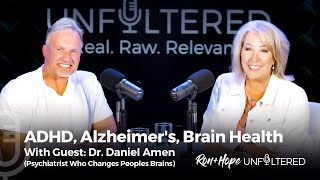
This is a YouTube episode of Ron & Hope Unfiltered featuring psychiatrist Dr. Daniel Amen (recorded Aug 25, 2022). Dr. Amen summarizes his 30-year clinical work (10 Amen Clinics) and large brain-scan database (over 210,000 scans from 155 countries), reframes psychiatric diagnoses as brain health issues, and offers practical prevention/rehab guidance (mnemonic: Bright Minds) covering blood flow, inflammation, head trauma, toxins, mental health, immunity, genetics, exercise, social connection, sleep, and diet. He also discusses ADHD (real, increased ~400% since 1987; lifestyle first, meds when needed) and Alzheimer's risk (claimed ~50% risk by age 85) and promotes brain scans, lifestyle changes, and his books (You, Happier; The End of Mental Illness).
Questions this video answers
10 clinics around the country.
Over 210,000 brain scans from 155 countries.
337 million prescriptions.
A 50% risk of being diagnosed with Alzheimer’s disease.
He says ADHD has increased fourfold (about 400%) since 1987.
Chapters
Foreign.
Hello, everybody. It's Ron and Hope Unfiltered. We are so glad. What are you doing?
That's your thing. You love to just come out.
Ron and Hope Unfiltered. It's real raw and relevant.
It's like a game show host.
I could do that.
You like a game? What was her name? Vanna White.
Vanna White. Look, it's real raw, relevant, and it's relevant. Yeah.
We're excited about everybody being on here again. Kind of giddy about our guest. I'll be honest with you.
A little bit.
We. We kind of probably batting out of our league here a little bit.
We hit the jackpot.
Yeah, we really did. And I think you guys are not just going to be glad to hear who we have, but I think you're going to be really helped out today and intrigued by some of the information you hear. Let's just take a minute and kind of set this thing up. When we started this podcast, we like, okay, we don't want this to be like what we do. They get our preaching all the time. You go on Instagram, Facebook, we got clips, we got devotionals, we got live services, we got ichurch. You can get all that on YouTube and the list goes on. We did this to be specifically different, and it was to get behind the curtain behind what we do. And really kind of the real roll and rather part is to kind of get vulnerable about the places where we don't have it all together. The places in our life where life tripped us up and the times where things flat out fell apart and we just had to stop and pick up the pieces and put them back together. And what we've learned, and we've learned a lot about it, and I think we are very transparent to the point that maybe it makes some people feel uncomfortable because I think in the Christian community, they don't want to know that their leaders have flaw. It makes them uncomfortable. They want to know that that guy lives a little bit stricter than I do. He's a little bit more rigid than I am.
He never stumps his toe and says it doesn't matter.
When they find out that, you know, he does have a bad thought and he does have a bad day and he does lose his temper, you know, they're just mortified at it. But the fact is, we love Jesus. The fact is we are very committed to our faith. The fact is our core value system is all initiated by our faith in Jesus Christ. But at the same time, our human bleeds through, we get depleted, we get burnt out. We're going to be some revelations here in a few minutes. There's been times where I've had to take medicine for anxiety. There's been times, and preachers don't want to ever tell anybody that because, well, maybe your walk with God is not.
As strong as you can, but it handicaps their followers. It really does. It holds them hostage, it keeps them ignorant. And we perish because of lack of knowledge. And until the church becomes vulnerable, until we speak about issues in this kind of forum, in the pulpit, we let people know, you know, that we struggle. The struggle is real. And in this world, you will have trouble. And we've got to learn to manage it. We've got to learn to balance, just not our spirituality. We got to balance our mental health. We got to balance our desires and our wants.
We got to manage. We got to manage them.
Yes.
Yeah, we got to manage them. So I know you've got some things there. He. He deserves. Amazing introduction.
I don't know that I can do.
It good enough to do it right. You wanted to actually write some things down, let everybody know who our guest is.
Oh. Are y' all ready?
Let's do it.
Oh. I have followed this man for a long time and just admire. Love his work, Doc. Amen. Love the last name and just love him and his wife Tana. Just such an incredible inspiration, inspiring couple. Just love everything they do. They're real, they're raw, they're relevant, they're vulnerable. They share their ups and downs. And he's done so much work, all things brain. And, you know, one of our best friends is a good friend of his, Dr. Caroline Lee. She's been here many times at our church and shared and done conferences. And so what an inspiring. I mean, really, they're pastors in their own right. They're pastoring and shepherding people in their sphere. Maybe not from a pulpit, but from what they do. And it's just so encouraging to me to hear all of the testimonies and people coming out of anxiety and coming off of medicine and living their best life, because that's what Jesus died for. You know, John 10:10, the thief comes to steal, kill, and destroy. But he said, I came. Why Life, that you might have abundant life, not existing life.
That flows out. The Bible says, as a man thinketh in his heart, so is he. A lot of the quality of your life is going to flow out of not just the mind, consciousness, but the brain, the organ being healthy. And we got the right person here.
To talk about.
Let'S me and you be quiet. Doctor, just share with us some of the things that you would like for our audience to know, because we're all ears, sir.
Well, I want to first say your book is just the most wonderful thing, the newest book, you happier. And you said in there, I'm going to spur this. You said in there that most people don't ever think about brain health. You know, we'll go to the doctor for a cough, we'll go to the doctor for a knee or a back problem. But when it comes to our mental health, we never think about that. Our brain is an organ. Talk to us about that.
So at Amen clinics, I have 10 clinics around the country. We've been working at this for 30 years. We built the world's largest database of brain scans related to behavior. Over 210,000 on people from 155 countries. And we. One of the first lessons I learned is that most psychiatric problems are not mental health issues at all, but rather they are brain health issues that steal people's minds. And this one idea changes everything. Get your brain right and your mind will follow. I hate the term mental illness. When I was third year student at Oral Roberts University, so I learned medicine in the context of my faith, which made me really happy. And I hated the term mental illness then because it shames people. It's stigmatizing and it's wrong. These are brain health issues. Yet we live in a society that makes diagnoses based on symptom clusters with neuroscientists, no biological data, and no love and care for the brain. So you'll end up on antianxiety medications, and nobody's talking to you about your diet. You'll end up on antidepressants, and nobody will be talking to you about exercise. You'll end up on sleep medications, but no one's ever done sleep hygiene with you. We live in this truly insane society where the pharmaceutical industry is making huge, huge on our illness and they're perpetuating illness, and I'm not okay with it. And in my new book, you, Happier, I actually start with the idea that happiness is a moral obligation. And it's like, now, I grew up Catholic in the San Fernando Valley in Southern California. And I guarantee you, in my family and in the Catholic schools I went to, that idea was nowhere to be found. Happiness is a moral obligation. But just think about how you impact other people. And I guarantee you if you were raised by an unhappy parent or married to an unhappy spouse, or rather raising an unhappy Child. And you ask them if happiness is an ethical issue, I guarantee you they'll say yes. And talk about today is not fluff, it's critical. And hedonism is the enemy of happiness. And that's what's happening in our society, is we wear out the pleasure centers in the brain. People are like, well, I'm depressed, so let me take an antidepressant. I'm like, well, why don't we rebuild your pleasure centers and have you stop wearing them out? Wow.
Wow, what a concept.
I bet your brain's just clicking right now. I'm intrigued just by what you said right there. You can take it anywhere you want to. But since we are living in a generation where more people are medicated for these types of symptoms than probably in any other generation in history, would you just speak some more about the pleasure centers? Because I know we have a generation that's wearing them out at warp speed. I've never even heard that referred to as a pleasure center in the mind. I would love to just hear your take on that.
But, you know that's a quick fix, though, right? Most people want the quick fix. They want a medicine. They want something.
But the quick fix wears out.
Yes.
So there are two areas deep in your brain called the nucleus accumbens, and they respond to dopamine. And when you hit them, like when we came on and we chatted a little bit, well, that made me happy. So connection makes you happy. Eye contact makes you happy. Really great. Food makes you happy. But if you hit them too hard, alcohol, vaping, nicotine, marijuana, repetitive gadgets, pornography. If you hit them too hard, what happens is you begin to wear them out. And pretty soon you need more and more to feel anything at all. I'm in Justin Bieber's docu series Seasons, because I've been his doctor for a long time, and we talk about dopamine deficit disorder that. I mean, if you just think of that boy, incredibly talented. But fame and money and travel and video games and drugs, basically anything he wanted completely wore out his pleasure center. And then he fell off a cliff. And it's only because of Jesus that he's still alive because he gave his life to Christ. And then he, you know, he got me in his ear about, we need to eat right, we need to think right? We need to take care of this organ. And he, you know, like many celebrities I see, sometimes he'd show up, sometimes he wouldn't, Sometimes he'd do what I said, sometimes he wouldn't. But when he was really In a dark place. He came into my office and he said, I think I get what you're trying to tell me. My brain is an organ, just like my heart is an organ. If you told me I had heart problems, I'd do everything you said. So I'm going to do what you say. And then he got radically better. And we need to stop calling people mental. Right? If you call someone mental, you shame them. We need to like change the paradigm from mental illness and mental health to brain health. Because nobody wants a mental illness. No one wants to be called mental. Everybody wants a better brain. So what if mental health was really brain health?
Wow.
And there's no better in my mind than the church to get this message out. Because the church has had problems. Because like, oh, if you're depressed, you need to pray more, you have sin in your life. And I'm like, when I went to Oral Roberts University, our dean, the first week went to the board and he drew these four big circles. He said, never think of your patients as their diagnosis. Always think of them, Always think of what's the biology. So for me, it's brain and body health. What's their psychology? So I teach people to kill the ants, the automatic negative thoughts that steal their happiness. And we deal with early childhood trauma, very common source of brain health problems. What's the social circle? If you want to be happy, you have to give happiness away. And what's the spiritual circle, which you won't hear very many psychiatrists talk about, but what's the spiritual circle, which is ultimately what's your essence? Why do you care? Why are you on the planet? What is your deepest sense of meaning and purpose? And I work in those four circles all the time. And when you see people that way, you just don't go, oh, you're depressed. Take Lexapro. It's like, why are you depressed? And you know, could it be your thyroid? Could you have had a head injury? Do you have Covid brain? Or do you have Lyme disease? Have you eaten too much mercury from fish? And you begin to really see the brain as an organ. Get your brain right, everything is better.
Wow. That's life changing.
Yeah. I want to take notes and I want to preach about a 10 part series off this sitting right here.
Don't do it, don't do it.
You know, doctor, this gets me excited. I know that the mind and the brain. The brain is the organ, the mind is the conscience. I get that. But to let you know what a big topic this is among Christians, I hope we have a much larger audience than that. If you're a non Christian out there, I want you to know you're welcome in this podcast, too. And we're so grateful that you've given us your time. But I know amongst Christians, which will be the major part of our audience, I was the same way. I probably come from that same circle, that same camp, the faith camp. And nobody ever taught me that I am, you know, I have several forms of energy. I have emotional energy, I have mental energy, I have physical energy, I have spiritual energy. And there are certain things in my life that depletes those, but they never teach me the things in my life that replenish those. And so especially a preacher, you are told to give everything to God. Well, I watched my daddy die at age 62 because there was such imbalance in his life because of how he was taught. I followed in those same footsteps. And in my mid four, doctor, I crashed. And if I may, I would just love to have your take on it, because when I got to the. I got hospitalized for insomnia, my anxiety was so bad that I dreaded seeing the sun go down. Because when the sun started going down, I knew my fight was going to begin. And after 23 days, I finally was hospitalized. I had to go in under an alias because the local media was chasing me down, trying to get the goods on the story because they knew I was struggling. But, doctor, the first thing they did when I walked in there, start handing me pills. Nobody ever listed any of the things you've just said. That's the first time I've ever heard that. I'd just love you to speak to that.
And nobody looked at your brain. I mean, why would you do that? You're suffering and they're thinking that your mind, but not looking at your brain. Think of this. There were 337 million prescriptions last year, year for antidepressants. And virtually all of those people, nobody looked at their brain. Now, that's insane, right? I'm a psychiatrist. I know how to diagnose insanity. And making diagnoses based on symptom clusters with no biological data, it's nuts. And when I started looking at the brain 30 years ago, what I realized is depression's not one thing. It's just like chest pain, right? Nobody gets a diagnosis of chest pain because chest pain doesn't tell you what's causing it, and it doesn't tell you what to do for it. So when you're going through this crisis, the first thing I would want to do is look at your brain. And then I would want to make sure your body was healthy, that your gut was healthy, that blood flow to your brain was healthy, that your hormones are right, that you don't have an infection or a toxin, or you hadn't been in a car accident and had a concussion recently because of all of those factors contribute. And oh, by the way, when you approach mental health that way through brain health, there's no shame in it. Not like, oh, try harder. Right. I didn't work. You were trying really hard. Or in the Christian community, pray harder.
Yes.
When God doesn't answer your prayer prayer, then you get bitter.
Bitter.
And that's not fair.
It's not.
I think God has given me, you know, this mission in life, and it's really because of my faith that I didn't care that much about my critics. Because when you're a Christian and you know, Right. We often say, you know, that, you know, that when, you know, looking at the brain is absolutely foundational, then when your colleagues say you shouldn't look, you just sort of stop paying attention.
Well, that's the first thing you do. Right? I mean, just coming into your clinic that is foundational is just to do a brain scan.
Because how do you know if your brain's working too hard or if it's not working hard enough or it's being like, you know, if I'm thinking of somebody who all of a sudden cancel, is really anxious, I'm like, is there mold in there? Is their brain have an infection? I mean, you should see the COVID scans that I've seen. Covid, like, activates the limbic or the emotional part of the brain. How do I know? And why would I guess? What other medical specialists never look at the organ they treat? What other medical specialists start giving you pills with no biological data?
That's so true.
That's insane. And then the medicine they give you changes your brain to need it in order for you to be normal. And I have problems with that. And it was about 40 years ago, the pharmaceutical companies that serve psychiatry, they decided they don't want to be in the order business where, you know, we'll give you something to fix it, and then you don't have to take it anymore, like an antibiotic. They want to be in the reorder business, where once you start it, they want you to stay on it forever. And I'm not okay with that because, you know, what I was taught at ORU is skills. Teach people skills. Don't just give them pills And I'm not opposed to medicine. People are listening. Don't stop your medication, but get my book, you happier or the end of mental Illness and go, is there a better way? In my book, the end of mental Illness, I go, if you're anxious, here are 10 things to do before you take anti anxiety medicine that we now know is addictive and increases your risk of dementia. Or if you're depressed, here are 10 things to do before you start on antidepressants. They don't work. Take the antidepressants because depression and suicide go together. It's just a different paradigm.
It is.
We should be thinking brain health first. And when you love your brain, well, then you sort of stop drinking, you really stop using marijuana because marijuana damages the brain. You stop eating bad food. And you know, people get hung up on, oh, I can't do this, I can't do that. And that's the mindset of failure. It's like, oh, with a better brain, I get to have better relationships. With a better brain, I have more money. With a better brain, I have more energy. With a better brain, the reason I'm on the earth, my mission is elevated. And so, you know, when I got really healthy, I'm like, oh, I missed rocky road ice cream for a minute. I didn't miss being fat and I didn't miss having joint pain and I didn't miss, you know, there's like nothing I miss from having a better brain.
I love it. And here's the thing. Spoiler alert. Your brain can change. Weak. It can, it can be bad. It can have issues from trauma, from child abuse, from injury, all of those things. But it can change, correct?
Well, it's sort of the big excitement of my life is you're not stuck with the brain you have. You can make it better. And I can prove it. In fact, I did the first and largest study on active and retired NFL players when the NFL was sort of lying. They had a problem with traumatic brain injury in football. For those who saw the movie concussion, I was one of the consultants and I've scanned and treated 300 NFL players. I mean, cool hall of fame players like Terry Bradshaw, Freddie Dreier and high levels of damage. I mean, stop lying about it. Playing football is a brain damaging sport, but 80% of my players got better when we put them on a rehabilitation program. How exciting is that? Even if you've been bad to your brain, you can make it better. But, you know, every day with the decisions you make, you're either making it better or you're making it worse. And the one thing that horrifies me is this one statistic. If you live to 85 or beyond, you have a 50% risk of being diagnosed with Alzheimer's disease. You basically have a one in two chance of having lost your mind. And I'm not okay with that. And every day you're increasing your risk with your behavior or you're decreasing your risk with your behavior. That's exciting that you can choose.
Yes.
You know, because I don't want to be a burden to my children. And quite frankly, I love my six kids. I never want to have to live with them.
Hear, hear. Hear, hear.
I want freedom and I don't want to be a burden. But, you know, it has to do with the decisions I make throughout my life.
It's choices. My, my parents are almost 80 years old and my mom is suffering with some early forms of dementia and drinks, I mean, liters of diet soda every day of her life. And she has for, by the gallon as long as I can remember. And I try to tell her, mom, let's not drink that. Let's drink something different. And her response is, I'm almost 80 years old. I can drink what I want to drink.
Absolutely she can. But the problem is, in fact, a brand new study came out and they looked at sugar, stevia and Splenda or sucralose. And they divided this into three groups and for six weeks, so they studied their memory, learning and brainwave patterns, executive function, decision making, and stevia didn't seem to change anything. Sugar learning went out the window.
Wow.
But the worst one was Splenda. The memory was bad, learning was bad, executive function was worse, and they had sleepier frontal lobes. That's a very bad thing. It's like the break in your brain that stops you. And so, you know, we have to find a sneaky way to get her to love her brain. And when you do, and that's, you know, the little lie, well, I'm 80. So it's like, well, so what? You can make your brain better, right? But the brain is lazy. It's habitual. And this is a very important point because what you alone allow your brain to do, it's going to continue to do. And it doesn't take a whole bunch of effort, but you sort of have to nudge it to like, go, all right, is this good for my brain or bad for it? And then start making better decisions. One that I just love a habit I do every day is when I go to bed at night. I say a prayer and then I go, what went well today? And I start reviewing my day. I actually. It's like a treasure hunt. I go on a treasure hunt every night looking for what? Fun, cool, amazing, even small things. I call them the micro moments of happiness that happen during that day. And as I put myself to sleep, what I'm doing is setting up tomorrow to be better. Because when you do that at night, your dreams are better and you're more rested tomorrow.
Yeah.
And most people lay down at night and toil over what didn't go right. Or they worry about tomorrow versus the opposite of what you do, which gets your brain, if you do it every night in that habit, and it sets a new course for you. But it's work, Doc. It's work. And people don't like that work.
Well, but all it's work either way.
Yeah.
It worked to be sick. I mean, that's not any fun, right? And even the day my dad died. So my dad died a little over two years ago, but I've been doing this habit for nearly a decade. And the day he died was an awful day. And it was awful. And when I went to bed that night, I did that. Now, the voice in my head sort of went, you know, the critic goes, oh, you're a bad son. But because I'm used to doing it. I then thought of the most funny interaction between my mom and the police officer. And then I thought of the hundreds of texts I got from my loved ones and friends. And then I remember just holding his hand before they took him away. And I remembered how soft it was. And then I went to sleep. And it didn't mean I didn't grieve, but what it meant is I was managing my mind.
Correct.
Somebody else or something random.
That is so good.
So good, so good, Doctor.
And that's secret number five. In you happier is manage your mind and gain psychological distance from the noise in your head. And one of my favorite New Testament verses is Philippians 4. 8. Think on whatever.
True.
Right. Lovely, Good. Worthy of praise. Let your mind think about these things. And another one I just dearly love is Romans 12:2. Be transformed by the renewing of your mind. Everybody knows that, but they don't know the second part of that. Then you can test each thought to see if it fits God's good, perfect and pleasing well. And I did this program at Saddleback Church called the Daniel Plan. So I was the chief architect with Pastor Rick Warren and my friend Mark Hyman and thousands of churches around the world. Did this plan, which they sort of marketed as a health plan. But I went, this is the mental health plan because it was based on five big ideas. Faith, why do you care? Food. Your brain uses 20 to 30% of the calories you consume. You want to think right, you have to eat right. Fitness focus, which was brain health. And friends, we get better together, we get sick together. So the church is the perfect vehicle to help our society get healthier.
I agree. Well, before I go into brain overload, I think we've got some sponsors, don't we? We need to talk about.
We do. We have a sponsor. And I love our sponsors. I love our sponsor Chime. And why do I love our sponsor Chime is because they help us manage one of our most important commodities. And that's our money. Our money. There's no monthly fees, no maintenance fees, no minimum balance fees. And there are more than 6 60,000 in network ATMs like Walgreens, CVS, 7Elevens. You can send money to anyone even if they're not in the Chime program. Chime has no monthly fees, so sign up today for a Chime checking account. It only takes about two minutes and it doesn't affect your credit score, which is amazing. So get started today@chime.com RonAndHope that's. That's chime.com RonAndHope and Chime is a financial technology company, not a bank. Banking services provided by and debit card issued by the Bancorp bank or Stride bank. Members of FDIC out of network ATM withdrawal fees apply except at MoneyPass ATMs in a 711 location and at any Allpoint or Visa Plus Alliance ATM. Other fees such as third party and cash deposit fees may apply.
We love chimes. No monthly fees, no maintenance fees, and no minimum balance.
Right.
Nobody's doing that. We love our sponsors at Chime. Give them where to go again. Because we make no bones about it. We want our sponsors at Chime to know that being right here and sponsoring this podcast is beneficial to them and their company. So where do they go?
They go to chime.com RonAndHope chime.com RonAndHope so Doc. Amen. All right. Where would the listener start if they say, I've never heard anything like this. This is crazy. This is mind blowing. Where do I start today? Simple things for my brain health.
So, you know, I often say brain health is three things. Brain envy, you got to care about it. I always say Freud was wrong. Penis envy is not the cause of anybody's problem. I've not seen it once in 40 years. You want to love and care for your brain, and then you want to avoid anything that hurts it. And quite frankly, most second graders would know the list. I actually went to my daughter's second grade class and wrote 20 things on the board. 10 good, 10 bad. And I go, separate them for me. Tell me which is bad for your brain, which is good for your brain. And they got 19 out of 20. Right.
Wow.
The only so head trauma, alcohol, marijuana, not sleeping, anger, sugar. They put them all in the bad category and they're absolutely right. And the only one they missed was orange juice, which they put in the good category. But it's totally bad for your brain because it's too much sugar. Whenever you unwrap fructose fruit sugar from its fiber source, it begins to turn toxic in your body. And so avoid things that hurt your brain, know the list, and then do things to help your brain. And it's simple. I have a mnemonic I talk about in the book called Bright Minds. You want to keep your brain healthy or rescue it if it's headed for trouble. So you talked about your mom having some early memory issues. So if you want to keep your brain healthy or rescue it, we have to prevent or treat the 11 major risk factors that steal your mind. And Bright Minds is the mnemonic. So, for example, B is for blood flow, low blood flows, the number one brain imaging predictor of Alzheimer's disease. And what gives you low blood flow? Caffeine, nicotine.
Wow.
Exercising, any form of heart disease. And so what do you do? You exercise, walk like you're late, 30 minutes, five or six times a week, significantly improve your mood and your memory. R is retirement and aging as we. I hate this because I turned 68 a couple of weeks ago. You know, as we age, our skin begins to fall off our face. That same process happens in the brain, but it doesn't have to. And so new learning, volunteering because isolation, what happened during the pandemic is a major risk factor for depression and dementia. I is for inflammation. Everybody should be taking omega 3 fatty acids. G is for genetics. And genes aren't a descent. They should just be a wake up call. Right? I have obesity and heart disease in my family, but I'm not overweight and I don't have heart disease. Why? Because I know it's my risk. And so I'm always on a prevention program. If I had addiction in my family, I wouldn't go near substances because why would I tempt the devil? If you Will. No, no, no. H is head trauma. We have to do such a better job at protecting our brains. T is toxins. And now in our society, it's like, alcohol's a health food, marijuana is innocuous. Those are just lies. But there are other toxic things. You probably have seen recently how they've taken some sunscreens off the market because it's causing cancer. Haven't you wondered why there's an epidemic of low testosterone in young men? It's because of the poison their parents have put on their skins as they were growing up. The dermatologists won. They made us afraid of the sun. And so now we have these very low levels of vitamin D that you get from the sun. And, oh, by the way, we also have toxic bodies. M is for mental health. If you have particularly childhood trauma, get treatment for it. It's so important. I is immunity infections. So it's. You know, I know this is a lot, but it basically comes down to this one question. Whenever you go to make a decision in your day, is this good for my brain or bad for it? And if you can answer that with information and love, love of yourself, love of God, your body is the temple of the Holy Spirit. I mean, why would you trash it unless you didn't care that much? Love of your family, love of your mission, you just start making better decisions.
That's so good. That is so good. Let me ask one question, because we have a lot of listeners who, who ask us these questions. And the question is, is ADD and ADHD real, or is it social, Home life, food? And what is the answer for these struggling parents with these precious kids who just seem to be bouncing off every wall and can't be tamed and struggle in school?
So ADD or ADHD. And it's like, why does it have two names? 1980, the diagnostic manual called it attention Deficit disorder, with or without hyperactivity. And in 1987, they messed it up. They changed it to ADHD and basically threw out all the people who didn't have hyperactivity. So it's the same name. Short attention span, distractibility, restlessness, impulse control. And it's real. And when left untreated, there's a very high incidence of addiction, incarceration, divorce, bankruptcy. It's a big problem. But the increased expression. So it's increased fourfold since 1987, when I finished my child psychiatry program, it's increased 400%. Why? Because of the gadgets, because of the bad food, because of the lack of sleep, because of a lot of the Nonsense in our society. So how do you know if it's induced by food as well? For a month you just put them on an elimination diet. I mean, you feed them really well for a month. And there's a study from Holland that found there was a 70% reduction in symptoms of ADHD kids if they just feed them properly. You don't give them gadgets until their brain is more, more developed. I think that's critical. But if you see ADD in your family, it's a genetic disorder. You know how when I get these kids, the first thing I do is screen mom and dad, see it in mom or dad. I begin to look at the kid to see if he looked like mom or dad, thinking maybe they got switched at first. But if you see it in of three or four generations, you probably should treat it. But treating it doesn't necessarily mean medicine. Again, I'm not opposed to medicine, but the first thing I'm going to do is exercise and fish oil and some simple nutrients getting their diet right and then go, let's watch. Because if they have ADD today, they're going to have it four months from now. But the problem is, you know, when you try to institute the lifestyle changes in an ADD family, the parents have ADD and they won't do what you ask them to do. So you end up. Because you know, they're distracted. And so you end up almost having to use more medicine than perhaps you might want to.
But there, but there are answers. What we're hearing from you today is, is exactly what we wanted to hear and we wanted our listeners to hear. You know, it's not a life sentence, anything that we're going through. And I believe that by the word of God as well, you know. Yes, we've heard in church, go to the altar, pray more. Jesus does give us a lot of answers. He really does. But I do believe that when he died, when he rose again, he went to the right hand of the father, sat down and said, it is finished. He's given us everything we need for life and godliness. But we've got to educate ourselves. We've got to become more educated.
It's intentional.
Yes, it's intentional. And I think so many people in church, we almost check our brain at the door and don't use. I think you said the other day in church, you said, I think common sense is now like a superpower.
Superpower, yeah.
You know, and we've just. I'm just so thankful to have you on here. I would love to have you again. Love To, I mean, just build our relationship with you because we're very passionate about this. What we went through in our marriage 10 years ago, we almost lost everything. I wrote a book and we sent it to you about our story. It's called the most beautiful Disaster where for many years in ministry, worldwide platform, my life was falling apart and I did not know why. I was abused as a child, Trauma, was raped when I was 15, lived in a very hostile environment, then married Ron, went into ministry and didn't know why. I was quaking on the inside all the time because Jesus is the answer. You know, why am I quaking? Why am I freaking out over here? Why do I feel so isolated and not good enough and performing and at 35 years old, I just had just a breakdown and went on a nine year tear of trying to be happy when I didn't understand. So many facets played into my life and why I was the way I was. Nobody asked why. And we've learned so much on this journey about reshaping our thoughts, dealing with childhood trauma, dealing with the rape, getting counseling, getting help. And we have now, I mean, it's just.
But I mean, like he said, blood work, hormone levels, we went through everything, all of it.
Yes. So this has really charged us up, you being on here today.
You've been very helpful and I guarantee you we're going to get a lot of feedback from this podcast. I'm very grateful for your time.
Tell our listeners how they can find you. You're all across the United States with your clinic. So if we have listeners in Florida, I know you have a clinic there. Washington, California, Texas, you're everywhere. How can they find you?
So they can go to Amen clinics dot com. Amen. Like the last word in a prayer. So imagine growing up with that last name. Calm. They can also follow me on Instagram or TikTok or Facebook. And my new book, you happier. It's sort of the foundation of happiness in those four circles. You know how to get your body, brain right, your mind right, your connections right and your spiritual life right. So I think that would be a great place to start as well.
It's a great book. I'm about halfway through. It's just amazing. We love you. Tell your beautiful wife we love her and support you. And thank you for taking your time to be with us today.
Blessings to you, sir.
Well, you guys should get scanned at some point. We have a Walnut Creek, so we'll do it. I'll look forward to it.
Thank you so much.
Thank you, sir.
Bye.
Bye.
Bye, bye.
More from Hope



How Do I Balance Marriage and Kids? With guest Chaz Carpenter | Ron + Hope: Unfiltered