Bigger Faster Leadership: Lessons from Builders of Panama Canal w Sam Chand | Ron + Hope: Unfiltered
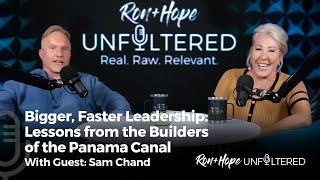
A recorded conversation (Ron & Hope Unfiltered) with Dr. Sam Chand about leadership, systems vs. structure, and organizational restructuring using the Panama Canal as a central metaphor. Dr. Sam Chand argues that an organization’s size and speed are controlled by its systems and structures, explains how to diagnose system vs. person problems, outlines four assessment questions (Where are we? Where do we want to go? What/who is in the way? How do we get there?), and recommends bringing trusted outside voices for large-scale resystematization. The episode closes with a free six‑month offer for Avail Journal and brief promotion of hosts’ books.
Chapters
Foreign.
Hello, everybody. It's Ron and Hope Unfiltered. And he's already getting on my nerves. He has been over here.
It's our anniversary week. I just want to touch you.
What are you doing?
I just want to touch you. It's anniversary.
Stop.
We had 34 years of marriage. We celebrated this Sunday. Yes, yes. And three years of dating. That we celebrated.
But why are you aggravating me?
And you know in the Bible that three years is the great tribulation period. So that's what I call people. That's what I tell people. Being engaged to a beautiful woman while in Bible school, trying to do the right thing, that was the great tribulation period. So I've already lived it. I've already lived it. I made it successfully through the great tribulation.
We did.
No, but we had a good week. We had a good week. We didn't. We didn't go but a couple of days. We started back work yesterday. But it was fun being away, wasn't it? It was not. Just. What?
I don't understand. You're going like this. Like you're scraping my arm.
I just want to touch you.
Oh. So what did we do on our anniversary?
Not a thing.
That's right.
You think that's indicative of our age? Most of the time we like. We want to go see this. We want to go see this.
No.
And we went to the beach. We went to the. We had a little. Kind of a little hideaway cabin. And when we say on the beach, it's literally you open up your sliding glass door and you're in sand. We were right on the beach.
Little Adirondack chairs. And we looked at the ocean.
We looked at the ocean. We sat around. We drank coffee. Sat around the fire pits. They set up fire pits around the ocean.
It was so relaxing.
And I think my blood pressure came down 10 points. And out of 48 hours, you slept 41 of them.
That is not true.
And so I know it was a really good trip for you because you got to do your number one thing, which was sleep.
I need it.
So anyway, I need it. We have somebody. Actually, I don't even want to call him a guest. Dr. Chan is my friend. You have guys, and for a woman, you have ladies that show up when you're on the highest of mountains. And he has seen us at some of our greatest breakthroughs. And then you have a much smaller group that shows up when you're in the lowest of lows who still loves you when you're loved. And who still loves you and who still believes in you and behind the scenes are still pulling for you and supporting you. This man has been there when we built our biggest buildings and dedicated our biggest dedications and is also there when it would look like, you know, were we going to make it another day. And so I want to give him the introduction that's due because he is a profound church builder. Not that he built the churches, but a lot of the churches in America and around the world that have been built. He has been their consultant. He has been my consultant many times and he's written about his. He's trying to catch up, I think, with John Maxwell for all the leadership books that he's writing. But as far as structure coming in, diagnosing the season that you're in and the steps that you need to take to move to the next one, I don't know that there's anybody better.
We're going to talk about that, too.
Church leader, author, very accomplished man. He was a college president for a while, done so many things, traveled the world, but today is our friend. And I want to bring up Dr. Sam Chan because we're going to talk about some leadership things. Dr. Chan, love you so much. I'm sorry I didn't read all your list of accomplishments as far as an introduction, but I'd just rather call you my friend than anything else. So I hope that's all right.
I'm totally honored by that. I'm kind of blushing right now, the things you're saying. But I have, I have an advantage when I blush. You can't really see.
You got that good godly suntan.
Yeah. He gave you, got the kind you don't have to work for like we do. So.
Well, you got to be baked in the right oven. That's right.
That's right. That's right.
Well, that's a delight and honor to be with you, Pastor Hope, Pastor Ron. You all are just. You are just genuine friends of mine. And I just cherish our relationship. Long, long, long time relationship, but cherish our relationship.
You know, how long have this. Off the, off the rails? A little bit. How long have we known each other? Thinking about that early 2000s, like3.04, I.
Think it was Bishop Tony Miller. So it had to be us. And then of course, I knew. I think I knew your dad before I knew you.
Yeah. I met. I met Bishop Tony Miller in 99.
Yeah.
And I think it was shortly thereafter he got us together. So sometime around 2000. So. Wow.
I know.
2025. Years. I didn't think about that. But you just said that. That's a long time. Let me tell you something.
We were all much younger.
We were.
Yeah, we were. And.
But now we're wiser.
Hopefully we're wiser now. We're a little more battle ridden, battle ready. And we're a little wiser now. But I want to give you to talk about some of the things, you know, Hope has just done her last book with you and with your company, and she was bringing me along and up to speed about how we want to talk to you a little bit about your book today. And first of all, I just wanted to ask you, I guess every book I've written two. I think every book you have an initial purpose, an initial agenda. Agenda you are trying to accomplish with the book. Your latest one. What. What was the origin of that inside of you?
Well, the. The book that Pastor Hope wanted me to talk about is called Bigger, Faster Leadership, and it is not my latest. I think this is like, like six books back I'm working on. My. My 30th book will come out two months from now. 30th, number 30 is gonna be.
I hadn't read that one. I gotta be honest. I'm not gonna be hypocrite because I'm still trying to finish all your ladder books. Hundred books on ladders. Okay.
The last ladder book I wrote was what, 2004. So. Yeah, yeah. You're 20 years behind right now. He is behind. So the. Pastor Hope wanted me to talk about systems and structures.
Yes.
And so let me kind of jump into that. The. The. So every book I write has a. Is built on a sentence. It's built on a sentence. And I'll give the sentence in a minute. A few years ago, friends of mine invited me to join them for a conference in Panama, the country of Panama. And of course, you know, you go to Panama, the thing is famous for the Panama Canal. So as soon as I landed, it's not a long flight from Atlanta, where I live. So I landed, I said to my host, hey, can you. Can you take me to the Panama Canal? So I went over there. It's just breathtaking if you. I mean, it's just hard to describe. But big ships are going, coming and going through it. And what realized was that they were expanding the canal. There was building things going on. So I asked them, what's going on? They said, we are widening the canal. Widening the canal. Wow. Why are you going to widen the canal? They said, well, when we built the canal, in 1914, we built it for the biggest ships at that time. But now cities float. They go through here. And for us to. This is our industry. This is how we make most of our money. So for bigger ships to go through, we have to widen the canal. And a thought occurred to me, and here's a sentence. Your size and your speed will be controlled by your systems and structures.
Oh, that's so good.
Speed will be controlled by a system structure. Because organizations never grow to the degree of their goals.
Right.
Organizations grow to the degree of their system. So if I could be a nerd for just another 45 seconds.
Absolutely, yeah.
So what's the difference in a system and a structure? So if you can look at any. Any. Any organization. Church Business Marketplace. Because I know that your podcast and your webinar and so on is not just for church people. It's for business people as well as for ministry and marketplace. So if you were to think of an organizational chart, there's you at the top, and then there are other boxes under that. A chart like that. An organizational chart like that is known as a system. There are no names in it. It is functions.
Functions.
When you put names in it, that becomes a structure.
Okay?
So when people say, we are reorganizing, in most cases, they are moving Sally from this box to this box because they don't like her there. She's not working out. And they move Joe from this box to this box. Or sometimes it's totally out of a box. But all we do is we talk about people. Most organizations never talk about systems. So at the Panama Canal, I noticed they were not talking about people. So. And so is not doing this. And why aren't they doing that? They were talking about their systems. How do we broaden and widen our system? Give you just one more example. Let us say you're on a train. A train. Let's say your train is built to go 200 miles an hour, but the tracks it's running on can only handle 100 miles an hour. The train can run 200 miles an hour. It's been engineered to do that. It's totally safe. But the tracks can only handle 100 miles an hour. Well, how fast is the train gonna go? 100 miles an hour, even though it can go 200.
Right.
It'll go only to the system. So systems are. Systems are those things that. Let me say it another way. The major companies of this world do not produce anything. They run on systems. Let me give you a few examples. Amazon. What does Amazon produce is just A system. Uber. How many cars does Uber own? None. But system Facebook produces no content. It's a system. Airbnb owns the houses. It's a system. Netflix is a system. So the bigger companies of our world are systems. And then you think in the Bible, for example, God created human beings on the seventh day, but sixth day. But what did he do the first five days? He, he created systems. He created sun, moon, light, dark, river, salt water, fresh water. He created food in greenery and food in red meat. He, he, he created the systems that would then sustain life. Jesus had Systems. Luke, chapter 10, verse 1. He just before he talks to the 70 where to go, he creates a system for them to be able to do things. You look at First Corinthians, chapter 12, 13, 14, they're all about systems. So, you know, you remember the rebuke of Jethro, the father in law of Moses to Moses your systems, you're doing a good thing, right? But your systems are messed up, right? So most organizations, ministry, marketplace, church, corporate, they are dependent on systems. And most of us pay attention to structure. That's the people in the boxes. But we don't pay as much attention to the system. Do we really need this box anymore? Do we add another box anymore? Do we need to move, have this box to the top of the organization or should it be shifted down here once you start talking about boxes? Since I work with organizations that talk about we're going to reorganize, we're going to reorganize, you know what the talking about is moving people around. Yeah, but they're not talking about how to totally change the system of how you do things.
So how do you realize you have a system problem versus a person problem?
Let me ask that a certain way I was going, I was going there too. It's amazing how long we've been married and we thinking the same thing sitting here. I In the early 90s, you know how when you're starting your church, we started in 91, you know, you just take whatever God brings you. But you have a couple of prize members. One of my prize members, you know, we'd have 60 or 70 people, was a retired military gentleman who was fairly high ranking. He wasn't a colonel or general, but he had been very successful and had spent an entire life in the military and started out as a helicopter pilot. I'm sure he's very, very older or going on to be with the Lord now, because he was about 70 in the early 90s. And he told me something one time in the early stages because I had never been in a church in my life bigger than 200 ever. And, and we were a church of approaching 100 people. And he said, Ron, he said, in the military, this is how we're trained. I don't know if he's telling me the truth and somebody in the military may rebut this, but this is what he said. He said every problem is either a system problem or a person problem. He said 100%. He said we are taught in high ranking military officials, whenever there is a problem, you go in and examine your system. He says, and if you come to the conclusion your system is not flawed, then the flaw is the person you have running the system. And he said that was the way he was trained to view every kink in the military when he would come up on it as a commander, would you say that's pretty close to the truth? Whenever you run up on something, it's a person or it's a system?
Absolutely. So the system is the what, the person is the who. And you deal with the what and who totally differently. When it's a who, you know, you can have a bad attitude towards them. You can fire them mentally a hundred times during the day, you know, but not really. But you know, you know what I'm talking about, the self talk that we do. So if you start with the who, that's a small conversation. You start with the what, that's the objective. The objective is the what. The people who drive. The objective is the who. So most people start finding fault with people. I'm not saying that's wrong, but the fourth place to find is are they part of the system? Is the system designed in a way that will help them succeed? It's all right. Now what we are recording right here is you have a system, it's a bicoastal system, but just, you know, some of your engineers are with you in California, some of them are in the west coast, east coast. But if the system was not working, then we couldn't do what we're doing right now.
Right, Right.
And the people have to. So you could have your engineers, you could have the best engineers, but if their systems are not what they need to be, they'll never be able to do what they can do.
That's true.
So a lot of times people are handicapped because they don't have the right systems. And so one of the challenges I'd like to give to my clients is so you've been. Let me, let me just ask you all this question. And you don't have to answer. It's a rhetorical question. We're on the air, so. Don't want to. You don't want to come. I know.
Be careful, be careful, be careful.
I know you have unfiltered behind you, but there's a limit to the filter.
Right?
Right.
Yeah, yeah. So you have been pastoring since the 1990s. Here we are 35, 36 years later, and if you had a whiteboard behind you and you could wipe out everything that your church is doing and you could reorganize your church with almost 40 years of experience, 40 years of heartache, 40 years of joys, 40 years of celebration, 40 years of just living life experience, what you learned about people. If you could reorganize your church totally, what would that look like? Don't answer that question. But what will that look like? That's what I'm talking about. Because you'll have to start with a system. Give you another example. If I was to give you a billion dollars and said to you, I need for you to start a baseball team, a baseball team, and I want it to be a world champion baseball team in three years time and you had a billion dollars, the first person you probably would hire would be either the head coach or the general manager. You wouldn't be hiring the fastest pitcher.
Right.
Or the best bet you'd be hired. You'd create a system. And all those later hires will fit into that system.
Let me ask you this, we just winging it now. This is what I like to do. This is about the only time we get to wing it is in the podcast. So I'm going to wing it. I noticed something about myself. I. Well, it wasn't quick after 99, it was quick. Our business is ministry. That's what we do. And I got a church up to a certain place and it exploded and it got to that place and it.
Yep.
And I mean to tell you, you know, about 10,000 in attendance and it was just a hard line lid. We expanded to the west coast and we came and took over a somewhat deteriorated situation. And I noticed I was able very quickly to get the west coast church up to about the same place. And so it dawned on me. I have a system that lets me get here quick, but I have a lid. And so right after Covid, we did something not many people do. Because I'm going to just tell you what you're talking about. You know, restructuring, a true restructuring and resistanization is scary because you basically take everything you've spent your life building and you tear it down. I'm not talking about a tweak. I'm not talking about an addition. I'm talking about tear it down and make it over. Because it was flawed in the way you built it from the inception. It had limitations to it. So we got the right people around us and we literally resist them. Restructured everything we do, our church, our media, our financial flow, everything we do, and replaced a lot of the people that have been put into that system, which you say is now a structure, and we feel like we haven't seen the fruit of it yet. But for the first time, we have a structure and a system that will let us go a lot further than the last one that we had. What would you say to somebody who is. And it's going to take a wholesale resistanization and restructuring, but they're looking at what they have and they're scared they might lose it, but would forfeit what they could have by making these changes.
I'm so thankful, though, Ron, that we have never been afraid to tear down.
We always tore it up.
Yeah, we're like, okay, if this isn't.
Working, it ain't working.
We don't mind shooting this down right now and getting a bulldozer in here.
Some people can't take tearing down what they built because they have a sentimental attachment to it. But Hope and I have probably on some level, done this about four or five times over 33 years. I told people, I said, I probably reinvented myself at least four times. But I've noticed when I say that you can see the fear in people's eyes because what they have is not bad, but it could be great.
It's got you to a certain point.
It could be great. And I recognize that in my life, I got two churches up to the same place quick, but after that, it didn't move.
Well, first of all, the harder part is what you're talking about cannot be done by people on the inside.
Yes.
You just. You just. You cannot do surgery on yourself.
That's so good.
You know, you're gonna start. You know, the knife is getting close to you. You're gonna just normally naturally pull away from it. So you need an outside voice and are trusted, somebody with good credibility to help you, that you trust to help you walk through the changes. So you cannot do the change. The can change you're talking about. The resystematization that you're talking about cannot be done from the inside. The other thing is, just like you are Limited in your thinking on the inside. So is your stack and what it becomes an echo chamber. It becomes an echo chamber. And doesn't matter how, how honest your staff is with you, they can only go this far.
It's true.
They can only go this far. And this is honoring respectful. So there's all reasons for that. So the first thing I would say to you is you need somebody from the outside to come and do an assessment, give you ideas, discuss options with you, and see your threshold for change. The higher. Okay, let me say it another way. If you're talking about church, the people in the church, in the pews, in the chairs, are more ready for change than people in the offices.
So true. That's so true.
I mean, you've had people walk up to you who hold no aspiration for any office, say, pastor, when are you going to do this? What's holding us back? Let's go do this. So the people in the. In the offices start seeing you as a chaplain, and people in the pew see you as a captain. So the people in the pews are saying, let's go make this happen. We can do this. But if people have to something to protect here. So the whole chaplaincy thing, you just take care of what it is and you end up not being a CEO, you end up being a pastor on the inside. And so it takes a different mindset where nothing is really, really sacred. I was on a call earlier today with the CEO of Home Depot, and the CEO was talking about he got hired. The older, the other CEO was fired. And he came in and the first thing he told the board was, we're not going to build any more stores. We're going to liquidate all the properties we bought, and we are going to put all our attention and money online to go digital now. He said we didn't see any results of it for the first time, two years, but after that it just caught up and one started feeding the other. The point I'm trying to make here is that you cannot do that from the inside. You've got to bring outside voices for perspective and then move from there. And I want to tell you, you are 100% right. It is extremely, extremely, extremely painful.
Yes, it is.
So when are you showing up? So when are you showing up at Redemption as an outside voice?
I tell you the most painful part is having to explain things to people that you don't fully understand yourself.
Yes, yes.
So you're making decisions and you're spending leadership equity like crazy. And the only reason people are Flowing with you is because of your past decisions. Your past decisions have been trusted. Your past decisions have been successful and fulfilling. So based you are leveraging all of your past equity into taking them place where you can't really tell them where you're taking them to and you can go, not guarantee where you're going to take them either. So the most frustrating part is how do I lead people into a direction with certainty when I'm uncertain myself?
How many times have I said that? You have, how many times have I said, I said, I'm chasing something. And I said, I said, I need you to trust me. I said, but I can't quite tell you what it looks like.
Yeah, that's the most frustrating thing.
It is.
I want to tell you as a consultant, you know, that's what I do as a consultant. Okay, give you another example. I would say 90% of my consulting work is not church growth anymore. 90% of my consulting work is leadership, succession and transition.
Wow.
So when I'm sitting down with a CEO of a company or director of a company or pastor of a large church, they have called me in. Now they have called me in. I didn't ask to come in. I didn't, I didn't call, hey, Pastor Ron, Pastor Hope, I think you need success and I need to come and help you. I can do that. Right. So I get invited to that space. So, so keep in mind they have invited me. But as I'm sitting in the room with them, I see pure terror in their eyes.
Yes.
Pure terror. The bodies are telling them that you don't need to be doing this anymore. Their spouse is telling them, hey, I'm done. Everything within them is saying, this is the right time, but that pure terror, because this is the system that we've always known. I'm comfortable here. And then everybody wants to know, what are you going to do? Everybody wants to say, okay, so you're not going to Pastor, what are you going to do? And that becomes. You can't really fully explain everything. You haven't been there yet.
Right.
Aspirations, you have plans, but you don't know. And so all that to say is very, very scary. Scary is a low level word. I don't know. What's the high level word? It's a terrorizing thought. And even more so when you are not only making a decision for yourself, but you're leading other people.
Yeah.
Into that place to be. And I think leaders need to embrace that, to say, there's nothing wrong with me. I am acting totally normal, totally Natural, totally neutral. I just don't. I know I need to do this. I just don't know if I need to do this.
Yeah. So, number one, you got to have an outside voice.
Well, I don't know if Dr. Chan will remember this. And, Babe, I can't even remember if you were a part of that meeting. The first time I saw us doing this, I'd say 2010, 2011, 2012. Is it just.
Yeah, we had a strong 10 years.
Yeah, it just stopped. And it was healthy. The bills are paid, the building's full. But I know what's been happening is no longer happening. I know it. And I brought you and Phil Cooke in and took you upstairs in my little loft. I don't know if you remember this. And I brought in a board, and I said, here's the things moving forward I would like to do. And you're talking about an outside voice, because an outside voice can be objective and have honest conversations. Nobody inside the institution is going to have an honest conversation. So you came in, and I always appreciated you for this. You came in, and I drew all this stuff up, and it was pretty elaborate. I said, here are the things I would like to do. And I said, I want you guys to tell me you all know a lot about how it's built, how it's structured, the people that I have here. Do you think we can do this? Phil Cooke said, I think you can do it. Sam Chan looked at me and said, I don't know. And then I said, what do you mean, Dr. Chan? You said, not with your present structure.
You did.
That was what you told me. And then you just started looking at it and said, you only got one here. You need three. And these two right here need to be. This needs to be moved. You need to strike. I mean, you immediately started saying, if you want to go there, these are the way the boxes are going to have to be moved and restructuring is going to have to take place. So what you're telling me, you know, you consult so many people over the years. I don't know if you remember, but for me, you did.
Yeah.
You were only one in the room. Said, I don't think you can do it. Under the present structure, I think you have the capacity, Ron Carpenter, but the way you've built it does not have the capacity.
It's. And I want to tell you it is the reason you have an outside person is they don't have a dog in the fight.
Right.
Okay. And I don't know your history with people, so I'M not even looking at who's in the box. I'm not looking at the structure at all. You know, I'm looking at the systems there. Right. So I do remember that room. I do remember going up the spiral. Right. Their way. You know, I don't know if I can climb it now, but there was a time I could have done that. Yeah, I can still do that. But I remember that meeting. And what I remember about that meeting is not what came out of the meeting. I just remember your face from that meeting. That's all I remember about that meeting. So when I said to you, I don't know, because your structure was very. I mean, you can prepare to the meeting.
Yeah.
And we were seeing it for the first time, so you had pretty much bought into what you were presenting. And when I said to you, I don't know, it was like, is this good? Is this bad? What does this mean? And it is that look I'm talking about. See, see, what was happening with you in 2010, 2012, is that you can sense it before you will see it.
It's so true.
That's true.
That is so true.
That is true. Because everything looked fine.
Totally.
If you come into one of our services, you're like, wow, man. Redemption has got it going on. But hope, and I see you don't feel the momentum. Hope. And I knew there was a great moment. We were hemorrhaging momentum.
Yes.
And we could find. Feel it on the inside. And you're right, Dr. Chen, it's so right. You have to go back and almost convince the people that something's wrong because they don't sense it. They're like, what are you talking about? The children's ministry full. We had 120 new visitors today. 80 people got saved. What's wrong? But inside, I knew that potential was being forfeited on some way. And here's what I would say to somebody, just to add to what you. If there's anybody listening, whether it be business or ministry, facing this, and they're identifying with this conversation, I think, with Ron and Hope Carpenter. And we're both built this way. And I'm grateful that God gave me a wife built the same way. The pain of staying the same was more terrifying than the pain of changing it. That was me. A terrifying thought to me was that I have plateaued and now I'm going to go down this slow, painful deterioration until they give me a watch and tell me to go off and find another guy. And that. That was terrifying to me. And so I was willing to tear the whole thing, just burn it down. Other than just sit there and be somebody else's sad story, I didn't want to be that. Does that make sense, Dr. Chan? Yeah.
And I want to. I want to pick up on something you just said there. When you are the CEO of a company, when you're the executive director of a corporation, when you are a senior pastor, something happens to your radar, your sensor that nobody else in your organization will ever have.
It's true.
You will send stuff that nobody else can. That if I could use the mantle, the gift, the anointing, the calling, whatever word you want to put on is to you as a senior leaders. That's why you sense it and nobody else does. They'll come to you and say, pastor wasn't. I mean, the Holy Ghost was there, man. It broke up. This happened. That happened. Did you see the altars? And even as you are preaching, you know something is missing.
Yeah.
Now you can't put your finger on what's missing or you'd fix it.
It's true.
Because you're on the inside. You know, never ask fish the taste of water because the fish cannot tell you the taste of water. Lives in the water.
Yeah.
Okay, I'm going to ask you another question. You both, both of you travel, both of you speak. When you are invited to a church to speak, do you not sit there on the front row saying, why do they do this? They should change that the whole time? The whole time?
Yes.
Why is that light bulb out? Why is that light bulb right now? Listen, that light bulb has been out for the last 23 years.
But they don't know it.
But they don't know it.
Yes.
You walk in there, you walk into the restroom, you walk into the lobby, you drive into the parking lot, you look at the platform, you look at the musicians, you look at how they're dressed, you look at. And the whole time you're sitting there, you're changing 10,000 things before you get up to speak.
It's true.
Now, question is, the pastor of the church, who's sitting next to you, very smart person, anointed person, obviously built this big church. Why can't they see it? Because you're a outside voice, Outside eyes. You see it right there, right now. So good they can see. That's why you need that outside voice. But back to sensing and seeing. If you are listening to this program right now and you're sensing something, it is not a moment for you to fix it. It's a moment for you to ask yourself a few important questions could like, for example, question number one is, where are we? Where are we as an organization? Where are we? Question number two becomes so what is in the way? Question number two is where do we want to go?
Where do we want to go?
So. So where are we? Takes assessments of where you are financially, material, wise people wise, all that. You assess where you're at. Number two is where do we want to go? And then number three is what is in the way? Or who's in the way? And number four is how do we get there? And the reason I'm giving you those four questions is everybody wants to get there without going to the first three questions. So where are we? Where you want to go. So someone says to you, hey, I'd like for my church to grow before you can have a plan. Because what they do is they'll have the staff meeting, the executive meeting, and they'll have these growth plans without doing question number two and three. So question number one. Let me repeat that for our listeners. Question number where are we? Question number two is where do you want to go? Question number three is what or who is in the way? Because unless you can eliminate here's the thing. You have to eliminate force before you can build.
Oh, that's good.
You got to move dirt before you can force cement.
So good.
Most people want to build on top of whatever there is, but they're not willing to eliminate.
Oh, that's so good.
So what or who is in the way? What would be the systems and structures? Who could be people, whoever, whatever is in the way. And then you come up with a plan now that you've done the hard work is how do we get there? Because how do we get there is not. That's tactics. How do we get there is who, when, how, how much with who? How will we know how much money, those kind of things? So the last question becomes the first question, unfortunately, and that is why we don't see organizations doing what they know they can do. They sense it.
Yeah.
But they get to the planning space too soon.
That's so good.
I think the first question is hard to ask and be honest. Where are we? I think that's not just a great. That 1, 2, 3, 4 you gave is not just great for organizations. That's great for a life for you. Personal inventory, you know, but that where are we?
That's honest conversation.
That's an honest conversation. And I've noticed that I can't speak for marketplace organizations because I'm not in the marketplace. I'm in the ministry world, but I can tell you, in the ministry world, honest conversations are difficult because we in the church world, Dr. Chan, we have a way to spiritualize a downturn, but God is filtering. We're being pruned, and no, we're not.
We're in the waiting season.
Yeah, we're in a waiting season. This is not our. And the fact is you're losing people and you're not healthy.
Yeah.
And. But we. I tell people a lot of times we get more spiritual when we should get more disciplined and get more. Get more honest about what is exactly going on. And I've done so many dumb things. I do have. I'm not a regretter, but I got things and times I wish I'd have done differently. But one of the things I think God has helped me with is that I was always able to sense when it wasn't going well, and that was not okay with me.
Yeah. And I think, though, one of the things, I mean, Goodness Gracious, after 30 something years of ministry, I think we finally got. Is when we've sensed that. When you sense that. That knowing on the inside, that sensor you were talking about, we have learned to move swiftly now, or at least quicker than we did before, because your mind does get in the way. You start rationalizing, you start talking about, oh, well, they've been with us 10 years.
Or you start thinking about the difficult. Yeah, you start thinking about the difficulties.
Yeah.
Yep. And you talk yourself out of it. And I think the older you get, maybe you're more inclined to talk yourself out of it and say, well, you know, I'm just going to ride out what I built. But I'm not okay with that. I haven't been okay at any season, and I pray that I'm not. Because ultimately it's the people who suffer with the lack of vision and lack of change. You know, Dr. Chan, we usually go about a half hour, but this has been so engaging. I really wish I'd had my laptop with me and I just could have written down some notes.
You can go back and at.
Look, listen, because it makes me want to bring you to my next network meeting and not have you speak. It makes me want to sit down and have this conversation in front of them. Yeah, I would love to have this conversation right here in front of a group of leaders, because sometimes conversation brings out my best stuff.
Well, let's do it. I'd love to do that. You know, the airplanes are still flying in the air.
I want you to Take. I want you to take a minute before we start winding it down. You got a lot of things going on and I know Hope is very, very proud to have worked with you on her last book that she did. And I just want you to tell everybody a little bit.
Resources.
If there's a way that Sam Chan could resource them. What are those ways? Just take a minute and tell us.
Yeah. I want to give a gift to all of your listeners for the next six months free of charge. You can look at the COVID That.
Is a beautiful, beautiful lady. Yeah. And I can say so myself because I know her.
Yeah. Yeah. So it's about 100 some pages glossy, beautiful five color high leadership content from ministry and marketplace for churches and corporations. You can get this for the next six months free of charge by simply going to the website avail availjournal.com that's it. Availjournal.com you can get it. You can get for your entire team. You can get for your entire church. You can get it for your entire company. The people just need to go to avail a b a I l journal.com and you can get this for next six months free of charge.
And the quality is so good.
Yeah, it is. It is. I'm told it's the best thing in the leadership marketplace right now. And we are just proud to have published your book, Pastor Hope. And it's. I love that book because it talked to people about what they might be sensing in their lives. It was just very, very honest, which few books are. Especially people who get to your level don't want to put it all out there like that. But you did. And I want to tell you that is healing. Your book is healing and you're living up to your name of hope. You brought hope into a lot of people's lives. So we are just delighted that you chose us to be your publisher and go forward with that. One of the things I do want to say to all of our listeners is the times that we are in right now are loaded with opportunities. But your new opportunities cannot fit into the old canal and for bigger ships to go through, you need to ask yourself, what am I willing to give up? What. What is the my greatest fear? And I can tell you how I handle my greatest fear. I asked myself a simple question. What's the worst that could happen? I actually asked myself and I started writing down. I'm a writer, so I'll just a pad and I'll start writing on it. The worst that can happen. And I can tell you nine times out of ten, the worst thing I write down I can live with. It's just free. Because as long as you're just thinking about there, the clouds are swirling in your head.
Yeah.
But if you put it on paper, nine times out of 10, I can tell you I can do whatever I want to do because the worst is not going to kill me.
So. Good.
Well, I will tell you this. And you know, here again, I could just go on and on with you about that. I love these kind of conversations. I came home one night after meeting with lawyers and things. Reconstructionists. We really brought in people. We really reconstructed our whole life. Everything we did, personal and ministry. We brought a lot of really good thinkers in to try to help us structure and systematize for success. And those things are in place now. Now we just have to execute what we put in place. But I remember, Dr. Chen, I came home one night and I told Hope. I said, I have had a revelation, an illumination, whatever you want to call it. I said, my success is not going to be what I say yes to. It's going to be what I say no to. Does that make sense?
Totally. That's the space I'm living in right now. So you're absolutely right. Till about mid-50s, you get ahead by saying yes, yes, I'll be there. Yes, I'll speak there. Yes, I'll do that. But after that it is no. I want to tell you the sweet spot. Sweet spot is after 65, when you move from yes to no to I don't care.
I can't wait for.
I look forward to those days. I'm not quite there yet, but I look forward to it.
That's live long and they are coming your way. What you say so so and so left my church. I don't care.
I think I'm there. I think I'm there.
So and so just resigned. I don't care.
I don't care.
Yeah. I will tell you, at almost 72, I care for very few things. Very few things, Very few. I just care for my family, make sure that we are good and the rest of it can come and go.
I love it.
I think that's a healthy place.
I love you all. I love you all. And I love the. The content you make. I provide to leaders every week and they're glad to be on the talk with you.
You're always such a blessing, not just to our life as a friend, but to so many people around the world. You really are.
You made a lot of investment.
You really have. And we are so grateful you took time to be with us today. Listeners. Listen, you got 45 minutes which a lot of industries about 10 grand today you got it for free. So we are so thankful that you tuned in that Dr. Chan is here. We speak blessing over you. Don't forget to go to avail journal.com and get your free six months, y'. All. You're going to be hooked. It's so, so great stuff. Content's amazing.
We got them laying on our coffee tables.
We sure do. And if you would like a free copy of my book that ail just published, if you don't fight, then you don't win. Becoming great. One battle at a time. Go to hopes inner circle.com and join the inner circle so that you can get an outside perspective on your life. We want to see you grow. We want to see you be everything that God's called you to be. We love you so much.
And if you want my book, you're going to have to go buy it because I'm not giving nothing away. So anyway, anyway, we love you. We love you guys. We'll talk to you later.
Real raw and relevant.
Bless you.
More from Hope



How Do I Balance Marriage and Kids? With guest Chaz Carpenter | Ron + Hope: Unfiltered