Mental Health Matters | Part 2 - Hope Carpenter (Feat. Dr. Alexis Nicole)
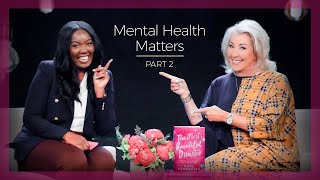
A live YouTube conversation (Part 2) between Hope Carpenter and Dr. Alexis Nicole about mental health, healing, and Christian faith. They emphasize that imperfection is universal, encourage vulnerability and honesty, and outline a four-step recovery approach (exploring past losses, connecting past to present, challenging internalized beliefs, learning new skills). Practical recommendations include therapy, setting boundaries (saying "no"), reading, and spiritual practices; the episode closes with prayer and invitations to get Hope's book.
Chapters
Hello. Thank you for being with us tonight. Listen, I'm so excited because I have Dr. Alexis White back with me here tonight. We had such overwhelming love and response to our Facebook Live, our Instagram Live together, talking about mental health and this book, the Most Beautiful Disaster. And so you know what? We're just going to keep going tonight. So tell everybody, call somebody, somebody. Press share, okay? Text your friends and say, you got to get on here tonight. This is going to be good. It's going to be for you. So it's going to be good. We're going to jump right in. She's a professional. I'm just over here gleaming off of her goodness. She is a clinical psychologist. She's done so much research and development. She's a psychotherapist. But she loves Jesus. She loves Jesus. So the. That makes her just doubly good. She's a double stuffed Oreo. She's an extra long Snickers. She is all the wonderful things. She is the big family pack of Doritos to me. She's the French fries with the seasoning on top. She's got all the goodness. So we're gonna jump in. We've been talking about the book, the Most Beautiful Disaster. And you know how it's gonna help people who really struggle. And I believe every one of us struggles. Absolutely. There's not a human alive, and I think that's a ploy, a trick and a plan of the devil to make us feel like we're the only ones who struggle. We look at everybody else and they look so perfect and their marriage looks so great. And, you know, on their Instagram reel, it looks just absolutely amazing with their children sitting around the table all coiffed and perfect and singing Kumbaya. And ours is just little hellions running around the house, right? And we. We want to beat them every second. And, you know, we want to pull our hair out and we're like, calgon, take me away. Way far away. But that is a lie.
It's a lie.
We all struggle. We all have issues in our life. And yours is different than mine, mine's different than yours. Your neighbor's is different than yours. And, you know, we just need to take that pressure off of us that we've got to be perfect, that we think we have to be perfect to even be saved or love Jesus or to be a good Christian. You know, we all struggle every single day. That's why we need Jesus. That's why he had to come. It's because he knew we were not perfect. So wholeness, healing, it's a pursuit, it's not a destination, right?
And we'll never get it completely right. So I always say, life is a journey.
Yes, it is.
We're going on a journey. And you said, take the weight off. I always say, listen, life is tough enough, right? We have obstacles to overcome. Like you said, parenthood, relationships. You may have lost your job or you're trying to get a new job. There's so many things that we. Death, right? Illness. There's so many things that happen in this life without adding the extra weight of having to be perfect, having to knock it out of the park. Right?
So it's okay to get mad sometimes at what?
All of our emotions are necessary. They are so critical. A lot of times people will say to me, well, Doc, you know those negative emotions and anger? And I said, no, those inform you of something. We need all of our emotions. They tell us things. They help us to navigate through life. And there are things that will upset you.
Yes, absolutely.
So saying, I'm fine, I'm fine. It's okay, it's okay.
That's what we call hitting the minimize button, right? Or to sweep it under the rug. Like, it really didn't bother me. I'm okay. I'm okay when you're really not okay.
And I really hope that people, especially through reading your book, and thank you so much for your vulnerability and your authenticity and how transparent you were in the book. It's really going to help to change lives.
That's my prayer.
Because that's what's important. That is the work, being vulnerable. And I call it beating shame. When I think of shame, we need to just beat shame because it really holds us back from having the life that God desires for us. It really, really does.
And that's what the devil does. He heaps shame and condemnation on us because we're not perfect. But we were never called to be perfect. So it's kind of crazy that we listen to him say that again.
I think that's important.
Heaps shame and condemnation on us because we're not perfect. But we were never called to be perfect.
And so we're believing something that we shouldn't even believe.
We take a lie to be the truth. That is called a stronghold. So it gets in there, and it's what we operate out of and it's what we live out of.
So good. So, so good. So we were talking about healing and wholeness. I think it's really, really important for people to know that if you have pain, you Deserve to heal.
That's so good.
You deserve to heal.
And healing takes time.
It does. It does. People want it to be quick and easy. Okay, I've had patients come in. Okay, Doc, one session. Fix me. What's happening? It's like, well, first of all, I don't fix you. Right. Only God can do that. He's the one that would allow the transformation. And another thing that a lot of therapists may not say, but I'm comfortable, was saying, you're the expert on your life.
Wow.
You're the expert on your life. So I want people to feel empowered and to know God and that through him, you can do all things.
Yes.
But you can't have Jesus and therapy.
Yes, you can do both. You need a guide sometimes. Sometimes you're just too overwhelmed to see clearly. Sometimes you've just been through so much pain and you're so tired that you need somebody to come and hold your hand and walk you through it and say, no. Maybe you're a. You're not thinking clearly right here. That's what your job is.
Absolutely.
It's an outsider looking in to help you get perspective on your own life.
Because we can't see ourselves.
It's like you can't smell your own stink sometime. Right? Right.
So you need someone else to look and say, hey, Pastor, hope you got a little lipstick on your teeth. Or, hey, your hair's out of place because you can't see those things. It's the same thing internally. It's not just about the external. Internally, there are things that go on that we hide, and we need someone to help us go on the journey of processing. I know something's wrong, but I don't quite have the words for it. I don't quite know what this feeling is in my body. My stomach hurts. I'm not sleeping. I don't want to eat. I'm overeating. You need someone to help you process that.
And a lot of times, it's not even what we're going through right now. It's what we went through years ago that has affected our body, it's affected our mind, it's affected our sleep, it's affected our perspective. Because what we bring into adulthood, from our childhood, from the way we were raised, from the way we were taught to look at life, from the way we were taught to look at people, affects every adult relationship that we go into, whether it's our job, the way we respond to our boss, our marriage, our friendships, all of it.
All of them. All of them. So typically When I'm working with patient patients, I say there's four steps of recovery. And I feel like you covered all of them in the book without even realizing you were covering them.
Well. Good.
Yay. So let's chat about them just for a bit. So, number one, exploring your past losses, which is what you were just talking about.
Yes.
Oftentimes people want to say childhood was great. Everything was perfect. I mean, we had food on the table. You know, my mom dropped me off at school.
It was perfect.
It was perfect. And if you sit with yourself and you dig a little deeper, you will see where there are things that I call emotional abandonment. Abandonment that happen. And so you didn't get the security or you didn't get the affirmation or validation that you needed. And that shows up, like you said.
Because then you go into adulthood and you demand, demand affirmation because you didn't get it as a child. So you go into relationships and you didn't praise me enough. Well, you didn't say, I looked pretty today and there. And your husband's like, what? What? You know, I think you're beautiful. Well, you didn't tell me. And it just snowballs. And it's all because you didn't get what you needed as a itty bitty.
That's right. Which is step two, connecting the past to the present.
Yes.
And a lot of times we don't. We don't want to do that because we don't want to look.
No, it's painful.
It's very, very painful.
Or your parents didn't beat you, so you think you had great parents, or you were raised in a very religious home where, you know, you honor and respect your parents. You don't say anything negative whatsoever. And we're not talking about this to bash anybody or to bring shame or reproach on your family, your mom, your dad. But you have to explore and you have to be honest.
Say that word again.
You have to be honest.
Honest.
And the Bible even says this. It says, speak the truth in love. You can say. You can say, yes, they were not there for me. But you're not bashing them. You're speaking the truth in love.
Yes. One of the things that's really important, I want to encourage people to. To really think about this as you're navigating your day to day. I hear this often, even when I'm talking to my husband. We'll think we can only have one emotion. Especially if you're raised in a household where you have to honor your parents. Right. And I love my parents. There's room for both. So they could miss the mark on something. And you could say, man, I really wish that I would have experienced this. And because of that, it impacted me this way. And I also love and honor my parents.
Yes. There's room for both because they weren't perfect either.
That's right.
And you can only give what you have. You know, you heard the. We've all heard the little statement, hurt people, hurt people. Well, imperfect people can't give you a perfect upbringing. Right. So they only give you what they have. And then the cycle continues. Unless we get healing.
Yes. And we start to step three, challenge those internalized beliefs. Right. Those thoughts that we have about, I'm not good enough. You know, I'm not worthy. I'll never be, you know, this person. I'll never look like her. I'll never be able to, you know, have that job.
Right.
You have to challenge those beliefs that have been there for so long.
Absolutely. And that takes time. This takes time. That's why I call it a healing journey. When I refer to the years that I have really dug deep and pursued wholeness and healing. It's a healing journey. And we talk, I talk about it in the book that. That healing is like, you know, peeling an onion. And even when you peel back one layer, if you take that one layer, you can even peel that layer into tiny little slivers. And it's the same way. It takes time. Say, well, Pastor Hope, I don't have all this time. I'm working three jobs and I'm trying to put food on the table, and I'm a single mom. How can I pursue healing? Where can they start?
So to start, it's what you said, being honest.
Right.
With yourself and having awareness. I am a huge advocate of just becoming aware. And when you tune in like you are now to, you know, Pastor Hope, when you seek out skills and you go online and you start to Google, when you get this book, I'm telling you, in this book, she touches a lot of things. That chapter on emotional needs, life changing. Okay? So make sure you get the book. Start to seek out resources. Right. And in your prayer time, you talked about before even reading and getting into the scriptures because we need God.
You have to.
You have to. So that's a place to start. You can start there.
Yes. Reading is life changing. You say, well, this is the most practical thing I've ever heard in my life. Absolutely. Come down out of the spiritual heavens and let's get our. Let's get our kitchen clean. Okay. Let's. Let's make up our bed and let's wash some things around here. Let's stop yelling and hollering and going to every revival, but leaving dumb as a rock. Okay. And falling out. But getting up mean, you know, nothing changes in our life. Reading is essential. I mean, you have to be. Every successful person I know is a reader.
They're definitely readers. Because you require so much information through reading here.
You can't change up here until you put something new in it. And it's not just, you know, the Bible is primary, but you have got to get into some books. You have got to get into the mind of people who are successful, who have been where you want to go and don't hate on them.
That's right. That's right. Which is step four of recovery process. You're learning some new skills.
Yes.
Because the one you've used up to this point, I usually tell patients, how's.
That worked out for you? Right.
It hasn't worked out. So let's try something new. Yeah, we really got to acquire some new skills. Some of the things that I emphasize, most of you said, well, I just need some quick tips, some quick things that I could do. A key part of interpersonal relationships. When we're talking about employees, friendships, or in your relationships, boundaries. That's one of my favorite words. Saying the little word.
No.
I like the word no. Yeah, it's good.
No, I just don't want to do that today. No, I don't think that's going to fit in my schedule. Yes. I love you and I'd love to have lunch with you, but I'm exhausted.
That's where you start learning how to set those boundaries. It's really, really important. We teach people how to treat us, and so boundaries allow us to do that. You draw the line in the sand and you say, here's my line.
Right.
No.
So what about family boundaries? Let's talk about family boundaries. Boy.
Family boundaries.
Do we want to go here, Dr. White? Do we want to go to family boundaries? Because, you know, sometimes we just feel guilty for, you know, drawing lines with our family members.
But I often say, say, you know, you're up and down on the plane all the time, right? What do they say on the plane? Please place your oxygen mask on before assisting others. Boundaries allow us to do that. We need those. So for my. My moms and my dads and my leaders, it doesn't matter what position you're in, when you feel that responsibility and that weight Of I have to do it. You know that messaging that tells us, well, to be a good mom, I have to. I got a soccer practice and I got to make the meal every night. And I got it. We've got to reprogram and set some boundaries. So taking care of yourself and saying, actually, tonight I can't make the meal. We're going to have to order takeout. Right. Actually, tonight I want to be in bed by 10 instead of 12. So.
So, hubby. Sorry.
Exactly. That is where you start. Boundaries. Yeah, I love boundaries. Yeah. It gets really difficult.
It's so empowering, too. It really is. To where you can say the truth, you can really say what you mean instead. Because it makes you feel so guilty almost inside when you're like, sure, I'll go. But then, you know, internally, it's not the same as what you are presenting out here. That's a word in your field called congruency. You're not congruent. You're not. What you're saying is not what you're really meaning. And so it makes you feel so hypocritical. And then the guilt and the shame, it's a cycle.
It's a vicious, vicious cycle. You're right. We do talk about, in psychology, the congruency. So it's me sitting here and saying, sure, Pastor Hope, I would love, when inside I'm dying a little bit, because it's not what I really want to do. And I think that God and I tell my patients this a lot, that God intends for and wants us to honor ourselves. He really wants us to honor ourselves and be true to who he created us to be.
That's right.
And you're not doing that when you're saying, yes, people pleasing, right?
Yes, sure. And there's a whole chapter in here on people pleasing, but we call it performing, performance, orientation. Because you feel like I have to do all these things to get love, to get approval, to get. Okay, she's the best employee we have. She's here before we open and she's here after we close. But something's always going to go missing, something's going to go lacking in your life when it's like that.
Absolutely. So I think that accepting our limitations as humans can bring that inner peace.
You're not perfect.
I mean, what, on any day that ends with y, probably not.
Okay, so how does that make you feel? Is it that. Don't you just want to run around your house with your hair on fire right now and do a happy dance that you don't have to be perfect. And Jesus does not demand perfection of you. We have been sold a bag of lies even in church. The church has got to do better at teaching our people that it's not perfection that we are seeking. It is a life called upward. It is becoming more like Jesus today than I was yesterday. It's just renewing our mind daily through the washing of the word. It is bearing more fruit every day. You know, fruit doesn't bear every season. So that is encouraging to me that I might be strong today on love, but lack patience. But tomorrow might be. I'm stronger in patience. So we're just supposed to be getting better. Say that out loud. Say, I'm not perfect. I'm just getting better. Say it again. I'm not perfect. I'm just getting better. Type that in the chat. Call somebody. They're missing it. Your friends are missing this. Tonight, somebody's going to get set free. It's so good. Yes.
Yes, yes, yes, yes. And what a relief it is to not have to meet that perfection. Right? We're allowed to be human.
Yes.
What a relief.
Yeah. I used to think when we first got married that I couldn't go to bed if I had dishes in the dishwasher in the sink and I couldn't leave the house if the beds weren't made and nobody could come over and eat on paper plates. They all. The dinner table had to be set because I had to be the hostess with the most.
Wow. So let me ask you this. Where did that.
Where do you think that came from? I don't know. Where do you think that came from, Dr. White? Probably the way I was raised.
Probably. So.
Yeah.
You talk a lot about it in the book, your childhood.
Yes.
And kind of how things had to be, what?
Perfect.
And so you took that into adulthood.
But when you come over to my house tonight to eat, you're gonna eat on paper plates. How's that?
And you're gonna like it. And what's gonna happen?
You're gonna love it. We're gonna laugh and have a great time.
Exactly. A lot of times we also catastrophize. We talk about that in psychology a lot. So we come up with these worst case scenarios. You see it a lot with anxiety.
Right.
We're trying to fix everything. Everything needs to be perfect. If it's not, then I'm a bad person. Something bad is going to happen and it's simply not true. These are lies. These are lies.
It is a lie. And that's what depression is. Depression is worried it's being depressed over the past. Anxiety is worried over the future. And we're supposed to live in the present.
Yeah.
He says, who, by worrying can add one hour to your life? Scripture says that who by worrying, can add one more minute, one more second, one more hour to your life. All you are guaranteed is the next breath you are breathing right now. I just believe that there are people listening right now, tonight who are really struggling with anxiety. Anxiety. It's an epidemic. It's an epidemic. And, you know, you don't have to live burdened down, burdened down with anxiety and worry about the future, what might happen, what will happen. You know, the Bible says this. He says, I will keep you in perfect peace. It's a promise. Say it out loud. He will keep me in perfect peace. But there is a condition whose mind is stayed on me. You cannot live in anxiety when you're thinking about Jesus and all he's done for you. Every price he's paid. He's already made a way. He's already made a provision for healing. He's already made a provision for prosperity. He said, it is my will that you prosper and that you be in help, comma, even as your soul prospers. Your soul is your mind, your will, your emotions. It is my will that you prosper and you be in health. But it will be to the same degree as your soulish man is healthy.
That's good, Pastor. Hope you some people are going to get free tonight. They are going to get free. You're talking about freedom.
Yes. True freedom.
Yes. And you do not. You said in the book, you do not have to ask whether you can be free. You already are.
You are.
I teared up when I read that.
Yes.
I teared up.
Yeah. It's done. The work, the finished work of the cross, the finished work of salvation. When he finished, he said, sat down. That's why he said, it is finished.
Not.
Not. His life was finished. Not. The death process was finished. The work of salvation was finished. Body, soul and spirit. He sat down. It's over. Now it's our job to pursue our wholeness, to pursue our freedom every single day. That's why mental health is so important. Just like going to get a physical exam, just like going to a dentist. We need mental help sometimes we need another perspective. We need somebody to talk to. We need somebody to help us not want to choke somebody by noon tomorrow. Right?
Absolutely. Because the brain is an organ.
Yes.
Just like the heart is an organ. Just like a lung is an organization. Right. That's the. The heart. I mean, the heart and the brain, they're the culprits that run everything in the body. So we need tune ups, we need to check in, just like you said. We'll go to the dentist. I really think we need mental health checkups yearly, too.
Insurance. Paid for by insurance. That's a whole nother conversation. Yes, it is.
So when we're talking about freedom, start taking the mask off. That's what you're allowed to do when you come into therapy. You're able to take the mask off, tell the truth.
But I'm sure you have people who come in there who you have to even pull teeth to get them to be honest.
Oh, absolutely. Because you're talking about your journey. You're talking about the skeletons, right? The things that you don't want to tell. The taboo. Anybody else?
Yeah.
The things that you say. Oh, no, I'll just take this to the grave. I never. I never did that. But if you want to get free, you have to be honest.
Yes.
You have to tell the truth. And so taking that mask off and being your true self allows you to do that.
It does.
Because most people walking around and, you.
Know, I wrote about that in the book, and when I say it, people still kind of look at me cockeyed. When I came to Ron in 2013 and just laid it all out on the table, just told him everything. He suspected, you know, some things, but I told him everything. And for the first time, I felt so free. Although it was ugly, although it was embarrassing, although it was not pretty. It was. It was sinful. But I finally felt free. Because the. The truth is what makes you free, right? Yes.
And it's ironic that we'll quote that and we'll say it, and yet we don't act it out. I know the truth shall set me.
Free, but I just keep this here. It's under the blood. I'm gonna keep it under the blood. Right.
But that authenticity, that ability to lean into the pain like you talked about, and. And to tell your truth is when you're really free. Okay. And you're being who God called you to be.
Yes. Yes.
So I love that freedom.
So people are out here listening tonight. Alexis, what is. Encourage them tonight, no matter what state they find themselves in tonight, encourage them.
So I oftentimes will tell my patients, this is one of my favorite questions, quotes. You come into this life, and we are characters in other people's stories with no audition.
Right.
You don't try out for your part, the mom you Got is the mom, you got the dad, you got is the dad, you got the kids, you got. They're the kids you got. There's no audition for this. And so you are human. You are not perfect. Right? Like I said, on any day that ends with yeah, but you can heal and you deserve to heal. God wants that for you. There's no one that you're looking at on social media. There's no one who's, you know, in the mall when you walk by. There's no one that you're seeing at church or even in your family who has it all together.
That's right.
And there's power in us sharing and us being honest and us not being shameful and. And it's beating that shame, as I call it, and just really leaning in into our truth. It's life changing. And God wants that for all of us. And you show us so beautifully in this book how to do that. I'm so grateful for this book. I pray that you get the book. It really will help you to lean in and start to understand how do I take this journey? How do I look at the shame and the hurt and the pain? Pastor Hope really offer some incredible advice and some practical ways to get to the core of things and at the brunt of it. Like you said, you had the opportunity to go to living waters.
Yes.
Right. And really do that work. So it's possible for you, too. It's possible for you. You did it. I've been on my own journey. I've done it. And you can do it, too. God desires that for you. He wants that for your life.
Yes, he does. So tonight, I want you, first of all to say to yourself, okay, I'm done pretending. I'm taking off the mask of perfection. I am going to stop people pleasing. And it's not that you're going to turn and be ugly to people. That's not the goal. The goal is wholeness. The goal is to live and enjoy this beautiful life that God wants you to live. After I've gone through what I've gone through, I had no idea how God was going to restore me, how he was going to do it, how long it would take, if he could even do it, if I would even be married again to my husband, if we would stay married, or if I would even hold a microphone, to be able to minister to people. But I promise you, I promise you, if you will lean in to truth, if you will lean into honesty, if you will lean into the journey of digging into your pain so that God can expose it so he can pour in the oil and the wine and bring healing to the most horrific, traumatized parts of you. You can have everything that God. God says you can have. You can be everything that you were created to be. Will it happen tomorrow? Probably not. But it will get better tomorrow, and it'll be better next week, and it'll be better next year. That's our goal, is just pressing in to be more like Jesus, less like me. And he's already paid the price for. For you. Lord, I pray right now for every person listening under the sound of my voice, Lord, that you would go to where they are. You don't. You're no respecter of time or space, Holy Spirit. You're omnipresent. You're everywhere. You're omniscient. You know everything. There's nothing that we think we can hide from you that you don't already know. So, God, I pray that. That you go and you wrap your arms around these people listening tonight, you be their comforter. You said you are our comforter, Holy Spirit. You're our comforter. You're our healer. And God, I pray tonight that you would meet them where they are, that you would let them know they've got strength for the journey, they've got grace for the day they're in. And that you love them 100% completely right now, where they are, whether they never do anything else good or admirable or spectacular. That, Lord, they are loved because of who they are, not because of what they do. And I thank you tonight, Jesus, that we're going to get testimony after testimony after testimony of the work that you began in them tonight. In the name of Jesus. If you're just joining in tonight, it's your first time. You're just catching this interview with Dr. Alexis White. Go back to YouTube and watch part one. This is part two. Just amazing knowledge. Revelation stirred in with the Holy Ghost, who can get all the work done. He can touch you right where you are. He can heal you right where you are. I love you, you so much. Get this book. Not for me. I want you to get it for you. Order one for your friend. Maybe you'll say, well, I'm not messed up. Well, you know, you got a couple of jacked up friends. You can order it for them, right? I love you. And until next time, God bless you. Send in your testimonies and let us know what God's doing in your life. I love you.
More from Hope



How Do I Balance Marriage and Kids? With guest Chaz Carpenter | Ron + Hope: Unfiltered