Ron + Hope: Unfiltered - Help with Relationships with Dr. Dharius Daniels
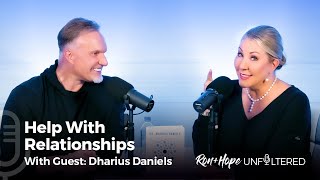
A YouTube episode of 'Ron + Hope: Unfiltered' featuring Ron and Hope Carpenter with guest Dr. Dharius Daniels. Daniels explains why he wrote Relational Intelligence, frames relationship-management as a meta-skill grounded in biblical examples (Jesus, John, David/Saul), and offers practical concepts (access, define, discern, align, activate), boundaries, and how growth/success strain relationships.
Chapters
Foreign.
Hello, everybody. This is Ron and Hope. Unfiltered, Real, raw. Relevance.
I'm from the country. I can't say those three words.
Okay, we just. You don't have to.
I do know that we're unfiltered. We are unfiltered and we're real and we're raw and we're relevant and that's right. Is this a new hairstyle or is this. I hadn't washed my hair today.
Hairstyle carpenter.
Is it new? I like it.
Who asked that of their spouse?
I like that hair, but it is.
It's new. It's new and it's dirty.
So you've gone back to your roots because you have a little bun in the back.
Oh, my holiness.
Yes, the holiness.
Oh, today might be holiness or hell. Yeah, what about that? That's going to be the top. Holiness or hell.
How many sermons did I hear called holiness or hell? And I ran down to the altar because I didn't want to go to hell.
But you never started living holy.
It didn't last long, but I'd stayed in there a little while and cried, and I'd get up and go right back to it. That ain't what we're talking about today.
No. Today we have an amazing friend. He's not just a guest. He's not just a pastor. He's not just a doctor. He is Dr. Darius Daniels.
He's been our friend for many, many.
Years, and I'm so grateful to know him. We love him. He's real. He's genuine. He's real. He's raw. He's relev. One of the. Honestly, one of the greatest communicators of our age. He really is. And I always say this, I always say, Ron's my favorite preacher. But under Ron is Darius Daniels. Because it is so rich in content, but it is so easy to swallow, and it's palatable and you can apply it to your life. So we are so thankful to have our friend Dr. Darius Daniels with us today.
How long? How long we've been friends? Was it. Didn't I meet you ed Young's in 2011?
It's been like nine years. I think it was 2013, something like that.
I remember February.
February of 13. So this year made nine years.
I remember first time I saw you, though, I was one of the lowly daytime speakers and you were the nighttime speaker. And I remember I had not filled the last slot for my conference, and I had a guy on my staff text me during the service and say, that's Your guy right there. And we've been friends ever since. Brilliant. Brilliant mind. I love to talk to Darius. Me and Darius have been in pools and been together on vacation time and this and that and other.
Not just you and Darius, Shamika. We were there, too.
Let's just go on.
And we need to. We need to define that in this day and time. Me and Darius didn't go swimming. We were swimming with our wives. Oh, Jesus. So anyway, we're not that good of friends. I like him, but we're not that good. So anyway, quit digging a hole and moving forward here. I've always loved dialogue with him. Politics, racial things, Kingdom. Oh, man. Just the kingdom conversations we had. They're always so rich. And I want to use our time wisely, but may I call you Darius? I respect the doctor, but you're Darius to me. So anyway, we're friends and family. You have written an amazing book. I've had some people call it a relational masterpiece called Relational Intelligence. And it is. I've told Hope. I'm going to let you. I'm going to jump start you and let you get started. I told Hope the greatest disappointment I have found in 32 years of ministry and it's consistent, is people's inability to. To resolve conflict.
That's true.
I say, I cannot believe how many things I get invited into and I have to referee and be a peacemaker to something that never should have made a demand on my attention. And it has been consistent, and it's been consistent for 32 years, even until this day. And I'm hoping that today. I know that's not all your book is about, but there's some aspects of your book that may speak to that. And I'd like for you to draw some attention before we get out of here today on what is it that that creates such a wedge from people being able to resolve even the simplest conflicts?
Well, you know, we're human. I mean, relationships are our whole life, right? That's. That's everything we do. Whether it's home, kids, friends, family.
Everything's a relation, relationship to your church.
Relationship, relationship. And then it's in imperfect people trying to do life together and get along with all of our background and baggage.
And personality profiles and everything.
So I'm sure you might have had a conflict a time or two, Dr. Daniel Steve. And get you to, you know, writing this amazing book. So why don't you share with us, you know, what even made you, you know, sparked your interest to even write the book?
Yeah. Well, first of all, I want to say I'm so glad to be a part of this. And you guys, you guys know, but I want the audience to know just respect and, and love and appreciation, admiration that I have for you guys.
Thank you, man.
You know, you know, most people don't know this, Ron, but I think I feel like I was at Redemption almost every year. You was since we met. At least it felt that way. And I stayed in a hotel one time after that. I was like these people, my family, do not put me in a hotel. I'm staying in their house. This is my first time inviting myself to somebody's house.
That's the. We like it though.
It's cuz you found out I could cook.
I say yes, put me in the house.
Give me 30 more seconds. I got to tell people. We, we the people. I. I want to give them a look behind the scenes. I remember the first time you ever spoke for me and you and you tore the place apart. But you know, Redemption has always been east coast or west. It didn't matter. It's always been a pretty intense atmosphere.
Yeah.
And I think you had had just come through some of the arc schooling and stuff. And I remember you got to the house before I did. I was finishing some things up. We had had tear down services. And I got back and you were looking out of a window out of the back of my house, and I came in the door, I said, dude, you all right? And you turned around and said, you are breaking every rule. He said, everything I was taught. You are breaking every single rule. I remember that.
Yeah, it was. It was amazing.
It was.
It was a. It was a unique place. You know, I was having a conversation with somebody yesterday, as a matter of fact, and I was like, you know, sometimes either God does it or we do it. We're just blinded to the uniqueness sometimes.
Of what.
Of what is happening in our midst and just what, like God's the. I'm not trying to over spiritualize this, but God's work through you and the ability you're gifting your wire, your makeup to build and to build barrier breaking entities is just so, so unique and, and it's happening on the east coast, west coast, and anyway, glad to be here on the podcast with you. So to answer. Hope, to answer your question, this is what motivated me to write the book. I was probably, I don't know, I don't know, maybe about a decade into pastoral ministry at least. And so I had two motivations. One was personal and then the other was professional as it relates to my experience with. With people in our church. I realized this, that personally and professionally, people's greatest joy in life and greatest pain came from the same place, relationships.
So good.
Greatest joy and greatest pain came from the same place, relationships. And I realized that the ability to manage relationships is one of those things that we would call a meta skill. So there are skills that. And then there's what's called a meta skill. A meta skill is. It's one of those skills. It's like a domino. If you got a bunch of dominoes lined up, if you knock that domino down, it knocks a lot of other dominoes down. And relationships are that way. It's one of those things where if you can get this part of your life right, it kind of helps you get other parts of your life right. Because you can't get life right if you get in relationships. Wrong. God himself is a relational God, and he wants relationship with his. With his creation. This is why he gives us free will so that we can choose him back. And I just. I saw that. And once I saw how much it was, the way in which it was impacting people's lives, I started doing research one to see what the Bible had to say about it. Because that's the most reliable source of information on the planet. You know, and I know people think we just throw the Bible around because we pastors and it's like, no, we don't do it. We don't. We're not just looking at the Bible because we believe it's right. We believe what's in there is better, it's more reliable, it's consistent, it makes sense. It's like in culture, you telling me to do one thing this, this year, then the next year, you tell me to do another thing. Ron, when I grew up, they told me milk does a body good. Now they're telling me to stay away from dairy. I'm confused. I don't know what else.
Right.
Ye.
And then it went from almond milk. Now you can't do almond milk. Now you got to do coconut milk.
I remember when they used to say, clean your plate. I remember we get in trouble for didn't clean our plate. Now they will train you not to clean your plate and eat small portions. I mean, so you're right. It always changes. But there's one constant.
Yeah, that's right. Yeah, that's right. And so I just went there and I wanted to do some research. I started studying the Bible. And this is something else that I saw, guys. I started researching books because what I saw is this, is that a lot of people's pain in relationships were not just romantic relationships. They would have all sorts of pain. Business, friends, church. It was all sorts of stuff that was grieving people. And one of the things that I realized was there was a lot of material that existed on marriage and parenting, but very little, at least with a Christian worldview on how to manage all these other relationships in your life. And, and so that is kind of what motivated and inspired me to do the research and to look at the life of the person who managed relationships the best in human history. And that was Jesus and see how can I pull some principles on how he managed relationships to help increase people's relational intelligence. So that was the motivation for the book.
That's awesome. Well, we are all busy, right? We all have relationships and things going on in our lives and we all want to make our lives flow better. That's the main thing. We want our lives to, in our relationships to flow better. So guess what? Good thing there's Chime now you can get your paychecks, what, up to two days early with direct deposit. Who don't want that?
How do they do that?
So you can get it up to two days early. This makes you feel safe, this makes you feel secure with your money and it makes me so happy I get to shop earlier. Just kidding. But it's an also, it's also an award winning mobile app, a checking account, debit card and an optional savings account. So what are you waiting for? What are you waiting for? Hopefully not your paycheck. So get started with Chime today by applying for a free account. It takes less than two minutes. Get started at chime.com roninhope that's chime.com ronInHope so all the banking services, the debit card, all of that is through Bancorp bank or Stride Bank. And listen, they have the choice. They have early access to the funds, depending on the payer. But get started today@chime.com Roninhope Darius, you're.
Talking about, you know, the meta skill. If one domino falls as a lot of other dominoes fall. I didn't say it that eloquently, but about three years ago I preached a series on first things and I just went through the Bible and everything God said, first, first and you won't. I say you won't. I was astonished at how many first things God said take care of that had to do with people like before you bring your gift to the altar first.
Yeah, yeah, yeah.
Go and be reconciled to your Brother, if you're a brother, have altar again. In other words, it was over and over and over that God said, before you do this vertical, I need you to go take care, horizontal. And so it almost evolved into a relational type teaching, because when I started that journey, I had no idea really how much the Bible approached that subject. So how much when you started doing your study, and I know here, again, I tell people you're a brilliant mind. How much of this was gained through experience versus how much of it was just what you learned out of word?
Yeah.
So I would say it started with experience. And my experience drove me to the word for solutions. And so I needed solutions for my own life personally, because, you know, this is one of the things what I'm doing is I'm framing something. This is not a complaint. I am grateful for what we do. I feel privileged to do it. I feel it is a gift of God that he's graciously given me. But I also want to. I don't want to sanitize this assignment either. And that is. So, for me, let's say, as a pastoral leader, I would not just spiritually lead people, but emotionally invest.
Yeah, yeah, right.
Into people who at times seem to be. I'll use this word, maybe a bit inconsiderate. I'll use that.
Right. Of that emotional way to say it.
Yeah, yeah. Of that emotional investment. And it was almost as if I was expected to care and to care when they were present and then not to care when. When. When they were absent. And I said, you know, I've got to find a way to manage what is going to be, to a degree, some chronic disappointment that I am going to have to live with in this role.
It's true.
The only other way for me not to be disappointed is to stop caring about people. And I. And I'm not going to come to this assignment and not bring my heart with me. So I knew, okay, I can't stop caring. But I need to be more judicious. I need to be more wise. Here's the word. I need to be more discerning about where to make certain kind of investments. And this is what. And so it drove me to the word for solutions. And there are certain. There are principles that I started pulling out of stories and statements in the Bible. And here's one of them, guys. Everybody is to be loved biblically treated. I mean, to be loved biblically or valued biblically. Watch this. But treated differently.
Ooh.
Well, and now that was. And this is what I mean by that. This is.
This is. This is what I mean. You can't leave me there. You got to keep talking.
Yeah, yeah, yeah, yeah.
So this. This is.
This is what I mean by that. So when I say treat it differently, we could say. We could argue. We could argue. Jesus loved everyone, let's say equally. When I say love, I'm not talking about fileto or whatever, because you shouldn't fileto everybody. You shouldn't Eros to everybody.
Right?
But I'm talking about agape. So he loved everybody equally. We would say off the street, Wall street, he loved everybody equally. So an example would be John 5. Everybody at that pool of Bethesda, he loved equally, but he did not treat them similarly.
Yeah, yeah.
He had to step over and walk around other people that were sick and get to the one that had been there 38 years and then ask him, do you want to be made whole? What is he doing? He's asking a clarifying question. It's a discernment, because. Some discernment. Some discernment. Is it spiritual? You get it natural, right? So he has a clarifying question. Do you want to be made whole? There are some criteria that needs to be met that determines what kind of investment I'm going to make here. And when I saw Jesus doing things like that, when I saw him having 12 apostles disciples, but then having three that historians call the inner circle, Peter, James, and John, he took them to the Mount of Transfiguration and did not give the nine an explanation as to why they didn't go. He took them to the Garden of Gethsemane and did not give the other nine an explanation as to why they couldn't go. And so he loved them all equally, but he treated them differently. And so once I saw that, it gave me permission to say, I owe everybody love, right? But I do not owe everybody access to certain places in my heart or a kind of investment that is reserved for those who meet the criteria that the scriptures lay out when it comes to making a certain kind of investment. And so it just kind of. It kind of revolutionized the way I approach relationships. And I'm gonna be honest with you guys. I feel like it has changed and in some sense, saved my emotional life.
That's so good. And, you know, in the book Darius, you actually break down all of these relationships. And I love how you say the access. Then you gotta define it, then you got to discern it, then you got to align, and then you gotta activate. Then you got to put them in these characters. Then you got to put them in these slots, and then you got to stick by it, right?
Yeah.
Boundaries, you know, boundaries.
Oh, you know what? I wish I talked to you before I wrote the book, because that definitely would have been a word I would have used more in the book. Boundaries.
Yeah.
I love that.
You know, I. I read. I read the book Henry. Henry Cloud, own Boundaries. And I've probably got about five books, Darius, that I will tell people changed my life. I've had a lot of books that I've gleaned from. I've had a lot of teachers I've gleaned from, but very few changed my life. I've got about five books. When people ask me, I say, I read that book, and I was never the same. And one of them was Boundaries by Henry Cloud. And here's what I learned. This is not his language. He's a clinician. But here's my language, everybody. And I'm saying in a different way what you did. Everybody can have my ministry, but everybody can't have me. Good. And when I went into ministry, I thought the whole world got the person.
You had to go to every cookout.
Every birthday party that will get you eaten alive, because I just went and gave myself away. And then I realized that everybody can have the gift. Everybody can have the anointing, Everybody can have the ministry, but not everybody can have Ron. And I don't know how you do it, but my circle's pretty small. Yeah, my circle stays small, and it stays deep. So if I'm your brother, now, I'm your brother. I don't love real wide, but I do love real deep. And I learned from that book that, really, it's hard to define relationship because I can put a fence between my front yard and yours. I can put a gate between my driveway and the road. But relational boundaries are invisible. And so getting people in the right category will save your life. Getting people in the wrong category will bankrupt you emotionally in a minute. I remember Dr. Miles Monroe always said, disappointment is the child of false expectations. So people put an expectation on a relationship that the relationship was never designed to meet, and then the end result is disappointment. For instance, I had a woman not too long ago say, you know what? When I got this job at such, it was a tech company out here. She said, I went there. I was believing, man, I was going to have friends, and I was going to have support. And I said, whoa. I said, your workplace was never designed for your emotional support. It wasn't designed for your healing. I said, you want me to Tell you what work is designed for. And she said what? I said, pay me.
Yeah, give me my money.
Pay me. I'm making an exchange right here. And if you expect anything else from it, you're going to leave disappointing and bad mouthing that company to everybody when that company hasn't done anything wrong. You simply had an expectation. It was not designed to meet.
Ron, you know, something you said previously is actually what framed the first two. I talk about four types of relationships. Something you said in a sermon years ago actually framed the first two categories of relationships that I identify in the book. This is what you talked about. You talked about. You talked about friendship, and you mentioned Jesus saying, no greater love than this that no man has to this day, we lay down his life for a friend. And the way you framed it was, everyone gets my gift, but my friends get my life.
Yeah.
And you didn't use these. You didn't use this next word, which is like. Which is where many people end up disappointed, not distinguishing between a friend and associate. And you kind of talked about. You gave. You gave an example of, like a co worker. And you say, you know, sometimes you could be working with someone and you can make the assumption that someone like a co worker is a friend, when really the relationship is just the result of intercepting schedules. And so those. Those two. Those two points, like, really opened up a whole realm and a different world of thinking for me, and it really helped me create the definition of relational intelligence, which is the ability to define and align relationships. And when I talk about, you know, alignment, it's not just like, okay, I'm putting people on a shelf. You're here, you're there. But it's aligning two things. One is aligning my expectations. It is. I'm looking at the fruit that I am seeing in your life and aligning my expectations accordingly. And the second thing is not just aligning my expectations, it's aligning my investment. How much of me do I put into this place? Is this safe for me? Is this good stewardship of my soul? Am I casting pearls before swine? And so I don't even know if I ever told you that, but those. Those thoughts that I got from a message that you taught years ago, man, it might have been like. It might have been you and Hope were dressed up like y' all were some professors or something.
Dressed up like what? Professors?
Some professors.
I found those CDs.
You know.
Stop it.
Hey, that's.
That's that. Hey, look it.
Look.
Hey, look, it looked kind of cool.
But that was back in the. The CD series.
Yeah, that was about 30 pounds ago.
Yeah. So anyway, that. I didn't remember saying that exactly, but I. I remember the. The context of what you're talking about. I did a whole summer on relationship.
It was good. Darius, you know, I believe. And I know you believe. We believe that we are here on assignment and we are here walking out our purpose, bottom line. And I don't believe there's any Christian alive or some. Most people don't. Don't want to just be here floating through life. We all want to be everything we were created to be. So here we are on our purpose. And I believe that our relationships are key for our purpose. I believe that there are. There's no neutral relationships there. There's nobody we can just hang out with and it does not affect us. I believe there are plus people and there are minus people. People who pour into us, people who push us to be everything we were called and destined to be. People who open doors for us, people who are the plus people in our life.
There's people who replenish you and there's people who diminish you.
Then there are other people who take away, who can pull us from our purpose. And you know, I love the scripture that bad company. We always say this to our children, but it's so true that the bad company corrupts good character. And that's a little bit hard to take, you know, our Christian brain and our faith brain to even understand that we want to think that we change them, you know, but it says that bad company corrupts good character. So I believe that our relationships are so important that's right. For determining our destiny. Talk about that. I know you got a whole part in your book. I've read your book. So about that. So go there with us.
I think it goes back to Ron's idea is what we would call the biblical circles, like the law first mentioned. But this whole idea of first.
First things.
And when you look at the first time we introduced two human relationships in the Bible, what you'll see is God's original intention for it. And, you know, the course and quality of life is not just determined by who we are. What we have is equally impacted by who we're with.
Right.
And what you'll see is the first time human relationships are introduced, it was not because God is introducing Eve because that's the first time you see Eve to Adam because Adam needed company. He's introducing Eve to Adam because Adam needed help.
Ooh, that's good.
So that's the first time that. So the first human relationship. What you see is a value add. Eve immediately adding value to Adam so that Adam and Eve collaboratively and collectively could carry out the calling that God had for the human species. And so that's the way I believe God intends for it to work. That like our relationships, they are purpose partners. I'm telling you right now, there are aspects about my purpose I could not fulfill without certain relationships. And I'm not just talking about relationships that help me do something. I'm talking about relationships that help me become someone, that helped me become someone safe relationships. Relationships where I can get advice and coaching and counseling people that I can hang with. My schedules. I got to do better with this. My schedule's been too crazy. So I've been doing a lot of that lately. But the point of the matter is you need people you can just relax with, like Jesus and go to the garden of Gethsemane with. And so it's man there. It's not just about company helping us carry out. It's not just about us having company. It's about helping us carry out our calling.
Yeah. It's purpose partners. Yes, purpose partners.
Let me ask you this question. This might be putting you on the spot a little bit, but you, you. I believe in you. You can handle it all right. In ministry, I know everybody watching, the vast majority or not, but that's my life. When. When you say I love you, I know there are different categories, even of love, but when you say I love you, basically when I say, when I tell Hope I love her, I had to say, number one, I love you. Let me back up. Most people say I love you and they mean this. I love you based on everything I've learned about you up until this point. Right, right, right, right. But if you go acting crazy tomorrow, this is to change, you know, so when you really love somebody, even as a friend, I have to be understand that I have to love not who they are, but who they will become.
Yeah, yeah.
I have to love their future. And then managing and navigating as the seasons of life change, I see so many good relationships break off. It was Jesus and John the Baptist. I'll throw this and let you comment. You know, John the Baptist was the one that opened the door. Behold the lamb that takes away the sin of the world. He was there in the river. He. I don't know how you get more revelation than this. He saw the heavens open. He saw the spirit come down and descend on him. I mean, this is a Front row seat and the heavens open and God speaking. This is my son. Well, later on, you know, John had all the crowds. Jesus was a nobody. Later on, Jesus has got the crowds and John's in prison. I'm in my preacher voice. I'm in my preacher voice. So John's in prison. John sends his disciples, say, go ask him, is he the one? Or do I look for another? And I'm like, dude, you're the one who prophesied who he was. You're the one that opened the door. You're the one that told everybody, behold, you saw the dove come out of the sky, and now you're wondering. And Jesus said this. Go tell John the lame walk, the blind see. And that's usually where all the Pentecostals start running and shouting right there, but comma, keep going, he said, and tell John, blessed is he who is not offended because of me. In other words, he said, John is wanting me to relate to him like I was in my previous season. He's wanting a personal visit, and he's offended because I ain't coming.
Uh oh, I'm not coming.
He didn't want to break the relationship, but John could not understand Jesus. Jesus's life had changed.
Yeah.
And he wanted. He wanted a previous season and couldn't manage where it was going. Speak to navigating through seasons, but holding a relationship together, that's tough.
You know, that is, you know, Ron, that is so, so insightful. And, you know, I want to, you know, say something in addition to that. And that is.
Everyone.
I'll put it this way. A lot of people may have some of the same expectations that John has had of Jesus, but obviously I feel like John kind of managed those expectations in a way that the average person probably wouldn't. And so here it is. And this is what I mean by that. It means that you, that anybody that's listening to this philosophically has to wrap their head around this idea that my. When I make decisions to grow, I must be willing to live with the reality that my growth is going to be misunderstood by something so good.
Yep, that's good. That's good.
It is really tough because when you love people, you want them to understand, so. But I've realized, and I know you guys can speak to this. Just think about your life and your demands. You know, there's a one time I was having a conversation with someone, there's like, hey, I just need 10 minutes. And I wasn't. And you know, I had a conversation with a lady just said, hey, you know, this is. I don't ever want you to be offended if I can't give you that right away. I just want you to know there are a lot of people asking me for 10 minutes.
Yeah.
But I had to realize and recognize that until somebody's sitting in that seat.
Yeah.
It's very difficult for them to understand now this. But it's a test of the kind of love that they have for you. The way they respond to you, making decisions that are in the best interest of you is an indication of whether or not they love you or whether or not they love what the relationship was doing for them. And it's tough when those things are exposed. It can be difficult. But I really, really believe that this is the kind of love we. The kind of love that God loves us with and the kind of love we should love each other with is a love that. Whenever there's a gap between what I'm doing and what you understand, if you're loving me, well, you're going to fill that gap with trust and not suspicion. So even if you don't understand why I can't come see you, John, I need you to trust and love me enough to. Don't feel that gap was suspicious. Don't feel that gap with he think he this or that. Feel that gap with trust.
Yeah.
Because hopefully, hopefully the relationship we've had over time has shown you who I really am.
Now, Darius, would you recommend, in close relationships like that, if you. If somebody's listening, feels that God's transitioning them, God's moving them, you know, God's calling them to set some boundaries in their life for their own personal and emotional health, for. For whatever. If they've gotten a new job and, you know, their time is constricted, would you recommend that they sit down with their circle, with their closest friends and explain what they going on? Because, you know, I believe that, you know, in. In talking, you can cut off a lot of misnomers. You can cut off a lot of, you know, you know, misconstrued ideas or thoughts. If you would just sit down and explain God's doing this in my life or, you know, be very upfront with people. What would you say?
I'll say that's very wise. And, you know, this is. This. This is unfiltered.
Right.
This is the unfiltered podcast. So we want to be transparent. And I would say that has probably been one of my greatest relational mistakes, is not proactively sitting down and articulating to those that matter greatly. To me, there are things that are changing about me, and there are things that are changing about my life. So there might be things in terms of the way we previously managed this relationship that might change. I just want to let you know why it's changing so that you don't assume that my feelings for you or the priority that you are in my life. I just assumed naively that people would kind of get that, and that's just not. It's not realistic, and they don't. And so, yeah, I will say unequivocally, that's probably been one of my greatest relational mistakes. You know, if people. It's just. It was naive, but I think you're.
Spot on with that and especially with the people who you love, really do love. You know, there's a lot of people who, you know, the categories we're talking about. I'm friends with a lot of people, but there's some friends that I truly love, you know, that I would love to do life with them. I would love to do vacations with them. Those are the people that I'm talking about. And I think the people listening, you know, have had those times in their life where the lack of communication usually does cause problems and that we could have avoided. Right.
We got time for one more question with him. Let me ask you one more. Oh, yeah. I'm asking you because I want you to know. I want you to give me an answer. I want to know success. Can somebody get me another water? She backwashed in my water. She backwashed and I can't drink it.
I do not backwash. Golly.
So anyway, why does success strain a relationship? I've seen people that would hang with me through every trouble I've ever had. But you let God bless me. Everything gets weird. Everything changes. And me and Hope have lost more friends over the blessing of God probably, than anything else. Because when my life started changing and I was honest about it, they couldn't go. And I'm sitting there like, less time does not mean less love. When I had three kids instead of one kid, my time was divided, but my love never was divided. And simply mine and Hope's life began to grow. There was a greater demand. We had more responsibilities, and we had less of what we had when my church had 18 members and people that we cared about. But when God began to bless and multiply, it gets weird. And honestly, sadly, some people very important to us, it ended in deep offense. Deep just because I could no longer relate to them with this much responsibility as I could when I had nearly no responsibility.
Yeah. Wow.
And I don't think we even had the words even back then.
No, I had no clue.
We were struggling our own.
We just couldn't understand growing.
We felt like we were going down a hill, you know, in a snowball that was with our legs and arms out. So we didn't even understand or how to articulate, you know, all of that either. You know, a lot of things just come with time and learning.
It was painful. It was painful at the time because some of those people we cared about deeply. And when I look back on it and say, why are we no longer speaking? It started when our life started to rise. And I'm like, what is it about success that puts such a strain on relationships?
Well, you know. Yeah. You know, I feel like, Ron, what you're saying is so relevant and, you know, people might be listening and they need to know this. This same principle that Ron is talking about doesn't just apply to ministry. It applies to business. Let's say you're starting up. It's just a principle, period. You know, you could be startup right now, and it's three of y' all in an office banging it out and getting it done. And then all of a sudden it goes from 3 to 30, and then from 30 to 90. It's completely different dynamic. Now, to answer the question, I think there are a few reasons I'm going to give one that I think is extremely important but not talked about a lot as it relates to why success strains relationships. And it's this simple. I see it with David and Saul. Your success can become someone else's trigger. It's really Hope mentioned earlier, we deal with. We are imperfect people, and we're trying to have relationships with imperfect people. We're all imperfect. And that imperfection expands to every area of a person's existence, including their emotions. No one is emotionally perfect. Now, there are people that might be healthier or more emotionally intelligent, but no one's emotionally perfect. And very often, very often, we assume that people love us less if they're not responding to our success. Well, what I tell people is this, is that someone can love you greatly, but how they treat you is based on what's leading them. And sometimes love isn't leading them. Sometimes their hurt is leading them. Sometimes their triggers are leading them. And I think very often that is what's happening with some people, because that is exactly what happened with David and Saul. I mean, Saul, the Bible says. The Bible says Saul loved him greatly. He made him his owner, bearer until people started singing songs.
When they started singing songs about him, everything changed. Saul has slain his thousands, David has slain his tens of thousands and man, everything changed. That's when I love him. I love David greatly. And it goes to Spears being chunked at his head.
Yeah, I love you, but I don't want you better than me. I love you right where you are, right here.
I used to say something that is very elementary, but I believe it's true. People don't mind you rising to the level of success or influence that they have. It's when you start surpassing them that they have a hard time celebrating.
I think that shows your own insecurity. It shows your own truth.
But you know this is this, you know, if this can happen with someone's parents, then we know it can happen with their friends and it happens with parents. And I know we don't but you know it can happen where sometimes there's sibling rivalry.
Yeah.
You know, brothers and sisters and then sometimes I know circumstances where parents were just affected by their children's success. And so it happens in all kinds of relationships.
Well, listen here. It's time parents, we're talking about parents. But it's time parents to finally cross off one of the most important things on your to do list. What would it be?
Life insurance. And you know what? Life insurance don't sound exciting some people but it has to be done.
Yeah. Because I've seen so many families suffer because the parents did not make the necessary choices to have life insurance. That blows my mind. I don't know why people do not have it but Fabric has made getting a great term life insurance policy for your family quick, easy and surprisingly affordable. It's built by parents for parents and Fabric has an online hub. It help you will help you to create a will to to set up your kids college fund. It's just a one stop shop. So protect your family with term life insurance. Now in just 10 minutes. You can apply today at meetfabric.com RonHope not Ron and Hope. Meetfabric.com Ron Hope that's M E-E-T fabric.com Ron Hope issued by Ventus Life. It's not available in New York. Sorry New York. It's not available in Montana. Sorry Montana prices are subject to underwriting. But listen make that important decision today. Take care of your family.
We especially being in ministry see it all too often.
Yeah we do.
So we would encourage you to get that.
Pastor, pastor, pastor, pastor. Tell the people listening how they can follow you, how they can get this information and not just, I mean, this book is amazing. Everybody needs to get this book. But Pastor Darius has an amazing circle called the Lion's Den. He has a coaching ministry, a coaching, coaching. Tell them everything, how they can get a hold of you.
Yeah, well, the hub for everything is dariusdaniels.com and that is a place where people, whatever offerings we have that might add value to people, everything is really literally right there at that hub. And the book, Relational Intelligence, you can, you can literally get it anywhere books are sold. And hopefully if you haven't read it, it adds some value to you. I know. You know, I feel like so far it is the most important thing that I've. That I've ever written.
Yeah, it's absolutely amazing because, you know, that is where, like you said, the most value in our life and then also the most hurtful things and places and times in our life come from people. And, and this is, this is a guide. It's almost like the book that I wrote. It is, it is a guide for you. It's a step by step tool book that will help you appropriate your relationships in your life, put them in the right categories, understand what friends mean, understand what acquaintances mean and associates mean. And Pastor Darius, you've just done a phenomenal job. We love you so much. Everything you know comes out of your hand, everything that comes out of your mouth is gold. And we celebrate you. We love you so much. And we are over here in California or in South Carolina clapping for you, watching you succeed, watching you go to greater heights and, and deeper levels. And we are so honored to be your friend and comrade in ministry. We love you. Everybody listening. You know, we always take questions and we always have questions. A session where we do questions from our listeners and people say, where do we send those in? And most of the time people just send them to the church or they DM me. But we have set up a place where you can go and it's called unfiltered@ronandhope.com unfiltered@ron a d hope.com so send us your questions, some topics you'd like to see us covered. And until next time, it's running Hope.
Unfiltered, Real, raw and relevant.
More from Hope



How Do I Balance Marriage and Kids? With guest Chaz Carpenter | Ron + Hope: Unfiltered