Ron + Hope: Unfiltered - Self Publishing School with Guest: Chandler Bolt
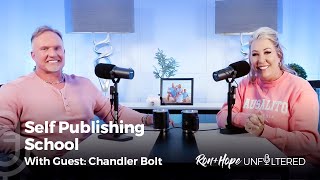
Chandler Bolt, founder of Self Publishing School, talks about how books build author platforms and why self-publishing keeps more royalties. His company has published roughly 7,000 books since 2015 and charges clients typically $10k for writing coaching, production, and distribution support.
Questions this video answers
February 2015.
About 7,000 books over the last seven and a half years.
Approximately $6,000–$12,000 (he said a typical successful publish costs about $10,000).
Publish 100,000 books by 2035.
selfpublishing.com/apply.
Chapters
Foreign.
Hello, everybody. It's Ron and Hope. Unfiltered, real, raw, relevant.
Say it again.
Ron and Hope. Unfiltered. Real, raw, relevant.
And we got the mugs to prove it.
Yes, we do.
Look, we have gone to the next level.
We have.
When you got mugs with your.
We are so official.
Oh, my goodness.
And they can be yours for the low price of your donation to the Ministry of Ten. $10,000.
Can they really?
The one that I actually do.
We have these available. We don't have these. It's just ours, isn't it? Well, maybe we're not. Might need to make this really exclusive.
Oh, that's why I said $10,000, Ryan. And it's tax deductible.
Very, very exclusive.
Tax deductible. If y' all need a tax write off, well, you don't. You won't get a mug. You can just sew into the ministry.
You know what? We've recuperated yet from the max out, honey. It's amazing.
We never recuper.
It's amazing.
I was the one almost who messed. Look, I can't even talk.
You get.
I'm not recuperated.
Okay. Hope just made up her word. You always do that to me.
I did.
She has a word she made up. That's the fact is. Yeah. It comes back around. The Bible says if you sow it, then what will happen? Yep. It'll come back.
Reap it.
But the fact is, we had just an amazing time. For those of you who don't know, you know, you only know us by our podcast. Hope and I do Pastor. Pastor on both coast. Feel so fortunate and blessed to be able to do that. Amazing, amazing people called redemption.
It is.
And. But we also have a ministerial fellowship, and over the years, we've just had a lot of dynamics added to our life. And one time a year, we get to bring all those pastors and leaders in, and we just finished that up last week on the east coast. We might throw it back to the west coast. Yeah, that's right. Two weeks ago. And the fact is the hours are long and it's a lot of work, but, man, how rewarding is it to change your life? And. And that's a little bit about what we're wanting to do here today.
Yeah.
Is we want to unlock something that'll change lives. Before I introduce. Or I'll let you introduce our guest, how has your book changed your life?
Wow. I mean, in. In many ways, spiritually, emotionally, because we overcome, you know, by the blood of the lamb. And the word of our testimony. And that's what my book was about, is getting it out. And it's a testimony. And how it's changed other people's lives. It's just crazy. But it has put me on platforms that I would have never been on.
Platform, never been on. Put you in rooms with people that you never would have got to talk to. And not only that, but as your husband, somebody who lives with you every day in the natural sense, we can talk about spiritual dynamics forever. In a natural sense. I have seen a focus come out of you since you had to really. It takes a tremendous amount of focus to really pour your heart and soul into a book and a book that moves other people and empowers people. And since that time when you launched that effort, I saw just a dialing in on your part that began to happen in so many other areas of your life. Your book did better than mine. The fact is, I've always said I can say it. Your book did a lot better than mine, actually.
But you know what? Let me stop you right there. Your book was launched in 2010, and our platform was way smaller back in.
2010, and we needed who we were getting ready to introduce back in 2010.
Yes, we did. I think we need to relaunch your book because your book is so, so powerful.
I've often thought about that. It is such a powerful book, me being an author. That name was not out there. So it was 2010. You only had Facebook two years. I was only one.
And it's called People May not Know Listening.
It's called Necessity of an Enemy. And I think at that time, I had 10,000 Facebook followers, and now I've got 1.6 million. So I've often thought about a relaunch because the book does have a powerful message. But the fact is, that book, even in its infancy, took me places that I'd never been. Yours has done the same thing. And Hope's going to introduce our guest, and I want to say one thing before he starts talking, okay? Because we have something that happens to us all the time, and I want to encourage those people with what they're getting ready to hear. Go ahead and tell them.
Our guest is this guy right here, Chandler Bolt. I get kind of sentimental when I have guests on our podcast.
Their whole family is very meaningful.
Yes, very meaningful. They were a part of redemption for many, many years. And another little country Bo around the corner, actually, you know, country boy living.
Country boy gone city, gone city.
I mean, gone galactic. And so it just makes Me so proud, almost like motherly proud to have guests on our. On our programs and to see them doing well. Yeah, to see them doing well. And Chandler owns and is the mastermind behind an organization, a business called Self Publishing School. And just done. I'll just. I won't tell all the dynamics of it because he can do it better than me. But he's just published his book called Published and Doing so well in airports, all over.
In.
In places. Yeah, bookstores. Just a genius at doing what he's doing. So we wanted to have him on today to help people figure out how to publish this.
And here's one. Here's one. Everywhere I go, and I mean it without fail. And it doesn't just have to be a conference or preaching. It can be literally checking out food at the line. And they recognize who I am. And people say, I have a book. I have a book. Let me tell you something before you dial out of this podcast and say, okay, that's for book writers. I'm not going to ever write a book, so I'm going to go do. Hang in here. Because everybody has a story, everybody has something to say, everybody has something to contribute, everybody has lessons learned. But there was a day where if you didn't have a certain type of name and didn't have a marketing machine behind you, you had no chance of ever getting a book published. The person that we're getting ready to bring to you has changed the game where everybody now can have a voice and can have a book printed and go through this school and he walks you hand in hand and how to make that happen.
And it's reasonable.
It's very reasonable. And not only that, but it's also someone whose character I can vouch for because he's always been very generous to the ministry and the things we've done. So the generosity of this man and his desire to make other people's life better is extremely encouraging. Chandler, man, we're so glad to have you.
And he's got a big old pretty smile. The best smile. He gets the greatest smile award.
Exactly. And you know what? You were up in the Bay Area with us for a while, but you done moved down to la. Are you still there?
No, he moved.
You're not there anymore.
I'm in Austin, Texas now.
Austin. Oh, okay.
It worked out so great. I mean, you know, obviously going to Redemption, Greenville, so long when I. When I, you know. Well, we growing up in Wahala, an hour away, and we drive an hour one way each way to go Redemption Greenville and then when I was living in San Francisco, you guys came to the barrier Bay area and it just worked out. It's kind of similar, about a little over an hour to be able to at least come every now and then. But yet, no, now I'm in Austin, Texas.
I guess we got to put a campus there. Let's do it.
It's a sign. It's a sign.
East, west and middle.
That's right.
You know what? I kind of want to get out of your way because I don't want to show how ignorant I am of your world, but I do love people that change the game.
Yeah.
I wanted my church to come into cities and change the game. And I think in your world you've done that. And I want you to just grab our audience with a little bit of what you do and how it can help them. Because I do believe there's a lot of people that may not have a well known name, but they got something to say. And so just talk to us about your business and how you got here.
Yeah, well, I mean, I love the question that you asked Hope a second ago, Ron, which was, how did your life change when you published your book? Because we believe that books change lives. They change the lives of authors and they change the lives of readers. Yes, right. And everyone listening to this right now most likely has had their life changed by a book. If not, you need to read more. Maybe just read the Bible.
Yeah, right. That'll help.
That's a book that's changed a lot of people's life, but it changed the lives of authors and of readers. And so I think it's ever since, I mean, one of the. I think it was the first time that you and I ever met in person. I remember you saying, Ron, is people come up to me all the time, ministry partners and say, hey, I want to write a book. How do I do this? And so people listening right now. I think it's one of the best ways that you can kind of formalize what you know into this thing that will then go on to impact thousands, tens of thousands, maybe even millions of people. Right. It's. It's let you create leveraged impact through a book. And, and I know, you know, maybe not everyone, but at least a pocket of people listening to this or, you know, pastors, ministers, et cetera. You've already written a book, right? Think about your best, most popular sermon series. Four week series, six.
That's good.
That's a book.
Yes, it is.
You've already written it. And for the People who are like, hey, I'm not a writer, I'm not a pastor. Well, you've got something that probably people come to you for advice on or that you're known for or that you're passionate about that you could write on. And so that's kind of my mission. And our mission is to help make that process easier so that you can go from that sermon series or those ideas to. To book published and then use that to, to make a bigger impact.
So if we got, let's say we got Sarah out there, and Sarah was once at one time extremely overweight, and she's gone through this journey of weight loss, and now she's turned into a fitness guru. And now, you know, she has this journey of how she went through this life change, and now she wants to turn around and help other people. And let's say she went online and she got a hold of your website. Tell me those steps.
Yeah, so first step that most people take is they book a call with one of the publishing strategists on my team, totally free. And that's where we kind of walk people through, hey, what are your goals for your book? What are your challenges with your book? What are your next steps? Like, how do we go from inspiration to implementation with this book? Because that's the thing. For most people, it stops right there. The I want to, like, I want to do it. And because they don't know how. Yeah, it's either. I don't know how, I don't think I have the time. And a mixture of those people don't get started. So that's what that call is all about. And then if people say, hey, I'm interested and I want to work with you guys at self publishing school and self publishing.com, then we, we, we just plug them into the process. So we've got curriculum that we walk people through. We've got bestselling authors who are coaches who work one on one with our authors throughout the process. We help them get the book written and get ready to publish. And then as of recently, one of the big things that we do is now kind of that final mile of the publishing process, which is a big pain. The COVID the getting it ready to publish, the ISBN, the formatting, like all these things to make it feel like a traditionally published book, even though it's self published. And you get to keep 100% of the royalties, which is a big benefit.
That's huge.
Yeah. And so that's our goal is traditional published quality with all the benefits of self published, which is keeping all the royalties, maintaining your ip, you maintain control of the process and you don't have a publisher telling you what you say and cannot say, do and cannot do or ways that you can promote it, that sort of thing. So that's like a big picture view of the process that we try to work with people on. Our goal is to help them actually get it done, to save them hundreds of hours in the process, to save them thousands of dollars in the process and then really at the end that they have a book that they're proud of, that they feel like is going to further the message that they have and impact more lives in the process.
Absolutely.
That's so good. I think also the I was just thinking when you said and you get to keep 100% of the profits, that's huge because Ron's written a book, I've written a book and it's been with publishing and we have made them tons and tons of money. We have made them so much money over the years and still, still have not gotten a royalty check.
Do this, Chandler, because when I tell you that people are ignorant of the process, I've always said ignorant don't mean stupid. Stupid is the inability to learn. Ignorant means I just don't know. And the fact is, even when I was writing my first book, I mean, I had to be extremely educated on this path and how it worked.
I sure do love our sponsor, skillshare.
Skillshare.
Why do we love them? They provide a platform to where you can basically learn a brand new skill or brush up on the skills that you already have.
Skillshare.
It's never too late to learn something new or to start building something that's truly yours. Skillshare covers about every topic imaginable with expert LED classes on life, web development, graphic design, photography, public speaking, and so much more. Listen, I'm personally going to take this class called Personal Productivity five exercises to make your big goal a reality with Kate Ahrens. Each skillshare class is broken into bite size modules packed with actionable insights. I'm a firm believer that you should learn something new every single day and this platform gives us that opportunity. Skillshare is affordable. Its classes are under 60 minutes. You can ask questions. You can be a part of a great community of learners. Turn your passion into payday today with Skillshare. Visit skillshare.comron and hope today to get your first month free. Visit skillshare.comron and hope today to get your first month free.
What is the difference between you and a traditional publishing company deal.
Yeah, great question. So traditional publishers, they're kind of like banks where they give, you know, the, the saying is like, banks give money to people who don't need it, right. Traditional publishers typically will give publishing deal to people who don't need publishing deals because they can sell books, right. And so I look at it, not to jumble a bunch of analogies, but I look at it almost kind of, you guys are in the Bay Area now, venture capitalists, right, where they place bets, and one of them is going to be wildly successful. They call that a unicorn in Silicon Valley. And then the others are going to do okay, and then a bunch of them are going to fail, right? And so that's really the model of publishing is they make all of their money off of the unicorns, right? You guys sold a bunch of books, you're funding all the losses of the books that didn't do so well. Now, the downside for authors is that either way, it's kind of a not great experience. And so either I published and it didn't go well and I don't get to keep any of the royalties, or I published and it went really well and all I got was maybe an advance, right? So kind of just on a bumper sticker, like the pro cons of traditional publishing, self publishing, traditional publishing, they're going to take most of the royalties. Most, if not all.
Let me, let me say amen to that.
Yes, hallelujah.
Let me say amen to that. Go ahead.
And then, you know, they might have access to expanded distribution, so bookstores and stuff, Right? One advantage. And then you might get a big advance. Now, if you can get a big advance, sometimes it's worth it. 99.9% of people, it makes more sense to self publish because long term you'll keep the royalties. You'll have to do a little bit more work. It's kind of a more entrepreneurial version of publishing a book. But that's where we've tried to make that process simpler, where you don't have to turn into a project manager and a book cover designer and informant, all that stuff. So that's kind of the big picture differences. We don't keep any of the royalties. We do the services that help make the book better and then help coach people through the process. But that's kind of the main differences between us and a traditional.
Yeah, because I will tell you my. I'm grateful for the experience, but my experience was not a great one. In fact, I was Somewhat disappointed because it does seem like once the book was there, it just kind of dropped off a cliff. It really did. There were some real gaps in my process that I thought would be somewhat more efficient. Having said that, I don't think your listeners maybe know keeping 100% of the royalties because when you do get, especially your first book deal, it's almost like selling your soul. You get the crumbs off the table. Even though you wrote the book and it's your stuff, you're paying them for all the machinery that they bring to your book. And I just want to know, does your company actually do the implementing of this into the bookstores and the Amazons or is that something where they're entrepreneurial spirit and your coaching has to take over?
Yeah, it's a little bit of both. So we help unlock international distribution digitally and online. We don't do the in store bookstores because I mean, the fact of the matter is, is that's still pretty much an, it's an antiquated industry with a lot of gatekeepers kind of like, you know, my brother on the music industry side of things with record labels and stuff like that. So. But we help unlock a lot of distribution. Now 70% of all books sold are sold through Amazon and online retailers.
That's so true.
That's where the majority of book sales are happening anyway. But we help with a lot of the more online distribution. But the difference on kind of like we were just I guess backtracking a little bit. Actually, I'll say this no matter what, and I think this is a big misconception, is that as the author, you are responsible for marketing the book. Now we teach that a lot and we've got a lot of things that work and all that. But whether you're traditionally published or self published, I think this expectation isn't often set well because a lot of people think, oh, publishing through a publisher, they're going to market the book. The publisher is not going to market the book.
No, they don't.
In fact, the first meeting, I mean, you probably have been through this, they're going to ask you what's your plan to market the book. And so, but either way, so I think that's important for authors to know is that you've got to get behind the book. And if you, if you feel like you've created something that is valuable that will help people, well, then you should.
Right.
And it's not just a flash of the pen one week, hey, I, you know, I put out a book now drop it like it's hot and go on to the next thing. It's okay. This is something that I truly want to keep putting momentum behind so that it gets in the hands of as many readers as possible.
Yeah, you do. You have to, you're going to have.
To jump in here because I got a lot of questions.
Go, go.
What I've always said that disappointment is the childhood of false expectations. What is a reasonable expectation for a totally and completely unknown publisher who has a book, walks through your coaching school, finishes the project and is they grinding and they're doing everything they can with what they have available, the tools at their disposal to market it? What is a reasonable expectation? Because I do sense there have been people that handed me their book and like if you can get this in so and so's hand, it'd make me rich. And the fact is Hope and I have spent our whole life building a pretty decent platform and neither one of our books made us rich. We're grateful for them. They did well. Hope's did really well. But just set an expectation so they won't be sorely disappointed. I think you're in the industry every day. You know what that expectation should be?
Yeah, that's a great question. Which Shout out Hope knocking on the door of 500 reviews on the book on Amazon.
I see you.
Come on now. So. So there's two ends of the spectrum. The average self published book sells less than 100 copies. That's not great. Okay, that's your mom, your grandma and your family. And then you know, a traditionally published book is typically deemed a success if it sells 10, 15,000 copies. Like that's kind of just a lower benchmark of okay, that's a kind of a break even at about that point on average with us, you know, we don't have a lot of hard numbers, but I'd say if you sell a couple thousand copies, like that's a, that's a solid first book with no audience. Now that's where the. This varies wildly. I mean we just got a. Somebody was just posting in our internal company. We had someone who sold over a thousand, over 10,000 copies of fiction books which are a lot harder to sell in the last year and a million page reads. Working with our fiction side of the business, right. And so it just, it varies wildly and we've had people sell tens of thousands of copies and we've had people sell a few hundred copies and not care because they don't care about selling copies of the book. They just want to get it in the hands of their family.
And I think that's where it really depends. I think it's a win for everybody's wins different. You know I just think some people just want to get it off of their heart and, and, and to feel accomplished. That man, I did this. You know look, I, I published this book. Other people's win might be I broke even. You know I joined your self publishing school. It cost X amount of dollars. I sold enough to break even. And somebody else's win might be, wow, somebody picked this up and it's, it's hugely successful financially. So I think everybody's win is different. But I think the general public really just want a way to say how can I publish my, to say I've published my, you know, my own book. I have this copy here.
What is the, what is the dynamic? Pardon me? What is the dynamic Chandler behind that unknown that just strikes gold where they just. I'm thinking about like the, the Harry Potter lady.
Yeah.
An unknown.
Or the Twilight.
Yeah, the Twilight unknowns. Woman fighting depression, had a horrible life and just started pinning down these stories.
Yeah.
And now she could buy an island. I mean you know, it's what, what are the, some of the dynamics?
How did you get in somebody's head? Yeah.
How did what goes from an unknown to explosion? What is that?
I think there's two components. There's the book and then there's the author. Right. And I'll start with the book side of things and go into what the author does. I talk about the four P's of a best selling book. Person, pain, promise, price. And from what I've seen is they just nail those. So person, who is the person that you're writing this book for? And very specific. So if you're listening to this right now and you've got this book idea, I want you to think about one person in your life, you know, who needs this book. And then write that book specifically to them. And when you write it specifically to them, there will be a bunch of other people just like them.
That's good.
Oh my gosh, that is so good.
That's good.
Right? And then the pain. What's the pain that they have that they know that they have? Right. And I think you did a great job Hope in your book. Which is, let's see, it's. This is the most beautiful disaster that makes out of our mistakes. And so immediately how God makes miracles out of our mistakes. I can connect that and personalize it. For me there's a mistake that I've made that I know that I've made that this book might be able to help me with. Right. So that's the pain that I have that I know that I have. And then what's the promise that I'm making with this book? And then the price point that makes sense. So the books that really do well, they nail that. Now, on the fiction side of things, like you mentioned a couple of fiction authors, the promise is entertainment.
Right.
And it's filling a gap. And you know, nonfiction is kind of a baseball analogy. It's way easier to hit doubles and singles and even triples. And then fiction, the authors that make the most money write fiction, but it's grand slam or 100 strikeouts.
Yeah.
You know, it's like, it's way harder to do decent in fiction, but it's what. But then if you do well, you do super well. So that's kind of genre differences, but I think really nailing the book side. And then there's just the, the author side, which is what I call the one year launch. It's committing to marketing that book long term. And that's where I think, you know, you've got a little bit of an unfair advantage with running a church. But I would lean into that with your next book is, you know, you can. I've just seen so many different pastors do such an awesome job, is you've got a sermon series that connects to the book. Maybe there's even. I feel like Mike Todd, I think when he releases Relationship Goals book did. Did a devotional and did a relationship kind of.
And.
And the book was interwoven in all that. And so it's like almost providing a curriculum alongside this sermon series, which, I mean, it just moves a ton of books.
Yeah.
So it's very beneficial from the book side of things. It's very beneficial from getting people in your church to implement. It's like Zig Ziglar always says, you know, if somebody comes to my. I can't change someone's life through a Talk, through a 45 talk. But if they up to my talk and they buy the books and the tapes and that sort of thing, then I can create a truly lasting impact. That's kind of how I see that piece.
What about just a practical. We were talking about Ron relaunching. Relaunching his book. How does that work? How do you do that? How does that even work?
Yeah, I love that idea. I taught and published, which is my new book. I've got a whole chapter about relaunches. I'm trying to flip through it real, real quick because there's a few different types of. There's a few different types of relaunches. So a lot of times, the first. The first edition of the book, you know, it might do great, it might do not so great, but either way, I think just about everyone should relaunch their book. And a relaunch is really just a specific promotion period around your book. It could. You could go as far as, like, this is the second edition of the first book. Right. And so I did a relaunch, but I launched a second edition, which you could. You could totally do. It could be updated and revised. You could do new cover, new title. You could even. I'm just looking here. You could even. Yeah, you've all. Some. Some people will launch an additional format and use that as an excuse to relaunch. Like, let's say if you didn't have an audio book or something, or a paperback or something like that. But. So there's a bunch of ways to do it. I think it's. I think I would definitely do it. The only thing that can be a little bit tricky sometimes is if you've published the first edition through a publisher.
Yeah. And we did.
And then maybe I forget the Hachette.
Yeah.
But I think Faith Words was maybe the imprint. And so sometimes that can be a little bit tricky, like doing it. You might have to just do a new book or negotiate a new deal with that person. So that's the only thing that could be just a little bit tricky.
Yeah.
And because, I mean, especially being a pastor, any pastors listening, any life coach, you know, the longer you live, the more you learn, the more, you know. Yeah, hopefully. And so I just feel like with Ron's, there would be so much new and fresh information, you know, like 2.0, the name of his book, 2.0, you know, more information, more chapters, whatever. But, yeah, that's a great. So you do recommend people who have already published a book sometime, another in their life, to relaunch. That's great.
Yeah.
All right.
And it's just a matter of do you relaunch or do you do the next book?
Got it.
I've always thought, Ron, you should write a book on the kingdom. I know that I've just preached on that so much, and I just remember that from being a kid. I'm like, oh, man. But I'm sure you've got a hundred of those core concepts like that where.
You can say, I've probably got 500 series I know. I'm not kidding.
Probably he needs to take a year off of preaching, probably, and sit down and write.
So, you know, I got to pick and choose which one of these are going to go in print and not. I don't feel like a great writer. I feel like I say it better than I write it. But the fact is, I do know that the best way to get something to be a legacy is to put it on paper and to get it in print. And I certainly want everything I've said to outlast me. So I am starting to think along those lines. How can I do that? Tell us one of your best success stories. I mean, somebody that you helped, and I'm not talking about they went on to be a number one New York Times bestseller, but somebody who you walked them through the process and you would kind of put their picture on the wall. Is this is what our company's about right here?
Yeah, I'd say there's probably two. There's. One is a really successful memoir. It's called Redefining Normal. It's just Justin and Alexis Black, and they grew up in the foster adopt system, and that's what their book is about, is Redefining Normal.
Wow.
And found each other, got married. And it's about kind of giving hope to people who are growing up in the foster adopt system and saying, hey, this is our story. Now, memoirs don't sell well unless you're Matthew McConaughey or.
Yeah.
And they have sold that book like crazy. It's gotten all these book awards. They're doing traveling, doing speaking and inspiring people. So that's one fun example. Another one is 8 year old Emma Sumner.
What?
So this is one of our youngest authors. Her dad worked with us and did a couple books. She saw that, she said, hey, Dad, I want to do that. And he said, okay, hey, go write 50 or 500 words and come back. It's just like a little roadblock. It's like, okay, this is probably a fleeting thing. She came back a few hours later and had those words written. And then they went, I think every weekend to Panera Bread and worked on the book. And then she wrote this kid's book, and it made 4,000 bucks in the first few months. She donated all of that to autism awareness.
Oh, my goodness, Autism speaks.
And then now she gets an allowance, which is really just royalty money from her books every month.
That is so cool.
And she's done speaking, like, speaking at her school and all, and just thinking about the trajectory of that young woman the confidence that's built, the life skills that have been built. I mean, I think she's maybe in 10th grade now. It's been, it's been years. Maybe ninth grade or something, man.
Yeah, there's no telling.
That's crazy.
It's crazy.
There's no telling what she want to write.
Is it a child's book? It is, yeah.
It's called the Fairies of Waterfall Island. It's a kid's book. And yeah, it's, she's done awesome with it.
She said, I'm gonna read that.
Dang, I'm gonna read that one. Yeah, I need to talk to a fairy about right now. Anyway, what other questions we got? Because I want to make sure that our hearers are getting everything they can.
I'm sure the people listening are saying, okay, well, how much is this gonna cost me?
I knew I was wanting to go there.
What's the range? What? What is the range of somebody who wants to publish a book? They need to know what the investment will be.
Yeah, great question. So we found it's, you know, to publish a book successfully typically takes somewhere in the range of about 10 grand. Yeah, it's kind of the range that we look at now, our pricing, anywhere between 6 grand to 12 grand, kind of in that range, depending on how much help people need, how much services they need, all that's what type of book they're writing, where they're at in the process. But that's the ballpark of what it costs to work with us. And then our goal is to save them thousands of dollars in the publishing process. It's all these things that you're gonna have to spend money on anyway.
Yes.
You know, cover designer, formatter, ISBN, all this stuff. And then, but then, so save them a bunch of money. Save them hundreds of hours worth of their time.
Yes.
Which is worth a lot of money. And then help them actually get the book done and then keep the royalties. Which, the upside piece. I mean, depending on how well you sell the book, that's where it can, the ROI can really go crazy in terms of working with us because we charge a one time fee up front.
That's amazing.
We're not, we're not sticking our hands in their pocket taking royalties or anything like that. We're not even, you know, we give them everything and we say, hey, here it is, this is yours. Go market this.
Yeah, that's huge. Chandler. After being with, you know, publishing a book, you've published a book. That's huge. That's huge.
I was just Sitting there saying, for those of you who don't know this process, he's talking about one time fee to get you where you need to be with this book. I want you to know me and Hope will be paying our publishing company forever. Forever. Talking about hands in the pocket and our agent. Yeah, they got your hands in your pocket and the agent's got the hands in the pocket. All these people. And like I said, by the time it gets through, you feel like you're catching crumbs from a table, even though it was the investment of your work in your life. Do you provide ghost writers to people who may have a great story but are not a great writer?
Yeah, great question. We don't. So what I recommend instead, because ghost writing, it can be extremely difficult. And you know, you can hire a good ghostwriter. There's, there's companies and people out there for 20, 30, 50, some charge 100,000 plus for good ghostwriters. I mean, it's very expensive to get a good one. Now, in my experience, a lot of times what ends up happening is, you know, when I read the rough draft of a book that I've written, I think this sucks. I'm like, who wrote this? Now imagine If I paid 30 grand and I read a draft and it's not in my. It's really hard to do it. Right. And so what I recommend instead is, and this kind of goes back to you were saying, hey, I've got 500 sermon series is. So if you've got that eight sermon series or if you've got, you know, we talk about this, I talk about this in this book is mind map, outline, rough draft, right? And mind map and outline. And then some people can speak that book one chapter at a time using the outline. But then like in your case, Ron, when you've got a, you know, let's call it a six week sermon series or four week sermon series, if that is the main theme of the book. Well, you can start from there, is you could say, all right, I want to write this book. And I'm going to start with a six week series. And that six week series, I'm going to preach it. And then now I'm going to use that and get that transcribed. And then I, I can do work as an editor to make it better. So I don't feel like I've got to go from scratch to just put, you know, just put words on the page in type form. But play to your strengths and then either write or speak, whichever one is your strength.
Got you Gotcha.
That's so good.
We've been on a little over half hour, so I want to wrap it up. I want to know, is there anything about your life, your publishing company, what you do that we've not asked you a question that's enabled you to say it yet. I want you to be able to tell our listene because I got a feeling we're hitting a broader community than maybe we even think. Because it's just amazing to me how many people really feel like they have something that's just rich, but they think they'll never have a vehicle in which to get it out. So I want you to be able to take the floor and give your last comments to them and just pump yourself and your business. Take this time to advertise yourself and let them know, hey, guys, we can help you.
Yeah, so we've published about 7,000 books over the last seven and a half years. And so it's two, three books a day. So we do this all day, every day. And we're on a. Our big goal is to publish 100,000 books by 2035. So we've made a lot of progress. We got a long way to go and we'd love to help you with your book if you're interested. So kind of like Ron mentioned earlier, that first step, if you're interested, go book a call with my team, totally free. We'll talk to you about your goals for your book, your challenges with your book, your next steps. Go to self publishing.com apply so self publishing.com apply and we'd love to help you with the book. There's never going to be a perfect time to do it. You're going to have to get started before you're ready. You're going to have to make the time. And so that's what I would kind of leave with. And Rhondon, hope, you guys have been such an inspiration to me over the years and just a lot of this would not. I feel like I'm a better speaker and a better CEO and leader because of the lessons that I learned inside Redemption over the years and then from afar since then. And so you guys have just been such a huge blessing to me. And yeah, I mean, when we publish books, that's why I'm always like, hey, we're donating back to Redemption.
Yes, you are.
And a bunch of other churches.
You've been very generous.
I mean, that's the impact that books. Books creates, right? That books create is. Is the impact on the life of readers. But then impact in the life of my employees, our customers, nonprofits, churches from, from the profits of the business. So yeah, that's so much good on your guys shoulders. So much good.
Well, I want, I want to tell our listeners if you are contemplating praying about it's on your heart to publish a book, I would not recommend any other place than with Chandler Bold in self publishing school because he is a Christian spirit filled believer and he also so I mean he's huge. He's one of our largest givers. Yeah, he's so generous and so you need to bless what he's doing because the blessing of God is clearly on it. How long have you been in business?
Yeah, we launched in February 2015, so about seven and a half years.
Wow.
Going on a so proud of you. We really are and we speak blessings over you this venture and I'm sure there'll be many more because you're an entrepreneur. This is, this won't be the only thing you do. I know that. So we just know that God's gonna bless your hands in everything that you endeavor to do.
We appreciate so much you've given us your time. Maybe the next time we'll talk to you, it'll be about a relaunch. All right. Amen. Appreciate your time. Thank you so much. And all you guys out there that's been watching the podcast, bless to you. We love you guys as well.
More from Hope



How Do I Balance Marriage and Kids? With guest Chaz Carpenter | Ron + Hope: Unfiltered