Ask Jack #1: Finding Your Purpose and Success in 2020 | Jack Canfield
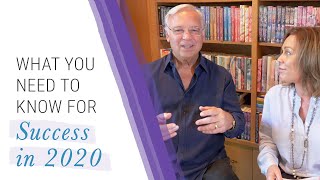
Jack Canfield and Patti Aubrey answer viewer questions about finding purpose and success in 2020. They discuss using the Passion Test to discover what makes you come alive, how introverts can thrive in training roles by becoming situational extroverts, and why goals fail when they're based on "shoulds" rather than genuine desire.
Chapters
Hi everybody, I'm Jack Canfield. I want to welcome to this. I'm sitting here with Patti Aubrey, who has been my business partner for 30 years. She's the president of the Campfield Training Group. She was the president of Chicken Soup for the Soul. She is the co author of how many Chicken Soup for the Soul books?
You always ask me this and I never can remember, I don't know, 12.
14, somewhere in that way, more than 10. And she's also an amazing coach. She's running all these mastermind groups now and developed something also called Permission Granted, which is a workshop for women which people are really loving. And everywhere I tell people about that, people are getting goosebumps. And so we're going to be sitting here today and we're going to take in some of your questions and revive something we used to do called Ask Jack Calls, but now they're called Ask Jack and Patty Calls. So we're going to both respond to these questions.
So this first question is going to be all around creating more success and fulfillment in your life and so getting really clear on your visions and your goals for the coming year. Because 2020 is coming up and 2020 is going to be. We're going to see it everywhere, 2020, the clear vision, you know, and all those kinds of things. So we want to help people create that 2020 vision.
We're ending a new decade.
We are. It's going to be interesting with all the wonderful things that are happening in the world.
Well, when you consider all the technology advances that are happening, all the wars that are going on, all the school shootings, the violence, the, the, what should we call it, the bipartisan divide we're finding not just in America, but in countries all over the world. The technology that' people out of jobs. There's like, you know, we all know that Amazon has closed down about half the retail stores in America. So things are definitely changing. So this is a very kind of pivotal point in history.
I think that's the important piece for people to know too, that things are always changing. It does seem like it's faster. So the more grounded we can help them be, the better life can become.
Well, I was talking to someone just earlier today about farmers. They were talking about how farmers have to respond to the changes. You plant your crops, but you don't know if it's going to rain. You know, if it's going to be a drought, if it's going to be too cold. And you know, when the crops ready, you gotta, you gotta harvest it. You can't wait and say, I think I'll wait a week. You know, so constantly everything's changing and we have to change along with it. And the only thing that never changes is change. It's always gonna be, I know. We learn how to navigate.
We would just get that. Right, right. Okay. So the first question comes from Tina, and she says, I'm still trying to figure out my true purpose. What's the best way to listen to the universe, life purpose for me? I've been asking, what's my purpose of my dream job? To best serve people for two years and still haven't found my true calling. What's your best advice, I would say.
For someone like you, Trina, rather than continuing to get stuck on this area of purpose, ask yourself, what makes me come alive? What makes me come alive? Where do I feel the most joy, the most excitement, the most passion? You can do something like the Passion Test. There's a book by Janet and Chris Atwood. We teach the Passion Test in our Breakthrough to Success and in our our Train the trainer programs. Also, there's a paper and pencil technique you can do in my book, the second chapter, be clear why you're here and the success principles. But I think most importantly, ask yourself not so much what does the world need? Or what's my purpose? Because you can get so hung up in the highfalutin kind of quality of all that. But to really say, what do I feel like I want to do? What's being wanted to be expressed through me? What difference do I want to make? Where do I come alive? Where do I wake up? What gives me the most joy? And lean into that and find a way to monetize that. There's always, you know, you can be what are. If you want to help people. There's coaching, there's teaching, there's training, there's doing all kinds of things. I mean, I know a bus driver in Connecticut who wanted to bring joy to the world. He has one of those little microphones you see on tour buses. He just picks people up, taking to work, and he tells jokes. He spends the night finding new jokes and humor on the Internet, on TV shows. He tells those jokes on the way to work. So he's found a way within a bus driver's job to bring more joy to the world. So the main thing is, ask yourself, what do I love to do? And then find out a way to monetize that. That's what I would say. What would you say?
I would say a lot of what you said. But I'd also say lots of times we get stuck in what we think. We're trying to make our purpose hard, and we're trying to complicate it. So the other piece of that puzzle that Jack just talked about is, what is effortless for you? What do you already do naturally?
Good point.
And so one of the things that Jack did really well when we first started out was he loved to aggregate content. He loved to bring things together. And who knew that Chicken Soup for the Soul, a book of aggregated stories, would become what it was you were living, your purpose and your passion. And I like to joke because I say to lots of people, you know everything, and I know everyone. And what I love to do was to connect people. And I struggled for years and years about what's my purpose. And that was really connecting the different pieces together, to bring people together, to have. Have them have this experience with us, not really knowing that and really struggling and suffering for a long time. And I see more women that just are suffering. So here's the thing. In chapter two of the success principles, ask your friends to fill out for you what they think your unique qualities are. Because sometimes we just don't see them.
True.
You know, so if you were to explain my qualities, they would be different than I would not the way I would explain yours are different. And they're even more different three decades later because I appreciate your qualities even more. So I would say that that would be how I would add to that.
I would say too. You know, I have three sons, and one's a drummer in a band. One is a hip hop singer and a dj, and the other is in music school right now. So they're all into music, but they're doing what they love to do. And when they do it really well, other people benefit. People love to go to my son's concerts that plays a drum. People love to be in. My son, who does the DJ work because he just puts together music from all over world. I mean, literally from Colombia, from Peru, from Europe, from South Africa. And they just love being educated about that as well as having a good time dancing. And then I have a stepson who loves to solve financial problems, and he's working for a private equity company right now. Went to the word miserable. Totally different from the other kids. And then my stepdaughter, she loves to write music, sing music, and do art and hang out with animals. And they are making a difference in the world. Maybe not at the level of a Tony Robbins or a Deepak Chopra or a Dalai Lama. But they're impacting the people that they're the impact by doing the thing they love to do.
Ready for number two?
I am.
Okay, this comes from Rosette. A lot has changed in the world in the past decade or century. How do we position ourselves for the coming decade, especially as people who are in the space of transformation and personal development?
Well, I think two things are true. I think everything seems to be moving to more and more online, more and more on demand. So, like when you look at our train the Trainer program online, people can watch that at 3 in the morning. They can watch it in Uganda, in Yemen, in Pakistan and South Africa on demand. And the idea is, I think we all have to be doing what we do online as well as live. I think there are certain things you can't hug someone online. There are certain kinds of things that happen in a room where all that energy is aligned. You know, John Eglin said, the power of an intention is the number of people holding the same. It's a square of the number of people holding the same intention at the same time. So if you get in a room of 400 people who are committed to opening their hearts, going through their dreams, there's something magical about that. So I do think we should continue to do live work. I think people are getting to a place in the human potential world where they've got the basics. I know I'm supposed to set goals. I know I'm supposed to, you know, believe in them. I'm supposed to use affirmation, visualization, all that. But where the rubber meets the road is the kind of thing you're doing. You're doing these, these mastermind groups with all these mostly women, not only women, and that you're kind of drilling down that, well, how do I apply it to this situation? How do I apply it to this unique niche, to this unique, you know, reality in the world right now? And I think a lot of work is going to be that, that unique application. Talk to it from your point of view, because you're working with all these people in those kind of groups.
So I would say, how do we position ourselves in this decade? I would say position yourself as who you are. And there's so much stuff out there. I just finished a workshop this weekend, and I had some young technology girls come in local university and they talked about the comparison game and how they were feeling so inept and not enough. And we're always looking around to see who's doing what, and it's just not scalable. You have to be you. And if you show up as your full self, whether you're online or live, and you're coming from a place that's vibrating from the right space, where you're coming from service, and that's really your purpose, and it's not your ego and being important, life works, it just does. So when you show up, others will show up too. And so you're gonna give them permission to be who they can become. And the only way to be our full selves and share that is the only way that we should be living at this point, because there is nothing else.
I just read a book for a friend of mine, hasn't come out yet, asked for a testimonial quote. It's called you are enough. And I think most of us are suffering from I'm not enough. I have to be more than I really am. And I think what people are asking for today, especially the younger generation, but everyone in general, is more authenticity, more vulnerability. Share your warts and your problems and your fears and your. All that stuff as well as all of your good stuff. Because online, you know, everyone's putting their best photo, they Photoshop it or they pick the best one, then you compare yourself with that and you're gonna lose.
Not with my filter.
Yeah, there you go. But we always say, as soon as you get Enter the comparison game, you can't win that game. There's always someone that's thinner, richer, you know, more beautiful, whatever it might be. And so just give yourself permission to be you. I've been being more authentically me in the last couple of weeks based on a seminar I just took, and everything's easier. I don't have to pretend I'm what I'm not. I don't have to kind of show up trying to be something more so they'll all think, oh, he's so this, so I can trust him. They trust you more when you're real. And that's what I hear over and over and over. I was just on a panel with Kevin Harrington from Shark Tank, and he was saying the exact same thing. What they're finding with all the products that they're doing is people want real, authentic people. And when you can be that for people and still be doing some extraordinary things, that's what's going to work.
Yeah, it's not. We say this all the time in our trainings. It's monkey see, monkey do. It's not do as I say, not as I do. So show up first, and then other people will too. So that is how you can be of service, by showing up first.
And I would say one last thing. People are as interested in who you're being as they are and what you know and what you do. So for me, I know that I've been getting a lot of feedback that my beingness, my love, my joy, my compassion, my unconditional acceptance of people is what creates a safe space that allows people to grow. And so whatever your true essence of being is, show up with that and, you know, give people permission to be themselves by you giving yourself permission to be yourself.
And I think that is the next decade. It's going to be focused more in essence, because we can't outdo technology. We're not going to beat the robot. And so just don't be the robot.
That's true. Most of what, the information, all that kind of stuff, they can't create that heart. The computers can do it better. It's the love and the caring and the compassion and the encouragement that people are really looking for.
Exactly. Okay, number three, this is an interesting name. Vard Hammam. I think you have more country knowledge than that.
Vardhamam.
Okay. My personality is an extreme introvert. So you can relate to this, which nobody on this will believe. And I dream of being a trainer. To me, it seems like it's two entirely opposite directions. How do I get these two in harmony with each other?
Okay, I am an introvert by nature. And a friend of mine, who Ivan Meisner, you know, who runs business bni. Bni. What does the N stand for?
Business Networking International Network International.
There you go. Anyway, he said he's a situational extrovert. And when he said that, I realized that's what I am. An introvert actually refuels by being alone, listening to music, meditating by being myself. And I do that. I come to my office and kind of chill out. An extrovert is someone who gets their fuel by being around a lot of people. And so someone like Mark Victor Hansen, our writing buddy with Chicken Super Soul, was an extrovert. I'm an introvert. And the reality, though is we can show up in an extroverted environment like a stage. I could still learn how to be dynamic, enthusiastic, use humor, raise my voice when I need to, and be calm when I need to and all that. So introverts can be what we call situational extroverts and go out there and teach. And there are a lot of introverts. Like Tony Robbins seems to be an extrovert to me. You know Brendan Burchard, they bounce around the stage. I don't do that. You know, Mother Teresa didn't do that. And so she didn't need to do that. You know, she just needed to be there and be present with what she was. So just be yourself. You don't have to become like someone else to be successful. You can be calm, you can be quiet, you can be deep and profound and be a very good trainer.
Well, and to just add to that, if you do want to be a trainer, just really be aware of the fact that you are. That I was just at a weekend with, I can pretty much go and go and go and then I need to go and be alone. And I had other people there that didn't have as much of that extrovert side. And if you don't give yourself that space, you'll melt down. So if you are that introvert, go do the work and then give yourself permission to really just go hibernate. I might Netflix you, sharpen pencils. I don't know, whatever you like to do. The more positive the better, the more healthy the better, whatever it might be, but it's okay. So you can be both. And I would say that it's actually a good thing because the people that I do know that are more introvert than extrovert typically are better trainers at the end of the day.
I think so too. And you will attract perhaps a different person than Tony Robbins or someone like that does. They'll be attracted to someone who's more dynamic, someone else will be attracted. Someone's more calm and peaceful and more introverted. And that's okay. So you, you're not going to be all things to all people, just be you and you'll attract the people who need you to take them to the next level.
Good answer. Okay, four from Luisa. I'm working on my goals for next year and realize I've been working on the same goals year for years. I'm really discouraged and wondering if it even makes sense to set goals anymore. I obviously don't follow through. Do you have any advice?
Yeah, I think sometimes you may be setting goals that are shoulds instead of wants. I find that people have set the same goals year after year after year. Some part of it think they should do that, but they don't want to do that. So you want to set goals for the things that you want, not things you think you should want. The other is there's probably some limiting beliefs you have that are undermining you without your knowledge, that are keeping you from achieving what you want. Because deep down, some part of you might be afraid if you got it, there might be some negative consequence. There might be some belief you have. I'll just give you a quick example. We have been working on this book about this. And there was a woman who wanted to be an Olympic athlete. And every time she would compete, she wouldn't do as well as she did in practice. And when she went through this process called identifying and releasing blocks, or also called the Heart Freedom method, she discovered that when she was little, her parents, her mother would hide her medals, her trophies and her ribbon. And she said to her mom, why? And she said, because when you win these and bring them home, it makes your brother feel bad about himself. So she decided at an early age, when I win, I make people I care about suffer. And so now here she is in her 20s and competing at a high level and unconsciously not knowing she made that decision, but it's stopping her from winning. When she realized that and redecided it, because you can do that, she started winning her events, breaking records and doing all that. So there's either some subconscious fears or subconscious limiting beliefs. And I would encourage you to come to one of our seminars or attend. We'll be doing a number of things this year where I'm going to do take people through that process for free online. Just stay tuned and you'll probably hear about that.
So that was the last question for this segment and we want to encourage you, if you have more questions, please send them in. And if something wasn't clear, ask. We'd love to have more. And that's what I have for today.
Today we're going to be doing this regularly. Ask Jack and Ask Jack. Ask Jack and Patty. And if you have a question, you can just put it in the comments below. We monitor that and we'll look at those questions and perhaps your question will get answered next time. So we hope you found some value here. And if you did, we really ask you to, to like it, to let a friend know if you found value, that maybe there's something we answered that you think they would get value from. Let them know about it and make sure you subscribe to this YouTube video channel. So we'll be doing Ask Jack and we'll. Paddy will also be doing lots of other things, constantly posting stuff here for your value, answering a lot of questions, but also some, you know, what we call podcasts, whatever you want to call them, videos. So make sure to join us and look forward to seeing you next time. Thanks for joining us again and sure. Make sure you ask a question. We want to be able to answer it for you next time.
Sam.
More from Jack






[EP 46] Creating Your Own Luck: The Power of Self-Confidence with Veronica de Andrés

[EP 45] Rewiring the Brain for Bliss: Activating Your Spiritual Intelligence with Dr. Dawson Church


[EP 43] Transform Your Life Through Visualization and Emotional Intelligence with Natalie Ledwell

[42] Enhancing Your Health & Longevity Through Peptides and Functional Medicine with Regan Archibald

[Episode 41] The Success Principles 20 Years Later: What’s Changed and What Still Works