Don’t Just “Cope” – THRIVE | Jack Canfield
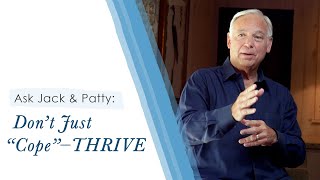
Jack Canfield answers community questions on reframing negative news, managing emotions, and starting a business at 50. He covers letting feelings in then letting go, finding mentorship through SCORE and the SBA, and testing ideas before scaling.
Chapters
Hi everyone, I'm Patti Arbery and I'm here with Jack Canfield for another segment of Ask Jack where our community sends in questions to get Jack's feedback and answers. Questions. So are you ready to go today?
I am.
All right, great. We have some good ones. How do you deal with when you receive negative news? Where do you go when you hear something bad?
Well, I think you know what makes the news negative. Obviously you have to start with that. You know, I love what Byron Katie says there's three kinds of things in the world. Your reality, other people's reality and then what she, what she says, your business, other people's business and God's business. So if you're the negative news is a tsunami in Japan, that's God's business. I can't do anything about that. Now if I have a daughter in law who's Japanese, I actually have one and she was in that, you know, Fushukima at the time, then the reality is I'd probably be concerned about that. I want to call her. If she was injured I would probably have some immediate reaction to that. But the fact is I can't do anything about that. You know, I can then what I can do, I can do something about sending her money, getting her back in the States, whatever. But there's a lot of things that people get upset about. The hurricanes, the floods, the earthquakes, etc. And it's just a waste of our time, nothing. We can do your business. If I get upset about how you're raising your children, you know, that's me dealing with stuff that is none of my business. How you do that's your business. How I raise my children is my business. So the same thing is with news. Is this news directly affecting me or is it not now? If it's directly affecting me, then I have a choice. I say what does this actually mean to my life? Either there's something I can do about it, I'm going to do it, or something I can't do about it. I need to let it go and just let it be what it is. It's not the events that upset us, it's what we believe about the event. And what really creates the most upset for people is believing something shouldn't be happening, that shouldn't be going on. This revolution shouldn't be happening. The people shouldn't be protesting in the streets. The people shouldn't be, you know, putting police cars on fire, whatever. And you know, you can have your belief about that. Maybe that needs to happen for something Socially, to change, we don't know. And so, you know, the thing is that it's your beliefs again, we go back to. That was your first question. What's the meaning I'm making about it? When a terrorist does something, let's say from Iraq, the people in Iraq get all excited and the people in America get bummed out. So it's the same event, it's just a different set of beliefs about it. So I think that when you get negative news, if it's really personal to you, let yourself have the feelings. I think we talked in an earlier episode of this where Oprah said, I give myself 17 seconds to react to it. And then I know if I keep focusing on it, I'm just going to create more of that in my life and attract it into my life. So then it's called let it go and move on. And the other thing is, like, why is there. You have to look at. Why is negative news coming into my life? If it's the news you're watching at 5 o' clock or 6 o' clock or 7 o', clock, maybe you need to take a break from that.
But let's look at it differently. What if you get the news that your child didn't get into the college of their dreams? That's negative news. So now I'm this mom who's bummed out. I'm bummed out for my child. How do I. I know some people will hold onto that forever. Weeks, months, and everyone's miserable. How do you know the difference between when to let it go? You know, when you're not just as. You don't care. Not like, oh, sorry, but you have to let it in, feel it. But what's a healthy amount of time?
Well, for me, even if my child doesn't get into the right college, you know, Harvard, Yale or whatever she was trying to get into usc, whatever. The reality is that I don't know that that's not for her best interest. Maybe she gets into a smaller school, that's going to be a lot better for her because she's going to be in smaller class sizes. She's going to meet some really cool people. She's not going to be, you know, in this huge diploma machine, whatever. So we never know.
Maybe it's all perfect.
Yeah. So basically, you know, I take the position that the universe has got your back. The universe is on your side. Einstein said, you can either believe the universe is for you or it's against you. And whatever you believe is what you're going to experience. So if my son didn't get into the college of his choice, I can have compassion for him. Know that he's upset about it, not try to push it away. Let him know that, hey, if you hear you're really upset, I would probably be upset too if it were me. And then begin to look at, at a certain point, you know, well, what could be the good news about this? You know? And then basically quit focusing on the negative aspect and ask yourself, well, as I've said many times before, Napoleon Hill said, every negative event or adversity challenge, whatever happens, is a seed of an equal or greater benefit. So we've all had experiences where we've lost jobs, divorces, people we love, died, the person we wanted elected, didn't get elected, et cetera. And then the reality is we survived it. I would say this to everyone watching you. You've survived everything that ever happened and so, so many things worked out. Garth Brooks has that wonderful song, thank God for Unanswered Prayers. And he talks about going back to his high school reunion and the girl that wouldn't look at him and the girl he thought was the greatest girl in the world was now an overweight alcoholic. And he said, thank God for unanswered prayers. So you never know. So I take the assumption that this is okay, that it's going to work out.
It'd be kind of fun to do a 30 day challenge, like everything that happens to me is perfect in this moment and what is it going to bring? And just to kind of have a reset, you know, just reframe. Because I think a lot of us just go there immediately and it's kind of a bad habit. So if we could practice something new, we'll have to maybe do that in the club or something at some point.
I'm not saying you should repress natural emotional reactions.
I agree.
But I do think most of our emotional reactions are caused by having a belief that this shouldn't happen.
Yeah.
And then we have to step back and see that. I used to give a metaphor about anger. Whereas if you come into your house and you see cow pies all around the living room, what would most people do? And the answer is you'd clean them up. Then you come home the next day and there's cow pies, which is manure around the whole living room. You'd clean it up. Eventually you'd say, how's this cow getting into my house? Yeah, where's the cow? How come there's a cow in my house every day? And you'd shut the door or whatever. And you realize that my anger is caused by having a belief that somebody shouldn't have done something. That's why I got angry. And when you let go of that belief, then you can just allow things to be. Doesn't mean you don't work to end racism or you don't work to deal with global warming, but you do it from a place of wanting to bring love into the world as opposed to thinking those people are evil and that's bad and they shouldn't do that.
So you ready for your last question?
Sure.
All right. I'm 50 years old and I want to start my own business. What advice do you have for me?
That your question?
No.
Should I?
I'm older than 50, but I'll take 50.
I'm just kidding. I'm just kidding you. I'd say, look, first of all, it's never too late to start. That's the first thing. I know many people that retired, and actually, then that's when their life started, because they started the business because they just wanted to do it, because they loved it. I know many people at 50 who've gotten out of the corporate world or their kids are out of the house. They just started. They've finally given themselves permission to what. What they want to do. So the first thing I would say is, number one, give yourself permission to do it. Number two, find some people who know about business. I was just interviewing some people earlier today who literally, they started out, they became a therapist, or they became a trainer, or they started out being an accountant or whatever, and they realized they knew their craft, their profession, but they didn't know how to run a business. And so there are many, many, many, many people who are skilled, skilled at running businesses. There's an organization called score, which is a society of retired executives who want to help people with their businesses. There's the Small Business Administration that has all kind of resources. There's local community colleges where you can take business courses. There's MBAs and so forth. So I would say find a mentor. Find somebody who's already done what you want to do. Ask them to mentor you. Create a business plan. Read a book about a business plan. You know, there's all the information's out there. I mean, it's probably videos on YouTube. How to write a business plan. So do the. Do the doing this of that and realize the most bit. And I recommend this book to read the E. Myth. That book, Michael Gerber's book, is such a. Such a valuable Thing, because most people don't really start a business. They give themselves a new job, and they're just working harder than ever to get their thing working, but they haven't really created a business. So when you understand a business and you know what you want to do and you learn how to do it, you look at someone like Sarah Blakely, who started Spanx. She didn't know how to run a business, but she learned, and now she's a billionaire.
That's interesting, because lots of times I'll ask people, why do you want to start that business? And they might be. They might want to start their own yoga studio. And I say, okay, do you want to run the studio or do you want to teach yoga?
And.
And so sometimes the answer is, find a partner that wants to run the business while you live your passion and your purpose, but still work for yourself.
Well, that's what I did. That's how I found you.
I know. Lucky you.
You were the first employee I hired. And now we have Russ, our CEO. And so I get freed up to do what I do, to write, to learn, to teach, to coach, et cetera. And so that's really good if, you know, I don't think anyone knows enough to fulfill every function in the business according to some books on business or seven functions in every business. You got marketing and sales and administration and development and all that kind of stuff. And most people are not an expert in all. And so if you can partner up with people and either share a percentage of the profits or find some interns coming out of college, that you can work with a lot of unemployed people today who will take a piece of the action that want to dream on something to do that makes a difference. And then I think that's the smartest thing that got said about this question so far.
Well, I think the other thing, too, is have the ability to enroll other people in your vision. That's where you're really good. So it's really clear and it feels safe to jump in.
Yes.
And I think a lot of people that are entrepreneurial or want to be, especially women, get really scattered. And so without being able to articulate what it is you want to do and enroll people, it can be very frustrating. So I think that's a big thing, too.
Let me just say one last thing about this, then we'll call it a wrap. But there's a principle in my book called just lean into it. And I was just talking with a woman the other day who was a coach to a person who wanted to start a restaurant. And he said, why would you start a restaurant now in the middle of all these restaurants closing? And it's really hard. He said, well, but when it's over, everyone's going to want to go out and eat again, and I'm going to be really poised to do that. She said, well, you know, why don't you do this? Why don't you go home and for the next month, cook all these meals that you think you'd like to serve in your restaurant, serve them to family, you know, work it all out at the end of the month. He said, I hate this.
No, it's a good idea, actually. Test it out.
And our friend Jacob, he thought he wanted to run a restaurant because he loved to cook and throw parties and dinner parties. And so my grandfather used to actually own a restaurant. And I said to him that there's more to a restaurant than just cooking and the food and just being out front and schmoozing with the people. I said, why don't you go work in a restaurant? Volunteer your time, find someone who owns a restaurant. Say, I'll come in every night, weekends, and I'll just volunteer my time. Find out what it really takes. After a month. He said, oh, my God, I don't want to run a restaurant. He said, you got to order all this food. You have people stealing stuff. Your chefs call in sick, they're drunk. You know, the people don't show up on time. The food doesn't get delivered on time. You got to start at 6 in the morning. You're still there at midnight, you know, counting all the money and doing all the accounting. He said, that's a real slog. I don't want to do that. So if you think you want to start a business, do what you said. Ask yourself, what's my why? And it may be that I don't really want to run a business. I just want to cook for people. Maybe I just want to entertain or I want to do, you know, run a yoga studio or do I would just want to teach yoga.
Or if you think you want to run a business or start a business, start with a nursery school. And if you're still liking it, then.
You can start a university.
All right, well, I hope you found the segment interesting. And if you'd like to add comments below, you can. If you'd like to send in your questions to Ask Jack, and you can do that as well. And we look forward to seeing you next time.
And one more thing, if you like this, if you found it valuable and you'd like to share some of these answers with friends and family who might need it. Make sure you let them know about it and you might forward this to them Also, if you would like. We would love you to like this and also subscribe to our YouTube channel for more videos like this in the future. We'll inform you when they're there. And basically, that's it. If you'd like more resources for how to get from where you are to where you want to be, make sure to check out my website@jackhamfield.com and we'll see you the next time we do this. Make sure you submit your questions. We'd love to help answer them. Sam.
More from Jack







[EP 46] Creating Your Own Luck: The Power of Self-Confidence with Veronica de Andrés

[EP 45] Rewiring the Brain for Bliss: Activating Your Spiritual Intelligence with Dr. Dawson Church


[EP 43] Transform Your Life Through Visualization and Emotional Intelligence with Natalie Ledwell

[42] Enhancing Your Health & Longevity Through Peptides and Functional Medicine with Regan Archibald