[EP 29] Consciousness: The Key to Everything with Dr. Tony Nader
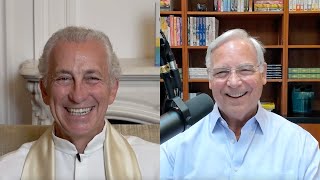
Dr. Tony Nader argues consciousness is a fundamental field and individual minds are local expressions of it. He explains how meditation, especially Transcendental Meditation, can access deeper consciousness and produce measurable benefits for individuals and society.
Chapters
Foreign. Welcome to the podcast. I want to ask you a question. Have you ever found yourself pondering questions like, what is the purpose of my life? Where do I fit into the cosmic scheme of things? Is there more to life beyond what I'm experiencing now? Or what we hear about the word enlightenment, like, what is that and how can I get it? And maybe bigger questions like, what is the purpose of life itself and what is consciousness and how did our universe get created? You know, philosophers and physicists have been debating these questions or exploring them, trying to come up with answers and solutions. Things like, do we have free will or is everything determined? What's the nature of good and evil? How can we best address climate change? What are the risks of artificial intelligence and how can we prevent them? How can we bring an end to the war and the terrorism and the create the permanent world peace that we all wish we could experience? How can you achieve a socially just society? What can I do to personally help solve these global challenges that we have? Well, if you have, you're in the right place today because my next guest is someone who has spent his entire life searching for answers to all of these questions. And in his new book, he claims to have the answer to all of them. I'm really excited about it. I've just been reading his book and I just. It's so wonderful. So I'm going to introduce to you Tony Nader, Dr. Tony Nader. He's got two doctorates, maybe some more honorary ones, I don't know. But he's got an MD from Harvard and a PhD in neuroscience from MIT. And he's not just a brilliant mind, but someone who is profoundly deep in our understanding of consciousness through a blend of modern science and ancient wisdom, which you're going to hear about today. So his new book is called Consciousness is All There Is. How understanding and experience consciousness will transform your life. And it challenges us to rethink everything we know about who and what we are and, and how we interact with the world. I've always been fascinated by how our thoughts and our awarenesses and our consciousness do influence our experience of reality. And Tony's work provides incredible insights to all of this. So, Tony, it's an honor to have you with us today to explore these profound topics and discuss how everything can benefit from understanding more about consciousness. Thanks for joining us.
Thank you, Jack. My honor and pleasure to be with the great Jack Canfield. It's wonderful.
Well, I like that my wife wouldn't always say the great Jack Kinfield, but nevertheless, I appreciate the honorific. So your thesis is that all that there is is consciousness. And let's start by maybe you could define consciousness, talk a little bit about what you mean by that. It's all based on your extensive research. But I think what you have to say about it goes beyond what most of us ever think about it.
There are two aspects of consciousness. One, we can say primary consciousness, or absolute consciousness, or the field of consciousness. And that is like a field. Like you have electromagnetic field or, you know, fields are not things that are localized in time and space. They are all permeating. You can imagine it's like an ocean that is infinite, that has no boundaries. And there is a field. Then this is how I look at consciousness, which is a field of consciousness that is non physical, non material. We call it consciousness because it can be conscious or it is conscious. It is conscious of itself. So that's the absolute level. That field is unmanifest. You cannot see it through your senses or detect it or anything. And then there are specific aspects of consciousness, like our human consciousness, which allows us to have thoughts, to have feelings. It's like a screen on which the movie of life unfolds. Because without this specific consciousness, we cannot experience anything. We don't experience pain, we don't experience joy, we don't experience love, we don't experience knowledge, we don't have hopes, we don't have anything. And to know what really consciousness is in that sense, imagine what it is like without consciousness. So, you know, the nearest you can get to that is actually either deep sleep, which is in my definition, one state of consciousness. Not, you know, the absence of consciousness, but it's a kind of consciousness. Or in deep anesthesia, for example, or in coma state where nothing exists. So consciousness is really fundamental in our life. Consciousness is meaning, life is existence in a sense. So this is what consciousness is. On the one hand, it is absolute, not a product of something. And on the other hand, different aspects of this ocean of consciousness are experienced through the machinery of what we call the body and what we call the, what we call the physical. Which of course I go through great lengths to explain that even that is a dynamics within consciousness.
Okay, so let's talk about that. I mean, you, you spend a lot of pages in your book unpacking all the implications of that for all the kind of questions we talked about earlier. And people are always looking for, well, okay, I get that, that's what it is. And then how do I apply that to my life? To being happier, to solving the problems of the World. So. And if I were to take your book, we could unpack a chapter by chapter by chapter. We probably need a five hour webinar here. But what would be the next step in helping us understand what it is and how we can apply it or be aware of it and how it impacts all of our belief systems about physicality and energy and so forth like that?
I think to really put it in context, we have to say what are the different theories that are about consciousness. So you know, we have subjective experience, we feel love, we feel pain, we feel joy, we feel who we are, we feel past. We have been something, we would like to be something. All of these things are happening on the subjective level, on the thought level, on the intellectual level, on the sense of self, what we call the ego and all of that. And so we have those variables or aspects that are not physical, they're not material. You know, what it is like to be a human being, what it is like to taste a strawberry and feel the joy of it, or you know, feel in love. It's not something physical, mechanical. So there is that reality of our life which is non material. There is another reality which appears to be completely material. It's our physical body, it's the environment, it's the atoms, the molecules, the trees, everything else. Physical body which appears to be physical. And that, you know, has been explained. You know, there is this kind of gradation of explanations, as some of the philosophers had said, like David Chalmers for example, that physics can explain chemistry, chemistry can explain biology, biology can explain the physiology and the nervous system. But then suddenly something comes out which is not mechanical, which is not physical. And that is our very personal subjective experience. And that is what we call consciousness or awareness. As part of consciousness there is a difference, if you like, we can go into that. But for the time being there is that non physical thing that emerges as if. So the big philosophical question is what is it? What is life about? What is it constituted of? So you can start with a presupposition that life is made out of, or everything that exists is made out of some energy. We don't know that energy comes from, where does it come from? But we know there is a big bang and then suddenly there is an energy fields. And then this energy fluctuates, becomes particles. Particles come together, they form atoms. Atoms come together, they form molecules. Molecules, they form cells, let's say in our human situation, organs, and then the nervous system. And this theory is the physicalist theory, which says that consciousness is an emerging quality from a Physical reality. That's one theory. That is Descartes, who is always referred to in this context, who said actually there are two things. There is that spiritual consciousness value, which is subjective and personal. And there is a physical reality, which is different. And somehow they talk to each other. So these are the dualists, because they think of two things are the ultimate aspect of reality and the monist, which means there is only one thing. They can be either saying that there is actually energy at the beginning. And then the subjective aspect emerges from that. These are the people who talk about emerging, the emergence of consciousness, the emergent quality of consciousness. Now there is another option. The option is that consciousness is primary. Therefore, there is a field which is non physical, non material. And it is that field that actually appears as physical and material in our existence. Why is this important? It's important because where you put your priority and how you can explain life. And all the big questions that you have posed at the beginning of our discussion, how to solve these big questions. That is one aspect. The other aspect is, what is the most important thing in our life and living? Is it physicality and taking things and grabbing things and building things, or is it actually a transformation in our consciousness? And this has to be explained and has to have a logic to it. That allows us to answer those big questions that you posed at the beginning of our discussion. So the fact that I come to the conclusion that consciousness is primary is based on a number of factors that converge together to give us a full understanding of life and living and meaning of life. And all of these points about freedom and determinism and happiness and why we are here, why there is pain, why there is suffering, why there is conflict. How can we resolve it? From which level we can resolve all these things really depends on how you see reality, which means your worldview. So if your worldview is all physical and material, you have a certain attitude towards things. And you try to solve things in a certain way. If your worldview is more spiritual, more subjective kind of feeling and being on a consciousness level, then you have a different set of ways to deal with reality. And so consciousness is primary in my proposition in this book helps us to understand all of these things. So that's what is called. It has a powerful explanatory power. So it has a strong explanatory power. And it also is in tune with findings in physics, findings in the laws of nature and explaining, again, the meaning of life. And also empirical experiments such as meditation and transcending and different kinds of behavior that you teach that, you know, help people to get ahead in their life. So it becomes a complete package that gives substantial value to the paradigm that consciousness is primary and also offers practical technology to develop consciousness because consciousness can be developed. And as one develops consciousness and grows in consciousness, there is greater fulfillment, greater happiness, and then the meaning of life is actually fulfilled. So this is how we can say we start living in the light rather than start living in ignorance and darkness and not knowing where we're going, not knowing, you know, why we are here, why there is suffering, why this happens. And that's what is called enlightenment, for example, as a term which means you are now knowing, you know, you are in the light, you're not in the darkness.
So obviously, you know, because of your experience with the Maharishi and your experience with Transcendental Meditation, and I'm a big meditator, I've not done tm, but I've done some very deep meditation retreats and so forth. And you talk about how when we're meditating, we're connecting into that. I'm going to call it silence and spaciousness that exists. And within that there's more potential. And you can correct me at any point, because I'm still trying to understand all this fully, but there's a potentiality for better experiences. To put it, you know, kind of simply in terms of happiness and health and solving world problems and having a more socially just societies and, and so forth and so on. And one of the things you said too, I'm just going to throw all this out and let you respond to it, is that I nature, which is out there, and it's just happening and evolving and unfolding and so forth. And, you know, there's this. Is it. Is there a plan? Is it random? There's chaos theory, there's all this different stuff. And yet my experience is that when I am more in touch with nature, whether I'm just being in it, when I'm meditating in it, standing on the grass with my shoes off, you know, taking plant medicines with the shamans in South America, et cetera, I. Everything just works better. I feel better, I'm healthier, I feel more loving and so forth. So can you speak to all that?
Yeah, absolutely. To put it in a metaphoric way, because, you know, a metaphor or an example can help, even though metaphors have their limitations. We go back to that ocean. We say there is an ocean of consciousness. That ocean is an ocean of consciousness, which means it is conscious. So if it is the one only thing, what is it? Conscious of. It's conscious of itself. And it's conscious of itself in an infinite number of ways. These different ways of being conscious creates. Again, it's a metaphor. It creates like waves in the ocean. So you have ocean and then you have waves in that ocean. And the waves are part of the ocean. And the ocean knows itself to be the ocean and to also be the waves. Now, what it is like to be only the wave without the ocean, that is what the life is about. Experiencing within life the specific values of individuality and separation. Which means you go to the surface of that ocean and you now say, I want to see just the wave. What it is like to be a wave without thinking about the ocean. And all that there is in the manifest field are different layers and levels of experiencing these waves on the surface of the ocean. And the purpose then, of course, life, if you like, is to actually go back and know that you are the ocean. It's like you've been out a lot and now you want to. You go back to the ocean level. So all evolution in life and all that happens with us is a path towards realizing that we are actually the ocean. And that is what we call expansion of consciousness. So, as if you are on the surface of the wave and you're looking at the small wave and your vision, let's say, is very limited. You can only see some molecules on the wave or something, you are limited. And so when the wave moves, you are shaken. When another wave comes, you get splashed around. You're afraid to fall, you're afraid to be drowned. You're whatever. You're just on that little perspective. And now your vision expands and you see the other waves, and you see the other waves are part of your reality. So when you are out, for example, and you're saying you are in the field and you meditate and you. You know, some things that you eat, something that you take, it is like getting in tune with all that is around you and starting to feel that you are more than just your body or what is limited in your physiology, in your physical body, that you are also part of that wholeness. So what's happening there is an expansion of your perception of the self. So the self is no more just limited. But suddenly it takes that dimension of including within your perception of yourself, bigger perspective. So all of life is about growing. To be happier means to be more. Not to have more, to have more. Sometimes people mix it up with being more. Because when you have more, you think, oh, it's myself. Also my house is Bigger, my car, my plane, like this. And you identify yourself with these things and you say, yes, I'm growing and I'm growing. But when sometimes these things break and they don't work well, and the friends go away and the lovers are like that, and your whole life is shaken, and your whole being is shaken, it's like you expand on the surface, it's fine. But what you really want is to be more. And that's what brings greater happiness and greater satisfaction. Why and this is why this paradigm is complete in that sense, is that it starts somewhere, goes to the surface, and come back to the ocean itself. So that the purpose of life, the meaning of ultimate fulfillment, is to actually realize that you are the ocean and that all the waves are part of you. And that is where you grow in happiness and fulfillment, because nothing is missing. So in Transcendental meditation, because you mentioned it, what we do is go beyond the wave, dive deep within ourselves and find that we are the ocean. And this is how you can get these experiences. Now, the experiences of expansion can happen, as you mentioned, but can also happen with, you know, people saying you should have compassion, for example. Why should you have compassion? Because it's nice to the other and you are more human and like that. That's one aspect. But the real reason why compassion is important is because it unifies you with the other. It makes you feel part of a bigger reality, why love is so great and you should love and all of that. Because love is a unifying force where your self grows. Because when you love more, it means you are more unified with the object of love, you know, or the person that you love. What is maximum love? Maximum love is to be in unity with the other. And that is when you say the other is myself. Is like myself. When you really love somebody, when a parent, you know, just taking an example, really love their children, you know, if there is only some food that is left, they'd give it to the child because intuitively they are unified with that child. And when you are with the other, you want the other to taste the right things, to have the beautiful things, you know, you don't, you know, mind your personal love because you see yourself in the other. So that all of these experiences in life and all of these points of life also support the idea that growing in the awareness of the self as being more expanded allows us to grow ourself and to feel bigger. So love of my family, love of my nation, love of my world, love of my environment, life of my universe, because I am one Wisdom. And that is the technology to grow in consciousness. All that we do that is in the right direction. For example, help thy neighbor or, you know, feel good with others. Be forgiving. All of this means grow in unity, grow in wholeness. Treat the other like you would treat yourself. This is, you know, the golden rule that's in all religions, all belief systems. All of that is there. You know, you should do unto others what you do on yourself. All of this indicates that this is the direction of the meaning of life, to grow oneself until you realize you are the ocean. And then everything is yourself.
I have a lot of different thoughts coming up as you share all that. I was remembering this rabbi I met once. He always introduced himself this way. He'd say, hi, me. Then I was like, hello, myself. That we are all, that we're all connected. We're all that you are part of me. Someone said once, if you look at this, there's five. Five fingers up there. But what happens is. Or four fingers. And if we hurt this one, we think, well, that's not a problem, because I'm over here. But we go deeper. The ocean. You realize we're all connected. I'm hurting myself, you know, and so. And then the other thing I. I was thinking about is, I. One of the things I say to people is, I'm. I'm a drop of water in the ocean. I'm not the whole ocean, but I am a drop in the ocean. So I motion. I motion. And maybe you're saying to go even further, like, don't think of it that way. This is go. I'm ocean. And this little seed of awareness or consciousness that I have, I can own the whole thing because I am all that. And then finally, I just want to say this. I lead a meditation process in some of my seminars, which comes out of a study or psychology called psychosynthesis. And the idea was that we have them say, I have a body. I'm not my body. I have emotions. I'm not my emotions. I have an intellect. I'm not my intellect. I have many roles I play. I'm not the roles I play. I have emotions. I'm not those. I have, you know, many. We'll go through a number of those and say who I am is a pure center of consciousness and will. And so, basically, I can choose with my consciousness where I want to place it. And so now I have a choice. Instead of being drifted around like the waves I think of, like, I remember being on a wave. My wife was teaching me to boogie board. And all of a sudden, she had taught me how to get on there and move it, but she hadn't taught me how to stop. I found this wave headed toward a wall of lava rock in Hawaii, going, oh. But the idea is, if you're on that wave and some of the waves take you places, perhaps that can be very difficult and challenging. But if you go under the ocean, there's no waves there. There might be some currents, but it's peaceful. And I really get people to realize that who you are at a deeper level is that that peaceful part of the ocean. And most of us live our self up here, you know, live our lives up here, not realizing that we are that. I want to ask you a question about consciousness. I think about plants and animals. We have a lot of people tell us that, you know, everything has consciousness, you know, and just thought, you know, here's a rock, here's a tree, here's a pebble on the ocean, a seashell, whatever. What are your thoughts about that?
Consciousness is all there is in this paradigm. That's the title of the book. So it's not that these objects have consciousness. In fact, in my definition, they are consciousness. So they are expressions of consciousness. So in that sense, you know, we have the small self and we have the big self. So that ocean of consciousness experiencing itself from its unbounded perspective, its nature is to know itself in all possible ways, and it knows itself from the unbounded perspective. As a starting point, let's say what it doesn't know is what it is like to be a stone, what it is like to be a tree. Because these are also different ways of being conscious. Actually, they are. They are being conscious. So a stone, for example, what is it conscious of? A stone is. Just reacts to gravity, for example, or has some, you know, electric inside, some heat or something, whatever it has. But just let's talk about gravity. So we can say it has a very minor, meager basic level of sensing, which is sensing gravity and responding to. Has no choice. It has no sense of self. It has no idea of present, past or future. It has no fear, you know, so when you drop the stone, it's not going to say, oh, my God, what's going to happen to me? Am I going to break myself? Has absolutely no idea like that. And so we are expanding again, going back to the definition of consciousness. We're expanding consciousness from being a human like consciousness, to any sensing, detecting or feeling or responding to. So when two particles, one positive particle, one negative particle come together because they're attracted. It's not that they are attracted and say, oh, I'd like to go and see the other particle. And like that. There's nothing to do with that is just automatic. They have no choice. They will be attracted and that's it. They have no sense of being attracted or anything. So we have to accept, to expand our understanding of consciousness to be something very minimal that grows, you know, take usually the example, for example sunflower that turns towards the sun. It's not that it says, oh, it's sunny, I'd like to look at the sun today. You know, it just has mechanisms within it which makes it turn to the sun. But that is a more complex level of experiencing than the stone. It is again not a human experiencing. The sun is completely different. And like this you go through the pyramid, if you like, of consciousness where you can have higher and higher and more complex consciousness and you reach a human being which has that sense of self, that sense of present, past and future, etc.
Etc.
So yes, all these are consciousness. They are dynamics of consciousness. And within consciousness they are the ocean moving into waves, experiencing itself as a wave, but wanting to go back to be the ocean. So the small self is real, but it is only an expression of the big self, which is the ocean. And the purpose of it all is to experience from a limited perspective and then to have the return journey of going back to the experience from an unlimited perspective.
So basically the purpose of life is to experience that. And to use the ocean metaphor, all the water eventually returns to the ocean. All of us eventually die and our consciousness goes on and returns to whatever we want to call that, you know, people with past life experiences and people with near death experiences give us some glimpse into that. And there's this, I'm curious about that. Like I, I'll share an experience I had once I was deepen this contemplation of things. And I realized the awareness I had was that here's I, at that point I was calling it God wants to know itself because you said consciousness conscious of itself. And then all of these expressions of creation, whether it's a rock, a tree, me, you, whatever. And I started thinking about, you know, here's this guy Mengele is over in Germany who's doing all the experiments on people during, you know, the, the, the Holocaust. And it was almost like God was going, well, how evil can people be? I want to know that, I want to experience that, you know. Or here's Salvador Dali with his insane mustache. Like, well, how far can you go with that before it's too ridiculous, you know, well, let's experience that. How kind can you be? How strong can you be? And it was really kind of freeing for me to stop judging everything. That these were just expressions of life in this kind of sense of consciousness, or might say God at that time. Wanting to know itself by expressing all the parts of itself that make any sense.
That's exactly. Actually, with some twists.
Yeah, tell me the twists. I want to understand it better.
Since this ocean of consciousness is consciousness and its nature, therefore that's why we're calling it consciousness is. Is to know itself. Because to be conscious of itself, it knows itself from all possible ways that can be potentially possible. And it's not an intentional thing. It's a spontaneous emergence. Now, when it emerges into small things, what it has to do in order to experience from a limited perspective, it has to first forget that it is the ocean. Because if it knows that it is the ocean, it would be cheating. It wouldn't be really experiencing from a limited perspective. So that is why there is what we can say, forgetting that it is the ocean. So it does forget, it hides itself, its true self, and sees itself from a specific perspective. Now, when it sees itself from a specific perspective, it wants to see itself from all these different specific perspectives. And it is not at all necessary that there should be pain or suffering. Actually, pain and suffering emerge as part of the freedom, which is the second element that is necessary. Because that is why I explained the necessity of freedom. In fact, there can be no creation or no meaning of manifestation without freedom. Why? Because in this context, if you want to experience truly from a specific perspective, you have to give that specific perspective its own reality on its own grounds. And you cannot force it to be something. If you force it to be something, then the experience is not truly new or complete. Because then you know exactly what is going to happen. You know exactly the sequence of things. And therefore you don't learn anything from experiencing in a limited perspective. So these are two aspects that are important. First, forget that you are the ocean. Second, put yourself in the shoes of small perspectives and give this small perspective their own reality, their own ability to make choices. That is how it happens. Now, when you have freedom, you can actually evolve quickly towards going back to the ocean. Or you can make right and left decisions. And this is where, on the specific level, you can go into negative things and create negative effects and therefore have to actually go back to the right path, you know, because you are not getting more and more fulfilled. And so this is how we see choice leading to potentially good decisions or bad decisions that have their own consequences, why they have their own consequences. There is also a logic for that.
What does that mean?
This is the action and reaction. You know, why there is action and reaction. Why there is, as they say, on the feeling and on the behavioral level, why there is karma. And that means for every action, there is a specific reaction. And I explained this in the book on the basis of that ocean of being always being equal to itself and having within it all possibilities, and all possibilities means everything and its opposite. So when you add everything and its opposite, you get a flat line. You get flatness. There is nothingness, really. So this field is a field of nothingness to start with, because it is beyond space and time, and everything in it is balanced with everything else. And this status of balance, it maintains eternally. It cannot be otherwise. Otherwise you'd be creating something out of nothing. But that nothing overall remains nothing. But how can it remain nothing when. When we see things being expressed, it's because every time you express something, there is the necessity to have its equal and opposite expressed at the same time. And this is how you know, if you do plus one at the same time you do minus one, you get zero. And so you stay into nothingness. So the field of consciousness is always equal to itself. And you can create any disturbance you want, any, you know, wiggle or something or dance or whatever you want. But whatever you create is automatically computed. And its equal and opposite is also created at the same. In the same manner. I'm not saying at the same time because time and space is another story where actually you can experience things as being separate in the field of manifestation, whereas in the infinite field of the computing, they are happening at the same time. This is a little more complex, but, you know, as you said. Yeah.
There's a friend of mine named Dr. John Demartini. I don't know if you're familiar with him or not, but he teaches the idea that, you know, that everything good, if you just focus on that, then that eventually there's going to be something you have to deal with over here that you're ignoring over here. And whenever there's something that's seemingly negative, the positive is already happening to balance. That there is this movement toward balance. For example, he was coaching my wife once. Her best friend died. And she was really very sad about it and had a lot of thoughts about it. You know, um, she was my best friend. She made me laugh. I loved her. We were sympathic on everything And John said, okay, let's look at all those qualities. And when she died, who came into your life that was funny? Who came into your life that loved you? Who came into your life that you know all the other qualities? And she went, oh yeah, that's my niece. Oh, that's this person. And it was all balancing out, but she was so focused on the loss of it that she wasn't seeing what was coming in. Does that make sense?
Yeah, absolutely. It's beautiful. Yeah, it's beautiful. Everything is balanced in that way also. But, you know, when you do good, it doesn't mean bad has to come. This is something people kind of confuse sometimes. If I, if I give you $10, let's say out of my good heart, for you to buy something nice and be happy with it, what is the balance of that? The balance of that is that you do something to me back that will actually balance my losing the $10, and that means something good will happen. So when you do something good, the balance of that is that something good comes to you. That's why we call it good karma. If you do something bad, then the balance of that, that something bad comes to you. And so, you know, not to have this mixed up. And it's part of the whole paradigm of consciousness.
Right. I love it. Okay, so I want you to pretend that you're Talking to a 15 year old like one of my grandsons, and you're explaining all this and like he's going like, well, based on you knowing all this, what advice would you give me for living a happier life?
Be sincere. Be yourself. And know that you have the field of all possibilities within yourself and only do the things that you truly feel are good for you and that are good for others. At the same time.
There'S a lot of people out there that are teaching something now called, you know, follow your bliss, follow your joy. You know, look to see what makes you come alive. Because when you're alive, then that's. You're doing what you're meant to do and that'll you'll express yourself fully. And that's what the world needs, is everyone to be doing that. And then the way I see it is we're all cells in a body and if each cell is doing what it's supposed to do, the whole body works. And it's, you know, so this idea of like, you know, follow what lights you up, follow what gives you that sense of joy. Your thoughts about that?
Yeah, absolutely. On the surface level, that's important. What I would have Said actually more, you know, if, if I am faced with the 15 year old, I will tell them go back or tell her go back or them go back into yourself, know to, to be established in yourself. My advice is transcend. Transcend the surface and then act. So go beyond the surface, enrich the roots of life and then the outer values will become clearer and more fulfilling. And then on that level, as you said, do, do the things that are fulfilling, that are healthy, that you feel are good.
So let's just talk about meditation for a little bit. Because I mean literally at the end of the book, it's all about like, let's, let's go inside and realize your consciousness. And when you do that, everything's going to work better. So given that and you, you, you espouse and teach and we're really close to the Maharishi Mahesh Yogi and Transcendental Meditation has been that path. Just talk a little more about how powerful and valuable meditation is for everything we've been talking about in terms of consciousness.
It is a natural way to discover one's inner being, to expand one consciousness. And it has powerful effects on health, on well being, on behavior, greater clarity, greater comprehension. So it has tremendous practical benefits in terms of even scientific research that has shown that. And what we have shown also is that the collective practice of this meditation leads to changes in society. So that's why we are also promoting, based on 116 scientific research studies that are, many of them published and peer reviewed journals, that show that a group practice of Transcendental Meditation leads to a reduction in crime, reduction in conflict, more peace, more harmony. And the reason why this happens is that individuals practicing this technique contribute to what we call the collective consciousness or the collective awareness of the people. And when the collective consciousness is settled and calm, peaceful, then the behavior of people within that collective consciousness, even those who don't meditate themselves, is more harmonious. And the studies have shown that there are, for example, less accidents of the road, less crime, less hospital admissions, even infant mortality decreases. So all of these things that seem to be independent one from the other, they all improve because of the collective consciousness improving through the individual practice of these technologies. And so we are now looking, you know, forward to do something on an international level where we are hoping to create a very large group of people who practice these techniques together and hope to have, and expect to have positive effects, you know, on, on all that is happening in different parts of the world.
I'm curious so, and I know about those studies in Washington And India and so forth, and how all that stuff you mentioned happens. There's a. Is going back to the fact that it's all a field. The energy is moving out. It's expanding beyond just that group, and that's how it's having that effect. And the more people that do that, the. The whole world's impacted by it. That basically how it works.
Beautiful. It's perfectly explained.
Okay, good.
By settling down in the ocean. So if, you know, if you have many people and they are agitated, so the group is agitated. If you have some people who settle down, then they can entrain the others, and the others can actually settle down also. This is a phenomenon that we see in physics also, for example, the creation of coherent waves, laser waves, or the Meissner effect, and all of that, where the collectivity of working together in coherence leads to a bigger collectivity joining. And that is a phenomenon of entrainment where when one thing is. When a small percentage of molecules, for example, or atoms, or in this case, photons, for example, for light, start vibrating together, all the other waves join. And that's how you get, for example, laser light. Laser light is the same light as we have in the room, the regular light, but it's. Waves of the photons are vibrating together rather than in a. In a haphazard or chaotic way. And to create that laser light, you don't need to get all the lights together. You create a certain percentage of lights in harmony and coherence, and all the others join and become coherent. So this is how we can influence the collective consciousness, by having a small number of people being coherent. And we see this coherence in brave brainwave EEG waves and all of that.
As I said, Dick, and spend four hours with you. And I have other questions that some. I know some things pretty well, and some things you're giving me new nuances for. And your book was doing that. I haven't memorized it all yet. But I love your exploration of quantum physics in there and neuroscience and how all the science kind of comes together and then looking at the ayurvedic experiences, you know, coming from the east, and these people knew things years and years and years ago that we're all now finding science to back it up, which I always love, the things I know intuitively. And then someone says, well, here's research that shows you're right about that. So you have a podcast. Talk about that for a minute.
I have a podcast called. Actually, like the book, it's called Consciousness is All There is people can tune.
Into that if they just go to your website, which is drtoneynader.com which we'll put in the show notes here, they can access that, get on your mailing list. They'll find out about your podcast, that how it works.
Yeah, absolutely. It's also on YouTube and in different media.
Okay.
And you know, the book is on drnaderbooks.com or it's in Amazon and it has all the, the references there.
Well, good. Yeah, go to Amazon, go to his website. Either, either one will get the book out there. I, I think what you've done, thought about and coagulated, if you will, and the quality of the work you've done, the whole life devoted to this is phenomenal gratitude from me to you for doing it. And I want to encourage everyone to get in touch with, with Dr. Nader and to take advantage of all this work. I often say that, you know, we get to take advantage of you having spent, you know, lots of years combining this information and it maybe takes us, you know, a couple of days, whatever, to integrate it and then maybe start doing the practices you teach where we don't have to reinvent the wheel. It's been invented and so we can take advantage of that and makes it easier for all of us. So thank you for doing the heavy lifting, as it were, and appreciate it. Yeah, very much so.
My joy and hope. Thank you for your.
Yeah. And what's so amazing, everyone looking at your face right now, look at the joy, look at the peace, look at the calmness, look at the happiness. This is what we all want. That's how we see it.
It's very kind of you can look at you and say the same.
Yeah. So there's a path to get there. And so really encourage you to do that. Reach out, go to his website and thanks a lot, Tony. I really appreciate you joining us today.
Thank you, Jack. It's wonderful to be with you.
Thank you. And for all of you who tuned in today, thank you for joining us. Share this with your friends. There's a lot of people out there who need this information. Let them know about the podcast, our podcast, Tony's podcast, and put some of this into practice. And I think the best two ways to do that be get a copy of his book, go to his website, watch some of the, the, the, the what do I want to say the podcast he's already done because they're out there for you to learn from. And also if you don't have a meditation practice, TM's there. There are many other practices as well. But I would really encourage you to make sure you have a daily or some kind of consistent meditation practice, because it is where so many of the things we talked about get to take root in you, to use a physical metaphor. But anyway, thank you for joining us. Know that I love you and join us again. We look forward to that. And take care.
More from Jack






[EP 46] Creating Your Own Luck: The Power of Self-Confidence with Veronica de Andrés

[EP 45] Rewiring the Brain for Bliss: Activating Your Spiritual Intelligence with Dr. Dawson Church


[EP 43] Transform Your Life Through Visualization and Emotional Intelligence with Natalie Ledwell

[42] Enhancing Your Health & Longevity Through Peptides and Functional Medicine with Regan Archibald

[Episode 41] The Success Principles 20 Years Later: What’s Changed and What Still Works