How to Say NO! | Jack Canfield
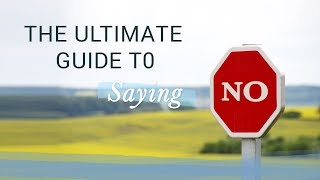
Jack Canfield teaches how to set boundaries by creating a "Stop Doing" list, communicating clearly with "It's not against you. It's for me," and adopting personal policies. The core idea: say no to the good so you can say yes to the great.
Chapters
Hi, I'm Jack Canfield, and today I want to talk to you about how to effectively say no more often so you can say yes to the people and things that really matter in your life. Just want to remind you I release new videos every week, so click on the subscribe button and the bell icon to receive notifications when I release new videos. Have you ever felt like everyone around you wants a piece of you? Your kids want you to drive them everywhere, or they want to borrow the car, which screws up your own plans for the day. Your co workers want your help on projects that aren't really your responsibility. Your boss wants you to work overtime to finish a report you could have completed days ago if he'd just given you the information you needed when you needed it. Your sister wants you to take her kids for the weekend. And your child's school wants you to be a driver for next week's field trip. Your mother wants you to come over and take her shopping. Your best friend wants to talk about her impending divorce. And local charity wants you to head up the annual luncheon committee. Feels like you never get a moment to yourself to focus on what you want to do. So how do you combat all the demands on your time and energy, especially when it's so easy for people to reach you at any time, no matter where you are, by phone, text, instant messaging, facetime, email, social media, or video chat. Simple. You learn to say no. Now, saying no doesn't make you a bad person. It simply means that you care about priority, prioritizing your time and energy so you're able to devote it to the things that matter the most to you. And yet, most of us find it extremely difficult to say no. We don't want to seem rude, selfish, or unhelpful. So we just keep saying yes to everything people ask of us and pushing ourselves to honor our commitments, no matter how stressful it is. And we tell ourselves that's just what it means to be a good person. But when you say yes to everything, you end up keeping yourself stuck in situations that that aren't healthy or conducive to your personal growth. And all those commitments you've agreed to end up devouring your time, your energy, your motivation, and your drive. And if you continue saying yes to everybody and everything, eventually you're going to burn out. And that doesn't do you or anyone else any good. So today I want you to make the commitment to say no more often. Now, the word no is a powerful tool for success, because when you say no to things that don't truly give you the joy you want or don't serve your ultimate goals in life. You open yourself to the opportunity of saying yes to things that will give you in your life more meaning and more fulfillment. And what is really true is that not only will that make your life better, it will ultimately improve the lives of others around you as well. If you'd like to lay the foundation for a more joyful, abundant and successful life, get the first two chapters of my best selling book, the Success Principles. Now here are some tips to help you say no more effectively. My first is simple but powerful. It's to create the opposite of a to do list. I want you to create a Stop Doing list. I want you to think of all the things you regularly say yes to that take up your time and energy without making you happier or advancing your goals in any way. Take some time today. And I say today because research has shown if you don't do it right away, you're not likely to ever do it. So take some time today to write a list of things you need to stop doing and make the firm commitment to not do them anymore from this point forward. Maybe this means telling your sister you will no longer babysit for her. Or letting your co workers know that since your own projects are taking up so much of your time, you no longer have time to help them out with their or telling your kids they need to start making their own lunches and doing their own laundry. Now if you do that, you'll need to create a training program for that one. I have a friend who, after taking one of my workshops, went home and announced that she was no longer going to be doing anyone's laundry anymore, and that included clothes, sheets and towels. She also said she was only going to cook dinner two nights a week and the other nights had to be divided up among the rest of the family. She agreed to conduct two classes on how to use the washer and dryer, and several times when she would conduct basic cooking classes. But after that they would need to develop a schedule, come up with shopping lists that she and her husband would then purchase on the weekend and then stick to the schedule. She said there were a lot of days when her kids went to school in dirty clothes and they ate spaghetti dinners in the first six weeks. But then everybody got that she was serious and they started improving the meals with more vegetables and better recipes that they learned from their friends and their friend's parents and from the Internet. Now the result is that she ended up with more time for what she was interested in. And the kids grew up much more responsible, competent and self sufficient than almost all of their peers. So what needs to be on your stop doing list? Maybe you need to stop answering all the unsolicited emails you get or watching the news. Every day can be so depressing and rarely contributes anything valuable to your life. And if anything really important happens that you really need to know about, you can trust that your friends or the people at work will tell you about it. And maybe there are some games on your phone or your computer that are time wasters that you need to delete. And do you really need to check every post on Facebook and Pinterest that your friends and family post Anyway, whatever those unproductive time wasters are, decide to stop doing them. Once you take the time to get clear on what they are and make the commitment not to do them anymore, it'll be easier than you think to remove them from your life Now. My second tip is to respectfully communicate your boundaries to others. Here's a sentence I'd like you to memorize. It's not against you. It's for me. Saying no isn't a rejection of other people. It's simply saying I'm sorry. I don't want to do that because my other commitments and priorities are more important to me at this time. For example, if your local PTA chairperson calls with yet another fundraising event she wants you to help with, let her know that you believe in her cause. But you've been over committing yourself outside the home too much lady, and have made a commitment to spend more time with your family. Your decision not to help isn't against her or the pta. It's a decision you're making for your family. Most people won't get upset with you for honoring this higher commitment. In fact, they'll probably respect you more for your clarity and the strength of your convictions. You might also want to frame your boundaries as a list of actual parts policies you maintain to be able to devote your time and energy more fully to the things that will have the greatest impact in your life. For example, some of my personal policies are I don't schedule more than five talks in one month. I no longer co author books with first time authors. They just take up way too much of my time and energy. I don't take any calls on Tuesdays and Thursdays because those are my writing or product development days. I don't lend money to anybody and I don't make charitable contributions over the phone. You have to send me something in the mail that I can read. And because I'm so clear about these personal policies when I express them to others, they understand that my refusal to honor their request is just a policy I have and has nothing to do with them personally, and they respect my boundaries. Finally, my third tip is to say no to the good. So you can say yes to the great. Now, by this I mean start making the distinction between the projects and tasks and time commitments that are merely good. And by this I mean the things that you're fairly skilled at, maybe you don't mind doing them and they yield decent results and those things that are truly great. And by truly great, I mean the things you are truly awesome at, the things you love doing best, and the things that make your life really better in some real and significant way when you do them. Then focus your time on doing more of those things that have the potential to produce really great results and less on the ones that are merely in the good category. For example, I would say I'm a good editor. I've written enough books to look at someone else's writing and be able to identify ways to make it stronger. But even though I'm good at it, it doesn't produce great results in my life when I'm editing their books. I'm also good at writing forwards for other people's books, but the time it takes to read their book and craft an introduction that I would be proud of is takes up way too much time and doesn't produce that much in return. I'm much better off to spend my time actually writing my own books. And when I do that, I'm getting my ideas out into the world. I'm reaching millions of people and making an impact that matters to me, and I'm making the royalties that come from that writing. Now, the same is true for my speaking. Speaking to a group of 100 people is good, but speaking to a thousand people is great. I used to say yes to almost any anyone that wanted to hire me. Now I'm much more selective. So what are the activities that you're great at and to produce your more awesome results as opposed to the ones that are merely good? The clearer you get about that distinction, the easier you'll find it to say no to the good and yes to the great and create the more deeply fulfilling life that you want and you deserve. Now, let's talk about this. I'd like to hear your thoughts after watching this video. Who and what do you have trouble saying no to? I'd love for you to answer that question in the comment section below. I'd like to read what you have to say, so thank you for watching. And remember, nothing in your life will change for the better until you do. Now, if you found this video helpful, make sure you like it, share it with a friend who may need it, and subscribe to my channel for more videos like this one, and for some additional resources on how to say no, visit my website@jackcampfield.com thanks again for watching.
More from Jack







[EP 46] Creating Your Own Luck: The Power of Self-Confidence with Veronica de Andrés

[EP 45] Rewiring the Brain for Bliss: Activating Your Spiritual Intelligence with Dr. Dawson Church


[EP 43] Transform Your Life Through Visualization and Emotional Intelligence with Natalie Ledwell

[42] Enhancing Your Health & Longevity Through Peptides and Functional Medicine with Regan Archibald