My Personal Vision Board | Jack Canfield
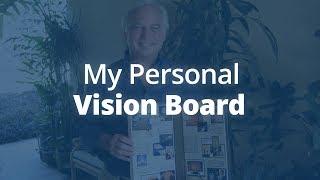
Jack Canfield explains how vision boards work and shares his own success visualizing $100,000 and then $1,000,000. He covers the psychology behind them, how to build one, and a visualization practice to activate your subconscious mind.
Chapters
Hi there. I'm Jack Canfield, and today I'm going to talk to you about my own personal vision board and how I use it. The best way to achieve your goals is to keep them top of mind. So you're always looking for ways to move yourself closer to them. And a vision board is the perfect tool to help you do that. A vision board can be anything. Where you put your pictures, the words that you want to represent, the qualities of the experience you want to have. Could be on the back of a door, can be on your refrigerator, can be on a big poster board like the kids do to do their science projects at school. Can be, you know, in a book that you unfold. Sometimes people have vision books where they turn the pages that are under, you know, page protectors. But the main idea is it's someplace where you capture images of the goals that you have in your life, the things you want to experience, the things you want to own, the things you want to do. So you constantly look at it and it brings forward the images. So you can then either just stare at it or you can close your eyes and then visualize after you look at it. Now, the reason you want to create and use a vision board is the subconscious mind is much more powerful than the conscious mind. And we can program the subconscious and the unconscious by putting in images and words and affirmations on a consistent and regular basis. So I would recommend you put your vision board somewhere where you're going to see it. It can be like, as I said, on your refrigerator that you go to every day. It can be on the back of the door that you go out of your house or your office in. Some people have placed their vision boards next to their mirror in their bathroom, so when they're putting on their makeup or doing their hair, they're seeing their vision board. But the key here is consistency. Some people have even made visual boards that are in their computer or on their iPad. Now, if you're young and you're technological and you want to do that, I constantly really encourage you to do that because you're probably looking at your computer more than you're looking at anything else. Now, I currently have two vision boards. One is a fold out vision board that I can travel with, that I can close up for privacy, that it doesn't look like your mansome. Note that most vision boards look like it's something that we sell. It's a vision board that we developed that has words that look on this burnt parchment paper that make it look much more Evolved. It's got a faux leather outside to it. So I call it the upper middle class vision board because it's the kind of thing you can put in your living room or your office and it doesn't look like something you did over the weekend. It looks very professional. However, it doesn't really matter. I also have a vision board on the back of my door. So every time I leave my office, I stop and I look at the images on that board. It's in my face. And every day, probably eight to 10 times now, I've been using vision boards in one form or another since the 1970s. That's when I met W. Clement Stone, who was my mentor, who first taught me these success principles. And I started by literally having a $100,000 bill on my ceiling that I would wake up every morning and I would see the first thing I woke up. And that was the result of having a goal where I wanted to make $100,000 in one year. And the reality is, at that time, I was making $8,000 a year. So this was more than 12 times my annual income up to that point in time. So I literally took a hundred dollar bill and I projected it onto a piece of paper. I then traced it really large, it was about this big. And then I just added a bunch of extra zeros and I put that on my ceiling. And every morning when I would wake up, I would visualize that I would close my eyes, I would visualize my $100,000 lifestyle, what it would be like where I would live, the Navajo rugs I was going to buy and put on my walls, the little lake house I would have, the car I would own, and all that kind of stuff. And the reality is, within about 30 days, I started having $100,000 ideas for the first time in my life. And to make a long story short, within a year, I had earned $92,000. This was literally, as I said, almost 12 times more than I'd earned the previous year. It was an amazing breakthrough. At the end of that, my wife said, do you think it'll work for a million? I said, I don't know. It worked for 100,000, let's do it. So we made a million dollar bill, we put that on the ceiling. And within a few years after that, I got my first million dollar check for a book realty for the first Chicken Soup for the Soul book. So literally, as you look at your vision board, it's programming your unconscious mind to come up with solutions and to open up the doors of perception to see resources and opportunities are out there. Ideas come to you, you start attracting through the law of attraction, people, resources, and I said opportunities and life becomes very, very magical. Now I see my vision board, as I mentioned, every day that I'm home because I'm going through that door in my office. And right now on my vision board there are million dollar bills, there's a picture of a man doing yoga, A picture of a strong back because I want to be pain free and have flexible back. Resort in Hawaii and Tahiti, I want to spend more time there. A world map because I want to see trainers everywhere in the world doing our train the trainer program. A piano keyboard because I'm learning to play the piano, etc. So make sure you put images and words. You can cut them out of magazines, you can go to Google images and other image sites online, print them out, cut them out, paste them on your vision board. Now, by putting a vision board somewhere you can see it every day, you're literally going to prompt yourself to visualize your ideal life on a regular basis. And that's important because visualization does three things. I've already mentioned them, but let's just highlight them. First, it activates the creative powers of your subconscious mind to come up with ideas and solutions for achieving your goals. Second, it programs the perceptual filters in your brain and to start noticing the available resources that are present in your environment that were always there, but they escaped your notice. Like right now, you're not aware of what you're feeling in your left foot, but as soon as I say it, you can feel it because it was streaming up into your brain and being cut off by your reticular activating system. Just as you look out into the world and it filters out certain things that are not related to your self image or your goals. And by changing the goals and visualizing them, you're opening up that reticular system to see those resources and quicken and accelerate your movement towards success. And finally, through the law of attraction, visualization also magnetizes and attracts to you the people, the resource and the opportunities you need to achieve your goal. So by adding visualization practice to your daily routine, you will naturally become more motivated to reach your goals. And you'll start to notice you are unexpectedly doing things that move you closer to your ideal life. You're going to feel more motivated and you're going to be doing things that you'll be surprised at. The outcomes that start to happen suddenly, you'll find yourself volunteering to take on more responsibility at work, you'll be speaking out at staff meetings, you'll be asking more directly for what you want and taking more risks in your personal and your professional life and experiencing bigger payoffs. Now, I'd like to leave you some homework related to this. First, start by collecting images and words that align with your goals that you'd like to put on your own vision board. Remember, magazines, catalogs, Google images, All great places to start. And if you already have a vision board, please leave a comment below on how it has helped you in your life and I'll be sure to follow up with you. And as a special gift, I'd like to offer you today my 21 ways to make your vision board more powerful. It's a wonderful checklist that will help you create an actionable vision board and create the success you want in your life. Thank you for watching today. And remember this, nothing changes for the better in your life until you do. Now, if you found this video helpful, make sure you like it, share it with a friend who may need it, and subscribe to my channel. For more videos like this one, and for some additional resources on vision boards, visit my website@jackgamfield.com.
More from Jack







[EP 46] Creating Your Own Luck: The Power of Self-Confidence with Veronica de Andrés

[EP 45] Rewiring the Brain for Bliss: Activating Your Spiritual Intelligence with Dr. Dawson Church


[EP 43] Transform Your Life Through Visualization and Emotional Intelligence with Natalie Ledwell

[42] Enhancing Your Health & Longevity Through Peptides and Functional Medicine with Regan Archibald