How Wander Raised Over $100M+ to Reinvent Luxury Travel

John Andrew Entwistle, CEO of Wander, raised over $100M in Series B funding to scale the luxury travel company globally. He picks investors based on ethical alignment and fiduciary duty, not just capital. Four rules from his childhood guide his decisions: accept mortality, act with urgency, fix problems or live with them, and always say yes to adventure.
Chapters
We signed our Series B term sheet. It was actually a wet signature, which is very rare nowadays.
We have an exclusive fresh off the term sheet.
Fresh off the term sheet.
Straight to Sorcery.
Straight here. Series B is one of the harder rounds, if not probably the hardest. Wander is a company that its entire purpose is to solve a problem. Really, it's a verticalized marketplace, which means that we own the booking platform and the distribution, but we also have this curation on the underlying inventory. And then all of the inventory is ran to this consistent standard, almost hotel-like. And so when you you pair those different dynamics together, you're able to solve the customer experience problem.
John Andrew Entwistle, welcome to Sorcery.
Thank you so much for having me.
First, thank you to Joshua Browder for the introduction. Shout out to Do Not Pay and Browder Capital.
Thanks, Josh.
Sponsored by Browder Capital. No, I'm just kidding.
Anyways, it's a premier pre-seed investor.
Well, big congratulations on your Series B. I know this was a massive opportunity for you, and I'd love to know everything about it.
Okay, well, yesterday or the day before, I do not remember, we signed our Series B term sheet. It was actually a wet signature, which is, you know, very rare nowadays.
We have an exclusive, fresh off the term sheet.
Fresh off the term sheet. So we don't actually know—
straight to Sorcery, straight here.
We don't know exactly how big the round is going to be—
Question marks.
Question marks. But yeah, it's all happening live.
So all be edited with the exact amount. Hopefully the lead is still the lead.
I'd love if it like shined. Can you do that kind of editing? There, with a rainbow, maybe some unicorns or something.
So who led this round and what was the process like for you?
Yeah, so the round is led by QED, who is an internal investor. They led our Series A. And the process has been really fascinating. I think that Series B is one of the harder rounds, if not probably the hardest. Um, and the reason for that is that you have to hit pretty incredible milestones. I'd say that probably today the minimum threshold is around $5 million of ARR, but really like $10 to $15 is starting to become standard. This sort of goalposts have moved quite a bit. And so I'd say that's rather difficult. You have to build a high-growth company, a good executive team. You actually have to have product-market fit. And so I, I'd say that those are the things that make it challenging. Uh, and then also too, you know, we're in a, a macro and a period where you don't know what firms are active or not active. Yeah. You don't know how much money folks still have to deploy or not. And so you kind of have to run a little bit of a, a larger process to sort of—
which partners are going to stay at the firm.
Exactly. So it's, it's, it's very complicated right now for, for founders, but it's definitely, definitely navigable.
So speaking of metrics, can you share some of your metrics?
Yeah. So we've been, we've been super fortunate. Wander's grown quite a bit. Uh, we just passed 1,000 locations, which is, is super exciting.
So congrats.
Thank you. Yeah, we, um, feels like yesterday we had like 2 locations on the platform and people are like, what is the point of what you're doing? And I'm like, well, one day—
Thank for the location.
Yeah, maybe there'll be more, you know, hopefully. So yeah, we've grown locations on platform about 14x year over year. Our net promoter score is 85 for Q1, which is super high. Wow. We're cresting a $40 million GMV run rate. I think we're targeting to finish the year around 80. Um, so yeah, a lot of, lot of good growth. I feel, I feel very fortunate.
That's fantastic. So to get to basics, could you just explain what Wander is and the evolution of the company?
Totally. So when explaining Wander, I always ask the question like, have you ever had a bad vacation rental experience? Um, you know, whether it's bad Airbnb or VRBO, you know, get there, it doesn't look like the photos, et cetera. And, and the reason why I start with that question is because at the end of the day, Wander is a, is a company that's entire purpose is to solve a problem rather than like trying to force feed people this like SaaS or something that we, you know, have an idea for. And so, you know, when you think about Wander and how we've solved that, really it's a verticalized marketplace, which means that we own the booking platform and the distribution, but we also have, um, you know, this curation on the underlying inventory. And then all of the inventory is ran to this consistent standard, almost hotel-like.
Mm-hmm.
Um, and so when you pair those different dynamics together, you're able to solve the, the customer experience problem.
That's amazing. So where are all the locations?
So mostly, mostly in the US. We have expanded into Mexico and Canada.
Congrats.
Yeah, thank you.
Wow. International.
Yeah, it's, it's cool. Um, there, there's nothing about the way that Wander works that actually requires any friction when going into these international markets other than registration and legal. And so you will see Wander expand across, across the globe, which I'm really excited for.
That's great. So I have heard that your pace is unreal. That is from Paki McCormick. Yeah, we have a, we have a good question from him right now. So shout out to Paki. So you've transitioned from owning homes through a REIT to doing managed properties. Somehow you've maintained this really high NPS throughout it all. How are you making this happen?
Yeah. So Wander, when we first started Wander, my big question was, do people actually want what we're going to create? Like, is there idea market fit on this idea of consistency and quality, which seems obvious in hindsight, but I wanted to prove it out. And so we had to solve the cold start problem of, you know, you have this marketplace, you have this demand, you have no locations. So we actually decided to own the first few assets on balance sheet, which is a very capital-intensive idea, a really big risky bet. But what it allowed for us to do is, is prove and build very, very quickly what works, what didn't, what the ultimate user experience was. And I think that that idea is something that candidly, like, wasn't fully appreciated. You know, when, when Wander launched as a 6-month-old company and you would go and stay at one of these homes, you had a Tesla that you could unlock through the app. So we like literally built an integration. Someone at Tesla like hit us up. It was so cool. Um, you could control the entire house through your smartphone. So turn on the lights and, you know, the TV and the Sonos. Through the Wander app. So think about that, like what startup 6 months in builds like that type of integration? And then you had obviously the full booking platform and everything like that. And so the user experience, and going a step further, concierge, we ran in this unlimited way. We said like concierge can do anything you want from booking a private chef to a private jet to stocking the fridge, whatever you can dream of, concierge can do it. And so we started the company with this exceptionally unscalable version, but it was all in this pursuit of like taking what I thought was the best chance of finding product market fit, which we did. We found, you know, product market fit very quickly. But then you run into this big question of how do you, how do you scale? You know, that, that classic tagline of do things that don't scale only works for like a very short period and then you actually do need to scale. And so the, the first step was taking those initial assets that we bought on balance sheet and transitioning them to an investor-owned model. So we, we needed to obviously bring the cash back to balance sheet and move to third-party ownership, but we wanted to retain the control even though we were moving to third-party owners. And so that's why we ended up structuring it as, as a REIT, which enters into the next, you know, sort of level of, of insanity. From a startup perspective, which is now you have a 12-month-old startup building a REIT, which is insanely complicated. Like, I don't think that people actually realize how wild of a concept that is.
And how old were you at the time?
I was 23. Yeah, 23 turning 24. And so, yeah, so we built a REIT. We, like, the first vacation rental REIT to ever exist it was exceptionally well done. Like, I wanted everything to be bulletproof, scalable, truly institutional grade. Latham Watkins was our lawyer, and then I think we used Ernst Young from a REIT accounting perspective and a tax perspective. We used Phoenix American for a fund administrator to actually manage, you know, folks' money to make sure that it was all being handled correctly. And so you had this massive investment, not to mention obviously all the technical pieces. Which at the end of the day ended up being, in my opinion, like one of the most beautiful products I've ever built. This idea that you could go, you could stay at these homes, you could own a piece of it through this platform, and to have everything be truly institutional grade and legitimate in a world where, candidly speaking, like most of these fractionalized investment companies are, uh, not exactly sound. Mm-hmm. Um, was something I was really, really proud of. So we, we scaled that until candidly we reached the point where we had owners of these homes say like, hey, we trust you now. Like we, we trust you with our $5 million beautiful house, you know, to, to take it and to run it. And we believe the data. You don't need to convince us anymore that running to a brand standard actually has an impact on the underlying performance. And, and at that point as well, you know, we had been building along this whole journey WanderOS, which effectively runs the underlying operations. You can think about it like this piece of software that coordinates vendors and cleaning crews, where we actually talk to our customers, all of that. And so at that point, we were actually able to scale the number of locations without adding headcount, which was a really important idea. And so from there, we closed out the Fund 1 for the REIT. Investors got a really great return, 22+%, which is really great in real estate. Um, and then we continued to scale, you know, asset light. And so here we are today, but obviously a crazy journey as you would expect, requiring a lot of iteration and speed, but solving the cold start problem in a marketplace like this was just phenomenally difficult. But I don't think that we would have been able to do it if we had gone through any other evolution.
Sorcery is brought to you by Brex, the The financial stack trusted by more than 30,000 companies, including 1 in 3 venture-backed startups in the US. Nearly 40% of startups fail because they run out of cash. Brex is literally built to help founders avoid that. Unlike traditional banks that let your money sit idle, chipping away at it with fees, Brex is designed to help you spend smarter and move faster. Their all-in-one solution combines checking, treasury, and FDIC protection into one powerful account. You can send and receive money globally at lightning speeds, get 20 times the standard FDIC coverage through their partner banks, and even high yield from day one with same-day and even same-hour liquidity. Access your funds anytime. Companies like Scale AI, DoorDash, ServiceTitan, Hims, Anthropic, Flexport, Robinhood, and Plaid trust and use Brex. Start today at brex.com. Brex.com/sorcery. That's brex.com/sorcery. Super high NPS, similar to that of the likes of like Apple. Yeah, you're building the amount of Airbnbs essentially. This is a very luxury market. So what gave you the conviction to go after this market and where is there opportunity? Like, how big is this?
So the top 5% of vacation rentals represent about 30% of the industry's revenue. Um, so there's about 300,000 locations that fit the Wander standard.
Mm-hmm.
And those 300,000 locations represent about $35 billion of GMV. Um, which is quite, quite a bit.
Okay. You could build a good business off of that for sure.
Yeah, absolutely.
So why exactly is travel broken right now?
I think that you have incredible fragmentation. It's sort of that classic Keith Rabois quote of take a highly fragmented, low NPS industry and vertically integrate it, and that's how you create enterprise value. You have legacy softwares, different types of operators, different qualities of inventory, conflicting incentives, and candidly speaking, no one's looking after the underlying customer. All of these companies are, and individuals are just trying to convince you to book a trip with them or spend your money with them. And then once that's done, they kind of just like are like, okay, great. Versus at Wander, literally like we have a button in the concierge chat, like a thumbs up or a thumbs down. And when you hit that thumbs down button, it doesn't go into the ether. Like it actually pings me on Slack.
Sirens go off.
Literally. Like it literally messages me directly. That there is like someone upset. And obviously I'm unable to deal with, you know, every customer. Fortunately, there's relatively few from a negative perspective. But the amount of care that we have is really, really special. And it's something that like we will never— we won't be able to be perfect 100% of the time. But from a company perspective, a cultural perspective, I never plan on, on on giving up in, in the pursuit of like delivering just consistently great experiences for people.
Let's dig into that further. I want to go deep into your customer experience. I've heard so many phenomenal stories about friends' stays at Wanders, how much they're excited by it. They're like, there's surprises at every turn. You don't even understand like how much you get access to and all the care and detail that goes into it. So let's talk about the customer experience and how you thought about even going that far.
Yeah. So when you think about travel and you think about life, like we all work really, really hard, we have little time, and every now and then there's a reason why you want to escape and get away. And maybe something emotional. It may be something where you want to spend time with friends or family. It may be something where you just like want to be happy. And to me, it's like an exceptionally vulnerable moment in someone's life that can either be a really horrendous experience, which is a drag in the worst time, or you can absolutely delight and like make their, make their day. And, and so make their week, make their year, depending on the memories that happen. And so the way that I think about it is, is that the first thing is we want the digital experience to represent and inform the user on what is the home that you're booking, where is it, here's a video, here's floor plans, here's all the information that we can give you to have you, you know, have a great experience, make that digital experience really beautiful. Once you actually go and book, you're presented with all the information, the home guides, you know, how to get to the property. And of course, try, you know, concierge is able, able to assist you. And then when you, when you check in, the idea is that, and really the brand promise of Wander is that what you booked actually matches reality. Like what you saw in the photos hopefully pales in comparison to like when you actually get there and start to experience it. And so, you know, that's really, I think, what makes Wander special. And of course there's all the little things like, uh, the amenity kits and, you know, the snack basket and the waters and, you know, all the things that you would, you would hope for. But I think that it's really that idea and why our NPS is so high is that as a company, you have a brand and that brand is effectively a promise to your users and your NPS is a measure of how well you're delivering on that promise. And so I think that, you know, again, for us it all revolves around the customer and ensuring that we're creating a platform and an environment for them to have like real memories. Like these are real people. Like it's not just like numbers on a screen. Like this is families and moments that shape their lives.
The marketplace is the heart of wander and booking, finding something that you find delightful and having a nice escape. How did you solve the cold start problem for the marketplace?
Yeah, so I think it goes, you know, into that question that, that Paki had asked about going from owned into the REIT and then going into obviously third-party inventory. You know, I think that on the demand side, we found idea market fit very quickly, and, and that's because you can put out what you're doing to the world. You can say, hey, this is what Wander is, here's a launch video, et cetera. The supply side was much, much harder. I mean, I remember when we were first scaling, you know, an idea that we had was, you know, how are we going to finance these homes? How are we going to be able to purchase more, you know, more homes on balance sheet to start to grow our supply? And so we ended up signing up a $100 million credit facility with Credit Suisse as a literal 8-month-old company. It was unheard of in terms of the level of sophistication, audited financials, you know, all the things that you would imagine that go into something that, that large, you know, we had to, we had to fulfill. And literally 6 months later, all of the banks were failing. You see it like literally I'm watching the headlines, you know, Credit Suisse is going under this 200-year-old plus, you know, globally important bank. And here I am, you know, as like little wanderer being like, okay, like, here we go.
Where's my $100 million?
Yeah, exactly. Like, you know, here we go. And so I think that that is, that is something as well. Like when you think about all Wander has gone through, everything we've had to do to get to this point now where things are, you know, scaling super quickly and, you know, it feels like this inevitability, you know, lots of, lots of ups and downs. And so, you know, for any founder who's, you know, watching or listening, just know that regardless of like how pretty the press release looks or, you know, oh wow, like Wander's this overnight success, it feels like yesterday they only had 2 properties or whatever. It is incredibly difficult and takes a lot of fast thinking, and sometimes the world makes it a little harder.
That brings me to Browder's question. What is the hardest challenge that you've had to overcome in your journey?
You know, it's interesting. So I'm a second-time founder, a venture-backed founder. In my first company, Coder, I ran from ages 18 through 23 and it became relatively large and everything was hard. I'd like wake up every day and it was like everything was that new. Everything was challenging. And I remember starting Wander and feeling like, okay, like this is going to be cake. Like I've been there, I've done it. I know how to raise capital. I know how to build a great product. I know, I know good people and can put together a team. And of course you immediately start to run into, you know, every company is unique in the way that it wants to cause pain to its founders. And Wander was, was no different. And so I would say that probably the most challenging period for us was when in 2022, Credit Suisse failed. You had interest rates skyrocketing. You had this platform which had great technology and a great brand and user love, but was now unable to scale supply. And how quickly as a team we needed to be able to react to that, to build, to power through. Even raising capital, as you would imagine, during that period was rather difficult. Even as a second-time founder with a great brand and great name, you know, it wasn't exactly as if money was laying on the floor, like, during that period. And so I'd say that that was really challenging. But one thing that I pride myself in as a CEO is we never had to do any layoffs. We never had to slow down. You know, if you look at our growth, it looks like we always post year-over-year growth, and that's because we do. But that, that that period was very, very difficult. Um, and I think that I tried to like, I think like when you have, like, uh, when you think about, um, our, you know, your parents, um, or my parents or anyone's parents, there will always be times where they have a bad day or, uh, they're struggling to provide or whatever else. Um, but they like walk into the room with their kids and they put a smile on and it's like, we got this, like, and of course you're working, you know, overtime. I think that that's what that period was like for me. And one of my proudest moments in that is that I, I was, I was telling, uh, I was relaying this experience to one of our executives and they said, from my perspective, everything was great. Like we were just, we were going and growing. You kept the culture moving, you kept everyone excited. And I think that's something that I'm proud of that. You know, like I remember laying awake many, many nights during that period, but again, ensuring that I kept the team moving and growing and excited. And so yeah, that's always difficult, but every founder, most founders go through those periods. It's very, very normal.
It's great to know that in your natural state, you operate with integrity and you take care of your team and everyone thinks it's seamless even though you might be, uh, lacking some sleep, sleep and sweating a bit.
Yeah, exactly. I mean, we, we were talking about this like this, this week I got like 6 hours of sleep last night, which was amazing. So, you know, I'm glad I can be coherent. Thank you. Yeah.
Yeah.
Um, but yeah, before that I was running on like 10 hours of sleep for the last like 7 days. Um, oof. Yeah, it was, it was, it was rough. But it's, it's, it's, it's so fulfilling. I feel very grateful. I can imagine the, you know, Brian Johnson comment, like, do not have a lack of sleep, which again, I do not endorse. So, you know, um, I fully prescribe to the idea that sleep is important. I don't want to create like hustle, hustle culture ideas.
Um, sometimes you just have to do it for the mission.
Yeah. Sometimes you have to like sacrifice a little bit. Um, which is hard, but, and, and to be clear, I think if I was smarter, maybe I wouldn't, I wouldn't have to be so sleep deprived. So I'm not sure if that's how it works, but well, I like to think so at least. Okay.
Yeah. I think you're probably doing fine. Oh, so how do you source top tier properties?
So the way that I looked at it was I saw it as a large data problem. So I, we knew the industry was very large. We knew that there was this idea of concentration of revenue in this, you know, quality subset. But there was this needle in a haystack problem. And so what I saw was the opportunity to effectively create a really interesting piece of software where we would be able to ingest every home bought and sold in the last 5 years, every single vacation rental, and a bunch of other surrounding data, and effectively feed it through a series of various agents. Looking at things like home quality, amenities, location, all the types of analysis that you would, you would have to do as a user, and filtering that down into the 300,000 locations that are obviously Wander's, you know, sort of target market. We've sifted through literally millions of units, um, that system, and it was probably one of the most fun data exercises that, that I ever worked on. And so then it's about enriching it with the owner information, the contact information, which is again, this, you know, massive data exercise, this, um, uh, OSINT or open source intelligence exercise. And so that was all very, very cool and a lot of, a lot of fun. And so we, we know literally every home, the address, where it is, um, and who owns it. Uh, and so we have a very clear path from here of sort of accomplishing our, our target.
Do you have any favorite properties?
Yeah, you know, it's interesting. So we're going to add about 200, 300 locations this month. You know, obviously you have that exponential growth curve happening. And so I candidly don't get to look at all of them anymore, which is a wild—
It would be hard to get to 200, 300 properties in one month.
Yeah. And so, you know, it's so funny, right? Because I was so— I loved the early days visiting these homes and like working on them and understanding, you know, the relationship with the vendors and how I could build software that they would want to interact with. And now it's like I just get to see the same photos that everyone else sees. It was funny, like even the launch video that we recently did. Yeah, I got to see it at the same time that everyone else did just because so much was happening around the company. And I was like, wow, this is a great video. Like, good job, guys. Like, you know, retweet. And so, you know, from a property location, you know, most of my favorites come from the early days where I was actually able to visit most of them. You know, I think that there's a house, Wanderbandon Beach in Oregon, that I remember standing at and thinking that if I could replicate the feeling that I was having there to millions of potential customers, that it would be a company that was a net positive. Um, and so that, that, that's probably my favorite.
Are there any particular like hot properties that people keep on going to or states that you wouldn't assume are like the place to be, but everyone keeps on going to? Like, I'm just really curious what the behaviors are on the consumer side.
I'd say that you have all of the normal sort of travel markets that you would think of, but one of the really cool things about Wander is that our focus isn't just on the revenue potential of the home, but certain sort of hard-to-measure characteristics about the look and the feel. And what ends up happening is that you have passionate homeowners who built these properties that you would see in Architectural Digest that are in the middle of nowhere. And one of the really cool things about Wander is that we surface those homes to people and say, hey, This isn't just a home that's in a magazine. Now, thanks to Wander, you can actually go and stay here. And so you do have these really beautiful homes. Like for example, Wander Orford Cliffs is this James Bond looking house that's made of glass on these two pedestals above a 180-foot cliff at the westernmost part of the United States, except for Alaska and Hawaii, obviously. And it is just the most insane views. And the owner, like, a funny antidote, like, set up the beds and even like the master bathroom to like look at this view. And so it's like you're washing your hands in the morning or whatever else, and you turn around and you just see this wild expanse. And you would never think to go to you know, Port Orford, Oregon, as a, you know, traveler. But there is this gem of a house that was previously never going to be seen by anyone other than the owner, and now is a place you're able to go to.
I'm surprised you're not getting hit up by like entertainment studios for booking these locations.
Are you? We are, yeah. So Wander—
you— was there a B2B side of this?
Um, A little bit. You know, obviously our focus is on the guest and the consumer, but we certainly get used for movies and photo shoots and car launches and all types of things. We actually had a relatively large movie, which I'm not allowed to talk about because it hasn't been like announced yet. That's been filmed at one of our locations. And so it's cool to see like, oh, this house was in the movies and now you can actually go and stay there as well.
Yeah.
So it's something that we don't necessarily focus on.
Hopefully it's not a horror movie.
It is not. No horror. Ironically, horror movies, you know, a fun story. I remember we had a relatively few number of locations, maybe about 10, and I see this message on Slack that is really excited. Oh, they want to give us all this money to film a movie at one of the locations. Like, this will be great, you know, great revenue. And I'm like, okay, cool. Like, is it a horror movie? And the guy's like, you know, the person responding was like, nope. Like, I checked with the producer. They confirmed it's not a horror movie. And I'm like, okay, like, can you send me the script? And I get the script under NDA, obviously. And it was a movie about like 15 people dying in some like horrific way and like totally a horror movie. And I'm like, okay, it's not a horror movie.
It's a thriller.
Exactly. That literally is the exact quote. And not that like, if it's like an action movie or something and it's like a random, you know, bad guy, like, okay, maybe. But to have it be like this like haunting, like cult massacre thing. Yeah, seriously. I was like, okay, that's a little like off brand. But it is funny. Like I do appreciate like my paranoia, like being useful there, being like, okay, like send me the script. Cause like people, lie like all the, all the time.
Um, always read the fine print.
Exactly. Yeah. And I, I also was like excited to read the script cuz I'm like, oh cool. Like, yeah. Like see what's going on.
Yeah. That's wow. Whoa. Yeah. I'm sure you have some crazy stories. What's the craziest story that's come out of, of Wanderer experiences?
Yeah. I mean, that one was really interesting.
Mm-hmm.
Um, and to be clear, like we have an exceptionally low incidence rate, mostly because our guests are very high quality and they're vetted and yeah.
that dynamic, but it's not like an Uber or an Airbnb where you just open up supply to the whole world.
Yeah. When you, when you go and book a Wander, like you will have to verify your ID. Like we will make sure that like, you know, you're not a like serial killer or something like that.
Naturally.
Um, and, and so I would say that that actually probably was like a very funny and interesting story. Um, when we had the Teslas. You had obviously like people who would like crash like every now and then, or like ding things or whatever.
Are you going to integrate Optimus into the house? Do you still have the Tesla partnership?
No, we no longer offer the Teslas at the house.
Yeah.
Yeah. The Teslas were so cool. Like such a cool feature, especially having the integration in the app. But obviously, like, you can't be adding 300+ Teslas you know, a month, though it's very, very cool. But yeah, certainly like when you think about robotics, it is interesting to think about like having those inside of the Wander home and taking care of things for the guests and whatever else. There's so much cool potential from like the hospitality perspective.
So I want to get into the app because we have many engineers in the audience, many founders and tech curious. So the app itself, can you just break down the magic behind it all? Because I know this is actually very robust and you've built something that's—
Yeah. So I mean, like the, the tech stack that we use is actually very simple. We made the decision early on to have the company be basically entirely TypeScript, which of course you have like that classic debate of like do you want to do native iOS development or not? Like, what do you want that to look like? And ultimately, we made the decision that we just didn't have enough money to have two different development teams and we couldn't support, you know, different versions. So we wanted to have in-use frameworks that were compatible across all platforms. And we also made the decision that, you know, building in TypeScript to have a little bit of continuity between frontend and backend teams. Which to be clear for, for all of you who are, you know, gonna like roast me in the, in the comments or, or whatever else, like, um, like, yeah, like there is definitely a, a, a more performant way to, to build, but, you know, in the early days, you know, it's like you have like 1 or 2 engineers and so you have to make those kinds of decisions. You know, I think that probably the most interesting thing about Wander from a software perspective is that you have the booking engine and the booking platform, and that's the only thing that we surface to guests. But underneath you have what we call WanderOS, which runs 100% of the property management tasks related to all the properties on the platform. So 100% of all the operations are being coordinated remotely, uh, with, with third-party vendors actually doing the underlying tasks. And I think that one of the most interesting things about Wander is that we don't actually have any local property managers. People think that, oh, we must have a bunch of like onsite property managers that are employed by Wander taking care of these homes. And it, it's actually all, all done with software. Obviously there are vendors who are onboarded onto the software who are completing these tasks, but everything that you can think of from intelligent pricing, vendor communication, coordination, logistics, guest vetting, uh, guest communication, is all done through WanderOS. And then there's really 3 or 4 core ideas from an agent perspective, whether it's, you know, communicating with the guest or automatically creating tickets and assigning them to the different vendors or actually communicating with the vendors through, uh, WanderOS, you know, directly to their phone. And so I'd say that like, Up top, you see this like really beautiful guest experience, this great booking platform. You stay, everything's perfect. But underneath is this massive amount of software and automation and this thesis that property management was really just a, a software problem. Obviously you just have a lot of logistics and coordination. And we felt that that could largely be, you know, automated. I'd say today we probably have about a 60% deflection rate. Where the items and the tickets and the coordination and communication is being handled by these agents. But I see a path to what I would, I would define as full deflection, meaning like 95% of these tasks being done by AI, probably in the next 12 to 18 months.
So do you guys take Brex?
The credit card?
Yeah.
Yes. Wander accepts Brex. Absolutely.
So you can potentially book a corporate stay there.
Yes. With Brex, who I believe is the sponsor of this show.
Thank you, Brex, for sponsoring this show. And, um, so I guess going back to your background, how did we get here? Like, you founded Coder. How did you start Coder? You have a really interesting founder background.
Yeah, I, I became fascinated with computers and software at a pretty young age.
Mm-hmm.
And so I started my first company when I was pretty young, 13, 14. My first venture-backed company I started when I was about 17, 18. That was, that was Coder.com. You know, it was interesting, like my college years were not spent in college, uh, or, you know, partying or anything else. It was spent like building enterprise software and learning all the hard things about building a company and I feel very fortunate in that my peer group was the most intelligent, fascinating, kind people that you could ever pray to be associated with at, you know, 18, 19, 20, 21. I still feel that way today. Like, I feel so lucky to have so many smart people around me and, you know, helping to, to create who I am. But it was a, it was a really. Incredible experience. And it's wild to say that, you know, now at 27, I've been a venture-backed CEO for a decade is a pretty, pretty crazy statement.
And you got involved in Thiel Fellows?
I did. I was a— I was part of the 2019 class of Thiel Fellows. It's one of the most, like, remarkable things, you know, as a, as a young founder, it can be a little bit lonely, especially as the CEO. You are responsible, at least this is how I felt about it. You know, I'm responsible for the mortgage and livelihood of, you know, 100+ individuals who are all relying on me. And am I making the right decisions or the wrong ones? And you just feel alone. And I don't want to use the word like scared because that makes it seem a little bit like too emotional, but I think it's something that, you know, unless you're a total psychopath, which I mean, to those who don't feel anything, like, you know, God bless. But for me personally, like, I feel it, like I feel the weight of it. And so the Thiel Fellowship was really special to me because it was the first time that I was able to meet people my age who are in a similar position. And that just allowed for, I mean, candidly speaking, like the first like true friends that I, that I had. Um, because there was like some level of, level of understanding. And I think that that word like fellowship was, was very, very real. And so yeah, something I'm, I'm grateful for.
I'm not sure many founders are that open and honest about it, but there is a tremendous weight and emotional experience to it, especially if you're locked in and you're building something. And you're not going the traditional path that everyone is swimming and you're constantly fighting that tension and you're doing it younger than, um, people would've expect, maybe you get treated differently, that kind of thing. But do you have any advice for young founders that might be going down this path?
You know, what I would say is that I think that nowadays there is a culture of, um, of celebrating, you know, young founders, young entrepreneurs. And so I wouldn't say that you actually have that much going against you. In fact, I would almost say a little bit of the opposite, that like if you are someone who's, you know, further along in their life, that there like may actually be some discrimination, which is, you know, terrible and something that I think like Silicon Valley should actually like very much fix. You know, I'd say that, so I'll actually give the advice more so to like any new founder and entrepreneur as opposed to just someone who's young, you know, which would be that like it is very hard, it's going to be difficult and very, very painful. And that, you know, ultimately like not to become like numb to that idea. Like, but to understand that, like, the feeling, that feeling is like just you being like a good human. And then obviously, like, you need to continue to work through it. Like, you can't let it paralyze you, but don't like, don't forget it, I guess.
How do you keep your mind clear while you're scaling so rapidly and so many opportunities pop up and you just have to be dedicated to the mission?
You know, it's funny. I'd say that I actually don't make like a great dinner guest, especially in periods like this where like we're scaling so quickly, we're going through our Series B, you know, I'm dealing with, you know, all of the chaos that comes with that. And so like, if you're talking to me at dinner, I'll just start staring off like into the distance. And one of my buddies, we were at sushi in New York. We just, I just signed the term sheet and, you know, that was like to to celebrate. And he's like, you know, John Andrew Entwistle, like, you just didn't talk for like the last 5 minutes, which I think is also like that I was sleep deprived. But, you know, I would say that like Wander was actually built for that idea. Like I started Wander after stepping down from Coder and I started it because I wanted to get away and the experience that I had wasn't good. And so, you know, I think that getting out into nature, going on a walk, you know, spending time with loved ones and candidly speaking, like going and staying at a Wander where you can be in this beautiful new place and have an experience where like everything's taken care of for you and you can think and process and transition. It's actually, we have quite a few customer stories where people send us very special meaningful notes. That talk about how they were making some really hard life decision and they ended up having the moment of clarity, you know, at, at one of our homes. And so I do think that that is really, really special. But I would say that, you know, one, one really difficult thing is that when you are in a mental space where, you know, you've had 10 hours of sleep and you're super stressed and like everything is going wrong and the world's all against you. It's hard to even know how to fix it, what decisions to make to feel better. And you almost have to be really prescriptive with yourself and say like, as silly as it sounds, like, like, okay, like my head hurts, like I should try drinking water. And like, you know, I'm feeling really stressed. Like even though I don't feel like going on a walk, I should go on a walk. And so you have to find those things for you. And almost like prescribe yourself it as if it's like medication. I'd say that that's been like a really useful, like, mental framework for me.
Given your experience and how much you've scaled the company, how big is the team? Who makes up it? How, how has this evolved?
So today we're about 100 people, but a little bit more. The team looks rather normal today where you have different department leaders, sales, marketing, product operations, and we have really phenomenal leadership. I think that, that, that's something that, that I feel very lucky, lucky for. And it is a relatively flat organization today. We do try and limit the number of sort of middle management that exists. And if there is middle management, it has to be leaders who actually are the best at said, said task. Like, I don't believe in the idea of having someone, you know, run, let's say, like a product team who doesn't actually know anything about product. You know, I think that as Wander goes through this next phase, you know, I had dinner with Nigel Morris, the founding partner at QED. And we were actually talking about how should I be thinking about organizational structure as, as we go from Series B to Series C. And he talked about this beautiful idea, which is, you know, very obvious to, I think, a lot of people who, who had gone to business school or whatever else, which is this idea that as you scale as a company, at some point you switch from functional teams to business units where you have some specific tasks, some specific KPI, uh, some specific item that needs to be, um, done where you have a team that is obviously, you know, multifunction. You have your business leader, you have your salesperson, you have your product person, and it exists in this sort of separate function as opposed to being like, okay, we have people from marketing and sales and whatever collaborating together. And so I think that that's, you know, something that I'm really excited for, for Wander to, you know, go into that next phase of being like a, a larger, larger company and switch from, you know, at first everyone reports to you to the second layer, which is you have a really great executive team to I think this third idea, which is that you have business units that sort of like operate on their own, basically companies inside of companies.
Wow. Yeah. So what do you exactly look for in hiring? Is there like a magic secret sauce? Is there an element? Are you looking for the dog in them?
And my answer is actually like ironically the opposite of that. Um, so I, I, I, I think that beautiful companies have a, have a soul.
Mm-hmm.
Um, and the reason for that is that companies are just groups of people and people obviously like have a soul. And so the soul that you want your company to have has to be the type of soul that you, you know, I ideally have in the types of people that you hire. And so, you know, when building Wander, I was very, very focused on alignment of ethics and virtues along with, of course, the, the quote unquote dog, um, in them or, uh, their skillset or whatever else.
Mm-hmm.
I wanted these to be like really good people. Um, because I think that if you can have an environment where folks aren't fighting with one another, where there isn't drama or, you know, a lot of the things that can exist in, in some, you know, sort of more toxic cultures, that it would actually be a more productive outcome. Even if, and this is a pretty contrarian statement, I think, you know, if I have two individuals who are making a decision and one of them is 10 out of 10 in the skill set that I need, but they are like just not a culture fit, meaning that they're like just a bad, aggressive, you know, sort of like person, then I will take someone who is a 9 because I know that at least I'm going to be able to collaborate with the 9. At least I know that the 9 is going to be able to collaborate with others. And as long as they have that work ethic and the drive to get to a 10, I think that, you know, at the end of the day, like, those will be better hires and make you excited to show up to work. And so I think that that's actually something I'd really recommend is to define the culture and the ethics and the type of people that you want and be like very, you know, sort of strict in that.
Are your business strategies with this— first off, before we get to that, are you hiring?
Yeah, absolutely.
What are you hiring for? Everything?
Yeah, there's lots of open roles.
All right, we'll link the careers page.
I think it's on wander.com/about.
Perfect.
Yeah.
Apply now.
The fourth wall breaking is so funny to me.
Have to do our part.
Yeah, I like it.
Um, so yeah, I just, so back, back to your point about everything is moving really fast. You saw your recent announcement on X itself.
Yeah.
You know, and, and, uh, the new promo video. And your CMO Kyle tweeted this out and I thought this was so interesting because it will— we'll get to this, but I want to know more about like how strategies are shifting as you go to this next stage. You mentioned talent's going to the next stage, thinking about hiring now that you're getting into the Series B range. So Kyle tweeted out that with the promo video, the team used no creative agency. It was all done internally. There was no production crew. It was just a single director filmed and edited, and it was low cost. You spent 35% less than original 2021 launch. So like, what kind of incentives are you giving the team or navigation to, to be more efficient, or is this all internally driven?
First of all, I think that frugality is a critically important idea and mindset when building a startup. Particularly seed, Series A, Series B, you have the classic story of Amazon building desks out of doors, and I'm sure that they don't do that today, but it is that like cultural idea. You know, I think that one thing that we, we do is we're a very budget-focused company where each department has their budget and then inside of that they can generally allocate the way that they would like. Knowing that if you spend too much on a launch video, then that's a hire that you're no longer able to make. Um, and I think that that's very different than most startups. I think most startups say like, okay, how much do we want to spend on this launch video and whatever else? There's no real incentive for them to spend less than the allocated budget. It becomes almost like this idea of like, we're going to spend right up to the budget. And so, you know, at Wander, I constantly encourage the team to think about efficiencies, you know, doing things ourselves, doing things with like scrappy individuals in the same way that you would in your own life. Like in your own life, you wouldn't spend, you know, money the way that I think that a lot of companies do. And so, you know, the net result of that is, is that when you, when you look at Wander and you think about all the things that we've accomplished and the rest, you know, it is only, only possible with that idea. If we had if we had a different culture, I mean, the company would have run out of money long ago.
What other demand generation tactics are you using?
Yeah, so about 35% of our bookings come from higher cost channels. So think like Google and Facebook. The rest are all lower cost. So SEO, influencer marketing, word of mouth, our repeat—
Podcasts.
Podcasts. Powered by Brex. This one, this podcast is.
Oh God.
And so, you know, I think that like our repeat booking rate is very high. That obviously drives a lot. You know, Wander has a pretty incredible LTV to CAC. Our, over a 3-year period, so our like 2022 cohort, 2023 cohort, Um, it has over a $10,000 LTV, uh, which means that basically folks are booking once a year.
Yeah.
Um, which is, is phenomenally high. You can imagine what that LTV looks like over a, you know, 30, 40, 50 year period, which is also why as a company I take customer satisfaction so, so seriously is that these customers aren't worth just one trip. They could be worth, you know, 20, 30, 40 trips over their lifetime. And they're also gonna tell 20, 30, 40 of their friends. And so it's, it's really critical that, that you nail that. But if from a, a marketing perspective, I think that as you go from seed to Series A, Series A to Series B, that it, you have multiple profitable channels because otherwise you are gonna fail to scale. You're gonna find out that that one profitable channel that you had can only reach, you know, a certain number of people and that, that certain number of people obviously isn't enough to get you to, that next phase. And so I think that de-risking that from a marketing initiative perspective during your Series A is really important to show growth investors that we have 5, 10 different channels at a very low CAC that we can put money into and that will actually improve as we grow.
How do you then match the demand with the rapid increase in supply? You mentioned you're going to be onboarding like 200 to 300 new properties. How do you scale that?
So going back to the dinner that I had with Nigel recently, uh, and Nigel Morris, um, for those entrepreneurs who aren't familiar with him, he is one of the clearest thinking, most interesting, passionate, um, you know, investors that I have ever met. Midas List investor. And we talked about this idea that Wander has about 400,000 users on our platform. And so it was less a question of how do you grow your user base and more of a question of how do you activate them? And I think that that subtle difference in framing is, could be really valuable to a lot of different startup founders out there, which is this idea that you already have all of the customers that you need. They're in your waitlist, they're signed up to your product. They're following you on Twitter, whatever it is, and you don't have a growth problem, you actually have an activation problem. And so the question is, how do you activate? How do you encourage? How do you light a flame under, you know, those, those users to go and make the leap with you, to go and try your product for the first time? And if you have a really high NPS product, you know, you should be off to the races. I think the same could be true, like a podcast audience. You think about like, I don't actually need to grow my subscriber count. Like it's more a question of how do I activate that community? How do I activate them? And so that's currently actually my focus is less so about growing the number of users on platform, but activating a larger percentage of them. And there are of course various different ways to do that. But, um, I think that that framing is probably a useful idea for a lot of listeners.
How does the business model work? So it's primarily a marketplace.
Yeah.
You're taking a percentage off of each booking.
That's correct.
Maybe a percentage off of each vendor, from chefs to, you know, maybe your private jet. Could you explain more on that?
Yeah. So Wander works as a, as a take rate on gross revenue. So when someone makes a booking, we, we take a fee of that booking and then we also charge a fee to the owner on the underlying revenue. We don't, we don't actually mark up any services. We don't charge any type of payment processing. Fee when it comes to vendor payouts or coordination or anything like that. We like to align ourselves as much as possible with, with the homeowners and with the guests, which is that we're creating, you know, value and providing you this, this place to stay. And it's going to be a really great experience. And to the owner, we're going to, you know, bring you this, this customer that you wouldn't, you wouldn't have had. And so I think that, you know, sharing in that is, is a really good way of ensuring that your NPS ironically stays high is that if you, if you align your monetization with what's important to the customer and what's important to the owner, what's important to both sides of the marketplace, then that is ironically the only way that you're going to be able to deliver, you know, a high, high NPS. The moment that you start to have conflicting monetization incentives, you could run a pretty serious risk.
Mm-hmm. And since this used to operate as a REIT, do you still own any properties? I know you're moving to asset light as well. What's the shift there?
Yeah, so Wander, all of our scale is asset light. When you think about the quantum of capital, the 300, 200, 300 homes that we'll add this month is about $1.5 billion of real estate. And so having any percentage of that, even 1%, wouldn't be possible unless we were partnered with a large capital provider. And so from that perspective, most of our original homes have all been sold to third parties, they've all stayed on the platform. You know, they were investors or whoever else who wanted, wanted to own them. We still do own one or two from a more of like a strategic perspective, like being able to have that control and understanding is actually pretty useful. And of course, like you can sell the asset in the event that you need to from a capital perspective. But everything, you know, to your, your question is asset light at this point.
We've covered so much. I have like 2 more topics to get through. I hope you're okay with that.
Absolutely. I'm excited.
We'll just keep going. You've raised a tremendous amount of money to date. Could you share how much you've raised? I know the debt facility was part of it. You can take that in, take it out however you want to do it. But who have you raised from and what was the total?
Yeah, so I don't, I don't like to include debt in like the total figure. Um, and to be clear, like that facility, you know, happened and then it didn't happen. Um, and so it's not like, you know, Wander as a company, it's like $100 million in debt or something. Um, you know, we, we raised, I think, I mean, gosh, with this round, I mean, it'll probably end up being over $100 million. Um, We're backed by some really, really remarkable investors, QED, Redpoint, Breyer Capital. I mean, there's a long list of folks. Packy is an investor in us. You know, I think that like raising capital tends to be something that is really celebrated, you know, in the startup community. But I think, and as it should be, like it's, you know, it is at the end of the day, a representation most of the time, hopefully, of building a good company. But I think that like, it would be cool if we liked the headline of like Wander, you know, achieved like 85 MPS this month and like that was like the big news. But yeah, we've raised, we're very fortunate, especially after this round to be super well capitalized. And so it feels really good as a founder to know that what I'm building is going to be around a little bit longer and hopefully build up, actually build an enduring company. I was talking with someone about that idea of like Google is only 20, 25 years old. You know, Apple, the same, even Tesla. And so it's like, I think people don't even know like what it actually truly means to build an enduring company, like something that's around for 100 years, like Coca-Cola or whatever else. And so I think that that's something that I'm really excited for is to spend the rest of my life building this company, if I'm so fortunate, obviously, I don't, I don't know how the world will turn out, but You know, it's something I'm excited for.
What do you look for in investors? I know you mentioned QED a bunch of times, but—
Yeah, I think that the first thing is that they share your ethics and that there is a certain level of protection and trust. You know, when you bring on a board member, you're effectively giving someone a vote. In how your company is ran, the allocation of capital. And it has a real effect. Like board meetings decide whether or not like a certain feature gets removed or if the company cares about Net Promoter Score or whatever else. And so if you, if you bring on the wrong investors, you can, you can totally destroy your company. Yeah. And so, you know, what I focus on is this idea of trust, like My hope is, is that like, I'm going to do my best each and every day. I'm going to ensure that, you know, the employees are taken care of, our customers are taken care of, that I'm a good fiduciary. And my ask is, is that, you know, as an investor, that you are a good actor, that you also, you know, fulfill your fiduciary duty as a board member to the company, um, as opposed to, you know, sort of prioritizing, um, your own, your own gain. And that, that is a really difficult balance. You obviously have the stories of VCs, you know, firing their founders and, you know, acting badly and, and giving predatory terms and bridges and all these different things. And so, you know, at, at the end of the day, I'd say as a founder, like, make sure that they match your ethics, make sure that they, you know, have a certain level of their own control. That, that also is something that can happen a lot is that you can bring on a firm and a partner where that partner may be great, but that firm may direct them in a different way. Um, and also vice versa, you can, you can partner with a name brand firm that has a great reputation and a partner act in a bad way. And so I think that it's, I mean, candidly speaking, it's risky. There's, if you are bringing on external capital, you now have shareholders, you have a boss. and that boss can fire you, they can change the direction. Um, and so like you, you should, you should do your best to ensure that they're aligned with, with what you're trying to accomplish.
Yeah, it's very sound, wise advice. And you've been doing this for a while, 10 years plus.
Yeah, feels like I've lived many lives at this point.
I have heard that you do run by some really strong life philosophies. Could you share more on that?
When, when I was, when I was younger, um, I, I became self-aware at like a pretty young age. Like, um, I remember being like 8 and laying on the grass and doing my homework and like stopping for a second and saying like, life is never gonna get better than this moment.
Oh my God.
Like, you are 8 years old, buddy, and soon you're gonna be 30 and 40 and 50 and like this is what's up, like enjoy, enjoy it. And so when I was young, I made this, this set of rules to help me live, live a good life and to help, to help me decide in what I thought were challenging circumstances and ideas. And so the four, the four rules are, and the first one is rather morbid for a kid to come up with, is that the worst thing that happens is you die. And for me, what that rule or that mentality enables me to do is it enables me to walk into situations with a level of almost comfort that like, hey, like you can do this, you got this. Like, you know, the worst thing that happens is you die, right? So it's like, which of course, like accepting death is a really like, you know, crazy idea. You know, the second one was about urgency, "Tomorrow is a lazy man's today," which was if you want to live a fulfilling life, like you can't just delay things, like you should try and get it done now. You should take that shot, you should take that chance, you should really go and try and accomplish it. The third was "Live with it or fix it," which was because I felt like and had seen A lot of people end up in circumstances where they were almost stuck. Like, um, this thing really bugs me and I don't know what to do and whatever else. And, and for me, the framework was you have two choices. You can either live with it, which is totally fine, or you can fix it. And once you decide which one of those you're going to do, then like, great. You're now out of this sort of purgatory of, of indecisiveness. Um, and the fourth, um, was that as I was, was getting older, as I was, you know, becoming like a teenager, mid-teens, I found that I started to say no a lot to, um, different things that were happening in favor of work. Uh, like I would be working really hard and, you know, some people would invite me to go, you know, do something. And I would say, I would say no. And I came up with a rule of always saying yes to adventure, which is rule number 4, which is this idea that if you want to have a life that also balances, of course, your ambition, that going out and experiencing the world and having adventures and, you know, that dynamic is really, really important to living a happy and fulfilling life. And so those, those were my four rules that I sort of came up with, you know, when I was younger and they've served me, they've served me well. And, and yeah, I'm very, I'm very grateful to have had them like along the way.
Yeah. John Andrew Entwistle, those are beautiful. That is like a beautiful way to wrap up the conversation too. I like to end on a positive note. That's a pretty positive note, but to extend that, because you're just so good, I'm gonna keep you here all day. What are you most looking forward to this year?
Gosh, that is a fascinating question because you have two, you have two sides, right? You have the personal side and, and the company.
Could be both.
Well, it's funny, like one of the things that I'd like to say, I can't because it would spoil the surprise for her. I think even saying that probably does. She probably won't even listen to this. Who listens to their boyfriend's podcast, right? No, I think it's fine. It could be a trip. It's probably a trip. Who knows?
We're going to cut that.
Or leave it in. Okay, we'll leave it in. You know, from a company perspective, I think that Wander has reached the point where we have a lot of the ingredients for success. You know, we're through this round, we'll, we'll be well funded. We have a great brand, we have a great team, we have customer love, and it's about taking all these ingredients and bringing them together, sort of, um, having the company enter into that next stage. And so I think that I have a, I have a, a very good path, um, an idea on, on how to get us there. And ultimately we'll certainly try our best, but Wander has now hit the point where if it doesn't work, if you don't see, you know, hundreds of thousands of locations and a big global company and hopefully a lot of happy customers, um, that it won't be because the idea shouldn't have existed. It will be because like I failed to make it happen and I am very dedicated to not failing. Like I think that the world will be a little happier with Wander in it and I think that that's, that's a good thing.
Find your happy place.
Yeah, exactly.
Well, John Andrew Entwistle, it was a pleasure to have you on. Thank you so much.
Thank you. Thank you for having me.
Hey, it's Molly. If you enjoy our interviews, check out our newsletter sorcery.vc. Where we deliver a once-a-week top deals and tech headlines email and also go deeper on our podcast interviews. Subscribe to Sorcery today and don't forget to subscribe to the podcast on YouTube, Spotify, Apple, or wherever you listen. Link in description to sign up.
More from John

What John Andrew Entwistle, Founder of Wander is Doing Differently as a Second-Time Founder
Wander CEO: How I built TWO $100M Companies (and beat Airbnb) - John Andrew Entwistle | EP21
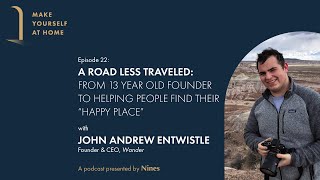
Make Yourself at Home, Episode 22 | John Andrew Entwistle, CEO & Founder, Wander