What John Andrew Entwistle, Founder of Wander is Doing Differently as a Second-Time Founder
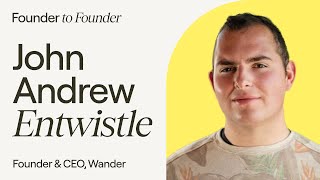
In this Founder‑to‑Founder interview, John Andrew Entwistle, the 26‑year‑old founder and CEO of Wander, reflects on how his experience as a serial entrepreneur shapes his approach at his second startup. He explains that founder growth is a gradual accumulation of 10,000+ hours, not a sudden transformation, and describes how running multiple companies rewires his brain and confidence. Entwistle shares several contrarian management choices—such as limiting one‑on‑ones and structuring meetings differently—made possible by the authority earned from his first venture, Coder. He emphasizes cultural alignment over pure skill in hiring, describing a "shared ethics" test (e.g., helping a driver with a flat tire) and the use of direct interview questions about weekend work expectations. He also discusses the mindset of interviewing as a two‑way match, aiming for Wander to be a lifelong workplace for employees. As a solo founder, he acknowledges moments of isolation but stresses the strength of his executive team and the company virtue that "no one is coming to save you," which fuels personal responsibility and freedom. The conversation moves to Wander’s rapid growth—about 30 % month‑over‑month portfolio expansion—and future product ambitions like AI concierge, dinner reservations, and geographic expansion into Canada. Entwistle offers a practical travel tip (inflatable seat cushions) for frequent founders and outlines his low‑key social media presence (website wander.com, @wander). The interview closes with enthusiasm for scaling Wander globally and making travel experiences more accessible.
Chapters
Hi, I'm Doreena. Welcome to Founder to Founder. In this episode, we're chatting with John Andrew Entwistle, founder and CEO of Wander. Wander is a travel startup that is fully redefining the travel experience. They're able to combine the amenities and the experience of staying at a 5-star hotel with the comfort and privacy of a home. They own and operate over 50 locations around the US And you know, they only got started in 2021, so they've accomplished so much in a short period of time. In our conversation with John Andrew Entwistle, we will learn about the story behind Wander, how they started, the way they've been able to scale their business and grow, and of course, about the way they're able to provide this amazing 6 out of 5 stars experience while offering a very consistent experience across their properties. Companies. So on that, please join me in welcoming John Andrew Entwistle, founder and CEO of Wander.
John Andrew, great to meet you.
Yeah, it's my pleasure. Thanks. Yeah, thanks for coming.
So excited to do this and get to know you. I was thinking about, you know, when I heard about Wander first, and I think it was when you guys were launching your founder— your, your founding members program.
Wow, so you heard about us super early.
I did. I think I have a lot of questions about that and the launch strategy, which I think was really brilliant. But I want to start from your story. I think a lot of people might not know, but Wanderer is not your first company. And you started a company called Coder when you were a teenager. You went through the whole journey. The company was valued several hundred million dollars, which is amazing. Series B. And that was also not your first company, which I, as I was learning, is just fascinating. Your first business was at the age of 13.
Yep.
That's amazing. Did you always know you wanted to be a founder?
Yeah, it's really interesting because obviously you do a lot of introspection when you spend the vast majority of your life doing something that's a little bit painful, which I think most founders and entrepreneurs know. It's a very painful career. And so late at night you're like, why am I doing this? What's broken inside me that causes me to want to do it over and over again? And I've narrowed it down to me and my sister, we were raised by my pop, he's a single dad. Really the most remarkable man you could possibly imagine, incredibly hardworking, just gave everything to us. And ultimately, I think that watching him work very late into the night, early in the morning while still taking care of me and my sister kind of instilled that I want to work like dad mentality. I think what it also instilled was a core motivator of doing well by and for others and making them proud. I think some founders are motivated by money or people or just all these various things, but for me it's really around making people proud. And as you know, when you're building a company, there are just so many people to serve. You serve your customers, your investors, your team. And so for me, it's a very pure Pure Source. But I would say that's really what got me started on the computer was wanting to work like dad. And fortunately, he was able to guide me through a lot of very complicated situations like, okay, son, this company's generating hundreds of thousands of dollars in revenue, you need to pay taxes. And I'm like, why? Is that—
What a common situation for a 13-year-old. You're like, yeah, dad.
Well, he definitely gets a lot of credit too, because I was not in the parenting books. Candidly speaking, I think that most kids aren't in the parenting books. And so he gets a lot of credit for not shutting it down. He could have unplugged the computer and been like, "Son, I need you to be focused on your homework." But instead, he sort of recognized what I was doing was a little bit different. And I certainly didn't make it easy on him. You're already the single dad, and then also you have this kid who's like, Hey, I don't want to go to high school because I want to work on these companies and I want to do it online so that I can save more time. And then also I want to travel the world, I want to race cars. And then like, "Hey, Pop, I'm not going to college. I'm moving to Austin to start Coder." And just all these things again, it's very different. So he gets remarkable—
Out of the playbook, no playbook. You kind of—
Yeah, no playbook. He gets a remarkable amount of credit. I would not be obviously anywhere near where I am without him.
It's amazing to have your dad as your role model, right? You almost have a mentor, a friend. That's incredible.
Yeah. He's also obviously a phenomenal asset. He's a truly incredible lawyer. He works on these large class action cases, so he just did the FTX case recovering funds for the customers and all these things. And so he's just a really great asset to have around the table. Free legal counsel, I always joke, is wonderful. So certainly we'll have him in the corner.
Competitive advantage. I love it.
It totally is.
Yeah. So you're 13, you are already thinking of— you're building businesses essentially at the age of 13. How did the idea for Coder come around? And how did you meet your co-founders?
Yeah, so those early companies that we built were just really anything and everything around the gaming space. So we hosted a lot of various game servers. We made little DDoS mitigation companies to protect those game servers, all those different pieces. And what ended up forming was this really interesting community of a lot of young hackers and people who are passionate about software and design and all the various various pieces. And so I met Kyle, one of my co-founders in Coder, as a software engineer. So he had joined and we ended up becoming co-founders on the little first companies. And then Amar was a system administrator that we had hired and then we ended up starting a few little companies together, particularly that DDoS mitigation company. And so the idea for Coder was really all around this idea of would there be Google Docs for code? Would software development move to the cloud? And it's interesting because today that's actually a pretty common thought. There are all these code sandboxes and all these various pieces, but ultimately none of that was mainstream when we started, which already makes me sound old because that's like if you talk to an old technologist, they're like, yeah, this was pretty—
Well, you were definitely ahead of the time, right? I mean, and when you started Coder, Yeah, what year was it?
We started in 2015. I think December 2015 was when Kyle and I were messaging about the idea. And then obviously we were still young, we were kids. I remember I was finishing up high school and so things don't move as quickly at that age because you have all these other shenanigans going on. You don't even know about venture capital and so you're just working on these projects. Maybe you have 1 or 2 software engineers that have now joined, so the team's a little bit larger. But it was a really phenomenal journey. I think things really started to pick up once Kyle and I and Amar had wrapped up high school, which is a funny statement because our parents were very strict on that topic of you guys have to finish high school. And then from there, we all moved to Austin, renting a rusty tin shack on the east side of Austin. I mean, literally just a joke of an office. And getting to work and then things picked up very quickly from there.
That sounds like a big milestone because you're leaving. Is that when you felt it was real? When did you feel it went from, okay, cool, it's friends, we're building something, we're having fun to this is a company?
Well, we were always so naive about what things could become in terms of being optimistic. So we never viewed anything we ever did as, oh, this is just a side project or it doesn't matter. We always viewed it in the absolute extreme of this is going to become a $100 billion company and we are going to rule the world. And we truly deeply believed that. I think you need that naivety when you're starting a company to get started because the odds are so low. The odds of building a successful startup, let's call it 1 in 1,000 depending on what your measure of success is. You have to be delusional to even get started. And so we were certainly always delusional about the impact we would have. And I think that what's so funny is if you asked an earlier John Andrew, hey, Coder ended up powering millions of software engineers and being used by large public companies like Vanguard and Goldman Sachs, all these incredible organizations. I would've been like, that's it.
That was the plan. It almost feels like for you, that was a part of the journey. Of course, what's next?
Exactly, right.
Was there a time in Coder's history when you— I'm thinking for some folks it's like the first big customer or you start hiring, you make your first couple of hires. At what point did you feel like you were It just seems like I know that those early days, it still feels a little bit more like a project and you're with your co-founders. It's very scrappy. Did you have a moment when it felt very real or like you said, it was from the beginning like that?
Yeah, I mean the company was always real, but there were some breakthrough moments. I will know obviously to anyone listening that one of the best pieces of advice that I got when starting the company was more of a warning, and it was that there will be 3 times in your company's history where you think it is going to die, flat out, you see no way out of the situation. And that was from this entrepreneur Alec Guttal, who I had met very early on. His other question to me was, are you sure you want to start this company because it's going to stock. It is going to be very painful.
You're in it for a lot of pain.
Yeah, exactly. Which at the time I didn't know how much pain, but he was absolutely right. And so there were multiple times where I thought the company was going to fail. I remember before we raised our seed, we had been doing friends and family and we had a month of runway and I had been pitching VCs nonstop. Meeting with everyone in the Valley you could imagine. And I remember when we had launched the product and we started to see that user graph really take off and we had a few technologists like Quinn Slack from Sourcegraph and John Kutemal from LaunchDarkly see the product and start to talk about it, that that was when the VCs that we were talking to were like, oh, there's something really interesting happening here. The reason why I mention that is because Obviously any successful startup will have those moments where things became real, like the big million-dollar customer and hundreds of thousands of users signing up and all these exciting things. But there were also plenty of times where I literally laid at bed at night crying as this 18-year-old, 19-year-old kid trying to figure out how I was going to navigate this company with 40 employees to that next milestone because you look at them and you know that you're responsible for their mortgage and their livelihood and the rest, and it is just a remarkable amount of weight to carry, especially as a young adult. And so even though obviously we had lots of successes along the way, those moments where we got close to death really helped form the company and also of course who you become as a founder.
Of course. Was there a specific moment you could share or something that is very vivid that you remember?
The one that I remember the most vividly where I literally would talk to myself that tagline that Alex shared of, okay, this is number one of the three times that I think the company's going to die. This is number one. While I was running Coder, I ended up hitting all three of them. That first one where again, the company had less than a month of runway. We had, call it maybe a dozen employees at the time. And it was on me to get that fundraise done and all the conversations I was having and all the diligence and back and forth. I do remember when I described crying, it was more just laying in bed staring at the ceiling with all these scenarios running through your mind and thinking about your team and how you're going to get to that next phase. And yeah, I mean, that tear rolls down your face and you're like, holy shit, you really are it's everything you have. And yeah, in any company there are multiple times where that happens. In Coder, like I mentioned, there were two more. I don't know if I want to share those because they're more recent history.
I have to tell you, I fully relate to that and it's almost any founder who doesn't, they're just not talking about it. But I'm curious, In that moment you're saying you have one month of runway, you'll have people depending on you. And you mentioned that one of the things that inspires you and pushes you through is making people proud. So you have a lot of people depending on you. What did you do to push through that? What was the insight that you were like, okay, here's how I'm going to get out of this?
Yeah, I mean ultimately constraints and pressure are a forcing function for action, or at least they should be. And so for us, we launched the product early, we turned on monetization, just any and every lever we could pull to show traction. And of course too, I was cold emailing every VC under the sun, which is ultimately how that seed round was led by Uncorked and Redpoint, and that's how I connected with them was just a really solid cold email, which of course is very lucky in Asia as well.
That is also very rare, especially with all the VCs who say, I mean some people say cold email works for VCs, others say no way. Totally. But you did it without, you didn't have any intros yet. You were just going for it.
Yeah, it was all pure raw outreach. I mean we had some people we'd meet along the way who would say, hey, happy to connect you. But ultimately Let's say that I was introduced to some new associate. As a new associate, how do you validate these 3 17-year-olds who are working on this project who have no track record? They don't even have a LinkedIn and they're trying to raise money for this concept of moving software development to the cloud, which is a very complex technical problem. And so, yeah, I mean, it was a lot of conversations. We also, I'm sure we're not the most polished fundraisers in the world. I remember my first ever meeting was with Google Ventures, which they're a remarkable firm, but not the best firm to do your first venture pitch with because you're just going to screw it up.
You should never do it with the firm. Yeah, you should kind of—
Exactly. You should pitch your second uncle, not Google Ventures as your first pitch. And I remember we were like, I guess we should dress up, right? We should look fancy. So we got some button-ups and dressed business casual. As we went, we got more casual. Like, okay, we don't need to look like bankers.
The less casual, the better. I feel like the look is the best fundraising look is like you have not been sleeping, hoodie, you just have to do that.
Yeah, but it was a great journey, a great experience. Candidly, a lot of brute force and a lot of credit to our early VCs for recognizing what we were building and that this was something that was a little bit different, especially before all the user traction kicked off. And ultimately it ended up becoming a really great round, which is how most rounds happen. It's like no traction until ultimately everyone's interested.
Feast or famine, right?
Exactly.
It's whatever.
But yeah, I remember too, Founders Fund ended up investing. I remember talking to Peter Thiel on the phone. I was so nervous. And then emailing back and forth with him and his team. I sent so many typos. And I'll never forget one of the partners from Founders Fund shot me a note and he's like, hey, you may want to slow down a little bit because you're sending a lot of typos. And I'm like, okay. And then I wrote it down in my list of everything I've learned to no more important emails from my phone. But yeah, it was a remarkable experience and a lot learned at a young age for sure.
And this is just what you shared. This is just leading up to the seed round. I'm only imagining how much you've learned throughout the entire journey. One thing that that really impressed me was that as you were sort of transitioning from Coder and between that time and you starting Wander, it was very little time. And I would love— it's a fascinating story. I would love for you to share it. And I'm just so curious about what was so special about the idea of Wander that made you essentially jump into it right away.
Yeah, so I had been running Coder for 5 years, CEO from ages 18 through 23, a very hectic 5 years. It was the majority of my adult life. Let's say I became self-aware at 16, which can sound funny to people, but let's just call it that. Then I was running Coder for, again, that vast majority. So my entire young adult brain had formed around building this company, running a startup. And so when I left that company post-Series B, and it just becomes quiet, it's the most interesting thing in the world. It's constant communication, constant everything, and it's like someone turns off the air conditioner and all of a sudden the room is just quiet. Your phone isn't blowing up anymore, there are no more emails. And I remember thinking to myself when I had done that last all hands and I had rehearsed it so many times that, because I knew I wouldn't be able to get through it if it wasn't rehearsed, saying goodbye to the team. And so I had just rehearsed it to the point where I was just on autopilot. I remember sitting up there and at that point I was in Boulder, Colorado signing off, doing the last board meetings, et cetera, and thinking to myself, whatever I do in the next basically 3 months will determine the rest of my life from a trajectory perspective. Like, no matter how planned or smooth a transition is, it's a very difficult period in your life. And so I knew that although I could feel almost like the sadness and separation and all these pieces, that I really had to hit the ground running. I had to quote unquote tough it out. And once I had decided that I was going to start another company, even if I wanted to take more time or whatever else, that I wasn't going to, that I wanted to make sure that the rest of my life was easy because I made a lot of hard choices early. And so when it came to Wander, I was evaluating a bunch of different ideas, obviously most of them SaaS, software, true software products.
And also with your experience at Coda, it would make so much sense. You would just be like, here I am.
Exactly. But when I had the idea for Wander, it wouldn't let me sleep at night. I began to think about all these different components about the booking engine and the property management software and the guest experience. And ultimately what the end deliverable was, like the impact of creating happiness. Every business has, I think, a positive impact, whether it's some medical supply company creating some niche product that then saves someone's life, or you can go as far up or down the chain as you would like. For Wander, I loved the idea of delivering happy customers, like delivering this true happiness in people's lives. It felt like a very pure outcome. And so once that idea had taken a hold on me and really started to tap into all of the pieces that I was passionate about, obviously as a kid, I loved to travel all through high school. I traveled all across the world. I loved brand and consumer products from my early days as a young teenager to, okay, how do we build the go-to-market motion for adding supply onto the platform, which I had built at Coder? It seems to people who know me very well, Wander is a very John Andrew company. But if you just look at my LinkedIn, you would say he should have gone and started some enterprise B2B SaaS company.
Selling to government, how it usually goes.
Exactly.
Consumer, you go from consumer to all the way up the chain to enterprise.
Exactly.
You did something different. I read somewhere that the idea for Wander came when you were staying at a you rented out a place and you kind of experienced the pain yourself. Could you share more about that?
Totally. So after I had signed the final paperwork for Coder, I was in Boulder. I got in the car and it went off to this cabin that I had rented deep in the Rockies. I wanted to give myself a week to recover. And it was so funny, I remember stopping at the local library and just picking up a bunch of random self-help books. 'Cause I'm like, I hear people read these, I'll read The Art of Happiness, I'll read all these things while I'm up there, get my head straight. Or at least arm myself with some mental frameworks to recover faster. And so when I got to that cabin, I mean, it was a very tranquil experience, but ultimately, The place didn't look like the photos, the beds were uncomfortable, the internet was nonexistent, which was fine. I sat outside and read my book all day and thought about the world and talked to whatever employees or investors or the like who had XYZ questions and those pieces. But that's where I wrote down that idea for Wander where was there the opportunity to verticalize the vacation rental space and solve this problem of consistency and quality for the consumer? And again, when you start to think about what Wander now does and the scale that it's at, it is a massively complex business. I think this is something we talked about a little bit earlier where you have the booking engine and the platform and the brand. Then underneath that, you have all these operations. You have the guest experience layer, you have the vendor management layer. And so I think it was actually that complexity in solving the customer problem that really made me excited and passionate about it because again, there are very few people who I think are passionate about the brand and travel and then also the software side and all these different components. And it just felt like I was creating a company that was that was who I was.
Yeah, it seems like people always talk about founder market fit or founder market fit, founder product market fit, one of those. But it seems like it makes a lot of sense based on your passion and things you care about. I think for me, before chatting with you, I think of Wander as a consumer, as a It's a great way to book a place to stay. You kind of get kind of almost drawn into your incredible photos, and you're almost like, okay, I'm booking, I'm booking, you know, a getaway right now. But obviously, as you mentioned, the business, everything that powers it behind the scenes, is so sophisticated and complex. And you mentioned when you were thinking about the idea, you were already thinking about all those pieces. How much of what Wander is today did you essentially anticipate or did the vision change dramatically or no?
Yeah, the vision itself didn't change in the sense of Wander solves the same customer problem that we set out to solve. At the end of the day, there are changes like any business in terms of thinking, okay, the first way that we're going to scale supply is this way, and then later on you change it to a different model or those types of pieces. What's really interesting is when starting the company or before I had started the company, I basically created this document, this pre-mortem document trying to figure out why would this company fail? And it turned into this 80-page document of all the different risks and reasons from, okay, we need to create our brand, to we need to own our demand channels, to can you actually automate property management? Is that possible? What type of margin profile can you get to? All these different things. And what you end up with is basically, okay, if we face a problem, then we need to do b solution, and that continues. And so most of the things that we changed or evolved were in that original document. They were just maybe plan B or C as opposed to plan A.
So it's almost like you were de-risking everything in that document.
It's a very important concept and this is actually probably one of the best pieces of advice I can give to early-stage founders is this idea of hedging progress or at least de-risking as you said. So in the early days you have so little data, so you need to do action to get said data. But the thing is, is if you have something that there's a 20% chance of working and you have 6 months of runway and that thing is going to take 3 months, then if that is the only thing that you do and it is very unlikely that it works, then you're going to be staring down the barrel of your company failing before you've started plan B or C. And so one of the things that we did very early on in Wander is run multiple different paths in parallel anytime that it was sort of a life or death situation for the company. A good way to visualize it is you have the main ship and then you kind of send out some dinghies to explore, does that island have fruit on it or not before you go and turn the main vessel? And so that idea of hedging progress is actually a company virtue of ours. As you grow, it's sort of less relevant because the main thing is working, it becomes more stable. But in the early days, it's kind of throwing things at the wall and seeing what sticks. And if you only throw one thing at a time and do a bunch of analysis and throw another thing at the wall, then it's like you burn time. And obviously as an early-stage startup, time isn't your friend. So I highly recommend hedging progress, thinking about the different solutions, seeing what you can run in parallel. It really changes your odds.
It's almost like you have your core mission bread and butter, and then you have teams in parallel exploring just hypotheses that are not aligned with that core mission.
Exactly. An easy way, I mean, it's even relevant in the world of fundraising as a very simple idea. So you obviously talk to more than one VC because you know that one of them could drop out or multiple of them could drop out.
And realistically, you only need one to say yes.
Exactly. But you talk to multiple and what you're doing there is you're hedging progress, right? Because if you only talk to one at a time, you're going to run out of money. If you talk to one, wait for them to say no and then talk to the next, it doesn't work. And you can have that same principle in other areas of the business. I will note you have to be very careful not to defocus the company to the point where you don't make any progress. So it's really only to see if something has initial signal and then once it does, you focus everyone back in.
It's almost like an experiment.
Exactly right. Yeah.
So I'm curious, you were talking about the early days of Wander and I really want to learn about your launch strategy because I think Frankly, as an outsider, I did not feel like you guys were throwing things at the wall. It felt very cohesive and intentional. At least that's my perception. But I'm curious, even before that, before launching and getting first folks, right? So you are now a second-time founder. What do you do differently? And what are the first things, like you made that document, 80-page document, right? Here you are off to build Wander. What are the first things you do as a second-time founder?
The output of your pre-mortem, which by the way, you don't need to wait until you start a company to do it. You can do it for new products. You can do it now if you have uncertainty in your business. Honestly, it's more like it just looks like a business plan with a very deep risk section. But what comes out of that is basically a bunch of questions that need to be answered. It's interesting. I think a lot of people who don't understand startups or startup founders well are sort of like, oh, here are all the reasons why your company can fail. Realistically, the founder is more than aware of all the reasons their company can fail. So it's kind of a funny interaction to have is like, well, your company probably won't work. And it's like, well, obviously.
Trust me, I have a doc on that.
Yeah, exactly. What are all the reasons? Yeah, it's a very silly mentality to me. It's like, yes, but there's a 1% chance that it will and that's what I'm going after. Sector. But to answer your question, the output of that doc is basically a bunch of core questions that ultimately I wasn't able to answer just working in my own head, such as can we create a brand that resonates with consumers? Would the NPS and customer satisfaction be a meaningful improvement over what existed in the industry?
Like 10x.
Exactly right. Could operationally we run each location as its own independent business? And scale across the United States as opposed to having to have geographic concentration? All these different questions that ultimately I wouldn't be able to answer other than have a general thesis. And so this is where I think it was Marc Andreessen said it. It's like this idea of peeling layers of an onion where it's like, okay, you have this thesis, you peel a few layers and you see what's there. Okay, then maybe you raise some capital, you peel a few more. It was very much like that, the early stage of Wander. I had all these core questions that had to be answered, and ultimately the answers to those questions relied on having really great team members as well. So on the idea of creating this really incredible brand, I ended up meeting Kyle Tibbetts from Twitter. He was previously the head of brand at Opendoor, also early at Hotel Tonight. Made a stretch higher to try and get him in very, very early on. On the technology front, I knew that I wanted to walk down the path of property management being a software problem. Could we coordinate all these vendors sort of how Uber coordinates their drivers to really optimize and run these properties at a higher margin profile? Was that even something that was possible? And if so, who would I work with? Ended up bringing Nathan Potter on as our CTO. He was previously the head of product with me over at Coder. And so you just end up building this team to solve these big questions and big problems that come out of basically that risk document. And so for us, we ended up answering a lot of questions on the way. And of course you end up discovering more as well. You can't see the whole future. There's going to be more data, things that you didn't see, clouds on the horizon that you didn't anticipate. But ultimately at this point in Wander, All of the core questions have been answered and now the last big one is scale. How big can this get and how quickly can it get there? And that's a very scary question to ask is how big of a company could this be? But so far the core things are all moving in the right direction. We've built something that customers [FOREIGN] And so we'll see what happens from here.
You have the foundation now, so now it's scaling, which I think it's fun and scary in a sense. But going back a little bit to that part, so you mentioned you bring in people, so you have all these things to de-risk. You bring in people who are going to own these areas because obviously you can't do it all by yourself. And I do remember seeing on Twitter the waitlist. I think you guys had a waitlist for founding memberships. Talk to us about that and just really what was the intentionality and the idea behind your launch strategy?
Absolutely. I think a big trap that founders fall into is that they build a product without any validation, which is not something that I wanted to do. And so I had two pieces of it. Number one was a lot of founders create a waitlist, But the problem with a waitlist is it's the lowest barrier to entry concept to find market validation you could think of, right? Because it doesn't take any effort for someone to put in their email address into a product. So you can build a lot of fake hype and excitement and validation, which is better than doing nothing.
You're collecting email addresses.
Exactly. But you're collecting email addresses. So I wanted to make sure that what I was building was something people were actually willing to pay for. And so the idea was rather simple. It was, to announce this idea that we were working on to have the waitlist, but to have a second tier that we called founding memberships where when we did launch, you would get $100 credited to your account, you get a Wander hoodie, you get certain community privileges, those different pieces to see whether or not people were actually willing to pay for this product that we were launching. How real was the signal? We ended up generating I think it was $200,000 or $300,000 in founding memberships in the month and a half ahead of launch. And again, that wasn't our business model. So the moment that we did launch, we turned off founding memberships and those founding members I still so deeply value. There will be a big party at some point that I will throw for all those people who gave us that early belief. Many of them have invested in the company, so there's ways to keep that core community.
Those early adopters are the reason why startups are here, right?
Exactly right. But that was the purpose of it, was to make sure that we were building something that people wanted and were willing to pay for. Once we had actually launched the product, the first 3 properties were instantly fully booked out.
And you already had an existing audience of those folks to basically say, guess what, here are the properties.
Yeah, exactly.
What was it about? Do you think it was the distribution, the message, the way you talked about what Wander is going to be? Because to get so many people not just to put in their email address, but to actually give you $100 when there is nothing tangible they're getting back, that's incredible. What do you think was it about the way you executed this launch that resulted in that? Type of response?
I think the first thing was idea market fit. So there's a lot of talk about product market fit, but before product market fit, there's idea market fit. And so we had built something that had, or we had come up with an idea that had idea market fit. So from a marketing perspective, you need to articulate that to the user. What is it that we're building? How is it different? Why would you be interested in this product? I also think that it was a problem that the majority of people have had. When I talk to anyone about their vacation rental experience, everyone has a horror story or something that they're unsatisfied with. And so I think that really deeply resonated with those consumers. And so once we had shared the idea and sort of talked about where we were going and they could see that we were going to make it real and they believed in the execution, Then I think from there to your point, those early adopters saw something that was real. You have these people who are optimistic about the future. Obviously, the counterpoint is you have all the people who are unoptimistic about the future, but you have this core group that was super excited. And yeah, to your point, there is not a single company that would exist today that changed the world that would not exist without those folks who believed and were excited and encouraged that team because that's what fueled us, or the excited tweets and all that sort of cool stuff.
I'm sure you guys get tons of repeat business, customers who are coming back, love the product, refer friends, all of that good stuff. But at this stage of the company, what are the main marketing channels that you use to get in front of new people?
There's a really wonderful book, it's called Traction, that sort of outlines what are all the various ways that you can get new customers and find them from TV to referrals to whatever else. Ultimately, there are only so many channels and then inside of each channel, there are a bunch of different subcategories. So on social media marketing, you have Twitter, Facebook, et cetera. And then within that, you have all different content strategies and as you know, it's a Massive, ever-changing field. The way that we do it is we definitely use a very multi-channel approach with this idea that we want to relentlessly track what are our costs, what are basically the unit economics of each customer, and then make sure that all of our marketing spend is very profitable. We're, I would say, pretty dialed in at this point to those core channels. Influencer marketing, search ads, those different pieces. But to find them, find what content worked well and those nuances requires a ton of testing. But ultimately, at this point now for Wanderer, it's really just getting the idea in front of travelers who want to go and book a vacation rental. And so it's distributing how do we get that idea to them in the mediums that they already are consuming? So think you're scrolling through Instagram or you're searching for vacation rentals in wine country, those different things. How do we ensure that Wander shows up to those users? What's really great is our NPS is remarkably high. It's in the mid-80s. And so that means that once a customer stays at a Wander, they tell absolutely everyone, which is exactly what you want. So we do see a really great flywheel of once someone experiences a Wander, then the 100 people in their network then just hear nothing about it, becomes a part of their identity, which we're obviously super grateful for.
And also it's a social experience, right? So a lot of times they'll be doing it with their friends, family.
Exactly right. Yeah, they'll bring 5 to 10 people with them on said trip. And so that expands it pretty quickly.
How do you think about just content creation in general? And the investment that you put into organic content?
Content, I would say, is one of the most valuable forms of marketing, original content specifically, obviously. When you look at the world that we're in today, the way that people find information, the way that these search engines are indexing, etc., even when you think about YouTube as an example, YouTube is the second largest search engine. Even Spotify, when people search for podcasts or whatever else, is a search engine. And so everyone's looking for this unique and original content, this information that they can't find anywhere else. And so creating that information as a company is really important. That used to look a lot like just writing original blogs as an example, but nowadays almost everything is indexable. And so whether it's a podcast like this or videos or even photos, which I find really fascinating, obviously you have Google Images and Pinterest and these companies that literally will show the consumer photos that are relevant to them and then take them to whatever website those are hosted on. The interesting thing about content as well, as opposed to just performance marketing, and we talked about this a little bit earlier, is that you own that content at the end of the day. And I think that that's something that doesn't necessarily click with a lot of marketers, is this idea that when you spend money on a Google ad, the moment that someone clicks, that money is spent and it's gone. Versus when you spend money on content, at the end of the day when someone clicks on that, you still own your content. So a really good way of thinking about it is like you own this stock that also issues a dividend as opposed to something that just goes away once it's used or only generates revenue for you once. If you can create this massive content library, then it can continue to support you and your company for a very long time. I think the easiest example of that would be like a Disney who has a massive catalog of original content, and that is what fuels obviously that business. And I think that's something that everyone can do.
I mean, it is a content business.
Absolutely.
So that's so interesting because I also, by the way, think that that works really well with influencer marketing. And I want to mention that the way I found Wander doing it is really smart because I think that— and it makes just so much sense, right? It's almost to me, it seems like for the kind of company you are building, Going back to when you wrote that 80-page document, was there a lot there around marketing and content? Because I feel like you need to be that content brand.
There certainly was. So the way that I looked at it was through the lens of having a moat. So there are obviously different types of moats. You have distribution moats, technical moats, all these different things. For me, the way that I looked at each home on the platform was like an original piece of content, sort of like how you have these original shows on Netflix that are only on Netflix. The idea was, could we have a bunch of exclusive inventory that was just original content to Wander? And then taking that idea even further, could we then create content and marketing around that specific thing so that when someone went onto our marketplace, they were like, oh, I think I'm going to watch that, or I think I'm going to experience this home. Really thinking about the homes as content and content engines in their own right. This idea that it was the home that was marketing to the consumer as opposed to marketing Wander as a single idea. What's interesting is that's the same idea behind an Architectural Digest. When you think about Architectural Digest, the reason why the brand is so strong is because the homes are remarkable. It was really taking that idea and bringing it to Wander.
I love that.
I would love for Wander to be like the Wander Concierge to be useful even when people aren't staying at a Wander. I would love the idea that you're like, hey, I just want to go and book a dinner reservation. I'm just going to message the Wander Concierge and have them go and take care of it for me.
That's amazing. I mean, now I'm actually immediately thinking from the— it's like a lot of products create free— I mean, it's the free product that is adjacent to your main product that could be just Wander Concierge available to anyone and suddenly I'm still in the marketing.
No, it's about this idea of just, it takes advantage. So going back to the idea of moats, you want to take advantage of whatever moats you can create with your strategy by building our own platform. One of the moats we created is this idea of a distribution moat. It's the same reason why when Apple released Apple Music, it became bigger than Spotify overnight is because Apple had this massive distribution moat to everyone who had an iPhone. And so for Wander, Any product we release is now instantly going to 250,000 users. And so that's very powerful. And so if we want to create all of these enrichments into our AI concierge, such as being able to book flights or dinner reservations or the like, now we have a distribution mode to 250,000+ high net worth travelers.
And they're also not just, they're very highly engaged with your brand, obviously. Absolutely.
Now, I think I do want to note in the space of AI, because it's one of those things where I think AI is moving so quickly that Siri will be able to go and book your flights and dinner reservations. Google Gemini or whatever they call it in its final version will be able to do the same thing. Alexa will be able to do the same thing. There will be so many AI assistants that can do all—
And startups are going to do a bunch of—
Startups. So there's going to be so many pieces. So you can't think about it in terms of is this my product? You have to think about it in terms of what are users going to expect down the line? And the interesting thing is that users' expectations, because of how advanced all these systems will get, will be that if I cannot book a private chef through my AI Wander concierge, then this platform is old and outdated. And so that's really the mindset that we're building these things in, not in the sense of like, oh, this is going to be its own standalone product and compete with Apple's eventual assistant and ChatGPT and all those different things. It's really around this idea of customer expectations in the world of AI and technology are rising so quickly that as a consumer company, if you don't have these features, you're going to end up behind.
After hearing all of this and after experiencing Wander myself, I definitely don't want to be your competitor, to be honest. You guys have elevated the expectations for customers, for guests. And I'm just curious, when you are doing that, when you are deciding, like, okay, what's the new way that we will innovate for our guests, surprise and delight, etc., do you take that inspiration from customer feedback? Is it your vision? Is it a mix of both? Like, what is it?
I think in the world of startups there are two potential customers, one that you know nothing about and the other that is very similar to you, this idea that you are your own customer. For example, in my first company Coder, our customers were large Fortune 500 companies with tens of thousands of software engineers. I have never worked at a Fortune 500 company. We were not a Fortune 500 company. We knew nothing about the security practices and the like. And so every conversation was discovery. I think that's where that Y Combinator concept of go and talk to your customer is such an important one because otherwise you're just flying blind. The other set of customer are the ones that are like you, this idea of I have good taste, I know what I want, I know what I like. I also know what other people like in this category. And so I have a vision for a better option. One of the great examples I always love to share is when people, when Henry Ford asked people what they wanted for transportation, they always said a faster horse. They didn't say the car. And so you do need to at some point recognize when do you know what your customers want and then build that. And then the other is when do you have absolutely no idea what they want and you want to validate and ask them In the early days of a startup, you need to identify which one of those it is very quickly, and then obviously you can build based on that. You always want to validate and check along the way that idea of seeing if you have idea market fit, sharing, asking questions, say, hey, this is what I'm building, what do you think? I can't tell you how many emails I sent to our broad user group of like, hey, I'm thinking about launching this feature, what do you think? Getting those replies, taking those into consideration. For the most part, Wander has been a vision company as opposed to an iterative company in the sense of I had a very clear vision of what I wanted the experience and the product to be like. And then that ended up resonating with consumers and of course we validated it over time. Now of course with a vision company, what you can get is a lot of things that don't scale. I always think about Steve Jobs being like the font needs to It needs to be like this or XYZ.
Very OCD about every little detail. Exactly.
And so it can be slow, it can be difficult to scale. Wander obviously was very similar. You want to deliver this 11-star customer experience. You want to give the customers the world, but ultimately as you scale from adding 1 location a month to 20 a month, you need to start cutting some of those pieces. And then the hard part is, What do you cut? And that's when you have to talk to customers and understand what do they actually care about? In Wander's case, I think when you went and visited Calistoga Valley, you mentioned that you saw a Tesla there. When we started, we wanted to deliver the most extreme experience you can imagine. And so we wanted every property to have a Tesla, all these different pieces. I mean, you could even control all the lights right through your phone, all the smart home technology. It was really epic. And the fact that an early startup built that, had an integration with Tesla, et cetera, was pretty wild. But as we—
Definitely not something people expected, right? You almost like, wow, all of this is here already.
We almost started with the perfect product first, which I think is ironic.
The anti-MVP.
Yeah, exactly. I think the version that was MVP was how small it was, how few properties it was in Wander's case, which I find really interesting. Versus a software product that follows that vein, it's like could scale to millions of users.
It's almost like narrowing the scope by narrowing the number of properties. The size.
Yeah, exactly.
But then delivering everything you could even imagine.
Exactly. And then having all the data that that action created to be able to make those decisions. Ultimately, as we scaled and we asked customers, did they care? They ended up not caring as much. Really what they wanted at the end of the day was incredible customer support. Cleanliness, its consistency, and the underlying quality of the home. And then there were certain wander standards like beds and linens and towels that they wanted to be consistent. But beyond that, those sort of frilly features didn't actually have any impact on our NPS or CSAT. And it was really interesting when we took those features away, not seeing that drop in CSAT, just seeing everything sort of stay the same. And so I think that candidly speaking, that's probably something that most founders should do is take a hard look at their product and say, okay, as we scale, what pieces of this don't scale very well or what pieces of the product are hard to maintain? And if we got rid of this, would it actually affect our MPS? Would it actually affect our CSAT?
Maybe it simplifies your operation. Exactly. It makes things a lot easier. That is not something I would agree. That's not what people usually talk about. It's usually the other way around when they offer very little, sort of like the MVP land, and then you add, add, add. But I think in your category with your kind of company, you had to do it this way. And I also think that all the details, all the amenities, everything you do at Wander created a lot of word of mouth. So even if you maybe remove some of those things, you've created a brand around that. Totally. People now view Wander as this insanely high-end experience.
Yeah. And I think the cool thing is obviously we continue to deliver on that, but it's all around this idea that to create a really beautiful and strong brand, you have to deliver a great product. You cannot have a good brand and a bad product. And so the two go hand in hand.
I have to ask you about your journey and the differences between being a first-time founder and a second-time founder. And one thing that I want to share is I was in touch with Kyle, your CMO, and I asked him, what is your founder superpower? Do you want to guess what he said?
I do not. I have no idea.
So he said something which I think is amazing and makes so much sense for me. He just said you are an execution machine and you velocity and ability to take an ambitious vision and break it down into a timeline that's a lot shorter than what people anticipate. He mentioned that as your superpower, and I think every founder wants to have that superpower. So what is your secret?
Well, first of all, I'm super flattered. Kyle is being way too kind.
Sometimes I find it's easier to know based on the folks you work with versus yourself. If I asked you that question, maybe you would be very humble.
Yeah, I think the idea of giving some type of self-flattering answer is not my personality.
Yeah, I figured.
I think at the end of the day, you really do want to break down some large problem into a bunch of smaller problems. And I think that mental framework isn't just something that's relevant in business, but it's also relevant in life. Like, okay, I want to be here in 5 years. That seems impossible until you break down the individual steps. I would say that I spend a phenomenal amount of time in the future to the point where I actually think that it's a little bit of a con, not a superpower, how much time I spend thinking about about the future, both in terms of the company and also my life. I think I've lived my life a million times in my head at this point. And so I would say that that level of clarity really does help break down what types of actions and goals I think are important for the company. It also allows for us to assign probabilities of success to various outcomes and to my point earlier, run different things in parallel to make sure that the company never seems to miss a beat even when 4 out of the 5 things we started failed, which I think is why to an outsider looking in at Wander or really any of my previous companies, they see something that always moved forward. And so it always seems like we always had the answer when in reality we didn't have the answer and we knew we didn't have the answer. We just knew that one of the 3 variables was going to be correct. And so we did all 3 at once and that allowed us to just keep moving forward.
Momentum breeds momentum. So the fact that you did that then made it easier for you to have the other set of assumptions and hypotheses to be tested.
And there are certain things on the topic of speed that I just believe in. I think that there's a lot of busy work that's done inside of companies. If something doesn't move the needle, I tell the team that I do not want us to think about it. We call it fake work inside of the company. And so now we have a culture where people, if they see some type of busywork being assigned, they'll just be like, this is fake work, which I find very funny.
You should also get a Slack emoji for that.
We do. Someone created one. Yeah, I will never use it obviously, but the rest of the company does. But yeah, it's all about this idea of laser focus on outputs, not inputs. I think that's also something that there's a little bit of back and forth about inside of company building or even as an individual is you want to measure your output. Obviously, you want to do inputs to get you toward those outputs, but you have to measure the output to know if the input is even productive. For example, if someone is starting an exercise regimen with the goal of lifting 100 pounds, but their success criteria that they're measuring is the fact that they go on a walk every day. It's like, yeah, you did all the inputs, but when you measure that output, you're no closer to lifting those 100 pounds. And so in a company building, it's all about saying what are the outputs? What are the specific goals that we want to get done? What are the KPIs and metrics and things that we need to do? And then from there, figuring out what the inputs are and if they have a positive effect. So I would say that that's really what leads to Wander speed is I spend a lot of time thinking about the future. I encourage the company to, we assign a probability to those futures and then basically chase down whichever ones we think are the most likely. And if there are multiple that are unlikely but very important, then we'll chase down multiple at the same time. And then from there it's cutting out all busy, all sort of quote unquote fake work, those different pieces to ensure that everything we're doing is is highly productive.
Yeah, I think it sounds, and I mean at the end of the day you need to do it in your context. It's one of those things that is just so hard.
Oh, it's remarkably difficult.
Especially as your company is growing. Thank you.
Yeah, it all boils down to clarity and I think also culturally not being afraid of getting rid of what I think are a lot of very basic corporate rituals. I think that we talked a little bit about this idea of one-on-ones as an example, which this can be a very controversial topic.
Oh, this is so controversial. Yeah.
Ultimately for me, pre-scheduled meetings are very difficult because they can take you out of flow. They can corrupt your calendar. And so when I need to talk to an executive, what I encourage is the idea of, hey, if we need to talk, let's talk unscheduled versus having something that's recurring on the calendar. And what ends up happening is let's say that we can even save 1 hour a week by potentially skipping something that was prescheduled or the like. And you take that and you multiply it across a 70-plus person company, you end up with just a lot of extra efficiency. And so there are all those little types of very comfortable corporate rituals you have to take a deeper look at and have a little bit of courage and say, okay, we're going to try to execute without this and see what happens.
How many team members do you have at this point?
I think we have about 70.
70. No one-on-ones?
I do not do any one-on-ones in the traditional sense. When I say something like that, everyone thinks, John Andrew just doesn't talk to anyone ever.
Yeah, you don't talk to people.
Which is obviously false. The way that it works is that when someone in the company needs to talk to me, they know that for the most part, my calendar is empty and they can reach out to me at any time, whether it's 3:00 AM in the morning or in the middle of the workday, and I will answer whether it's a Slack huddle or a phone call or the like, and we'll problem solve. If they have some personal thing going on, we'll talk through it. And then it's resolved and then the world continues. And so ultimately for me and for the team, they know that I'm accessible, they know that I care, they know that I'm very reachable and that in the same way, let's say you and your friends don't have some recurring meeting on the calendar. Some people may and I think that's totally fine, but let's on average—
You don't send Calendly to your friends?
Not for any type of recurring thing. I'll use my pop as an example. Me and my pop don't have a recurring one-on-one in the calendar. I will just call him when I want to talk to him. And that is the same virtue that we have inside of Wanderer. And we also keep everyone very aligned on their tasks and responsibilities. All of our communication is very asynchronous. And what ends up happening is you have a culture of freedom where again, what we measure are the outputs, not the inputs. For a team of very effective people, you have this total autonomy. I sort of tell the team that there is no concept of a workday. It's like you get your work done when you're most productive. You talk to people when you need to talk to people. If you can't join a certain— if you want to share something with the team, like a presentation, record a video of yourself and share it with them. And so you create this constantly evolving, constantly moving machine. To be clear, there are obviously cultural dynamics where that works and where that doesn't. And you can't— it's all about the type of people that you hire and whether or not they're productive in that environment. I like to talk about this example of certain trees grow well in certain environments and in other environments they don't grow well at all. And that doesn't mean that it's a bad tree. It just means that Some environment may be good for some people and some environments may not be good for others.
There are people who would probably love what you're describing and others who would say, hey—
It's tough.
Yeah, it's really tough.
A fast-moving autonomous asynchronous environment is some people's dream. The idea of I'm not being micromanaged, I don't have a calendar full of meetings. For some people that's really exciting. And then for other people, they need a little bit more structure. And that doesn't mean that they're not productive or incredible people. It just means that a company like Wander may be a little bit more challenging.
John Andrew now is a second-time founder versus John Andrew at Coder. What's the biggest difference?
I think that I would say that it's less of some separation in those 3 months between exiting Coder and starting Wander as, oh, I just went through some radical transformation as a founder in those 3 months that made me better. I think what's interesting is this idea that It's about time. It's about getting your 10,000+ hours in as a founder.
So it's a very gradual journey if someone were to—
Exactly right. And so for me, I've been running companies, obviously when I was 13, 14, I would not say that I was a good CEO. To be clear, ethically and culturally, I'm the same exact kid. I love I love people, I always speak softly, I'm the same individual. But as I've grown, I've become more intelligent, a deeper understanding, I've read more books, I've had more conversations, I've fallen more times than I can count. And so that makes you a different type of leader as you go. I've also at this point been through the journey of pre-seed, seed, Series A, Series B, at some point I'm going to hit the threshold of having been there and done that, which you would expect, right? I'm still relatively young. I'm 26. I haven't ran a public company as an example. And so not yet. Not yet. Hopefully one day I'm lucky enough. But the idea is that when I get there, it's not exactly like I'm going to be an expert. And so—
There's always a first time for that new stage.
Exactly. And so I think that there are certainly lessons that I've learned running companies and running multiple companies definitely totally shifts your perception. It rewires your brain in a really interesting way. Mostly I think because as a founder, your brain forms around company A and then all of a sudden now you're working on something entirely new and you kind of zoom out to a different degree. But I would say for me, I ran this company, I ran Wander in a very unafraid way. I developed opinions that were potentially a little bit contrarian, like wanting to limit one-on-ones as an example or wanting to structure them in a very different way. And had the confidence to actually go and execute on that as opposed to, I think a lot of first-time founders may not have the confidence to do that and they're trying to work inside of a structure that simply doesn't work for who they are or their management style or their team because it's the industry standard. So I would say that type of confidence, I would say prioritizing different things from a team perspective and cultural perspective. Yeah, there's a lot.
What's the difference in how you hire? Because I think that's obviously something that I know every founder talks about, things they wish they knew, mistakes they've made. What's the difference if you compare to your hiring process or hiring philosophy at Wander compared to previously at Coder?
I think that cultural alignment, is really important. And what I mean by that is the idea of shared ethics. I like to work with the type of people who, if they're driving down the highway and they see someone with a flat tire, they can't help but want to stop and pull over. That's who I am. Those are the type of people that I want to hire. And I will prioritize those attributes over skillset. Every day of the week because ultimately what you get is a team with very aligned ethics and who they want to be as a person. And that obviously translates into who the company is and what those things look like. And so I would say that that was a very radically different piece. As an early-stage founder, your first time around, you maybe hire that engineer who's not exactly a good cultural fit, just because they're so skilled. But in reality, that will end up really harming your company in the long run because at the end of the day, a company is just a group of people serving other people, AKA your customers. That's all it is. And so if you don't have a true people-first, ethics-first belief, then you're going to really struggle.
Yeah. I'm sure everyone wants to hire those incredibly kind, empathetic people. I think, you know, I can't imagine someone would say they don't. But the challenge is, how do you get those signals when you're talking to them during the interview process? How do you know before they're at the company that, hey, this person is perfect for our culture? Do you have any tips for that?
I ask exceptionally direct questions. I think that, like, one of the big mistakes that people make when interviewing is that they ask very roundabout questions or they kind of touch and feel and see and it's like they treat it like a game of poker. And it's like if you're the type of company that you want people to, let's say an example, if you're an early stage company, you may have times where people need to work on the weekends and that's just how it goes. But you obviously don't want to have a culture where you're telling people they have to work on the weekends and they hate you because that's not a great vibe. So you want to hire people who understand that, hey, I may have to work on the weekend for this role in this company, and is that something you want or not? Rather than asking some convoluted question about who is the hardest working person that you know, and then trying to extract, is that person good or not? I will just—
People ask that?
That's an interview question. I would just ask the question of, hey, sometimes we have to work on the weekends as an early-stage company to reach your goals. We're not going to tell you that you have to, but it may be obvious if you're falling behind. Is that something that you're okay with? And then people may say yes or no. And based on that answer, you can make a very clear decision about whether or not they're going to work for you at that stage.
And hopefully people are self-aware enough to also know, like, hey, is this going to work for me?
People really are. I think that that's also part of the problem with companies and interviewers. The goal is not to convince the person to join. I think a lot of interviewers get stuck stuck in like sell mode and they don't want to scare the candidate.
Like, it is like, we're all great, everything is great.
Exactly. Yeah, you want to communicate the reality of the role to the candidate as effectively as you can, and you want to ask as many questions as you can to ensure that you're getting past the— like, everyone wants to do a great job in a job interview, obviously, and you kind of have to tell them. And what I tell candidates at the beginning of an interview process is the goal is not to get hired. The goal is for you and I to figure out if this is a match made in heaven on both sides. And that kind of shifts their perspective to saying, okay, I'm interviewing you and you're interviewing me and let's figure out if this is my forever career. And that's one thing that I also tell the team is that I want Wander to be the last place that you ever work. I want it to be such a great fit that this is like you're going to have a 30-plus year career here and then you're going to retire. And so in that sense, we really need to figure out if this is the right place.
Yeah, I think what you're saying, it almost is so obvious, but sometimes you forget. And I think it's very natural for you as the— I'll tell you from my experience, for me as an interviewer, I feel like you almost immediately go into the sell mode, but that's a mistake because one thing's— of course, when you're joining a startup, you're joining, it's a roller coaster at the end of the day.
100%.
The person is not there for the tough times. Yeah, you have to be transparent and say, hey, you need to love this and this may look different day in, day out.
Yeah, absolutely.
And I think in your situation as well, I know you don't have co-founders.
That's correct.
So does it get lonely?
I want to note, even though I don't have direct co-founders, I do have the most remarkable team. In the world, so I am far from alone. I mean, my executive team is amazing, the entire team, our shareholders, our customers. And so I want to make that very clear. I know that a lot of times the CEO and the founder can be put on a pedestal, especially if they're a solo founder, but I really do truly view it that all I'm doing is representing the great work of of our team. And so without them, I would be nothing, obviously. In fact, I still think I'm nothing because of that mindset. I'm just here to help them do their work. But to that end, there are some times where the weight of the world does fall on your shoulders and you are sort of a little bit alone and isolated. Yeah, I mean, it can be difficult when you're staring out trying to solve a hard problem or you are in one of those moments where you think the company is going to fail and it's just on you. One of our core company virtues at Wander is no one is coming to save you, which can sound pretty hardcore.
It does sound hardcore.
But ultimately it's true. If you have a project that you need to do and you're the one responsible for it, then it's like you have to button down and say, okay, it's on me. And I actually think that there's a lot of freedom in knowing that you are responsible and the product that you create is yours. And if you win, if you can get out of this, and obviously people will help you, but it's yours, it can be a really exciting outcome. But yeah, as a solo founder, it's a little bit it's a little bit more difficult, but I'm exceptionally lucky to have such an amazing team. And candidly speaking, I don't even know what this idea of founder even means at this point.
You're all in it together. Yeah, we're all in it. And it takes everyone working together to do what you do. Maybe on a lighter note, I'm very excited to follow your journey, your personal journey, the company journey, Is there something that's coming maybe in the future for Wander that you are most excited about? Is there maybe a location you're really looking forward to launching or what gets you excited about the next couple of months?
I'm remarkably excited about the company, obviously. I think for us right now, it's really the pace of scale. We're growing about 30% every month right now in terms of portfolio growth, which is really outstanding. From there, I think Wander becoming culturally relevant to so many people, being able to open the Wander app and have a location where you want to go is going to be really exciting to folks. We were talking about having locations in Canada and the like at some point.
I would love that.
Exactly.
Please.
It's this idea of just really expanding all across the globe. I think from a technology perspective and a user delight perspective, adding in those features like we talked about with AI concierge and dinner reservations, all those cool things, that just make people happy and inspired and excited to get out and explore this beautiful world. Because ultimately, I think that's the reason why Wander exists. It's like, I want to build more infrastructure for people to experience the world because I think that that's such an important part of being a human.
Sure. Before we wrap up, you travel a ton. Always on the go and a lot of founders do as well. Do you have a tip for founders who do a lot of traveling, a lot of business travel outside of using, obviously staying at a Wander?
I would say the best piece of travel advice that I could possibly give, and this is going to sound kind of funny, is that airline seats are really hard as I think we've all experienced. So if you're on a 6-hour flight, it's like very uncomfortable. They have these inflatable seat cushions that like roll up very small in your backpack and you can just pop it out and like sit on it. And it is life-changing. Like I fly probably 20 times a month and like, yeah, you look a little bit like a, you know, like a weirdo, like with your inflatable seat cushion. But then like when everyone is like aching, like, and you're kind of like feel like you're on this couch, It's pretty luxe.
That's amazing.
That would be my biggest travel hack.
I feel like you know what you're doing then. You came prepared, you know what you're doing. I was wondering why these long flights, it's like you get out of the plane and you're done.
You're like, I can sit on this couch for 8 hours, I'd be fine, but an airline seat, very difficult. And the reason they do it is to save weight. They take the foam out because foam is very heavy. And so you bring it with you. Yeah, exactly.
Love it. Oh, that's very, that's very practical. I have a flight coming up. Maybe I'm gonna, I'm gonna see if I can—
I have a brand for you. I'll share, I'll show you.
You have a brand? Love it. For people, folks listening, watching, if they want to learn more about Wander, about you, follow your journey, what are the best things for them to do?
Wander's website is wander.com, um, and it's @wander on all the different social channels. So, that's pretty simple. And then, yeah, for me, I'm a pretty boring person to follow on social.
Do you post a lot on social?
I mostly just retweet Wander.
Yeah, that's right. Do you like all the mentions of Wander?
Of course. Yeah, I'm a good founder. It's like watching my kid win a soccer game or something.
I'm glad you're saying it. I do that and my Twitter has become basically it. And I'm here for that phase of like, that's cool.
Yeah, I'm like a proud mom. Yeah, that's cool.
It's amazing. Thank you for joining. Had a great time talking to you, and I look forward to following your journey and can't wait for Wandering Canada. I'm going to ask you about that.
It's been my pleasure. Thank you. Thank you so much for taking the time.
More from John

Wander CEO: How I built TWO $100M Companies (and beat Airbnb) - John Andrew Entwistle | EP21
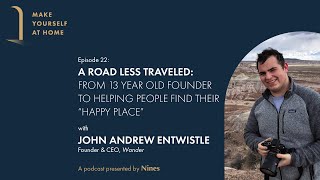
Make Yourself at Home, Episode 22 | John Andrew Entwistle, CEO & Founder, Wander