Make Yourself at Home, Episode 22 | John Andrew Entwistle, CEO & Founder, Wander
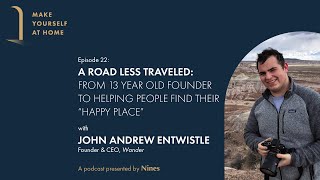
John Andrew Entwistle, founder of Wander, a short-term rental platform, started his first company at 13 and became a Thiel Fellow. He defines home as a place you can navigate without GPS, and started Wander after a disappointing cabin rental in Colorado. He lives by childhood rules like "Tomorrow is a Lazy Man's Today" and credits his single father's support for his resilience.
Chapters
I always found myself climbing to the tops of mountains and staring out into the world or looking at the ocean or trying to escape in, you know, a new city to find that one little corner that everything just felt right. You have to ask yourself if you're going on an adventure, why and where are you going to? And I've always sort of picked this idea of like, I'm going to go find that one spot, that one perfect spot.
That's John Andrew Entwistle. Founder and CEO of Wander. And this is Make Yourself at Home, the podcast that takes you into the homes of people you admire to show you a side you don't usually get to see. I'm Kristen Twyford, and every week we'll talk to someone at the top of their career to explore holistic success and how work and home are inextricably intertwined. Along the way, we hope to inspire you to live well, whatever that means to you. Make Yourself at Home is presented by NineS, the household management app designed to help you manage your home and everything that comes with it so you can live with ease. Today we're in John Andrew Entwistle's home in Austin, Texas, but more often than not, John Andrew is on the road. He founded Wander to create a better experience for travelers by vertically integrating short-term rentals. Wander has a deceivingly simple mission: to help people find their happy place. John Andrew Entwistle says this mission was born from a search of his own. He started his first company at just 13 years old and launched his second, Coder, right out of high school. Over the next 5 years, he became a Thiel Fellow and was named alongside his Coder co-founders to Forbes 30 Under 30. When he stepped down to Coder's board in 2021, he took some time away to ask himself, what's next? And now, less than a decade after graduating from high school, John Andrew says he's building the company he wants to work on until he's old and gray. In this conversation, he shares his perspective on the road less traveled, how he's guided by a set of rules he wrote down as a kid, and what shapes his idea of a meaningful life. Make yourself at home with John Andrew Entwistle. Well, John Andrew, thank you so much for having us into your home. I'm so excited to talk to you. I've really been looking forward to this.
I'm glad to be here.
And we're so happy to be here in your home. Tell us a little bit about where you live and what you like about it and, you know, how you feel about home.
Yeah, so I, I'm based in Austin, Texas, Barton Creek, and it's lovely. I mean, right now it's 70 degrees and sunny, so it's like the time of year where I think people really fall in love. They come to South by Southwest and then They're like, wow, this is nice and there's no taxes. Like, maybe we should move. Yeah, I do think they get caught in the summer though, when it's like 120 degrees and they're like, oh no, what happened? Um, but yeah, no, I love it. I moved here out of high school, um, to start, to start my first company. And yeah, Austin's been a great, great place for me.
And tell me a little bit about what home means to you.
Gosh. I mean, I travel so much, so that's like a really wonderful question. Um, I would say that home is, is probably that place wherever you get that sigh of relief, um, where you feel safe and loved and you sort of know where everything is. Um, I'd say probably being able to— where— somewhere where you can navigate without GPS, uh, is probably where home is.
I really like that answer. I've never gotten an answer quite like that, and I think you're exactly right. It's just like you're called there and you can find it on your own.
Yeah, exactly.
The last time that we talked on our prep call, you mentioned that you were kind of searching for a sense of home. Tell me a little bit about that, and as somebody who runs a travel company, you know, you're always on the move, you're always traveling, you know, why are you searching for that sense of home?
Mm, well, you know, if I look back at my childhood, I moved around quite a bit, probably up until I was like 12 or 13. I think I moved maybe 5 or 6 times, um, and I was always a little bit jealous of my friends who just had that one house, you know. I went there when I was, you know, 8, and they still, they still have it today, and, um And so, yeah, I think I miss a little bit of that idea of just a home base where you sort of understand exactly where everything is and the people in it and how it all works. And yeah, I haven't, you know, obviously I think a lot of young adults face this when you make the transition from being a kid to a young adult and you get to choose where you want to live and all that sort of stuff. I think it's a question that a lot of young adults have in terms of where am I going to live? Where do I want to set up shop? Because obviously they're not homeowners yet, or most aren't. And so yeah, I think, I think it's a question a lot of people ask. I've sort of broken it down though into the mental framework of figure out wherever makes you happy or whatever makes you happy and then be as close to that as possible. So that's my new mental framework for, for figuring out where's, where's next.
Mm-hmm. I think that makes sense. And in all of your travels, have you found a place that is starting to feel like home? Do you feel like Austin is the place, or do you think you've found a couple other places in your travels that you're— that feel right?
I don't, I don't think that Austin is my final stop yet. It's a, it's a magical place, but I don't think it's my final stop. I mean, there are lots of really beautiful, magical places, um, little towns like Cashmere, Washington, or Yeah, or just be banned in Oregon or otherwise, just these lovely little, little, little communities. But yeah, I haven't, I haven't figured out where, where that is yet. And I think the unfortunate thing is, is that international is not off the table either. So I have quite a bit of exploring to do before I settle down. But I'll definitely let everyone know when I find it, when I've evaluated every small town in the world. I will let everyone know objectively what is, what is the best one.
Yeah, there you go. And speaking of sort of finding that final right place, you have done so much already in your career. You started your first company at 13, you were named to Forbes 30 Under 30, now you're seeing incredible success with Wander. And I heard that you want this to be your kind of forever role and that before you started Wander, you wanted a to start something that would be your, you know, your calling, your number one thing really for the rest of your career. Is that true? And do you still feel that way? And, you know, why did you search for something like that?
Yeah, absolutely. I mean, I definitely, I definitely want Wander to be my forever company. I mean, I'm still relatively young. I have a lot of life left in me and I feel like channeling that into a vision and an idea that you're passionate about is just like a really fulfilling outcome of life. And so, yeah, I always joke around that I want to work on this until I'm old and crusty and fall over, and we'll see if I'm, if I'm so lucky.
Yeah, I think it's incredible to have that sense of commitment at such a young age. What about that idea of a forever company was exciting to you? What made you want to have something that you were committed to forever?
I think that when you sort of look at different companies or people who have changed the world, it really just takes time, right? You look at Apple, I mean, Apple is obviously a world-changing company. Steve Jobs started it very young and ultimately worked on it until his unfortunate early death, but until his death. You even look at companies like Tesla and SpaceX, I mean, they're over 20 years old at this point. And so it just, it takes time to build something meaningful. And for me, I think in order to have the largest impact, continuing to be dedicated to one idea and take it as far as I can is probably the best way to do so.
Mm-hmm. And what about this mission felt like the thing that you wanted to commit to forever? What was it that, you know, when you had this idea for Wander, you thought, this is it, this feels right?
I think it's all about like what is the end product that you're sort of selling. And so I'll use like Apple as an example. Like Apple sells technology, but that technology is used by people and it's used for all types of things, right? Like for example, this podcast I'm joining from my Mac, my Mac, or like I'll take a photo of some friends on my iPhone or whatever that may look like. And so what you're doing is you're selling like, uh, I mean, Steve Jobs called it like the bicycle for the mind, but you're also selling like happiness and connectivity and like that's the real end product. And in Wander's case, basically what we're selling is, is happiness, right? People are looking to go on this incredible trip and they go to the website and book one of our locations. And, and at the end of the day, if, if they're happy, we've done our job and I think that when you are working on something where the outcome is sort of pure, then it's really easy to say, okay, I'm going to dedicate the rest of my life to this. So yeah, I would say it's really driven from the outcome. Like, the end product that Wander delivers to the world is just making people happy and having incredible memories. And so when it's something that's kind of a pure mission, then you can spend a lot more time on it.
Mm-hmm. Yeah, one of the things that I love about Wanderer is this tagline of helping people find their happy place. When you talk to Wanderer customers, what does that mean to you when you have this sort of pure mission of helping people find that happy place that they actually feel, wow, I found that?
Yeah, I mean, I think we've all— it's sort of hard to describe, but I think it's something that we've all had, right? You go on this trip. And for some people, it's staring into the ocean. For other people, it's like standing up underneath the redwood trees. For, for some, it's sitting on the top of a mountain or in a field of wildflowers or wherever it may be. And for some people, you don't have to go anywhere, right? It's just, you know, with your family at your dinner table. And so I think that everyone has these, these locations where regardless of what's going on in the world, regardless of what's going on in their life, they just feel happy and at peace and connected. And unfortunately, what I've learned is that a lot of people don't actually ever really get to find those places or they don't get to go to them frequently enough, or there's some type of limiting factor where they can't necessarily live there or whatever it may be. And so the idea for Wander really is around, like, how can we make as many of these types of locations available for people for them to go and experience and to wake up in the morning and hear the ocean crashing, or to look out their door and see the mountains or aspen trees changing color, or whatever it may be. So that's really what it's all about for us. It really is just this feeling of just, you're just overwhelmed with happiness and joy, and that's really what we're trying to deliver for people.
Mm-hmm. How did you set your sights on that mission? Made this idea come to you about this helping people find their happy place?
Well, I mean, I've always, um, like as a kid I was always an adventurer, so I ended up doing high school online. And anytime you have a kid who has like disposable income, uh, who's doing high school online, means that you obviously like, uh, get a lot of, a lot of travel and wild ideas and everything else. And I always found myself climbing to the tops of mountains and staring out into the world or looking at the ocean or trying to escape in a new city to find that one little corner that everything just felt right. And that's really how I've sort of always traveled, is always around this idea of exploration and adventure. And you have to ask yourself if you're going on an adventure, why and where are you going to? And I've always sort of picked this idea of like, I'm going to go find that one spot, that one perfect spot. And so when it came to, to starting Wander, I mean, really it started because I had stepped down as CEO of my previous company and I had rented this cabin out in Colorado to sort of get away and think about the world. And it wasn't a perfect experience. Beds were uncomfortable, place didn't look like the photos, etc. And what I really wished for was, you know, this like wonderful modern home that was safe and comforting and everything was where I wanted it to be, where I could like go and enjoy that time. And that's really where the idea for Wander sort of came from was, you know, I needed, I needed to find my happy place in sort of like one of the most important times in my life. And it wasn't necessarily there or it was harder to find than I wanted it to be. And so decided to start a company around that.
Amazing. And when you started pitching this, how did people react? Everyone kind of I think can relate to that idea of that happy place. What were the aha moments when you were telling this story for other people?
Well, I mean, I think that the consumer definitely understood it pretty quickly, right? Every— I think everyone's rented a vacation rental or otherwise where it didn't look like the photos or the beds were uncomfortable or it just didn't meet expectations. And so this idea of a brand and quality standard and real ownership to mitigate and solve that problem was super exciting. I think for investors, you really had to explain like, how does this business actually work? And in order to do that, you have to look at sort of the broader travel space and understand the dynamics of these online travel agencies and property managers, homeowners, and why is it broken? And if you do verticalize it, like, what's the business opportunity? So I think that consumers definitely understood it very early and very quickly. I think that investors, some investors definitely understood it very quickly and very early. I think others candidly sort of saw my track record and were like, I don't really know what this kid's up to again, but like, we're going to, we're going to support him. I think now it's become incredibly clear. But yeah, you have to remember in the early days of starting a company, it's just me with no deck or anything talking about this like esoteric idea of like verticalizing the vacation rental industry to like solve this customer need. It's very confusing. But yeah, now it's starting to become more clear. I think people just understand it and, and that's a beautiful thing, right? It's sort of simple in hindsight is the way I like to put it.
Mm-hmm. And you have some incredible people backing you. You're a Thiel Fellow. You've accomplished some pretty incredible feats. In a very short timeline. You got a head start starting your first company at 13, but at the same time, you've accomplished a lot in your career already that, you know, people work their whole lives to achieve. When you were a kid, what did you picture, and was this close to what you pictured? You know, when you were looking out off the mountain thinking about your life, is this what you would have ever thought for yourself?
Yeah, it's interesting. I think little John Andrew, as I like to put him, because I do make a lot of decisions in that framework, Yeah, he was very ambitious. Um, he— I mean, and he still is. Um, he, he saw, he saw a future for me where basically I had accomplished everything that I could have possibly dreamed of, I think by the time I was like 23 or 24, uh, which I have not, I have not yet. We've accomplished a lot today, and that's thanks to some incredible people. Um, but I think for him, you know, being 12, 13 years old, thinking about the future. He's like, in 10 years, we can accomplish a lot in 10 years, which we obviously did. But I think his timeline was even more, more ambitious. You know, I think that there are some things that like he would be really like shocked and pleased at, right? I mean, you know, there are certain things that aren't necessarily clear, like what types of companies are you going to start and what is that going to look like? And of course, you don't, you don't know what you don't know. But there are other avenues where I think he would have been, yeah, just very pleasantly surprised. So overall, I think he'd be pretty happy. I think he'd be pushing for me to probably even go on even more adventures or to have the company be even larger than it is. But yeah, I think he'd give me a solid B+ today.
B+? Wow. That's a lower grade than I would have expected, but I guess that's where that ambition really comes from. Talking about that, where do you think that ambition comes from? Is it from your personality? Is it from your upbringing? Is it, you know, where did you get that ambition?
Yeah, it's interesting. I mean, since I was like pretty young, I've always had a decent clarity and sort of self-awareness. And a long time ago, I basically created this like set of rules, these like virtues and philosophies that I wanted to follow. I was probably like 8 or 9 when I wrote them down and I still have them, so they've aged pretty well. But the first one was the worst thing that happens is you die, which is a pretty like more like morbid thing for like an 8-year-old to put as like a life philosophy.
Mm-hmm.
But it basically was around this idea of recognizing that like at some point, like you are going to die and like that is the worst thing that does happen. And so like when you're stressed out, I guess at the time I must have been stressed out about like second grade homework or whatever, but like, it's not a big deal. Like, you know, life will go on, et cetera. And I think that it's like that mentality of recognizing that like life is temporary and we're all on this like small pebble hurtling through space at like 26,000 miles an hour around the sun. Like it's, you sort of, your goals sort of shift into like, what is the most impact that I can have? And sort of what is the, what is, what is the best result that I can have in the world? And what's the most interesting life that I can lead? And that's sort of how I look at things is my goal is to have like the most interesting, most positive impact possible and just see how much I can do before before it's game over. So, wow.
And you overcame a serious illness as a kid. Was that before or after you wrote down that rule?
That would be after. Yeah. So my, like, I had a few, like, issues in, like, in middle school that sort of, like, put me on a little bit of a different track. And, and yeah, that would have been, that would have been before. But I think the beautiful thing was, candidly, is that like that time where I wasn't in school, it allowed me to build like these little companies and to be on my computer and otherwise. And so, you know, at the end of the day, it set me on a very different life trajectory. But yeah, very, very grateful for it at the end.
Do you think that having that illness kind of created urgency around some of the things that you wanted to achieve? Did it really make that first rule hit home for you in a different way?
I don't know. I don't— I wouldn't say— I wouldn't say that it sort of gave me urgency in the sense of that, like, I thought that I was gonna die, like, immediately. Um, I do think that it definitely sort of, like, broke a bunch of paradigms, right? Like, when you're young— and this happens to, I think, people who are, who are older as well— you sort of like have what society expects of you. You wake up, you go to school, you do good at your schoolwork, XYZ. I think like as you get older, right? Or even in college, like you have to go to a great college and then like you start a family and like all these different things and you stay in one place. Like there are all these different societal expectations and I think people kind of get stuck in them. And so to have like my trajectory sort of like thrown off so early, I mean, candidly, like, definitely contributes to, like, where I am today. I think most interestingly, though, is that, like, that can always go in two directions, right? It could go in a direction where it's like, wow, that's a unique upbringing. And, you know, it turns into a great story. But there are also lots of kids who had untraditional circumstances and it didn't end up so well. And I think that that's really where, like, my pop gets incredible credit. He's a, he's a single dad. And so his, like, his love and attention and efforts dealing with a very untraditional kid, he gets, he gets an incredible amount of credit for the fact that it turned out to be a good story.
Yeah. Can you think of some moments or some stories that really illustrate how he handled that situation? That you think would help people understand the way that he kind of fostered you?
Yeah, I mean, that situation specifically. So basically, I think I was out of school like 200-something days in 8th grade. And obviously, as you'd imagine, every single teacher was just like failing me. As you would expect, right? Like the kid didn't go to school for basically all of 8th grade. And basically the school system, because it was a public school system, sort of has a lot of, a lot of like politics in terms of here's what we're going to do. And I think a lot of school systems also kind of jump into like parenting or like putting themselves in the shoes of the parent rather than like looking at the, rather than, or sort of putting themselves in the shoes of like, what's our graduation rate or XYZ, we're just gonna hold them back, kind of looking at everyone as numbers, as opposed to like, who is this kid and what's happening? And for me, I'm very lucky in the sense of that school's always been like remarkably easy. And so what my pop did is basically, go to the school and say, hey, in New York, there's this test called the Regents Test, which is basically what the school prepares the kids for all year long. And it covers vast amounts of materials in each subject. So you have the Regents for science and math and otherwise. And what we should do is whatever score he gets on the Regents is the score that he should get for the year. And of course, all of the teachers were like, he's going to fail the Regents, so this doesn't matter, whatever. Like, let's just agree to it and move on. And I ended up scoring top of the class, really. Like, I think I was in like the top percentile in all of New York, which was really just thanks to like, you know, my pop just bought the textbooks and I was like, all right, I'll just like read these textbooks a week before the exam and like, relatively, you know, easy. Um, but like that kind of belief and support, especially in the face of like this school board and teachers telling you like, hey, we're gonna have to hold this kid back, XYZ, was really, really special. Um, and there are so many stories like that. I mean, out of high school when I started Coder, um, you know, I think at that point he kind of knew that like things were a little bit different, but I moved down to Austin to start that company because I couldn't afford like rent at an office in New York or otherwise. And he uprooted his whole life and moved down here with me. And like that kind of like imagine, imagine your kid saying he wants to start a company and then move to Austin, Texas to start it. And you saying, yes, like, let's do it. It's just a remarkable story, remarkable man. And certainly would be nowhere near where I am without him.
So that's amazing. And he's involved with Wander now, right?
Yeah. So he's a, he's a very successful lawyer. And so he's, he's GC at Wander. And I always like to joke, you know, obviously starting a company, I think anyone who deals with lawyers knows this, that free legal is always, always welcome.
No doubt about that. Yeah, I think it's really interesting to hear how he really just recognized from the beginning that you had this potential. And he's— it sounds like he didn't really hesitate. He just said, we're gonna make this work. And it's interesting because so many parents who have a 13-year-old kid or an 18-year-old kid, I think this would seem so foreign to them where, you know, he just kind of seemed to go all in. What do you think made him just believe in it and go for it with you.
He's also a very like adventurous spirit, right? And he's obviously the— he's one of 5, first-generation immigrant on my grandfather's side, and then I think second-generation on my grandmother's side. Didn't grow up rich or anything like that, like grew up poor, son of a coal miner and a schoolteacher. And obviously with, you know, 5 kids, like that, those salaries don't go very far. And yeah, I think that like for him, he was just always adventurous and outgoing. And when he ended up taking care of me and my sister, he ended up making a choice, right? I mean, it's really a choice for any parent, but you kind of have to decide, like, am I going to, like, put aside, like, my career and take care of the kids? Or, like, what ends up happening? And he's always put me and my sister first, which I remember when I was really young, I sort of recognized it when he had picked us up from school, hung out with us, cooked us dinner. And then I was, you know, going to bed and ended up waking up at like 3, 4 in the morning and coming downstairs and he was on his computer working. And all of a sudden I realized that basically his, his day was probably getting, you know, 2, 3 hours of sleep. Maybe he was about to go to bed, then dropping us off at school, going to work, picking us up at school, hanging out with us for a few hours, and then working all through the night while we slept. And I think as soon as I recognized that, which I'm very glad I recognized it at such a young age, I think that's sort of like what put the work ethic in me. And also, I think, too, that it's something that I wish that most kids got to realize at a young age is the sacrifices that their parents make, because it really is extraordinary, the sacrifices that every parent makes to put food on the table and the fact that they share shield their kids from the stresses of life and mortgage payments and everything else. Yeah, it's like when your parents have a bad day at work, like, you know, they're not dumping that on you. And I like a lot of kids don't. Yeah, they take it, you know, it's funny too. It's like I even think about the fact that it's like when you come home from school, first question your parents ask you is like, how was school? And it's like, it's not like kids are responding like, how was work? Like, you know what I mean? And it sort of shows how like a lot of parents put their kids at the center of the universe. But yeah, I was very, very, very lucky to have him as my pop and still am, obviously. So.
Mm-hmm. And what does it mean to you now to have him involved in Wander? I know your sister is involved in Wander too, to be able to bring, you know, your passion and your home life together and have them a part of your journey. What does that mean to you?
Yeah, I mean, I think that candidly, it's hypercritical. To basically create threads with the people in your life who are really meaningful and that you want to have a part of it. I think that, you know, unfortunately, when you're ambitious or career-driven, it's very hard to balance family and work or friendship and work. And a lot of times what ends up happening is, is that like you just lose those friends, you lose contact with your family, etc. And so I've learned a long time ago that you need to create threads with these types of people. You need to invest in the same startup or work together on the same project or like some type of permanent infrastructure that keeps everyone together. And so, yeah, getting to have my father involved in the company, aside from the fact that he's a world-class lawyer, is something that I very much love and plan on never losing. And obviously getting to work with my sister as well, although she, she doesn't report directly to me. Having her involved in the company is wonderful. And yeah, I think it's just a hypercritical dynamic that when you find people or have people in your life that you love, whether it's friends or colleagues or family, you have to create some type of permanent thread because at the end of the day, texting someone once a month is not necessarily sustainable, right? Life changes, you move away. Or otherwise, but if you can create some type of real permanent connection that keeps them involved, yeah, it's a beautiful thing.
Right. And you mentioned your work ethic. It seems like right now you probably don't have a lot of free time. Is that right?
I haven't had free time in, gosh, since you were a little kid? Well, not that, yeah, I'd say probably since I was 18. Um, wow. You do get to integrate and go on all these other types of adventures. Um, and as long as you're doing what you love, then, you know, you don't really need free time.
So that was going to be my question. Do you look forward and think, okay, one day I'm going to have free time and I'm going to do this? Or are you just doing what you love already? And it doesn't matter that you don't have free time because you're doing what you wanted to do?
Gosh, I mean, I hope that I don't have like total free time. That sounds like, um, that sounds scary to like wake up and, um, you know, just, just not, not have anything. Um, no, I mean, I, I think that like I'm doing what I love to do already. You know, I think after I stepped down from my previous company, I obviously had a choice at a pretty young age, like what I wanted to I'm going to spend my time doing next. And I decided to sort of start it all over again. You know, I do think that like my life will change as I get older, obviously, like I expect to have like a family and other obligations and all those types of things. And integrating all that is going to become a challenge, I think, like again, so many other people have faced before me. But yeah, I'm super happy with what I'm doing now. And I think that it's causing me to grow as a person so quickly that as long as I never lose that dynamic where I'm constantly learning, then I think I'll be able to do it for a while.
Mm-hmm. When you think about your happiness today, is there a moment or a decision that you've made that you think has been really key in getting you to where you are now?
So it's interesting. So there's this idea within happiness of basically recognizing the difference between pleasure and happiness. So like a great example is, is that like pleasure is like having an ice cream cone, right? Like it's not true happiness, it's just, it's sort of pleasure versus like happiness is around this idea of fulfillment and doing right by others and whatever that necessarily means for you. And so there have been a lot of times in my life where I had to do and deal with like very difficult things, right? I think like even just like a standard workday is a great example where you have to put in long hours and, you know, even if you don't feel great, you have to motivate a team and all these different things where it's like, it's a huge burden on yourself. And it's definitely like unpleasurable or discomforting, but at the end of the day, it leads to incredible happiness. Right? Because, you know, you're, you're fulfilling, you know, whatever it is. And so there have been multiple times, um, in my life where I've sort of made the choice to be uncomfortable, um, in the pursuit of happiness. And I think each time that I've done that, I've, I've always been really happy with that, that decision.
And you mentioned that you make a lot of decisions based on what little John Andrew would do or what he would think. How does that play out when you're making a decision?
Little John Andrew is hyper-ambitious. He has incredibly strong ethics. So he, he really evaluates everything through the lens of like, if you end up at the Pearly Gates and they show you a reel of like every single thing that you've done and who you've been, like, is it going to be a good movie? Are you going to be proud of it? And so that's, that's really the lens that I make these decisions through is like, how can I make others proud? How can I make the right decisions that I know I'm going to be able to live with and be happy with? And then how can I continue to, you know, be ambitious and ultimately have a positive outcome? He has a few other rules too, like always say yes to adventure and like live with it or fix it, like those types of things, which I try and follow. I like those. Because yeah, he hasn't been wrong, so.
Mm-hmm. And now looking forward, what does a happy, meaningful life look like to you?
I mean, it's definitely building a big and important company that like does well for our customers and for our investors and has a really important impact on the world. And then I would say personally, I think it's, you know, having an incredible family and seeing as much of the world as possible and doing right and leaving a good impact. And as long as at the end of the day, people sort of like can stand over my grave and say, hey, like, that guy was a pretty good guy and like he did some pretty cool stuff and like we're glad he was here. Like, you know, we don't want to like refund him. Like, it's like a product we want to keep. Um, then yeah, that would be a good outcome as far as I'm concerned.
And on this show, we really love to talk about holistic success. And when you think about that idea of success, how much of it is personal and how much of it is professional? And, or is it just you can't separate the two?
Yeah, I would say I really truly cannot separate the two. I mean, there was actually this study where they took a group of founders and they analyzed the difference between like a parent and a company in the person's brain. And it had the same type of emotional response. Like when the company is not doing well, it's the same as if your kid isn't doing well. And I think any parent who's had that, right, where your kid is sick and like that, like deep gut feeling and that discomfort and the idea that that's the same that like a founder or executive is also feeling is a pretty wild idea. So yeah, candidly, the two really can't be separated. You know, I want to, I want to create an incredible company. And obviously companies are just groups of people. And so I want to have an incredible group of people who we do well by and shareholders who do very well and otherwise. And then at the same time, I also want to have hopefully as big of a family as I possibly can. And, and yeah, just, just to again see, see, see how interesting and as positive a life as possible I can lead over the next however long I get to live.
So what's amazing about you is that already you're an outlier, and yet you have this big vision of where you want to go in terms of, you know, what you want to achieve with your company and how you want to live your life. Can you point to something about yourself that you think made you an outlier, or do you think it's just a combination of who you are and the circumstances that you've had and what you talked about earlier, that, you know, sort of non-traditional path that kind of happened early on? What do you think it is that set you on this path that is different from a lot of other people's paths?
Yeah, I mean, like I mentioned, I think that like a lot of people end up going down an untraditional path. In fact, I actually think that almost everyone has had some type of hardship or some type of event in their life or something which like deeply affected them. I think that when those types of things happen, again, there's really two, two routes. It can either be an incredibly positive outcome or it can be a, um, a negative outcome. And what determines that, I think, is like what's most interesting. And what I truly think it is, is the people around you, right? When something happens, like, do you have people who want to see you succeed and support you and show you the right path and otherwise, and then continually do so? Or do you have people who like throw you to the wayside and you have to like pick yourself up? And obviously picking yourself up can be pretty hard, especially if you're young and you don't even know what picking yourself up even means. So I mean, if I had to say, I'd say that it's really like I've, I've had a lot of like events in my life that people would, would say are like unfortunate. And I've obviously had a lot that are like extremely, you know, wonderful. But during like those unfortunate events, like without like my pop and my family and otherwise, yeah, it would, it would just be a very different outcome.
Do you think that you're inherently positive, or do you think your dad's support and the support of your family really helped you take that positive path?
Um, I mean, I made the decision a long time ago that being positive was just more fun. Um, I agree. So I think, I think obviously he had a big, a big part to play in it, but yeah, I mean, again, like at a young age, I was just super like self-aware. And yeah, I made, I made a few decisions in terms of who I wanted to be and how I wanted to live my life. And again, like I saw people who are negative and I saw people who are positive, and I just decided that being positive was, was far more fun. And now it's interesting because there's a bunch of studies that show that optimists actually do much better in life. But But yeah, I decided it not for any type of gain, but just because I decided that it was going to be more entertaining. And it's very much stuck. So I just enjoy it. I love positive outlook. I love making people's days. I love seeing like the brighter side of things.
Mm-hmm. Me too. And when you look back at that list you made when you were 8, does it still hold or have you updated it since then?
There's been a few different virtues that have been added. And there's also been like a separate list of things that I've learned, which I always enjoy reading, reading back through. There was one, uh, that I saw the other day because the list is super long now. It's like, like 1,000 line items. But one of the earliest ones was, uh, don't stand under a tree with birds in it. And I don't remember when I wrote that down, but I just like found myself laughing because it meant that at some point little John Andrew was under a tree with birds in it, and obviously they went to the bathroom, and his first inclination was to write down the lesson.
Um, that's amazing.
So, so yeah, that list has held up, and I, I still don't stand under trees with birds in them.
Any big changes that you've made to the list?
No, I mean, the, the core virtues have stayed rather true. The worst thing that happens is you die is number one. Um, Number 2 is Tomorrow is a Lazy Man's Today, which is really just all about urgency and getting things done. Live with It or Fix It is one that I always love because a lot of times in life there's something that creates stress. And in reality, it's just this little thing that's nagging at you. And you have a choice, right? To just break it down into what do I do? You have a choice, you either live with it or you fix it. Can create a lot of peace. So yeah, the list has done— has really like stood the test of time pretty well. And obviously the list of things that I've learned is not only a good refresher, but also a good source of comedic relief.
I'm sure. Well, John Andrew Entwistle, thank you so much. This has been an amazing conversation and I love that line, live with it or fix it. I'm going to use that. Moving forward, I'll make sure to quote you, but I want to get into our lightning round of fun questions and they're all kind of home related. So to start out, what's one thing in your home that you love?
Well, I don't know if you can see it behind me, but, um, for my birthday, I recently got an Eames chair. Um, and I'm an avid, I'm an avid reader. And so having an Eames and being able to read a good book, preferably about a subject that I know nothing about. It's just a really wonderful thing. So I'd say that chair.
What's your favorite book?
My favorite book is Danny, the Champion of the World by Roald Dahl. It's a children's book. And it's about this kid and his father who go on this grand adventure. And, and yeah, I think I always just saw a lot of myself and and Danny and his dad. So that was always my favorite.
What's one thing in your home that makes your life easier?
Hmm. That makes my life easier. I mean, all of my lights and otherwise are all automated. So like the whole home is smart. So that's obviously very nice. But I'd say the thing that actually I love the most is like all of my travel items are very well organized in like these little like packs. Um, and since I travel so much, like having that all super down is really crucial.
Yeah.
So I would say like the organization for my like trips, um, is really wonderful. I'm sort of like that guy with a, um, like a fanny pack where it's like if I go traveling with you and you're like, oh, I'm starting to feel sick, I'm like, no problem, like here's some like emergency. Or it's like, oh, like I need a wet wipe. It's like, I got you. Like it's in my backpack. Like it's, I'm fully kitted out, so.
You've got it all. When you walk into a home that's not yours where you're staying, what's one thing that you love to see? What's one thing that you're always like, Yes, I'm so glad that's here.
I would say views. If a home has views and preferably like some type of seating that looks out at those views. Yeah, I mean, that's really candidly all I need to like just love, love a place.
What's one place on your travel bucket list?
Norway. I haven't been to Norway and it is certainly on the list. I also haven't been down to Patagonia yet. Which is also very much on the list. So you can probably see a theme of the types of places that I like to go. But yeah, but yeah, both of those are very, very well established on, on the list. I think Patagonia will end up happening sooner just because the time zone is actually very easy. But yeah, both of those locations.
Who's one person you admire who you think really lives well?
Gosh. I mean, there are so many people that I admire. I think it's really hard to like look at one person totally holistically because like by definition as people we're imperfect.
Mm-hmm.
And sort of by definition we all make mistakes.
Yeah.
In fact, I would say that if someone doesn't make any mistakes, then you have to ask like, how is that even possible? Because you need to make mistakes to learn from the mistakes. So it's just like they just came out perfect. Like, it doesn't make any sense. Um, so yeah, I would say I respect a lot of people for like a lot of different, different reasons. Um, like I love like a lot of the National Geographic photographers for like their adventurous spirit. And I think we all like can imagine ourselves with like that like leather vest and that camera standing on top of the volcano, like Peter Lick or otherwise, like, super cool. Or like, you can find it like romantic, like certain authors like writing their book. And like, you know, there's just so many different things and pieces. What I've determined personally is like what I want to emulate is I want to have as many of those individual highlights as possible. So my goal is to just string together everything that I find exciting and interesting So one day I want to be writing a chapter of a book in like Sun Valley, Idaho, and then the next day I want to be taking a photo on top of a volcano, and then like the next day I want to be like building housing and like, you know, like in Africa. Like I just want to, I want to do it all. Um, so yeah, really the answer is I find, um, I find really something about every single person that I meet to admire and something to learn from them. Awesome. Yeah, my goal is to try and stitch it all together.
Yes. What's one thing you've learned about living well from your dad?
Gosh, my dad has taught me so many lessons. For him, it's really all about like quality and taking care of things. You know, obviously like growing up without money, it's really about this idea of like you buy quality and then you take care of it and it has to last because it like really means something. And that's not to say that, like, you don't use something, but taking care of it, respecting the item, those types of things are really important. And then he's taught me a whole lot about other things, like, um, always buy rubber-soled shoes in the winter in New York, like, like dress shoes rather than the leather ones, because the leather ones you'll slip, etc. Yeah, so he's taught me a lot, um, but But yeah, taking care of things is something that's really important. I think it's also something tough for kids to fully understand as well. I mean, by definition, like, we're little monkeys, like, we don't, we don't know what's going on. Um, but yeah, that's something I'm starting to understand more and more.
Mm-hmm. And what inspires you to live better?
What inspires me to live better? I'd probably say that, like, life comes to an end. Um, and if that's not, like, all the motivation you need, then I don't know what is.
Yeah, amazing. Well, John Andrew, thank you so much. This has been such a great conversation, and I'm so happy that we got to have you on the show.
Thanks for having me, really appreciate it.
Thank you to John Andrew Entwistle for welcoming us today. Follow along with John Andrew on Twitter @JAntwistle. I'm Kristen Twyford, and if If you enjoyed our conversation, I hope you'll subscribe to Make Yourself at Home and leave us a review. Make Yourself at Home is presented by NineS, household management software that helps you manage your properties and everything that comes with them so you can make the most of your time at home. Learn more at ninesliving.com.
More from John


What John Andrew Entwistle, Founder of Wander is Doing Differently as a Second-Time Founder
Wander CEO: How I built TWO $100M Companies (and beat Airbnb) - John Andrew Entwistle | EP21