179 Sell to Serve! Why Business is All About Sales & Helping Others with Jamaul Ford
In this 2025 interview, host Mac talks with entrepreneur and consultant Jamaul "the Maven" Ford about his approach to scaling businesses and the central role of sales. Jamaul explains his two‑track service model: helping brand‑new ventures reach a sustainable $10K‑per‑month revenue, and guiding established businesses ($50K‑$200K/month) to scale further through systematic frameworks. He introduces the LAPPS sales funnel (Leads, Appointments, Presentations, Sales) and the ACA conversational technique (Acknowledge, Compliment, Ask) for warm outreach. Jamaul stresses the importance of content volume, using Dunbar’s Number to become part of a prospect’s social circle, and recommends platform‑price alignment (TikTok for sub‑$70 products, Instagram for sub‑$150, YouTube for high‑ticket offers). He outlines a local‑dominance strategy (dominate a 3.5‑mile radius) and a demand‑first validation method that turns a waiting list into a "wealth list" before building supply. The "Rule of 100"—making 100 outreach actions daily—underpins his sales discipline. Jamaul also shares 2025 trends: a shift toward long‑form content, buying existing businesses, real‑time community engagement, and leveraging virtual assistants for cost‑effective scaling. Contact information and service offerings (Funnel Factory, virtual assistant integration) are provided at the end.
Chapters
And again, thanks for jumping on. And today I have the absolute pleasure to be speaking to Jamaul Ford from Louisiana. And hey, Jamaul, thank you for jumping on. Really appreciate it.
Thanks for having me, Mac. I'm glad to be here.
Thank you. And Jamaul is known as the Maven. Jamaul the Maven. Right. So he's an accomplished— he's an accomplished entrepreneur, second-generation entrepreneur. And his magic, if you like, is helping different businesses to scale to $10K, $10,000 per month, and eventually over $100,000 per month milestones, which are significant milestones for any business. So Jamaul Ford, tell us a little bit about your— what is it you do now? Because I want to understand that so our audience are clear on, you know, what your expertise is. Plus, then I want to talk about after that your entrepreneurial journey and then loop back again. Go ahead.
So there's two big things that I do now, Mac. Um, I either, I help a business that's just starting to get to that $10K milestone, which is a really pretty $10K a month milestone, which is pretty big for most businesses to know that they have some level of sustainability. And the second thing I do is establish businesses who are making like $50K or $60K, they're trying to make over $100K, maybe $150K, $200K a month. I come in and I implement a scaling plan and sometimes I also implement a team to allow them to be able to get there at minimal cost, different things like that.
Okay, great. We're going to get more in depth on that and learning more about that as well. And how did you start on your entrepreneurial journey? Um, what, what was the, um, pivots for you? Were you an entrepreneur? Were you an employee before and, and had to change, or what happened?
Yeah, so I'm a second generation entrepreneur, so I kind of been in entrepreneurship my whole life. My mom owns like 11 rental properties. She owns 2 daycares. She owns a lot of different things like that. So I kind of grew up in, in the realm of entrepreneurship. I got my master's degree in kinesiology and human performance. And so I was working an everyday job and I never forget I was, I'm also a musician, so I was playing music too. And I remember I was making, I was 26, I maybe was making $35,000 a year at the hospital, and I was making like $40,000 as a musician. And as a musician, I was just— I was playing like maybe 5 hours a week making that amount of money, and I was working a full-time job. And my boss at the time, I was talking to him, he was transitioning to another hospital, and I'll never forget, he told me— I was like, this is really tough for me because I'm working so many hours here and I'm making this. I'm only working this amount of hours here and I'm making this. And he said, Jamaul Ford, you are the only person that can create your own price point. You can't allow other people to put a price on your time 'cause they're only gonna take a certain amount of your skills. And so that kind of put me back on the path of what I grew up in 'cause I completely understood it when he said it because I had grew up in entrepreneurship. I had seen my mom working entrepreneurship. So it, kind of put me back on the path of entrepreneurship. So that's kind of how I got into the point where I am now.
So you quit the hospital job and, and, and, and went into full-time, uh, uh, musician.
And then, well, it actually is a little bit more nuanced than that. At the time, uh, my wife at the time was, uh, clinic. Oh, sorry, give me one second. Apologize for that. Okay. Yeah, my wife at the time was opening her clinic and when she opened her clinic, She was seeing adults for hearing services, and from there what wound up happening was she wasn't having a lot of adults come in. And so we was having a conversation, and I was working at Corporate Wellness. I said, well, maybe in Corporate Wellness we were going out and doing screenings for our major companies. And so I said, well, maybe there are schools that hearing, uh, checked And so what wound up happening was she said, uh, okay. So she went and she checked and wound up there was a huge need for this. Um, fast— and so fast forward to maybe a year and a half, we were generating maybe $1.7 million. Uh, fast forward another 2, 3 years, we probably would generate about $4.3 million a year in that particular, uh, instance. And then we started other businesses, started doing other things, and then eventually people started reaching out to me to ask me to do consulting work, asking me to do different things like that. So that's kind of how I wound up getting to the point where I am now.
Yeah, apologies for that. I think the internet went out, uh, a little bit. It came back anyway. Let's continue. I mean, we're having a chat, it's great chat. Uh, I think we've got your words anyway. Thank you. Okay, let's talk about then, how— what do you— in, in terms of helping Obviously, you worked with your mother, you helped her scale, you grew that business. All good. You're a man of many talents by all accounts. You know, master's degree in kidney physiology. You worked in that hospital. You're a musician. You're very talented. And when you are working with someone who wants to scale from $50,000 a month to $100,000 or more, What's your framework? Do you have a model you follow in order to create that kind of result for them?
Yeah. Yeah. It really just depends on the business. Um, for the most part, sometimes it'll be if they're doing services, I will use a LAPPS framework. So a LAPPS framework would be how many leads they have, how many appointments they have, how many presentations they're doing, and then ultimately how many sales. So let's say for instance, the business is making roughly $50,000 a year. Um, maybe they charge $1,000 a month for their services. These are just rough numbers, right? And let's say in the next upcoming year, they're trying to get to $150,000 a month, right? So that would mean they need an additional 100 or so customers. So in order to get— always look at it at closing at a 10% margin from presentations to sales. So if I, if I have to get 100 sales, then I'm generally trying to get roughly about 1,000 appointments on the books. Because if I can get 1,000 appointments on the books, I should be able to close 100 people. So then I figure out how many leads I need to get 1,000 appointments. So from there, I would probably assume this is rough numbers. I would probably look towards getting 60,000 leads. Now, the one thing about that is there's 8 billion people in the world, so you just gotta find the right people who are in need of your services, right? So for me, this comes from word of mouth, social media, running ads, or cold outreach. And I always believe these are the, the right sequence in getting those things. So for me, I always do warm outreach first. Who you know, who you know knows, those type of things.
Yeah.
Then making sure we have consistent content out in the world on the right platforms. If it is business-based, I might use LinkedIn. It just depends on what we're selling, or YouTube, or any other platform. From there, we'll look at running ads. If it's a local business, we may run ads locally. If it's a business that does business across, you know, larger spans, then we'll look at running ads online. And then from there, cold outreach. But We all know that when you do cold outreach, you're not gonna sell to somebody the first time, right? They're gonna get on the phone, they're not gonna sell, but you have to give them value that first time they're on the phone. And then when they get off the phone with you, they're gonna look you up online. And when they look you up online, they're gonna see those ads, they're gonna see those social media content, they're gonna see the people that's having success with your product or services. And that's gonna reinforce that you are the person they need to be working with. So you always want to use that sequence in order to actually get more customers. So I have different frameworks based on what the business is, but businesses are built on frameworks and understanding how to be consistent with that. So yeah.
Got it. Got it. Got it. Got it. Got it. Got it. So it really depends on the business owner that you're working with, the outcomes that they want. And then designing or putting the infrastructure in place that will deliver that result. So I love what you said about the numbers there. So for example, typically if they are doing this amount and they like, let's say doing $50,000 and they want to get to $150,000 per month or per year, it doesn't matter. You'll then peel it back and say, okay, what are the things that need to happen? And if it's $1,000, leads coming in, a 10% conversion, you're going to get them 100 clients. Now tell me something. What is the general trend in terms of social media now and what works for small business and what doesn't work for small business? Because, you know, I hear a lot of different gurus saying different things, do this type of thing or do this thing. I don't want to mention any names, but so what's your take on that?
So I have, uh, my biggest take is you want to put out content in volume. So there's this thing called Dunbar's numbers. Dunbar's numbers says that there's 150 people in your network at a time as a human being. When someone else enters the number, so when someone else enters your 150, someone leaves out of your 150. You don't really know who leaves out, right? But an example would be The people you were close to in high school, you may not be close to them now, right? Because high school was a long time ago, or grade school, and people have entered into your life to replace those people that was there. So now it becomes, how do you become a part of someone's Dunbar numbers? Well, that means that's 7 hours of communication, or 7 hours of just content of things, 11 interactions. So that's back and forths. Okay, and then 4 different loc— and then 4 different locations. Now the magic of that is you don't have to know someone in order to hit Dunbar's numbers, right? So an example I always tell people, you take Beyoncé or Taylor Swift. If there's an announcement that says, oh, Beyoncé's dog died, people are going to be crying with, oh my God, Beyoncé's dog died, and they never met Beyoncé in their life, they don't know Beyoncé, but They've consumed 7 hours of her, of her music. They've interacted with people over 11 times about her music, and they've listened to her music in 4 different locations.
Okay.
Which made her a part of their Dunbar's numbers, if that makes sense. So yeah, yeah. When I make content, I always think about content as Netflix. I want people to binge watch my content. Generally, if someone likes my content, they're not gonna just watch one piece of content. They're gonna watch more and more and more content. That allows me to become a part of their Dunbar's number. So I am on multiple platforms. I am gonna have stuff on YouTube, stuff on Instagram, stuff on LinkedIn, stuff on TikTok, so they can see it in 4 different locations. I am gonna have built-in interactions such as funnels, as lead magnets, these particular things that they can interact with. And I'm going to make sure that I have over 7 hours of content online. That they can actually consume. So let's say for instance, I'm, I'm talking at an event and I speak to someone at an event and they love my presentation. They're just meeting me. They may come back, they may not buy that day, but they may go online and find more, try to learn more about me, right? When they go online, they're gonna see a ton of content. They're gonna see those funnels, they're gonna see the, all the locations I am until they decide that they like me as a person. And the last thing I'll say about that is people buy people, people don't buy products, right? So you, if you always understand that people buy people, you'll understand that you're selling yourself. And then people, and then whatever product or service goes behind that, people will get behind that. So that's super important as well when it comes to social media content.
And how's that, uh, different from traditional, uh, types of marketing or media then? Because in the old days, I suppose, you know, you know, maybe, you know, your mom was first generation, you saw her doing things in a certain way, you've picked up the, the, the more modern ways. So how does it all relate? What, what makes it all different? And what's, what's, what's better, traditional marketing? Obviously social media is so prevalent that everyone's got on there. Is there a time to do additional marketing, a time to do social media, or is it, is it a mix, mix of both?
It really once again depends on what type of business you have. If you have a local business then, and you do local services such grass cutting or pest control or anything like that, then you do want to have a focus on local, uh, areas and have a local foothold. In those particular instances, I always tell people you want to dominate the 3.5 miles around your business address because generally if you Google something, you say pest control near me, it's going to be 3.5 miles around your general location. So generally, and people— one statistic that people don't realize is 60% of people live within 10 miles of where they grew up, and 80% of people live within 100 miles of where they grew up. So that's what that means, that word of mouth is very prevalent. So if I'm a person that's looking for somebody to cut my grass and the guy is amazing, then I'm within 10 miles of everyone I grew up knowing, and I'm going spread word that he's a great grass cutter, right? Right. So that's why it's super important if you're a local business to dominate the 3.5 miles around your general vicinity. If you are an online business or you do international business or anything like that, it really just depends on what platform your target audience generally is on. So if you're doing more B2B services, are you catering more to professionals, um, then you will probably look towards being on LinkedIn a little bit more. Whereas if you're doing stuff more for people who are, um, selling products, let's just say you're selling, uh, home care goods or trinkets or anything like that, you may be on Facebook but also on TikTok doing some live things. It just really just depends on what product or service you're offering. I will lastly say this. If you're selling a product that's $70 or below, I would probably look towards pushing that on TikTok, right? If you're selling a product that's $150 or below, I would probably look towards Instagram. And if you're selling a product that's over $150, then I would definitely have some content on YouTube because the more people spend, the more they need to know about your product and services, right? Like when you go to buy a car, You're gonna go on YouTube and review the car. You're gonna go and learn more about the car long before you get to the dealership. If you're gonna pay $1,000 for a program or some kind of software or something that someone's offering, you're gonna wanna go and review it on YouTube before you make that investment. That's why you need to be on YouTube if you're selling a product that is beyond a certain price point.
Great, great, great. This first time I've heard this. So if you're, if you're, if it's less than $70, TikTok, it's less than $150, Instagram. If it's more than that, they need long-form content. They need more information. They need a series of videos that they can consume to really make an informed decision about the buying process, especially if it's over $1,000, $2,000, $3,000. I love that. Thank you for sharing that. So for those people sitting there thinking, I'd love to start a business, not sure where to start, what are some ways of identifying what business to start and how to start monetizing that, making, making money from that?
Yeah. So for me, I first start off with supply and demand. I really, I really like to call it demand and supply. Like, I like to figure out what the demand is before I create a supply. I think The biggest mistake most people make is they have the idea of starting a business and they start getting all the materials and everything. And then once they have everything, once they put things together, then they go out, start asking people to buy their stuff. Nobody told you they want— nobody told you that they wanted to buy your stuff. And that's the— and now you have all this supply but no demand, right? So for me, I, I generally will start a waiting list. I will start something similar to a waiting list. To figure out if people really want my product. So if I'm selling, let's say if I'm— I use grass cutting again. If I'm starting a grass cutting business, I'm going to go around the neighborhood and I'm going to look at people's yards who don't. I'm probably going to visit maybe 300 properties that are not cut, and then I'm going to go there, say, hey, do you have someone currently cutting your yard? I see that it's kind of high. I see this, you know, whatever. They're going to give me some feedback. I'm going to give them value up front saying, yeah, well, if you do this, if you do this, then your yard will look much better. If you're interested, I'm probably gonna start cutting grass. You can sign up on a waiting list. If I reach out to 300 people and 50 people join my waiting list, then that's enough for me to know I can go back to those 50 people and say, well, look, I'm gonna be charging roughly $65 per grass cutting, but if you sign up today, I will only charge you $40, right? So if I tell them, you know, moving forward, you're for the next year, it'll only be $40. Out of those 50 people, let's say 25 of them decide, I'll give you the $40, right? So they give me the $40. Now I actually have money to go buy the lawnmower, to go buy the weed eater, to go buy the supplies to start cutting grass. And I already have customers who have paid. Now those additional 25, I have the stuff and I come back to them and say, hey, look, you want me to cut it? They are, I, they know that their yards are not looking great, so they're going to let me cut the grass. I originally went to 300 people, right? So now I can even go back to those 300 and show them pictures of what I've been doing. And that's so, you know, getting the demand first before you actually go out there and start the business is super important.
I love that. Is this what you're talking about in terms of turning your waitlist into a wealth list?
Yes. Yes.
Right. Right. I love that because if you got a demand of people waiting and you're giving them preferential treatment, a discounted offer, and they need those services, naturally they're going to buy because they've opted in to what you're saying. So How did you discover or learn about these tech, these strategies, tactics that you've been using and helping clients to, to, to grow and scale? Is that through trial and error for your mother's businesses? Did you go and learn that somewhere, or is it just common, plain common sense when you're working with business owners?
I mean, I think it's a little bit of everything. I think I grew up in entrepreneurship, so I understand I see frameworks a lot easier probably than what most people would typically identify frameworks. An example would be, um, I can look at a company like Disney and see what framework they're using in certain instances. Or I'll look at Nike and see what frame, and I can see, oh, this is the strategy that they're using at this particular time, right? Primary example, the presidential election for the United States just finished, right? And in the world of marketing, the presidential election is like the biggest— it's like the World Series of marketing. There's billions and billions of dollars spent. And so every time, every 4 years, major companies look at the presidential election and see how the marketing was done. What did people use? How was it utilized? And those things are then for the next 4 years implemented into smaller marketing strategies for other businesses. I'll give you some backend, uh, information. When, um, John F. Kennedy ran for president, there was a lot of radio prior to that, but he was on TV, right? He, he actually went on TV and let people see his face. He won because he was more visible than people moving forward. There was a lot less radio and a lot more television. Yeah, when Barack Obama ran in 2008, he utilized social media, which had never been done for any presidential election in the past. After 2008, when he ran, businesses started to look at social media a lot different from that particular standpoint. In 2016, when Donald Trump ran the first time, there was a lot— there was this infrastructure where people were saying that there was a, um, people were hacking or like swarming, uh, or putting out particular messaging on social media. But in actuality, that was the beginning of AI. That was the beginning of what AI has become today. Fast forward to today, this, this, this previous, uh, presidential election that just happened. It's interesting. It almost reverted back to what it was before when Eisenhower ran, because what happened was Donald Trump was on a lot more podcasts than Kamala Harris, and he was on the podcast for like 2 hours, 2.5 hours, whereas Kamala was on there maybe 30 minutes. So it became more of a fireside chat, like when people used to listen to radio back in the day and the president would talk for an hour or 2 hours. So whether you didn't like him or did like him, uh, you got more information from him than what you got from the other person, right? So now the next 4 years, you're going to see a lot more long-form content. Because people— the over— since people are becoming— the overstimulation of short form or the high editing, people are skipping that now. You don't really need to necessarily do that anymore because people are looking for more substance in what they're consuming because they have so much to consume. Before, there wasn't as much to consume as there is now. Now there's so much to consume, now you can pick and choose what you're actually going to consume. And now you are looking for things with more substance. And so now long form will become something that people are gonna actually listen to and be more intrigued by if it is within the niche of what they're doing.
Amazing. Great, great, great observation. Great share. I'm gonna take it sideways a little bit to say someone's listening in now and they, they have a business, they're working hard. And they want to create financial freedom, in a sense, financial freedom in the sense that they have their business, they can set up in a way that they're not really worried about money because they've got things in place to be okay. What's your advice or what would be your approach towards that, creating that kind of financial freedom?
Yeah, well, the first thing is to understand what the main thing is. Being an entrepreneur, that one of my favorite books is called The E-Myth. And The E-Myth is, it's a fantastic book and it talks about the 3 hats that entrepreneurs wear. The hat of the technician, the hat of the operator, and the hat of the entrepreneur.
Yeah.
Um, and we generally get into entrepreneurship because of the technical aspect of it, right? Um, because maybe I'm good at baking, so I should open up my own bakery, right?
Yeah.
Or something like that. But the truth is entrepreneurship is just sales. Yeah, it's really just sales. And that's why I'm so passionate about starting a waiting list and getting out and selling. Don't worry about having a product. Don't worry about having everything set up. First, get out there and sell, because most people are not comfortable with selling. Most people can't handle rejection, and you have to build up a tolerance for rejection. And I always say this, I never take no as N-O. I take no as K-N-O-W, like know, like I— maybe they don't know enough about my product or service, or maybe I need to know more about sales. But I don't take a no in a negative context, right? And so generally what I would tell anybody is if you're starting a business, make sure that the first 4 hours of the day you're working on the front-facing part of the business, which is the sales. Don't worry about operations. Don't worry about the technical stuff. If you own a bakery, guess what? The easiest thing to do is to bake those cookies. That's, that's the easy thing. The hardest thing is finding people to buy the cookies. You need to find people to buy the cookies. So you, the first 4 hours, you should be putting out social media content. You should be text messaging people. You should be emailing people. You should be DMing people online saying, hey, look, I'm coming out. Valentine's Day is right around the corner. I'm having a special, just telling people what you have going on. And the more you do that, if you do— and I have this rule of 100 that I use all the time. So a rule of 100 says I'm going to do 100 of something a day in order to improve. So let's say, for instance, if I'm starting a business, my first rule of 100 would be I'm going to reach out to 100 people a day, right? That might sound like a lot, but when you look at your social media You probably have 5,000 people that's following you on Facebook. You probably have 300, 400 people in your contacts in your phone. You probably have hundreds of emails of people that has reached out to you and talked to you. These are warm leads. These are people who have already agreed to communicate with you in some capacity. So now you just need to let them know what you're doing. The key is not to ask them directly to buy from you. The key is to say, Hey, look, I'm starting this. If there's this framework, this is a great framework. I'm glad we're talking about this. It's called the ACA. It's called the ACA framework. Acknowledge, compliment, then ask, right? So if I'm on social media and I'm, and I'm baking cookies and I'm starting a cookie thing and I'm looking online and I see I've already identified who my avatar is and maybe it might be mothers, right? And I see this, this lady who I went to high school with, she has 3 and 4-year-old kids. I'm going to first acknowledge her kids. So I might DM her, say, hey Jennifer, nice to see you. I see your kids are growing up. That's acknowledgement. Then compliment, they look great, right? That's a compliment, right? She's going to reply back, oh yeah, they're growing so fast, blah blah blah blah blah, whatever. She's going to say something, I'm going to say something back, and then I'm gonna say, hey, are you looking for nutritious snacks for them? Or like, what are— what snacks are they typically eating? Yeah, whatever. And I say— and then I would tell her this, this is exactly what I would say: well, I'm starting a cookie business, and if you know anybody, if you know anybody who's looking for healthy cookies for their kids that won't cause sugar rush, I'm going to tell her that. And if she's interested, she's going to say, oh, I would love that for my kids, right? That's a sale. But if she does not when she's talking to her other friends that have kids and she's like, they're eating these terrible snacks, she's going to tell that person, oh, a girl that I went— a guy I went to high school with just started a business and they're making healthy snacks. Yeah, this is their page, right? Because I didn't ask her directly, I asked her if she knew somebody. And that's the key because she knows herself and she knows other people. So it did not— but if I had just asked her and she said no, she would never think beyond that moment. Wow. Yeah, and that's the key.
So yeah, that's amazing, that's amazing. Because the reason why that's great is you, like you said, you're not asking her directly, but it's very much third party. Who do you know? And now she's thinking, well, I want that for my kids, and she's starting telling other people. Now that's a great technique. Uh, I love your ACA technique as well. Acknowledge and compliment and ask. And if you don't do that, you don't get that. But from a sales angle, it's not intrusive. It's not in your face. It's like a cordial conversation rather than what some people do and they just jump in. Hey, I've got this thing here. I think you're going to love it. Just buy it. It's like, wow, too much, too soon.
What—
yeah, where did you learn how to sell? Um, was it being thrown in at the deep end for your mother's thing, or is it through trial and error?
Because yeah, yeah, I would say it's probably come through more trial and error. I would say I've created my own frameworks, but as well as understanding that when I talk to someone, my I have to solve their problem first, right? And my solution, my current solution, or what I'm presenting to them, or what I'm talking to them about, may not be their most significant problem at the moment, right? And so most of the time, if when you're having conversation with people, you want to first acknowledge what they're going through, because it's not about you, it's about them. I have this saying, um, that I'm Jiminy Cricket and you're Pinocchio. I'm just trying to guide you to the right answer. So I don't want to take the— as a business owner, my customers are the heroes of the story. I'm not the— I'm just the person helping them get to the right answer, right? They have a problem. I have the solution. I can't force the solution to them, but I can guide them to the right solution, right? And when they get the right solution, I'm going to celebrate them. but I helped them get to it. But it wasn't the story, it wasn't about me, it was about them. And so when I get on the phone with someone, when I'm talking to someone, I'm not thinking about my product or service. I'm present in the communication. I'm not thinking about the past, I'm not thinking about the future. I'm literally listening to what the person is saying and acknowledging what they have, what they're saying, if that makes sense.
It makes absolute sense. It makes absolute sense. And, um, the other thing I wanna ask you is this, what does the, what does 2025 look like from your prediction in the sense that, you know, we, we're at the beginning of the year, uh, we still have 11 months to go. What are some of the trends you're seeing from a business growth or a sales or a marketing or social media, um, angle?
There's a lot of trends. There's a lot of different things that's happening. I think that, um, I can talk about a lot of different things. I would say ultimately for most entrepreneurs, I would say like I talked about before, long form, making sure you're doing a lot more long form with your content to educate people about your, what you're doing and what you're bringing to the table. Um, I would say, you know, in the United States we have a lot of baby boomers who are selling their businesses, who are getting out of business and retiring. So for me, I always think to myself, you don't necessarily have to start a brand new business. If there's a business that's been around 15, 16 years, it might be better for you to buy that business and implement some new things to scale that particular business. Um, outside of that, um, I would definitely say, um, just understanding how to get leads and understanding how to get people to your product is super important. TikTok is, is a big thing here. I know it's different in different countries and things. So just getting out there and selling and being live, like being present, being in real time selling to people. So yeah, it, it's a lot of different trends, but I, I would definitely say if you have a local business, make sure to get out in the community and do things in the community. If you're selling things that does not translate online on, on the internet, do things in the community. Let people see who you are. Let people know what you're doing. It does not always have to be your business. If someone is in need in the community, help that need, and then people will ask, because reciprocity works. If you help others, then people will inquire and want to support what you're doing. If you're doing something online, just make sure to answer a lot of questions. Most of my social media content is answering questions from people who are on my online communities or even sometimes on Reddit. I'll go— I've gotten— I, to be honest with you, which is crazy, you'll be surprised how many business owners are on Reddit. All right. Having so much trouble understanding how to scale their business. And just by me just going, like, I will spend like 30 minutes on Reddit a day just answering questions to business owners, like saying, oh my God, I, I'm losing this amount of money. I don't really know what to do. And I would just answer that question. And just by me answering their question, they're like, oh, who are you? Can I get in contact with you? Can we schedule a meeting? And that's a part of those 4 hours I was telling you about. Like those, that time of doing outreach, just answers, just going out there and putting value out there. So I would just definitely say be out more. Don't work on the back end of the business. Don't, don't focus so much on the supply. Don't focus on the back end operations. Touch people, meet people, talk to people. If you're not talking to 20 to 30 people a day about your business, you're not going to have— like, it's going to be very difficult for you to have success. So you should definitely put a benchmarker in your business about that. I need to at least tell 30 people about my business today, and that would be the biggest thing I would tell anybody to do.
Yeah, you know, you know one thing I love about you? All my questions always came back to you, you, you saying look, just be out there, serve people, add value to their life, give them something, and reciprocity-wise it will come back to you. And every single time you've gone that angle, any question, just help people, support people, give them what they need, give them some value. I love that. Listen, Jamaul Ford, for those who, uh, want to reach out to you, want to learn more or explore what you can do for them, what's the best way for them to reach you?
Okay, so you can follow me on Instagram @JamaulTheMaven. That's J-A-M-A-U-L F— Jamaul The Maven, T-H-E M-A-V-E-N. You can follow me on Instagram, the same thing, Jamaul The Maven. TikTok, Jamaul The Maven. Um, X or Twitter, Jamaul The Maven. Also I have a community called the Funnel Factory. You can look it up. Um, I give people free funnels to be able to get people into the business, be able to get their business up and going. Um, and yeah, that— those are the places you can find me. You can also go to my website, brandmaven.org. If you are a business who are trying to scale from $20,000, $30,000, $40,000 to over $100,000, we help with, um, infrastructure. I have, um, virtual assistants that I can implement into your system with business strategy to be able to help scale at minimal cost, whereas typically you'll maybe be paying $10 to $15 to $20 for a staff member. My, my virtual assistants not only come with a lower price point but also the strategies associated with, um, scaling your business as well.
Very nice. You heard it here first. Jamaul Ford in the house. Jamaul, thank you so much. Thank you so much. And, uh, I want to say, those who are listening in now and watching wherever you are Remember to like, remember to subscribe, remember to make some comments, give us emojis, say something, just let us know what you got out of this. And also ask Jamaul some questions as well. This will be shared across social media as well, across all the podcast stations and YouTube. And so I want to say thank you so much again, Jamaul, and wishing you a great rest of your day. Thank you for jumping on.
Thanks so much, Mac. I really appreciate you having me.
My pleasure, my absolute pleasure.
More from Jamaul


THE HEALTHCARE WAR: Congress vs. Your Wallet | Betting on ACA Future (Kalshi LIVE)

Reframing the Perspective on Business w/ Jamaul Ford, Upgrade Your Online Presence
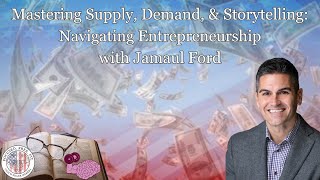
Mastering Supply, Demand, & Storytelling: Navigating Entrepreneurship with Jamaul Ford (Episode 25)