The Secrets to Leadership, Empathy, and Business Success with Jamaul Ford
In this January 30, 2025 episode of the New Beginning Inspiration for You podcast, host Sue Pets interviews second‑generation entrepreneur Jamaul Ford, who has generated roughly $8 million for himself and his clients. The conversation moves from common solopreneur questions about branding, reputation, and the perceived death of social‑media marketing to a deep dive into 2025 marketing trends. Jamaul argues that presidential election cycles reveal effective tactics—especially the power of long‑form content and podcasts—as the modern equivalent of the “Kentucky Derby of marketing.” He explains how to repurpose a single long‑form piece (the “masterpiece of content”) into clips for Instagram, TikTok, Facebook, and blog posts, turning one interview into a multi‑channel funnel. He outlines a four‑step lead‑generation framework (warm leads, organic social content, paid ads, cold outreach) and introduces the concept of “signs and symptoms” to help prospects self‑identify. Jamaul stresses building a business on personal values, supply‑and‑demand validation, and market research (300‑person surveys) before product development. He describes funding models that rely on pre‑sale deposits, waiting‑list payments, and MVP financing, citing Tesla’s $1,000 deposit strategy as a template. Collaboration is highlighted through his Funnel Factory community and exclusive in‑person cohorts that match complementary entrepreneurs. He advises tailoring channel selection to the target audience (e.g., pet‑supply ads on Animal Planet) and warns against chasing viral hits without infrastructure. Time is framed as the most valuable resource; sustainable growth requires a solid foundation before scaling. Specific advice is given to baby‑boomers about leveraging local knowledge, buying/selling legacy businesses, and focusing on hyper‑local marketing. Jamaul shares his view of AI as a neutral tool—a “second brain” for research and feedback—while cautioning against misuse, drawing parallels to cryptocurrency’s evolution. Finally, he introduces his 2025 “Focus Forward” program, which pairs entrepreneurs with virtual assistants for daily planning and weekly accountability calls, emphasizing that money is a by‑product of helping many people. The episode closes with a reminder to be relentlessly consistent, chopping away at goals daily.
Chapters
Hey, I'm Sue Pets, lifelong solopreneur, now living my life with only one passion: to help solopreneurs to launch their digital products on fast track so that they can be profitable as fast as within one week. And they want to scale, they can join the membership, and as a bonus, I show them how they can sell their digital products all over the world using affiliates. Without further delay, let's get started.
Yeah, as a new business owner, people have many questions. People have many questions that, okay, how will I do my branding? Because they think branding, branding means just colors and fonts. They really don't know personal branding. And I'm not talking about them, even I was like that. Plus Reputation management, what is that? All those questions people have, but those are really vital aspects of your business. Third thing, many, many times you hear, oh, social media marketing, it is dead because everyone is going for ads, so your post is not going to be seen. Algorithm is changing every platform, and, oh, social media marketing is dead. You just cannot see the results unless and until you are on social media for 6 months, 1 year, and you are spending money on ads and all. So people have a lot of questions, even I have a lot of questions, and we have expert to answer all these questions. And here is Jamaul Ford. So here he is going to answer all our questions. Before get started, hey Jamaul, welcome, welcome to New Beginning Inspiration for You podcast, and I want to know more about your story. How did you get started on the business? And, uh, yeah, yeah, success story, your travel, your journey, I want to know.
Thanks so much, Sue. So yeah, my name is Jamaul Ford. I'm a second-generation entrepreneur, so my mother was an entrepreneur. So now, you know, I've— that kind of got me into entrepreneurship. And in the last 3 years, I've generated roughly about $8 million for myself and my clients. And so for me, entrepreneurship has been a part of my life, um, pretty much my whole life. And so I like to help people not only with scaling their businesses but also helping them with getting funding, be able to get more clients, and really understand the foundation of what a business is.
That is really amazing. And I, I want to just get directly into the questions because I want to know what are the future social media marketing trends for 2025? Because social media marketing, it's so crucial. Many of these platforms are available for free. Only thing, people don't know how to use them. People don't know where their ideal customers are sitting. So will you put some light on social media marketing trends in 2025?
So one great thing happens to this particular year, and a lot of people are in the same predicament, like wondering, oh, social media has been around for so long, um, how can I make a foothold? How can I actually get my actual products or services seen? Well, something happens every 4 years that indicates to us what we should be doing via social media. And what that is, is the presidential election. So the presidential election, they spend hundreds of millions of dollars on marketing, right? Across the world, the presidential election is considered the Kentucky Derby of marketing. It is like the biggest marketing thing that can happen, but it lets us know what we should be doing moving forward. I'll give you examples. So there was a time where, um, John F. Kennedy ran for president and Nixon ran for president. I believe that they were running against each other. Kennedy went on TV, Nixon was not on TV as much. Kennedy won because he was on TV. You fast forward all the way to 2008, President Barack Obama used social media, um, whereas I believe John McCain did not use social media. And so because he started using social media, it became a thing. In 2016, when Donald Trump ran against Hillary Clinton, uh, one big component was— which people didn't realize at the time— was AI. AI was generating a lot of information. We didn't know what to call it at that time. We just kept calling it spam, like someone's spamming and putting out all this information. But that was the beginning of what AI has become today. So to answer your question in regards to what people should be doing, you have to look at the presidential election and see what was successful, right? And what was successful, um, was actually the fact that Donald Trump went on podcast, right? And I'm not— I'm not talking about my pros and cons. I'm not— don't get it— I'm not, I'm not talking about who I voted for or anything like that, so I don't, I don't want it to seem that way. I, I just want people to understand what happened and why ultimately he won outside of that. So when he went on podcasts, which is what we're doing now, right, the podcast that he went on were like 2, 3-hour podcasts, and they were really, really long podcasts. Like when he went on Joe Rogan, when he went on all these other podcasts, He wasn't there for 15, 20 minutes, 30 minutes. If you go and look at these podcasts from this previous presidential election, they were hours. The— so podcasts today are very similar to townhouses, or town— like when they used to have townhouses, when people could come and talk to the presidential candidate and really get feedback from them and really understand what his thought process is. That is what podcasts have become. So ultimately what happened was there was so much— whether it was good media, bad media, it didn't matter— there was so much more content out there about Donald Trump compared to Kamala Harris that more people were able to figure out what he stood for, what he didn't stand for, what his thought processes were. And unfortunately, on the counterpart, there was not— it just— not to say she didn't put out content It just was not as much as Donald Trump put out. And because of that, the— it's not that people wouldn't vote for her or people or she— anything. It was the fact that enough wasn't done to make people want to come out and vote in the first place. People stayed home and didn't vote. It wasn't that if they went to vote they wouldn't have voted for her. It's just that they wasn't compelled enough to go out and vote, right? So what does that mean when it comes to business? If you're trying to sell a product or service, people, people buy people. People don't buy products. People want to know who you are. They want to know your story, your background, what you bring to the table. Because when people make buys or purchases, they're usually emotional buys or emotional purchases. You cannot trigger emotion just with a product or service. There has to be something behind that. There has to be a feeling that comes with the purchase of your product or service. The best way to get that is by doing podcasts, by putting out long-form content and letting people really know who you are, really knowing what you bring to the table that's unique compared to what everybody else brings to the table. And then you will find your own tribe, and that's the most important thing. When you put out a ton of information you're going to find the people that are so— that agree with you. You just have to be consistent with putting out content. One piece of content, two pieces of content are not going to do it. You have to put out content at volume, and you have to put out long form. A long form piece of content is called the masterpiece of content. So we're doing this podcast right now, Sue. If we do this podcast and it's 30 minutes, we can take this 30-minute podcast and chop it up into smaller pieces for Instagram, Facebook. You can take what I— yeah, right. We can also take this information and write blog posts. We can write Twitter posts. We can do so much with this one 30— however long we're going to be on here, we can do so much with this one piece of content. And people are going to know more about you. People are going to know more about me. And when they make the decision if they want to work with me or not, or work with you or not, they're going to be making that decision not based off of the products or services that I'm offering, but who I am as a person and them believing that I can help them.
You know, I have a question because there are so many TV channels, they are dedicated, they were dedicated for Democratic promotions. So even this podcast and social media advertise, um, sorry, marketing that outweigh to this dedicated TV channels?
Well, I think that it depends. I think what you do with the content, or like how you decide to put the content out there, whether it be TV channels, whether— whatever you decide to do, it really depends on who your target audience is, right? So let's say for instance, Sue, if I'm selling— if I'm selling, um, pet pet, um, supplies, right? I'm not— I'm more likely to put, um, that like commercials or things on like Animal Planet or something associated with that or something close to that. So I, I think everybody is very unique. I think what channels are what you use to promote your products or promote your services, to put it out, it depends on what you're doing and where your target audience is located.
You should work where your target audience is. And because what happens, people just keep on attending webinar, and then one webinar says, okay, TikTok, TikTok, it is, you should do that. And then people keep on doing TikTok for 3 months, nothing to show for. Then they attend webinar, oh, Instagram, Instagram, that is how you do IG sales. They do IG sales for 3 months, 6 months, they try to do that, nothing happens. and then they realize, oh, I'm into B2B, I should be on LinkedIn. So everything means it takes time, and you know, time is so precious. You can make more money, but you cannot make more time. The time which is gone is gone. And that's why the mentorship is so important. Someone who, who is experienced in that field, they can guide you. Okay, yeah, you want to do social media marketing, do this way. This is where your ideal customer is, and then you can see the fastest way to get results. Because it's always good to learn from mistakes. Yeah, you, you can learn from your own mistakes, but better to learn from someone else's mistakes. And when someone hires an expert like you, they don't have to do the mistakes what you have done, because you will tell them, hey, this doesn't work, don't do that, right? And you are cutting their basically learning curve and you are giving them faster results, right? Yeah.
Yes. And I have a lot to say about what you said because you said so many powerful things just now. Time is the most valuable resource we have as human beings, right? It is the one non-perishable— like, we can't get it back. Is something that you can never replenish. Like, once a moment is gone, that moment is gone. And so we have such an association with time, and we base our success and what we're looking for based off of time. The— there's a few things that you always have to understand. True success will take time. If you're building a house, it has to have a solid foundation. Right? So I would never want to have my very first post go viral. If my very first post goes viral and I get a million people that want to buy my product, I don't have the capacity to fulfill a million people, right? And so now my business looks bad, and it's going to look bad forever because people are going to be like, oh, I know it happened during the Super Bowl advertisement.
Someone advertised And they got so many orders they couldn't fulfill. Yeah, you're right.
They didn't have it, and your website will crash. Like, all those things happen. So success has to be built over time, sustainable. And that way, if you fall or something goes wrong, you're not going back to square one. And you're not looking for everything to go viral, especially when it comes to social media. I think about social media two ways. I think about social media as Netflix. When people watch Netflix, people binge watch a show. So you don't just watch one episode, two episodes, three episodes. You pretty much watch at least five episodes of a show, right? So yeah, that's how it goes.
I was watching one show on Netflix and he kept on saying, this is so boring. Then they say, why are you watching? No, I want to know. I want to finish it. But you're not enjoying it. It is so boring. No, no, no. There are some mysteries, they need to be solved. You kept on watching. It is so boring. Netflix got it, right?
Yeah. Yeah. And so you have to think about your social media that way. Think about it this way. You want people to binge watch Sue, right? So if they watch one episode of your podcast, you want them to love it so much that they want to watch 4, 5, 6, 7 episodes of your podcast. Now whatever Sue sells, they're going to buy it because they have fallen in love with your podcast, and they— it has nothing to do with your products, it has to do with you as a human being, and they like you as a person. And so I think that one of the biggest things people have to understand is that Second thing they need to understand is Instagram, TikTok— Instagram and TikTok posts, even Twitter posts, should be seen as commercials for the main product. So think about it this way: if the movie Rocky is coming out, they're going to put out 4 or 5 commercials. Those commercials are going to entice you to want to watch the movie, right? So whatever I post on Instagram Whatever I post on TikTok, whatever I post even on Facebook should be the commercial for what I'm really trying to get them to do. So an example, when you— when we finish this podcast, you're going to cut this up into smaller pieces, you're going to put it on Instagram, TikTok, Facebook, wherever, Facebook, wherever, and you're probably going to push people to want to watch it on YouTube, right? So the movie is on YouTube, the commercials are on Instagram, Facebook, and TikTok, right? Now, once they watch the movie, which is on YouTube, they might love the movie so much that they want to buy products associated with the movie. So if I went and watched the movie Rocky— oh, I love Rocky so much, let me go buy a t-shirt, let me go buy boxing gloves, let me go buy these different things associated with the movie. And so you have to always think about social media content from that—
you're creating no life. Yeah, because People need to know, people need to know your brand. Means you, you can see that people, even, even that's companies, they are actually on the top, they still are marketing. Because once they stop marketing, they know people will lose interest because no like and trust factor will be gone. And then again, it is very hard for them to create that again, the market and audience. And so it's, it's really important. And I liked your point, you talk— talking about going viral and all. See, even if you go viral, but if your audience is not your ideal customer profile, what is the use? Because finally, you have to see what returns you are getting about from the content you are creating, right? It is so important. It is so important to have proper mentorship in this area. It is really important. So what are the best ways to start a business and how can someone sharpen their ideas? Because I work with lots of solopreneurs and they have so many ideas. And I also work with entrepreneurs and small business owners And they say, oh, I hate this, but I'm doing it. So what can you tell them?
Yeah, figuring out what you should do can be complex, right? Because it can be tough, and not just from the standpoint of being tough when it comes to business. It's like a thing that's complex and simple at the same time. It's like it can be so simple, but because it is so simple, it becomes so hard. We make it very hard, right? And what I always like to tell people is two big things— well, actually three big things. You want to start off with your values as a human being, like who you are as a person, like understanding who you are and what makes you unique. Is the epicenter of starting a business. Because you have to remember, people are buying you. People are not buying your product. Because at the end of the day, when you start your business, your most important job will be sales. It won't be creating the product. It will be going out there and convincing people to buy the product. Ultimately, if you're going out there and convincing people to buy the product, they're buying you, right? So you have to know what you stand for. And most of the time when you make a business, your business is going to stand for the same things you stand for as a person. If your business becomes even more advanced, when you hire staff members, you want to hire staff members that have the same values as you have, because it's going to be easier for you to communicate with those staff members because you have the same value system. So that's the first thing, understanding your unique value proposition, your values as a human being, and understanding just overall your mission as a, as a person, right? The second thing is supply and demand, figuring out what people want. I'm not going to sell something that people don't want. I might have a friend that's selling pencils and he's having millions and millions of dollars. That does not mean that I'm going to have that same success selling pencils because that might not be what people are asking for me, right? So I always try to tell people, you want to look at supply and demand and figure out what people really want. And you want to— striking gold is not as hard as it seems. You got to think about it like this: is it easier to sell water at the beach or water in the desert? Yeah, it's much easier to sell water in the desert, right? And so ultimately, you— when you're looking for something as an entrepreneur, you're a problem solver. As entrepreneurs, we solve problems. We see a problem in the world and we want to solve that problem, right? If you find yourself opening a business and you're solving the same— like, if you're looking at it from the standpoint of like, oh, my friend is solving this problem, I should open a business solving that same problem. Is less— you're not— you're probably not going to have success. So your unique vision of the world and how you see the world allows you to figure out what you should bring to the table. You know that saying that people say, opportunity passes you up every day? Well, that is true, but it's not a problem because you didn't see that opportunity because it wasn't how you see the world, right? I can pass down the street and not think about it at all A guy who's been cutting grass for 20 years may pass down the street and say, this is over 100 yards that's not being cut, this might be a great opportunity. I would have never seen that, you know what I mean? Because my— that's not my perspective on life. So understanding supply and demand, making sure that people actually want what you're selling them. So once you have an idea of what you want to do, you should never come out with the product, you should never develop the product. You should then go ask 200 to 300 people, would they be interested in marketing, market research, validate your offer. Surely you have to. It is super important to validate, and it's called, uh, and then so you do that. So let's say I asked 300 people, and out of the 300 people half of them say, yeah, I would be interested in. So now we had 150 people, right? And it's not hard to ask 300 people. You actually— all you have to do is go through your contacts in your phone, everyone who's giving you their phone number, everyone who's followed you on Facebook, social media, everywhere like that, anyone you've ever emailed. Those are your 3 main lists that you start off with as an entrepreneur, and you have to If you're uncomfortable reaching out to those, those 3 lists, that business is not for you because you're not willing to market your business. If I'm trying to start a business and I'm like, I don't really want to ask nobody to buy my t-shirts, that means t-shirt selling not for you. That is not— you know what I mean? Because you're not passionate enough about it.
If you're not confident about your product, right? So how are you going to transfer your confidence to others, and others can judge it, you know, they can sense it. And it's really, it's, it works at the, not at the conscious level, but subconscious level, unconscious level, it works. And people have that instinct. Yeah, you're absolutely right.
Yeah. And people know, for me, I'll be honest with you, Sue, I I— and this is, this is the first time I'm probably ever gonna say this on a podcast— I'm not a great salesperson. I don't feel like I'm a great— because I don't really want— I'm not trying to sell people on anything. Like, I'm not trying to convince you to work with me. I love what I do so much, and I want people to have success so much that when you talk to me, you know I want you to have success. And even more so, you know that I'm going to do everything in my power to make sure you have success. I, I don't want people to reluctantly agree to work with me because then they're going to feel suspect about it the whole time, and that doesn't allow me to do my best work, right? So I don't want people to reluctantly agree to work with me because they're not going to give their all. They're going to make me feel like I have to be someone that I'm not, and that's just not comfortable for me, and it's not going to be comfortable for them either. So For me, I think it's really important to make sure that you're comfortable with your product, comfortable with who you are, comfortable with your target audience. And the great thing about it is when you see the world a certain way and you see that problem you want to solve, most of the time the people that's in your phone, they're your contacts for a reason, probably because they see the world the same way you see the world. And when you tell them about the problem you want to solve, they probably have the same problem. So that's the great thing about it, because you probably generally do the same things that they do. Um, you live in the same region. You know, uh, one fact, Sue, um, 60% of people live within 10 miles of where they grew up. 80% of people live within 100 miles of where they grew up. So the thing about that is most of the people that's going to be in my phone is going to be within 100 miles of where I grew up. So we're generally going to have the same problems, right? We're going to have the same issues. Last thing I'll say about it is, you ever heard this saying where people make— the most money is made during like national disasters? Like when disasters happen or something big happens? Let me tell you why that's, that's facts. When things like that happen, everybody has the same problem. So like in 20— from 2020 to 2023 or 2022, everybody had the same problem. So if you were able to come up with a solution for that problem, you were going to make a lot of money because everyone was dealing with the same problem. And it's easy. So for me, when I was selling at that particular time, I was working at a clinic. And for me, when I was talking to people, I was not trying to sell them on clinic services. I was trying to help them. I was talking because it was more B2B. So I was like, hey, look, I know you have a lot of people coming in. Let me get you sanitizing wipes. Let me get you a therm— a step to school. Let me get you a temperature check. Let me get you all these things. Once I solved their problems, then whatever I was selling them, they were willing to buy from me because I was able to solve their main problem. Everybody had that problem. So I got way more clients during that time, whereas most businesses probably went out of business or struggled I assessed what the main problem was and came up with a solution for that. And then by that, once I did that, people didn't want to work with me on whatever I was doing.
Absolutely. Find a need and provide a solution. Yeah, that's the bottom line of any business. Yeah. So also, you know, solopreneurs, when they start their business, they start their business because they have a passion and they want to live their ideal life. Their dream life. But most solopreneurs, they don't have a lot of money sitting in their bank. Means I haven't seen anyone that they started a business that they have hundreds of thousands of dollars sitting in the bank and they want to invest and start a business. Most of them actually, they just start as a side hustle. So if they have such a shoestring budget, how can they start a business? And how can they market? Because if the disposable income is so low, then how can they have a business? Are there chances for them?
Yeah, so I will say two big things about that. The first thing is, money doesn't make a business successful. Money only accelerates the success a business is already having. So an example is, if, if I'm building a business and I'm in— before I get customers, before I get a whole bunch of things, I'm dishing out a ton of money, um, just to try to get customers. That's not a sustainable model. I have to be able to get customers without spending money and then know that I have a good formula and then put money behind that formula. Right? So that's, that's really the first thing. So don't depend on money to make your business successful. The second thing I will say, and I will go back to the example that I was giving as far as supply and demand, if I found— if I reached out to 300 people and 150 agreed that they wanted my solution, I'm going to go back to that 150 and tell them, hey, look, you guys, I'm going to be offering the solution at $100 a month or $100 $100 per person, but if you want to sign up early, I'll give it to you at $50 per person, right? And so now if out of the 150, 75 agree to give me $50 up front, now I funded the business with other people's money that's agreed to work with me, and I'm not coming out of pocket because these people have already agreed two things. That they have the same problem that I, that I, that I have identified, and they want me to solve that problem for them at a discounted rate. So that's how I'm going to get money to actually get the business up and going. And I would even start a waiting list. I would start a waiting list and have people pay to actually join the waiting list, um, for the solution. And because they in even from that particular standpoint, you could come out with what we call a minimal viable product, which is like a demo or something like that. You know, one of the two— one of the greatest companies in the history of just the last 20 years at doing this is actually Tesla. And Tesla got it from Apple. And what they do is— I'll use Tesla, I'll go back to what Apple did. But what Tesla does is when they come out with a new model car, they put it out there on stage and they say, hey, this is the new Cybertruck. You guys are going to love the Cybertruck. Here are all the features of the Cybertruck. Okay, if you want a Cybertruck, you got to put $1,000 down. We're only letting 50,000 people put $1,000 down on the Cybertruck, right? Well, if I'm not mistaken, if 50,000 people give you $1,000, that's $50 million. Now with that $50 million, you can go to a bank, you can go anywhere and say, hey, I have 50,000 people that want me to make this product for them. They've all given me $1,000, but I need $150,000, so I need another $100,000. I'm going to use this $50,000 as the capital collateral. But even though I have 50,000 give me $1,000, I have over 100,000 people that actually want to buy it, right? So now if I make 100,000 units of the product now, and the product was not $1,000, the product was $75,000 or $100,000, right? So just by the 50 people alone coming back and having to give you $99,000 to finish out the, the thing, you have the money to pay it back. You have the money to pay that loan back. So you never came out of your own money. You know, when people put deposits down, like, it is— this is not a new concept. Apple has done it for years. Tesla has done it for years. Hey, we're gonna do a demo, put a deposit down, let us know that you're gonna— because we're gonna run out if you don't give us a deposit. They're not using their money.
Tesla, I remember they were taking deposit, and that time we didn't, um, pay a deposit, and my friends have How come?
No, they didn't even come out with the vehicle.
How are you going to get Tesla? Oh my goodness, that time we were like outcasted. Means it was— how come you didn't give deposit? Because everybody in my circle gave the deposit. And you know, Sue, let me—
Sue, let me tell you something, and this is crazy. People don't even realize this. In 2018 Tesla did a demonstration of a sports car. I can't remember what it was called. It was a demonstration of a sports car, and they asked for a $1,000 deposit. Till this day, that car has never come out. No one has ever gotten that car. But guess what else? Those people that gave that $1,000 are still waiting on that car because— and they, in their minds, the car is eventually going to come out, and that $1,000 was disposable. They're not complaining about it. They're not frustrated about it. In their minds, eventually it's going to come out and they're going to get their money back. And that is super important to understand. When you sell, when, when you know who you are and when you're telling people something, they're not going to question you even if there's a time delay on you getting them the product. If you sell, if you question yourself If you question your ability to fulfill the order, they're going to question your ability to fulfill the order. No one's questioning Elon Musk's ability to fulfill the order, and it's been close to 10 years since he took their $1,000. You see what I mean? So you gotta— it's all about believing in yourself, understanding yourself, letting people know what you're doing.
That's my next question: how to convert waitlist to wealth list. But you answered that already because I just wanted to know how to convert— way— yeah, because many people have waitlist but they don't know how to convert that to wealth list. And that is a really great example.
Yeah, yeah. And most of the time, like I say, for me, like I was saying before, you, you have to start off with one— there's only 4 ways to get leads. and that's warm leads, social media content, running ads, and cold outreach. But you have to do it in that sequence. You have to first reach out to your warm leads, the people that you know, and let them know what you're doing and let them know about your product. You don't have to sell those people. You just have to let them know, hey, you guys, I'm doing this. If you know anybody that will be interested, let them know. These are some of the things they may be having. So I like to call that signs and symptoms, right? So when you have— when you have a cold, there's signs and symptoms that come with you having a cold, right? So if I'm walking and I see someone sweating, I see someone with a fever, I see them sneezing, coughing— so what are you going to say? I think you have a cold, right? Because you've identified the signs and symptoms of a cold. For me, I let people know the signs and symptoms of my potential client. So what happens is, hey, you guys, if, if you know any entrepreneurs that are looking to scale their business but having trouble focusing or having trouble staying on task, let me know. They may be jumping from project to project. They may be confused about what their direction is for the new year. They may be questioning themselves. They may be trying to transition from their jobs. They may be— and I list out all these signs and symptoms Most of my clients come from my other clients letting people know about me, or people who have watched my content, has never liked a post ever, but randomly call me or randomly say, hey, I seen that post, I had a friend, I told them about you and I gave them your phone number. So you can't always judge social media by likes. You like— the more you put content out there, the more people are going to find you, and that's just how it goes. So list those signs and symptoms of your ideal client. Let people know what they are so when they're out and about talking to people, they're gonna be like, hey, you need to get these. An example, um, let's say I had, um, a company that was selling, um, what would be a good example? Let's say I had a company that was selling like a shoe cleaning company, right? And I was like, if it— my, my stuff will work for people who have tennis shoes that get dirty, people who wear a lot of white tennis shoes, people who have scuffs on their shoes, people who have these different things, right? Now all of a sudden we're walking and they're walking with their friends and their friends are complaining about looking at their shoes or taking their shoes off at the airport. Oh, you have white shoes? I have a friend that has a product that actually helps with white shoes. How many pairs of dirty shoes people see every day walking down the street? All the time. So as long as I tell people who my ideal client is, they're going to find my ideal client and tell them about me.
And the referral is actually— and that's very great because, you know, they already have trust, the person who is referring you. So the conversion ratio is very, very high because then, yeah, it is, yeah, surely better than the cold lead, right? So, uh, You know, I also wanted to ask you about the collaboration because I have a membership and the one pillar in that membership is collaboration. And collaboration has been going on, but still some entrepreneurs are hesitant. So if I want to know more about B2B collaboration, I want to know your insights and your tips.
Yeah, so, um, actually, and this is a great segue to what I'm doing now. So I have an online community called the Funnel Factory, and the Funnel Factory gives people— oh yeah, awesome. So the Funnel Factory gives people funnels absolutely free that they can implement, um, just to scale their business. But the second thing is I'm doing more in-person events now. For— and it's, and it's very exclusive. Not really exclusive, I'm just only taking the first 10 people every month. And ultimately what it is is a safe environment for entrepreneurs to come together and actually have collaboration with one another, know that they're not alone, and know that they have support. Most collaboration is difficult because people are embarrassed, because they feel like they're not where they need to be. And the truth is, you have to know that that's life. That's not a problem. You have to be open about where you are in order to get where you're trying to go. If you have high blood pressure and you don't tell the doctor that you have high blood pressure, you're never going to get, you know, the medicine to deal with your high blood pressure, right? So you can hide it all you want to, but you're never going to get where you got to go. Now, I can't tell that to people, but I did— that's just the facts. So what generally what I do is I set up opportunities for collaboration. So an example is like, if I'm doing consulting or coaching, what I'll generally do is I'll be like, hey, you guys, um, I see you doing this. Oh, this other person that's in the community, or this other person I'm working with, does this. I think they would be great if y'all collaborated with one another. When I introduce them to one another, I not only list the benefits of them working together, I also list the position they're in at that time in a way that's constructive. So an example would be, uh, let's say I have someone who is doing social media, or like doing social media posts, and then I have someone who has clients that are maybe B2B clients who are looking to make content. And if I collect— if I put them together, I will say, hey, look, uh, hey, look, Sue, here's Terry. Terry has a social media, uh, company. Her social media company is growing, and she has great work. She puts out great content. You have a lot of clients who are looking to put out content. And I know you're not currently doing a lot of content, you're helping them with just scaling business. I think that if you connect with Terry, Terry will not only be able to give them that content, she may also even, even be able to give you a percentage of the money that she's making from the clients. So not only have I established what the opportunities are, I've also established a way of them collaborating to benefit one another.
It is a win-win-win situation. Yeah, it's really great. And yeah, everybody's winning over here.
Yeah, correct.
So what are the major shifts you recommend in 2025 in marketing strategy?
I think people should focus on making long-form content. I think doing podcasts, I think Putting the word out there on who you are, being aware. I mean, there's steps to it, right? Like, you have to do something. You're not going to be perfect at first, so you just have to start. For me, I think that you start with long-form content and you evaluate your content. So once you put your content out there, you look at it in a constructive way and say, how can I get better? Michael Jordan was not the greatest of all time when he got cut from his, uh, from his junior varsity— from his varsity team in his junior year in high school. He was not who he became. It became through consistently working on his game over and over and over and over again. You see what I mean? So you already have to have in your mind, my first piece of content, my first 100 pieces of content are not going to be great. They won't be. That's okay. Guess what? 5 years from now, my content has to be better. I have no choice if I do the volume, right? But the great thing about that is 10 years from now, my content is going to be even better than what it was 5 years from now. And that's just, that's just how progress works. That's how life works. And that's how success— yeah, I see. Even the podcast, that's super important to understand.
Your 100th podcast episode will be better than your first one. Yeah. But you won't reach to your 100th podcast unless you do your first one, unless you do your fifth one, it is not possible. Because many people actually quit after 1 or 2 weeks, and you say, how are you going to reach to pinnacle? Because you didn't give enough try. Yeah, that's really— no, I have a question about baby boomers, because I come across with lots of baby boomers, and they have lots of questions about the business. Some are confused, some are thinking that they are too old and all. What message you can give to baby boomers?
Few messages to baby boomers, actually, to be honest with you. So there's, there's two ways that baby boomers can look at business. I think growth as a human being, you always want to grow, so you always want to become better. Right? And you always want to stay active, um, in learning and growing as a human being. So you first just need to first start putting yourself out there on social media and get comfortable with putting yourself out there on social media. You don't have to do what other people are doing in order to have success. One great thing about baby boomers recently is that a lot of baby boomers are selling their businesses. So some baby boomers have businesses that they're retiring from and they're looking to be bought out or something like that. And if you're selling a business from baby boomer to baby boomer, then they probably have more of an understanding of what that business is. An example would be someone selling a car wash, right? So baby boomer, he has a car wash, he's owned it for 30 years, he's looking to sell the car wash. Me, I'm a baby boomer. I understand car washes. I may not understand social media. I may not understand all these other things. I understand car washes. Now, for me, I look at his numbers. I see that he is making money. I see that there is traffic across the road where the, the actual car wash is. He's just looking to exit to retire. So I may buy his car wash. In order to scale his car wash, I may then incorporate social media content in a comfortable way, in a local way. Because my— I don't— most of my clients are going to come from 3.5 miles from where my car wash is, right? So I don't have to put out content in Timbuktu. I don't have to put content out far out. I just need to put out content within the 3.5 miles around my car wash to get people known, right? Or people know what I'm doing. I may also add a value add to my car wash. An example may be I may go to a local high school and identify kids who are looking to make money after school from 5 PM to 7 PM. I may teach them how to wash cars, and then I may offer personalized car washes from 5 to 7 at my car wash. That is a value-add, and I'm giving kids the opportunity to make money if they're doing that. And I I start having success with people with the car washes, guess what's going to happen? People are going to be waiting to get their car washed. Okay, let me have snacks out here while they're waiting to get their car washed. So it just becomes something that stacks on itself, right? Um, and so baby boomers shouldn't feel like they have to do what other people are doing. I think there's a medium in an area where opportunity can They can find opportunities and stuff that they're comfortable with.
And it's a great inspiration for them also. So, uh, I just wanted to ask you means about AI. There's so many people confused about AI. They think that AI is going to take their job. Some people are overusing AI, some people are not using AI at all, and I don't know. I saw people from every aspect thinking about AI. So I want to know your opinion about AI.
So my opinion about AI— AI is technology, right? We all agree that it's technology. If you look at the history of technology, and you understand technology has always been a tool. Right, so there was a time in the world where roads were considered technology, right? Now we just consider them to be roads. Now you look at iPhones or cell phones, cell phones were considered technology, right? Oh my God, and which it is still considered technology, but now it has solidified itself as an item and not just the overall generalization of technology. We understand what it is a staple. Regardless of everything I just said, technology is a tool. It should not do the work for you. You should allow it to be the tool that it is to help you do the work, right? When I'm— if I'm a mechanic and I have a wrench and I have a whatever I have as far as mechanic, those tools can't do the work. I have to use those tools to get the work done. And that's how you have to see AI. I use AI for feedback to allow me to think through things, to allow me to be able to figure out other possibilities. I also feed AI other concepts. So the great thing about the evolution of AI, even in the last 6 months, um, large language models, which you can teach an AI a data source. So an example would be let's say, let's say social media marketing. I'm not a great social— let's say I'm not a great social media marketer and I, I need help from the best social media marketer. I can go to AI, teach that AI through a large language model, which a large language model is just a pool of information. So I can take books and books and books from the greatest marketers in the world and put it in that AI and then ask it questions based off of those books or based off of that information, which allows me to not have to keep that information in my head because I put it in another brain, right? So it's almost like a second brain for me to figure out how to do it. I don't let the brain do the work, I let it give me feedback so I can figure out how to do the work myself. So that's how I see AI, and I think that that's what AI is going to be in the future. And that's what people should always understand, that it's just a tool to help you.
You're always trying to get done. Should be used properly because, you know, the knife can be used for cutting vegetables, but the same knife can be used for killing people. So it is up to you, it is up to you how you are using that.
Exactly.
Get educated about using that tool properly, you won't have any problem. Absolutely.
Yeah, and that's how life works. People, people, you always have to realize when something comes out, when something new happens, it's going to be used in good and bad ways. We cannot dictate how people use things. One of the greatest examples that's recently happened is cryptocurrency. Cryptocurrency came out and it was like, it's so secure, it's so this, like no one can do this, no one can do this. And then all of a sudden, lo and behold, people started doing it. People started doing the wrong things, and then, um, it wasn't regulated enough. Then once it kind of fell off and people started to figure out how to regulate it, now you look at cryptocurrency, it's back on a surge because now people have come to terms with the good and bad of it, and now it can be the best version of crypto. There's going to be a time where people are going to look at AI, they're going to see the good and bad of it they're going to fall off, they're not going to want to use it, and then it's going to become a standard, right? I, I'll say this, Sue, there's like, prior to 2020, how many people were using virtual, uh, virtual meeting spaces, or like this podcast? Not that many people at all. I remember when it first happened, people were like, I don't want to show myself on camera, I don't want the camera to see me, they're taking these pictures. That was the mindset, right? And then there was good and bad of it. But now it's become a standard.
Yes. So I want to know more about your offers and your company.
Yeah.
So because if someone wants to know more, so just tell me about your website, your offers, your company, because so that— and please elaborate because I don't want it to be concise so that people will have idea exactly what you are Helping them with—
awesome. So 2025, my biggest offering that I just launched this year is something called Focus Forward. And what Focus Forward is, it's a program that helps entrepreneurs have accountability to help them reach their goals. They're so— over the past year and a half of Brand Maven and the Funnel Factory, I've come across so many entrepreneurs who know what they want to do, have an idea of it, but don't know where to start. And then they get discouraged very quickly in the process. For me, they need a support system. They need someone to hold them accountable. They need a roadmap, and they need consistency. Success comes through consistency, through when things are great and when things are not great. So Focus Forward is a program that allows entrepreneurs to be able to have consistent focus. That you have a— you— what happens is you have a virtual assistant that meets with you every morning. You go through your schedule, what your goals are for the week, and we map out the day. The virtual assistant maps out the day, say these are the big 3 things you need to get done today, these are the other things you have to get done just in life. And we're going to make sure that we map it out for you to have success so that way you can consistently have success. And many people don't understand, when you keep all that information in your head, you get nothing done, right?
Yeah.
So, so Focus Forward is a program that allows you to have support in getting your goals done. Also in Focus Forward, you meet with me once a week and then we go through those goals. We figure out if you're on pace, not on pace, and we make adjustments. And this is the best way I found to make sure that people have success in their business. And last thing I'll say about that is success— money is the benefit of success. Money is not success. Success is success. Money is the benefit of success. So the thing about it is this. If we put you on the road to success, let's say for instance, Sue, you are trying to get 30 clients, right, in the next 6 months. Then the goal would be let's get Sue 60 clients in the next, in the next 6 months. We need to touch 6,000 people for her to close at 1%. So if we get 6,000 people, we know we can close 1% of them. That'll be 60 people. Now based on what we charge those people. If we charge those people $1,000 a month, well, that's $60,000 a month. Now Sue is having the benefit of success. The benefit is the money, but the success was the fact that she wanted to help 60 people, right? And that's the key. And that's what I always try to frame the people, that money comes if you help a million people. You're gonna make a million dollars. It's impossible for you to help a million people and not make a million dollars. So the more people you're able to solve problem, the more money you have, the more benefits.
Absolutely right.
Thank you.
And just wanted to ask you, of course we came to know about your company, your website, but are there any other channels where you're prominently seen?
Yeah, you can find me on Instagram, Jamaul the Maven, on Instagram, on Twitter or X, Jamaul the Maven, LinkedIn, Jamaul Ford, um, TikTok, Jamaul the Maven.
You can find consistency.
You have the same, always posting the same name.
Yeah.
Oh yeah, everywhere. Yeah. And, and even when you see my content, my content is very consistent. From the standpoint of I do what comes natural to me and I find my clients. And I don't really— I don't feel like I have to do what other people are doing. I know that the people who are in need of my services are going to gravitate to my content.
And that's how I wanted to ask, but in case I missed something, and if you want to wrap up, if you want to, yeah, mention something which is in your heart, you want to share? Yeah, please, please let us know.
Yeah, so there's one thing I want to share, and I— it's very important to me, and I like to tell people, um, especially when it comes to entrepreneurship, things don't always go the way you want them to go. There's ups and low— there's ups and downs, and that's just how life goes. Life is a roller coaster. In entrepreneurship, the most important thing you have to remember is to be relentlessly consistent. Like, be consistent and be relentlessly consistent. Like, you have to just find something that you can do every day. It's almost like chopping down a tree one, one chop at a time. Everything is not going to be a home run. You just have to be consistent. So don't try to swing for the fences every time. Do something that's sustainable over a long period of time. And it's possible for you, right?
You know, as far as you're living, your heart is also going to go like this. If it's a straight line, you're gone. So yeah, so it's absolutely right.
And right, absolutely.
We are really grateful you came, you blessed our community. Really, I just want to convey my thanks to you. And All your, yeah, website info and even your offers and all, everything will be there in the show notes and the description. And thank you, God bless you, really appreciate about all your services and great wisdom you gave us. Thank you, really appreciate you being on now.
Thank you, thank you so much. I had a great time.
Hey, Thanks for joining us. We are blessed to have you as part of our community, and whatever way we can help you, serve you, let us know. Please subscribe and let us know how we can help you, what resources you want. We have lots of free resources and also free collaboration joint venture groups you can join and explore your business because most solopreneurs quit their business before they launch their first products, and I don't want that to happen to you. And that's why we have special launch service where you can monetize your digitals and become profitable as fast as within 7 days. And if you want to scale your business, join our membership New Beginning Success Collaboration where we'll provide you MRR PLR products and collaborations so that you can scale your business with ease and effortlessly. And hey, if you want to sell your digitals all over the world, yes, we will provide you affiliates more than 200 countries. So everything is possible. Just live your dream, follow your dream, and whichever way we can help you, do let us know. Thank you and God bless you.
More from Jamaul


THE HEALTHCARE WAR: Congress vs. Your Wallet | Betting on ACA Future (Kalshi LIVE)
179 Sell to Serve! Why Business is All About Sales & Helping Others with Jamaul Ford

Reframing the Perspective on Business w/ Jamaul Ford, Upgrade Your Online Presence
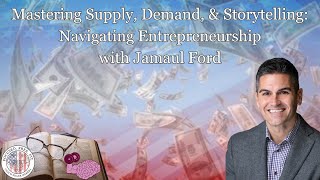
Mastering Supply, Demand, & Storytelling: Navigating Entrepreneurship with Jamaul Ford (Episode 25)