Prioritizing Humanity In Legacy Building With Jamaul Ford
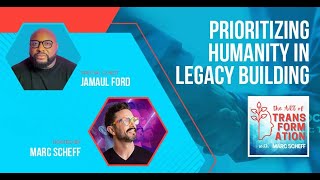
Jamaul Ford, a healthcare consultant and entrepreneur, lost a $2 million contract over a trust breakdown. He argues that empathy over ego builds sustainable success: understanding customers and employees creates a caring culture that fuels growth and lasting legacy.
Chapters
Hey everybody, welcome to The Art of Transformation Podcast. I'm your host, Marc Scheff, and if you're watching this video, you will notice a little bit of a shiner right here. I do love jiu-jitsu, and I will say that this week it loved me back just as hard. So this week's guest is a little bit different from my usual guest. He's actually got a long career in healthcare, and he now works with all kinds of businesses, startups, entrepreneurs, taking them from 0 to 10K, 10K to 100K. But what's so interesting is he really thinks about this from a human perspective. And he talks— in this podcast, we talk a lot about how to create a legacy through empathy and through a commitment to growth of the people around you. So what's so fascinating for me is even with somebody who's so different from me and, and just doing things, you know, that, that are so foreign to me in terms of his day-to-day, there's so many commonalities in terms of what we're trying to do as people who create things in the world. So have a listen and I'll see you on the other side. Hey everybody, welcome to the show. Jamaul, welcome to the show. Really good to have you here, man.
Man, Mark, I'm so glad to be here, man. I'm glad to actually be getting the chance to get to know you more and more from talking to you. So I'm super excited to be a part of the podcast.
Yeah, that's awesome, man. You know, I gave a little intro before we got on the call, but, you know, I'd love for you to share with our listeners just a little bit about you and kind of what your mission is in the world.
Yeah. So my name is Jamaul Ford. I'm a second-generation entrepreneur. Jamaul Ford. I've been in the healthcare industry for probably about 12 years now. And for me, I've really hung my hat on really trying to help people be more empathetic to their customers, empathetic to their employees, making sure that there's a good understanding and a good buy-in across the board on the products or the services that a company is offering. And I believe that once you do that, you're going to have a long-lasting actual business compared to a business that is only for a short period of time.
Yeah. Yeah. You've got a long— I mean, I'm looking at your bio here and you've got like a long, rich history of working with lots of different people. And, you know, when we talked earlier, you talked a lot about— we spoke a lot about really the importance of an empathetic approach. I'm curious, you know, How would you say an empathetic approach affects, you know, the course or the, you know, the course of success for, you know, either a small business or individual to something larger?
Yeah. So one big thing that I always try to remember, whether it's me trying to start a new project or I'm working with a potential client that is creating a new project or trying to expand their particular business or project, I always think empathy over ego. Because I really believe that we sometimes get so locked into what we want to do that we don't consider what the market is asking us for, or what our actual customers are asking us for. So I think it's a blend of understanding what people want, what your community wants, understanding what you have the tools to give them, and actually being committed to giving them what they want in your own way. So I think it's a blend of the two.
Yeah, I love that empathy over ego. Yeah, because right, it allows you to do the voice, you know, the kind of voice of customer work that whether you're in healthcare or, you know, if you're running a creative agency or running your own business, which I would argue is a very creative pursuit, running a business, being an entrepreneur, you know, being willing to put yourself in the shoes of someone else, right?
Well, I would tell you this, Mark, I 100% agree with that. And I think, um, from a creative standpoint, it's, it's also super important, um, outside of the business standpoint. I actually have been a professional bass player for probably about 15 years since I've played bass. And, um, even in my, my bass playing, I still play, I play at my local church and sometimes I play festivals or different things like that. And for me, As a musician, I've always said to myself, okay, I love to play, I can play all these licks, I can play all these things, but that's not what's important. The most important thing is that the actual crowd gets the message that the artist up there is trying to present. So it's very important for me all the time, even from that aspect, to get out of the way, to be able to get the overall message that people came to receive out there. Sometimes even as a musician, you can want people to look at you and what you're doing and not see the big picture. So, I mean, I definitely agree with that. Yeah.
Something, you know, something that it's reminding me of something that I read in Donald Miller's book, the Building Your StoryBrand book, you know, where he talks about the sort of customer journey. And it's, you know, for me, when I was reading this as an artist, it's a little bit hard because you're like, like, you know, it's not the same kind of thing when you're talking about business, but there there are really ways to think about it. Like, you're not the hero up there. Like, you're working, you know, whether it's with a crowd or with a company or, you know, however you're working, you're guiding them through a journey. And they, you know, they are experiencing some sort of transformation. I mean, look, I love music. I've been to some live music. Not as much as probably a lot of people, but, you know, when you're there and you are, you know, people talk about feeling transported. Are transformed, you know, the, the, the, you know, there's feelings and chemicals going on in your body when that stuff happens, all that stuff. Like you're literally changing the chemistry of your body. Like you're doing that for people out there, right?
Yeah, 100%. It's very much so super important from that standpoint. And even to go back to what you were talking about before, one of the greatest examples of actual being an artist and trying to help people tell the story is actually the book Pinocchio. I like the book Pinocchio, is like the ultimate example of that. I always think people always think about Jiminy Cricket, right? And Jiminy Cricket's responsibility was to guide Pinocchio to being a real boy, right? But one thing that people never consider is Geppetto was the artist. Geppetto was the artist who created Pinocchio, and then that was his creation. Jiminy Cricket came in and said, hey, this is your creation. I want to make it better, but I can't force it. I have to guide it. And so I have to— I'm not the hero of the story. Pinocchio is the hero of the story. I can only give him advice and tell him what to do. Right. So I've always loved that example when it comes to actual— you're not the hero. And so when you talked about being an artist and not being a hero, that's the first thing that came to my mind.
Oh, yeah. Yeah. I think even in the book he mentions Jiminy Cricket. Now that you mention it. Right? Sort of the ultimate guide. Like, he literally doesn't have the physique to really, you know, make anything happen. But he's this voice of— he's the conscience, right? He's the voice of reason. He's the voice of purpose for Pinocchio. I'd have to reread this. It's been a while, I'll be honest. You know, I don't know how well it ages. But I think, you know, when I think about that position as a guide and, you know, bringing it back to you, You know, that's what I hear. And we've talked, that's like what you do for a lot of your clients is really guide them, challenge them, push them through to, you know, bring more empathy to their communication, bring more collaboration, and give them the tools that they then have to execute with. Right?
Yeah, 100%. I believe that really being in this particular space and being a thought leader in the space of consulting in business, you can really get hung up on what you believe is best for that company's, um, for that founder, for that CEO, for that COO, and just tell them you should do this. Um, and for me, um, it's always said, teach a man to fish or give a man a fish, right? So for me, I always step back, and I— and many times, even as a consultant, you can see it, like, it's like, do this, but that's not really your responsibility. Your responsibility is to consult and to guide them to the answer. That way, when you're not there, they still know the pathway to get to the answer, right? But once again, empathy over ego. Many times our ego gets in the way of us allowing the customer to be the hero. You want the accolades for coming up with the answer, right? So it's like, you know, so it can become a slippery slope. And I really believe that when you actually set us— like when you're working with an actual customer and you set a pathway, whether it be in the creative space or in the business space, when you put that roadmap together, that roadmap and you stick to it is going to allow you not to get in the way of the customer. So as a consultant, when I'm working with someone, and I say, this is the goal that they have, and I put that roadmap in place, I'm not the person that's coming up with the ideas in the roadmap. I'm helping guide them down that road, right? And so that way, they can go back and forth down that road. So yeah, yeah.
And you know, that actually is a nice segue into something that, that we talked about before. Is that one of the things you said you like to do is to, you know, when you're working with clients, when you're consulting or co— I mean, there's a, you know, you can kind of, as consultants, sometimes you kind of go back and forth, right? You advocate for a culture of open collaboration and collective growth. So I'd love to hear, I mean, if you've got even a specific example of like, you know, an individual again, or an organization, you know, What happens when someone shifts that? Like, what, like, are there, are there tools? Like you talk about the roadmap, like, where does that fall on the roadmap? How does that, how does that sit within that framework?
Yeah. So another thing I like to say, and I always like to bring into a consulting standpoint, if I'm working with a company as a whole and not maybe an executive, I always say caring cultures succeed, right? So what that means is, as the leader of the company, it's not just about everybody seeing my vision, but it's about them seeing themselves in the vision of the company. One of my favorite books is Extreme Ownership, and in Extreme Ownership, it really delves into the mission. And when you're in the Army, there's a mission and you may not agree with what your commander is telling you to do, but if you go rogue, you may die, right? So.
Right, right.
The number one thing they tell you you to do is this is the mission. You have to find yourself within the mission. You have to say, what part of this mission I like? How can I really fully invest in this mission? And so for me, when I'm bringing on a team member, I'm working with someone that's bringing on team, team members, I always once again bring it back to the values of the owner of the business. And then making sure that they understand the values of their employees. Because from there, the buy-in on both sides is very easy. When, when I say a caring culture succeeds, it's easy for me to care about my employees and for my employees to care about me if we have the same value system, right? And going from that, caring even goes beyond the company. I'm really big on um, when I'm transitioning someone internally from a regular role to a leadership role, I never teach people how to be a leader strictly for my company or for that company. I teach them leadership skills overall, and then I tell them how these skills apply to this company, right? And that's, for me, it's investing in them to where if they can have success beyond my company, I don't want to pigeonhole them to being with me. And I think it becomes tricky because when you find a quality worker, many times we get so stuck. We don't want them to leave. We don't want them to leave. And so we do things as a company or as a business to try to make them want to stay, or we don't invest in their success overall. Right. And it still is to the detriment of the company because you're working against the outcome.
Right? You're working against the outcome because you don't want them to leave. They're your best worker. You should be investing in them. But that's like almost like a personal risk. Like if I, you know, if I'm creating this culture of openness, communication, I would offer a culture of coaching where you're invested in people's growth. You know, there's a chance that they may grow beyond. I can, you know, I can relate to this.
Yeah. And I think them growing beyond your company It's great. It's great to say.
Why is it great? I would love to hear. I would love to hear you say why it's great.
So for me, I, it's great for a number of reasons and I don't want to, I don't want to like, uh, but for me, I, I'm really big on when a company, there's few things that a company needs to have success and you need pipelines and you need two major pipelines. For me, you need a pipeline of customers and you need a pipeline of employees. Um, cause those are the two things that really pigeonhole most companies. Um, so you want to find your target audience in a collective group. So like, let's say if I'm in the fitness industry, I'm going to go marketing to apartment complexes because I know there's 800, 900 people that stay in this apartment complex, and that's a huge funnel for me, right? If I'm working in, um, same thing, if I'm working in the fitness industry and I need employees, I'm going to go to the local college and find kids who are, um, maybe getting their degree in some sort of fitness, right? And if I put together a system of training that is spectacular, I can actually win awards for my company through this system, which will attract even more employees. So really, by— because I'll say this— really focusing on that individual employee will ultimately stop your growth from being able to train fully, to be able to train the rest of your employees, right? And so I think that's super important to always consider, like stopping someone else's growth is actually stopping your growth on a multitude of levels, right?
You know, there's, there's, I can, I can almost, I can almost hear the comment section going, well, what about, you know, what about employee satisfaction and all that other stuff? What I'm actually hearing you say is that by being dedicated to employee satisfaction, by offering opportunities for growth, by offering education, by offering, you know, the top, the most top quality training and opportunities and that kind of thing. I mean, you know, in my world, in my background as a creative, you know, I run an art gallery. It's one of, in fact, this just happened today. It's almost one of the greatest joys of owning and running this art gallery. When someone says, you know what, I've got bigger fish to fry now. Like I've grown out of the gallery. We sell small work, we sell work I work every day. It's a great, I think it's a great place. People have great things to say about it. But every now and then, you know, an artist grows beyond where they say, you know what, my prices have gone up, they've gone up too far. I need to go to a bigger gallery. I say, that's great because my mission isn't necessarily, I mean, certainly there's like a bottom line somewhere, right? Like if you wanna keep being in business, you gotta attend to that. You gotta make sure people are happy while they're there. But along the way, you know, if I'm known as a place where people come and they end up in a better place when they leave, that's great. If I'm the place that just churns people out and people are burnt out when they leave, that's probably— we're not talking about that. Yeah. You're not talking about not giving a crap about your employees.
Right. 100%. I agree. I will say even from that particular standpoint, in the even bigger picture, um, legacy. Yeah. In talking about legacy, um, many people always wanna figure out what their legacy is, what their business is, what their business legacy is, and A legacy lives beyond you. It's something that goes beyond your physical time here and your, your human experience, right? So for me, I always think if my legacy is to live on beyond me, I have to fully invest in others because word of mouth, whether it be business, whether it be whatever, that is the number one thing that's always going to cement legacy. So when someone leaves, if someone leaves your art gallery, and you've invested full time, full energy into them, they will always give you praise. And when they find those young creatives, those young people who are trying their best to find their way, and they see the success of this person who left your art gallery, the very first thing that they're going to ask them, well, how did you get here? And your gallery is going to be the number one thing that they say, because you put full energy into the success of that person. So I really believe that is legacy. That is why it's important to invest, whether it be in creatives or employees, because I want an employee to— employees are going to leave regardless. Like, they're going— people get hired and fired all the time.
Yeah, we don't live in the culture of— I mean, my dad's of the generation, you know, you get a job and you stick with it. And, and, um, you know, that, that time is gone for most, you know, a lot of, a lot of professions.
Yeah. And I would say Even from that standpoint, and even from the standpoint, I'll use what you said. You said that you sell smaller works because you sell smaller works that has probably a roundabout price range for those works. And so generally when, um, an artist gets recognition or starts to work on other things, that has to change, like whether the size of the work changes or the price point of the work changes. Those are all factors that has to happen in order for that artist to feel success, right? Same thing with employees. An employee comes to work for you, they are at a level, and unfortunately, you know, inflation is, is, is large. Like, we have a lot of things that's going on. As a company, you have to know not only your target audience, but your target employee too, right? And so like, are you a starter job? Are you a job that's for people in between the ages of 18 and 25? Are you a job for people between, you know, 26 to 35? Are you a job— and it gets very unique— like, are you a job for single mothers? One of my favorite, one of my favorite stories is a guy by the name of Pat Bet-David. I don't know if you're familiar with Pat. He's an insurance professional. And I think he sold his insurance company for like $350 million or something like that. Um, and he runs like these huge, uh, actual, uh, conferences now. He has something called Valuetainment. But when Pat started his insurance company, he had trouble finding employees, and he actually niched down to Hispanic single mothers, and that was the people that he invested in because he understood that their income level wasn't where they needed it to be. And he had the resources and tools to give them the skill set to be able to get them to the next level, right? And so I think that that's really important that he knew who his target employee is. So I think it's super important to understand that.
That's a, that's a beautiful example. And, and I gotta say, you know, it's still ringing in my ears what you just said about legacy. I just think that's maybe one of the best, just one of the best ways I've really heard, like, if you, you know, if you want to have an impact in the world that goes beyond your time, your physical form, if you will, then you have to invest in others. You know, it's not about— it's, it's not— I, I like it because it's not, you know, it's not influ— it is in a way influence, but it's not about influence, power, and money. It's about investing in others on whatever scale, right? Like, if you, you know, I, I've heard this, and I, I'm gonna have to look this up, but there's some sort of quote about like, you know, we live for as long as people remember us, or, you know, something like that. And And that's just a beautiful way of thinking about it, right? Like, if we— Ralph Waldo Emerson also said, and I'm gonna blow this quote, but, you know, he said basically like, if we're truly here to serve others, then we have to invest in ourselves. So there's like two sides to that coin because people often get kind of stuck in their minds about like, well, I feel selfish about building this thing because I'm building myself up. But if you're doing that and you're investing that right back in others, then there's that beautiful sort of virtuous cycle, if you will, if you're not hoarding all of that.
Right.
That's just— that really stood out to me as a really beautiful way to phrase that.
You know, one thing I will say about that, and this actual event really put it in perspective for me, the death of the Queen of England, Queen Elizabeth. When she passed, it probably was like 8 or 9 months and people were not talking about her. At least in our— in the United States society, people were not talking about her as much as maybe when she was alive, right? Why is that important? She is the most successful monarch in human— almost in human history, I would say, at least from our somewhat of recorded history, um, outside of the Roman Empire, because her reign was about 70 years. And for England, it was the most financially successful time of the actual country, and she has a ton of accolades. But today, you know, as the world, we don't talk— like, maybe in England they talk about her a good bit, but for us, we don't really mention her on a day-to-day, right? And so legacy has a timeline, legacy has certain things. And so I don't want my legacy to be one day, right? I want my legacy—
I mean, it's also— that example kind of brings the point, and, and I, I might have a slightly different view on, on what, what success is, but certainly financially, like they did, you know, the royal family did great the last 100 years and she reigned for 7. So by those metrics, certainly successful. You know, I'm not, I'm not as up to date on, on, you know, how she actually did serve over there. But I will say, you know, it's, it's an interesting commentary that not to get too political, but like money isn't, money really isn't everything. It is an important factor in the success of a business. But what I'm, what I'm hearing you say, like all the stuff we're talking about, legacy, and communication and empathy. It's funny, I just feel like this is in the air now. Like people are really aware that, you know, there's only so far you can get by focusing on, you know, on numbers, on getting people in the door, on getting employees in the door. If you're not focused on, and however this is going to sound, on really the human side of creating, whether it's in this world, right? Whether you're creating a business or whether you're creating relationships, you know, whether it's work or personal, if you're not focused on the human side of the collaboration that you're having, again, with a client, with a friend, with a partner, kids, if you're not focused on that human side, if you're just focused on these sort of traditional success metrics, I mean, there's people who are maybe disagree with me on that one, but in my mind, that's not a success to me. You know, but if I—
I agree with you.
If I have people leave and say, You know what, you helped me get to the next level, even though we're not working together, right? You helped me get to the next level. Like, I got kids, right? And, you know, someday they may be grateful. They're not, you know, they're teen— one's a teenager now, right? Yeah, yeah, they still— they're still kids. They don't— they, you know, they hate me every other day. But, you know, I'd like to think that somebody notices that, you know, we got them from really nothing to you know, to being successful people in the world. And that's what I mean. Parenting is like an amazing example of this. Like, we, you know, it is, it is not a profitable business. You know, we are, we are spending all kinds of money just to like, just to invest in the growth. So that's like maybe too far in the other direction, but—
Well, I don't think so. I would say like what you do, especially with the gallery, has such a profound impact on the idea of legacy. Because being a creative and being able to tap into— it kind of goes back into empathy. It kind of goes back into these things. When you're able to tap into society, what the— what's going on in the world at that particular time, um, what, what the experience— your human experience, everyone around you human experience— and you're able to create a piece of art that transcends time, that transcends certain things. That's very impactful because when you leave, like even us, you doing this podcast, it's a form of art, it's a form of leaving, um, something towards your kids. Um, it's also a form of, um, being able to show people beyond your time frame here, um, what you did, right? And so that's, that's very important. I believe that at the end of the day Art, when done the right way and when done with— in the, in the right, I would say in the right spirit, I would use that term, and from the right perspective, can really have an impact very profound, long beyond your time frame. You talk about great books, Think and Grow Rich, Napoleon Hill, the Bible, you know what I mean?
Like, so many books. That's certainly a very good example of something that's—
Meditations of Marcus Aurelius, like those particular things, like, you know, they, they transcend time. I, I'll say this, and, and obviously if you want to transition to something else, that's cool. But I always think, like, um, the Roman Empire was 1,600 years, right? And that the Roman Empire was actually AD and BC, right? BC and AD. It was 1,600 years. The United States has only been here roughly about 500 years. And I always think to myself, I don't know any Sumerian, I don't know any Samaritans, I don't know any Roman people. I don't— I know Marcus Aurelius, you know Julius Caesar, you know a few people But there's a lot of people in that time frame where you don't know what really happened. You have a vague idea, you learned it in school. So legacy has a time frame. Even the people we know today that has legacy, their legacy still have a time frame. Um, like the Martin Luther Kings of the world, the, um, J.D. Rockefellers of the world. Like these people, while they have legacy for us in 1,000 years, who's to say they're going to be remembered? So That's why it's so impactful and so important that you take the time to make sure that you do something in your lifespan that transcends yourself. So whether that's creative, whether that's business, you want to make sure that you're leaving some nugget beyond yourself. And that's sometimes that's very hard to do in business because you generally tend to find yourself being selfish. But when you invest in your employees and not only from a financial standpoint, but from an education standpoint, from a well-being standpoint, that's going to carry with them whether they're not with you and they're 70, 80 years old and they're like, you know, I loved my job. You were that job, you know what I mean? You were the person that allowed them to take off to be able to go to their kids' baseball games. Their kids are going to remember, my dad always came to my games, so I want to be at my kids' games. So legacy is super important and it presents itself in a multitude of ways.
Yeah. God, I almost feel like that's a That would be like a great note to kind of close on. But actually, I had another question that does relate, and it ties a couple of things together. You know, this idea, you know, of legacy and, you know, creating what sounds to me like a culture of coaching, but this open communication and this investment in the growth of the people around you. So I wonder if you have any specific suggestions if you were talking to, you know, if we had people, if people listening are, you know, thinking of, of either growing, if, you know, I, I know a lot of independent artists who are, you know, looking to bring people on to help them with marketing or sales or that kind of thing. You know, if you were to talk to, uh, folks like that or even small businesses, you know, what's one way or, or one piece of advice that you would say that could create that culture of growth?
Yeah, I, I have a lot of sayings, I have a lot of maxims. So one thing I always say, so what I always use is empower to excel. And for me, it's really important because, you know, when you have a team, you, you don't— micromanaging is a huge thing. And, and as an artist, as a business, you're real sensitive about your work. You're real sensitive, like that's your baby. Your, your work is your baby. Your, your, um, business is your baby, and you want people to handle it a certain way. And you can, but you always gotta remember you hired that person for a reason because they have expertise in some area, and you have to let them do their job. You can give them guidance on what's important. You can teach them the standards of your business. You can teach them what your vision is, what your mission is, and how to get there. You, you— that's what 90 days of training is for. Um, but there becomes a time that you have to let people make mistakes, and that's very hard. That's very hard as an artist because when you're doing an art show and you have a marketer and the marketer sent out the flyers, uh, 2 days before and they were supposed to send it out 2 weeks before, you gonna want to fire that person, you know? And you're gonna be like, no, you gotta go.
So that's a great example, right? That's a great example. Like, I was thinking about my kids and like, I have a 13-year-old and, and he, you know, we're definitely— and an 8-year-old. And we're at the point where like sometimes you like, you want to like sort you know, keep them in the lane so they don't get, you know, so they don't hit their head or whatever. And sometimes you're like, you know, they gotta, they gotta touch, they gotta touch the hot pan and, and learn. Um, but the example you gave is, that's even more scary, right? Like if you're, you know, if I'm working with you or even, you know, if you're working for me or we're working together and you have a set of responsibilities, maybe we have a partnership and your work impacts me in a way. I mean, I can imagine that it would be incredibly difficult to, to, to find a, so what would be a different path? Other— like, you want to fire the person. You screwed up. You had an impact on my business. I'm, you know, I'm done. What would be another way to approach that situation?
Mark, I'm going to give you— I'm going to give you the worst example. I'm going to give you the best, most terrifying example you've ever heard. So, okay, 2019, we— I was operating at High Level Speech and Hearing Center and we had an employee. He was— I was working at the hospital. At the time, and he was interning at the hospital. And then whenever I transitioned to HighLevel, I felt like he would be a good fit as well. So he wound up coming and working at HighLevel, and we kind of implemented some of the systems that we were doing at the hospital. And I trusted him a good bit, and I trusted his skill set because I had taught him prior to. And at that time, I would say I was not a good leader. I was not a good leader at all. And so I felt what wound up happening was we wound up getting this contract. We had this contract with this school. The contract was worth maybe $1.5 million. And then at the time, they wanted us to do additional work. And the work that they wanted us to do, they wanted us to implement therapy for the school. And they told us they had about 200 kids they needed therapy for every week. It wound up being 400 kids. So we were severely understaffed. To do the work. So I found myself scrambling, trying to find employees. I found myself like trying to do a lot of different things to make it work. What wound up happening with this particular employee was he was doing a lot of the work on his own. He found himself like, you know, and I'm always about team, let the team work. But he was so like, I don't want anybody to mess up what I have going on. This is the system that I built and I'm the only person that knows. So he found himself working at 1, 2 in the morning doing things. Well, what wound up happening, Mark, was I want to say March of 2020, we wound up losing the contract. And we lost the contract because he had lied about something that he had done that he was supposed to do and he didn't do it. They were requesting information because they had to have it submitted by a certain period of time. And, um, he said he was going to have it done. He did not have it done, um, in the time frame. And then when we got that email, we not only lost the additional money from the additional work that they wanted us to do, but we lost the original contract. So we're talking about a $2 million annual contract.
Yeah.
And your first mind tells you, hey, I want to let him go, right? Because, you know, and—
but that would be up there. That would be up there.
Yeah, it would definitely be. It would, you know, but the thing about it was I stepped back and I looked, and when those things happen, I look at myself. I say, you know what, What could I have done? What could I have done better? And you know what? I'm not a good leader at this moment. I'm not where I need to be in order for him to have the success he needs. So for me, I challenged myself to become a better leader. And that was really hard because what I had to do was not only educate myself on leadership, start reading more, get consultants, get people to help me with leadership. I had to reestablish that relationship with him. Of him seeing me as that leader as well. And that's very, very common with me even dealing with companies now that, you know, have, you know, um, many times I'll get places and sometimes the employees have actually lost respect for their leaders. And that generally happens because you say you're going to do something and you don't do what you told them you were going to do. So an example would be in your gallery, if you had an artist come in and you said, okay, we're going to put your stuff here, we're going to do this, this, this, and this because you have the ability to do it. You said it with good intention, but you have so many other things going on and you have so many other people that you want success for that you did not actually get that artist what they needed. And so they start to lose respect for you because you, you over— you overpromised and underdelivered from your position. And that's— and you never want to find yourself in that space. So I'm always conscious of that and I always keep a mindset of making sure that not only I'm empowering my team from a standpoint— not empowering my team from a standpoint of you do the work and I'm not going to— I'm just going to let you do it and I'm not going to be a part of the work. I empower from a standpoint of I'm knowledgeable about it. I'm here to help you. We are a team. You're not by yourself. I'm not going to do it on my own. We're working on this together. But even though I'm your boss, sometimes I can let you— I can lead from behind. I can lead from behind, have you walk in front and then turn back and ask me questions. Right. So really, for me, really, for me, empowering to excel, that's really what that means. And I'm really big on that.
Yeah, I like that visual. I was actually talking with a coaching client earlier today and we talked about different ways of having a conversation where you're eliciting, in the case of business, maybe called voice of customer. In the art world, it's maybe a critique of the work, something that's really intended to help you improve. And from the person who's sort of looking for the feedback, maybe it's from the leadership or maybe it's a 360, right? Like maybe it's going the other way. What's so effective is, or the way that I like to think about it that I'm hearing you say too, is, you know, you're not like sending somebody out on their own and good luck, you know, you can't call me. And you are, you know, you're leading from whatever position, maybe you're leading from behind and you're facing in the same direction. So like one of the conversational tools that I offered to this person earlier today was, you know, if I'm going and I'm talking to, you know, maybe somebody, you know, who was a client of mine or, you know, somebody who's, Bought some of my services or bought some of my art, you know, I might, if I wanted to have this kind of conversation with them, I might offer them this framework and say like, look, we, you know, we both want my, you know, if I'm, if you're my boss, I'll say, look, we both want my work to be better. Like, you know, that wouldn't that be great? Even if my work is already really good, like, wouldn't it be great if it was better? Okay. So we both are oriented in that direction because that's good for the company. That's good for you. So the format of this conversation that I love, it sort of puts you on the same side of the table is to say, let's I want to hear from you what's working really well. Like what is working about, you know, maybe I'm on time, maybe, you know, I'm always showered, you know, I get my work done on time, whatever. And then to say, you know, what are some things that you can think of that would make it even better? So it's a less oppositional framework than like, okay, pros, cons, or like what's working, what's not working. But it's more like we're sitting on the same side. We both want you to move forward because when you move forward, all the boats go up, right? So what's working well and what are some things that would make it even like, that would help me improve, that would help me get even better. So it's less about like, well, you're not doing this the right way. It's more like, well, I think you could, you know, you, you could organize, if you organize this just a little, if you added that column there, that would actually help improve your speed or, you know, whatever it is. So I like that example that you gave because the visual for me is that you're all moving in the same direction. You're moving with them. You're right next to them. You're there. You're available. They feel supported. Which I think is a big, big part of empowerment.
Yeah, I agree. I— one other example I'll give you really quickly is, um, I don't, I don't know how many, um, national football games you've watched. I played football in college, I played football in high school, and there's different coaches for different things. And during the game, there's always a coach that's in the press box, and he's up there and he's watching the game from a downward view and kind of seeing what's going on. Um, at halftime in the, in the NFL, there's a lot of interaction between that coach and what's going on, um, with the coaches, with the players on the sideline. Um, but generally in high school, sometimes that coach comes down at halftime and tells people what he's seeing and what adjustments he needs them to make. The thing about that particular coach is he has a, a big picture view of what's going on on the field, right? But when he tells a certain player, hey, I need you to block that guy this way. I need you to run the route this way. The response of that player will either be, yes, sir, or it will be that they tell that coach why he's having trouble doing that. Because that coach has the big picture perspective and he's not in the woods, like actually on the ground with them, he has to consider what that player is saying because maybe there's a physical aspect where the player he's going against is stronger than him. And what the coach is asking him to do, he can't physically do. Maybe the player in front of him is faster, and he's like, Coach, that guy is whooping me every time. Coach, I can't get past him. I know that's what you want me to do, but I'm having trouble doing that. Now the coach, because he still had that big picture perspective, can come up with an alternative solution and have some— and he brings the whole team into the solution because the individual solution would not work for that player. So for me, leading from behind looks like that. It's like, hey, this is what I believe you should do. You give me feedback, and then after I get your feedback, we're going to put together a strategy and we're going to go implement that strategy. So yeah, definitely.
I love, I love that example. I love that image. You know, you, you have, you have somebody whose role it is to look over the whole situation, and that's an important role, but it's also important be whatever that means to you on the field so that you can communicate back and forth and say, okay, you have this idea about a direction. Let me tell you about a couple things here. Go ahead, tell me what you think we should do to adjust. And then we, you know, we execute. I love that. I got to close things up here. I know when we talked before, I think we talked for like an hour and a half. So I'm impressed that we're here at 43 minutes. But before we go, I'd love for you to share, you know, if people are interested in finding out more about you and what you do, where can they go?
So if you want to find out more about me, you can go to Jamaul Ford on Instagram, um, Jamaul Ford on Facebook and on Twitter or X. Um, also I'm launching, um, a community, um, the Maven Mastermind. So you can go to MavenMastermind.io. Um, in the community there's a waiting list at this particular time. You can sign up for the waiting list to join the community. Um, once you join that waiting list, you will actually get, um, the one of the first courses and it's absolutely free. The course is Getting Your First 100 Customers in 90 Days, and it's a step-by-step guide to getting your first 100 customers for whatever you're doing. Generally, um, a lot of times, um, you'll get a course and you are supposed to have success with that course. For me, I think courses and community coincide. So it's not just about giving you the information. It's about helping you along. So this community is super important to not only give people information, but let them collaborate and work together to have ultimate success. Success is a team game. It's not an individual game. You can have individual success, but even the greatest tennis players in the world have a team behind them supporting them whenever they actually hit the stage. So my goal and the goal of the Maven Mastermind is to give you that support.
Well, Jamaul Ford, thank you so much for being on the show. It's been a real pleasure to have you here.
It's been great, Mark. I really appreciate it.
Wow. Thanks for listening, everybody. That was such a great episode, such a great conversation for me. As always, we would love it if you like this episode, if you rated the podcast, if you subscribe to it, if you shared it with friends. I believe that unleashing people's creativity and finding ways to do that can change your relationships. It can change your business. And I really believe this, it can change the world. So thanks for listening. And if you ever need to find me, I'm at marcsheffcoaching.com. That's M-A-R-C-S-C-H-E-F-F coaching.com. I'll see you next time.
More from Jamaul


THE HEALTHCARE WAR: Congress vs. Your Wallet | Betting on ACA Future (Kalshi LIVE)
179 Sell to Serve! Why Business is All About Sales & Helping Others with Jamaul Ford

Reframing the Perspective on Business w/ Jamaul Ford, Upgrade Your Online Presence
Mastering Supply, Demand, & Storytelling: Navigating Entrepreneurship with Jamaul Ford (Episode 25)