A practical tactic to make taking action on your overwhelming goals easy
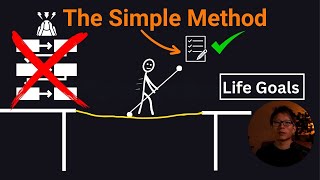
When your goals feel overwhelming, break them into absurdly simple rules that take almost no willpower. Instead of "exercise more," try "put on workout clothes." Three concrete examples show how to design actions so easy you actually do them.
Chapters
So I want you to think about this little graph here to try and really hammer this home. Your usefulness and effectiveness on the Y axis. This is what you think. This is how effective you think you're going to be. And this is the reality. Yeah. So you're much less effective than you are. This happens for me. This happens to me still on a daily basis. Right. So I think of an amazing script that I'm going to write. Then when I actually open the Word document, I've got these great ideas. And then when I open the Word document to type something out, my, my fingers can't seem to move and it's like all of the words just fall out. I. They just disappear. I get the mental fog. I can't even string sentences together and I'm like, what on earth is going on here? The performer is trying to perform and is struggling. But that's okay. What you need, everything must be designed for the person executing. This is one of the fundamental flaws. People do not think about who is executing the plan because we live in one head. We think, well, it's all the same. However, I feel away from it while I'm planning is the same person as the person executing. It's not. It's very different. That's why I've tried to use this kind of analogy here, to help you separate those two, because it can help you think this through and create better, more effective plans. You must make them easy to execute. No ambiguity. No ambiguity. They have to be really clear. I want you to imagine you give someone a map to navigate their way through a forest. The same thing. You're like, oh, I'm gonna go here, here, here. Go through these checkpoints. This is the fastest route. As long as you do this and you cross a river here and then you make it across this ravine. But then you know when you're going out into the forest, into the jungle and actually doing that, you know you're going to get lost. You're going to feel really stressed and anxious because things are not exactly what they seem. You. You feel like you're late. It's physically challenging. Same thing here. So you need the map to be ultra clear. No distraction. You need to. You need to allow them to be fully focused on the mission. Here we want to imagine this person is here. We want to help this person. They're here, they're not up here. Give this person a break. So this is compassion. This is practical self compassion here. If you do not design plans that are designed for this person here, you're not actually being. You're not showing self compassion to yourself. A lot of literature out there talks about being compassionate. But again, they often don't show you exactly the actions and behaviors you must take to demonstrate it. This is an example. Simple rules. So with the map thing, you want to have it super simple. So when you get to the clearing, turn left. That's it. Right. Nothing. No. Go these degrees to the left. Take seven steps here, take a jump here. If you make it too complicated, it overwhelms the performer. The simple rules designed for performance mode helps focus on performance. If you give very simple rules, it allows the person to just execute and focus on executing it well. Give your brain some help. Make it easy so you don't have to use mental resources on trying to figure something out on the fly. Design simple rules in the preparation stage. Don't design them while you are performing. Try and design them away to make it easy for you. Pass simple rules to performance emotional state. So you do it in preparation. Then you pass it to the performance emotional state. You may have heard this kiss. Keep it simple, stupid. It's an interesting history on this. The need to simplify aircraft for repairable repairability. The people repairing needed it to be done under pressure very quickly. So they needed it to be quick and easily actionable. Cannot deal with over complicated systems. So the idea here was these guys and girls were the performers. They needed the design up front and the repairability instructions to be really simple so that they can just focus on executing, not trying to figure stuff out on the fly. Concern at the edge. Then you go and read. Then you design your plan. Put right foot here, put your left foot here. And then you take your plan and take it to the execution point. You have very simple rules and then you execute. Here's some guidance for how to create simple rules so we understand the concept simple rules. Now we are going to implement them. They must be clear and precise actions. Very, very high clarity. Put your left hand on the rope here. Low mental effort. The instructions must be very, very easy. It must solve a bottleneck in your plan. So highly focused on a specific thing moves you in the direction of your goals. So it's a critical action that is moving you where you want to go. So on the bridge scenario we want to gain a few feet or meters along the bridge. So we know we can give them actions of placing your hand here and placing your feet here. Because we know that it's going in the right direction. It acts as a catalyst for a series of behaviors. What we're saying here is once you say, put your left hand here and your right hand here, it is likely that it is going to continue after that. Left hand here, right hand here. Well then we'll keep doing that. So simple rule usually helps you start the process. Here are some very specific guidance on how to create how to construct simple rules for yourself. The rule wording should be really concise, not some kind of verbose long paragraph. It's usually about less than 12 words. Does not describe or explain the problem. You're not trying to activate the performer's mental state. You're just trying to keep it really simple. Say do this. The reasoning and the why should have been done in the preparation stage. So you should have done that away from the performance stage. The rule results in a desired behavior. So when you say, let's say we're trying to cross the bridge, the problem is we're not gaining physical distance toward our goal to the other side. We have this system of making our hands placing one in front of the other and your feet one in front of the other across the rope bridge. So we know the rule is going to result in this desired behavior of moving forward. So I'm going to give you some practical examples now. Example 1. You want to write more critical action to see words on the page. Yeah. That's all you need to do if you're getting words on the page you're writing. So the bottleneck is you have too many ideas and you get overwhelmed by all of the ideas. Your simple rule is open a blank word document and press keys. This might be a bit. You might find this a bit funny, but this is one of my personal rules. Why does this work? Well, sometimes I have plenty of ideas about videos I'm going to make and it just gets overwhelming. So a simple rule is if I get the word document open and as long as I, my, my hands and my fingers are pressing keys, I'm not going to press any random keys. I know I'm going to start creating words. And that is a very simple rule for me. If the performer we trust the performer can perform in some way. So you just need to give a nice simple signal. There's no thinking in this. Open the word document and press keys. And I've actually done this for a handful of writers in various forms of this and it's worked quite well. Other ones we've had is click the bullet point button and start typing. Your start typing with bullet points and it usually gets them going. Example two, you want to work out more critical Action to be outside walking. Bottleneck too much effort to get started. Your simple rule put your workout clothes. In this scenario, we're looking at what triggers the performer to start performing in the whole series of actions. So even though the simple rule is not literally working out, it triggers off a chain of behaviors. Once they put their workout clothes on, put their running shoes on, put a running top on and shorts on, that is enough to trigger the next series of actions. They're less likely to go back to bed it your running shoes. The reason this works is it's so simple. And when you're resisting getting started because it's too much effort, the simple rule neutralizes that because this is a fairly low effort task. If you think put work up clothes, get my car keys, I need to go and drive, you know, to a park or whatever, that can get very overwhelming very quickly. Example three, you want to reduce high sugar foods. So I've done this personally and done this with a number of clients. Critical action have no high sugar snacks in the house. Bottleneck buying chocolate and treats when shopping. So when they go to the do their groceries, very easy to go and buy chocolates. Now, simple rule is to walk past the treats aisle while doing your groceries. Now, you may have heard variations of this. It's there for a good reason, because it's quite simple.
More from James




The mental system I ALWAYS use to transform myself. Warning: Simple, not easy.


Why you lost your confidence and how to get it back - Thrive and Decay: [Full training]



5 PAINFUL truths to improve your life (you're probably not ready to hear them)


Why you always feel conflicted when making important decisions [Three Monkey Framework]