Why it's so hard to find your own direction in life [CLIP]

James Lim explains why external noise drowns out your own direction, then walks through clarifying your values, mapping alternative paths, and building a new identity through small wins. He uses client stories and personal examples to show how staged habits create real change.
Chapters
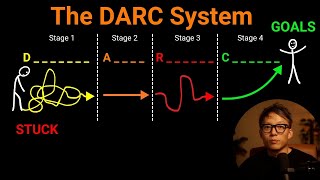
Stage one, establishing direction. Without a clear direction, it doesn't matter how hard you work, you will be constantly chasing your tail. I have been here how to spot if this is a problem for you. So the symptoms, if you have so symptom one is you have goals you work toward, but they don't feel fulfilling or meaningful. Number two, constantly chasing new ideas. So someone will suggest something, you see something on social media, and then you, you'll start researching about it and then you'll get excited and then you'll drop it in a few weeks. Number three, you're constantly questioning what you should do next. Now I'll give you a quick example. I had a client of mine, Jody. She was stuck in corporate life and struggling with only short vacations and she had 15 years of dreaming of doing something else. But what that was the big question for her. So we were trying to get her over here, but we didn't know where that would be and she definitely didn't know. So we will come back to her a bit later. Now, quick reflection. Now this will help you figure out whether you need to focus on this area. Do you know where you'd like to see yourself in the future? Do you feel fulfilled on your current trajectory? Are you busy? Constantly busy with work and life, but there's a feeling of emptiness. These are signs that you may need to work on it. The goal here is to find your direction. I'm going to introduce you first to one of these bonuses, a mental trap, which I call the copy paste trap. Now imagine trying to hear yourself think with all of this stuff going on on the street. Transfer that to thinking about your direction. How do you expect to find your direction with all of this stuff going on? Now we can transfer this metaphorically to this social media. Colleagues, society, family and friends all telling you all pitching in about what you should do with your life and what you should do with your direction. It's extremely difficult. It feels like this. You've got this compass that you're trying to listen to, but there's magnets all around pulling you away from it. So we've got society, culture, school, social media, friends, family, colleagues. Some of them want the best for you, but it pulls away from your compass. Now there's a symptom I like to track and it's the feeling of what you should do. If you feel that this could be the issue, it's sometimes like someone trying to present a trainer to you. They and they're telling you it's the best trainer to wear. They're Pushing this particular one, maybe because they like it or they believe in it. They've not even checked your foot and not even checked your size. They want you to wear this particular trainer and so you don't know what to think. You think, okay, I think that might be a good thing to do. You know, maybe you're not even using it for running. Maybe you're using it for the gym or dancing. Right. It might not be the most appropriate shoot. So we have to find a way to. To check your own fit. We need a way to create some kind of force field around this, like a protection barrier against all of this. So you can pick, so you can gain the true reading of your compass. It's not easy though, because we have to learn how to read a really weak signal inside your compass and maintain this force field around you. So how do you avoid falling into this copy paste trap? Find your own direction. So, number one, we need to create a fairly strong signal here. No more looking outside. We need to look within. This is a side note. Why do we look outside so much? Well, it's often because we want a quick answer. We want someone else to tell us what we should. Which direction to go in. It's a lot easier because trying to figure out what it is for yourself is really difficult. Yeah. So like I said here, it is a difficult exercise, especially if you're tuned to external noise about what you've been told. Growing up and through education, family, society, we have to retune ourselves. It's about defining what truly matters to you. And this is about your values, which we'll come on to next. Now, values act as your compass. It's like choosing a holiday destination. If you go to one of these and you start picking your filters about where you want to head to, popular filters, and you want an ocean view. This is the equivalent of your values. But rather than holiday destinations, this is about your life. It helps filter out the distractions and shiny objects. There are quite a few exercises to help you figure this out, but it's not easy. Now back to Jody. So some of her values here were nature, wild animals, people, and communication. So we knew we had to. That was where we were aiming for. There's a hint here in this picture about what, what are her values? And we can see an elephant up here. So we did a lot of work trying to figure out what mattered to her the most. And we came up with a very, very strong list of values. And it ultimately ended up in her making a massive transformation from a corporate comms A corporate comms role in a fairly big energy firm. And to this now working out here. And you can, you can have a quick look at this. Take a pause. So see all of all of her achievements over the last couple of years to work through your own values. There are quite a few ways to do this. These are the most effective ways I found to mine your values. Now this is from observation of working with clients. It takes a lot of work. So that's why there's quite a few exercises here. Now I'll link you a video somewhere, somewhere on the screen where you can click and you can. I'll take you through the values work. But it is, don't underestimate it. You can work through these exercises and it should help you. So number two, paths and vision. Our brain needs context of the whole journey. What does success look like in the long run? What does a fulfilling life path look like? This process is pretty challenging because there's lots of uncertainty. You don't really know where you're going to end up in this stage. It's really important we start exploring paths where and we can do that with experiments. Back to Jody as an example. She had gone through here for 15 years and had all of these missed opportunities to try new things. And the same thing with Joe, lots of opportunities, 10 years and had a lot of regret about a lot of this in this recruiting role. And like we spoke about earlier, he had a dream of creating big impact with people. So we'll come back to that in a bit. So think about what does the journey look like for you? Articulating your possible paths can help you visualize this. You can think about it like this. You've got your life 1. You can continue on that path or you can start thinking about an alternative life, life 2 or life 3. Here. Now these can be like different destinations for a holiday. Think about where is your ideal destination. Now for Jody, over here, she had life one over here continue like she's always done the last 15 years. But she will continue to get what she's always got. Or she can go for this. And this is what we started to flesh out. Now I really remember this quite viscerally. And this really felt like a pipe dream at the time she used those words again. We will return later. Now, number three, version two. We want to start thinking about who you want to become. Just as a caterpillar turns into a butterfly, we can change ourselves too. We can start thinking about the identity we want to adopt. We can start thinking about who must you become to reach your vision from the previous exercise and what habits and behaviors are needed. So this is you now, version one, and this is who you want to become. Version two, your future. You might be stuck in this one and you're trying to figure out who this is. We want, we need to figure out. And once you figure this out, we can then figure out how we can do this. The reality is the change happens quite gradually. You don't suddenly shift into version 2. You go through these stages through version 1, 1.1, 1.2 to 2.0. What happens is it actually makes it easier because when you get to version 1.5, you can see that you have made some progress and you reach some milestones and it makes it easier to accept that it's possible. So I'll give you a quick client reflection. I had a client, Chris, who was really unhappy in multiple areas of life. And this was a really, really difficult starting point because it was a physical and mental health side location and relationships. And he couldn't see a way out, was deeply unmotivated, and we eventually got him to be fitter. He exited toxic relationships and ended up in a new country, which was crazy. And we eventually gotten to the point where he's setting up a new life in a new country as version 1.6, moving to version 2, which contains a much bigger goals. And this was really, really cool. Now, now I'm going to show you one of the shifts that I made. I went for a physique change and it was actually pretty crazy because the version one, I really, really hated how I looked and I just resided to the fact that that was who I was always going to be. My version 1.1, I couldn't imagine being at that last stage, but at the first stage was just about losing weight. It was really hard, but I was already starting to feel a little bit better. But I definitely wasn't there yet. Now version 1.3 is I could start seeing changes. The weight started to drop at version 1.4 and I started to get to some visual feedback, which really helped with motivation. And then there was a really important moment of version 1.5 where I started getting some comment from some close friends. And that really, really gave me a lot of feel when I was really, you know, I was really getting a bit precarious with my consistency. And then eventually got to these finishing kind of points, which, which I was really proud of. And it just opened my mind because I tried to do this for like 10, 15 years and I could never do it. I didn't have the consistency, but I employed all of the things I've done in this, in this whole video to make this work. And the same thing happened with content creation. So I started here. I was terrified of the camp, so much so I actually had a phobia of looking at camera lenses and the little red light that comes on when you start recording. It eventually got to this point where, you know, I'd had some. Some content go viral. Yeah, the first bit, the first area I was really scared of speaking and speaking. Version 1.1, I'd be speaking in the car to myself. Version 1.2, these were my first videos, which are still up there on TikTok, and I was so embarrassed by them. Then you can see version 1.3 to 1.5 starting to get more comfortable and then started to upgrade the production quality and then eventually get into version two where it started to have some viral videos and connecting with my audience. That's a little bit of incentive for getting your direction right and figuring out how you're going to do that. The problem comes up next. You're all set, but the car won't start. You're not taking any action on this big idea that you're motivated about. This is the next.
More from James




The mental system I ALWAYS use to transform myself. Warning: Simple, not easy.


Why you lost your confidence and how to get it back - Thrive and Decay: [Full training]



5 PAINFUL truths to improve your life (you're probably not ready to hear them)

Why you always feel conflicted when making important decisions [Three Monkey Framework]