How to start the next chapter of your life [A proven 4 stage process]
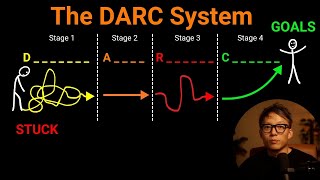
James Lim breaks down a four-stage process called the Dark System: Direction, Action, Resilience, and Consistency. He walks through client stories and names the mental traps that derail people, like the copy-paste trap and the recovery paradox, then gives you frameworks to move through each stage.
Chapters
You've been wanting to start a new chapter in your life, but you still haven't done it yet. Why? We can visualize this here. This is you stuck going around in circles and this is where you want to be. You want to be working on your goals and achieving them. But you may be stuck with things like decision paralysis, you can't commit, on which option to pick. You get overwhelmed when you do pick an option about where to start. So you start procrastinating and then you experience fear of failure. So we're going to go over how you can get from this step state of mind to over here, where you're actively working on your goals. Now, this is me about 10 years ago, and it was taken while I was at work in my corporate job. I can tell because this is my work lanyard here. I don't know why on earth I would take a selfie like this because I do not look in a good way. I was this character here really, really stuck and I felt trapped, desperately wanting to change, but I just couldn't do it for the following reasons. The problems. I was totally unclear about exactly the direction I wanted to go in. And therefore committing to a decision was really difficult because I'd be scared about making the wrong one. I was stuck in research mode. I constantly researched new ideas, especially with social media popping on the scene. I chased these different business ideas constantly. Then when I did pick one, I'd look at how to do it and I'd get overwhelmed by the instruction and then want to get away from it. So I'd make excuses and start procrastinating. When I did make some traction, some kind of life setback would hit me and then it would completely derail me so I wouldn't be able to make any progress. Even when I did make it past a few months, I just had no consistency. So I just had a constant stream of half finished projects. It felt like this. When I fixed one thing, something else would break and it was really, really frustrating. So I'm going to take you through a four stage system that helped me resolve this. I call it the Dark System and it has these four stages in it. So this video will be a structured guide. It will be everything you need to successfully start your next chapter with a high likelihood of success. You will need each of these stages. If you skip, be warned. Now stage four in particular is really critical and it actually relies on the previous three stages. A lot of people jump to consistency because that's what they want, but if you do, because it relies on the previous ones, you will probably find it really difficult not following. This could easily cost you years of your life. And as we go through this, you'll probably see points in your life where you've made a lot of these mistakes. It will be really obvious that you cannot break this cycle if you actually want to start achieving some of your long term goals. Now this is a process I've used successfully with hundreds of clients. I'm only sharing it now because I needed to make sure it actually works with real people, not just myself. So these are some screenshots from testimonials and case studies that I've done with lots of past clients. And you can check these out on my website. I'll give you a link in a minute. So just to give you an idea, this is a client I worked with, Joe, who was working in a pretty well paid job but lacked direction and purpose, really suffered from fear of failure and just was not making any progress whatsoever. He had a dream of connecting people and kind of connecting cultures as well, but he was stuck for over five years. He actually started a YouTube channel. It was just dormant. Now I actually had this problem for over 10 years and eventually broke it. Likewise same with Joe. He started from zero and we eventually got him. This was on TikTok, I think. And now he is connecting and bringing joy to people's lives, connecting cultures through food and earning an income from it. Really living the dream. He's now getting views like this and has well over 140,000 followers on social media. And this is another client, Anne. She rapidly climbed the corporate ladder but felt really unfulfilled and was all work and no play. And now she's landed her dream job working in climate tech and is proud to be an artist, which she does in her spare time and runs some small local exhibitions which is really, really great to see and hear. So you can find some of these stories on my website here. Just Jameslim me, okay? Warning. This video is going to be a deep dive. It's not about five tips to solve your life that is just not going to work. This is going to be really comprehensive. I don't want to waste your time. So if you're, if you're not interested in all of this, you might as well leave the video now. Now at the end I'll be going over some details about a free assessment I've built that will help you figure out what areas you need to work on to maximize the chances that you'll be successful along your journey. Okay, let's get going with the dark system. Number one, direction. It's all about knowing where you are heading and figuring out where this needs to be. We will go through this. Number two, action, the ability to get started. A lot of people struggle on making those first few steps, so we'll go through that. Number three is all about resilience, getting back on track after some kind of setback. And four is consistency showing up no matter what. Without direction you will have shiny object syndrome. With no clear direction, you just jump on various thing to thing. Without action you won't be able to execute and you will have nothing to show. Without resilience, you'll keep falling off track. Even when you make progress, you'll fall off track and you just leave it for six months. And without consistency, you just have a pile of half finished projects. I've been through all of these, right? Why does this all matter? Well, look at these two images. What do you want to create? Big moves in life require a lot. It requires a lot of energy, time and emotion. There are many ways for things to go wrong. Now if you want to build something small and you just want to get on with life more like a mud hut, then you don't need to probably worry about these things. But if you're trying to build something big and meaningful and ambitious in your life, it works much better when you've got a framework and a structure to follow because there are so many things to go wrong. So this will be a systematic approach that will help get you there. And plus, if you do it this way, it can actually make the journey more possible and and fun at the same time. So there are going to be 12 key concepts here and I will go through each of those. So three in each direction, action, resilience and consistency. You can skip ahead. Hopefully I'll have the chapters all put in this video later. But the first time round I would watch this and you can watch it in fast speed if you want. And I also include four bonus common mistakes and traps here. So stage one, establishing direction. Without a clear direction, it doesn't matter how hard you work, you will be constantly chasing your tail. I have been here how to spot if this is a problem for you. So the symptoms if you have symptom one is you have goals you work toward but they don't feel fulfilling or meaningful. Number two, constantly chasing new ideas. So someone will suggest something, you see something on social media and then you'll start researching about it and then you'll get excited and then you'll drop it in A few weeks. Number three, you're constantly questioning what you should do next. Now, I'll give you a quick example. I had a client of mine, Jody. She was stuck in corporate life and struggling with only short vacations. And she had 15 years of dreaming of doing something else. But what? That was the big question for her. So we were trying to get her over here, but we didn't know where that would be. And she definitely didn't know. So we will come back to her a bit later. Now, quick reflection. Now, this will help you figure out whether you need to focus on this area. Do you know where you'd like to see yourself in the future? Do you feel fulfilled on your current trajectory? Are you busy? Constantly busy with work and life. But there's a feeling of emptiness. These are signs that you may need to work on it. The goal here is to find your direction. I'm going to introduce you first to one of these bonuses, a mental trap, which I call the copy paste trap. Now, imagine trying to hear yourself think with all of this stuff going on on the street. Transfer that to thinking about your direction. How do you expect to find your direction with all of this stuff going on? Now, we can transfer this metaphorically to this. Social media, colleagues, society, family and friends all telling you all, pitching in about what you should do with your life and what you should do with your direction. It's extremely difficult. It feels like this. You've got this compass that you're trying to listen to, but there's magnets all around pulling you away from it. So we've got society, culture, school, social media, friends, family, colleagues. Some of them want the best for you, but it pulls away from your compass. Now, there's a symptom I like to track, and it's the feeling of what you should do. If you feel that this could be the issue. It's sometimes like someone trying to present a trainer to you. They, and they're telling you it's the best trainer to wear. They're pushing this particular one maybe because they like it or they believe in it. They've not even checked your foot and not even checked your size. They want you to wear this particular trainer. And so you don't know what to think. You think, okay, I think that might be a good thing to do. You know, maybe you're not even using it for running. Maybe you're using it for the gym or dancing. Right? It might not be the most appropriate shoe. So we have to find a way to. To check your own fit. We need a Way to create some kind of force field around this, like a protection barrier against all of this so you can pick, so you can gain the true reading of your compass. It's not easy though because we have to learn how to read a really weak signal inside your compass and maintain this force field around you. So how do you avoid falling into this copy paste trap? Find your own direction. So number one, we need to create a fairly strong signal here. No more looking outside, we need to look within. This is a side note. Why do we look outside so much? Well, it's often because we want a quick answer, we want someone else to tell us what we should. Which direction to go in. It's a lot easier because trying to figure out what it is for yourself is really difficult. Yeah. So like I said here, it is a difficult exercise, especially if you're tuned to external noise about what you've been told. Growing up and through education, family, society, we have to retune ourselves. It's about defining what truly matters to you. And this is about your values, which we'll come on to next. Now, values act as your compass. It's like choosing a holiday destination. If you go to one of these and you start picking your filters about where you want to head to, popular filters and you want an ocean view, this is the equivalent of your values. But rather than holiday destinations, this is about your life. It helps filter out the distractions and shiny objects. There are quite a few exercises to help you figure this out, but it's not easy. Now back to Jody. So some of her values here were nature, wild animals, people and communication. So we knew we had to, that was where we were aiming for. There's a hint here in this picture about what, what are her values? And we can see an elephant up here. So we did a lot of work trying to figure out what mattered to her the most. And we came up with a very, very strong list of values. And it ultimately ended up in her making a massive transformation from a corporate comms, a corporate comms role in a fairly big energy firm and to this now working out here. And you can, you can have a quick look at this. Take a pause. So see all of all of her achievements over the last couple of years to work through your own values. There are quite a few ways to do this. These are the most effective ways I found to mine your values. Now this is from observation of working with clients. It takes a lot of work. So that's why there's quite a few exercises here. Now I'll link you A video somewhere, somewhere on the screen where you can click and you can. I'll take you through the values work. But it is, don't underestimate it, you can work through these exercises and it should help you. So number two, paths and vision. Our brain needs context of the whole journey. What does success look like in the long run? What does a fulfilling life path look like? This process is pretty challenging because there's a lot of uncertainty. You don't really know where you're going to end up in this stage. It's really important we start exploring paths when and we can do that with experiments. Back to Jody as an example. She had gone through here for 15 years and had all of these missed opportunities to try new things. And the same thing with Joe, lots of opportunities, 10 years and had a lot of regret about a lot of this in this recruiting role. And like we spoke about earlier, he had a dream of creating big impact with people. So we'll come back to that in a bit. So think about what does the journey look like for you? Articulating your possible paths can help you visualize this. You can think about it like this. You've got your life one, you can continue on that path or you can start thinking about an alternative life, life 2 or life 3. Here. Now these can be like different destinations for a holiday. Think about where is your ideal destination now for Jody? Over here, she had life one over here. Continue like she's always done the last 15 years. But she will continue to get what she's always got. Or she can go for this. And this is what we started to flesh out. Now I really remember this quite viscerally. And this really felt like a pipe dream at the time she used those words again. We will return later. Now number three, version two. We want to start thinking about who you want to become. Just as a caterpillar turns into a butterfly, we can change ourselves too. We can start thinking about the identity we want to adopt. We can start thinking about who must you become to reach your vision from the previous exercise and what habits and behaviors are needed. So this is you now, version one. And this is who you want to become. Version two, your future. You might be stuck in this one and you're trying to figure out who this is we want, we need to figure out. And once you figure this out, we can then figure out how we can do this. The reality is the change happens quite gradually. You don't suddenly shift into version 2. You go through these stages through version 1.1.1, 1.2 to 2.0. What happens is it actually makes it easier because when you get to version 1.5, you can see that you have made some progress and you reach some milestones and it makes it easier to accept that it's possible. So I'll give you a quick client reflection. I had a client, Chris, who was really unhappy in multiple areas of life. And this was a really, really difficult starting point because it was a physical and mental health side location and relationships. And he couldn't see a way out, was deeply unmotivated, and we eventually got him to be fitter. He exited toxic relationships and ended up in a new country, which was crazy. And we eventually got him to the point where he's setting up a new life in a new country as version 1.6, moving to version 2, which contains a much bigger goals. And this was really, really cool. Now, now I'm going to show you one of the shifts that I made. I went for a physique change and it was actually pretty crazy because the version one, I really, really hated how I looked and I just resided to the fact that that was who I was always going to be. My version 1.1, I couldn't imagine being at that last stage, but at the first stage was just about losing weight. It was really hard, but I was already starting to feel a little bit better. But I definitely wasn't there yet. Now version 1.3 is I could start seeing changes. The weight started to drop at version 1.4 and I started to get to some visual feedback, which really helped with motivation. And then there was a really important moment of version 1.5 where I started getting some comment from some close friends. And that really, really gave me a lot of feel when I was really, you know, I was really getting a bit precarious with my consistency. And then eventually got to these finishing kind of points, which, which I was really proud of. And it just opened my mind because I tried to do this for like 10, 15 years and I could never do it. I didn't have the consistency, but I employed all of the things I've done in this, in this whole video to make this work. And the same thing happened with content creation. So I started here. I was terrified of the camp so much so I actually had a phobia of looking at camera lenses and the little red light that comes on when you start recording. It eventually got to this point where I'd had some content go viral. Yep. The first bit, the first area, I was really scared of speaking and speaking version 1.1, I'd be speaking in the car to myself. Version 1.2, these are my first videos which are still up there on TikTok and I was so embarrassed by them. Then you can see version 1.3 to 1.5 starting to get more comfortable and then started to upgrade the production quality and then eventually get into version two where it started to have some viral videos and connecting with my audience. That's a little bit of incentive for getting your direction right and figuring out how you're going to do that. The problem comes up next, you're all set, but the car won't stop. You're not taking any action on this big idea that you're motivated about. This is the next problem I had. So stage two, initiating action. You know you need to take action, but why aren't you the symptoms, you're stuck in research mode. You take, you read books, you buy courses, you watch motivation videos. Symptom two, you're constantly planning or strategizing. And symptom three, you've got strong avoidance and procrastination tendencies. If this is you, this is a section that you're going to need to concentrate on. So I want you to imagine you are this person here and your goals and dreams are over here. You want to get over here and you think easy and someone comes up to you and says, just do it. And you say, okay, I'll do it. So in your mind you think, I'll just get over here and I'll be over here easy. But the reality is, is really, really different. When we zoom in, we realize when we get here we're actually really, you know, all of these self doubts start to flood our system and we start thinking about this. We experience fear, uncertainty, self doubt, lack of confidence, imposter syndrome, overwhelm, anxiety, stress. So we start avoiding. Which leads us into our next mental trap number two, the fake action trap. This is where we start to do lots of activities like reading books, acquiring more knowledge. It's all about and it's reinforcing this shelter to be on this side and not going across the bridge. Years will pass you by. As it did for me. It was 14 years before I started posting content and that's something I really wanted to do and start running my own thing. And so you end up doing this. You're watching YouTube, buying books, you've got bookshelves of books, TikTok, Netflix, and you're just taking a whole bunch of these fake actions. You feel like you're doing work, but you're not really this is something I would see a lot with clients. Many were stuck in the knowledge acquisition state. And I call this intelligent intelligence flattery. It makes you feel, you feel really prideful that you understand all of this new knowledge and you're consuming more and more. They experience a lot of shiny object syndrome. And then at the first sign of discomfort in whatever this new object that they're kind of work project that they're working on, they jump to the next one and it just goes on in a continuous cycle. They have a lot of pride in crafting a plan that they never execute. So this big elaborate, the number of times I've seen these big flowcharts and mind maps that no one ever executes. Crazy. And a lot of people are forever building portfolio projects and never going to market and actually speaking to real potential customers that could potentially reject them. Looking for perfect job descriptions but never actually reaching out to the people with the jobs or applying and perfecting their work but never shipping it and showing it to the world. So these are some of the fake actions. This is a big problem just spending time watching motivation videos online like this. So you need to get away from this. Otherwise you will end up like this with a lot of regret and lots of missed opportunity. This now just to hammer this home, this was me. Look at this date. 2006. I didn't start posting until 2019. 13 years. Every day. I really wanted to make my own YouTube video since then, since the first day I created it and I couldn't do it. It was because of all of these reasons. And eventually I broke it. And eventually I broke it and have not looked back since. I also did a lot of work on TikTok and Instagram. It has totally changed my life. We want to get over here. We have to figure out a way to get across this bridge. So how do you break your patterns and start taking action? So there's three immediate focus points we can help you get started. But first, a quick reflection. Are you doing lots of research and you've got lots of half started projects? Are you frequently getting overwhelmed? Are you always making excuses? But first, why is it so much harder than it should be? This is what happens. We feel this effect like the spotlight is on us at the very point that we're trying to cross the bridge. What's going on here? Well, we can look at the emotional energy side of things. On the surface, a simple straightforward action, just step forward becomes really difficult. What's going on? If we look at our whole energy chart, most of it is emotional Saturation. It's the fear we are experiencing. And then we experience things like mental fog. The task might only be this, right, Just to step forward onto this little rope bridge, but we can't do it. This is a way to visualize what is going on in our brain and why we can't do a simple task. When we approach the edge, how can we resolve this? Well, we need to think about what would actually work. What would work is something like this. We still have a fear element, but it is a minority of our total emotional energy. Most of the energy is on task and just a healthy amount of fear here. But how do we do this, given we've got a situation? We need to cross the rope bridge. Well, this is where. This is the next concept. How do you get started and take your first steps when it feels risky? Because this is the problem. It feels risky. Yeah. We go back to here. We can start approaching it with something I like to call psychological safety. I have a concept I call Ollie the octopus. If we think about how an octopus moves, it moves like this. It doesn't jump across. It reaches one tentacle and then another and then another. And it slowly works its way across. Eventually, in the early stages, it is trying to. It. It is trying to gather data. It makes progress but keeps risk low. If it loses a tentacle, it will still survive. The rest of the body in a brain remains safe on this side. So we have this quite optimal situation where it's managing safety but still maintaining progress. And it allows the octopus to keep making progress like this. It only learns when the tentacle is moving, taking action. It doesn't think about moving the tentacle. It's there. If you actually. And I'll. I've got a video on this, which I'll link to you in a moment. But you'll see this where they're not. They're constantly moving and learning about what is on the other side. How can we do this in. In our little situation with the rope bridge? Well, we can do something like this, where we can have a. A test rope. Here we still have the. We still have things to learn, like balancing on the rope, but we don't have this maximal fear. We can get used to this. Then we can manage that emotional energy. Now, the key here is to design psychologically safe steps. We want to make it feel psychologically safe so no overwhelm. It will feel difficult, but it's just not overwhelming. And we do a first tentacle approach. I've got a full breakdown of how to do this. In my video called Ollie the Octopus. And you'll find it here. It's quite a few months old. Now, number two, we need to make your actions doable. We need to create a plan that actually works. So many people get this wrong. It is easy to make elaborate and really grand plans, but we overlook the reality of implementing that plan. Complexity increases overwhelm. Right. So a lot of people increase to make plans look even more amazing. They increase the complexity. So what's, what's going wrong here? So what do we need to do here? We actually need to simplify to reduce your overwhelm. We're trying to. We're trying to work with overwhelm, not creating really perfect plans. Now again, I've got a full training module on this. Again, I will link lots of videos here. Otherwise this video will go way too long. So we can look at this chart here. You may have seen a chart similar to this. Exposure to what you're learning. If you go too aggressively in too short a time, you end up with too much. It feels overwhelming and you get anxious. It's very paralyzing. If you do too little over a lot of time, you won't be motivated and you will feel too little reward and it'll be boring. So there's like an optimal point here. Now if you create bigger and bigger plans, you are going up here, you're going into the overwhelm zone and that's not good. Now you might be asking, why do we do it to ourselves? Why do we make things so much worse for us? It's kind of like a self torturing mechanism. I want to introduce you to a concept I call the strategist and the performer. So the strategist is in the preparation stage. Right. This is on the planning side. And the performer is in the execution stage when you implement. When you're implementing the plan. So the strategist develops a plan for the performer. I want you to imagine you've got this split personality. You've got these two people in your head. The strategist is a highly skilled thinker and they're always thinking and developing his plans. A good job for them is making sure the performer can perform. Now the performer is a doer. They have to manage their emotions in the moment. They're affected by the weather and the environment when they're actually executing. And a good job is. Is executing what the plan says. Yep. So this is the basis of it. Or I've just seen you can't quite see here. But we'll keep going. So here's an example. In the planning stage, here's Roger Federer with a coach, and then here's Roger Federer in the performing stage. So I want you to think about this with your projects. Now let's look at the tendencies of what actually happens in the real world and what I tend to observe and what I experience. Strategist creates these really complex plans that look good on paper. I mean, I was the worst for this. I create these big, elaborate charts on my whiteboards in spreadsheets, which look really amazing. And I remember just sitting there feeling really relaxed and creating these things that looked. They just look so they look like circuit boards for, you know, for some kind of complex electronic device. And they get frustrated when a performer doesn't follow the plan. The performer, on the other hand, gets overwhelmed by complex plans. When they're taking the plan and they need to execute it, they're just questioning how complex it is. And they get frustrated when the plan is really difficult. So they end up procrastinating. They just go on YouTube and start scrolling. So this is what we think we're capable of doing in the playing stage, but this is the reality. Why? Because we're experiencing those emotions in the moment. We need to focus on helping this person here. This is the really important element to focus on. But we never think about this. One way around this is we can create something I like to call simple rules. And we need to create simple rules for the performer because they just need a simple set of step one, step two, step three. They need to be clear and precise actions with very, very, very high clarity, low mental effort, so that they're easy, and it solves a bottleneck in your plan. Really, really focused, moves you in the direction of your goals. A critical action. And it acts as a catalyst for a series of behaviors. I'll give you a few examples in a moment. So guidance rule wording should be concise, kind of less than 12 words, and it does not describe or explain the problem. The rule should result in the desired behavior, a critical action. So this will all make sense in the example. So, example you want to write more. The critical action is you want to see words on your page. The bottleneck is you just have too many ideas. You've got lots and lots of writing ideas, and you're getting overwhelmed. And you start planning around how you're going to flesh everything out into a perfect order and structure. And it just gets overwhelming for you. The simple rule is to open a word document and press the keys. You can really rely on the on the performer to, to figure out what to do and you'll start writing some words. Now I'm going to give you an example of a client I worked with, we'll call her Helen. Now she wanted to start writing and she wanted to put herself out there and it was difficult because it was quite a sensitive topic. So she wanted, but she wanted to really get her message out there. And this was in blog format and on social media. And this was a really difficult task for her. Her original plans totally overwhelmed her. The setting up a blog, setting up a website, Instagram profile, TikTok profile and this completely, it completely caused her to shut down. So what we did is we focused on really simplifying it so she had, so she had an easier way to start and we gave her some very simple instructions and it was to open the Google document and to start typing. In the early days I actually helped her. So we, we actually got in session, we would share a document and I would help her type out some of the, some of the first few words just to get her started because she had such intense writer's block and this really worked. She's now got a blog. She's now got a blog live. She's got a fairly good social media following. Now. It is about a sensitive topic, so I won't be sharing that. Number three, avoidance and excuses. This is where we get to the edge. And just as we're about to go, there's nothing else to do I than to do it. And then we just scream, I want to get away. And we say, I need to clean the house. So why do we make excuses? We often we only experience max fear at the edge. So anticipation of pain is imminent. And your brain is really desperate to escape this. It does what is necessary to get out of it. Your brain is simply trying to survive and it's by design, so that's okay. Escape. Any type of threat to survival breeds a need to escape. Our brain signals pain to try and get us out of this situation. And then it will use all known tactics to evade capture. And that is why your excuse system is so powerful and can really, really take over. So don't underestimate the level of sophistication of your brain. So just to summarise the excuses, despite having a plan, it makes you want to sabotage because of how your brain is wired and we have this peak fear at the edge and your brain is desperate to escape. Focus on who you want to become. We go back to stage one. Think about your direction. Think about who you want to become. Now I'll give you an example. We had a client. Mark really wanted to focus on his working out and career progression and training. But he constantly made excuses and every day he'd set a plan but evaded it. And he wanted to do things in his lunch break. So this was pretty tricky. Now he was really frustrated because no matter what plan he set up, he'd just wriggle out of it the last minute. So we'll return to Mark's problem once I explain a few concepts here and I'll explain how we solve it. We have a few particular advantages with how we can get past this. The same excuses always show up. The excuses are really weak, right? If you actually call them out, you can see how weak they are because it relies on the absence of any counter. You don't fight it, right? When you're standing at the edge, it's in your interest to try and get away. So you don't, you don't even question it. So how do we build a system to neutralize it? It's not easy, but these are some guidelines you can follow. You want a clear and precise counter argument. It is a bit like having a kind of like a script. You can say when you're about to jump off as to why, why it makes sense to jump off. And that is safe. It has to align with your long term identity. For example, you want to jump into the water. You've got to think, I want to be a swimmer, I want to be swimming. That means I've got to be in the water somehow. Because it may sound simple and obvious, but in that moment we often don't do it. It's good to have multiple counters, right? Because one for one often doesn't work. You need quite a few. So in this case I would say I usually suggest around three to one. Three excuse, three reasons for one excuse. It must be done away from the edge, right? Not doing the strategy. So you can't wait to make this stuff up at the edge because your brain will override you. So an example with Mark, we had this exist. He wanted to go to the gym during his lunch break. So the excuse he made is I need this time to continue my work and finish my, my pending emails. If I don't work in this hour, I won't be ready for my evening calls. So the counter is 90% of time. You use this hour to watch television or eat. That was his reality. And I'm taking my work phone to the gym in case there's anything urgent that comes through and exercising is better than any drug in the market and it will make you more productive at work. So this helped him. It, this helped him counter that, that feeling that he wanted to follow the excuse and the same thing elsewhere. But you can, you can pause this and read through. We need to neutralize excuses. They, and they are nearly always unique to you. So every time I've done this exercise with a, with a client, we have really interesting excuses. They're never the same. And the counters will be specific to the person. It often won't make sense to anyone else who reads it because. Because it's about what you care about and what you value. So in this case, feeling. Feeling and staying young was important. This is really difficult, very difficult. So I. Hopefully you're getting a theme here that none of this is particularly easy. You have clarity, you know which direction you're heading in and you feel excited about the journey that you're about to go on. You can start taking action. Maybe you get. You're gaining some momentum. But. But at some random moment, something in life knocks you completely off track and you don't know how to write yourself or you try and write yourself, but you can't. And then it causes you to quit and stop. And then you don't return to this for another couple of years. This is why stage three is really important. All about mental resilience. The symptoms. Here, you quit when things get hard, you sometimes overdo it, and then you end up burning out and then quitting. And symptom three, you experience a life curveball. Something in your personal life hits you and then you just can't right yourself. You can't get back into your flow. So next up is mental trap three, what I call the recovery paradox. After a setback, you often intend to push harder to try and catch up with the lost time. Does that ring a bell? This doesn't work most of the time. Why? So why do we do this? Well, you feel behind, so you try and get back on the horse and as quickly as possible. And that's what this image is there for. Sometimes you feel a bit guilty because you've had this period of time where you've not made any progress. I would constantly push so much so I would get sick and it would knock me out. And sometimes I've actually ended up in hospital when that's happened. Now I notice my most driven and ambitious clients will often experience this. They feel so bad for the lost time, they overcompensate and overdo it and eventually get sick and they have similar, you know, they have similar symptoms to me. So we need to resolve this. And there are a few ways now, there are a few ways to get to right yourself after a fall that are really sustainable. But first, a quick reflection. When setbacks happen. What is your recovery plan? Do you have systems to get back on track when you're overwhelmed, stressed or burnt out? How can you become more resilient so that nothing can stop you? Here are three immediate focus points. Number one, recovery routines. Imagine you finally got some momentum, okay? And you're in a rhythm until something happens. It feels like this. You hit a wall, appears out of nowhere and life hits you with some kind of curveball. You go there and the next thought, you have a break and you think, right, this is what I intend to do. Quickly get back up and then get back into the flow. I heard this story time and time again. Now I have experienced this, right? So I'm very familiar with this and I hear this from lots of clients and they actually do this. So this is what actually happens. They try and then it fails bad and it stays that way. And this is not something that can, that can be sustained. And sometimes even just the thought of trying to pick yourself up looks like this. It feels like an insurmountable wall. And so then they don't even bother a client. Example. We'll use Jody, because this was a quite a big issue for her and she's extremely hard worker and had very high expectations of herself working full time and had really stressful periods from her full time job, which made her push harder in her, in her home projects. And this was, you know, this was a big transition for her to change career. Now historically, she would push and push and push on her own projects and then she'd eventually get sick and have to take a few months off. So what we did is we focused on building a more sustainable recovery plan after she'd been beaten down with these stressful periods with work. And what it looks like, and what it looks like is this. You have a break now. We want some kind of recovery routine. It is a sustainable rehabilitation process. A bit like this. When.
More from James




The mental system I ALWAYS use to transform myself. Warning: Simple, not easy.


Why you lost your confidence and how to get it back - Thrive and Decay: [Full training]



5 PAINFUL truths to improve your life (you're probably not ready to hear them)


Why you always feel conflicted when making important decisions [Three Monkey Framework]