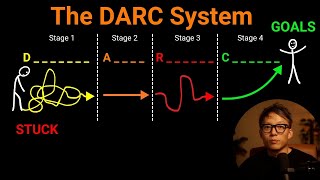
James Lim explains how working on multiple projects simultaneously often sabotages progress because of energy dilution, underestimated initial friction, and timing errors when switching tasks. He contrasts a disciplined energy-management/skill-stacking approach (focus on one then stack others) with the common pattern of overcommitting and repeatedly failing, which creates a negative track record and lowers future motivation. Lim illustrates with an anecdote about launching a meetup for introverts — initially plagued by no-shows, later growing to about 3,000 members and hundreds attending monthly — and explains how frameworks developed for event descriptions later cross-pollinated into viral content strategies. He teases forthcoming practical guidance and an energy-input "math" to determine how much effort and for how long one should focus on a project.
Chapters
So what is the obvious mistake here? Sabotage. Let's explain. So what happens is you try and load all of these projects at the same time and then you end up quitting up here. Well, no surprise, you're struggling to do one and then you get yourself all the way up here. Now there's a counterintuitive trap that keeps us in this pattern and that's why you keep doing it. It makes us look like we are intentionally sabotaging ourselves. So don't forget this because we're going to come back and explain this a bit later. If you do it well, it will look like this energy manage in the first one and then you quickly stack the next one and then you quickly stack the next one and you end up with multiple competencies achieved. And this is keeping it simple. And your skills can keep growing with fairly little input. Now when you get to this point, you have the ability to start cross pollinating your skills. Now a quick example is how starting a meetup for introverts led to making really viral content. And I'll just explain. So I was trying to create this in person meetup in my city in the uk. It was to allow introverts to socialize, which may sound like a contradiction in a sense, and it kind of is. In the early days I was trying to set up these events and I was a bit too optimistic at the time. Then I posted my first event and no one showed up. And this continued to happen. So I'd get punished each time I'd set an event up and no one would show up. So I was very incentivized to, to try and do a better job in writing better event descriptions. And it was as cringe as you can imagine showing up and booking events and for no one to show up. I really, really tried hard and pushed myself to figure out how to, how to write better. And what happened is it eventually started to take off and now it's like one of the biggest meetup events in my city. And we have kind of, you know, it's about 3,000 members in there and we have hundreds, hundreds of people show up at our monthly events. What I did was when I started to create content, I realized I could use a lot of the frameworks from writing the events description for my business. And I didn't make the connection at first. I realized the frameworks were really useful, you know, were really useful there. And it was all about relatability and resonance. That is what really helped explode a lot of my content in the early days. And so you can see getting my content up to these kind of numbers. We really need to make it through this. The initial period. Now, an important note. When you switch over from one project to the next, this timing is really crucial. If you get it right, you get really efficient and you can start compounding lots of these skill sets. If you get it wrong, you could end up collapsing the whole thing and then you end up back to square one again. So we'll go over that a bit later and how to make sure you do it right. Getting started is worse than you think. We're going to talk about initial friction now. We underestimate the effort needed at the beginning. This is what we think it looks like. This is what it actually is. Our brains often underestimate the experience. It's worse when it's new and unfamiliar. We struggle to empathize with the person who has to execute the thing as opposed to the idea. In another video, which hopefully I'll link up here too, I talk about the strategist versus the performer error. And it's why, when we're making plans, it's kind of easy in our head, but we don't take into account what it's like to do this in real life. And we'll go into the details about why this happens in the next chapter, but it's why we overstack and over commit because we continuously underestimate this and we get really frustrated by this because we expect to put in less, but it takes so much more and we ultimately make less progress. It's like this feeling here, and we eventually get it moving, but it's exhausting. So we make this error and multiply up with each project we add. And this is where the problem compounds pretty badly. So it looks like this. And then we end up quitting here. No surprise, it all collapses. I want to add this point. This is about the mental game. It totally messes with it. Before you know it, what happens is your little airport becomes known globally for crashing. This is how your beliefs are formed. When you continuously crash these planes, the only evidence you have a plane crashes, right? I experienced this so many times. Honestly, I felt like my motivation was going to get me there. But all it did was put more planes on the Runway and then I crashed them all. And so you end up with this. You just a track record of crashed planes. It will mean in the long term, your planes will be grounded for life. It looks like this. Yeah, we don't want that. Now this comes back to this chart here. What happens is you end up with this, a track record of all of this. And the separation that you get from the people who manage to do it. Well, they go up this way and this is where it gets. And this is where you get the big separation of different people. Now if you get. I'm going to give you a little side note here. When you are taught by people who are really successful, sometimes they can forget what it was like to be. To be down here. Now, if you've been depending on how many failures you've been through, it can be really hard to get started again because you might be starting from down here. But we'll come back to that. So unfortunately, it often means it's especially hard if you're new or coming off failures. You need to stack the odds in your favor. You cannot afford to keep making these errors because it actually makes it worse. We need you to focus on the one thing first. But how much do I need to do? For how long? And why is this even the case? So we're going to talk about the energy input. A bit of maths for you.