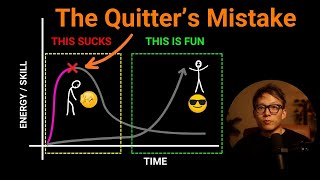
James Lim explains the U-shaped curve of learning new skills: exciting at first, then a painful tedious phase where most people quit, then growing competence and real enjoyment. Stick through the dip and you might find something worth keeping.
Chapters
When to decide if you should pursue an interest. This is really important. Your perception of enjoyment, if it's for you, can change over time. Depending on where you are, hopefully will be. Will be fairly obvious to you. Your experience will influence your feeling. Yeah, this can be a goal. What we're saying is it's very easy during this period to say, you know what, this thing, not for me, not interested. And then when you get here you're like, I love this thing, it's really fun. And that's why you hear this thing about people. There's quite a lot of debate around whether you get passionate about things or whether you find interesting things. One thing about this is this mechanism just changes that level of enjoyment. Now one thing to think about is this could be your. Your goal is to just get here, to get to competence to find out if this has legs. Why? Well, you might only be in this phase for a couple of months. If this happens to be a hobby, a business, a project or a change in direction in your life, it's likely to last for decades, multi years. Why would you not want to check whether that's true or not? Right. If you made all of your decisions in this point, you could be completely ruling out this thing which could be lasting for years. This, this happened to me with so many of those activities that I do and they've all got quite, quite, very painful beginning periods. So a lot of people quit at this point and they just say, not for me. You can cut it early. But just remember, this phase is likely to leave a negative impression on your relationship. Just imagine deciding you hate driving because you don't like adjusting the mirrors or changing gears because you don't know where they are yet. Or disliking videography because you don't know where the camera buttons are. And you keep forgetting, well, that's going. That's not going to be a thing once you've done a lot of practice. The sad thing is that this is where most people quit. And I see this a lot with a lot of client work too. So we often have to kind of go back and check over these. Some activities that they've done. Be conscious where you are in this process. Now I'll give you a very quick example. I'll just go back here surfing. This is one where admittedly I've stopped somewhere around here. I haven't pursued it. I've made the call a little bit earlier, but I've also accepted for now at least. And I think if I did have some more time, I might Continue to explore it. I've experienced lots of the admin side of things and it's very painful and you know, it's hard to swim out, it's hard to paddle and all of that. So I don't get to do the enjoyment side. So just to give you an example of something that I've gone through more recently now, here's a chart for things that I've, you know, that I have done. I remember when I was snowboarding, learning to snowboard, it was really hard. I went for lots and lots of coaching to help me get along this because it was, I found it really difficult. It was just drills. But eventually you break out of the drills and you start to learn how to play again. This is what I was talking about earlier. Then I'm spending all the time doing tricks and in the park, it is so much more fun. Yeah, same thing with bowling. This is us, me and my team winning a, winning a league a few years ago. And here with the break dancing now I should find some old, really old videos of me trying to learn to dance when I definitely had two left feet. And I actually got so mad at myself, I threw, I threw a plastic dumbbell at a mirror and cracked and smashed it because I hated seeing myself dance. It was just so embarrassing and I couldn't get any better. I was totally in this point here. And then the same thing with the, you know, eventually it was really fun. And then event and same thing with social media. So where are you, where do you usually stop on this chart? Are you really prone to staying here or, or have you gone through some periods where you've made it here? Are you giving projects a fair chance? So a quick note on emotion. You might be thinking, why would anyone want to stop here? Now you know this well, no, it's not as easy as that. This is really not trivial. There's a good reason why we stop here. It's extremely uncomfortable. It goes against our brain's wiring. Creating evidence of passing. This point is vital. This is one of the problems with. If you've not been through this journey before, it's really hard to convince your brain to stick with something. I just gave you an example with the surfing thing. I've done loads of these, of these journeys and I still find it hard to go through. So if you haven't been through one of these curves before, it's really, really difficult. Your brain saying, why are you forcing me to do something that I don't need to do? It's a long term vision. But hopefully, if you understand this chart, you'll. You'll create a space in your mind that will allow you to travel this journey. So, yeah, just. So just remember, we are really trying to get through this period here. Okay? So now we're going to focus on shrinking this.