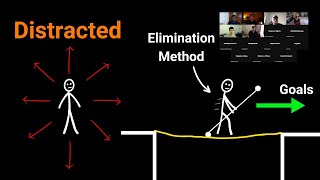
James Lim breaks down shiny object syndrome, the pull toward seemingly productive distractions that derail your main goal. His fix: focus hard on one primary goal for about a month until it reaches cruise altitude, then carefully add smaller secondary goals without losing momentum on what matters most.
Chapters
And this answer the next point about getting distracted easily without the plan, it's actually quite difficult to know what is a distraction and what is not. There are obvious distractions, like mindless scrolling, going on YouTube, doing extra research. There are more insidious distractions that look very productive but are often not and are not aligned with where you're trying to get to. I often see people taking on these side missions that are consuming up a lot of their time and energy, but are not moving them in the direction that they really need to go. I'd say that is something that I. I see more often than not. Who, who gets distracted by kind of shiny objects along their. Along their way, particularly. Yeah, I'd say this is probably one of the biggest problems I usually see. I have a slightly biased audience because a lot of people I work with, they're usually very interested in new things and want to learn. But that's also the trap, because you want to learn. It is. It hits the dopamine centers in the mind and makes you get really excited. And if you don't have that plan, you sometimes follow that trial. So it's kind of like wandering through a jungle and, you know, catching a smell of something and following that. If you don't have a very firm plan on where you're going and what you're looking for, you can just continuously be following these extra trails. And so the next thing I want to talk about is this prioritization. This is the painful one. Once you've got this idea about what you're trying to solve, what is required to move you in that direction, that will help you understand what are distractions and what are not, then there comes this, I'd say the significant pain one, which is this prioritisation. Who here has seen my plane video? You may have even got to me via that video. Well, I mean, one reason I. I use that analogy, which I don't think I talked about in a video, I really struggled with sacrificing all of my ideas. I wanted to work on all of my ideas. Yeah. And people would tell me, no, you need to kill that idea. You need to put that aside. You can't work on that. And that had that. That gave me a lot of tension inside. And I would nearly, I might agree with it on the surface, but kind of deep down, I don't want to let go of these other ideas. And then I end up in this cycle of accepting the. The idea of when someone tells me, you need to let go of all these other things. But then when it comes down to it, I can't. It's, it's like a child with lots of toys and you're saying, you know, you can only take one toy with you and you know, you say, yeah, that's the right thing and then you just want to grab all of them. Yeah. The plain analogy is really, the plain analogy is nearly, is nearly a type of compromise here. It allows you to focus on the one thing but also not completely remove some of the other ones. And this idea of staggering, but in the purpose of what we're talking about here, we're talking about in a month to two month time frame, I would usually always suggest you want to keep that focus on really, really one thing. And so that first month, I would, on average, I would say that's, that's a period of time that you should be able to focus on one thing. And if you try and focus on, on even more than two or three, it really kills the chances of what you're working on there. But I would usually say this is probably, maybe relevant to what Bassey just said. One month is a good starting point. You often won't get the full on results that you're looking for from that from, from that month alone. And just like I talked about, in a plane, that first hump that's to get you to cruise altitude, it doesn't get you to your destination, it gets you to cruise mode. Things can usually after about a month, you can get to a point where some of those actions become a bit more second nature. But just don't confuse that with the destination. So if you just remember the plane takes off, we're trying to allocate lots of mental energy to the takeoff. Just, just like air traffic control focusing on that plane having a safe takeoff and then during the ascent period, lots of turbulence. At that point we want to still give a lot of attention to that plane, but when it gets a cruise altitude, it's not at the destination. We can pull back at that point, but we still need to keep it going. I think at this point this is where this takes a bit of practice and I'll just give you some client insights. This is varied from person to person for sure. I usually need to do quite, I'm usually quite involved with helping people transition. So if they are at cruise altitude, we're trying to focus on the next plane. How much focus you can take off that first plane for the second plane to take off really, really varies. Some people, they can switch quite quickly and the first one is fine and you don't need to kind of focus on it too much. Other people I know people who have a habit of finding focus and attention very difficult. We need to keep quite a lot of energy in that first one still for quite a while. And we look into it really becomes habitual. And then sometimes when we take, try and take off planes two and three, they sometimes need to be quite small. So an example would be if someone's trying to work on their business, that's usually quite a big plane to take off. There's a lot of mental load on it in terms of the work you have to do, but also emotional load too. So it's a really big plane. Sometimes the second plane, we can't really take such a big plane off. Second one, it's usually something else. Examples might be getting someone's fitness back, back on track, not starting it. It's usually something that they've been able to do in the past. So we're kind of just getting it going again. Or they're eating or their nutrition routine or their sleep routines, as opposed to starting one business and then month two you're starting another business. Those would be putting two big planes back to back. I've seen people try that and it rarely, rarely ever works.